EYESATLK ABLATION
SUBMITTED BY
VALA FORAM D.
M. F. Sc 1st yr
C O N T E N T S
INTRODUCTION
ABLATION PROCESS 🤔
METHOD OF EYESATLK ABLATION ✂️🤔
ROLE IN GONADAL DEVELOPMENT
ROLE OF EYESTALK IN THE
REPRODUCTION OF CRUSTACEANS
WHAT IS EYE STALK ABLATION
EFFECTS
EYE STALK WHAT TO DO
VIABLE ALTERNATIVES
INTRODUCTION
Introduction
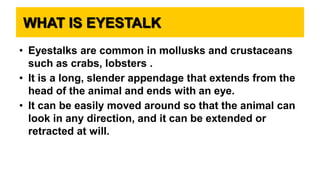
WHAT IS EYESTALK
• Eyestalks are common in mollusks and crustaceans
such as crabs, lobsters .
• It is a long, slender appendage that extends from the
head of the animal and ends with an eye.
• It can be easily moved around so that the animal can
look in any direction, and it can be extended or
retracted at will.
What is Eye stalk ablation
It is the removal or elimination of one
or both eyestalks in order to at least
reduce the level of inhibitory
hormone or to fully prevent their
secretion in the body for full and
accelerated maturation of the ovaries.
B
A
Types
1. In unilateral ablation, only
one eye will be removed
and the animal will be
allowed to live one eye.
2. while in bilateral ablation
method, both the eyes will
be removed with the stalks
of the eye.
Enter title Enter title
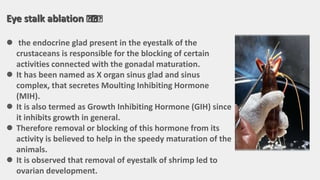
Eye stalk ablation 🤔🤔
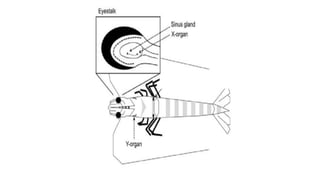
 the endocrine glad present in the eyestalk of the
crustaceans is responsible for the blocking of certain
activities connected with the gonadal maturation.
 It has been named as X organ sinus glad and sinus
complex, that secretes Moulting Inhibiting Hormone
(MIH).
 It is also termed as Growth Inhibiting Hormone (GIH) since
it inhibits growth in general.
 Therefore removal or blocking of this hormone from its
activity is believed to help in the speedy maturation of the
animals.
 It is observed that removal of eyestalk of shrimp led to
ovarian development.
 Shrimp seeds were collected from natural wild waters in the past.
 Following development of hatchery technology and larval production in
captivity, seeds have been produced in the hatcheries and supplied to
the farms.
 But there has been a difficulty in getting the mother shrimps for the
seed production. Matured mother shrimps have been collected from
wild waters for copious seeds and production of good quality seeds.
 It is a fact that all species of shrimps do not attain sexual maturity in
confined waters.
 It has been found that hormones secreted by the X-organ sinus gland
complex are responsible for the inhibition of the gonad maturation and
breeding.
 Therefore, removal of eyestalk in the matured shrimps is believed to
result in the inducement for the maturation and spawning.
Its role in gonadal development
Ablation process 🤔
 It is more essential to perform the ablation at appropriate stage in
order to avoid loss of mother shrimps.
 For all practical reasons, it is emphasized that only inter molt
shrimp is to be used for ablation.
 Post-molt (stage) female shrimps are not recommended for
ablation, due to increased risk of handling mortality associated
with softened exoskeleton and weakness of the animal.
 Pre-molt (Stage IV) individuals are also not recommended since
there may be immediate molting during recovery from the ablation
process leading to loss or delay in spawning.
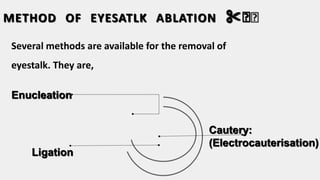
METHOD OF EYESATLK ABLATION ✂️🤔
Several methods are available for the removal of
eyestalk. They are,
Enucleation
Ligation
Cautery:
(Electrocauterisation)
A d d Y o u r W e b s i t e
1
 Grasp the eyestalk just behind the eyeball using the thump and
index finger.
 Squeeze hard and roll the thump and finger outwards away from the
body, thus crushing the eyestalk and squeezing out the contents of
the eye.
 The objective is to squeeze the contents outwards and not let them
follow the eyestalk back in to the head region.
 Enucleation has the advantages of simplicity and rapid clotting of
hemolymph within the empty eyestalk.
 This method of ablation required one person and it is without
application of antibiotics.
Enucleation
 A string is tied around the base of the eyestalk as close to
the carapace as possible.
 The string should be drawn fairly tight causing the eyestalk
to fall off in a few days.
 The procedure does not leave the shrimp with open wound.
 However, successful ablation is often unpredictable and
this process will give the result only after two or three days.
 It requires two persons, one to hold the shrimp and the
other to tie the eyestalk
Ligation
2
2
3 Cautery:
(Electrocauterisation)
 This method is the severing eyestalk followed
by sealing of the wound through the process
called electrocauterization.
 Heated forceps, or the application of a silver
nitrate bar on the wound will prevent the
secondary infection at the wound site.
What to do
01
02
03
04
05
the stress that will be arising due to the ablation has its
own ill effects on the animals. Stress can be reduced and
losses minimized if shrimps are held in chilled water
before and after ablation.
To minimize stress, the ablation should be performed as
quickly as possible under chilled water.
Further the stress to the mother shrimps can be
reduced by doing the ablation in the early morning hours,
when the temperatures is the lowest.
Care should be taken to see that female mortality due
to ablation is very low.
The effects of eyestalk ablation vary with season and
stage in the molt cycle.
Before removing eyestalks, the brood stocks are kept
in large plastic pools containing filtered sea water.
 The temperature, salinity and pH of the medium are
maintained at 28 ± 2, 32 ± 2% and 8-8.2 respectively.
 The ablated female and unablated males are the putput in 2:1 ratio.
Role of eyestalk in the reproduction of
crustaceans
 In prawns, the neutrosecretory centers located in the eyestalk (X
organ sinus gland complex), brain and thoracic ganglia mainly
influence the egg production (vitellogenesis).
 While the X organ sinus gland complex of the eyestalk inhibits
vitellogenesis under the influence of its hormone, viz., Gonad
Inhibiting Hormone (GIH), the brain and thoracic ganglia promote
vitellogenesis by their hormone, viz., Gonad Stimulating
Hormone(GSH).
 Under natural conditions, when the physiological parameters of
the prawns and the environmental factors are favorable, the GSH
promotes vitellogenesis.
Cont..
 The eye stalks apart from GIH, produce other
neutrosecretory hormones which regulate
 lipid metabolism and protein synthesis in
hepatopancreas.
 induce hyperglycemia in blood to combat
stress;
 regulate calcium metabolism during cuticle
formation,effect water balance during moulting
 inhibit production of moulting hormone by ‘Y’
organ and influence movement of pigments in
chromatophores.
Effects
• There are several direct and indirect effects of eye
ablation in female shrimps, including,
• increases total egg production by producing more
frequent spawnings, but not larger spawns
• moult cycle duration is shorter
• increases mortality rate by up to three times
• deteriorates female condition
• leads to changes in ovarian colour
• leads to eventual loss in egg quality
• production of offsprings that are more susceptible to
diseases such as WSSV
Viable alternatives
• giving high quality, nutritious feed to broodstock in
pre-maturation stage
• changing the sex ratio in breeding tanks from 1:1 to
1:2 (male-to-female)
• Non-ablated females have lower mortality rates and
produce more robust offspring thereby reducing the
need for chemicals and antibiotics
T H A N K S

Eyestalk ablation technique

  • 1.
    EYESATLK ABLATION SUBMITTED BY VALAFORAM D. M. F. Sc 1st yr
  • 2.
    C O NT E N T S INTRODUCTION ABLATION PROCESS 🤔 METHOD OF EYESATLK ABLATION ✂️🤔 ROLE IN GONADAL DEVELOPMENT ROLE OF EYESTALK IN THE REPRODUCTION OF CRUSTACEANS WHAT IS EYE STALK ABLATION EFFECTS EYE STALK WHAT TO DO VIABLE ALTERNATIVES
  • 3.
  • 4.
  • 5.
    WHAT IS EYESTALK •Eyestalks are common in mollusks and crustaceans such as crabs, lobsters . • It is a long, slender appendage that extends from the head of the animal and ends with an eye. • It can be easily moved around so that the animal can look in any direction, and it can be extended or retracted at will.
  • 7.
    What is Eyestalk ablation It is the removal or elimination of one or both eyestalks in order to at least reduce the level of inhibitory hormone or to fully prevent their secretion in the body for full and accelerated maturation of the ovaries. B A Types 1. In unilateral ablation, only one eye will be removed and the animal will be allowed to live one eye. 2. while in bilateral ablation method, both the eyes will be removed with the stalks of the eye.
  • 8.
    Enter title Entertitle Eye stalk ablation 🤔🤔  the endocrine glad present in the eyestalk of the crustaceans is responsible for the blocking of certain activities connected with the gonadal maturation.  It has been named as X organ sinus glad and sinus complex, that secretes Moulting Inhibiting Hormone (MIH).  It is also termed as Growth Inhibiting Hormone (GIH) since it inhibits growth in general.  Therefore removal or blocking of this hormone from its activity is believed to help in the speedy maturation of the animals.  It is observed that removal of eyestalk of shrimp led to ovarian development.
  • 9.
     Shrimp seedswere collected from natural wild waters in the past.  Following development of hatchery technology and larval production in captivity, seeds have been produced in the hatcheries and supplied to the farms.  But there has been a difficulty in getting the mother shrimps for the seed production. Matured mother shrimps have been collected from wild waters for copious seeds and production of good quality seeds.  It is a fact that all species of shrimps do not attain sexual maturity in confined waters.  It has been found that hormones secreted by the X-organ sinus gland complex are responsible for the inhibition of the gonad maturation and breeding.  Therefore, removal of eyestalk in the matured shrimps is believed to result in the inducement for the maturation and spawning. Its role in gonadal development
  • 10.
    Ablation process 🤔 It is more essential to perform the ablation at appropriate stage in order to avoid loss of mother shrimps.  For all practical reasons, it is emphasized that only inter molt shrimp is to be used for ablation.  Post-molt (stage) female shrimps are not recommended for ablation, due to increased risk of handling mortality associated with softened exoskeleton and weakness of the animal.  Pre-molt (Stage IV) individuals are also not recommended since there may be immediate molting during recovery from the ablation process leading to loss or delay in spawning.
  • 11.
    METHOD OF EYESATLKABLATION ✂️🤔 Several methods are available for the removal of eyestalk. They are, Enucleation Ligation Cautery: (Electrocauterisation)
  • 12.
    A d dY o u r W e b s i t e 1  Grasp the eyestalk just behind the eyeball using the thump and index finger.  Squeeze hard and roll the thump and finger outwards away from the body, thus crushing the eyestalk and squeezing out the contents of the eye.  The objective is to squeeze the contents outwards and not let them follow the eyestalk back in to the head region.  Enucleation has the advantages of simplicity and rapid clotting of hemolymph within the empty eyestalk.  This method of ablation required one person and it is without application of antibiotics. Enucleation
  • 13.
     A stringis tied around the base of the eyestalk as close to the carapace as possible.  The string should be drawn fairly tight causing the eyestalk to fall off in a few days.  The procedure does not leave the shrimp with open wound.  However, successful ablation is often unpredictable and this process will give the result only after two or three days.  It requires two persons, one to hold the shrimp and the other to tie the eyestalk Ligation 2 2
  • 14.
    3 Cautery: (Electrocauterisation)  Thismethod is the severing eyestalk followed by sealing of the wound through the process called electrocauterization.  Heated forceps, or the application of a silver nitrate bar on the wound will prevent the secondary infection at the wound site.
  • 15.
    What to do 01 02 03 04 05 thestress that will be arising due to the ablation has its own ill effects on the animals. Stress can be reduced and losses minimized if shrimps are held in chilled water before and after ablation. To minimize stress, the ablation should be performed as quickly as possible under chilled water. Further the stress to the mother shrimps can be reduced by doing the ablation in the early morning hours, when the temperatures is the lowest. Care should be taken to see that female mortality due to ablation is very low. The effects of eyestalk ablation vary with season and stage in the molt cycle.
  • 16.
    Before removing eyestalks,the brood stocks are kept in large plastic pools containing filtered sea water.  The temperature, salinity and pH of the medium are maintained at 28 ± 2, 32 ± 2% and 8-8.2 respectively.  The ablated female and unablated males are the putput in 2:1 ratio.
  • 17.
    Role of eyestalkin the reproduction of crustaceans  In prawns, the neutrosecretory centers located in the eyestalk (X organ sinus gland complex), brain and thoracic ganglia mainly influence the egg production (vitellogenesis).  While the X organ sinus gland complex of the eyestalk inhibits vitellogenesis under the influence of its hormone, viz., Gonad Inhibiting Hormone (GIH), the brain and thoracic ganglia promote vitellogenesis by their hormone, viz., Gonad Stimulating Hormone(GSH).  Under natural conditions, when the physiological parameters of the prawns and the environmental factors are favorable, the GSH promotes vitellogenesis.
  • 19.
    Cont..  The eyestalks apart from GIH, produce other neutrosecretory hormones which regulate  lipid metabolism and protein synthesis in hepatopancreas.  induce hyperglycemia in blood to combat stress;  regulate calcium metabolism during cuticle formation,effect water balance during moulting  inhibit production of moulting hormone by ‘Y’ organ and influence movement of pigments in chromatophores.
  • 20.
    Effects • There areseveral direct and indirect effects of eye ablation in female shrimps, including, • increases total egg production by producing more frequent spawnings, but not larger spawns • moult cycle duration is shorter • increases mortality rate by up to three times • deteriorates female condition • leads to changes in ovarian colour • leads to eventual loss in egg quality • production of offsprings that are more susceptible to diseases such as WSSV
  • 21.
    Viable alternatives • givinghigh quality, nutritious feed to broodstock in pre-maturation stage • changing the sex ratio in breeding tanks from 1:1 to 1:2 (male-to-female) • Non-ablated females have lower mortality rates and produce more robust offspring thereby reducing the need for chemicals and antibiotics
  • 22.
    T H AN K S