Extreme Scale Breadth-First Search on
Supercomputers
Tokyo Institute ofTechnology / RIKEN
IBMT.J.Watson Research Center
RIKEN
Kyushu University
Tokyo Institute ofTechnology / AIST
Koji Ueno
Toyotaro Suzumura
Naoya Maruyama
Katsuki Fujisawa
Satoshi Matsuoka
Large-Scale Graph Mining is Everywhere
Symbolic Networks: Human
Brain: 100 billion neuron
Protein Interactions
[genomebiology.com]
Social Networks[Moody ’01]
(Facebook: 1 billion users) Cyber Security ( 15 billion log
entries / day for large enterprise)
Cybersecurity
Medical	Informatics
Data	Enrichment
Social	Networks
Symbolic	Networks
WWW[lumeta.com]
(1 trillion unique URL)
2
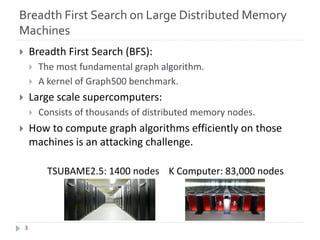
Breadth First Search on Large Distributed Memory
Machines
} Breadth	First	Search (BFS):
} The	most	fundamental	graph	algorithm.
} A	kernel	of	Graph500	benchmark.
} Large	scale	supercomputers:
} Consists	of	thousands	of	distributed	memory	nodes.
} How	to	compute	graph	algorithms	efficiently	on	those	
machines	is	an	attacking	challenge.
K	Computer:	83,000	nodesTSUBAME2.5:	1400	nodes
3
Graph500 Benchmark [http://www.graph500.org/]
} One	of	our	major	targets	is	Graph500	benchmark.
} Benchmark	for	Big	Data	(data	intensive)	applications.
} BFS	is	a	main	kernel	for	ranking.
} K	computer	is	#1	using	our	result.
Graph500	Latest	Ranking
4
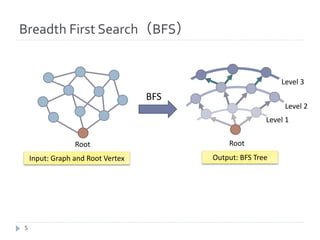
Breadth First Search(BFS)
RootRoot
Level	1
Level	2
Level	3
BFS
Input:	Graph	and	Root	Vertex Output:	BFS Tree
5
Direction Optimization [Beamer, ’11-12]
} Direction	optimization	is	an	fast	BFS	algorithm	which	switches	
direction	(Top-Down	and	Bottom-Up)	for	each	searching	level.
} Direction	optimization	is	effective	for	small	diameter	graphs.
} Scale	free	networks	and	small	world	networks	are	small	diameter	
graphs.
} The	target	of	Graph500	benchmark	is	also	small	diameter	
graph	and	direction	optimization	is	effective.
Frontier
Neighbors
Level	k
Level	k+1
Frontier
Level	k
Level	k+1
Neighbors
Top-Down Bottom-Up
6
2D Partitioning BFS
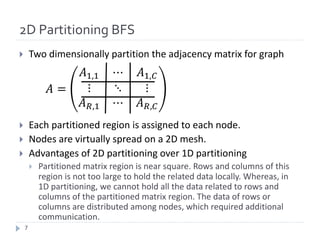
} Two	dimensionally	partition	the	adjacency	matrix	for	graph
} Each	partitioned	region	is	assigned	to	each	node.
} Nodes	are	virtually	spread	on	a	2D	mesh.
} Advantages	of	2D	partitioning	over	1D	partitioning
} Partitioned	matrix	region	is	near	square.	Rows	and	columns	of	this	
region	is	not	too	large	to	hold	the	related	data	locally.	Whereas,	in	
1D	partitioning,	we	cannot	hold	all	the	data	related	to	rows	and	
columns	of	the	partitioned	matrix	region.	The	data	of	rows	or	
columns	are	distributed	among	nodes,	which	required	additional	
communication.
7
RelatedWork
} Distributed	BFS	with	Top-Down	only:
} 2D	Partitioning	BFS	on	BlueGene/L	[Yoo ‘05]
} Proposed	Distributed	Memory	BFS	on	Large	Distributed	Memory
} Comparison	of	1D	Partitioning	and	2D	Partitioning [Buluc ‘11]
} Distributed	Memory	BFS	on	Commodity	Machine	(Intel	CPU	and	
Infiniband network)	[Satish	‘12]
} Distributed	BFS	with	Direction	Optimization
} 2D	Partitioning	BFS	with	Direction	Optimization	[Beamer	’13]
} Our	proposed	BFS	is	based	on	their	BFS.
} 1D	Partitioning	BFS	with	Direction	Optimization	and	Load	Balancing.	
[Checconi ‘14]
} This	is	very	scalable	and	they	achieved	23751	GTEPS	on	BlueGene/Q	98304	Nodes.
} They	Proposed	novel	sparse	matrix	representation	“Coarse	index	+	Skip	list”.	
However,	our	bitmap	based	sparse	matrix	representation	is	more	efficient.
8
Problem of Graph Data Structure
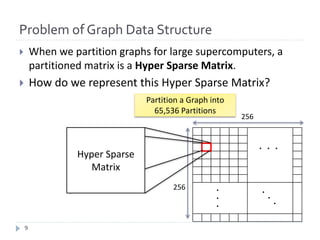
} When	we	partition	graphs	for	large	supercomputers,	a	
partitioned	matrix	is	a	Hyper	Sparse	Matrix.
} How	do	we	represent	this	Hyper	Sparse	Matrix?
・・・
・・・
256
256
Hyper	Sparse	
Matrix
Partition	a	Graph	into	
65,536	Partitions
9
Existing Approaches for Sparse Matrix
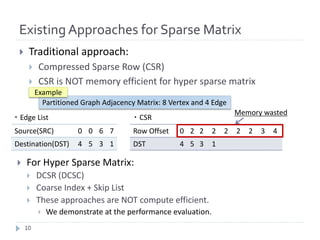
} Traditional	approach:
} Compressed	Sparse	Row	(CSR)
} CSR	is	NOT	memory	efficient	for	hyper	sparse	matrix
Source(SRC) 0 0 6 7
Destination(DST) 4 5 3 1
Row Offset 0 2 2 2 2 2 2 3 4
DST 4 5 3 1
・Edge	List ・CSR
Partitioned	Graph	Adjacency	Matrix:	8	Vertex	and	4	Edge
Memory	wasted
} For	Hyper	Sparse	Matrix:
} DCSR	(DCSC)
} Coarse	Index	+	Skip	List
} These	approaches	are	NOT	compute	efficient.
} We	demonstrate	at	the	performance	evaluation.
Example
10
Bitmap based Sparse Matrix Representation
SRC 0 0 6 7
DST 4 5 3 1
・Edge	List
Offset 0 1 3
Bitmap 1 0 0 0 0 0 1 1
Row Offset 0 2 3 4
DST 4 5 3 1
・Bitmap	base	Sparse	Matrix
Only	consumes	8	bits
} Structure
} Row	Offset:	Skip	vertices	that	has	no	edges	(same	as	DCSC)
} Bitmap:	one	bit	for	each	vertex:	represents	the	vertex	has	at	least	one	edge	(set	
bit)	or	not	(not	set	bit).
} Offset: Supplemental	array	for	faster	computing:	Represents	cumulative	#	of	set	
bits	from	the	beginning	of	bitmap	to	the	corresponding	word	boarder.
} How	to	compute	the	row	offset	index	of	a	given	vertex?
} Row	offset	index	=	Offset[w]	+	popcount(Bitmap[w]&mask)
} Where	w	=	v	/	64,	mask	=	(1	<<	(v	%	64))	– 1,	v	is	index	of	a	given	vertex.
} This	is	no	loop.	Therefore,	this	is	an	O(1)	operation,	which	is	same	as	CSR.
In	this	example,	1	word	is	4	bit.
Partitioned	Graph	Adjacency	Matrix:	8	Vertex	and	4	Edge
Example
11
Vertex Reordering
} Problem
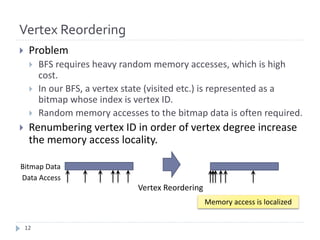
} BFS	requires	heavy	random	memory	accesses,	which	is	high	
cost.
} In	our	BFS,	a	vertex	state	(visited	etc.)	is	represented	as	a	
bitmap	whose	index	is	vertex	ID.
} Random	memory	accesses	to	the	bitmap	data	is	often	required.
} Renumbering	vertex	ID	in	order	of	vertex	degree	increase	
the	memory	access	locality.
12
Vertex	Reordering
Bitmap	Data
Data	Access
Memory	access	is	localized
How to output in original ID?
Reordered	ID ID	table
BFS	tree
(output)
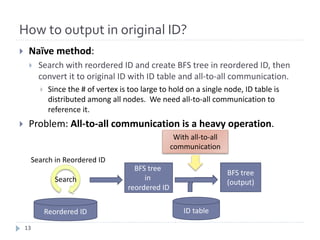
} Naïve	method:
} Search	with	reordered	ID	and	create	BFS	tree	in	reordered	ID,	then	
convert	it	to	original	ID	with	ID	table	and	all-to-all	communication.
} Since	the	#	of	vertex	is	too	large	to	hold	on a	single	node,	ID	table	is	
distributed	among	all	nodes.		We	need	all-to-all	communication	to	
reference	it.
} Problem:	All-to-all	communication	is	a	heavy	operation.
BFS	tree	
in	
reordered	ID
With	all-to-all	
communication
Search	in	Reordered	ID
Search
13
Our proposal
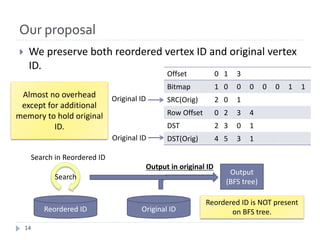
} We	preserve	both	reordered	vertex	ID	and	original	vertex	
ID.
Reordered	ID Original	ID
Search
Output
(BFS tree)
Search	in	Reordered	ID
Output	in	original	ID
Reordered	ID	is	NOT	present	
on	BFS	tree.
Offset 0 1 3
Bitmap 1 0 0 0 0 0 1 1
SRC(Orig) 2 0 1
Row	Offset 0 2 3 4
DST 2 3 0 1
DST(Orig) 4 5 3 1
Original	ID
Original	ID
Almost	no	overhead	
except	for	additional	
memory	to	hold	original	
ID.
14
Algorithm Detail
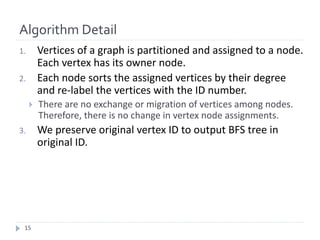
1. Vertices	of	a	graph	is	partitioned	and	assigned	to	a	node.	
Each	vertex	has	its	owner	node.
2. Each	node	sorts	the	assigned	vertices	by	their	degree	
and	re-label	the	vertices	with	the	ID	number.
} There	are	no	exchange	or	migration	of	vertices	among	nodes.	
Therefore,	there	is	no	change	in	vertex	node	assignments.
3. We	preserve	original	vertex	ID	to	output	BFS	tree	in	
original	ID.
15
Top-Down Load Balancing
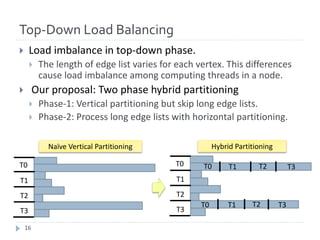
} Load	imbalance	in	top-down	phase.
} The	length	of	edge	list	varies	for	each	vertex.	This	differences	
cause	load	imbalance	among	computing	threads	in	a	node.
} Our	proposal:	Two	phase	hybrid	partitioning
} Phase-1:	Vertical	partitioning	but	skip	long	edge	lists.
} Phase-2:	Process	long	edge	lists	with	horizontal	partitioning.
T0
T1
T2
T3
T0
T1
T2
T3
T0
T0
T1
T1
T2
T2
T3
T3
Naïve	Vertical	Partitioning Hybrid	Partitioning
16
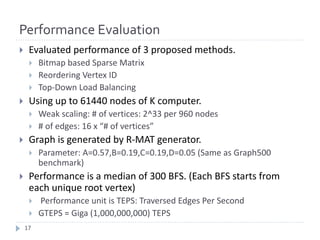
Performance Evaluation
} Evaluated	performance	of	3	proposed	methods.
} Bitmap	based	Sparse	Matrix
} Reordering	Vertex	ID
} Top-Down	Load	Balancing
} Using	up	to	61440	nodes	of	K	computer.
} Weak	scaling:	#	of	vertices:	2^33	per	960	nodes
} #	of	edges:	16	x	“#	of	vertices”
} Graph	is	generated	by	R-MAT	generator.
} Parameter:	A=0.57,B=0.19,C=0.19,D=0.05	(Same	as	Graph500	
benchmark)
} Performance	is	a	median	of	300	BFS.	(Each	BFS	starts	from	
each	unique	root	vertex)
} Performance	unit	is	TEPS:	Traversed	Edges	Per	Second
} GTEPS	=	Giga	(1,000,000,000)	TEPS
17
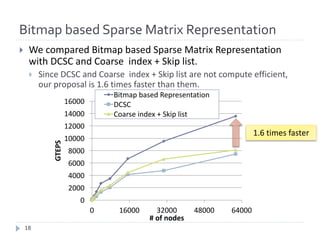
Bitmap based Sparse Matrix Representation
} We	compared	Bitmap	based	Sparse	Matrix	Representation	
with	DCSC and	Coarse		index	+	Skip	list.
} Since	DCSC	and	Coarse		index	+	Skip	list	are	not	compute	efficient,	
our	proposal	is	1.6	times	faster	than	them.
1.6 times	faster
0
2000
4000
6000
8000
10000
12000
14000
16000
0 16000 32000 48000 64000
GTEPS
#	of	nodes
Bitmap	based	Representation
DCSC
Coarse	index	+	Skip	list
18
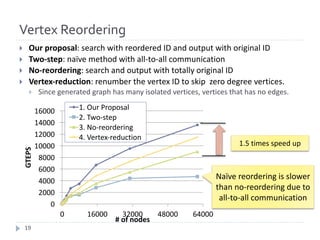
Vertex Reordering
} Our	proposal:	search	with	reordered	ID	and	output	with	original	ID
} Two-step:	naïve	method	with	all-to-all	communication
} No-reordering:	search	and	output	with	totally	original	ID
} Vertex-reduction:	renumber	the	vertex	ID	to	skip		zero	degree	vertices.
} Since	generated	graph	has	many	isolated	vertices,	vertices	that	has	no	edges.
1.5 times	speed	up
Naïve	reordering	is	slower	
than	no-reordering	due	to	
all-to-all	communication
0
2000
4000
6000
8000
10000
12000
14000
16000
0 16000 32000 48000 64000
GTEPS
#	of	nodes
1.	Our	Proposal
2.	Two-step
3.	No-reordering
4.	Vertex-reduction
19
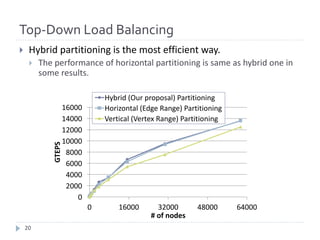
Top-Down Load Balancing
} Hybrid	partitioning	is	the	most	efficient	way.
} The	performance	of	horizontal	partitioning	is	same	as	hybrid	one	in	
some	results.
0
2000
4000
6000
8000
10000
12000
14000
16000
0 16000 32000 48000 64000
GTEPS
#	of	nodes
Hybrid	(Our	proposal)	Partitioning
Horizontal	(Edge	Range)	Partitioning
Vertical	(Vertex	Range)	Partitioning
20
Overall Performance
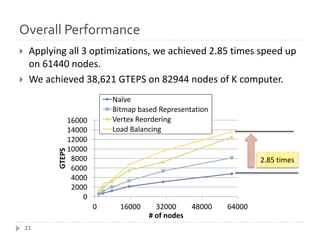
} Applying	all	3	optimizations,	we	achieved	2.85	times	speed	up	
on	61440	nodes.
} We	achieved	38,621	GTEPS	on	82944	nodes	of	K	computer.
2.85	times
0
2000
4000
6000
8000
10000
12000
14000
16000
0 16000 32000 48000 64000
GTEPS
#	of	nodes
Naïve
Bitmap	based	Representation
Vertex	Reordering
Load	Balancing
21
Conclusion
} We	proposed	efficient	Breadth	First	Search	for	large	
distributed	memory	machines.
} We	present	3	methods	to	speed	up	distributed	BFS:
} Bitmap	based	Sparse	Matrix	Representation
} Reordering	vertex	ID	without	searching	overhead
} Top-down	load	balancing
} We	achieved	38,621	GTEPS	on	K	computer,	which	ranked	
top on	Graph500	now	from	July	2015.
22

Extreme Scale Breadth-First Search on Supercomputers

  • 1.
    Extreme Scale Breadth-FirstSearch on Supercomputers Tokyo Institute ofTechnology / RIKEN IBMT.J.Watson Research Center RIKEN Kyushu University Tokyo Institute ofTechnology / AIST Koji Ueno Toyotaro Suzumura Naoya Maruyama Katsuki Fujisawa Satoshi Matsuoka
  • 2.
    Large-Scale Graph Miningis Everywhere Symbolic Networks: Human Brain: 100 billion neuron Protein Interactions [genomebiology.com] Social Networks[Moody ’01] (Facebook: 1 billion users) Cyber Security ( 15 billion log entries / day for large enterprise) Cybersecurity Medical Informatics Data Enrichment Social Networks Symbolic Networks WWW[lumeta.com] (1 trillion unique URL) 2
  • 3.
    Breadth First Searchon Large Distributed Memory Machines } Breadth First Search (BFS): } The most fundamental graph algorithm. } A kernel of Graph500 benchmark. } Large scale supercomputers: } Consists of thousands of distributed memory nodes. } How to compute graph algorithms efficiently on those machines is an attacking challenge. K Computer: 83,000 nodesTSUBAME2.5: 1400 nodes 3
  • 4.
    Graph500 Benchmark [http://www.graph500.org/] }One of our major targets is Graph500 benchmark. } Benchmark for Big Data (data intensive) applications. } BFS is a main kernel for ranking. } K computer is #1 using our result. Graph500 Latest Ranking 4
  • 5.
  • 6.
    Direction Optimization [Beamer,’11-12] } Direction optimization is an fast BFS algorithm which switches direction (Top-Down and Bottom-Up) for each searching level. } Direction optimization is effective for small diameter graphs. } Scale free networks and small world networks are small diameter graphs. } The target of Graph500 benchmark is also small diameter graph and direction optimization is effective. Frontier Neighbors Level k Level k+1 Frontier Level k Level k+1 Neighbors Top-Down Bottom-Up 6
  • 7.
    2D Partitioning BFS }Two dimensionally partition the adjacency matrix for graph } Each partitioned region is assigned to each node. } Nodes are virtually spread on a 2D mesh. } Advantages of 2D partitioning over 1D partitioning } Partitioned matrix region is near square. Rows and columns of this region is not too large to hold the related data locally. Whereas, in 1D partitioning, we cannot hold all the data related to rows and columns of the partitioned matrix region. The data of rows or columns are distributed among nodes, which required additional communication. 7
  • 8.
    RelatedWork } Distributed BFS with Top-Down only: } 2D Partitioning BFS on BlueGene/L [Yoo‘05] } Proposed Distributed Memory BFS on Large Distributed Memory } Comparison of 1D Partitioning and 2D Partitioning [Buluc ‘11] } Distributed Memory BFS on Commodity Machine (Intel CPU and Infiniband network) [Satish ‘12] } Distributed BFS with Direction Optimization } 2D Partitioning BFS with Direction Optimization [Beamer ’13] } Our proposed BFS is based on their BFS. } 1D Partitioning BFS with Direction Optimization and Load Balancing. [Checconi ‘14] } This is very scalable and they achieved 23751 GTEPS on BlueGene/Q 98304 Nodes. } They Proposed novel sparse matrix representation “Coarse index + Skip list”. However, our bitmap based sparse matrix representation is more efficient. 8
  • 9.
    Problem of GraphData Structure } When we partition graphs for large supercomputers, a partitioned matrix is a Hyper Sparse Matrix. } How do we represent this Hyper Sparse Matrix? ・・・ ・・・ 256 256 Hyper Sparse Matrix Partition a Graph into 65,536 Partitions 9
  • 10.
    Existing Approaches forSparse Matrix } Traditional approach: } Compressed Sparse Row (CSR) } CSR is NOT memory efficient for hyper sparse matrix Source(SRC) 0 0 6 7 Destination(DST) 4 5 3 1 Row Offset 0 2 2 2 2 2 2 3 4 DST 4 5 3 1 ・Edge List ・CSR Partitioned Graph Adjacency Matrix: 8 Vertex and 4 Edge Memory wasted } For Hyper Sparse Matrix: } DCSR (DCSC) } Coarse Index + Skip List } These approaches are NOT compute efficient. } We demonstrate at the performance evaluation. Example 10
  • 11.
    Bitmap based SparseMatrix Representation SRC 0 0 6 7 DST 4 5 3 1 ・Edge List Offset 0 1 3 Bitmap 1 0 0 0 0 0 1 1 Row Offset 0 2 3 4 DST 4 5 3 1 ・Bitmap base Sparse Matrix Only consumes 8 bits } Structure } Row Offset: Skip vertices that has no edges (same as DCSC) } Bitmap: one bit for each vertex: represents the vertex has at least one edge (set bit) or not (not set bit). } Offset: Supplemental array for faster computing: Represents cumulative # of set bits from the beginning of bitmap to the corresponding word boarder. } How to compute the row offset index of a given vertex? } Row offset index = Offset[w] + popcount(Bitmap[w]&mask) } Where w = v / 64, mask = (1 << (v % 64)) – 1, v is index of a given vertex. } This is no loop. Therefore, this is an O(1) operation, which is same as CSR. In this example, 1 word is 4 bit. Partitioned Graph Adjacency Matrix: 8 Vertex and 4 Edge Example 11
  • 12.
    Vertex Reordering } Problem }BFS requires heavy random memory accesses, which is high cost. } In our BFS, a vertex state (visited etc.) is represented as a bitmap whose index is vertex ID. } Random memory accesses to the bitmap data is often required. } Renumbering vertex ID in order of vertex degree increase the memory access locality. 12 Vertex Reordering Bitmap Data Data Access Memory access is localized
  • 13.
    How to outputin original ID? Reordered ID ID table BFS tree (output) } Naïve method: } Search with reordered ID and create BFS tree in reordered ID, then convert it to original ID with ID table and all-to-all communication. } Since the # of vertex is too large to hold on a single node, ID table is distributed among all nodes. We need all-to-all communication to reference it. } Problem: All-to-all communication is a heavy operation. BFS tree in reordered ID With all-to-all communication Search in Reordered ID Search 13
  • 14.
    Our proposal } We preserve both reordered vertex ID and original vertex ID. Reordered IDOriginal ID Search Output (BFS tree) Search in Reordered ID Output in original ID Reordered ID is NOT present on BFS tree. Offset 0 1 3 Bitmap 1 0 0 0 0 0 1 1 SRC(Orig) 2 0 1 Row Offset 0 2 3 4 DST 2 3 0 1 DST(Orig) 4 5 3 1 Original ID Original ID Almost no overhead except for additional memory to hold original ID. 14
  • 15.
    Algorithm Detail 1. Vertices of a graph is partitioned and assigned to a node. Each vertex has its owner node. 2.Each node sorts the assigned vertices by their degree and re-label the vertices with the ID number. } There are no exchange or migration of vertices among nodes. Therefore, there is no change in vertex node assignments. 3. We preserve original vertex ID to output BFS tree in original ID. 15
  • 16.
    Top-Down Load Balancing }Load imbalance in top-down phase. } The length of edge list varies for each vertex. This differences cause load imbalance among computing threads in a node. } Our proposal: Two phase hybrid partitioning } Phase-1: Vertical partitioning but skip long edge lists. } Phase-2: Process long edge lists with horizontal partitioning. T0 T1 T2 T3 T0 T1 T2 T3 T0 T0 T1 T1 T2 T2 T3 T3 Naïve Vertical Partitioning Hybrid Partitioning 16
  • 17.
    Performance Evaluation } Evaluated performance of 3 proposed methods. }Bitmap based Sparse Matrix } Reordering Vertex ID } Top-Down Load Balancing } Using up to 61440 nodes of K computer. } Weak scaling: # of vertices: 2^33 per 960 nodes } # of edges: 16 x “# of vertices” } Graph is generated by R-MAT generator. } Parameter: A=0.57,B=0.19,C=0.19,D=0.05 (Same as Graph500 benchmark) } Performance is a median of 300 BFS. (Each BFS starts from each unique root vertex) } Performance unit is TEPS: Traversed Edges Per Second } GTEPS = Giga (1,000,000,000) TEPS 17
  • 18.
    Bitmap based SparseMatrix Representation } We compared Bitmap based Sparse Matrix Representation with DCSC and Coarse index + Skip list. } Since DCSC and Coarse index + Skip list are not compute efficient, our proposal is 1.6 times faster than them. 1.6 times faster 0 2000 4000 6000 8000 10000 12000 14000 16000 0 16000 32000 48000 64000 GTEPS # of nodes Bitmap based Representation DCSC Coarse index + Skip list 18
  • 19.
    Vertex Reordering } Our proposal: search with reordered ID and output with original ID }Two-step: naïve method with all-to-all communication } No-reordering: search and output with totally original ID } Vertex-reduction: renumber the vertex ID to skip zero degree vertices. } Since generated graph has many isolated vertices, vertices that has no edges. 1.5 times speed up Naïve reordering is slower than no-reordering due to all-to-all communication 0 2000 4000 6000 8000 10000 12000 14000 16000 0 16000 32000 48000 64000 GTEPS # of nodes 1. Our Proposal 2. Two-step 3. No-reordering 4. Vertex-reduction 19
  • 20.
    Top-Down Load Balancing }Hybrid partitioning is the most efficient way. } The performance of horizontal partitioning is same as hybrid one in some results. 0 2000 4000 6000 8000 10000 12000 14000 16000 0 16000 32000 48000 64000 GTEPS # of nodes Hybrid (Our proposal) Partitioning Horizontal (Edge Range) Partitioning Vertical (Vertex Range) Partitioning 20
  • 21.
    Overall Performance } Applying all 3 optimizations, we achieved 2.85 times speed up on 61440 nodes. }We achieved 38,621 GTEPS on 82944 nodes of K computer. 2.85 times 0 2000 4000 6000 8000 10000 12000 14000 16000 0 16000 32000 48000 64000 GTEPS # of nodes Naïve Bitmap based Representation Vertex Reordering Load Balancing 21
  • 22.
    Conclusion } We proposed efficient Breadth First Search for large distributed memory machines. } We present 3 methods to speed up distributed BFS: }Bitmap based Sparse Matrix Representation } Reordering vertex ID without searching overhead } Top-down load balancing } We achieved 38,621 GTEPS on K computer, which ranked top on Graph500 now from July 2015. 22