Extracting City Events from Social Streams
Pramod Anantharam
Kno.e.sis – Ohio Center of Excellence in Knowledge-enabled Computing
Wright State University, Dayton, Ohio, USA
http://www.ict-citypulse.eu/page/
Collaborator: Dr. Payam Barnaghi
Advisors: Prof. Amit Sheth, Prof. Krishnaprasad Thirunarayan
Pramod Anantharam, Payam Barnaghi, Krishnaprasad Thirunarayan, and Amit Sheth. 2015. Extracting City Traffic Events
from Social Streams. ACM Trans. Intell. Syst. Technol. 6, 4, Article 43 (July 2015), 27 pages. DOI=10.1145/2717317
http://doi.acm.org/10.1145/2717317
http://wiki.knoesis.org/index.php/Citypulse
A Historical Perspective on Cities and its Inhabitants
“kings, emperors and other rulers benefited from being on the front lines with their
people when it came to making decisions.”1
1http://gicoaches.com/what-we-can-learn-from-kings-of-the-past-who-disguised-themselves-as-ordinary-men/
http://en.wikipedia.org/wiki/Qianlong_Emperor
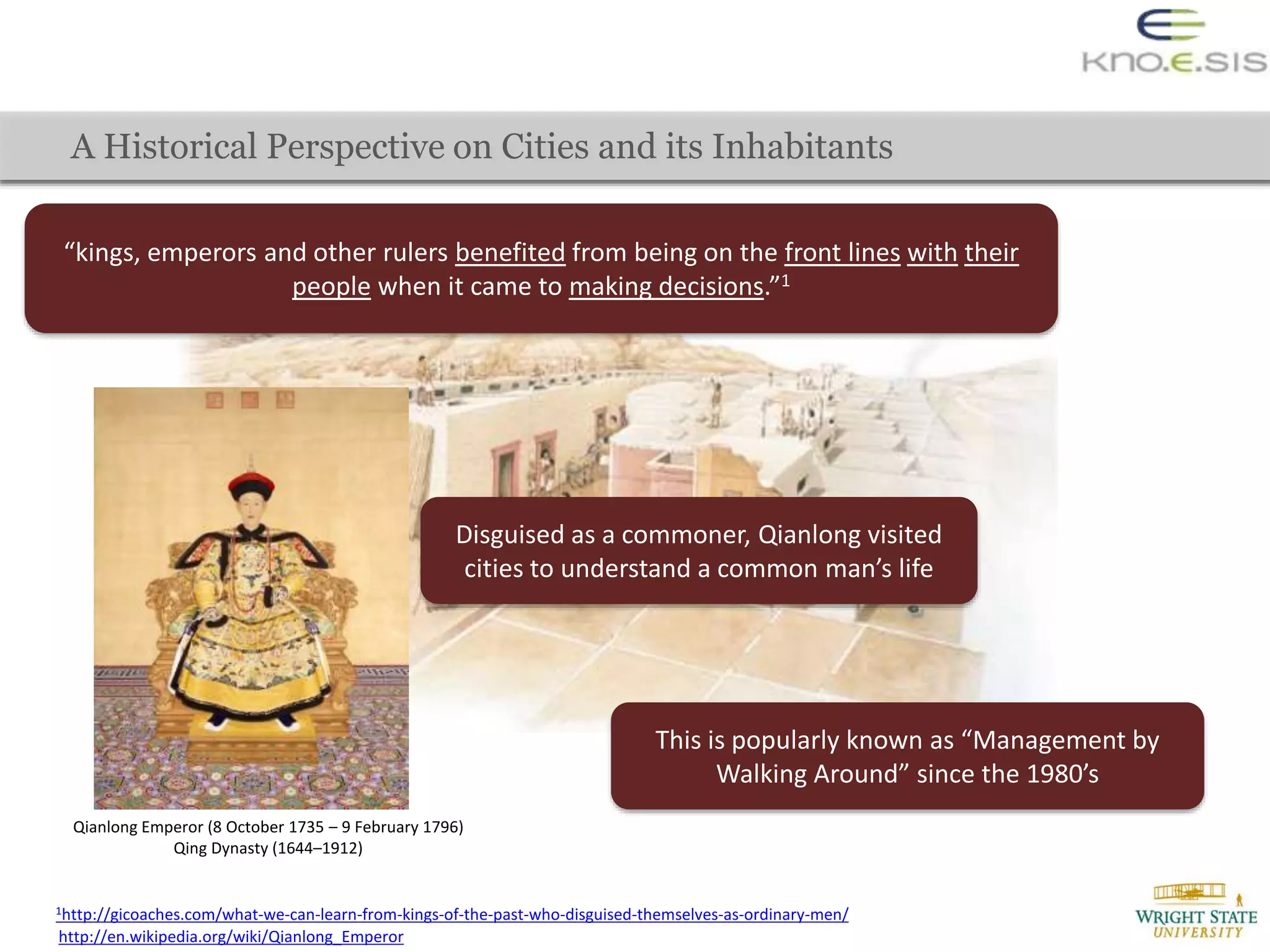
Qianlong Emperor (8 October 1735 – 9 February 1796)
Qing Dynasty (1644–1912)
Disguised as a commoner, Qianlong visited
cities to understand a common man’s life
This is popularly known as “Management by
Walking Around” since the 1980’s
A Modern Perspective on Cities and its Inhabitants
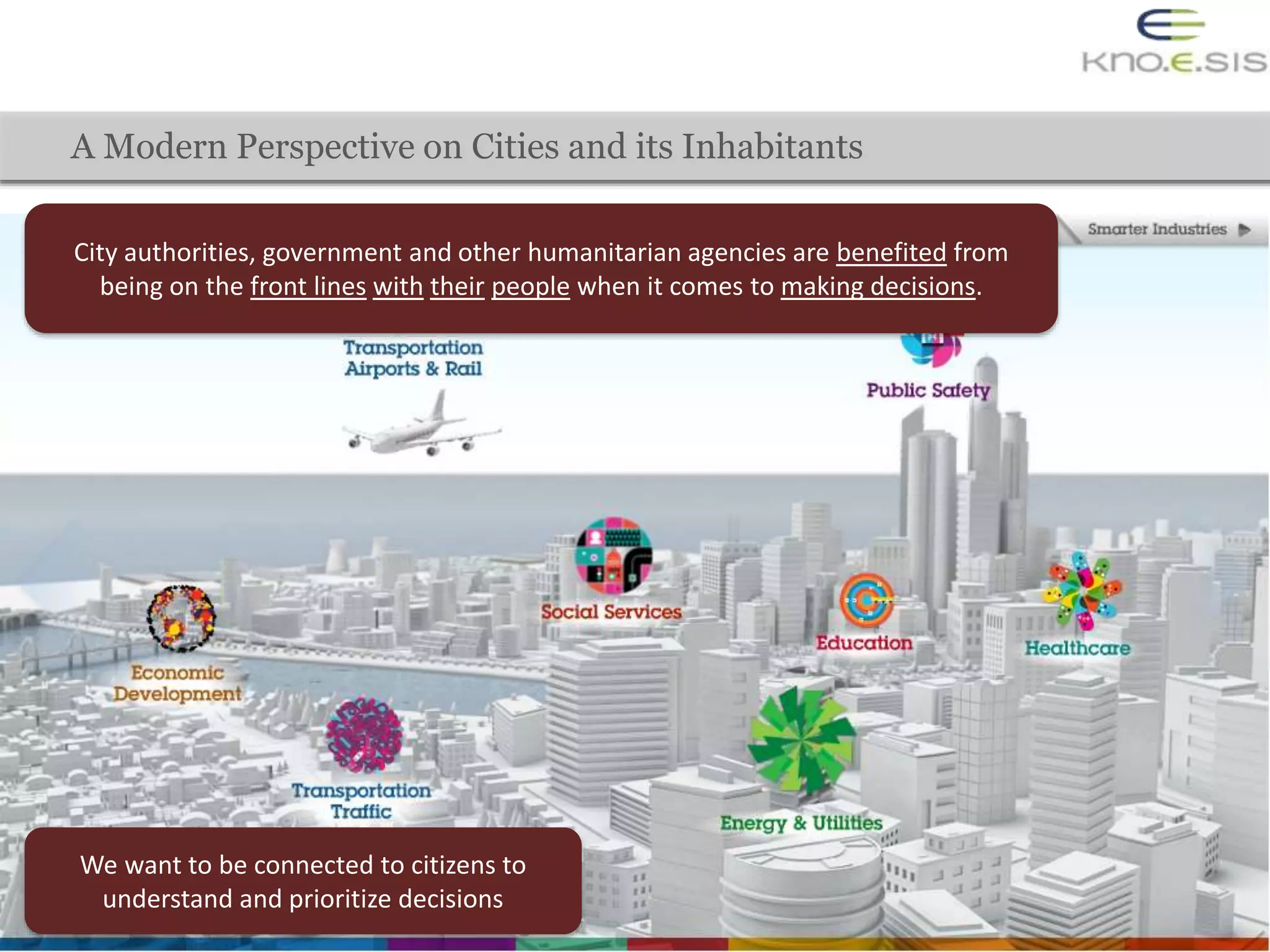
City authorities, government and other humanitarian agencies are benefited from
being on the front lines with their people when it comes to making decisions.
We want to be connected to citizens to
understand and prioritize decisions
Image credit: http://www-03.ibm.com/software/products/us/en/intelligent-operations-center
Image credit: http://www.ibm.com/smarterplanet/us/en/smarter_cities/overview/index.html
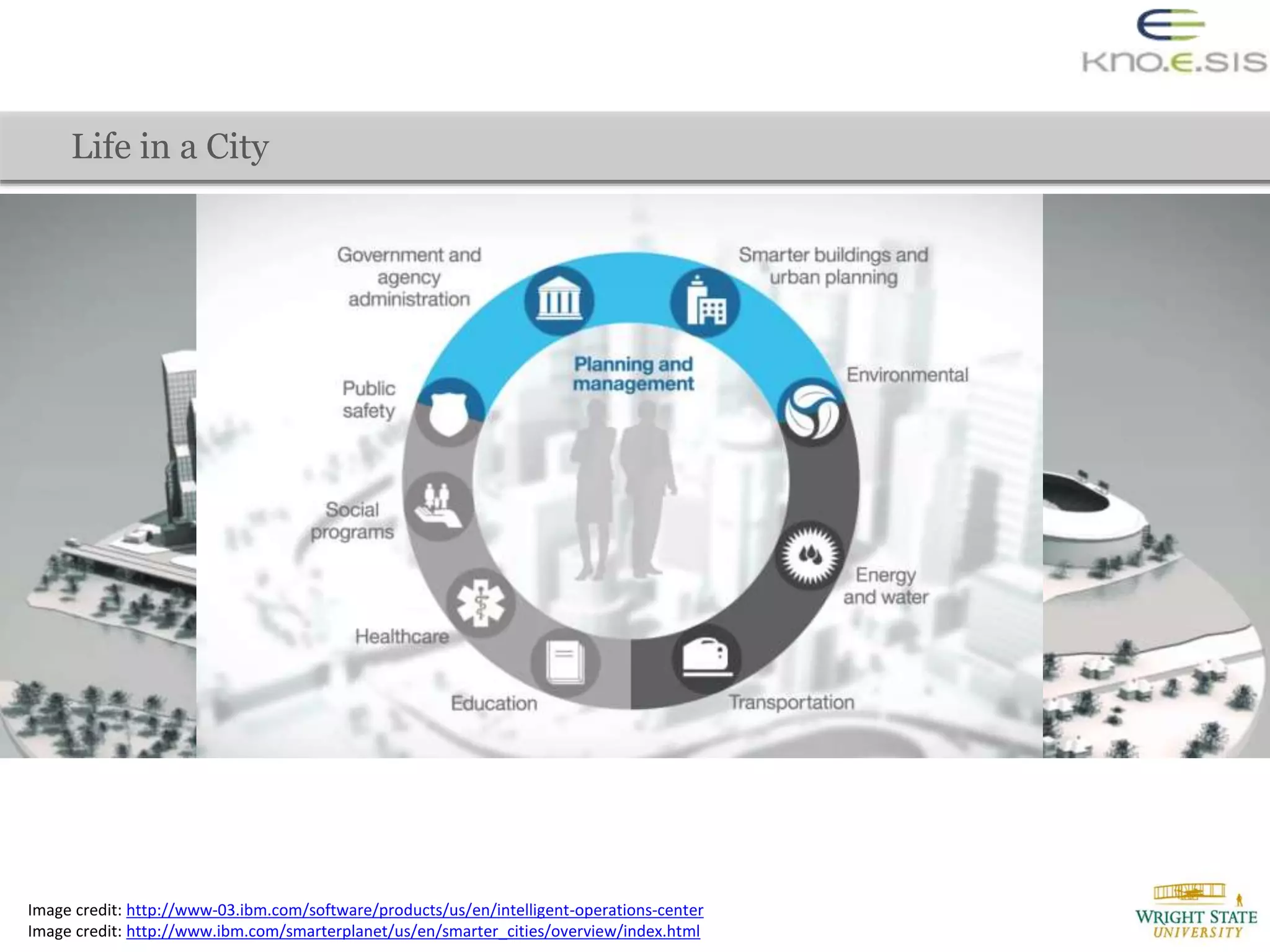
Life in a City
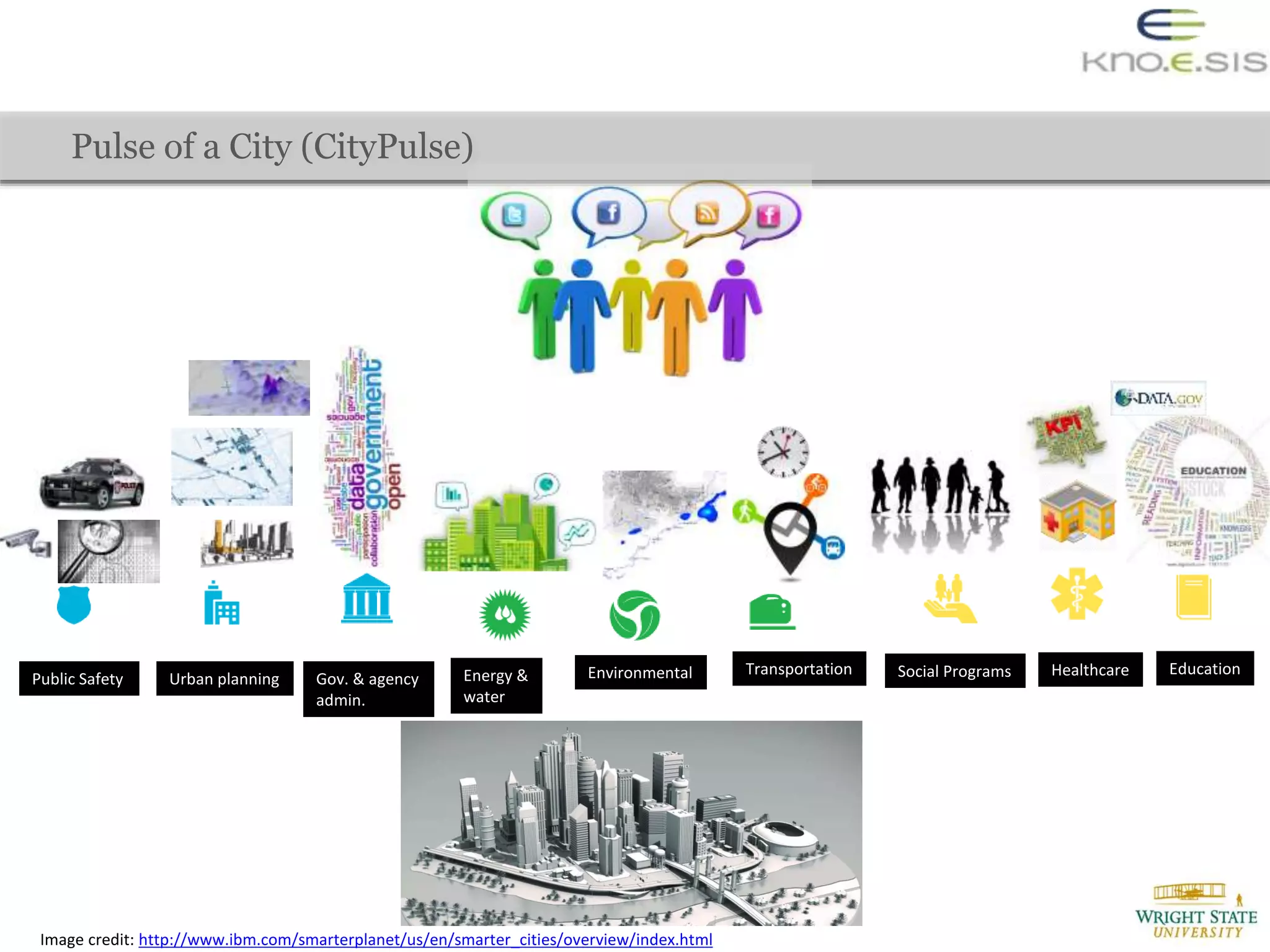
Image credit: http://www.ibm.com/smarterplanet/us/en/smarter_cities/overview/index.html
Public Safety Urban planning Gov. & agency
admin.
Energy &
water
Environmental Transportation Social Programs Healthcare Education
Pulse of a City (CityPulse)
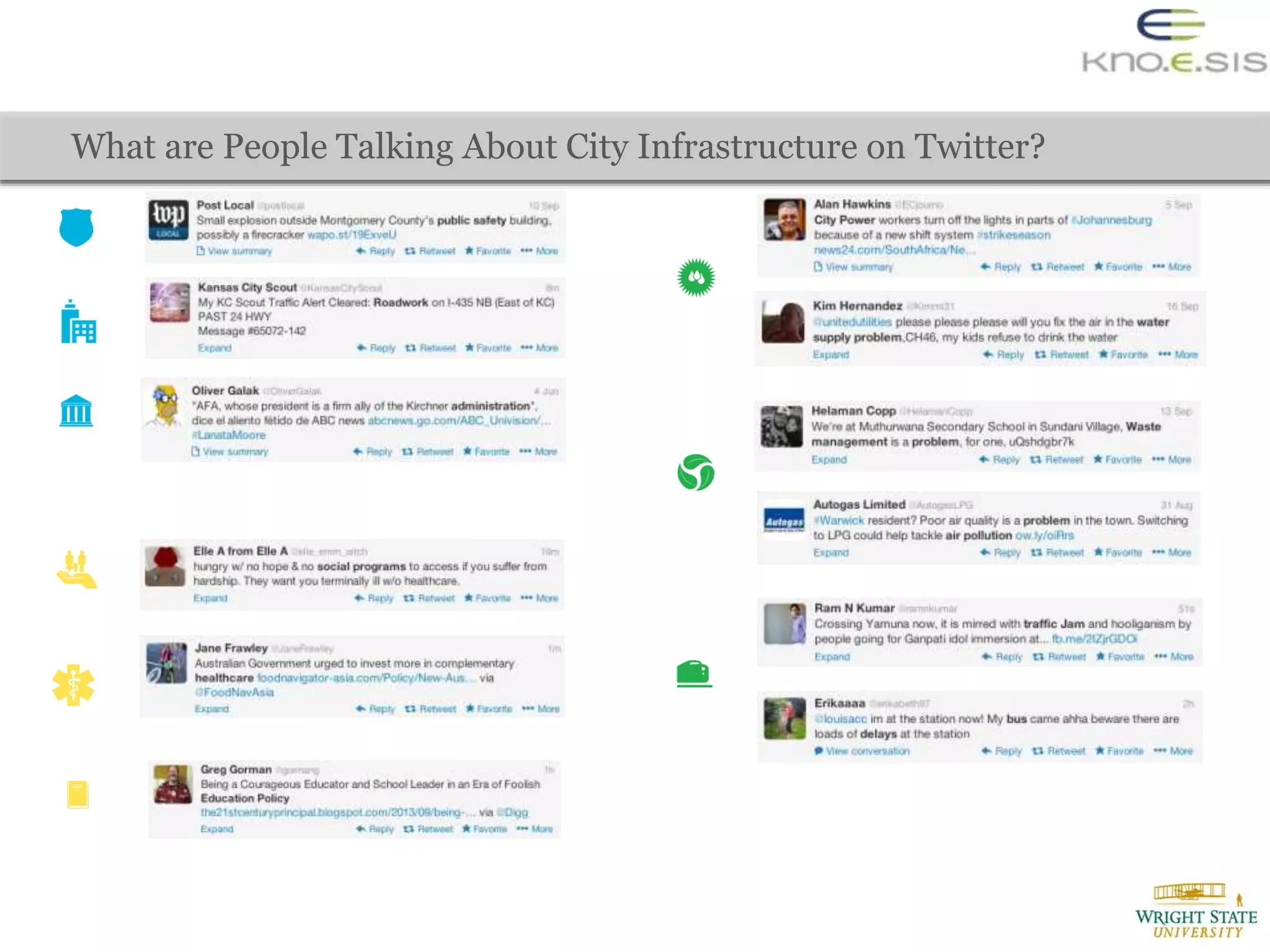
What are People Talking About City Infrastructure on Twitter?
• What are people talking about city
infrastructure on twitter?
• How do we extract city infrastructure related
events from twitter?
• How can we leverage event and location
knowledge bases for event extraction?
• How well can we extract city events?
Research Questions
Some Challenges in Extracting Events from Tweets
• No well accepted definition of ‘events related to a
city’
• Tweets are short (140 characters) and its informal
nature make it hard to analyze
– Entity, location, time, and type of an event
• Multiple reports of the same event and sparse
report of some events (biased sample)
– Numbers don’t necessarily indicate intensity
• Validation of the solution is hard due to the open
domain nature of the problem
Formal Text Informal Text
Closed Domain
Open Domain [Roitman et al. 2012][Kumaran and Allan 2004]
[Lampos and Cristianini 2012]
[Becker et al. 2011]
[Wang et al. 2012]
[Ritter et al. 2012]
Related Work on Event Extraction
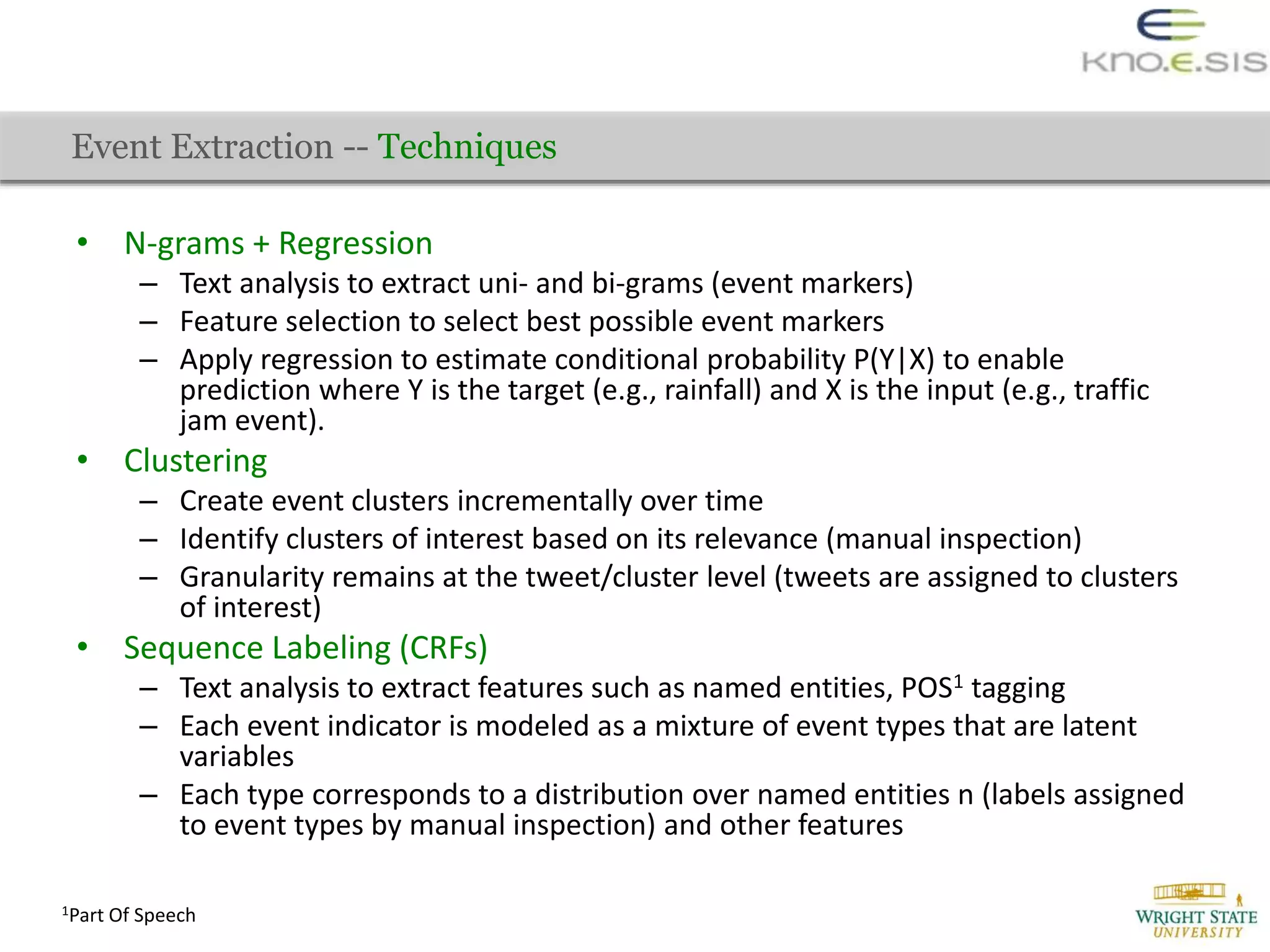
• N-grams + Regression
– Text analysis to extract uni- and bi-grams (event markers)
– Feature selection to select best possible event markers
– Apply regression to estimate conditional probability P(Y|X) to enable
prediction where Y is the target (e.g., rainfall) and X is the input (e.g., traffic
jam event).
• Clustering
– Create event clusters incrementally over time
– Identify clusters of interest based on its relevance (manual inspection)
– Granularity remains at the tweet/cluster level (tweets are assigned to clusters
of interest)
• Sequence Labeling (CRFs)
– Text analysis to extract features such as named entities, POS1 tagging
– Each event indicator is modeled as a mixture of event types that are latent
variables
– Each type corresponds to a distribution over named entities n (labels assigned
to event types by manual inspection) and other features
Event Extraction -- Techniques
1Part Of Speech
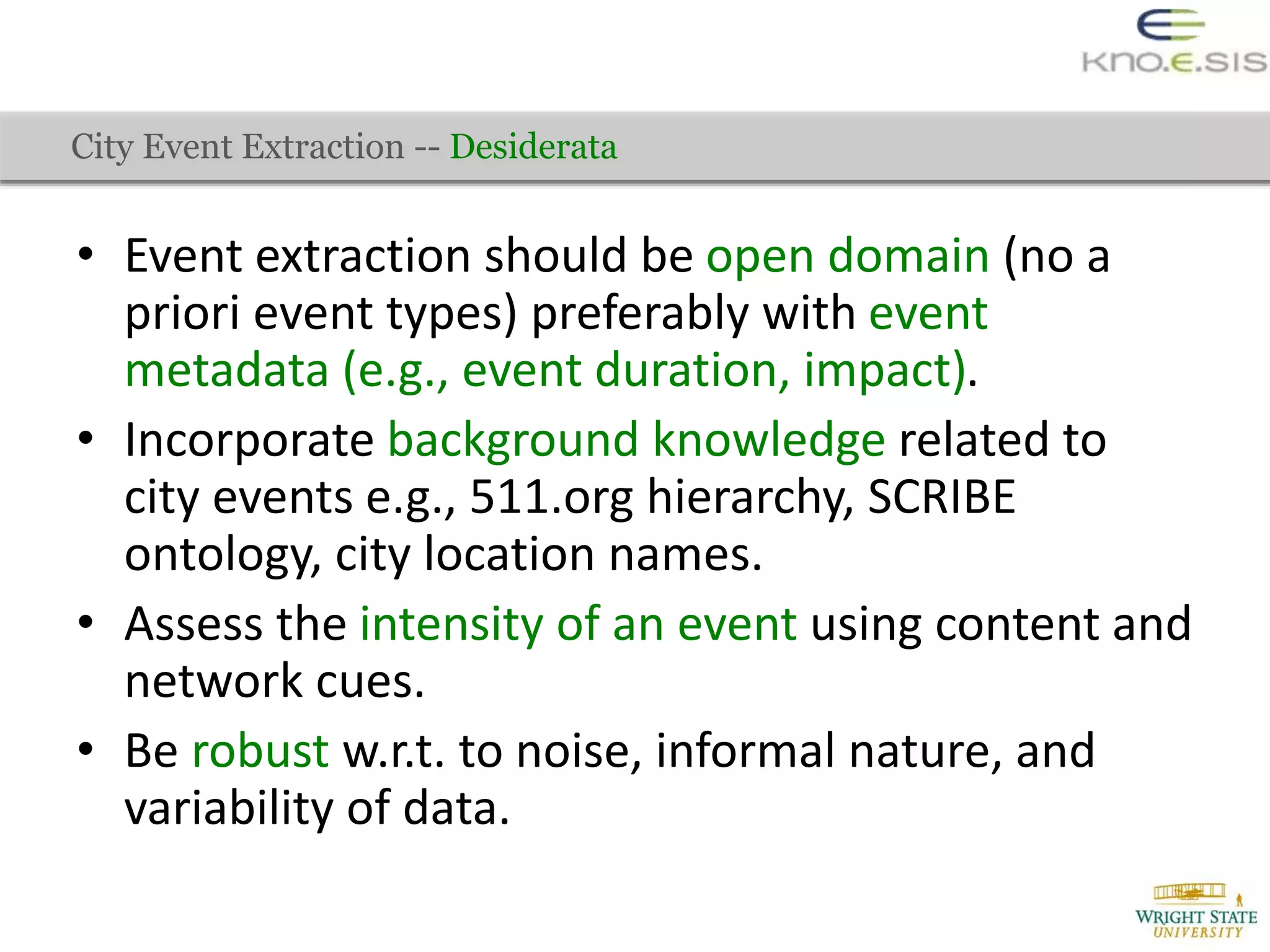
• Event extraction should be open domain (no a
priori event types) preferably with event
metadata (e.g., event duration, impact).
• Incorporate background knowledge related to
city events e.g., 511.org hierarchy, SCRIBE
ontology, city location names.
• Assess the intensity of an event using content and
network cues.
• Be robust w.r.t. to noise, informal nature, and
variability of data.
City Event Extraction -- Desiderata
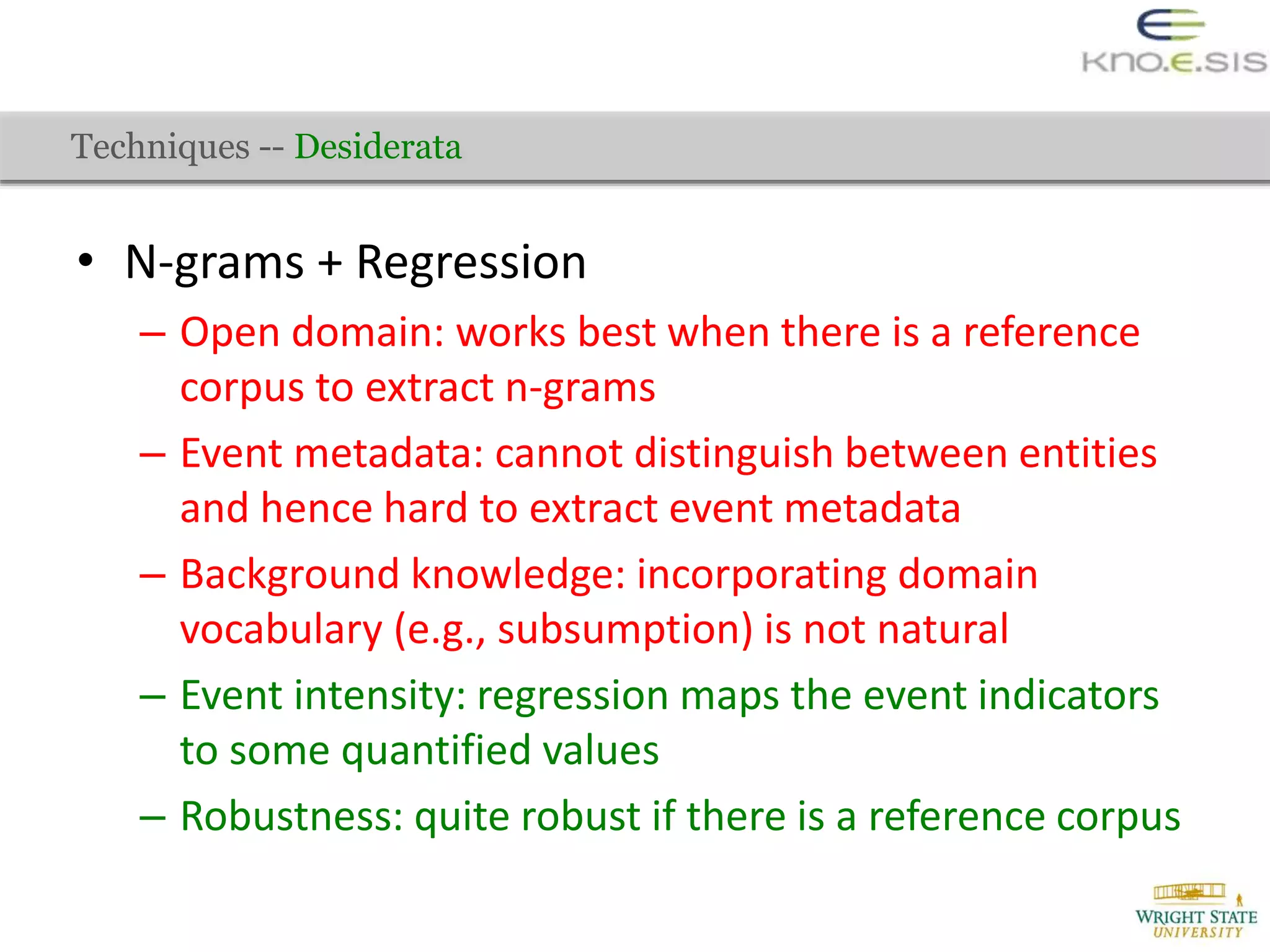
• N-grams + Regression
– Open domain: works best when there is a reference
corpus to extract n-grams
– Event metadata: cannot distinguish between entities
and hence hard to extract event metadata
– Background knowledge: incorporating domain
vocabulary (e.g., subsumption) is not natural
– Event intensity: regression maps the event indicators
to some quantified values
– Robustness: quite robust if there is a reference corpus
Techniques -- Desiderata
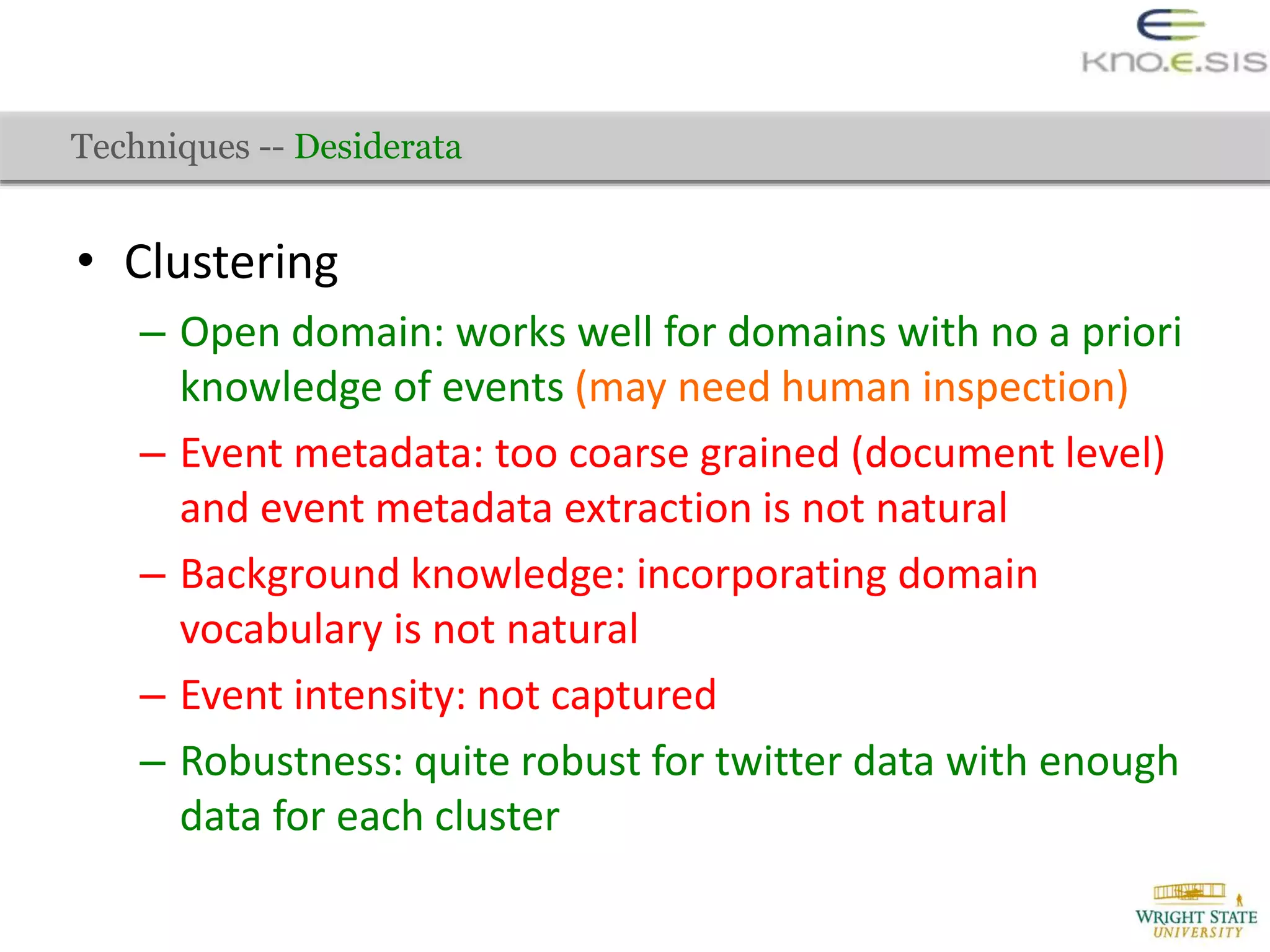
• Clustering
– Open domain: works well for domains with no a priori
knowledge of events (may need human inspection)
– Event metadata: too coarse grained (document level)
and event metadata extraction is not natural
– Background knowledge: incorporating domain
vocabulary is not natural
– Event intensity: not captured
– Robustness: quite robust for twitter data with enough
data for each cluster
Techniques -- Desiderata
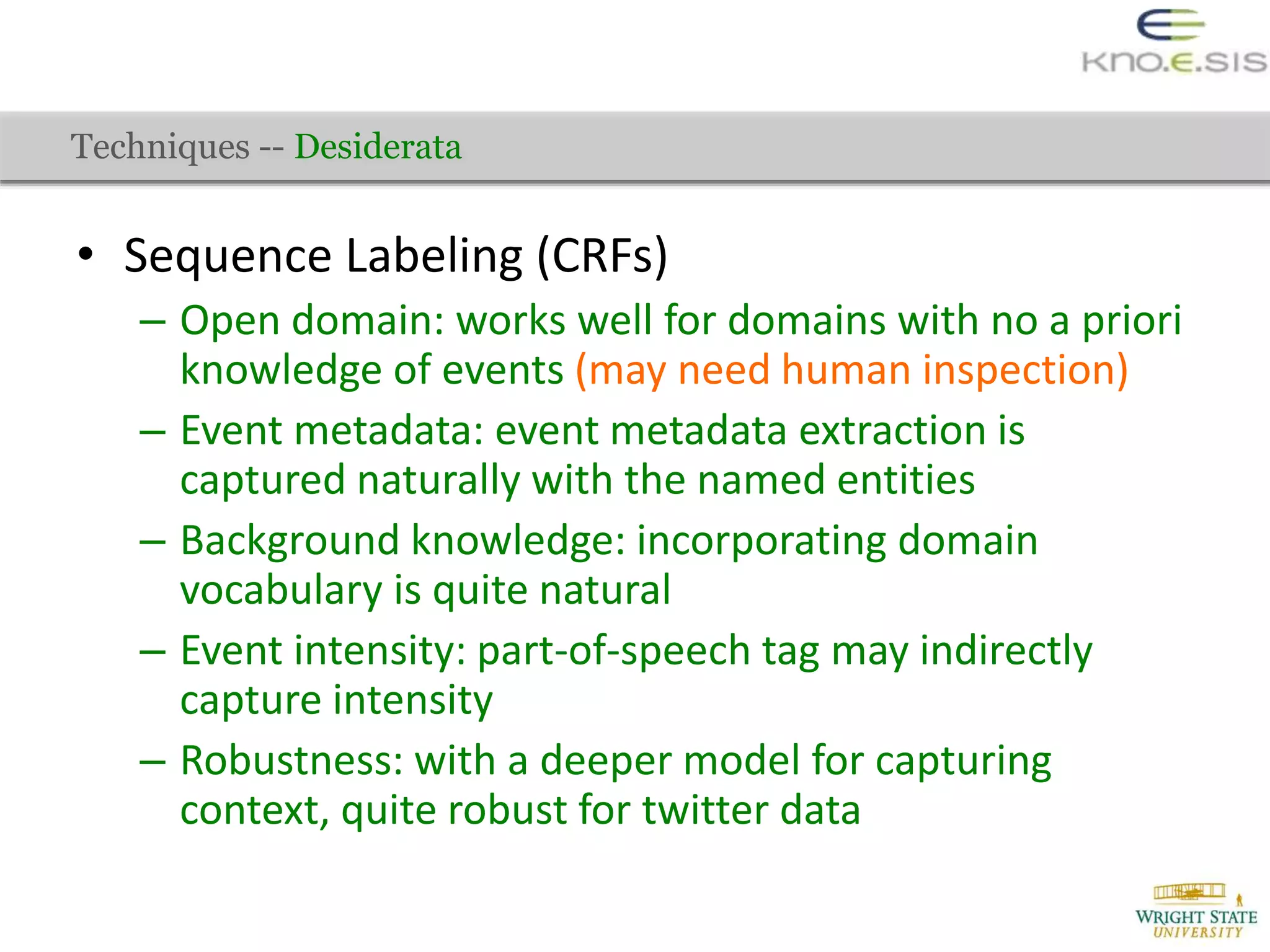
• Sequence Labeling (CRFs)
– Open domain: works well for domains with no a priori
knowledge of events (may need human inspection)
– Event metadata: event metadata extraction is
captured naturally with the named entities
– Background knowledge: incorporating domain
vocabulary is quite natural
– Event intensity: part-of-speech tag may indirectly
capture intensity
– Robustness: with a deeper model for capturing
context, quite robust for twitter data
Techniques -- Desiderata
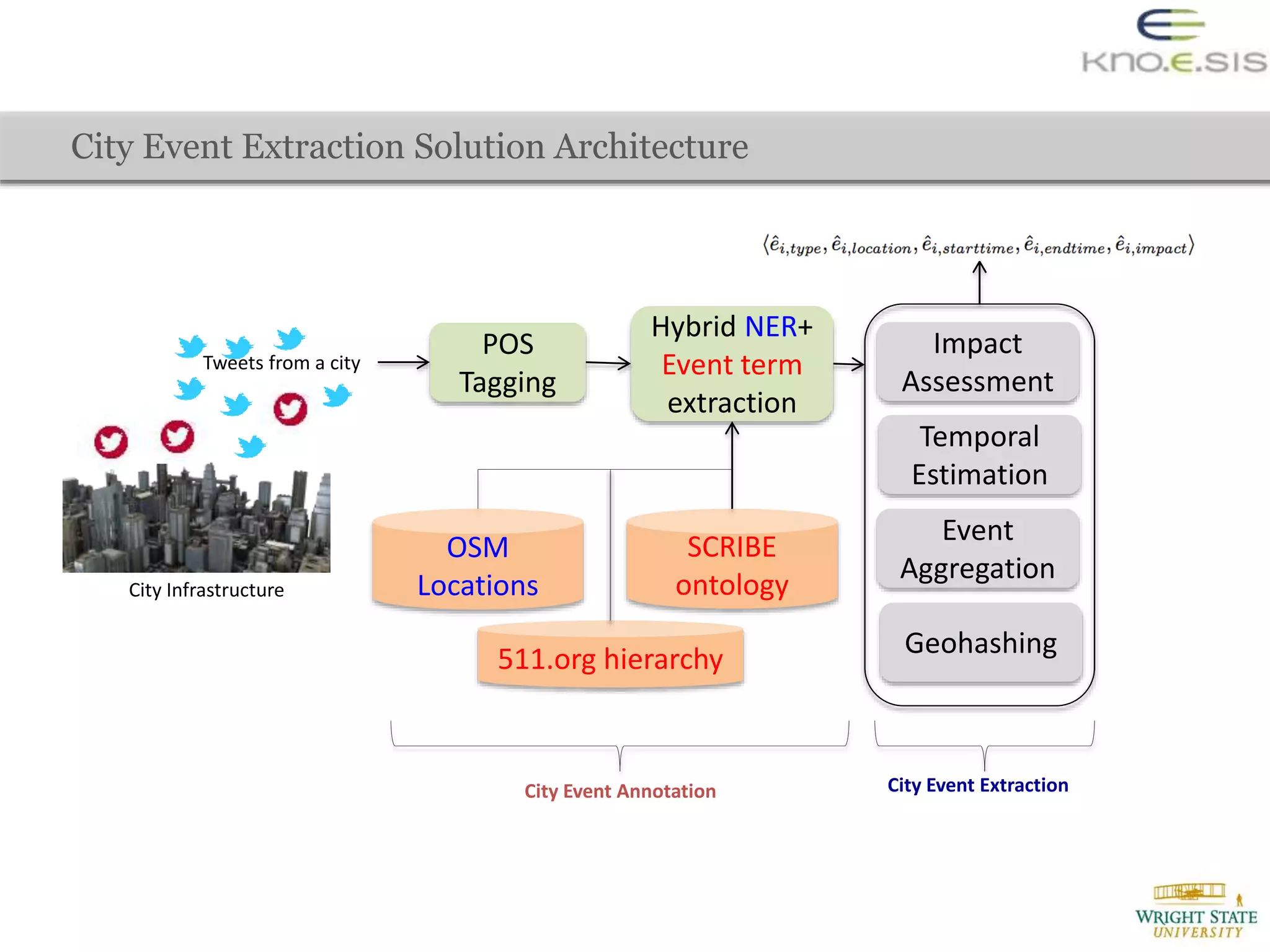
City Infrastructure
Tweets from a city
POS
Tagging
Hybrid NER+
Event term
extraction
Geohashing
Temporal
Estimation
Impact
Assessment
Event
Aggregation
OSM
Locations
SCRIBE
ontology
511.org hierarchy
City Event Extraction
City Event Extraction Solution Architecture
City Event Annotation
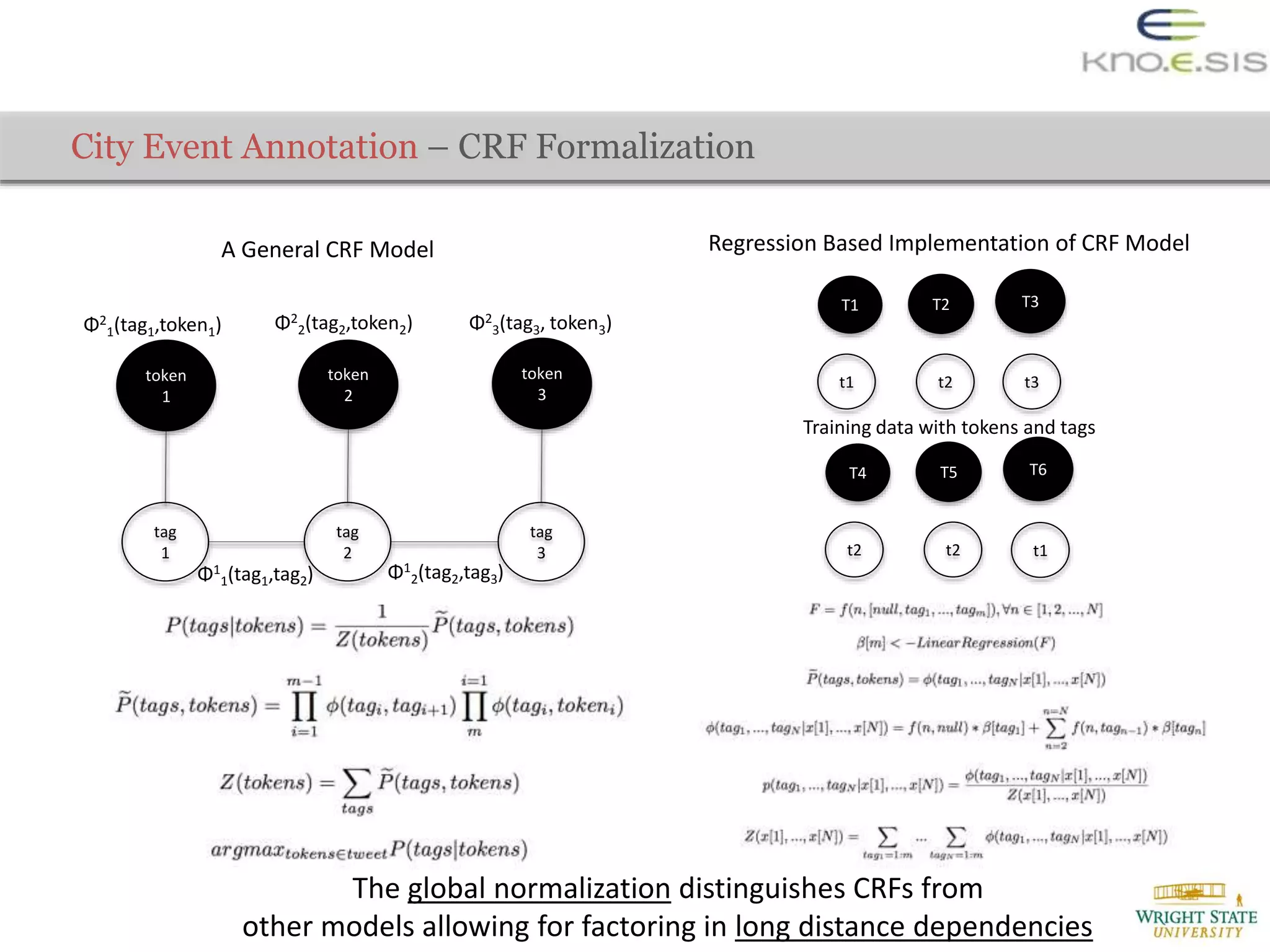
tag
1
tag
2
tag
3
token
1
token
2
token
3
Φ1
1(tag1,tag2) Φ1
2(tag2,tag3)
Φ2
1(tag1,token1) Φ2
2(tag2,token2) Φ2
3(tag3, token3)
t1 t2
T1 T2 T3
Training data with tokens and tags
A General CRF Model Regression Based Implementation of CRF Model
t2 t2
T4 T5 T6
t3
t1
City Event Annotation – CRF Formalization
The global normalization distinguishes CRFs from
other models allowing for factoring in long distance dependencies
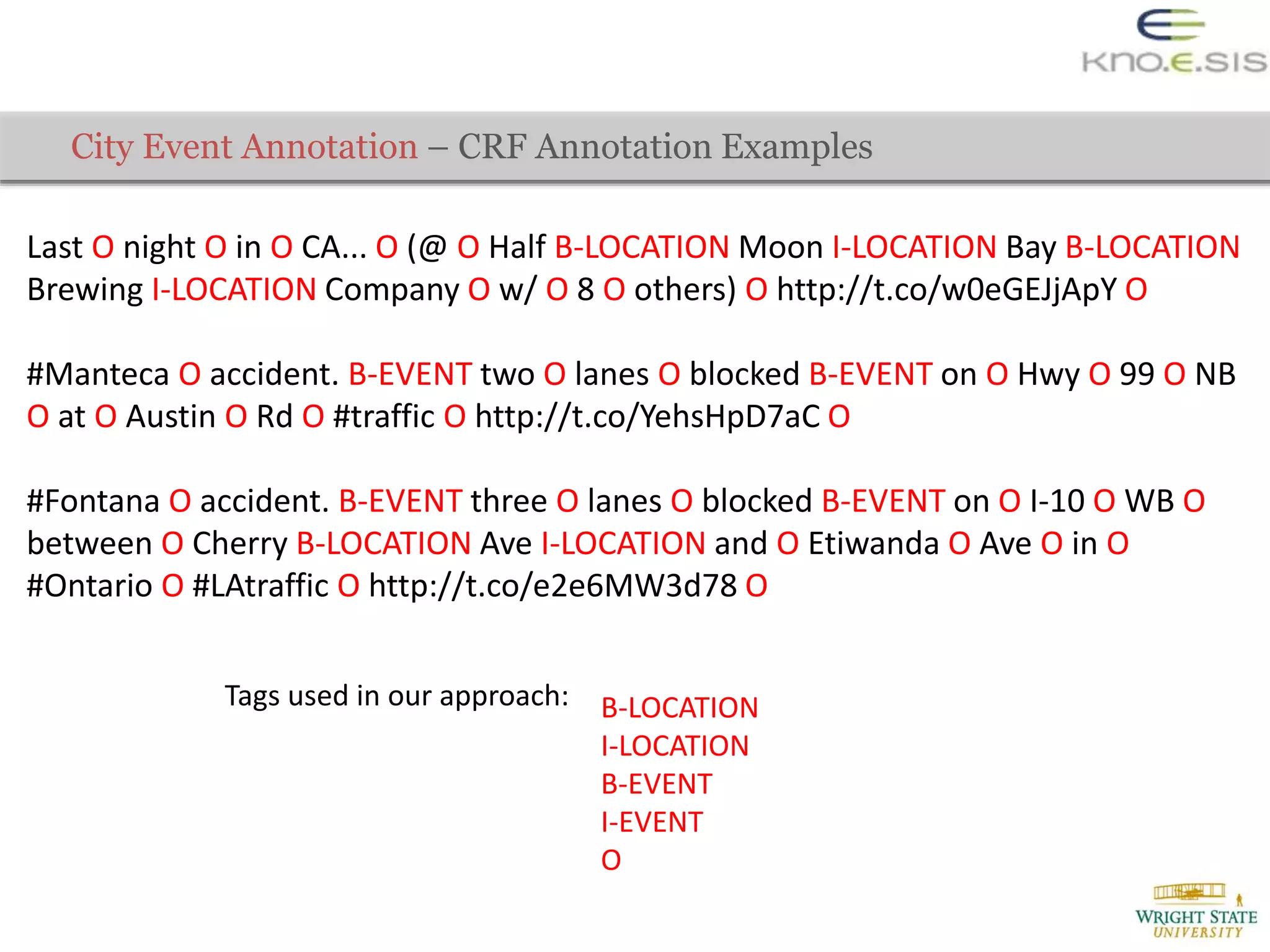
City Event Annotation – CRF Annotation Examples
Last O night O in O CA... O (@ O Half B-LOCATION Moon I-LOCATION Bay B-LOCATION
Brewing I-LOCATION Company O w/ O 8 O others) O http://t.co/w0eGEJjApY O
#Manteca O accident. B-EVENT two O lanes O blocked B-EVENT on O Hwy O 99 O NB
O at O Austin O Rd O #traffic O http://t.co/YehsHpD7aC O
#Fontana O accident. B-EVENT three O lanes O blocked B-EVENT on O I-10 O WB O
between O Cherry B-LOCATION Ave I-LOCATION and O Etiwanda O Ave O in O
#Ontario O #LAtraffic O http://t.co/e2e6MW3d78 O
B-LOCATION
I-LOCATION
B-EVENT
I-EVENT
O
Tags used in our approach:
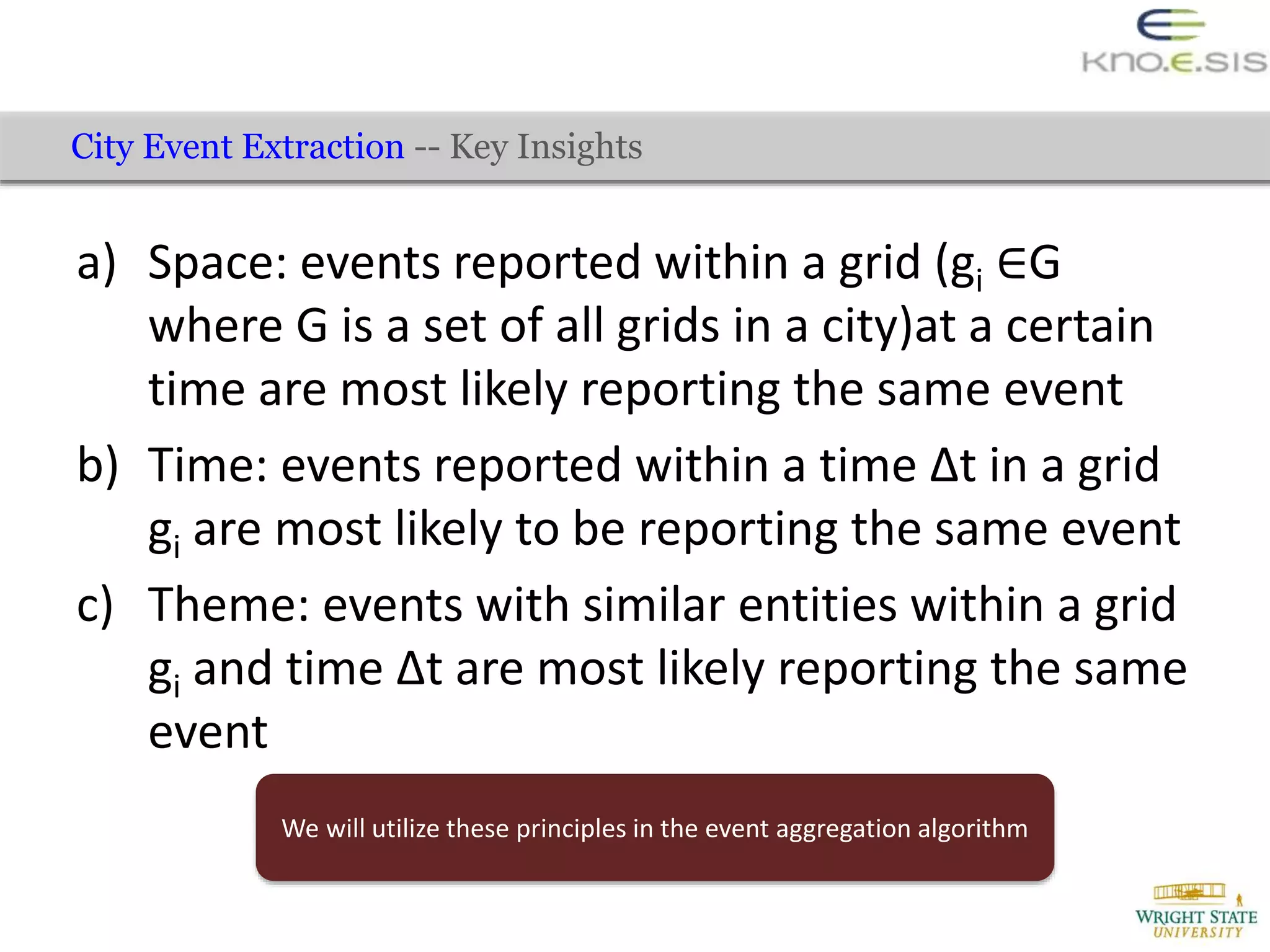
a) Space: events reported within a grid (gi ∈G
where G is a set of all grids in a city)at a certain
time are most likely reporting the same event
b) Time: events reported within a time ∆t in a grid
gi are most likely to be reporting the same event
c) Theme: events with similar entities within a grid
gi and time ∆t are most likely reporting the same
event
City Event Extraction -- Key Insights
We will utilize these principles in the event aggregation algorithm
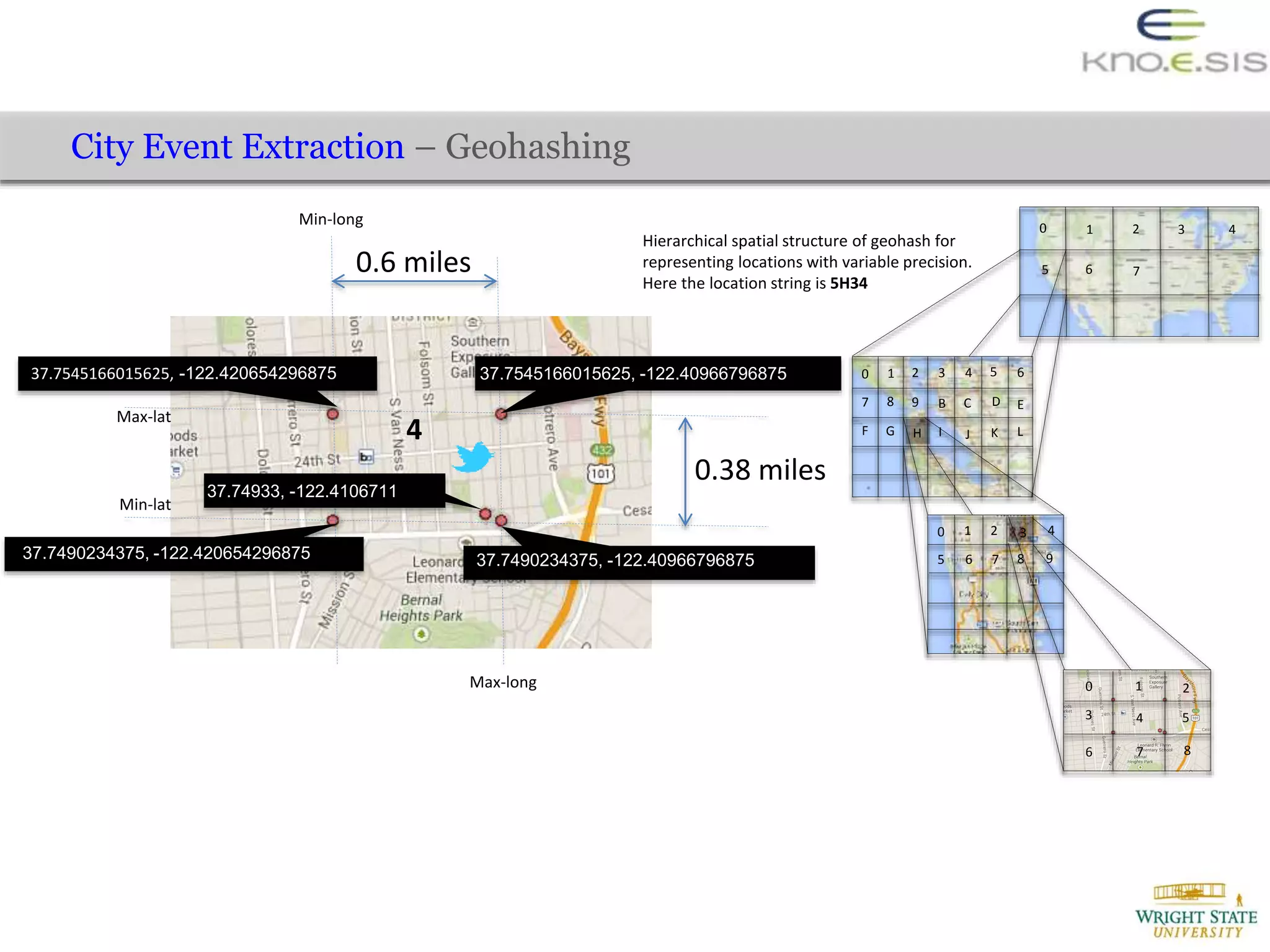
0.6 miles
Max-lat
Min-lat
Min-long
Max-long
0.38 miles
37.7545166015625, -122.40966796875
37.7490234375, -122.40966796875
37.7545166015625, -122.420654296875
37.7490234375, -122.420654296875
4
37.74933, -122.4106711
Hierarchical spatial structure of geohash for
representing locations with variable precision.
Here the location string is 5H34
0 1 2 3 4 5 6
7 8 9 B C D E
F G H I J K L
0 1
7
2 3 4
5 6 8 9
0 1 2 3 4
5 6 7
0 1 2
3 4 5
6 7 8
City Event Extraction – Geohashing
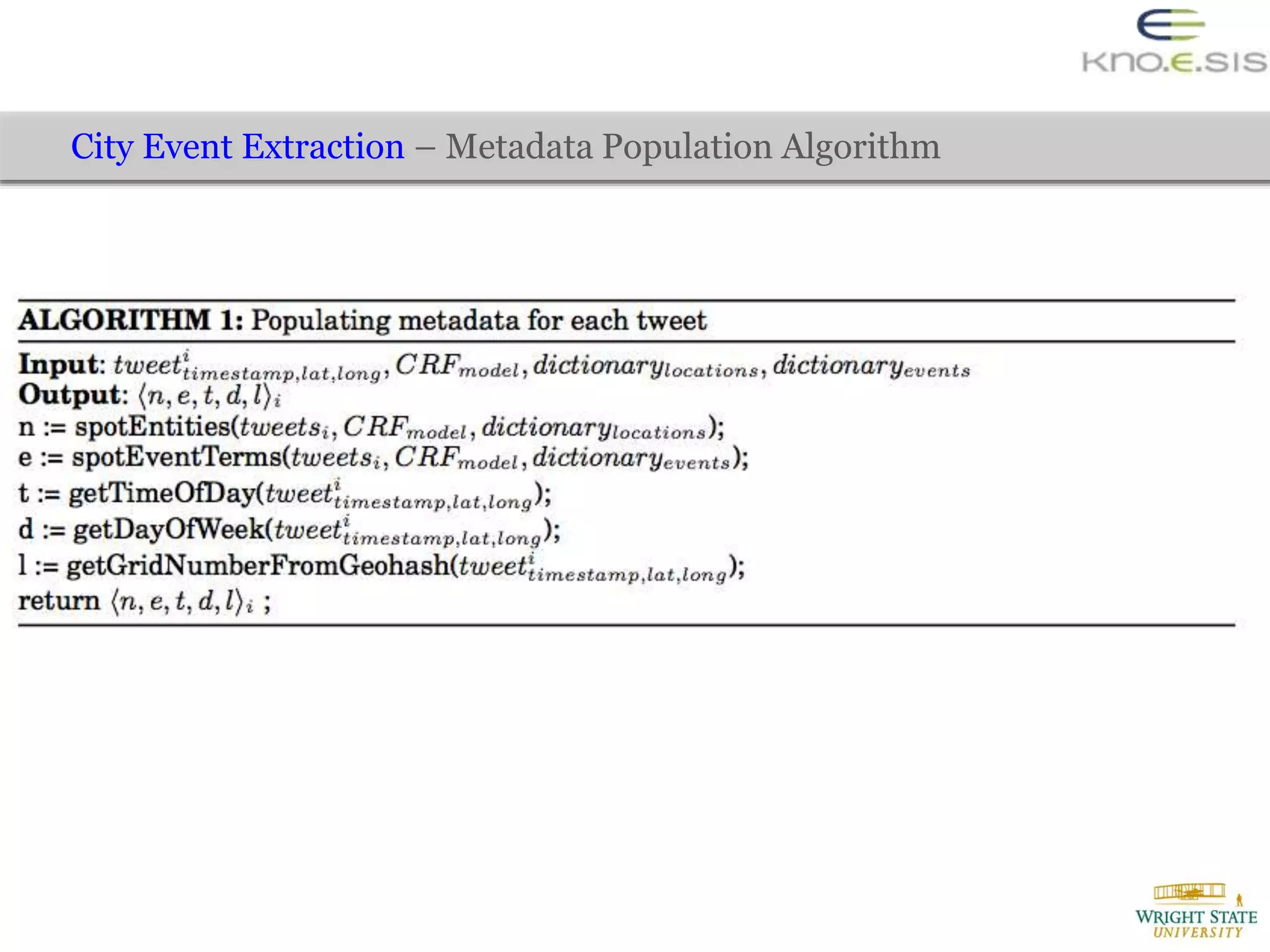
City Event Extraction – Metadata Population Algorithm
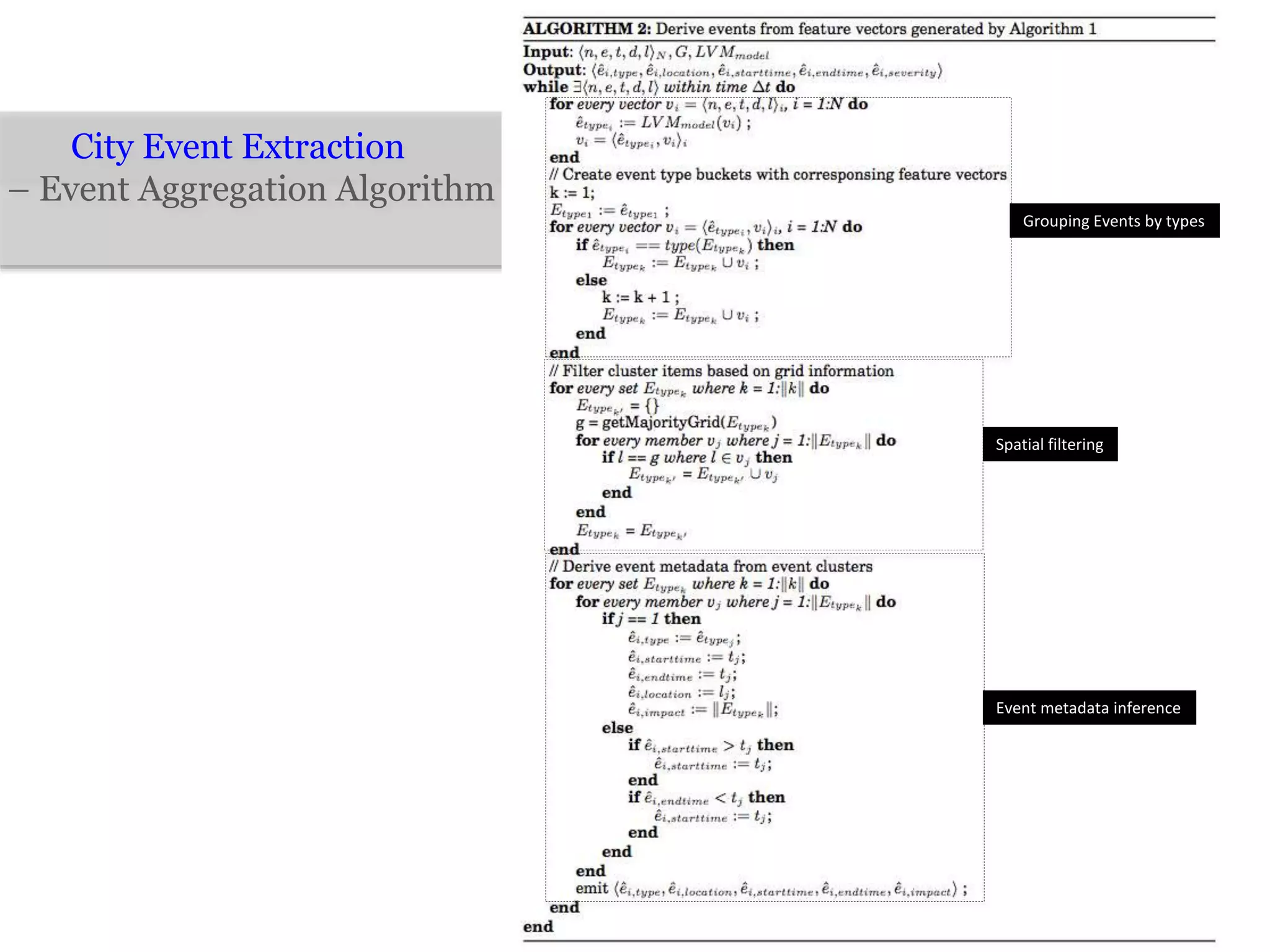
City Event Extraction
– Event Aggregation Algorithm
Event metadata inference
Spatial filtering
Grouping Events by types
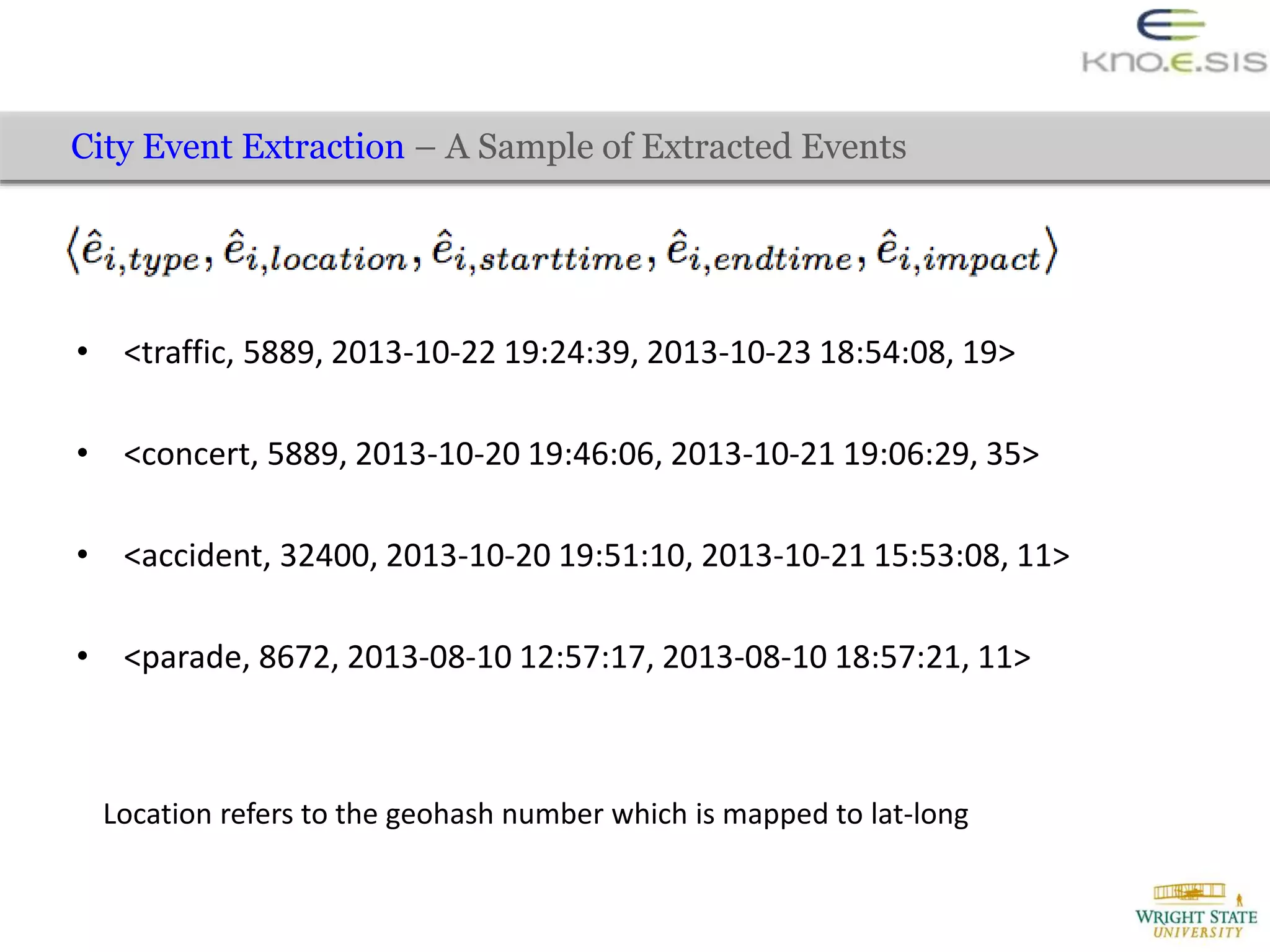
• <traffic, 5889, 2013-10-22 19:24:39, 2013-10-23 18:54:08, 19>
• <concert, 5889, 2013-10-20 19:46:06, 2013-10-21 19:06:29, 35>
• <accident, 32400, 2013-10-20 19:51:10, 2013-10-21 15:53:08, 11>
• <parade, 8672, 2013-08-10 12:57:17, 2013-08-10 18:57:21, 11>
City Event Extraction – A Sample of Extracted Events
Location refers to the geohash number which is mapped to lat-long
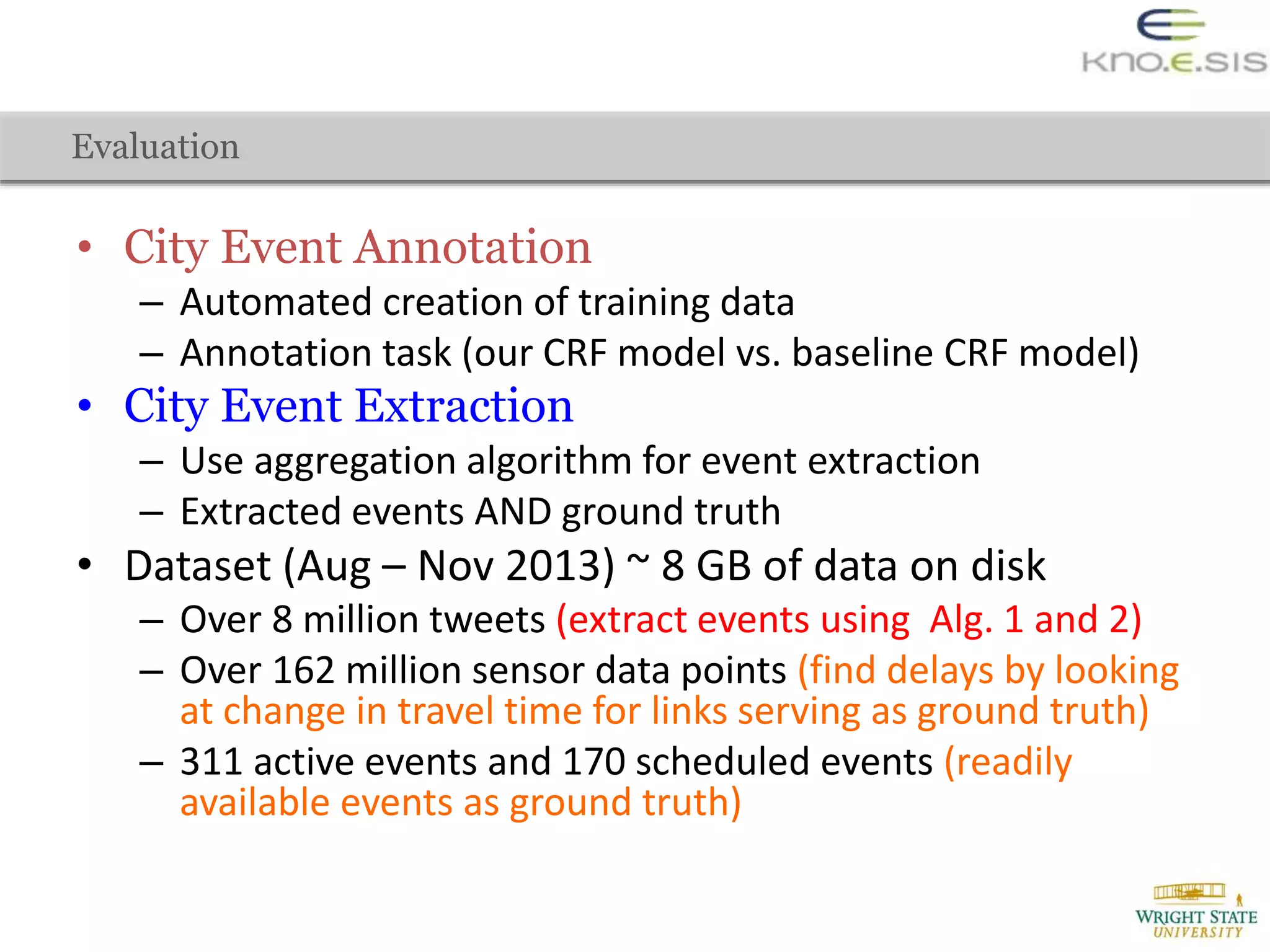
• City Event Annotation
– Automated creation of training data
– Annotation task (our CRF model vs. baseline CRF model)
• City Event Extraction
– Use aggregation algorithm for event extraction
– Extracted events AND ground truth
• Dataset (Aug – Nov 2013) ~ 8 GB of data on disk
– Over 8 million tweets (extract events using Alg. 1 and 2)
– Over 162 million sensor data points (find delays by looking
at change in travel time for links serving as ground truth)
– 311 active events and 170 scheduled events (readily
available events as ground truth)
Evaluation
Evaluation – Automated Creation of Training Data (to train CRF model)
Evaluation over 500 randomly chosen tweets from around 8,000 annotated tweets
Aho-Corasick [Commentz-Walter 1979] string matching algorithm implemented by LingPipe [Alias-i 2008]
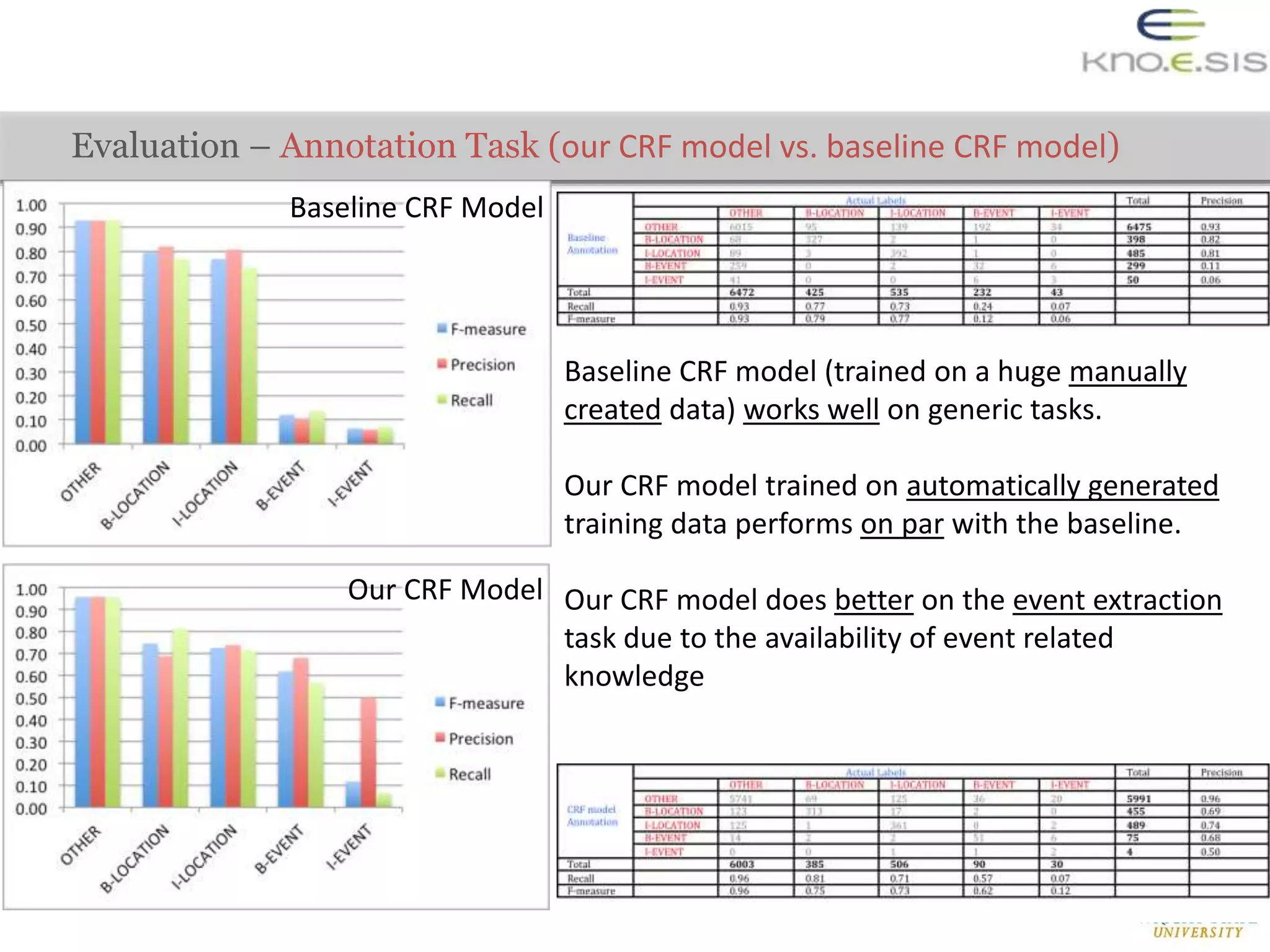
Evaluation – Annotation Task (our CRF model vs. baseline CRF model)
Baseline CRF Model
Our CRF Model
Baseline CRF model (trained on a huge manually
created data) works well on generic tasks.
Our CRF model trained on automatically generated
training data performs on par with the baseline.
Our CRF model does better on the event extraction
task due to the availability of event related
knowledge
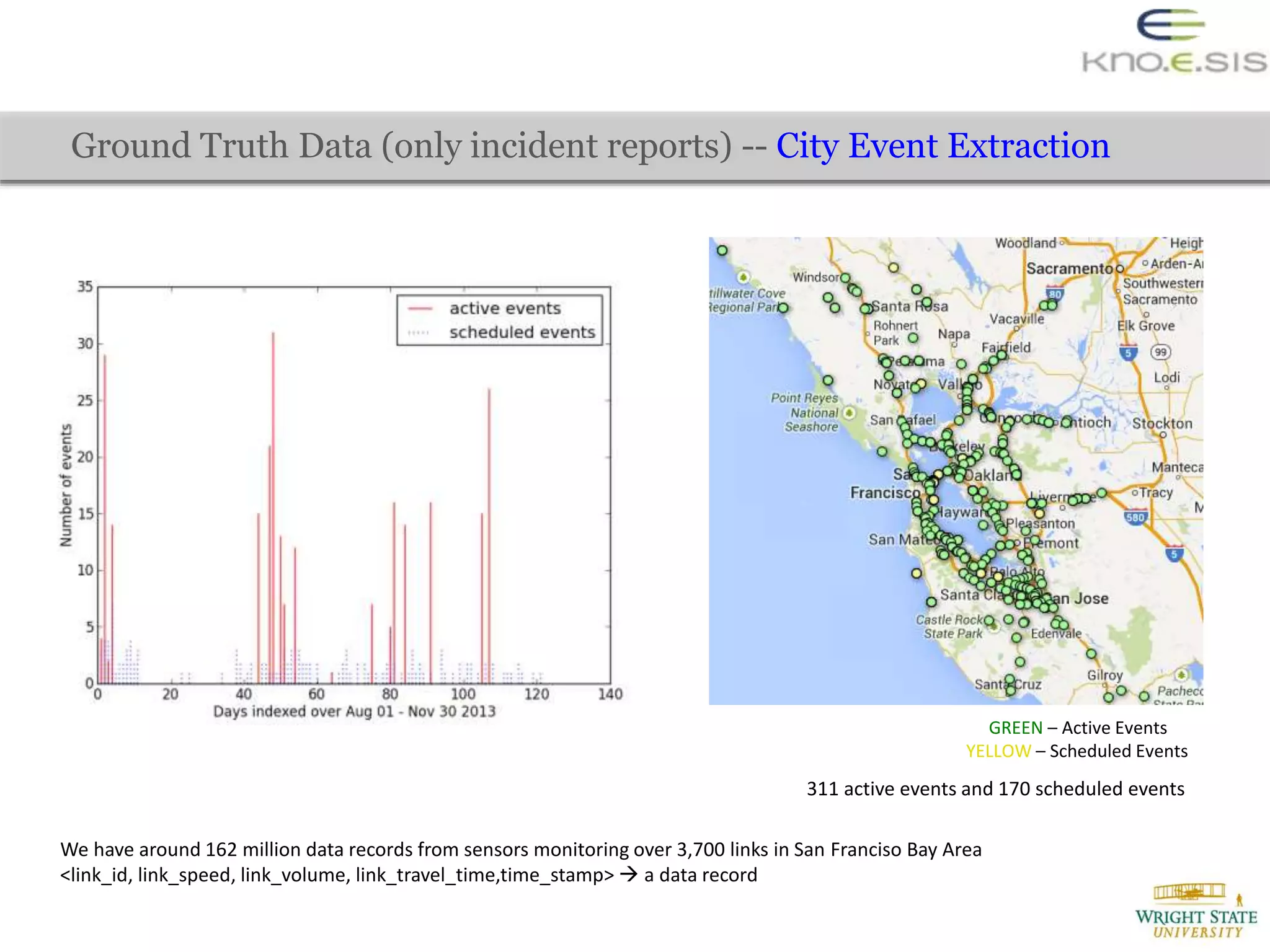
Ground Truth Data (only incident reports) -- City Event Extraction
We have around 162 million data records from sensors monitoring over 3,700 links in San Franciso Bay Area
<link_id, link_speed, link_volume, link_travel_time,time_stamp>  a data record
GREEN – Active Events
YELLOW – Scheduled Events
311 active events and 170 scheduled events
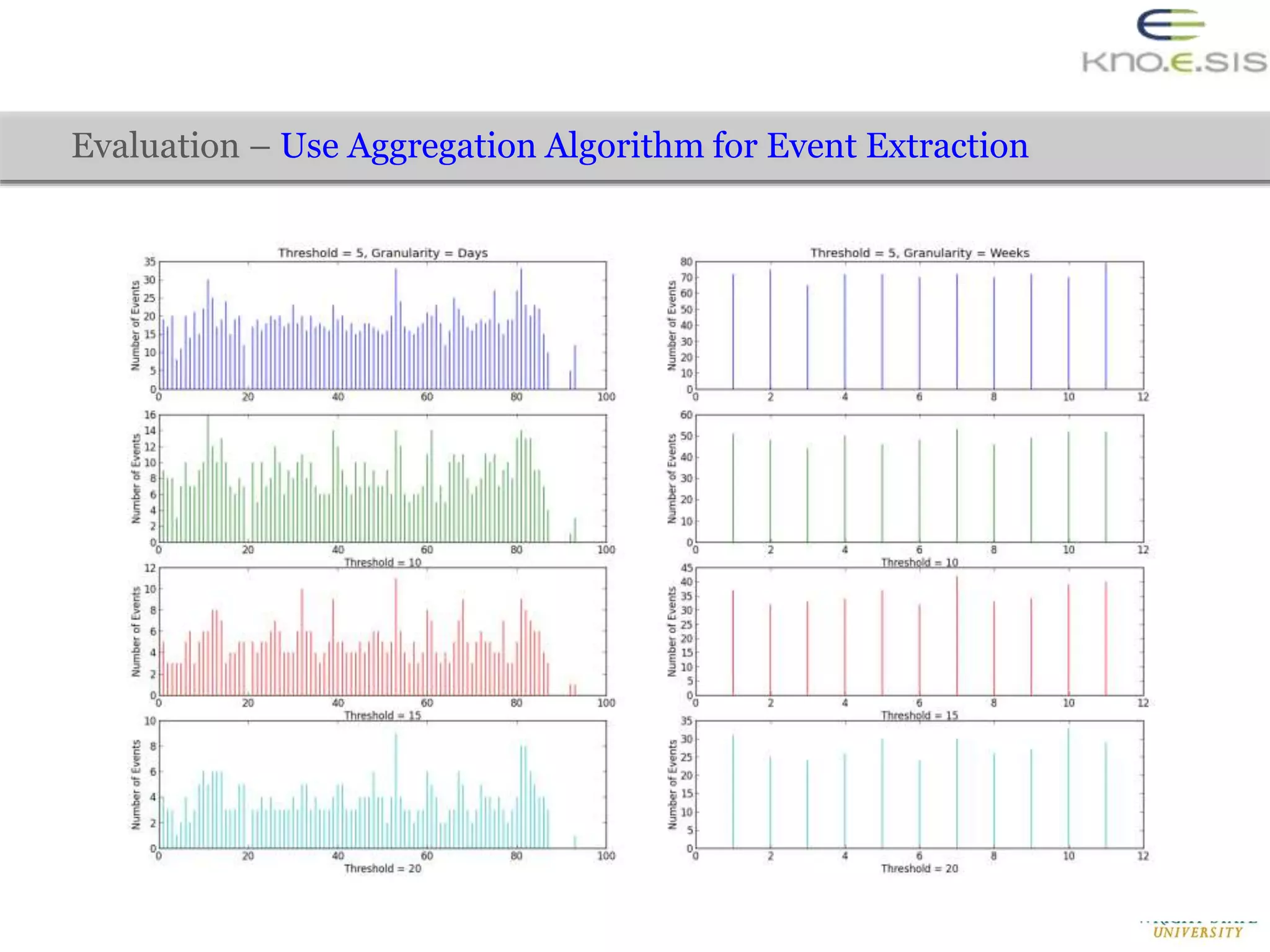
Evaluation – Use Aggregation Algorithm for Event Extraction
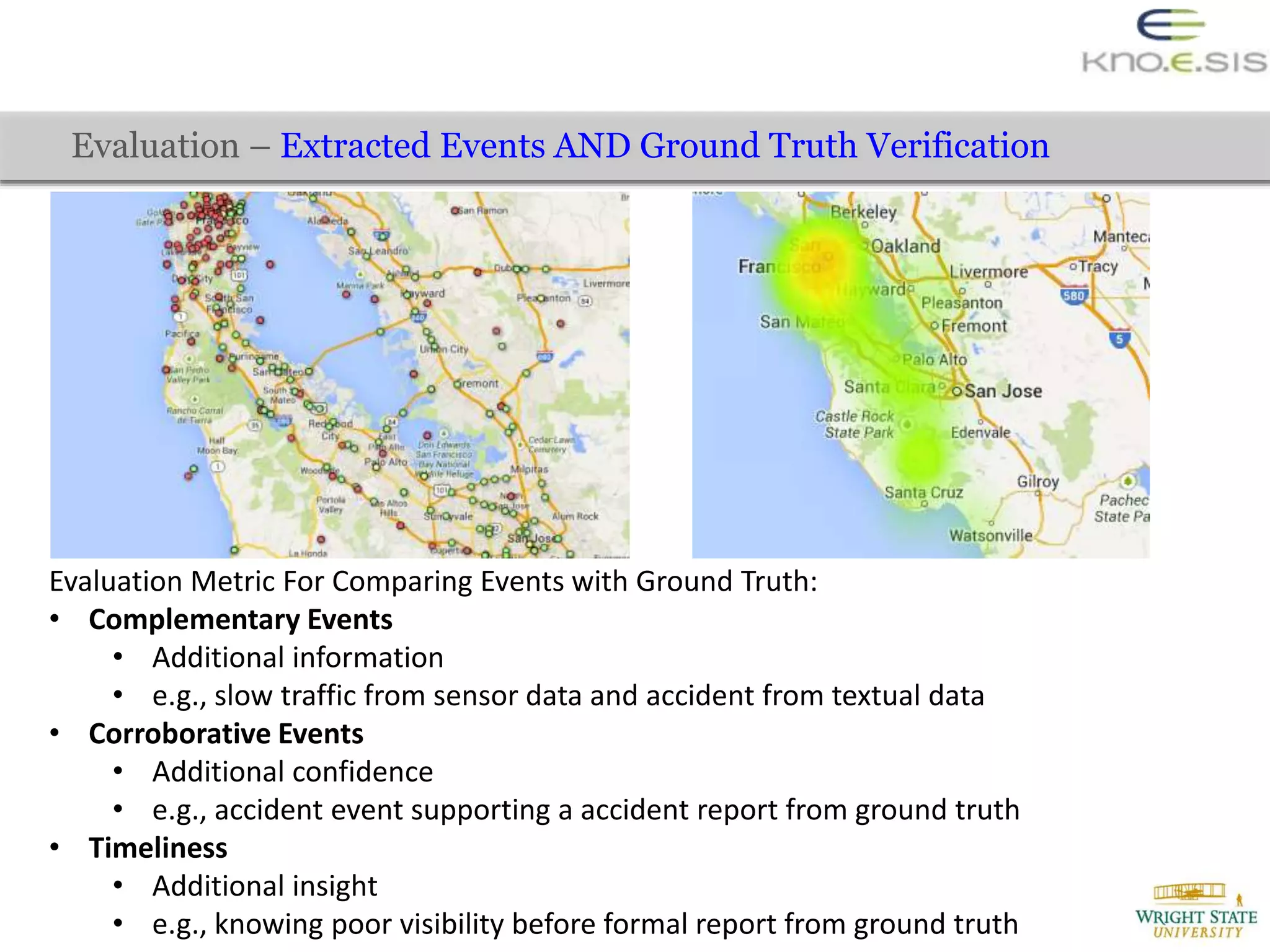
Evaluation – Extracted Events AND Ground Truth Verification
Evaluation Metric For Comparing Events with Ground Truth:
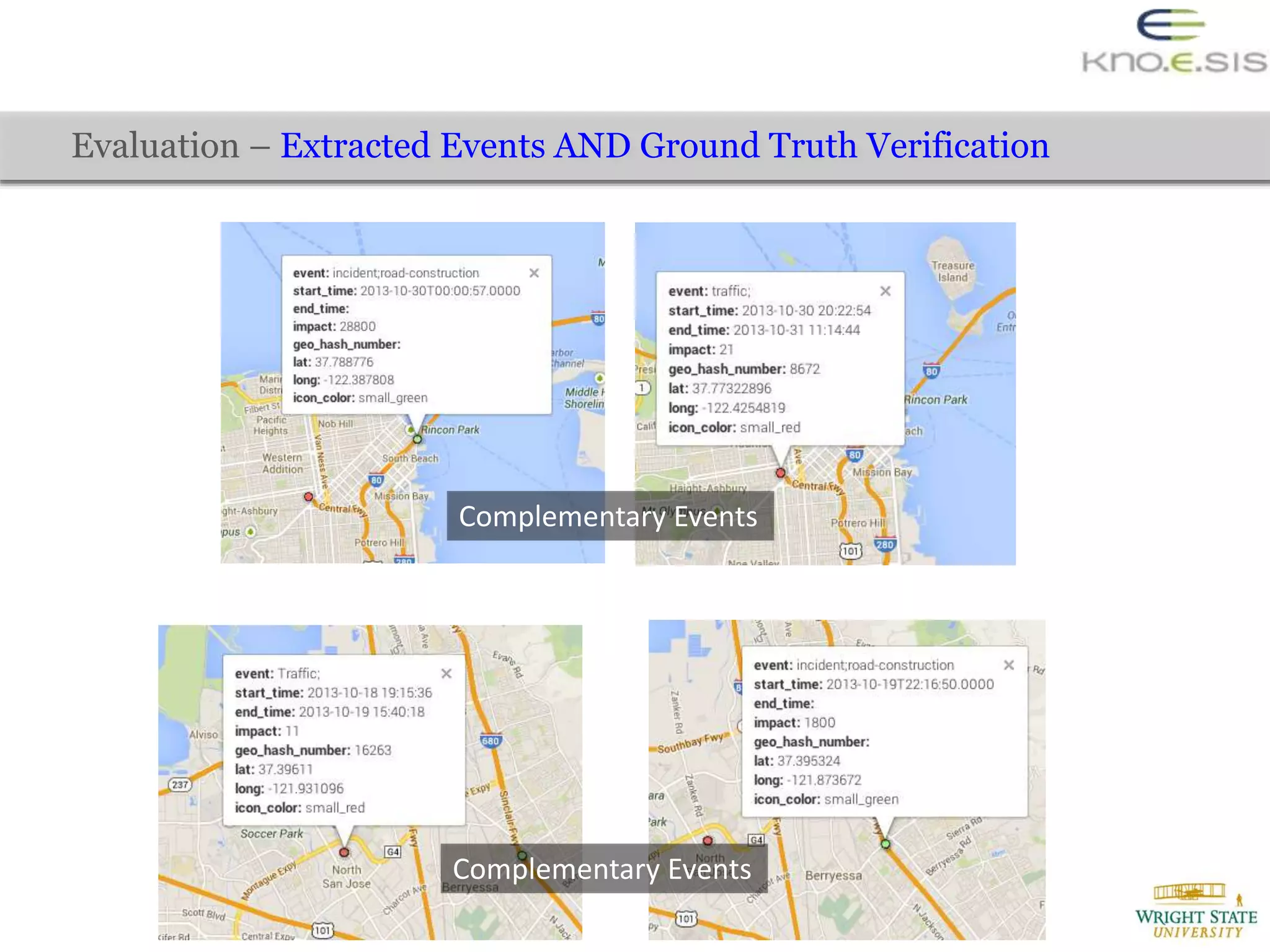
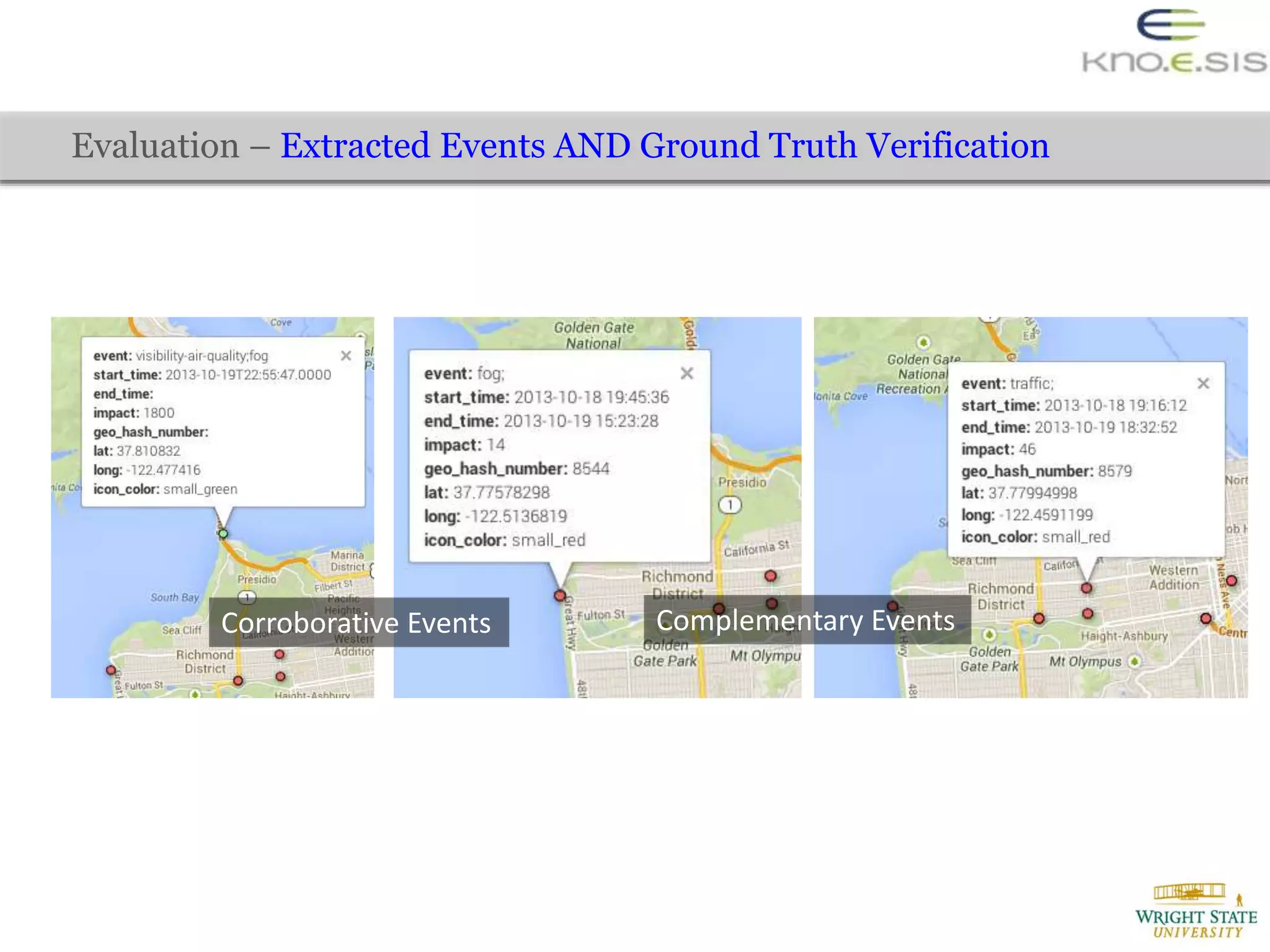
• Complementary Events
• Additional information
• e.g., slow traffic from sensor data and accident from textual data
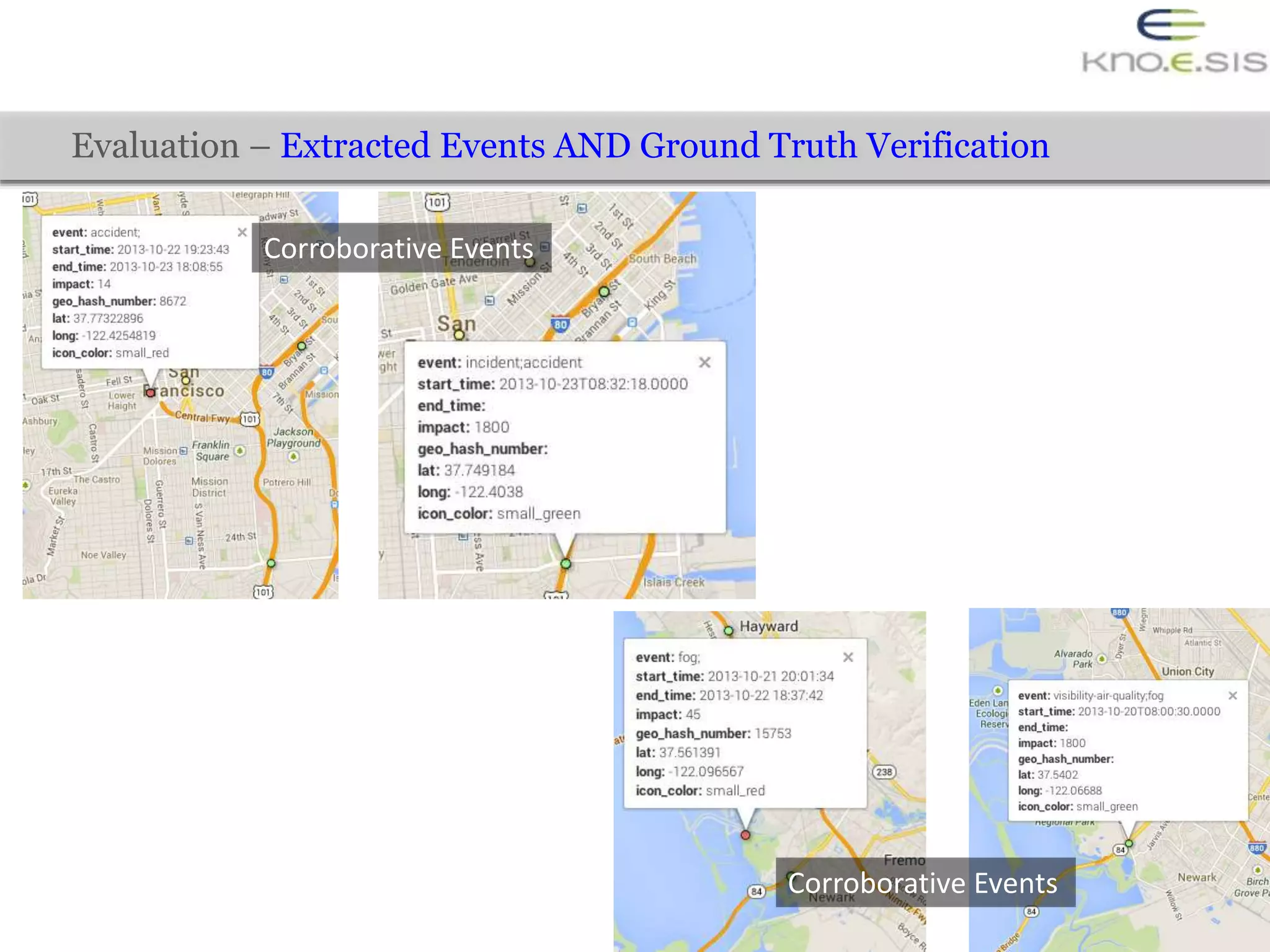
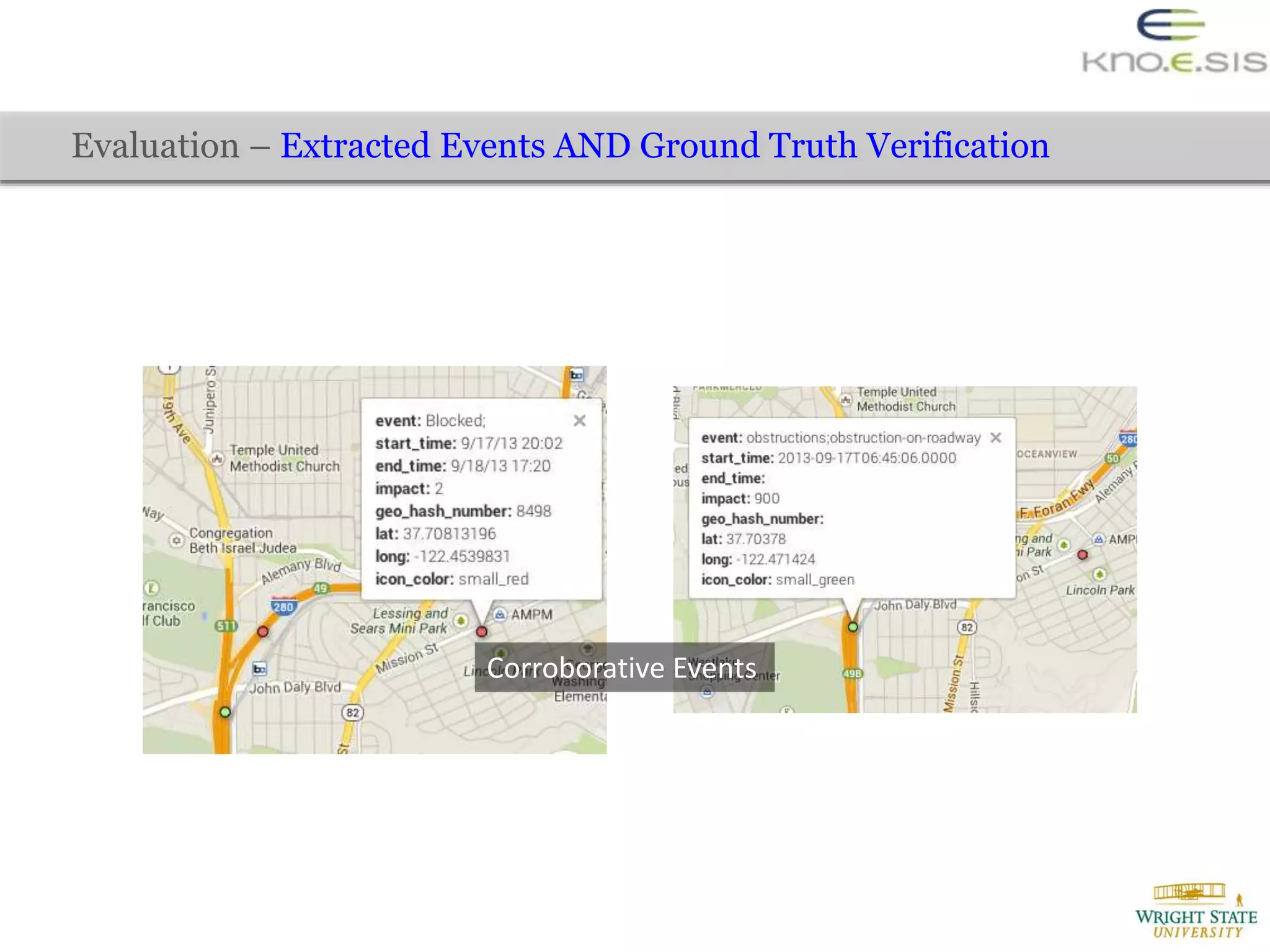
• Corroborative Events
• Additional confidence
• e.g., accident event supporting a accident report from ground truth
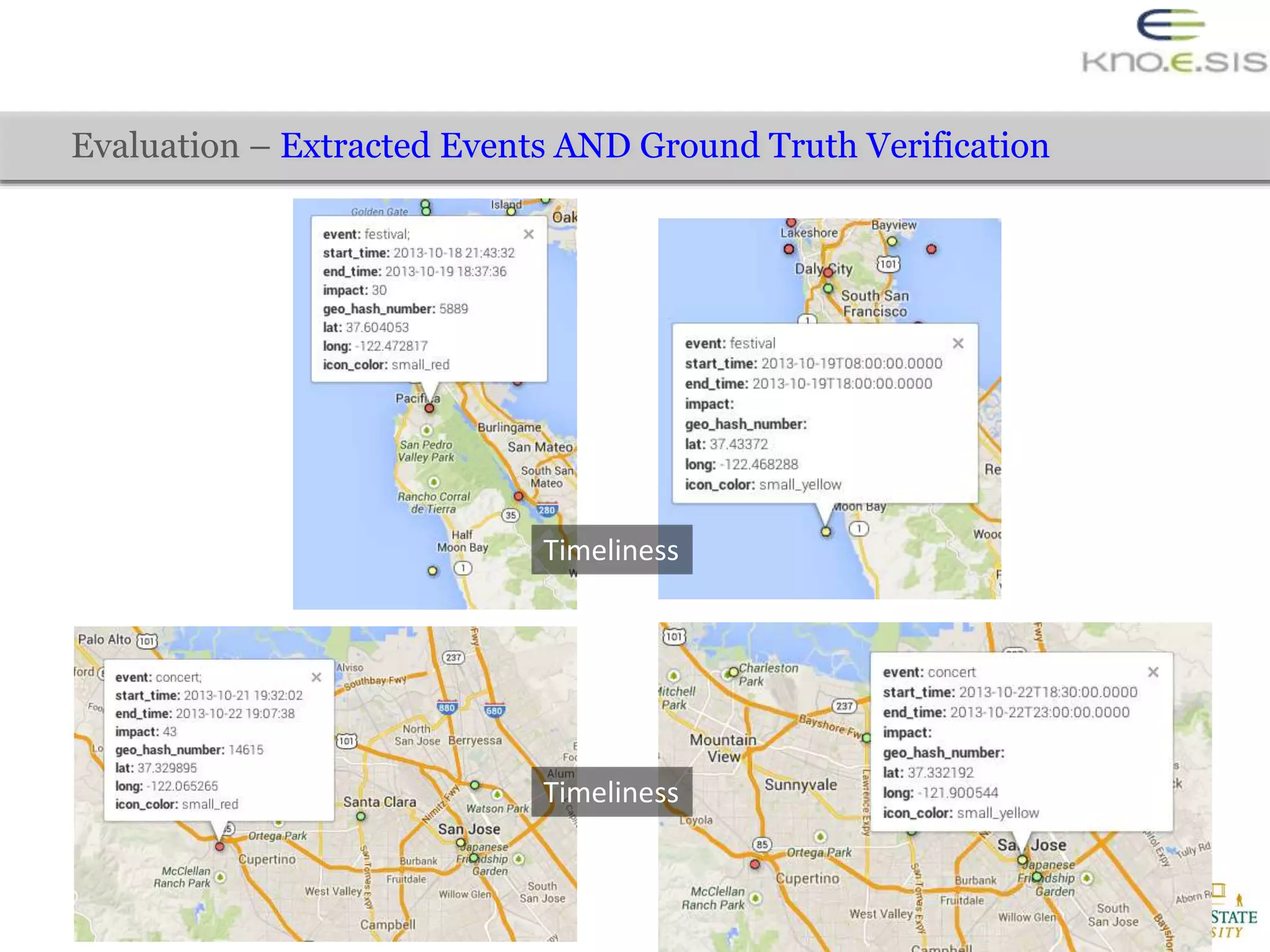
• Timeliness
• Additional insight
• e.g., knowing poor visibility before formal report from ground truth
Evaluation – Extracted Events AND Ground Truth Verification
Complementary Events
Evaluation – Extracted Events AND Ground Truth Verification
Corroborative Events
Evaluation – Extracted Events AND Ground Truth Verification
Corroborative Events
Evaluation – Extracted Events AND Ground Truth Verification
Corroborative Events Complementary Events
Evaluation – Extracted Events AND Ground Truth Verification
Timeliness
Timeliness
• People in a city indeed talk about various
infrastructure related specifically, traffic.
• City traffic related events can be extracted from
tweets using sequence labeling techniques and
spatial aggregation algorithms.
• Domain knowledge of events and locations can
be utilized to create large training datasets to
train sequence labeling algorithms.
• Traffic events extracted from twitter can be
complementary, corroborative, and timely
compared to formal reports of traffic events.
Conclusion
[Kumaran and Allan 2004] Giridhar Kumaran and James Allan. 2004. Text classification and named entities for new
event detection. In Proceedings of the 27th annual international ACM SIGIR conference on Research and development
in information retrieval. ACM, 297–304.
[Lampos and Cristianini 2012] Vasileios Lampos and Nello Cristianini. 2012. Nowcasting events from the social web with
statistical learn- ing. ACM Transactions on Intelligent Systems and Technology (TIST) 3, 4 (2012), 72.
[Roitman et al. 2012] Haggai Roitman, Jonathan Mamou, Sameep Mehta, Aharon Satt, and LV Subramaniam. 2012.
Harnessing the Crowds for smart city sensing. In Proceedings of the 1st international workshop on Multimodal crowd
sensing. ACM, 17–18.
[Ritter et al. 2012] Alan Ritter, Oren Etzioni, Sam Clark, and others. 2012. Open domain event extraction from twitter. In
Proceedings of the 18th ACM SIGKDD international conference on Knowledge discovery and data mining. ACM, 1104–
1112.
[Wang et al. 2012] Xiaofeng Wang, Matthew S Gerber, and Donald E Brown. 2012. Automatic crime prediction using
events extracted from twitter posts. In Social Computing, Behavioral-Cultural Modeling and Prediction. Springer, 231–
238.
[Becker et al. 2011] Hila Becker, Mor Naaman, and Luis Gravano. 2011. Beyond Trending Topics: Real-World Event
Identification on Twitter.. In ICWSM.
[Alias-i 2008] Alias-i. 2008. LingPipe 4.1.0. (2008). http://alias-i.com/lingpipe
[Commentz-Walter 1979] Beate Commentz-Walter. 1979. A string matching algorithm fast on the average. Springer.
References

Extracting City Traffic Events from Social Streams

  • 1.
    Extracting City Eventsfrom Social Streams Pramod Anantharam Kno.e.sis – Ohio Center of Excellence in Knowledge-enabled Computing Wright State University, Dayton, Ohio, USA http://www.ict-citypulse.eu/page/ Collaborator: Dr. Payam Barnaghi Advisors: Prof. Amit Sheth, Prof. Krishnaprasad Thirunarayan Pramod Anantharam, Payam Barnaghi, Krishnaprasad Thirunarayan, and Amit Sheth. 2015. Extracting City Traffic Events from Social Streams. ACM Trans. Intell. Syst. Technol. 6, 4, Article 43 (July 2015), 27 pages. DOI=10.1145/2717317 http://doi.acm.org/10.1145/2717317 http://wiki.knoesis.org/index.php/Citypulse
  • 2.
    A Historical Perspectiveon Cities and its Inhabitants “kings, emperors and other rulers benefited from being on the front lines with their people when it came to making decisions.”1 1http://gicoaches.com/what-we-can-learn-from-kings-of-the-past-who-disguised-themselves-as-ordinary-men/ http://en.wikipedia.org/wiki/Qianlong_Emperor Qianlong Emperor (8 October 1735 – 9 February 1796) Qing Dynasty (1644–1912) Disguised as a commoner, Qianlong visited cities to understand a common man’s life This is popularly known as “Management by Walking Around” since the 1980’s
  • 3.
    A Modern Perspectiveon Cities and its Inhabitants City authorities, government and other humanitarian agencies are benefited from being on the front lines with their people when it comes to making decisions. We want to be connected to citizens to understand and prioritize decisions
  • 4.
    Image credit: http://www-03.ibm.com/software/products/us/en/intelligent-operations-center Imagecredit: http://www.ibm.com/smarterplanet/us/en/smarter_cities/overview/index.html Life in a City
  • 5.
    Image credit: http://www.ibm.com/smarterplanet/us/en/smarter_cities/overview/index.html PublicSafety Urban planning Gov. & agency admin. Energy & water Environmental Transportation Social Programs Healthcare Education Pulse of a City (CityPulse)
  • 6.
    What are PeopleTalking About City Infrastructure on Twitter?
  • 7.
    • What arepeople talking about city infrastructure on twitter? • How do we extract city infrastructure related events from twitter? • How can we leverage event and location knowledge bases for event extraction? • How well can we extract city events? Research Questions
  • 8.
    Some Challenges inExtracting Events from Tweets • No well accepted definition of ‘events related to a city’ • Tweets are short (140 characters) and its informal nature make it hard to analyze – Entity, location, time, and type of an event • Multiple reports of the same event and sparse report of some events (biased sample) – Numbers don’t necessarily indicate intensity • Validation of the solution is hard due to the open domain nature of the problem
  • 9.
    Formal Text InformalText Closed Domain Open Domain [Roitman et al. 2012][Kumaran and Allan 2004] [Lampos and Cristianini 2012] [Becker et al. 2011] [Wang et al. 2012] [Ritter et al. 2012] Related Work on Event Extraction
  • 10.
    • N-grams +Regression – Text analysis to extract uni- and bi-grams (event markers) – Feature selection to select best possible event markers – Apply regression to estimate conditional probability P(Y|X) to enable prediction where Y is the target (e.g., rainfall) and X is the input (e.g., traffic jam event). • Clustering – Create event clusters incrementally over time – Identify clusters of interest based on its relevance (manual inspection) – Granularity remains at the tweet/cluster level (tweets are assigned to clusters of interest) • Sequence Labeling (CRFs) – Text analysis to extract features such as named entities, POS1 tagging – Each event indicator is modeled as a mixture of event types that are latent variables – Each type corresponds to a distribution over named entities n (labels assigned to event types by manual inspection) and other features Event Extraction -- Techniques 1Part Of Speech
  • 11.
    • Event extractionshould be open domain (no a priori event types) preferably with event metadata (e.g., event duration, impact). • Incorporate background knowledge related to city events e.g., 511.org hierarchy, SCRIBE ontology, city location names. • Assess the intensity of an event using content and network cues. • Be robust w.r.t. to noise, informal nature, and variability of data. City Event Extraction -- Desiderata
  • 12.
    • N-grams +Regression – Open domain: works best when there is a reference corpus to extract n-grams – Event metadata: cannot distinguish between entities and hence hard to extract event metadata – Background knowledge: incorporating domain vocabulary (e.g., subsumption) is not natural – Event intensity: regression maps the event indicators to some quantified values – Robustness: quite robust if there is a reference corpus Techniques -- Desiderata
  • 13.
    • Clustering – Opendomain: works well for domains with no a priori knowledge of events (may need human inspection) – Event metadata: too coarse grained (document level) and event metadata extraction is not natural – Background knowledge: incorporating domain vocabulary is not natural – Event intensity: not captured – Robustness: quite robust for twitter data with enough data for each cluster Techniques -- Desiderata
  • 14.
    • Sequence Labeling(CRFs) – Open domain: works well for domains with no a priori knowledge of events (may need human inspection) – Event metadata: event metadata extraction is captured naturally with the named entities – Background knowledge: incorporating domain vocabulary is quite natural – Event intensity: part-of-speech tag may indirectly capture intensity – Robustness: with a deeper model for capturing context, quite robust for twitter data Techniques -- Desiderata
  • 15.
    City Infrastructure Tweets froma city POS Tagging Hybrid NER+ Event term extraction Geohashing Temporal Estimation Impact Assessment Event Aggregation OSM Locations SCRIBE ontology 511.org hierarchy City Event Extraction City Event Extraction Solution Architecture City Event Annotation
  • 16.
    tag 1 tag 2 tag 3 token 1 token 2 token 3 Φ1 1(tag1,tag2) Φ1 2(tag2,tag3) Φ2 1(tag1,token1) Φ2 2(tag2,token2)Φ2 3(tag3, token3) t1 t2 T1 T2 T3 Training data with tokens and tags A General CRF Model Regression Based Implementation of CRF Model t2 t2 T4 T5 T6 t3 t1 City Event Annotation – CRF Formalization The global normalization distinguishes CRFs from other models allowing for factoring in long distance dependencies
  • 17.
    City Event Annotation– CRF Annotation Examples Last O night O in O CA... O (@ O Half B-LOCATION Moon I-LOCATION Bay B-LOCATION Brewing I-LOCATION Company O w/ O 8 O others) O http://t.co/w0eGEJjApY O #Manteca O accident. B-EVENT two O lanes O blocked B-EVENT on O Hwy O 99 O NB O at O Austin O Rd O #traffic O http://t.co/YehsHpD7aC O #Fontana O accident. B-EVENT three O lanes O blocked B-EVENT on O I-10 O WB O between O Cherry B-LOCATION Ave I-LOCATION and O Etiwanda O Ave O in O #Ontario O #LAtraffic O http://t.co/e2e6MW3d78 O B-LOCATION I-LOCATION B-EVENT I-EVENT O Tags used in our approach:
  • 18.
    a) Space: eventsreported within a grid (gi ∈G where G is a set of all grids in a city)at a certain time are most likely reporting the same event b) Time: events reported within a time ∆t in a grid gi are most likely to be reporting the same event c) Theme: events with similar entities within a grid gi and time ∆t are most likely reporting the same event City Event Extraction -- Key Insights We will utilize these principles in the event aggregation algorithm
  • 19.
    0.6 miles Max-lat Min-lat Min-long Max-long 0.38 miles 37.7545166015625,-122.40966796875 37.7490234375, -122.40966796875 37.7545166015625, -122.420654296875 37.7490234375, -122.420654296875 4 37.74933, -122.4106711 Hierarchical spatial structure of geohash for representing locations with variable precision. Here the location string is 5H34 0 1 2 3 4 5 6 7 8 9 B C D E F G H I J K L 0 1 7 2 3 4 5 6 8 9 0 1 2 3 4 5 6 7 0 1 2 3 4 5 6 7 8 City Event Extraction – Geohashing
  • 20.
    City Event Extraction– Metadata Population Algorithm
  • 21.
    City Event Extraction –Event Aggregation Algorithm Event metadata inference Spatial filtering Grouping Events by types
  • 22.
    • <traffic, 5889,2013-10-22 19:24:39, 2013-10-23 18:54:08, 19> • <concert, 5889, 2013-10-20 19:46:06, 2013-10-21 19:06:29, 35> • <accident, 32400, 2013-10-20 19:51:10, 2013-10-21 15:53:08, 11> • <parade, 8672, 2013-08-10 12:57:17, 2013-08-10 18:57:21, 11> City Event Extraction – A Sample of Extracted Events Location refers to the geohash number which is mapped to lat-long
  • 23.
    • City EventAnnotation – Automated creation of training data – Annotation task (our CRF model vs. baseline CRF model) • City Event Extraction – Use aggregation algorithm for event extraction – Extracted events AND ground truth • Dataset (Aug – Nov 2013) ~ 8 GB of data on disk – Over 8 million tweets (extract events using Alg. 1 and 2) – Over 162 million sensor data points (find delays by looking at change in travel time for links serving as ground truth) – 311 active events and 170 scheduled events (readily available events as ground truth) Evaluation
  • 24.
    Evaluation – AutomatedCreation of Training Data (to train CRF model) Evaluation over 500 randomly chosen tweets from around 8,000 annotated tweets Aho-Corasick [Commentz-Walter 1979] string matching algorithm implemented by LingPipe [Alias-i 2008]
  • 25.
    Evaluation – AnnotationTask (our CRF model vs. baseline CRF model) Baseline CRF Model Our CRF Model Baseline CRF model (trained on a huge manually created data) works well on generic tasks. Our CRF model trained on automatically generated training data performs on par with the baseline. Our CRF model does better on the event extraction task due to the availability of event related knowledge
  • 26.
    Ground Truth Data(only incident reports) -- City Event Extraction We have around 162 million data records from sensors monitoring over 3,700 links in San Franciso Bay Area <link_id, link_speed, link_volume, link_travel_time,time_stamp>  a data record GREEN – Active Events YELLOW – Scheduled Events 311 active events and 170 scheduled events
  • 27.
    Evaluation – UseAggregation Algorithm for Event Extraction
  • 28.
    Evaluation – ExtractedEvents AND Ground Truth Verification Evaluation Metric For Comparing Events with Ground Truth: • Complementary Events • Additional information • e.g., slow traffic from sensor data and accident from textual data • Corroborative Events • Additional confidence • e.g., accident event supporting a accident report from ground truth • Timeliness • Additional insight • e.g., knowing poor visibility before formal report from ground truth
  • 29.
    Evaluation – ExtractedEvents AND Ground Truth Verification Complementary Events Complementary Events
  • 30.
    Evaluation – ExtractedEvents AND Ground Truth Verification Corroborative Events Corroborative Events
  • 31.
    Evaluation – ExtractedEvents AND Ground Truth Verification Corroborative Events
  • 32.
    Evaluation – ExtractedEvents AND Ground Truth Verification Corroborative Events Complementary Events
  • 33.
    Evaluation – ExtractedEvents AND Ground Truth Verification Timeliness Timeliness
  • 34.
    • People ina city indeed talk about various infrastructure related specifically, traffic. • City traffic related events can be extracted from tweets using sequence labeling techniques and spatial aggregation algorithms. • Domain knowledge of events and locations can be utilized to create large training datasets to train sequence labeling algorithms. • Traffic events extracted from twitter can be complementary, corroborative, and timely compared to formal reports of traffic events. Conclusion
  • 35.
    [Kumaran and Allan2004] Giridhar Kumaran and James Allan. 2004. Text classification and named entities for new event detection. In Proceedings of the 27th annual international ACM SIGIR conference on Research and development in information retrieval. ACM, 297–304. [Lampos and Cristianini 2012] Vasileios Lampos and Nello Cristianini. 2012. Nowcasting events from the social web with statistical learn- ing. ACM Transactions on Intelligent Systems and Technology (TIST) 3, 4 (2012), 72. [Roitman et al. 2012] Haggai Roitman, Jonathan Mamou, Sameep Mehta, Aharon Satt, and LV Subramaniam. 2012. Harnessing the Crowds for smart city sensing. In Proceedings of the 1st international workshop on Multimodal crowd sensing. ACM, 17–18. [Ritter et al. 2012] Alan Ritter, Oren Etzioni, Sam Clark, and others. 2012. Open domain event extraction from twitter. In Proceedings of the 18th ACM SIGKDD international conference on Knowledge discovery and data mining. ACM, 1104– 1112. [Wang et al. 2012] Xiaofeng Wang, Matthew S Gerber, and Donald E Brown. 2012. Automatic crime prediction using events extracted from twitter posts. In Social Computing, Behavioral-Cultural Modeling and Prediction. Springer, 231– 238. [Becker et al. 2011] Hila Becker, Mor Naaman, and Luis Gravano. 2011. Beyond Trending Topics: Real-World Event Identification on Twitter.. In ICWSM. [Alias-i 2008] Alias-i. 2008. LingPipe 4.1.0. (2008). http://alias-i.com/lingpipe [Commentz-Walter 1979] Beate Commentz-Walter. 1979. A string matching algorithm fast on the average. Springer. References

Editor's Notes

  • #2 Note Citizen Centered Smart City Understanding Events in a City from Twitter Streams – hope this will be my direction
  • #3 Citizens are central to a city, country or in the past kingdom Since the beginning of civilizations (or settlements) around 8000 BC, people have moved toward living in ‘cities’ Kings and emperors realized the importance of understanding citizen moods, sentiments, and opinions in making decisions Qianlong emperor is one such example Concept applies to even today!
  • #4 - Connection to people is the key! We always want to hear citizens talk about both good and bad in a city - Good will help us know what works and bad will help us prioritize and work toward making it better Social media such as twitter, FB, myspace, and many others gives direct access to what citizens think about a city Best way to tap into the problems and challenges citizens face in a city
  • #5 - Citizens need following services to help lead a healthy and prosperous life in a city
  • #6 Data gathered in a city by various departments Citizens reporting their observations of city infrastructure You may ask do citizens really talk about city infrastructure?
  • #7 Twitter as a source of real-time information There are over 200 million users generating 500 million tweets / day Twitter as a source of events in a city Citizens use twitter to express their concerns of city infrastructure that impacts their life
  • #9 There are some knowledge bases from IBM Smart Planet initiative that can help us for city events
  • #10 [Kumaran and Allan 2004] - event detection from news articles using a combination of classification and NER techniques [Lampos and Cristianini 2012] – they estimated rainfall in London using tweets & compare it with actual rainfall, influenza like illness and compare it with Health Protection Agency [Roitman et al. 2012] – interesting piece of work on harnessing the cowd for city sensing, sensor fusion [Ritter et al. 2012] – open domain event extraction from twitter (general events such as product release, TV shows, movie release) [Wang et al. 2012] – predicts crime using a prediction model built by associating topics in tweets to ground truth data [Becker et al. 2011] – distuinges between real-world events vs. Non-events tweets using clustering
  • #11 Classification is another method – but it is not feasible for the open domain problem we are interested in. CRFs – Conditional Random Fields Sequence Labeling Consider deeper features such as named entities, POS tags Captures context of mention of entities within a tweet Allows natural incorporation of domain knowledge
  • #12 Intensity vs. density => tweets, page-rank analogous to importance of event, importance of events Importance of event based on location + time Contrasting density Noise Flood - people affected vs. people conversing
  • #13 N-grams + Regression No direct way to extract event metadata extraction May need reference corpus for creating n-grams Needs good quality tweets if no reference corpus
  • #14 Clustering Does not capture event metadata Too coarse grained (tweet level) May not be able to identify location, time etc.
  • #17 CRF assigns a tag to each token Global normalization is the argmax term RHS is just a regression based implementation of linear chain (potentials defined only over adjacent tags) CRF LingPipe implementation of CRF is used in our experiments
  • #19 localized event detection strategy, city a composition of smaller geographical units We call these geographical units as grids Geohash provides us a way of compartmentalizing a city into uniquely addressable grids
  • #20 Distance computed using the formula: dlon = lon2 - lon1 dlat = lat2 - lat1 a = (sin(dlat/2))^2 + cos(lat1) * cos(lat2) * (sin(dlon/2))^2 c = 2 * atan2( sqrt(a), sqrt(1-a) ) d = R * c (where R is the radius of the Earth) Found the box for the tweet! 37.7545166015625, -122.420654296875 37.7545166015625, -122.40966796875 37.7490234375, -122.40966796875 37.7490234375, -122.420654296875
  • #24 Infer delays – we have sensor data including speed of vehicles and travel time. We will use this data for verifying the events we have extracted. We look for change (reduction/increase) in travel time for all the links in the vicinity of the event (we will vary the radius from 0.5 miles to 2 miles)
  • #25 [Alias-i 2008] Alias-i. 2008. LingPipe 4.1.0. (2008). http://alias-i.com/lingpipe [Commentz-Walter 1979] Beate Commentz-Walter. 1979. A string matching algorithm fast on the average. Springer. - The only place this annotation suffered is the I-EVENT since this is a stateless model
  • #34 The record of 511.org may have its own timestamp which may be before tweets