AGRIPOLICY
Introduction to Agricultural Policy and
Development
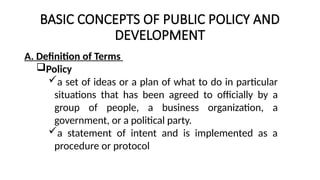
BASIC CONCEPTS OF PUBLIC POLICY AND
DEVELOPMENT
A. Definition of Terms
Policy
a set of ideas or a plan of what to do in particular
situations that has been agreed to officially by a
group of people, a business organization, a
government, or a political party.
a statement of intent and is implemented as a
procedure or protocol
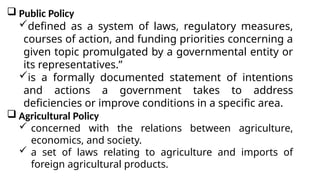
 Public Policy
defined as a system of laws, regulatory measures,
courses of action, and funding priorities concerning a
given topic promulgated by a governmental entity or
its representatives.”
is a formally documented statement of intentions
and actions a government takes to address
deficiencies or improve conditions in a specific area.
 Agricultural Policy
 concerned with the relations between agriculture,
economics, and society.
 a set of laws relating to agriculture and imports of
foreign agricultural products.

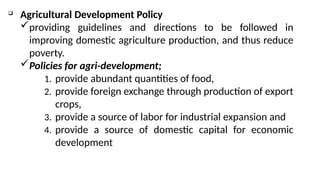
Agricultural Development Policy
providing guidelines and directions to be followed in
improving domestic agriculture production, and thus reduce
poverty.
Policies for agri-development;
1. provide abundant quantities of food,
2. provide foreign exchange through production of export
crops,
3. provide a source of labor for industrial expansion and
4. provide a source of domestic capital for economic
development
Sustainable Development
development that meets the needs of the
present without compromising the ability of
future generations to meet their own needs.
 Economic Development
programs, policies or activities that seek to
improve the economic well-being and quality of
life for a community.
What are some examples of Sustainable Development?
• Wind Energy
• People have utilized the power of the wind for
millennia, dating back to the first recorded windmill
in Persia between 500 and 900 AD. Fast forward to
the 21st century and, in many localities, energy
generated by wind power has become either
competitive with or less expensive than coal-
generated electricity.
What are some examples of Sustainable Development?
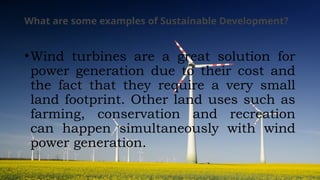
•Wind turbines are a great solution for
power generation due to their cost and
the fact that they require a very small
land footprint. Other land uses such as
farming, conservation and recreation
can happen simultaneously with wind
power generation.
What are some examples of Sustainable Development?
• Solar Energy
• From roof-top solar panels to massive solar farms that
can attain the same generating capacity as a
conventional power plant, it is clear that there is a
renewable energy revolution happening in the world —
and it is powered by the sun.
• A solar farm can reduce 94% of the emissions that a
coal power plant emits. It also eliminates noxious
pollutants like sulphur nitrous oxides and mercury
which are major contributors to the air pollution
responsible for millions of premature deaths every year.
What are some examples of Sustainable
Development?
• Crop Rotation
• Currently we produce the bulk of our food through
industrial agriculture. A system which relies on large farms
that monocrop and use enormous amounts of fertilizer and
chemical pesticides. Industrial agriculture is immensely
damaging to soils, water, air and the climate.
• Crop rotation, in contrast, is defined as “the successive
planting of different crops on the same land to improve soil
fertility and help control insects and diseases.” This way of
farming is not a new practice, but rather a more ancient
way of farming chemical-free, whilst maximizing the long-
term growth potential of land.
What are some examples of Sustainable Development?
• Water efficient fixtures
• Many countries in the world are becoming water stressed
and we are beginning to understand that water is not as
unlimited as we once believed. In most buildings around
the world, essential water usage such as showering,
washing hands and sewage conveyance is unavoidable.
• However, the amount of water used for these essential
services can be drastically reduced by more than 50%
with the use of water-saving fittings and fixtures. Some
examples of water-efficient fixtures include: low-flow taps
and shower heads, dual flush toilets and toilet stops.
What are some examples of
Sustainable Development?
• Green Spaces
• Green spaces such as parks, wetlands, lakes, forests or
other eco systems are fundamental to sustainably
developed urban areas. These areas are essential for
cooling cities while trees produce oxygen and filter out air
pollution.
• Well-designed green spaces also play a critical role in
providing safer routes for those commuting by foot or
bicycle and providing safer spaces for physical activity
and recreation.
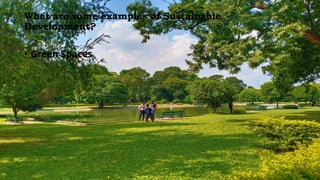
What are some examples of Sustainable
Development?
• Green Spaces
Introduction
• Governments have influenced agriculture directly through the
following mechanisms; health regulation programs; price support laws
and production controls; and the collection and distribution of
agricultural statistics.
• In addition to the general policies of the nation as a whole, agriculture
is specifically affected by inflation, unemployment, and foreign policy.
• Agricultural policy describes a set of laws relating to domestic
agriculture and imports of foreign agricultural products.
• Governments usually implement agricultural policies with the goal of
achieving a specific outcome in the domestic agricultural product
markets.
• Outcomes can involve, for example, a guaranteed supply level, price
stability, product quality, product selection, land use or employment.
•Agricultural policy outlines the steps that will
be taken to reach certain goals in the food and
fibre economy.
•Typically such policies affect the resources,
production, and markets related to agricultural
products and services.
•They often are concerned with the safety,
consumption, and nutritional value of food.
Agricultural policy like most national-level
policies is influenced by economic, foreign, and
environmental policies and considerations.
• Goals of agricultural policy
Maintaining a profitable, viable, efficient, and environmentally
safe agricultural production sector capable of meeting demands
for food and fibre while providing satisfactory incomes to
producers for use of their land, labour, capital, and
management.
Providing for an efficient, profitable, and dynamic agribusiness
sector, including input suppliers and agricultural output
sector.
Providing consumers with an abundant, varied and safe supply
of food and fibre at the lowest possible cost consistent
Operating a food and fibre economy within the framework of a
democratic society, relying on the free market system as much
as possible consistent with other goals.
Maintaining and enhancing the competitiveness of the
country’s agricultural product in the global market.
B. PROBLEM ARISING FROM AGRICULTURAL PRODUCTION
1. Role of Agriculture in Economic Development
Agriculture plays a significant role in the Philippine economy.
Involving about 40 percent of Filipino workers, it contributes
an average of 20% to the Gross Domestic Product.
This output comes mainly from agribusiness, which in turn
accounts for about 70% of the total agricultural output
The main agricultural enterprise is crop cultivation
Others are chicken broiler production, including operation of
chicken hatcheries (20.4%). Agricultural services (19.8%), and
hog farming (18.4%), (NSO,2002).
B. PROBLEM ARISING FROM
AGRICULTURAL PRODUCTION
1.Low Productivity: Philippine agriculture has
relatively low yields compared to other countries,
due to factors like small farm sizes, outdated
farming techniques, poor infrastructure, and lack
of access to modern inputs and technologies.
2.Limited Crop Diversity: Philippine agriculture is
highly dependent on a few staple crops like rice
and corn, leaving it vulnerable to price
fluctuations and climate-related shocks that affect
those crops.
B. PROBLEM ARISING FROM AGRICULTURAL PRODUCTION
3. Inadequate Irrigation: Only around 60% of agricultural
land in the Philippines is irrigated, limiting crop yields
and making farmers more susceptible to droughts.
4. Lack of Farm Mechanization: Many Filipino farmers
still rely on manual labor and basic tools, reducing
efficiency and productivity.
5. Land Tenure Issues: Insecure land tenure and lack of
access to arable land is a major challenge, especially for
smallholder farmers.
B. PROBLEM ARISING FROM AGRICULTURAL PRODUCTION
6. Climate Change Impacts: The Philippines is highly
vulnerable to extreme weather events like typhoons,
droughts, and flooding, which can devastate agricultural
production.
7. Insufficient Farm-to-Market Infrastructure: Poor roads,
storage facilities, and post-harvest handling practices
lead to high levels of crop loss and wastage.
8. Limited Access to Credit and Farm Inputs: Many
farmers have difficulty obtaining affordable loans,
fertilizers, seeds, and other necessary inputs.
The general trends in the last two decades present a dim
picture of the agriculture sector. Significant decrease in
productivity, high production costs, and low government
support to the sector, among other things, have led to a
crisis in Philippine agriculture (CIDA-LGSP, 2003).
Agricultural development is one of the most powerful
tools to end extreme poverty, boost shared prosperity,
and feed a projected 9.7 billion people by 2050. Growth
in the agriculture sector is two to four times more
effective in raising incomes among the poorest compared
to other sectors.
Agriculture is also crucial to economic growth:
accounting for 4% of global gross domestic product
(GDP) and in some least developing countries, it can
account for more than 25% of GDP.
agricultural growth and poverty reduction
• to reduce extreme poverty is next to impossible
except where agricultural productivity increases and
incomes increase for poor farmers.
Was agriculture more important than other sources
of income in reducing poverty?
Agriculture dominates non-agricultural activities by
its potential to reduce poverty, whether the
comparison is within or between countries. More than
half of the reduction in poverty achieved in the
selected countries during the years under study can
be attributed to growth in agricultural incomes.
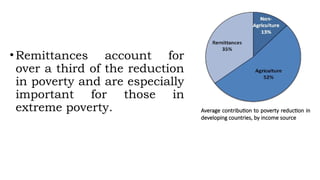
•Remittances account for
over a third of the reduction
in poverty and are especially
important for those in
extreme poverty. Average contribution to poverty reduction in
developing countries, by income source
Were the countries making rapid progress in
reducing poverty similar in other ways?
• Per capita incomes grew robustly for all countries in the
study
• Macroeconomic stability increased for most countries
• Primary school completion rates increased in all countries,
remarkably so in Ghana, Mali, Nicaragua, Egypt and Tunisia
• Scores on the United Nations Human Development Index - an
indicator combining scores on per capita income, education
and health - were improved
• Land reforms took place in some of the countries, most
notably in Vietnam
2. The Interrelationship of Agriculture, Development
and Environment

A key challenge for the agriculture sector is to feed an
increasing global population, while at the same time
reducing the environmental impact and preserving
natural resources for future generations.

Agriculture can have significant impacts on the
environment. While negative impacts are serious, and can
include pollution and degradation of soil, water, and air,
agriculture can also positively impact the environment,
for instance by trapping greenhouse gases within crops
and soils, or mitigating flood risks through the adoption
of certain farming practices.
3. CRITICAL ISSUES THAT NEED TO BE ADDRESSED

These include trade and export development, agri-
industrial business corridors, youth engagement in
agriculture, easy and affordable access of farmers
and fishers to agri financing, private sector
participation in agriculture as ‘big brothers,’
mechanization and infrastructure investments, and
agriculture digitalization, among others.

The main problems facing agriculture are usually
land-related. Loss of viable land, erosion, and other
factors decrease the ability of farmers to use land.
Other factors include inflation and government
restrictions.
MAJOR AGRICULTURAL PROBLEMS
1. Small farm size; 78 percent farms are less than 3 hectares. –
Farms have shrunk due to rapid population increase. More
houses are built at the expense of agriculture. Arguably, the
land reform program was seen to address this concern but with
limited or no success.
2. Land Conversions. Almost the same as the first one.
Additionally, urban landscape and land uses have been re-
defined that even agricultural areas are now part of the so called
Metropolis.
3. Lack or absence irrigation systems. Irrigation is one of the
most if not, the most important factor in agriculture. The
worsening climate change impact necessitates irrigation and its
appropriate engineering and technology must be put in place in
order to make agriculture productive.
4. Inadequate management programs on soil, pests
and diseases. Impact of climate change invites
infestations as studies have shown. Without adequate
research and funding for this purpose famines might not
be far at hand.
5. Reduced farm labor. Industrialization and
modernization detached from agriculture alienates many
of the Filipinos especially the rural youth. While this is a
global phenomenon other countries cope to this major
gap in their labor force but not the Philippines.
6. Expensive and inappropriate agricultural and
farming equipment. The ARB’s and the Filipino farmers
can only hope for the services and farm assistance from
the government. Acquisition of advanced and modern
7. Climate change and natural disasters. Philippines is
officially identified as one of the top 20 countries prone to
natural calamities notwithstanding the dramatic decrease of
forest covers, dead water tributaries caused largely human
activities.
8. Inadequate technology transfer mechanisms. Our
technology regarding agriculture is not given enough
attention. Our country lacks machinery and technology to
improve our produce. We lag behind compared to South
East Asian neighbors.
“Among the problems enumerated climate change and natural
disasters are inevitable”
Three key challenges facing agriculture
• Current challenges facing the global food system
The global food system is expected to provide safe and nutritious food
to a population that will likely grow from 7.5 billion people today, to
nearly 10 billion by 2050. Not only will there be more mouths to feed,
but
as incomes grow in emerging and developing economies, so too will the
demand for meat, fish, and dairy
.
The global food system also has a large environmental footprint. In
fact, agriculture occupies nearly 40% of the earth’s surface, far more
than any other human activity. In addition,
irrigation of agricultural crops comprises 70% of global water use, and
agriculture directly contributes to around 11% of global greenhouse ga
s (GHG) emissions
(mostly through cattle). Expanding agricultural land can also lead to
deforestation, additional GHG emissions, and a loss of biodiversity.
• Setting the table to address the triple challenge
These three challenges – feeding a growing population,
providing a livelihood for farmers, and protecting the
environment – must be tackled together if we are to make
sustainable progress in any of them. But making progress on
this “triple challenge” is difficult, as initiatives in one
domain can have unintended consequences in another.
• Future policies may require new recipes
good meal is a balanced meal, good policies will need to strike a
balance between the different objectives of the triple challenge facing
the global food system today. And just like a good meal depends not
only on the chef, but also on the quality of the ingredients – so too
will good policies depend not only on the policy maker, but also on
the input from many stakeholders.
Development Perspectives in agriculture
1. IRRI and IPAC
The International Rice Research Institute (IRRI), for example, has
developed a rice variety that can survive natural disasters,
especially floods.
The Philipinnes government is also working towards agricultural
development by implementing the
Inclusive Partnerships for Agricultural Competitiveness (IPAC)
Project. Funded partially by the World Bank, the project works on
expanding the capacity of small farmers to make a living.
Through commercial agriculture and improved infrastructure,
small-holder farmers can increase their incomes and slowly
become more self-reliant.

Developing irrigation systems in rural farming lands
which is an important aspect of the project, makes
farming more efficient for the people of the Philippines.
The project plays an important role in reducing poverty,
with 20 percent of the beneficiaries being poor farmers.
2. IFAC Projects in the Philippines-International Federation of Accountants
(IFAC) is an international association for the accountancy profession. IFAC supports the
development, adoption, and implementation of high-quality international standards.

The International Fund for Agricultural Development (IFAD) has
funded 16 projects that aid farmers from the Philippines.

IFAD provides investment and business plans to 55,000
farming households in the poorest parts of the Philippines.
Through educating and guiding farmers, especially with the
use of sustainable farming methods, IFAD hopes to
increase their incomes and reduce poverty in the

Through the combined efforts of organizations and the
government, the issue of poverty among farmers in the
Philippines is being addressed. Still, more work needs to
be done in the field of agriculture development so that
poverty rates in the country can begin to decrease.

Chapter 1.pptx. Introduction to Agricultural Policy and Development

  • 1.
  • 2.
    BASIC CONCEPTS OFPUBLIC POLICY AND DEVELOPMENT A. Definition of Terms Policy a set of ideas or a plan of what to do in particular situations that has been agreed to officially by a group of people, a business organization, a government, or a political party. a statement of intent and is implemented as a procedure or protocol
  • 3.
     Public Policy definedas a system of laws, regulatory measures, courses of action, and funding priorities concerning a given topic promulgated by a governmental entity or its representatives.” is a formally documented statement of intentions and actions a government takes to address deficiencies or improve conditions in a specific area.  Agricultural Policy  concerned with the relations between agriculture, economics, and society.  a set of laws relating to agriculture and imports of foreign agricultural products.
  • 4.
     Agricultural Development Policy providingguidelines and directions to be followed in improving domestic agriculture production, and thus reduce poverty. Policies for agri-development; 1. provide abundant quantities of food, 2. provide foreign exchange through production of export crops, 3. provide a source of labor for industrial expansion and 4. provide a source of domestic capital for economic development
  • 5.
    Sustainable Development development thatmeets the needs of the present without compromising the ability of future generations to meet their own needs.  Economic Development programs, policies or activities that seek to improve the economic well-being and quality of life for a community.
  • 6.
    What are someexamples of Sustainable Development? • Wind Energy • People have utilized the power of the wind for millennia, dating back to the first recorded windmill in Persia between 500 and 900 AD. Fast forward to the 21st century and, in many localities, energy generated by wind power has become either competitive with or less expensive than coal- generated electricity.
  • 7.
    What are someexamples of Sustainable Development? •Wind turbines are a great solution for power generation due to their cost and the fact that they require a very small land footprint. Other land uses such as farming, conservation and recreation can happen simultaneously with wind power generation.
  • 8.
    What are someexamples of Sustainable Development? • Solar Energy • From roof-top solar panels to massive solar farms that can attain the same generating capacity as a conventional power plant, it is clear that there is a renewable energy revolution happening in the world — and it is powered by the sun. • A solar farm can reduce 94% of the emissions that a coal power plant emits. It also eliminates noxious pollutants like sulphur nitrous oxides and mercury which are major contributors to the air pollution responsible for millions of premature deaths every year.
  • 9.
    What are someexamples of Sustainable Development? • Crop Rotation • Currently we produce the bulk of our food through industrial agriculture. A system which relies on large farms that monocrop and use enormous amounts of fertilizer and chemical pesticides. Industrial agriculture is immensely damaging to soils, water, air and the climate. • Crop rotation, in contrast, is defined as “the successive planting of different crops on the same land to improve soil fertility and help control insects and diseases.” This way of farming is not a new practice, but rather a more ancient way of farming chemical-free, whilst maximizing the long- term growth potential of land.
  • 10.
    What are someexamples of Sustainable Development? • Water efficient fixtures • Many countries in the world are becoming water stressed and we are beginning to understand that water is not as unlimited as we once believed. In most buildings around the world, essential water usage such as showering, washing hands and sewage conveyance is unavoidable. • However, the amount of water used for these essential services can be drastically reduced by more than 50% with the use of water-saving fittings and fixtures. Some examples of water-efficient fixtures include: low-flow taps and shower heads, dual flush toilets and toilet stops.
  • 11.
    What are someexamples of Sustainable Development? • Green Spaces • Green spaces such as parks, wetlands, lakes, forests or other eco systems are fundamental to sustainably developed urban areas. These areas are essential for cooling cities while trees produce oxygen and filter out air pollution. • Well-designed green spaces also play a critical role in providing safer routes for those commuting by foot or bicycle and providing safer spaces for physical activity and recreation.
  • 12.
    What are someexamples of Sustainable Development? • Green Spaces
  • 13.
    Introduction • Governments haveinfluenced agriculture directly through the following mechanisms; health regulation programs; price support laws and production controls; and the collection and distribution of agricultural statistics. • In addition to the general policies of the nation as a whole, agriculture is specifically affected by inflation, unemployment, and foreign policy. • Agricultural policy describes a set of laws relating to domestic agriculture and imports of foreign agricultural products. • Governments usually implement agricultural policies with the goal of achieving a specific outcome in the domestic agricultural product markets. • Outcomes can involve, for example, a guaranteed supply level, price stability, product quality, product selection, land use or employment.
  • 14.
    •Agricultural policy outlinesthe steps that will be taken to reach certain goals in the food and fibre economy. •Typically such policies affect the resources, production, and markets related to agricultural products and services. •They often are concerned with the safety, consumption, and nutritional value of food. Agricultural policy like most national-level policies is influenced by economic, foreign, and environmental policies and considerations.
  • 15.
    • Goals ofagricultural policy Maintaining a profitable, viable, efficient, and environmentally safe agricultural production sector capable of meeting demands for food and fibre while providing satisfactory incomes to producers for use of their land, labour, capital, and management. Providing for an efficient, profitable, and dynamic agribusiness sector, including input suppliers and agricultural output sector. Providing consumers with an abundant, varied and safe supply of food and fibre at the lowest possible cost consistent Operating a food and fibre economy within the framework of a democratic society, relying on the free market system as much as possible consistent with other goals. Maintaining and enhancing the competitiveness of the country’s agricultural product in the global market.
  • 16.
    B. PROBLEM ARISINGFROM AGRICULTURAL PRODUCTION 1. Role of Agriculture in Economic Development Agriculture plays a significant role in the Philippine economy. Involving about 40 percent of Filipino workers, it contributes an average of 20% to the Gross Domestic Product. This output comes mainly from agribusiness, which in turn accounts for about 70% of the total agricultural output The main agricultural enterprise is crop cultivation Others are chicken broiler production, including operation of chicken hatcheries (20.4%). Agricultural services (19.8%), and hog farming (18.4%), (NSO,2002).
  • 17.
    B. PROBLEM ARISINGFROM AGRICULTURAL PRODUCTION 1.Low Productivity: Philippine agriculture has relatively low yields compared to other countries, due to factors like small farm sizes, outdated farming techniques, poor infrastructure, and lack of access to modern inputs and technologies. 2.Limited Crop Diversity: Philippine agriculture is highly dependent on a few staple crops like rice and corn, leaving it vulnerable to price fluctuations and climate-related shocks that affect those crops.
  • 18.
    B. PROBLEM ARISINGFROM AGRICULTURAL PRODUCTION 3. Inadequate Irrigation: Only around 60% of agricultural land in the Philippines is irrigated, limiting crop yields and making farmers more susceptible to droughts. 4. Lack of Farm Mechanization: Many Filipino farmers still rely on manual labor and basic tools, reducing efficiency and productivity. 5. Land Tenure Issues: Insecure land tenure and lack of access to arable land is a major challenge, especially for smallholder farmers.
  • 19.
    B. PROBLEM ARISINGFROM AGRICULTURAL PRODUCTION 6. Climate Change Impacts: The Philippines is highly vulnerable to extreme weather events like typhoons, droughts, and flooding, which can devastate agricultural production. 7. Insufficient Farm-to-Market Infrastructure: Poor roads, storage facilities, and post-harvest handling practices lead to high levels of crop loss and wastage. 8. Limited Access to Credit and Farm Inputs: Many farmers have difficulty obtaining affordable loans, fertilizers, seeds, and other necessary inputs.
  • 20.
    The general trendsin the last two decades present a dim picture of the agriculture sector. Significant decrease in productivity, high production costs, and low government support to the sector, among other things, have led to a crisis in Philippine agriculture (CIDA-LGSP, 2003). Agricultural development is one of the most powerful tools to end extreme poverty, boost shared prosperity, and feed a projected 9.7 billion people by 2050. Growth in the agriculture sector is two to four times more effective in raising incomes among the poorest compared to other sectors. Agriculture is also crucial to economic growth: accounting for 4% of global gross domestic product (GDP) and in some least developing countries, it can account for more than 25% of GDP.
  • 21.
    agricultural growth andpoverty reduction • to reduce extreme poverty is next to impossible except where agricultural productivity increases and incomes increase for poor farmers. Was agriculture more important than other sources of income in reducing poverty? Agriculture dominates non-agricultural activities by its potential to reduce poverty, whether the comparison is within or between countries. More than half of the reduction in poverty achieved in the selected countries during the years under study can be attributed to growth in agricultural incomes.
  • 22.
    •Remittances account for overa third of the reduction in poverty and are especially important for those in extreme poverty. Average contribution to poverty reduction in developing countries, by income source
  • 23.
    Were the countriesmaking rapid progress in reducing poverty similar in other ways? • Per capita incomes grew robustly for all countries in the study • Macroeconomic stability increased for most countries • Primary school completion rates increased in all countries, remarkably so in Ghana, Mali, Nicaragua, Egypt and Tunisia • Scores on the United Nations Human Development Index - an indicator combining scores on per capita income, education and health - were improved • Land reforms took place in some of the countries, most notably in Vietnam
  • 24.
    2. The Interrelationshipof Agriculture, Development and Environment  A key challenge for the agriculture sector is to feed an increasing global population, while at the same time reducing the environmental impact and preserving natural resources for future generations.  Agriculture can have significant impacts on the environment. While negative impacts are serious, and can include pollution and degradation of soil, water, and air, agriculture can also positively impact the environment, for instance by trapping greenhouse gases within crops and soils, or mitigating flood risks through the adoption of certain farming practices.
  • 25.
    3. CRITICAL ISSUESTHAT NEED TO BE ADDRESSED  These include trade and export development, agri- industrial business corridors, youth engagement in agriculture, easy and affordable access of farmers and fishers to agri financing, private sector participation in agriculture as ‘big brothers,’ mechanization and infrastructure investments, and agriculture digitalization, among others.  The main problems facing agriculture are usually land-related. Loss of viable land, erosion, and other factors decrease the ability of farmers to use land. Other factors include inflation and government restrictions.
  • 26.
    MAJOR AGRICULTURAL PROBLEMS 1.Small farm size; 78 percent farms are less than 3 hectares. – Farms have shrunk due to rapid population increase. More houses are built at the expense of agriculture. Arguably, the land reform program was seen to address this concern but with limited or no success. 2. Land Conversions. Almost the same as the first one. Additionally, urban landscape and land uses have been re- defined that even agricultural areas are now part of the so called Metropolis. 3. Lack or absence irrigation systems. Irrigation is one of the most if not, the most important factor in agriculture. The worsening climate change impact necessitates irrigation and its appropriate engineering and technology must be put in place in order to make agriculture productive.
  • 27.
    4. Inadequate managementprograms on soil, pests and diseases. Impact of climate change invites infestations as studies have shown. Without adequate research and funding for this purpose famines might not be far at hand. 5. Reduced farm labor. Industrialization and modernization detached from agriculture alienates many of the Filipinos especially the rural youth. While this is a global phenomenon other countries cope to this major gap in their labor force but not the Philippines. 6. Expensive and inappropriate agricultural and farming equipment. The ARB’s and the Filipino farmers can only hope for the services and farm assistance from the government. Acquisition of advanced and modern
  • 28.
    7. Climate changeand natural disasters. Philippines is officially identified as one of the top 20 countries prone to natural calamities notwithstanding the dramatic decrease of forest covers, dead water tributaries caused largely human activities. 8. Inadequate technology transfer mechanisms. Our technology regarding agriculture is not given enough attention. Our country lacks machinery and technology to improve our produce. We lag behind compared to South East Asian neighbors. “Among the problems enumerated climate change and natural disasters are inevitable”
  • 29.
    Three key challengesfacing agriculture • Current challenges facing the global food system The global food system is expected to provide safe and nutritious food to a population that will likely grow from 7.5 billion people today, to nearly 10 billion by 2050. Not only will there be more mouths to feed, but as incomes grow in emerging and developing economies, so too will the demand for meat, fish, and dairy . The global food system also has a large environmental footprint. In fact, agriculture occupies nearly 40% of the earth’s surface, far more than any other human activity. In addition, irrigation of agricultural crops comprises 70% of global water use, and agriculture directly contributes to around 11% of global greenhouse ga s (GHG) emissions (mostly through cattle). Expanding agricultural land can also lead to deforestation, additional GHG emissions, and a loss of biodiversity.
  • 30.
    • Setting thetable to address the triple challenge These three challenges – feeding a growing population, providing a livelihood for farmers, and protecting the environment – must be tackled together if we are to make sustainable progress in any of them. But making progress on this “triple challenge” is difficult, as initiatives in one domain can have unintended consequences in another. • Future policies may require new recipes good meal is a balanced meal, good policies will need to strike a balance between the different objectives of the triple challenge facing the global food system today. And just like a good meal depends not only on the chef, but also on the quality of the ingredients – so too will good policies depend not only on the policy maker, but also on the input from many stakeholders.
  • 31.
    Development Perspectives inagriculture 1. IRRI and IPAC The International Rice Research Institute (IRRI), for example, has developed a rice variety that can survive natural disasters, especially floods. The Philipinnes government is also working towards agricultural development by implementing the Inclusive Partnerships for Agricultural Competitiveness (IPAC) Project. Funded partially by the World Bank, the project works on expanding the capacity of small farmers to make a living. Through commercial agriculture and improved infrastructure, small-holder farmers can increase their incomes and slowly become more self-reliant.
  • 32.
     Developing irrigation systemsin rural farming lands which is an important aspect of the project, makes farming more efficient for the people of the Philippines. The project plays an important role in reducing poverty, with 20 percent of the beneficiaries being poor farmers. 2. IFAC Projects in the Philippines-International Federation of Accountants (IFAC) is an international association for the accountancy profession. IFAC supports the development, adoption, and implementation of high-quality international standards.  The International Fund for Agricultural Development (IFAD) has funded 16 projects that aid farmers from the Philippines.  IFAD provides investment and business plans to 55,000 farming households in the poorest parts of the Philippines. Through educating and guiding farmers, especially with the use of sustainable farming methods, IFAD hopes to increase their incomes and reduce poverty in the
  • 33.
     Through the combinedefforts of organizations and the government, the issue of poverty among farmers in the Philippines is being addressed. Still, more work needs to be done in the field of agriculture development so that poverty rates in the country can begin to decrease.