
Lecture 11
EXTENSION AGENT
1- The extension agent
2- The role of the agent
3- Knowledge and personal skills
4- Public speaking
5- Report writing
Contents
The extension agent
The whole extension process is dependent upon the
extension agent, who is the critical element in all
extension activities. .
the effectiveness of the extension agent can often
determine the success or failure of an extension
program.
The extension agent has to work with people in a variety
of different ways.
The agent can be seen as having two main, but different, areas of
responsibility.
Knowledge/communication/innovation
Educator/facilitator/ catalyst
The role of the agent
Knowledge/communication/innovation
The extension agent is responsible for providing the
knowledge and information that will enable a farmer to
understand and make a decision about a particular
innovation .
In this role, the agent's work is usually highly structured
and based on existing government policies and programs
of rural development.
Educator/facilitator/ catalyst
The agent's role is essentially to help support and actively encourage farmers to
develop their own initiatives and to begin to tackle their own problems.
This discussion can be summarized by listing the wide range of key words used
in extension throughout the world to describe the role of the extension agent:
Teacher Facilitator Organizer Arbitrator Educator
Broker Administrator Advocate Leader Consultant Enabler
Catalyst Communicator Intermediary Activist Friend
Motivator Listener Provider Stimulator
The list is not intended to suggest that the agent must be
all of these things. It does, however, underline the agent's
importance in extension practice throughout the world,
and the many-faceted interpretation of this role
Two other important issues are the types of knowledge that an agent must
have, and the personal skills required of him to do his job effectively.
Knowledge and personal skills
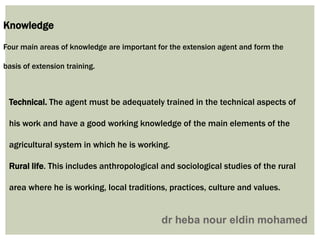
Knowledge
Four main areas of knowledge are important for the extension agent and form the
basis of extension training.
Technical. The agent must be adequately trained in the technical aspects of
his work and have a good working knowledge of the main elements of the
agricultural system in which he is working.
Rural life. This includes anthropological and sociological studies of the rural
area where he is working, local traditions, practices, culture and values.
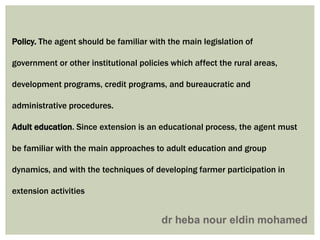
Policy. The agent should be familiar with the main legislation of
government or other institutional policies which affect the rural areas,
development programs, credit programs, and bureaucratic and
administrative procedures.
Adult education. Since extension is an educational process, the agent must
be familiar with the main approaches to adult education and group
dynamics, and with the techniques of developing farmer participation in
extension activities
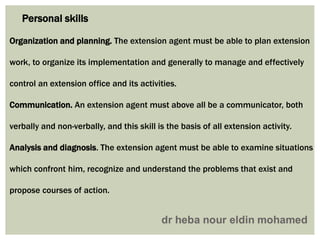
Personal skills
Organization and planning. The extension agent must be able to plan extension
work, to organize its implementation and generally to manage and effectively
control an extension office and its activities.
Communication. An extension agent must above all be a communicator, both
verbally and non-verbally, and this skill is the basis of all extension activity.
Analysis and diagnosis. The extension agent must be able to examine situations
which confront him, recognize and understand the problems that exist and
propose courses of action.
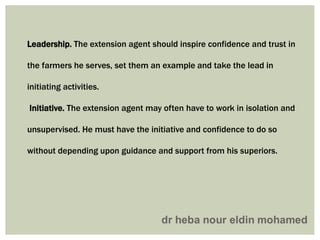
Leadership. The extension agent should inspire confidence and trust in
the farmers he serves, set them an example and take the lead in
initiating activities.
Initiative. The extension agent may often have to work in isolation and
unsupervised. He must have the initiative and confidence to do so
without depending upon guidance and support from his superiors.
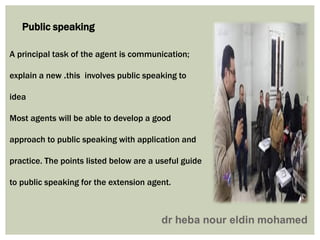
A principal task of the agent is communication;
this involves public speaking to.explain a new
idea
Most agents will be able to develop a good
approach to public speaking with application and
practice. The points listed below are a useful guide
to public speaking for the extension agent.
Public speaking
Preparation.
This preparation includes:
checking the facts, figures and other information to be included in the presentation,
organizing the material in a logical manner and preparing any supporting audiovisual
material.
check the place where the talk is to be given and to take into consideration the
interests, needs and knowledge of the expected audience.
he should write the main items in order for reference in large print on paper or on
small cards. Another technique is to note the main points on an overhead projector
sheet which can be uncovered step by step as the speech progresses. This serves a
dual purpose: helping the agent in the presentation and providing a summary of the
main topics for the audience.
Content
The subject of the talk should be introduced and a general outline of the subject
given. The main body of the talk should contain the key points that the agent
wishes to make. He should not put too much content into a talk; a short, concise
and well-thought-out talk will have far more effect than a lengthy, rambling
presentation. It is also important to take some care in the use of words and
expressions and to adapt these, where possible, to the local context. Similarly, it
is important to avoid the use of over-complex technical language or jargon, which
might confuse the audience.
Delivery
Confidence is very important in delivery. If an agent knows what he wants to say, prepares
himself and says it clearly and effectively, he will probably give a good talk. It is useful to
develop a friendly·style and to talk to or with an audience, and not at them.
During a talk, posture and body movement are important
The agent should continually observe the faces of his audience and take note of signs of
interest, boredom or disapproval.
A talk should be a two-way communication process in that the agent should be sensitive
to the effect he is producing and be prepared to react positively.
The agent should always ensure that his voice is loud and clear enough for all those
present to hear.
He should try not to be nervous, and should not apologize in advance for any
shortcomings. A positive attitude to the delivery of a talk is very important.
Finally, the talk should be relatively short, about 15-20 minutes. Farmers will probably be
unwilling to concentrate for longer than that, so the content should be restricted to the
time available.
Questions and discussion
The audience should be told beforehand about a question and discussion period at
the end of the talk, so it has time to prepare itself accordingly.
A question and answer session alone should be avoided as this will discourage
genuine dialogue and reduce the educational purpose of the talk. Moreover, the
discussion should not drag on for too long, or be dominated by just a few farmers.
It is also acceptable for the agent to direct questions to the audience in an effort to
stimulate a two-way discussion.
Like public speaking, report writing is a skill that the extension agent
can develop and put to good use.
Ensure that all the information and data which will go into the report
are available and readily at hand.
Plan the report beforehand and decide upon its general content, format
and style of presentation.
Structure the content in a logical order, introducing the purpose of the report,
followed by the main substance, and then some concluding remarks.
Keep it brief! At whatever level the agent is operating, a brief, concise and well-
structured report is far more useful and effective than a lengthy, rambling one.
Check over the report, once written, and ensure that the final version is clear, neat
and easy to read..
Report writing

Extension agent

  • 1.
  • 2.
    1- The extensionagent 2- The role of the agent 3- Knowledge and personal skills 4- Public speaking 5- Report writing Contents
  • 3.
    The extension agent Thewhole extension process is dependent upon the extension agent, who is the critical element in all extension activities. . the effectiveness of the extension agent can often determine the success or failure of an extension program. The extension agent has to work with people in a variety of different ways.
  • 4.
    The agent canbe seen as having two main, but different, areas of responsibility. Knowledge/communication/innovation Educator/facilitator/ catalyst The role of the agent
  • 5.
    Knowledge/communication/innovation The extension agentis responsible for providing the knowledge and information that will enable a farmer to understand and make a decision about a particular innovation . In this role, the agent's work is usually highly structured and based on existing government policies and programs of rural development.
  • 6.
    Educator/facilitator/ catalyst The agent'srole is essentially to help support and actively encourage farmers to develop their own initiatives and to begin to tackle their own problems. This discussion can be summarized by listing the wide range of key words used in extension throughout the world to describe the role of the extension agent: Teacher Facilitator Organizer Arbitrator Educator Broker Administrator Advocate Leader Consultant Enabler Catalyst Communicator Intermediary Activist Friend Motivator Listener Provider Stimulator
  • 7.
    The list isnot intended to suggest that the agent must be all of these things. It does, however, underline the agent's importance in extension practice throughout the world, and the many-faceted interpretation of this role
  • 8.
    Two other importantissues are the types of knowledge that an agent must have, and the personal skills required of him to do his job effectively. Knowledge and personal skills
  • 9.
    Knowledge Four main areasof knowledge are important for the extension agent and form the basis of extension training. Technical. The agent must be adequately trained in the technical aspects of his work and have a good working knowledge of the main elements of the agricultural system in which he is working. Rural life. This includes anthropological and sociological studies of the rural area where he is working, local traditions, practices, culture and values.
  • 10.
    Policy. The agentshould be familiar with the main legislation of government or other institutional policies which affect the rural areas, development programs, credit programs, and bureaucratic and administrative procedures. Adult education. Since extension is an educational process, the agent must be familiar with the main approaches to adult education and group dynamics, and with the techniques of developing farmer participation in extension activities
  • 11.
    Personal skills Organization andplanning. The extension agent must be able to plan extension work, to organize its implementation and generally to manage and effectively control an extension office and its activities. Communication. An extension agent must above all be a communicator, both verbally and non-verbally, and this skill is the basis of all extension activity. Analysis and diagnosis. The extension agent must be able to examine situations which confront him, recognize and understand the problems that exist and propose courses of action.
  • 12.
    Leadership. The extensionagent should inspire confidence and trust in the farmers he serves, set them an example and take the lead in initiating activities. Initiative. The extension agent may often have to work in isolation and unsupervised. He must have the initiative and confidence to do so without depending upon guidance and support from his superiors.
  • 13.
    A principal taskof the agent is communication; this involves public speaking to.explain a new idea Most agents will be able to develop a good approach to public speaking with application and practice. The points listed below are a useful guide to public speaking for the extension agent. Public speaking
  • 14.
    Preparation. This preparation includes: checkingthe facts, figures and other information to be included in the presentation, organizing the material in a logical manner and preparing any supporting audiovisual material. check the place where the talk is to be given and to take into consideration the interests, needs and knowledge of the expected audience. he should write the main items in order for reference in large print on paper or on small cards. Another technique is to note the main points on an overhead projector sheet which can be uncovered step by step as the speech progresses. This serves a dual purpose: helping the agent in the presentation and providing a summary of the main topics for the audience.
  • 15.
    Content The subject ofthe talk should be introduced and a general outline of the subject given. The main body of the talk should contain the key points that the agent wishes to make. He should not put too much content into a talk; a short, concise and well-thought-out talk will have far more effect than a lengthy, rambling presentation. It is also important to take some care in the use of words and expressions and to adapt these, where possible, to the local context. Similarly, it is important to avoid the use of over-complex technical language or jargon, which might confuse the audience.
  • 16.
    Delivery Confidence is veryimportant in delivery. If an agent knows what he wants to say, prepares himself and says it clearly and effectively, he will probably give a good talk. It is useful to develop a friendly·style and to talk to or with an audience, and not at them. During a talk, posture and body movement are important The agent should continually observe the faces of his audience and take note of signs of interest, boredom or disapproval. A talk should be a two-way communication process in that the agent should be sensitive to the effect he is producing and be prepared to react positively. The agent should always ensure that his voice is loud and clear enough for all those present to hear. He should try not to be nervous, and should not apologize in advance for any shortcomings. A positive attitude to the delivery of a talk is very important. Finally, the talk should be relatively short, about 15-20 minutes. Farmers will probably be unwilling to concentrate for longer than that, so the content should be restricted to the time available.
  • 17.
    Questions and discussion Theaudience should be told beforehand about a question and discussion period at the end of the talk, so it has time to prepare itself accordingly. A question and answer session alone should be avoided as this will discourage genuine dialogue and reduce the educational purpose of the talk. Moreover, the discussion should not drag on for too long, or be dominated by just a few farmers. It is also acceptable for the agent to direct questions to the audience in an effort to stimulate a two-way discussion.
  • 18.
    Like public speaking,report writing is a skill that the extension agent can develop and put to good use. Ensure that all the information and data which will go into the report are available and readily at hand. Plan the report beforehand and decide upon its general content, format and style of presentation. Structure the content in a logical order, introducing the purpose of the report, followed by the main substance, and then some concluding remarks. Keep it brief! At whatever level the agent is operating, a brief, concise and well- structured report is far more useful and effective than a lengthy, rambling one. Check over the report, once written, and ensure that the final version is clear, neat and easy to read.. Report writing