{
Osaka
Expo ‘70
Amna Al Dhaheri
200812433
Mariam Al Dhaheri
201110178
Fatema Al Tenaiji
200708149
Laila Mohammed
200905001
Aysha Al Kaabi
200908931
 Overall Survey
 Social, cultural and historical circumstances
 Level of Technology and building
 Most Important Pavilions
 Case Study: US Pavilion
 Reasons for selection
 Most important architectural feature
 Significance of structure
 Extra Information
 Logo meaning
 The Tower of the Sun
 Interesting events
 Conclusion
Outline
Location : Osaka City, Japan
Overall Survey
 Expo Location: Osaka City in Japan, the third
largest cities and the second important city
economically across Japan.
 Organizer: The Japan Association for the 1970
World Exposition
 President: Taizo Ishizaka
 History: From March 15 until September 13, 1970.
 Value: First expo in Japan also the first in Asia! It broke
the world expos record for visitor by having 64,218,770
visitors.
 The central structure of Expo 70 was the Festival Plaza,
where musical performances and electronic presentations
were held. From the Tower of the Sun.
Level of technology and
building
 The main idea of the expo design was to
concentrate people’s attention of technological
advancement, which was suitable to Japan
image of an advanced and highly developed
country.
 There were around 32 Japanese buildings and
84 foreign pavilions.
 The main theme was capturing of how the
future will be.
 Lost and Found Centers used "TV-telephones", enabling
you to browse lost articles held at the center from a
faraway location.
 Parking lots were set up with underground loop coils to
detect traffic and help guide motorists to available
parking lots.
 Computers were not only used in informational systems,
but also in lighting, human traffic, and the water and
sewage systems.
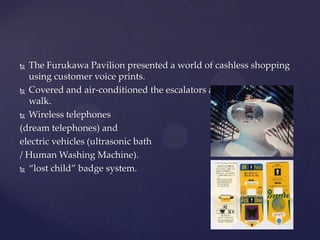
 The Furukawa Pavilion presented a world of cashless shopping
using customer voice prints.
 Covered and air-conditioned the escalators and moving side
walk.
 Wireless telephones
(dream telephones) and
electric vehicles (ultrasonic bath
/ Human Washing Machine).
 ‚lost child‛ badge system.
US Pavilion:
• by NASA's Apollo 11 first visit to the moon
• They used vinyl-coated fiberglass fabric and steel cables for the roof surface.
• reinforced concrete ring girder resting on an earth berm.
Most Important Pavilions
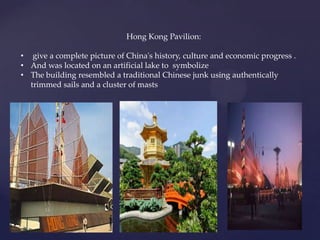
Hong Kong Pavilion:
• give a complete picture of China's history, culture and economic progress .
• And was located on an artificial lake to symbolize
• The building resembled a traditional Chinese junk using authentically
trimmed sails and a cluster of masts
Netherland Pavilion:
• In Osaka, the Dutch government presented itself with a pavilion
designed as a ‚viewing machine‛.
Switzerland Pavilion:
• It is covered with aluminum foil and has 35,000 illumination
lamps, reminding visitors of a snow-covered Alpine trees in
Switzerland.
Bulgaria Pavilion:
• The stob pyramids are famous geological phenomena in Bulgaria.
They are rocks shaped as pyramids.
Case Study: US Pavilion
 The expo’s title is "Progress and
Harmony for Mankind" which is
presented in US glorious moment of
landing on the moon.
 has technical and architectural
innovation as it was built in low budget
and during a very tight time range
 the simplicity of design and the white
color added a sense of elegance to the
building
 the roof and its presentation of space
age inflated like a giant balloon
 built from fiberglass fabric on a grid of
steel cables and supported by
reinforced concrete ring.
 The Apollo 11 spaceflight the carried
man to the moon for the first time was
the inspiration of the building design
 Artifacts were displayed inside the
pavilions like Apollo 11 capsule and a
piece of moon rock
Most important architectural
features
 presenting not just the US remarkable
achievement but the whole human
kind’s
 based on the Apollo 11 mission in 1969
that formed the future of America in
industry and technology
Significance of structure
 introduced by Takeshi Ohtaka
 An abstract cherry blossom flower
 presents harmony among the 5 petals as the
five continents of the world revolving around
Japan as meeting point
Logo Meaning
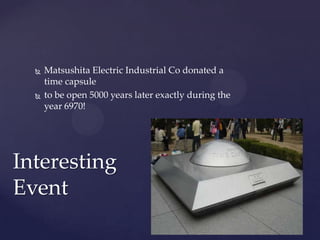
 Matsushita Electric Industrial Co donated a
time capsule
 to be open 5000 years later exactly during the
year 6970!
Interesting
Event
 Designed by the Japanese architect Kenzo
Tange
 symbol of the Commemorative Park in Expo
’70
 It was designed to have 3 faces: the sun, black
sun & the golden mask. The top face, which is
the golden mask, represents the bright future
ahead
 It is 70 meters height and 20 meters diameter
of base steel frame covered with reinforced
concrete.
The Tower
of the Sun
 Expo ’70 was one of the most amazing expos of
all time and the number of visitors proves it.
 the success of the expo related to sincere focus
of vision on the concept of future
 looked like the place came out of a comic book
 amazing mixture of colorful bizarre structures,
many of them daring in their designs and
concepts.
Conclusion

Expo70 project presentation

  • 1.
    { Osaka Expo ‘70 Amna AlDhaheri 200812433 Mariam Al Dhaheri 201110178 Fatema Al Tenaiji 200708149 Laila Mohammed 200905001 Aysha Al Kaabi 200908931
  • 2.
     Overall Survey Social, cultural and historical circumstances  Level of Technology and building  Most Important Pavilions  Case Study: US Pavilion  Reasons for selection  Most important architectural feature  Significance of structure  Extra Information  Logo meaning  The Tower of the Sun  Interesting events  Conclusion Outline
  • 3.
    Location : OsakaCity, Japan
  • 4.
    Overall Survey  ExpoLocation: Osaka City in Japan, the third largest cities and the second important city economically across Japan.  Organizer: The Japan Association for the 1970 World Exposition  President: Taizo Ishizaka
  • 5.
     History: FromMarch 15 until September 13, 1970.  Value: First expo in Japan also the first in Asia! It broke the world expos record for visitor by having 64,218,770 visitors.  The central structure of Expo 70 was the Festival Plaza, where musical performances and electronic presentations were held. From the Tower of the Sun.
  • 6.
    Level of technologyand building  The main idea of the expo design was to concentrate people’s attention of technological advancement, which was suitable to Japan image of an advanced and highly developed country.  There were around 32 Japanese buildings and 84 foreign pavilions.  The main theme was capturing of how the future will be.
  • 7.
     Lost andFound Centers used "TV-telephones", enabling you to browse lost articles held at the center from a faraway location.  Parking lots were set up with underground loop coils to detect traffic and help guide motorists to available parking lots.  Computers were not only used in informational systems, but also in lighting, human traffic, and the water and sewage systems.
  • 8.
     The FurukawaPavilion presented a world of cashless shopping using customer voice prints.  Covered and air-conditioned the escalators and moving side walk.  Wireless telephones (dream telephones) and electric vehicles (ultrasonic bath / Human Washing Machine).  ‚lost child‛ badge system.
  • 10.
    US Pavilion: • byNASA's Apollo 11 first visit to the moon • They used vinyl-coated fiberglass fabric and steel cables for the roof surface. • reinforced concrete ring girder resting on an earth berm. Most Important Pavilions
  • 11.
    Hong Kong Pavilion: •give a complete picture of China's history, culture and economic progress . • And was located on an artificial lake to symbolize • The building resembled a traditional Chinese junk using authentically trimmed sails and a cluster of masts
  • 12.
    Netherland Pavilion: • InOsaka, the Dutch government presented itself with a pavilion designed as a ‚viewing machine‛.
  • 13.
    Switzerland Pavilion: • Itis covered with aluminum foil and has 35,000 illumination lamps, reminding visitors of a snow-covered Alpine trees in Switzerland.
  • 14.
    Bulgaria Pavilion: • Thestob pyramids are famous geological phenomena in Bulgaria. They are rocks shaped as pyramids.
  • 15.
    Case Study: USPavilion  The expo’s title is "Progress and Harmony for Mankind" which is presented in US glorious moment of landing on the moon.  has technical and architectural innovation as it was built in low budget and during a very tight time range  the simplicity of design and the white color added a sense of elegance to the building
  • 16.
     the roofand its presentation of space age inflated like a giant balloon  built from fiberglass fabric on a grid of steel cables and supported by reinforced concrete ring.  The Apollo 11 spaceflight the carried man to the moon for the first time was the inspiration of the building design  Artifacts were displayed inside the pavilions like Apollo 11 capsule and a piece of moon rock Most important architectural features
  • 17.
     presenting notjust the US remarkable achievement but the whole human kind’s  based on the Apollo 11 mission in 1969 that formed the future of America in industry and technology Significance of structure
  • 18.
     introduced byTakeshi Ohtaka  An abstract cherry blossom flower  presents harmony among the 5 petals as the five continents of the world revolving around Japan as meeting point Logo Meaning
  • 19.
     Matsushita ElectricIndustrial Co donated a time capsule  to be open 5000 years later exactly during the year 6970! Interesting Event
  • 20.
     Designed bythe Japanese architect Kenzo Tange  symbol of the Commemorative Park in Expo ’70  It was designed to have 3 faces: the sun, black sun & the golden mask. The top face, which is the golden mask, represents the bright future ahead  It is 70 meters height and 20 meters diameter of base steel frame covered with reinforced concrete. The Tower of the Sun
  • 21.
     Expo ’70was one of the most amazing expos of all time and the number of visitors proves it.  the success of the expo related to sincere focus of vision on the concept of future  looked like the place came out of a comic book  amazing mixture of colorful bizarre structures, many of them daring in their designs and concepts. Conclusion