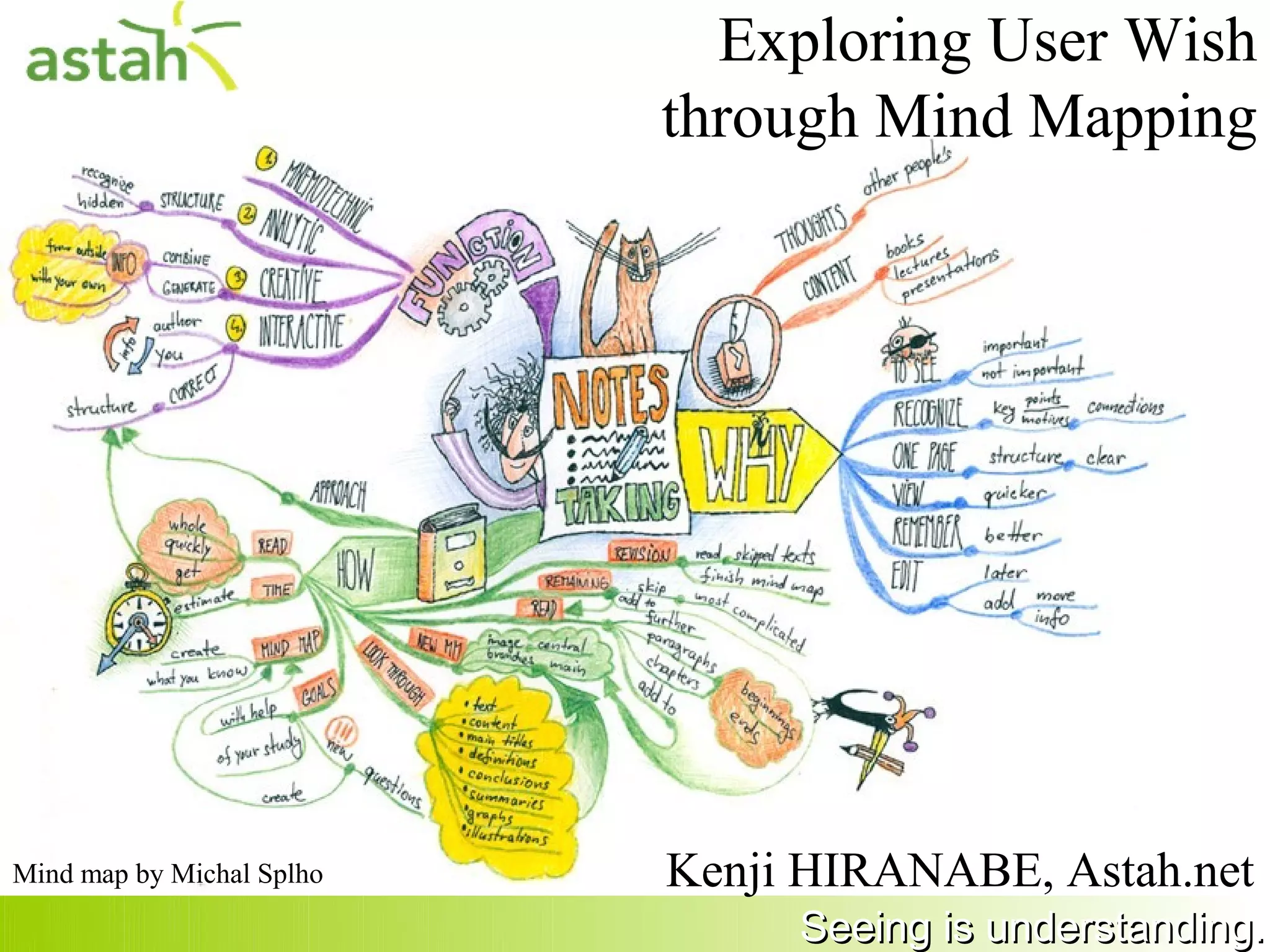
Exploring User Wish
                               through Mind Mapping


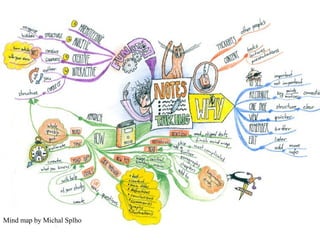
Mind map by Michal Splho
http://michalsplho.sk/?p=267               Kenji HIRANABE
                                       Seeing is understanding.
Objectives
    • To understand what is Mind Mapping and
      how software development can benefit from it.


    • To experience how to use Mind Maps to
      explore user wish and carve out UseCases or
      User Stories.


2                                 Seeing is understanding.
Agenda
    • Self-introduction
    • What is a Mind Map and Why
    • Exploring User Wish using Mind
      Mapping
    • Demonstration
    • Conclusion


3                            Seeing is understanding.
Father and Grandfather of Scrum


http://scrum.jeffsutherland.com/2011/02/meeting-nonaka-san-in-tokyo.html
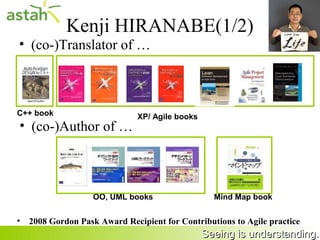
Kenji HIRANABE(1/2)
    • (co-)Translator of …


    C++ book                  XP/ Agile books
    • (co-)Author of …


                   OO, UML books                  Mind Map book

• 2008 Gordon Pask Award Recipient for Contributions to Agile practice
7                                               Seeing is understanding.
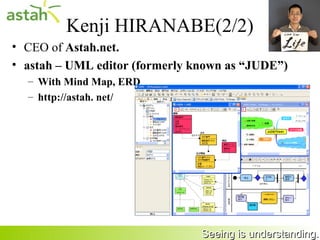
Kenji HIRANABE(2/2)
• CEO of Astah.net.
• astah – UML editor (formerly known as “JUDE”)
    – With Mind Map, ERD
    – http://astah. net/


8                               Seeing is understanding.
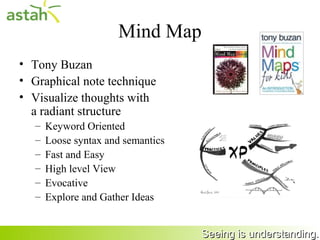
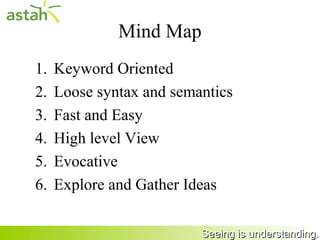
Mind Map
    • Tony Buzan
    • Graphical note technique
    • Visualize thoughts with
      a radiant structure
       –   Keyword Oriented
       –   Loose syntax and semantics
       –   Fast and Easy
       –   High level View
       –   Evocative
       –   Explore and Gather Ideas


9                                       Seeing is understanding.
10                       Seeing is understanding.
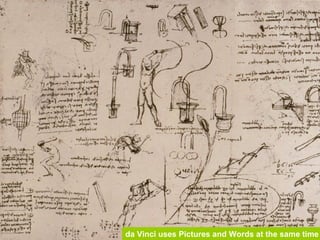
     da Vinci uses Pictures and Words at the same time
Mind map by Michal Splho
http://michalsplho.sk/?p=267
13   Seeing is understanding.
Mind Mapping
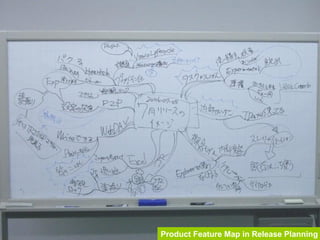
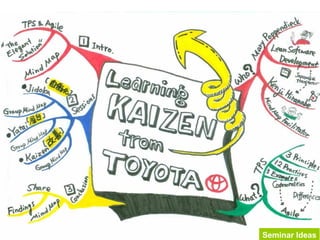
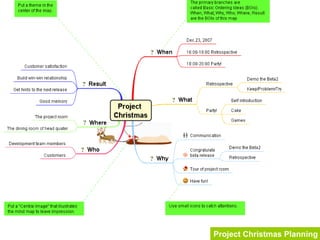
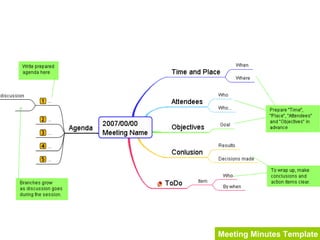
     • Examples …


14                        Seeing is understanding.
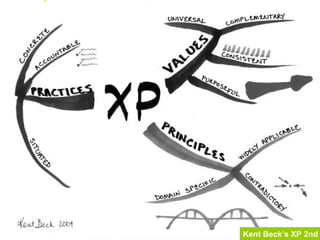
15   Seeing isKent Beck’s XP 2nd
               understanding.
Seminar Ideas
Project Christmas Planning
Meeting Minutes Template
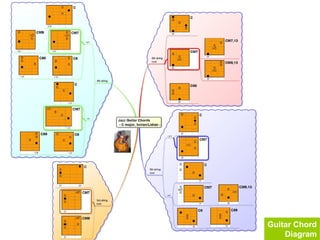
Guitar Chord
    Diagram
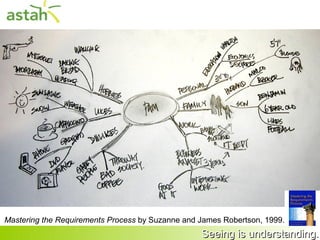
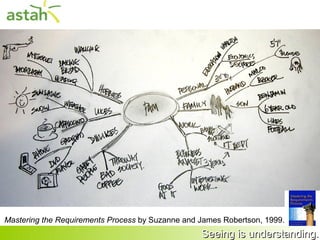
Mastering the Requirements Process by Suzanne and James Robertson, 1999.
20                                                Seeing is understanding.
21   Seeing is understanding.
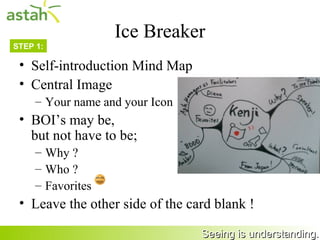
Ice Breaker
     STEP 1:

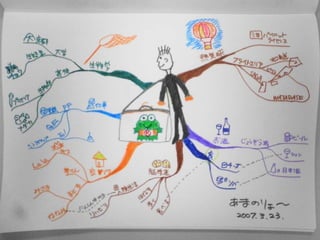
      • Self-introduction Mind Map
      • Central Image
          – Your name and your Icon
      • BOI’s may be,
        but not have to be;
          – Why ? (you come here)
          – What ? (do you do)
          – Favorites
      • Leave the other side of the card blank !

22                                    Seeing is understanding.
Ice Breaker
     STEP 2:

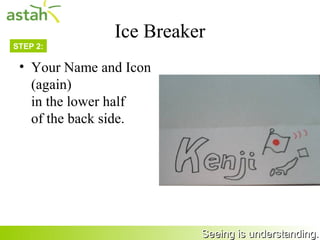
      • Your Name and Icon
        (again)
        in the lower half
        of the back side.


23                            Seeing is understanding.
STEP 3:


24             Seeing is understanding.
User Stories: Ron Jeffries’ 3 Cs
     • Card
       – Written on note cards.
       – Cards may be annotated with estimates, notes, etc.
     • Conversation
       – Details behind the story come out during
         conversation with customer
     • Confirm
       – Acceptance tests confirm the story was coded
         correctly

25                                      Seeing is understanding.
User Stories: Mike Cohn
     • Shift focus from writing to talking
     • Metaphor of Trawling (by Suzanne and James
       Robertson)
        – Requirements can be captured with different sized nets
        – Requirements change, mature, possibly die
        – Skill is a factor
     • Avoid “The user”, find “Roles”
     • In order to <benefit>,
       as a <role>,
       I want to <story>.


26                                            Seeing is understanding.
Why Mind Map and User Stories Fit ?
     • Shift focus from writing to talking
     • Trawl requirements with coarse sized net first
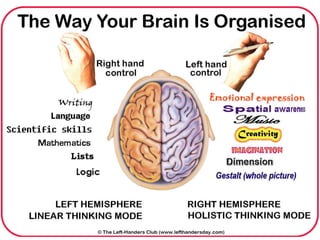
     • Capture Emotion, Use your right brain !
       Colors, and Pictures !
       – To fully utilize broadband communication and
         preserve it in your brain, as the same time, keep it
         into a mind map as a memento of the situation. In
         the future conversation, you can use it to resume
         the context back.

27                                       Seeing is understanding.
User Wish Mind Map
     •   The first step of getting what you want.
     •   Get the Big Picture.
     •   Who? first.
     •   Semi-structured.
     •   Gather info and mine UseCases/User Stories.


28                                   Seeing is understanding.
Demonstration
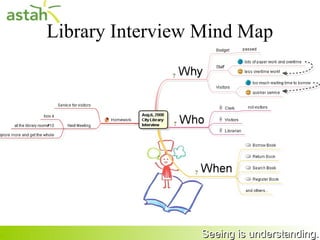
     • City Library System Interview…
       – I will visit my client at a city library
       – And Using mindmapping, I interview to gather
         user wish.

       – Bit goes like …(have fun)


29                                    Seeing is understanding.
Library Interview Mind Map


30                    Seeing is understanding.
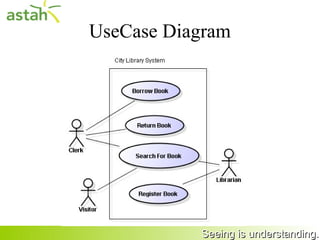
UseCase Diagram


31              Seeing is understanding.
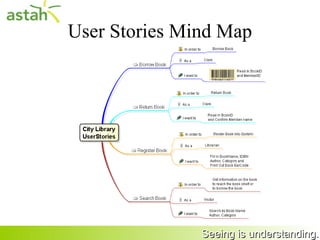
User Stories Mind Map


32                  Seeing is understanding.
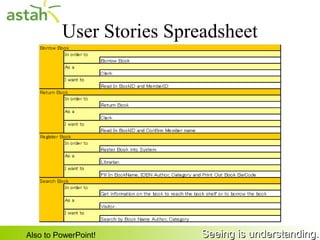
User Stories Spreadsheet


33   Also to PowerPoint!       Seeing is understanding.
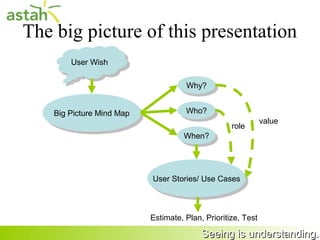
The big picture of this presentation
             User Wish
             User Wish

                                           Why?
                                           Why?


         Big Picture Mind Map              Who?
                                           Who?
          Big Picture Mind Map
                                                                    value
                                                         role
                                          When?
                                          When?


                                 User Stories/ Use Cases
                                 User Stories/ Use Cases


                                 Estimate, Plan, Prioritize, Test

34                                              Seeing is understanding.
Conclusion
     • Mind Mapping is effective when
       – Gathering Information
       – Exploring topics freely
     • User interview with Mind Mapping
       – Is Semi-structured
       – Gives a high-level view of user wish
       – Creates a big picture of the user wish from which
         you can carve out good use cases or user stories.
     • Why, Who, When are good input to user stories.
35                                      Seeing is understanding.
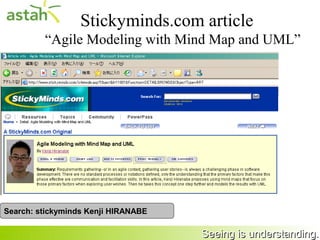
Stickyminds.com article
         “Agile Modeling with Mind Map and UML”


Search: stickyminds Kenji HIRANABE

36                                   Seeing is understanding.
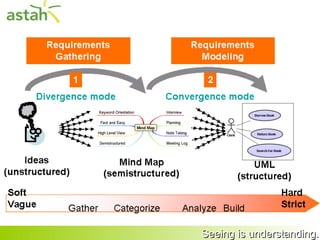
37   Seeing is understanding.
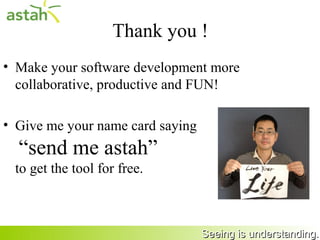
Thank you, Agile New England!
• Make your software development
  more collaborative, productive and
  FUN!
• Whitepaper available.
  http://astah.net/resources/documents/
  zen-and-the-art-of-user-requirements.pdf
• Visit http://astah.net for the free version.

38                                        Seeing is understanding.

Exploring User Wish through Mindmapping

  • 1.
    Exploring User Wish through Mind Mapping Mind map by Michal Splho http://michalsplho.sk/?p=267 Kenji HIRANABE Seeing is understanding.
  • 2.
    Objectives • To understand what is Mind Mapping and how software development can benefit from it. • To experience how to use Mind Maps to explore user wish and carve out UseCases or User Stories. 2 Seeing is understanding.
  • 3.
    Agenda • Self-introduction • What is a Mind Map and Why • Exploring User Wish using Mind Mapping • Demonstration • Conclusion 3 Seeing is understanding.
  • 4.
    Father and Grandfatherof Scrum http://scrum.jeffsutherland.com/2011/02/meeting-nonaka-san-in-tokyo.html
  • 7.
    Kenji HIRANABE(1/2) • (co-)Translator of … C++ book XP/ Agile books • (co-)Author of … OO, UML books Mind Map book • 2008 Gordon Pask Award Recipient for Contributions to Agile practice 7 Seeing is understanding.
  • 8.
    Kenji HIRANABE(2/2) • CEOof Astah.net. • astah – UML editor (formerly known as “JUDE”) – With Mind Map, ERD – http://astah. net/ 8 Seeing is understanding.
  • 9.
    Mind Map • Tony Buzan • Graphical note technique • Visualize thoughts with a radiant structure – Keyword Oriented – Loose syntax and semantics – Fast and Easy – High level View – Evocative – Explore and Gather Ideas 9 Seeing is understanding.
  • 10.
    10 Seeing is understanding. da Vinci uses Pictures and Words at the same time
  • 12.
    Mind map byMichal Splho http://michalsplho.sk/?p=267
  • 13.
    13 Seeing is understanding.
  • 14.
    Mind Mapping • Examples … 14 Seeing is understanding.
  • 15.
    15 Seeing isKent Beck’s XP 2nd understanding.
  • 16.
  • 17.
  • 18.
  • 19.
  • 20.
    Mastering the RequirementsProcess by Suzanne and James Robertson, 1999. 20 Seeing is understanding.
  • 21.
    21 Seeing is understanding.
  • 22.
    Ice Breaker STEP 1: • Self-introduction Mind Map • Central Image – Your name and your Icon • BOI’s may be, but not have to be; – Why ? (you come here) – What ? (do you do) – Favorites • Leave the other side of the card blank ! 22 Seeing is understanding.
  • 23.
    Ice Breaker STEP 2: • Your Name and Icon (again) in the lower half of the back side. 23 Seeing is understanding.
  • 24.
    STEP 3: 24 Seeing is understanding.
  • 25.
    User Stories: RonJeffries’ 3 Cs • Card – Written on note cards. – Cards may be annotated with estimates, notes, etc. • Conversation – Details behind the story come out during conversation with customer • Confirm – Acceptance tests confirm the story was coded correctly 25 Seeing is understanding.
  • 26.
    User Stories: MikeCohn • Shift focus from writing to talking • Metaphor of Trawling (by Suzanne and James Robertson) – Requirements can be captured with different sized nets – Requirements change, mature, possibly die – Skill is a factor • Avoid “The user”, find “Roles” • In order to <benefit>, as a <role>, I want to <story>. 26 Seeing is understanding.
  • 27.
    Why Mind Mapand User Stories Fit ? • Shift focus from writing to talking • Trawl requirements with coarse sized net first • Capture Emotion, Use your right brain ! Colors, and Pictures ! – To fully utilize broadband communication and preserve it in your brain, as the same time, keep it into a mind map as a memento of the situation. In the future conversation, you can use it to resume the context back. 27 Seeing is understanding.
  • 28.
    User Wish MindMap • The first step of getting what you want. • Get the Big Picture. • Who? first. • Semi-structured. • Gather info and mine UseCases/User Stories. 28 Seeing is understanding.
  • 29.
    Demonstration • City Library System Interview… – I will visit my client at a city library – And Using mindmapping, I interview to gather user wish. – Bit goes like …(have fun) 29 Seeing is understanding.
  • 30.
    Library Interview MindMap 30 Seeing is understanding.
  • 31.
    UseCase Diagram 31 Seeing is understanding.
  • 32.
    User Stories MindMap 32 Seeing is understanding.
  • 33.
    User Stories Spreadsheet 33 Also to PowerPoint! Seeing is understanding.
  • 34.
    The big pictureof this presentation User Wish User Wish Why? Why? Big Picture Mind Map Who? Who? Big Picture Mind Map value role When? When? User Stories/ Use Cases User Stories/ Use Cases Estimate, Plan, Prioritize, Test 34 Seeing is understanding.
  • 35.
    Conclusion • Mind Mapping is effective when – Gathering Information – Exploring topics freely • User interview with Mind Mapping – Is Semi-structured – Gives a high-level view of user wish – Creates a big picture of the user wish from which you can carve out good use cases or user stories. • Why, Who, When are good input to user stories. 35 Seeing is understanding.
  • 36.
    Stickyminds.com article “Agile Modeling with Mind Map and UML” Search: stickyminds Kenji HIRANABE 36 Seeing is understanding.
  • 37.
    37 Seeing is understanding.
  • 38.
    Thank you, AgileNew England! • Make your software development more collaborative, productive and FUN! • Whitepaper available. http://astah.net/resources/documents/ zen-and-the-art-of-user-requirements.pdf • Visit http://astah.net for the free version. 38 Seeing is understanding.