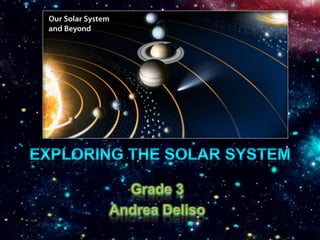
Exploring the solar systemGrade 3Andrea Deliso
The sun   Like all the other planets in our Solar System, the Earth revolves around a medium-sized star. This star provides all the energy necessary to sustain life on Earth.Click the title to find out more information about the sun!!!
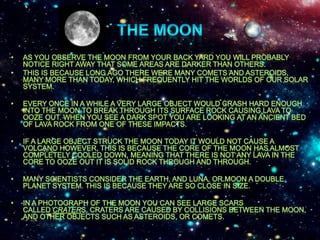
The moonAs you observe the moon from your back yard you will probably notice right away that some areas are darker than others. This is because long ago there were many comets and asteroids, many more than today, which frequently hit the worlds of our Solar System. Every once in a while a very large object would crash hard enough into the Moon to break through its surface rock causing lava to ooze out. When you see a dark spot you are looking at an ancient bed of lava rock from one of these impacts. If a large object struck the Moon today It would not cause a volcano however, this is because the core of the Moon has almost completely cooled down, meaning that there is not any lava in the core to ooze out it is solid rock through and through.Many scientists consider the Earth, and Luna, or Moon a double planet system. This is because they are so close in size.In a photograph of the Moon you can see large scars called craters. Craters are caused by collisions between the Moon, and other objects such as asteroids, or comets.
Chart your planetary knowledge
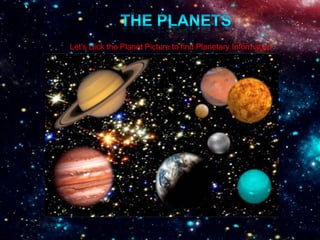
The planetsLet’s click the Planet Picture to find Planetary Information
The 9 Planets in the solar systemLet ‘s click  the planet names to find out planetary facts about each one!MercuryVenusEarthMarsjupiterSaturnNeptuneUranuspluto
Pluto's Not a Planet Anymore Why is Pluto no longer a planet?After being classified as a planet for more than 60 years, Pluto has been demoted! Why would scientist change Pluto's status?Let’s read the poem by Jeff Mondak. Then listen to it being sung by Alex Stangl.Together we can use the internet to answer the questions that are raised in the poem/song.
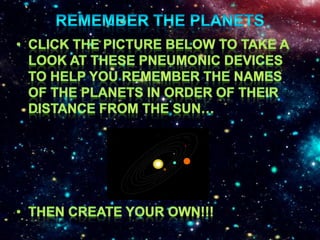
Remember the planetsClick the picture below to Take a look at these pneumonic devices to help you remember the names of the planets in order of their distance from the sun…Then create your own!!!
Pneumonic FeverMVEMJSNUpWrite your pneumonic device in the box below
Let’s Click the Link:Let’s use the web to find out some facts about the solar system. If we click the words Solar System underlined below it will help us explore the solar System by reading facts from the internet.  When We have finished reviewing the Solar System facts:Use the information on the Solar System to answer the Solar System “WH” Question worksheet.
Test Your Skills on…..Solar system Jeopardy
Click the Picture Below to find your weight on different planetsThen we will use the website to solve the word problems on the Math Links handout.

Exploring the Solar System

  • 1.
    Exploring the solarsystemGrade 3Andrea Deliso
  • 2.
    The sun Like all the other planets in our Solar System, the Earth revolves around a medium-sized star. This star provides all the energy necessary to sustain life on Earth.Click the title to find out more information about the sun!!!
  • 3.
    The moonAs youobserve the moon from your back yard you will probably notice right away that some areas are darker than others. This is because long ago there were many comets and asteroids, many more than today, which frequently hit the worlds of our Solar System. Every once in a while a very large object would crash hard enough into the Moon to break through its surface rock causing lava to ooze out. When you see a dark spot you are looking at an ancient bed of lava rock from one of these impacts. If a large object struck the Moon today It would not cause a volcano however, this is because the core of the Moon has almost completely cooled down, meaning that there is not any lava in the core to ooze out it is solid rock through and through.Many scientists consider the Earth, and Luna, or Moon a double planet system. This is because they are so close in size.In a photograph of the Moon you can see large scars called craters. Craters are caused by collisions between the Moon, and other objects such as asteroids, or comets.
  • 4.
  • 5.
    The planetsLet’s clickthe Planet Picture to find Planetary Information
  • 6.
    The 9 Planetsin the solar systemLet ‘s click the planet names to find out planetary facts about each one!MercuryVenusEarthMarsjupiterSaturnNeptuneUranuspluto
  • 7.
    Pluto's Not aPlanet Anymore Why is Pluto no longer a planet?After being classified as a planet for more than 60 years, Pluto has been demoted! Why would scientist change Pluto's status?Let’s read the poem by Jeff Mondak. Then listen to it being sung by Alex Stangl.Together we can use the internet to answer the questions that are raised in the poem/song.
  • 8.
    Remember the planetsClickthe picture below to Take a look at these pneumonic devices to help you remember the names of the planets in order of their distance from the sun…Then create your own!!!
  • 9.
    Pneumonic FeverMVEMJSNUpWrite yourpneumonic device in the box below
  • 10.
    Let’s Click theLink:Let’s use the web to find out some facts about the solar system. If we click the words Solar System underlined below it will help us explore the solar System by reading facts from the internet. When We have finished reviewing the Solar System facts:Use the information on the Solar System to answer the Solar System “WH” Question worksheet.
  • 11.
    Test Your Skillson…..Solar system Jeopardy
  • 12.
    Click the PictureBelow to find your weight on different planetsThen we will use the website to solve the word problems on the Math Links handout.