21st
Century Literature from the
Philippines and the World
Teacher: Edmar Gilla
Exploring Philippine Literacy Forms, Genres,
Elements, and Traditions
• Philippine literature is as rich and diverse as the
7500 plus islands that make up our archipelago.
This is not surprising considering that we have
183 living languages (ethnologue.com) across 17
regions comprised of 82 provinces. One can only
imagine the many forms of artistic communication
(oral or written) that have been passed on to and
through generations, communities, and groups.
Lesson
1
LITERATURE
• is derived from the Latin word "littera"
which means "a letter of the alphabet".
• can either be in oral or written form.
Literary text
• The products of written literature
the best way to describe the characteristics of literary text is that (1) it narrates
a story; (2) it expresses feelings, thoughts, and ideas, (3) it delivers significant
information and crosses boundaries of time, places, cultures and languages.
Literary Structure
refers to the organizational method
used in literature in which the most
common type is the narrative.
Parts of the narrative structure (or plot)
are the exposition, rising action,
climax, falling action, and
resolution (denouement).
Two Major Forms of Literature
1. POETRY
This literary type is usually written
in lines and is characterized by having the
element of rhythm, sound, imagery, and
form. Its main purpose is to express
feelings, thoughts, and ideas.
Two Major Forms of Literature
1. POETRY It can be divided into three types:
(1)narrative,(2)dramatic, and (3)lyrical poetry.
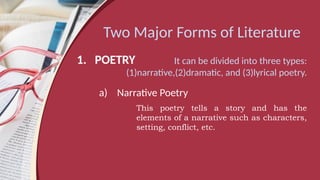
a) Narrative Poetry
This poetry tells a story and has the
elements of a narrative such as characters,
setting, conflict, etc.
Two Major Forms of Literature
1. POETRY It can be divided into three types:
(1)narrative,(2)dramatic, and (3)lyrical poetry.
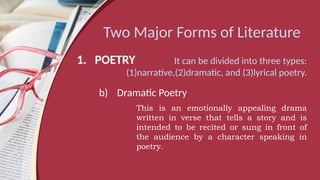
b) Dramatic Poetry
This is an emotionally appealing drama
written in verse that tells a story and is
intended to be recited or sung in front of
the audience by a character speaking in
poetry.
Two Major Forms of Literature
1. POETRY It can be divided into three types:
(1)narrative,(2)dramatic, and (3)lyrical poetry.
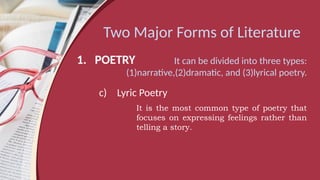
c) Lyric Poetry
It is the most common type of poetry that
focuses on expressing feelings rather than
telling a story.
Two Major Forms of Literature
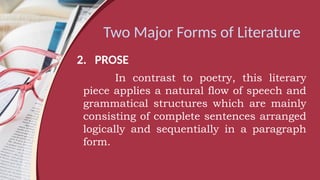
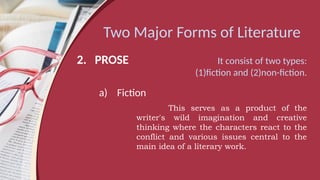
2. PROSE
In contrast to poetry, this literary
piece applies a natural flow of speech and
grammatical structures which are mainly
consisting of complete sentences arranged
logically and sequentially in a paragraph
form.
Two Major Forms of Literature
2. PROSE It consist of two types:
(1)fiction and (2)non-fiction.
a) Fiction
This serves as a product of the
writer's wild imagination and creative
thinking where the characters react to the
conflict and various issues central to the
main idea of a literary work.
Two Major Forms of Literature
2. PROSE It consist of two types:
(1)fiction and (2)non-fiction.
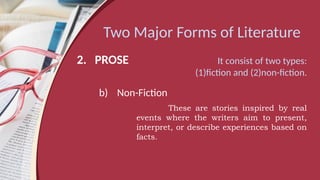
b) Non-Fiction
These are stories inspired by real
events where the writers aim to present,
interpret, or describe experiences based on
facts.
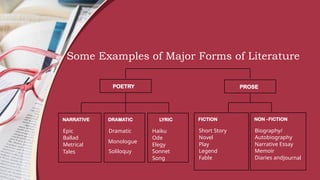
Some Examples of Major Forms of Literature
POETRY
NARRATIVE
Epic
Ballad
Metrical
Tales
DRAMATIC
Dramatic
Monologue
Soliloquy
LYRIC
Haiku
Ode
Elegy
Sonnet
Song
PROSE
FICTION
Short Story
Novel
Play
Legend
Fable
NON -FICTION
Biography/
Autobiography
Narrative Essay
Memoir
Diaries andJournal
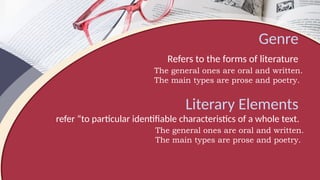
Genre
Refers to the forms of literature
The general ones are oral and written.
The main types are prose and poetry.
Literary Elements
refer “to particular identifiable characteristics of a whole text.
The general ones are oral and written.
The main types are prose and poetry.
Common elements of a story
• setting, character, conflict,
theme, point of view, and plot.
Plot also has its own elements
• exposition, rising action, climax,
falling action, and resolution or
denouement / de nu m /
ˌ ɪˈ ː ɒ̃
Poetry
• there are 4 essential elements:
form, imagery, rhythm, and
sound.
An overview of Philippine Literature
Historically speaking, Philippine
literature can be divided into three most
important periods: pre-colonial, colonial, and
post-colonial.
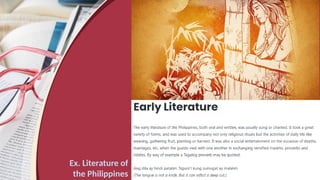
All literary works produced before the Spanish
colonization such as chants, proverbs, songs,
and folk narratives are considered under pre-
colonial period which are mostly of oral
traditions.
An overview of Philippine Literature
Our forefathers also valued words of
wisdom for teaching values as evidenced by
numerous proverbs or salawikain.
Having bugtong or riddles was also a favorite
past time and listening to narratives of bravery,
magic, and heroism in epics was a box office hit.
An overview of Philippine Literature
The focus of literature suddenly changed
upon the arrival of Spaniards. An emphasis on
morality and religion was common in literary
forms such as Corrido, Pasyon, and Cenaculo.
Filipinos started to write about
oppression, corruption, and other social ills
such as in the works of Dr. Jose P. Rizal entitled
Noli Me Tangere and its sequel El
Filibusterismo.
An overview of Philippine Literature
The literary production during the
American Period was inspired by the
developments in education and culture.
During the apprenticeship period, the
Filipino writers imitated English and American
models.
With the new knowledge of English
language, many writers started to gain
recognition both locally and internationally like
Jose Garcia Villa who earned the International
title, “Poet of the Century" as an example.
An overview of Philippine Literature
Philippine Literature was interrupted in
its development when we were conquered by
Japan between 1941-1945 since freedom of
expression was uncommon back then. Filipino
writers in the Philippines were forbidden to write
anything against the government and only those
who were in exile had the privilege to do so. As a
result of banning the English language, short
stories written in the vernaculars flourished in
the country.
An overview of Philippine Literature
The three most influential foreign
invaders to the types of literature produced
during colonial periods are Spanish, American,
and Japanese wherein the common themes and
subject mostly tackle about oppression, religion,
freedom, or anything that reflects the
experiences of Filipino people under the
colonizers.
FACT OR FICTION:
What I Have Learned
Write "Fact" if the statement is true about Philippines and
"Fiction" if it is false. Write the correct word or phrase on
top of the incorrect one to make the false statement right.
______________1. Earliest Philippine literature before the colonization
period was rich in written literary works.
______________2. Christianity is the first religion known to ancient
Filipinos.
______________3. Islam emerged first before Catholicism faith.
______________4. Philippine literature can be divided into three major
periods.
______________5. The two major classifications of poetry are fiction
and non-fiction.
FACT OR FICTION:
What I Have Learned
Write "Fact" if the statement is true about Philippines and
"Fiction" if it is false. Write the correct word or phrase on
top of the incorrect one to make the false statement right.
______________6. Spanish were the ones who introduced
Protestantism in the Philippines.
______________7. The Filipino is a unique blend of both Eastern and
Western influences.
______________8. Biography is a non-fiction literary work.
______________9. Sounds and rhythm give a musical effect to any
prose.
______________10. Philippine history and cultures are associated to
the country's literature.
FACT OR FICTION:
What I Have Learned
Write "Fact" if the statement is true about Philippines and "Fiction" if it is false. Write the correct word
or phrase on top of the incorrect one to make the false statement right.
1. Fiction – (written) ORAL
2. Fiction – (Christianity) ISLAM
3. Fact
4. Fact
5. Fiction – (Poetry) PROSE
6. Fiction – (Spanish) AMERICAN
7. Fact
8. Fact
9. Fiction – (Prose) POETRY
10.Fact
Description
___________________________________
___________________________________
___________________________________
___________________________________
___________________________________
___________________________________
___________________________________
___________ ________________________
___________________________________
___________________________________
___________________________________
___________________________________
What I Can Do
LIT AND ART: Do each task as instructed. Use the space provided for
your answers.
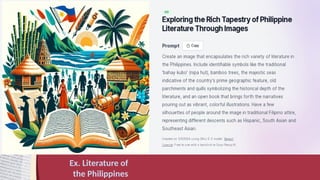
•Draw an image that will best describe the type of literature in the
Philippines. Write a short description of your drawing.
Ex. Literature of
the Philippines
Ex. Literature of
the Philippines
Ex. Literature of
the Philippines
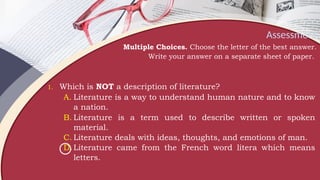
Assessment
Multiple Choices. Choose the letter of the best answer.
Write your answer on a separate sheet of paper.
1. Which is NOT a description of literature?
A. Literature is a way to understand human nature and to know
a nation.
B. Literature is a term used to describe written or spoken
material.
C. Literature deals with ideas, thoughts, and emotions of man.
D.Literature came from the French word litera which means
letters.
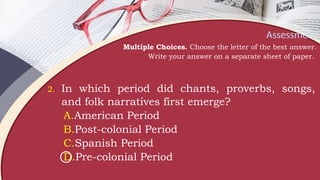
Assessment
Multiple Choices. Choose the letter of the best answer.
Write your answer on a separate sheet of paper.
2. In which period did chants, proverbs, songs,
and folk narratives first emerge?
A.American Period
B.Post-colonial Period
C.Spanish Period
D.Pre-colonial Period
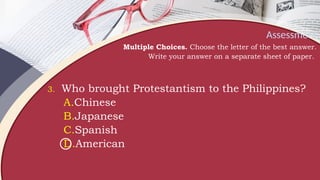
Assessment
Multiple Choices. Choose the letter of the best answer.
Write your answer on a separate sheet of paper.
3. Who brought Protestantism to the Philippines?
A.Chinese
B.Japanese
C.Spanish
D.American
Assessment
Multiple Choices. Choose the letter of the best answer.
Write your answer on a separate sheet of paper.
4. What is common among these literary genres: legends,
myths, fables, biographies, novels, and short stories?
A.They are based on true historic events.
B.They are all non-fiction prose.
C.They are all written in lines.
D.They all have stories to tell.
Assessment
Multiple Choices. Choose the letter of the best answer.
Write your answer on a separate sheet of paper.
5. Which cannot be found in poetry? They are based on true
historic events.
A.rhyme scheme
B.rhythm
C.stanzas
D.paragraphs
Assessment
Multiple Choices. Choose the letter of the best answer.
Write your answer on a separate sheet of paper.
6. What element of a story is depicted in this text: “It was
1986. The country was still euphoric for having ended a
terrible regime”?
A.conflict
B.point of view
C.theme
D.setting
Assessment
Multiple Choices. Choose the letter of the best answer.
Write your answer on a separate sheet of paper.
7. What element of a story is depicted in this text: “The hero
faces the fiercest enemy of all- his monstrous other self”?
A.Character
B.Plot
C.Setting
D.Conflict
Assessment
Multiple Choices. Choose the letter of the best answer.
Write your answer on a separate sheet of paper.
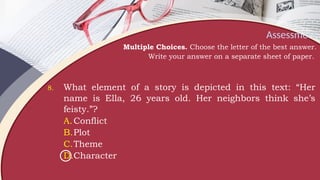
8. What element of a story is depicted in this text: “Her
name is Ella, 26 years old. Her neighbors think she’s
feisty.”?
A.Conflict
B.Plot
C.Theme
D.Character
Assessment
Multiple Choices. Choose the letter of the best answer.
Write your answer on a separate sheet of paper.
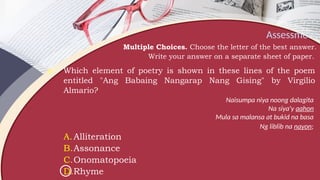
9. Which element of poetry is shown in these lines of the poem
entitled "Ang Babaing Nangarap Nang Gising" by Virgilio
Almario?
Naisumpa niya noong dalagita
Na siya'y aahon
Mula sa malansa at bukid na basa
Ng liblib na nayon;
A.Alliteration
B.Assonance
C.Onomatopoeia
D.Rhyme
Assessment
Multiple Choices. Choose the letter of the best answer.
Write your answer on a separate sheet of paper.
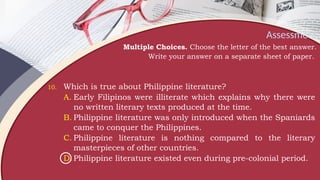
10. Which is true about Philippine literature?
A. Early Filipinos were illiterate which explains why there were
no written literary texts produced at the time.
B. Philippine literature was only introduced when the Spaniards
came to conquer the Philippines.
C. Philippine literature is nothing compared to the literary
masterpieces of other countries.
D.Philippine literature existed even during pre-colonial period.

Exploring Philippine Literacy Forms, Genres, Elements, and Traditions.pptx

  • 1.
    21st Century Literature fromthe Philippines and the World Teacher: Edmar Gilla
  • 2.
    Exploring Philippine LiteracyForms, Genres, Elements, and Traditions • Philippine literature is as rich and diverse as the 7500 plus islands that make up our archipelago. This is not surprising considering that we have 183 living languages (ethnologue.com) across 17 regions comprised of 82 provinces. One can only imagine the many forms of artistic communication (oral or written) that have been passed on to and through generations, communities, and groups. Lesson 1
  • 3.
    LITERATURE • is derivedfrom the Latin word "littera" which means "a letter of the alphabet". • can either be in oral or written form. Literary text • The products of written literature the best way to describe the characteristics of literary text is that (1) it narrates a story; (2) it expresses feelings, thoughts, and ideas, (3) it delivers significant information and crosses boundaries of time, places, cultures and languages.
  • 4.
    Literary Structure refers tothe organizational method used in literature in which the most common type is the narrative. Parts of the narrative structure (or plot) are the exposition, rising action, climax, falling action, and resolution (denouement).
  • 5.
    Two Major Formsof Literature 1. POETRY This literary type is usually written in lines and is characterized by having the element of rhythm, sound, imagery, and form. Its main purpose is to express feelings, thoughts, and ideas.
  • 6.
    Two Major Formsof Literature 1. POETRY It can be divided into three types: (1)narrative,(2)dramatic, and (3)lyrical poetry. a) Narrative Poetry This poetry tells a story and has the elements of a narrative such as characters, setting, conflict, etc.
  • 7.
    Two Major Formsof Literature 1. POETRY It can be divided into three types: (1)narrative,(2)dramatic, and (3)lyrical poetry. b) Dramatic Poetry This is an emotionally appealing drama written in verse that tells a story and is intended to be recited or sung in front of the audience by a character speaking in poetry.
  • 8.
    Two Major Formsof Literature 1. POETRY It can be divided into three types: (1)narrative,(2)dramatic, and (3)lyrical poetry. c) Lyric Poetry It is the most common type of poetry that focuses on expressing feelings rather than telling a story.
  • 9.
    Two Major Formsof Literature 2. PROSE In contrast to poetry, this literary piece applies a natural flow of speech and grammatical structures which are mainly consisting of complete sentences arranged logically and sequentially in a paragraph form.
  • 10.
    Two Major Formsof Literature 2. PROSE It consist of two types: (1)fiction and (2)non-fiction. a) Fiction This serves as a product of the writer's wild imagination and creative thinking where the characters react to the conflict and various issues central to the main idea of a literary work.
  • 11.
    Two Major Formsof Literature 2. PROSE It consist of two types: (1)fiction and (2)non-fiction. b) Non-Fiction These are stories inspired by real events where the writers aim to present, interpret, or describe experiences based on facts.
  • 12.
    Some Examples ofMajor Forms of Literature POETRY NARRATIVE Epic Ballad Metrical Tales DRAMATIC Dramatic Monologue Soliloquy LYRIC Haiku Ode Elegy Sonnet Song PROSE FICTION Short Story Novel Play Legend Fable NON -FICTION Biography/ Autobiography Narrative Essay Memoir Diaries andJournal
  • 13.
    Genre Refers to theforms of literature The general ones are oral and written. The main types are prose and poetry. Literary Elements refer “to particular identifiable characteristics of a whole text. The general ones are oral and written. The main types are prose and poetry.
  • 14.
    Common elements ofa story • setting, character, conflict, theme, point of view, and plot. Plot also has its own elements • exposition, rising action, climax, falling action, and resolution or denouement / de nu m / ˌ ɪˈ ː ɒ̃ Poetry • there are 4 essential elements: form, imagery, rhythm, and sound.
  • 15.
    An overview ofPhilippine Literature Historically speaking, Philippine literature can be divided into three most important periods: pre-colonial, colonial, and post-colonial. All literary works produced before the Spanish colonization such as chants, proverbs, songs, and folk narratives are considered under pre- colonial period which are mostly of oral traditions.
  • 16.
    An overview ofPhilippine Literature Our forefathers also valued words of wisdom for teaching values as evidenced by numerous proverbs or salawikain. Having bugtong or riddles was also a favorite past time and listening to narratives of bravery, magic, and heroism in epics was a box office hit.
  • 17.
    An overview ofPhilippine Literature The focus of literature suddenly changed upon the arrival of Spaniards. An emphasis on morality and religion was common in literary forms such as Corrido, Pasyon, and Cenaculo. Filipinos started to write about oppression, corruption, and other social ills such as in the works of Dr. Jose P. Rizal entitled Noli Me Tangere and its sequel El Filibusterismo.
  • 18.
    An overview ofPhilippine Literature The literary production during the American Period was inspired by the developments in education and culture. During the apprenticeship period, the Filipino writers imitated English and American models. With the new knowledge of English language, many writers started to gain recognition both locally and internationally like Jose Garcia Villa who earned the International title, “Poet of the Century" as an example.
  • 19.
    An overview ofPhilippine Literature Philippine Literature was interrupted in its development when we were conquered by Japan between 1941-1945 since freedom of expression was uncommon back then. Filipino writers in the Philippines were forbidden to write anything against the government and only those who were in exile had the privilege to do so. As a result of banning the English language, short stories written in the vernaculars flourished in the country.
  • 20.
    An overview ofPhilippine Literature The three most influential foreign invaders to the types of literature produced during colonial periods are Spanish, American, and Japanese wherein the common themes and subject mostly tackle about oppression, religion, freedom, or anything that reflects the experiences of Filipino people under the colonizers.
  • 21.
    FACT OR FICTION: WhatI Have Learned Write "Fact" if the statement is true about Philippines and "Fiction" if it is false. Write the correct word or phrase on top of the incorrect one to make the false statement right. ______________1. Earliest Philippine literature before the colonization period was rich in written literary works. ______________2. Christianity is the first religion known to ancient Filipinos. ______________3. Islam emerged first before Catholicism faith. ______________4. Philippine literature can be divided into three major periods. ______________5. The two major classifications of poetry are fiction and non-fiction.
  • 22.
    FACT OR FICTION: WhatI Have Learned Write "Fact" if the statement is true about Philippines and "Fiction" if it is false. Write the correct word or phrase on top of the incorrect one to make the false statement right. ______________6. Spanish were the ones who introduced Protestantism in the Philippines. ______________7. The Filipino is a unique blend of both Eastern and Western influences. ______________8. Biography is a non-fiction literary work. ______________9. Sounds and rhythm give a musical effect to any prose. ______________10. Philippine history and cultures are associated to the country's literature.
  • 23.
    FACT OR FICTION: WhatI Have Learned Write "Fact" if the statement is true about Philippines and "Fiction" if it is false. Write the correct word or phrase on top of the incorrect one to make the false statement right. 1. Fiction – (written) ORAL 2. Fiction – (Christianity) ISLAM 3. Fact 4. Fact 5. Fiction – (Poetry) PROSE 6. Fiction – (Spanish) AMERICAN 7. Fact 8. Fact 9. Fiction – (Prose) POETRY 10.Fact
  • 24.
  • 25.
  • 26.
  • 27.
  • 28.
    Assessment Multiple Choices. Choosethe letter of the best answer. Write your answer on a separate sheet of paper. 1. Which is NOT a description of literature? A. Literature is a way to understand human nature and to know a nation. B. Literature is a term used to describe written or spoken material. C. Literature deals with ideas, thoughts, and emotions of man. D.Literature came from the French word litera which means letters.
  • 29.
    Assessment Multiple Choices. Choosethe letter of the best answer. Write your answer on a separate sheet of paper. 2. In which period did chants, proverbs, songs, and folk narratives first emerge? A.American Period B.Post-colonial Period C.Spanish Period D.Pre-colonial Period
  • 30.
    Assessment Multiple Choices. Choosethe letter of the best answer. Write your answer on a separate sheet of paper. 3. Who brought Protestantism to the Philippines? A.Chinese B.Japanese C.Spanish D.American
  • 31.
    Assessment Multiple Choices. Choosethe letter of the best answer. Write your answer on a separate sheet of paper. 4. What is common among these literary genres: legends, myths, fables, biographies, novels, and short stories? A.They are based on true historic events. B.They are all non-fiction prose. C.They are all written in lines. D.They all have stories to tell.
  • 32.
    Assessment Multiple Choices. Choosethe letter of the best answer. Write your answer on a separate sheet of paper. 5. Which cannot be found in poetry? They are based on true historic events. A.rhyme scheme B.rhythm C.stanzas D.paragraphs
  • 33.
    Assessment Multiple Choices. Choosethe letter of the best answer. Write your answer on a separate sheet of paper. 6. What element of a story is depicted in this text: “It was 1986. The country was still euphoric for having ended a terrible regime”? A.conflict B.point of view C.theme D.setting
  • 34.
    Assessment Multiple Choices. Choosethe letter of the best answer. Write your answer on a separate sheet of paper. 7. What element of a story is depicted in this text: “The hero faces the fiercest enemy of all- his monstrous other self”? A.Character B.Plot C.Setting D.Conflict
  • 35.
    Assessment Multiple Choices. Choosethe letter of the best answer. Write your answer on a separate sheet of paper. 8. What element of a story is depicted in this text: “Her name is Ella, 26 years old. Her neighbors think she’s feisty.”? A.Conflict B.Plot C.Theme D.Character
  • 36.
    Assessment Multiple Choices. Choosethe letter of the best answer. Write your answer on a separate sheet of paper. 9. Which element of poetry is shown in these lines of the poem entitled "Ang Babaing Nangarap Nang Gising" by Virgilio Almario? Naisumpa niya noong dalagita Na siya'y aahon Mula sa malansa at bukid na basa Ng liblib na nayon; A.Alliteration B.Assonance C.Onomatopoeia D.Rhyme
  • 37.
    Assessment Multiple Choices. Choosethe letter of the best answer. Write your answer on a separate sheet of paper. 10. Which is true about Philippine literature? A. Early Filipinos were illiterate which explains why there were no written literary texts produced at the time. B. Philippine literature was only introduced when the Spaniards came to conquer the Philippines. C. Philippine literature is nothing compared to the literary masterpieces of other countries. D.Philippine literature existed even during pre-colonial period.