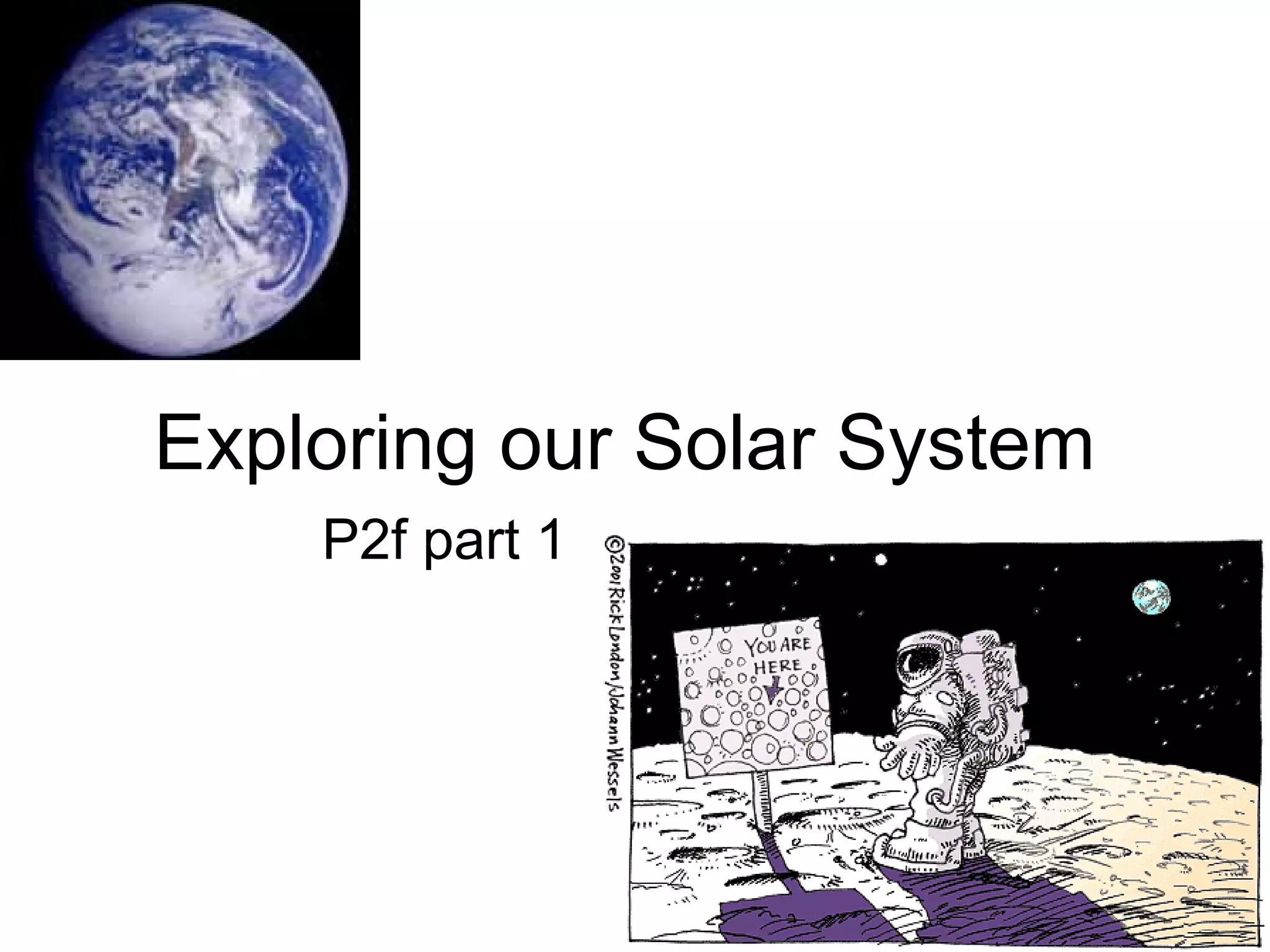
Exploring our Solar System P2f part 1
Objectives In this lesson we should learn: about the bodies in space that make up the Universe why planets and moons stay in orbits about the planets in our Solar System, producing a model of the Solar System
Outcomes Foundation Paper You should now be able to.. Know that: Earth is one of a number of planets that orbit the Sun: the Moon orbits Earth; Earth orbits the Sun and the relative positions of Earth, Sun and planets  Know that the Universe consists of: stars and planets, comets and meteors, black holes, large groups of stars called galaxies Describe why stars can be seen even though they are far away  Describe that gravitational force determines the motion of planets and satellites   Higher paper Know the relative positions of planets, stars, comets, meteors, galaxies and black holes Know that circular motion requires a centripetal force and that gravity provides the centripetal force for orbital motion
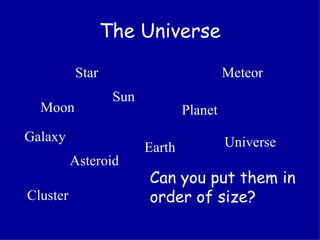
The Universe Moon Cluster Star Meteor Sun Universe Earth Asteroid  Galaxy  Planet Can you put them in order of size?
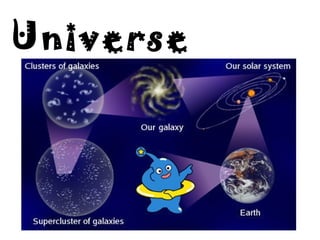
Universe
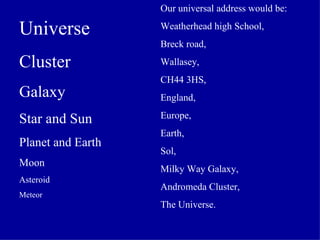
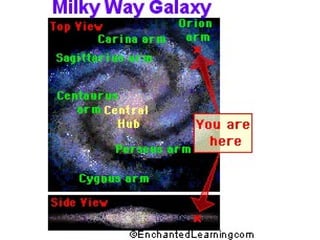
Universe Cluster Galaxy Star and Sun Planet and Earth Moon Asteroid Meteor Our universal address would be: Weatherhead high School, Breck road, Wallasey, CH44 3HS, England, Europe, Earth, Sol, Milky Way Galaxy, Andromeda Cluster, The Universe.
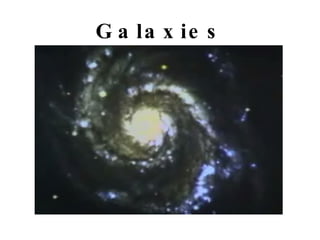
Galaxies
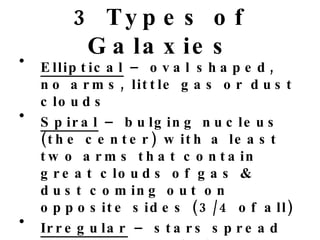
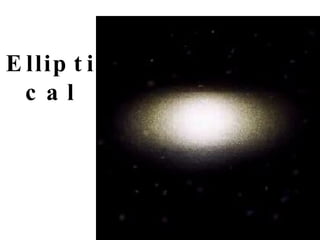
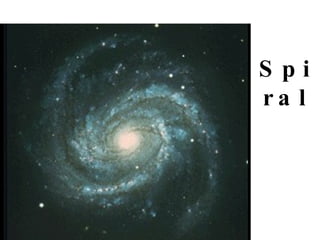
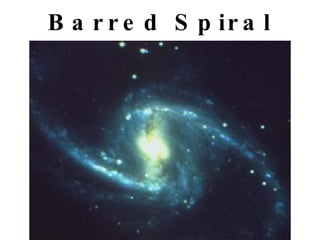
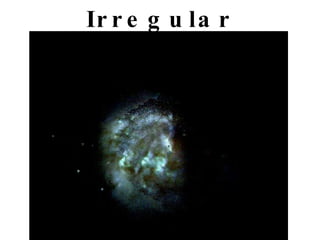
3 Types of Galaxies Elliptical  – oval shaped, no arms, little gas or dust clouds Spiral  – bulging nucleus (the center) with a least two arms that contain great clouds of gas & dust coming out on opposite sides (3/4 of all) Irregular  – stars spread unevenly, no distinct shape, least common
 
Elliptical
Spiral
Barred Spiral
Irregular
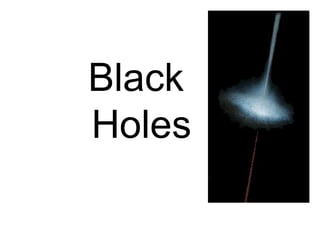
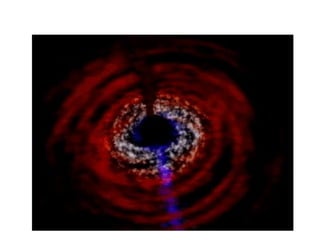
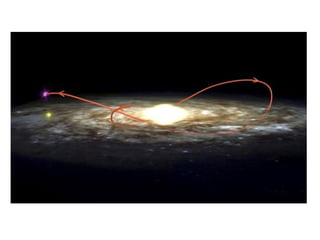
Black holes The gravity on neutron stars, white dwarfs and black dwarfs is so strong that it crushes atoms, so the matter in stars is millions of times denser than anything on earth. A black hole is formed if enough of this dense matter is left behind after a supernova explosion then the gravitational field is so strong that nothing can escape not even light. Scientists know they exist using x-rays
Black  Holes
 
 
Black Holes The intense gravitational field left when a giant star collapses
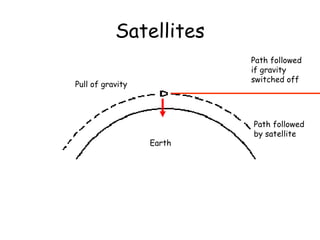
Satellites Path followed by satellite Path followed if gravity switched off Pull of gravity Earth
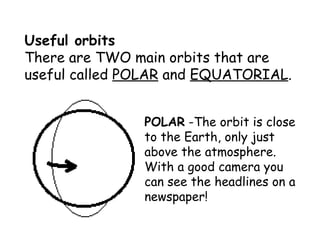
Useful orbits There are TWO main orbits that are useful called  POLAR  and  EQUATORIAL . POLAR  -The orbit is close to the Earth, only just above the atmosphere. With a good camera you can see the headlines on a newspaper!
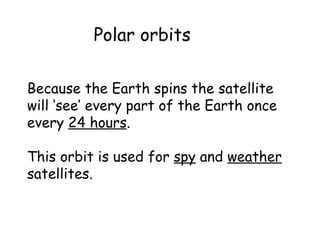
Because the Earth spins the satellite will ‘see’ every part of the Earth once every  24 hours . This orbit is used for  spy  and  weather  satellites. Polar orbits
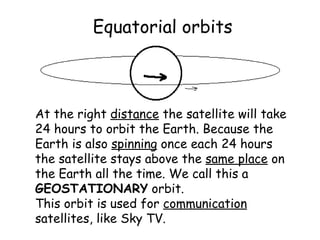
Equatorial orbits At the right  distance  the satellite will take 24 hours to orbit the Earth. Because the Earth is also  spinning  once each 24 hours the satellite stays above the  same place  on the Earth all the time. We call this a  GEOSTATIONARY  orbit. This orbit is used for  communication  satellites, like Sky TV.
Outcomes Foundation Paper You should now be able to.. Know that: Earth is one of a number of planets that orbit the Sun: the Moon orbits Earth; Earth orbits the Sun and the relative positions of Earth, Sun and planets  Know that the Universe consists of: stars and planets, comets and meteors, black holes, large groups of stars called galaxies Describe why stars can be seen even though they are far away  Describe that gravitational force determines the motion of planets and satellites   Higher paper Know the relative positions of planets, stars, comets, meteors, galaxies and black holes Know that circular motion requires a centripetal force and that gravity provides the centripetal force for orbital motion
This powerpoint was kindly donated to  www.worldofteaching.com http://www.worldofteaching.com  is home to over a thousand powerpoints submitted by teachers. This is a completely free site and requires no registration. Please visit and I hope it will help in your teaching.

Exploring Our Solar System Part 1

  • 1.
    Exploring our SolarSystem P2f part 1
  • 2.
    Objectives In thislesson we should learn: about the bodies in space that make up the Universe why planets and moons stay in orbits about the planets in our Solar System, producing a model of the Solar System
  • 3.
    Outcomes Foundation PaperYou should now be able to.. Know that: Earth is one of a number of planets that orbit the Sun: the Moon orbits Earth; Earth orbits the Sun and the relative positions of Earth, Sun and planets Know that the Universe consists of: stars and planets, comets and meteors, black holes, large groups of stars called galaxies Describe why stars can be seen even though they are far away Describe that gravitational force determines the motion of planets and satellites Higher paper Know the relative positions of planets, stars, comets, meteors, galaxies and black holes Know that circular motion requires a centripetal force and that gravity provides the centripetal force for orbital motion
  • 4.
    The Universe MoonCluster Star Meteor Sun Universe Earth Asteroid Galaxy Planet Can you put them in order of size?
  • 5.
  • 6.
    Universe Cluster GalaxyStar and Sun Planet and Earth Moon Asteroid Meteor Our universal address would be: Weatherhead high School, Breck road, Wallasey, CH44 3HS, England, Europe, Earth, Sol, Milky Way Galaxy, Andromeda Cluster, The Universe.
  • 7.
  • 8.
    3 Types ofGalaxies Elliptical – oval shaped, no arms, little gas or dust clouds Spiral – bulging nucleus (the center) with a least two arms that contain great clouds of gas & dust coming out on opposite sides (3/4 of all) Irregular – stars spread unevenly, no distinct shape, least common
  • 9.
  • 10.
  • 11.
  • 12.
  • 13.
  • 14.
    Black holes Thegravity on neutron stars, white dwarfs and black dwarfs is so strong that it crushes atoms, so the matter in stars is millions of times denser than anything on earth. A black hole is formed if enough of this dense matter is left behind after a supernova explosion then the gravitational field is so strong that nothing can escape not even light. Scientists know they exist using x-rays
  • 15.
  • 16.
  • 17.
  • 18.
    Black Holes Theintense gravitational field left when a giant star collapses
  • 19.
    Satellites Path followedby satellite Path followed if gravity switched off Pull of gravity Earth
  • 20.
    Useful orbits Thereare TWO main orbits that are useful called POLAR and EQUATORIAL . POLAR -The orbit is close to the Earth, only just above the atmosphere. With a good camera you can see the headlines on a newspaper!
  • 21.
    Because the Earthspins the satellite will ‘see’ every part of the Earth once every 24 hours . This orbit is used for spy and weather satellites. Polar orbits
  • 22.
    Equatorial orbits Atthe right distance the satellite will take 24 hours to orbit the Earth. Because the Earth is also spinning once each 24 hours the satellite stays above the same place on the Earth all the time. We call this a GEOSTATIONARY orbit. This orbit is used for communication satellites, like Sky TV.
  • 23.
    Outcomes Foundation PaperYou should now be able to.. Know that: Earth is one of a number of planets that orbit the Sun: the Moon orbits Earth; Earth orbits the Sun and the relative positions of Earth, Sun and planets Know that the Universe consists of: stars and planets, comets and meteors, black holes, large groups of stars called galaxies Describe why stars can be seen even though they are far away Describe that gravitational force determines the motion of planets and satellites Higher paper Know the relative positions of planets, stars, comets, meteors, galaxies and black holes Know that circular motion requires a centripetal force and that gravity provides the centripetal force for orbital motion
  • 24.
    This powerpoint waskindly donated to www.worldofteaching.com http://www.worldofteaching.com is home to over a thousand powerpoints submitted by teachers. This is a completely free site and requires no registration. Please visit and I hope it will help in your teaching.