28/05/13
Junior CycleJunior Cycle
PhysicsPhysics
The Earth and Beyond
Edited and Reproduced by
Theresa Lowry-Lehnen
RGN, BSc (Hon’s) Specialist Clinical Practitioner (Nursing), Dip Counselling, Dip Adv Psychotherapy, BSc
(Hon’s) Clinical Science, PGCE (QTS) , H. Dip. Ed, MEd, Emotional Intelligence (Level 9) MHS Accredited
28/05/13
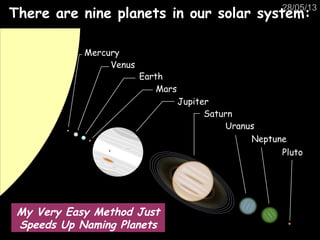
There are nine planets in our solar system:There are nine planets in our solar system:
Mercury
Mars
Jupiter
Saturn
Neptune
Uranus
Pluto
Venus
Earth
My Very Easy Method Just
Speeds Up Naming Planets
28/05/13
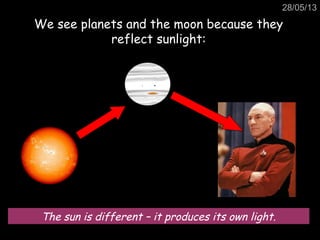
We see planets and the moon because they
reflect sunlight:
The sun is different – it produces its own light.
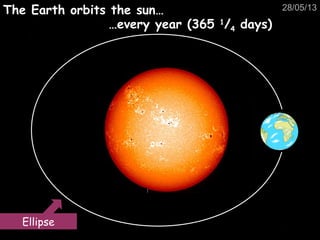
28/05/13The Earth orbits the sun…The Earth orbits the sun…
……every year (365every year (365 11
//44 days)days)
Ellipse
28/05/13
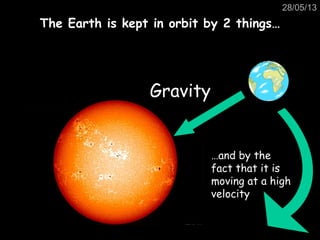
The Earth is kept in orbit by 2 things…The Earth is kept in orbit by 2 things…
GravityGravity
…and by the
fact that it is
moving at a high
velocity
28/05/13
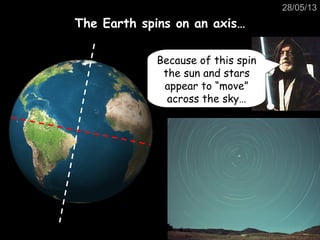
The Earth spins on an axis…
Because of this spin
the sun and stars
appear to “move”
across the sky…
28/05/13
GravityGravity
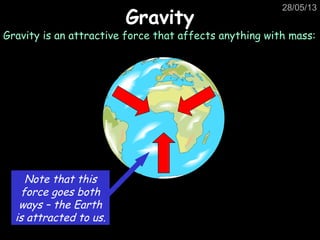
Gravity is an attractive force that affects anything with mass:
Note that this
force goes both
ways – the Earth
is attracted to us.
28/05/13
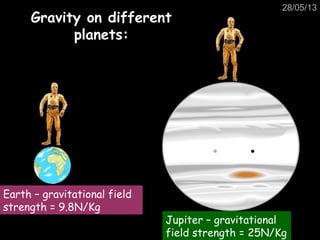
Gravity on differentGravity on different
planets:planets:
Jupiter – gravitational
field strength = 25N/Kg
Earth – gravitational field
strength = 9.8N/Kg
28/05/13
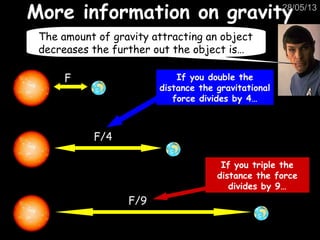
More information on gravityMore information on gravity
F
F/9
F/4
If you double the
distance the gravitational
force divides by 4…
If you triple the
distance the force
divides by 9…
The amount of gravity attracting an object
decreases the further out the object is…
28/05/13
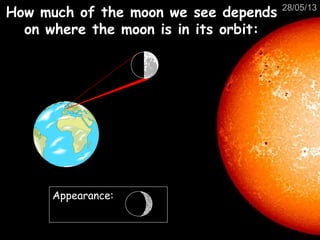
How much of the moon we see dependsHow much of the moon we see depends
on where the moon is in its orbit:on where the moon is in its orbit:
Appearance:
28/05/13
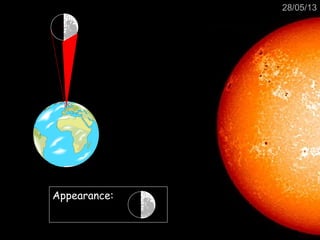
Appearance:
28/05/13
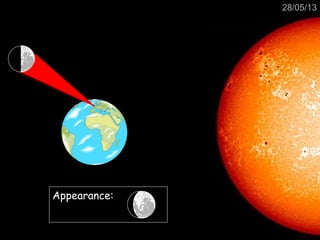
Appearance:
28/05/13
CometsComets
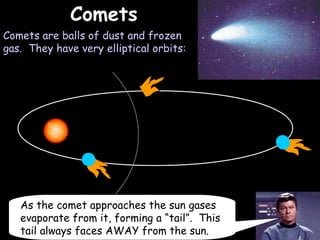
Comets are balls of dust and frozen
gas. They have very elliptical orbits:
As the comet approaches the sun gases
evaporate from it, forming a “tail”. This
tail always faces AWAY from the sun.
28/05/13
Artificial SatellitesArtificial Satellites
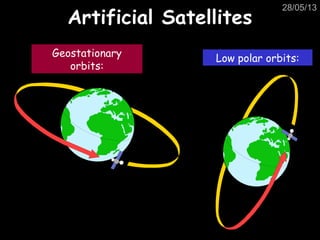
Geostationary
orbits:
Low polar orbits:
28/05/13
Artificial SatellitesArtificial Satellites
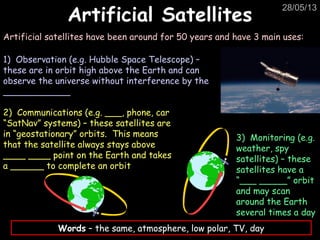
1) Observation (e.g. Hubble Space Telescope) –
these are in orbit high above the Earth and can
observe the universe without interference by the
____________
2) Communications (e.g. ___, phone, car
“SatNav” systems) – these satellites are
in “geostationary” orbits. This means
that the satellite always stays above
____ ____ point on the Earth and takes
a ______ to complete an orbit
3) Monitoring (e.g.
weather, spy
satellites) – these
satellites have a
“___ _____” orbit
and may scan
around the Earth
several times a day
Artificial satellites have been around for 50 years and have 3 main uses:
Words – the same, atmosphere, low polar, TV, day
28/05/13
Solar systems, galaxies and the UniverseSolar systems, galaxies and the Universe
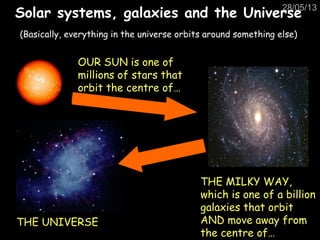
OUR SUN is one of
millions of stars that
orbit the centre of…
THE MILKY WAY,
which is one of a billion
galaxies that orbit
AND move away from
the centre of…
THE UNIVERSE
(Basically, everything in the universe orbits around something else)
28/05/13
Quiz..Quiz..
1) What is the sixth planet in the solar system?
2) What is the biggest planet in the solar system?
3) Name 2 differences between stars and planets
4) How long does the Earth take to orbit the sun?
5) What 2 things keeps the Earth in orbit?
6) Why does Mars take longer to orbit the sun than
Earth?
7) How long does the moon take to orbit the Earth?
8) Would the acceleration due to gravity on Mars be
bigger or smaller than on the Earth and why?
9) Which hemisphere is Britain in?
28/05/13
Quiz..Quiz..
10)What is the name of the line that divides the two
hemispheres?
11) How long does the Earth take to rotate?
12)Where does the sun rise and set?
13)If you double the distance between two objects what
happens to the force of gravity between them?
14)What shape describes the shape of a comet’s orbit?
15)What is a comet made up of?
16)Where does a comet’s tail point and why?
17)What keeps stars in orbit around the centre of a
galaxy?
28/05/13
Searching for ETSearching for ET
In any scientific enquiry you have to OBTAIN some evidence and
then ANALYSE it. Consider searching for extra-terrestrial life on
Mars:
OBTAINING EVIDENCE
•Fly to Mars yourself (takes ages)
•Use robots to bring back samples (not very reliable)
•Use robots to take pictures and send them back (also not very reliable)
ANALYSING EVIDENCE
•Use microscopes to search for fossilised remains
inside the samples
•Place the sample in a container and monitor changes
in the environment due to living organisms being
present in the sample
28/05/13
Evidence about the origins ofEvidence about the origins of
the universe…the universe…
28/05/13
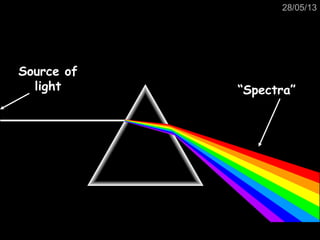
Source of
light “Spectra”
28/05/13
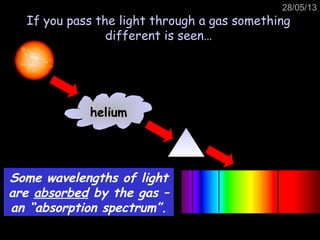
If you pass the light through a gas something
different is seen…
helium
Some wavelengths of light
are absorbed by the gas –
an “absorption spectrum”.
28/05/13
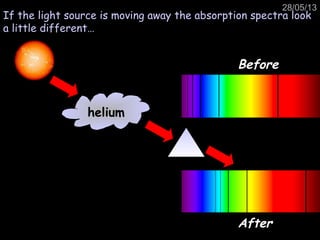
After
helium
If the light source is moving away the absorption spectra look
a little different…
helium
Before
28/05/13
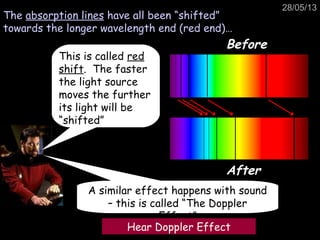
The absorption lines have all been “shifted”
towards the longer wavelength end (red end)…
After
Before
This is called red
shift. The faster
the light source
moves the further
its light will be
“shifted”
A similar effect happens with sound
– this is called “The Doppler
Effect”
Hear Doppler Effect
28/05/13
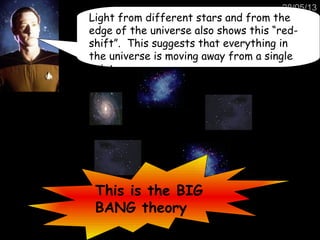
Light from different stars and from the
edge of the universe also shows this “red-
shift”. This suggests that everything in
the universe is moving away from a single
point.
This is the BIG
BANG theory
28/05/13
Red shift summaryRed shift summary
Light from other galaxies has a longer _________ than
expected. This shows that these galaxies are moving ____
from us very quickly. This effect is seen to a greater
extent in galaxies that are _______ away from us. This
indicates that the further away the galaxy is, the ______
it is moving.
This evidence seems to suggest that everything in the
universe is moving away from a single point, and that this
process started around 15 _____ years ago. This is the
____ ________ Theory.
Words to use – faster, away, big bang,
billion, wavelength, further
28/05/13
The Life Cycle of a StarThe Life Cycle of a Star
28/05/13
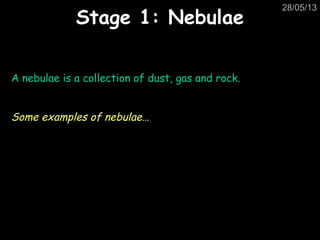
Stage 1: NebulaeStage 1: Nebulae
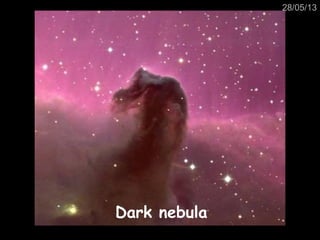
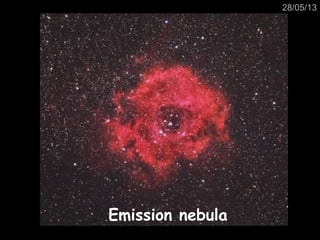
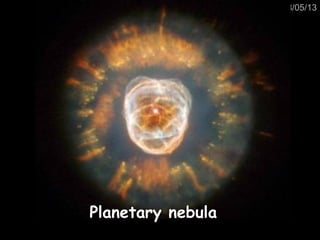
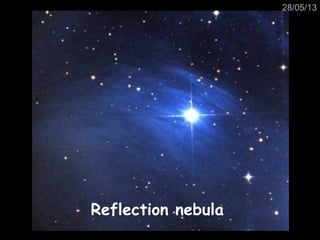
A nebulae is a collection of dust, gas and rock.
Some examples of nebulae…
28/05/13
Dark nebula
28/05/13
Emission nebula
28/05/13
Planetary nebula
28/05/13
Reflection nebula
28/05/13
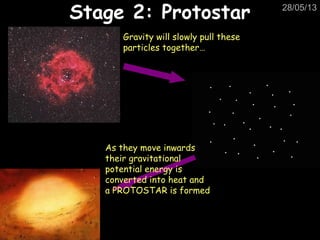
Gravity will slowly pull these
particles together…
As they move inwards
their gravitational
potential energy is
converted into heat and
a PROTOSTAR is formed
Stage 2: ProtostarStage 2: Protostar
28/05/13
Stage 3: Main SequenceStage 3: Main Sequence
Our sun is an example of a main sequence star –
it’s in the middle of a 10 billion year life span
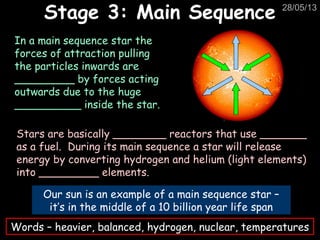
In a main sequence star the
forces of attraction pulling
the particles inwards are
_________ by forces acting
outwards due to the huge
__________ inside the star.
Stars are basically ________ reactors that use _______
as a fuel. During its main sequence a star will release
energy by converting hydrogen and helium (light elements)
into _________ elements.
Words – heavier, balanced, hydrogen, nuclear, temperatures
28/05/13
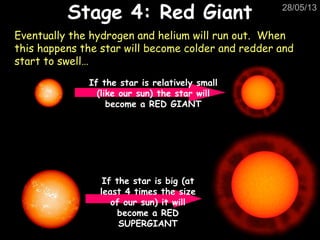
Eventually the hydrogen and helium will run out. When
this happens the star will become colder and redder and
start to swell…
If the star is relatively small
(like our sun) the star will
become a RED GIANT
If the star is big (at
least 4 times the size
of our sun) it will
become a RED
SUPERGIANT
Stage 4: Red GiantStage 4: Red Giant
28/05/13
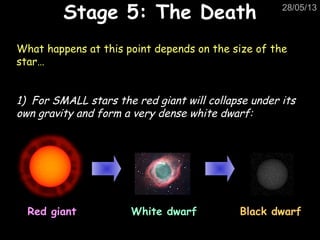
What happens at this point depends on the size of the
star…
1) For SMALL stars the red giant will collapse under its
own gravity and form a very dense white dwarf:
Stage 5: The DeathStage 5: The Death
White dwarf Black dwarfRed giant
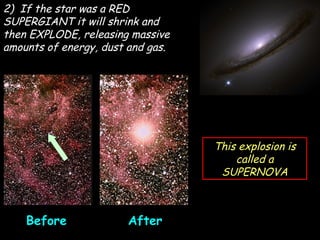
28/05/132) If the star was a RED
SUPERGIANT it will shrink and
then EXPLODE, releasing massive
amounts of energy, dust and gas.
AfterBefore
This explosion is
called a
SUPERNOVA
28/05/13
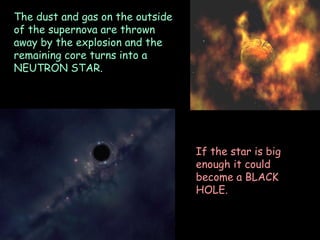
The dust and gas on the outside
of the supernova are thrown
away by the explosion and the
remaining core turns into a
NEUTRON STAR.
If the star is big
enough it could
become a BLACK
HOLE.
28/05/13
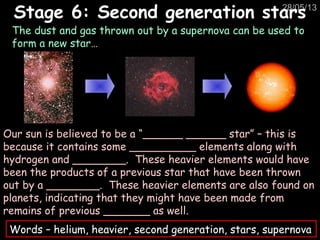
The dust and gas thrown out by a supernova can be used to
form a new star…
Stage 6: Second generation starsStage 6: Second generation stars
Our sun is believed to be a “______ ______ star” – this is
because it contains some __________ elements along with
hydrogen and ________. These heavier elements would have
been the products of a previous star that have been thrown
out by a ________. These heavier elements are also found on
planets, indicating that they might have been made from
remains of previous _______ as well.
Words – helium, heavier, second generation, stars, supernova

Junior cycle science physics the earth and beyond. By Theresa Lowry-Lehnen. Science Teacher.

  • 1.
    28/05/13 Junior CycleJunior Cycle PhysicsPhysics TheEarth and Beyond Edited and Reproduced by Theresa Lowry-Lehnen RGN, BSc (Hon’s) Specialist Clinical Practitioner (Nursing), Dip Counselling, Dip Adv Psychotherapy, BSc (Hon’s) Clinical Science, PGCE (QTS) , H. Dip. Ed, MEd, Emotional Intelligence (Level 9) MHS Accredited
  • 2.
    28/05/13 There are nineplanets in our solar system:There are nine planets in our solar system: Mercury Mars Jupiter Saturn Neptune Uranus Pluto Venus Earth My Very Easy Method Just Speeds Up Naming Planets
  • 3.
    28/05/13 We see planetsand the moon because they reflect sunlight: The sun is different – it produces its own light.
  • 4.
    28/05/13The Earth orbitsthe sun…The Earth orbits the sun… ……every year (365every year (365 11 //44 days)days) Ellipse
  • 5.
    28/05/13 The Earth iskept in orbit by 2 things…The Earth is kept in orbit by 2 things… GravityGravity …and by the fact that it is moving at a high velocity
  • 6.
    28/05/13 The Earth spinson an axis… Because of this spin the sun and stars appear to “move” across the sky…
  • 7.
    28/05/13 GravityGravity Gravity is anattractive force that affects anything with mass: Note that this force goes both ways – the Earth is attracted to us.
  • 8.
    28/05/13 Gravity on differentGravityon different planets:planets: Jupiter – gravitational field strength = 25N/Kg Earth – gravitational field strength = 9.8N/Kg
  • 9.
    28/05/13 More information ongravityMore information on gravity F F/9 F/4 If you double the distance the gravitational force divides by 4… If you triple the distance the force divides by 9… The amount of gravity attracting an object decreases the further out the object is…
  • 10.
    28/05/13 How much ofthe moon we see dependsHow much of the moon we see depends on where the moon is in its orbit:on where the moon is in its orbit: Appearance:
  • 11.
  • 12.
  • 13.
    28/05/13 CometsComets Comets are ballsof dust and frozen gas. They have very elliptical orbits: As the comet approaches the sun gases evaporate from it, forming a “tail”. This tail always faces AWAY from the sun.
  • 14.
  • 15.
    28/05/13 Artificial SatellitesArtificial Satellites 1)Observation (e.g. Hubble Space Telescope) – these are in orbit high above the Earth and can observe the universe without interference by the ____________ 2) Communications (e.g. ___, phone, car “SatNav” systems) – these satellites are in “geostationary” orbits. This means that the satellite always stays above ____ ____ point on the Earth and takes a ______ to complete an orbit 3) Monitoring (e.g. weather, spy satellites) – these satellites have a “___ _____” orbit and may scan around the Earth several times a day Artificial satellites have been around for 50 years and have 3 main uses: Words – the same, atmosphere, low polar, TV, day
  • 16.
    28/05/13 Solar systems, galaxiesand the UniverseSolar systems, galaxies and the Universe OUR SUN is one of millions of stars that orbit the centre of… THE MILKY WAY, which is one of a billion galaxies that orbit AND move away from the centre of… THE UNIVERSE (Basically, everything in the universe orbits around something else)
  • 17.
    28/05/13 Quiz..Quiz.. 1) What isthe sixth planet in the solar system? 2) What is the biggest planet in the solar system? 3) Name 2 differences between stars and planets 4) How long does the Earth take to orbit the sun? 5) What 2 things keeps the Earth in orbit? 6) Why does Mars take longer to orbit the sun than Earth? 7) How long does the moon take to orbit the Earth? 8) Would the acceleration due to gravity on Mars be bigger or smaller than on the Earth and why? 9) Which hemisphere is Britain in?
  • 18.
    28/05/13 Quiz..Quiz.. 10)What is thename of the line that divides the two hemispheres? 11) How long does the Earth take to rotate? 12)Where does the sun rise and set? 13)If you double the distance between two objects what happens to the force of gravity between them? 14)What shape describes the shape of a comet’s orbit? 15)What is a comet made up of? 16)Where does a comet’s tail point and why? 17)What keeps stars in orbit around the centre of a galaxy?
  • 19.
    28/05/13 Searching for ETSearchingfor ET In any scientific enquiry you have to OBTAIN some evidence and then ANALYSE it. Consider searching for extra-terrestrial life on Mars: OBTAINING EVIDENCE •Fly to Mars yourself (takes ages) •Use robots to bring back samples (not very reliable) •Use robots to take pictures and send them back (also not very reliable) ANALYSING EVIDENCE •Use microscopes to search for fossilised remains inside the samples •Place the sample in a container and monitor changes in the environment due to living organisms being present in the sample
  • 20.
    28/05/13 Evidence about theorigins ofEvidence about the origins of the universe…the universe…
  • 21.
  • 22.
    28/05/13 If you passthe light through a gas something different is seen… helium Some wavelengths of light are absorbed by the gas – an “absorption spectrum”.
  • 23.
    28/05/13 After helium If the lightsource is moving away the absorption spectra look a little different… helium Before
  • 24.
    28/05/13 The absorption lineshave all been “shifted” towards the longer wavelength end (red end)… After Before This is called red shift. The faster the light source moves the further its light will be “shifted” A similar effect happens with sound – this is called “The Doppler Effect” Hear Doppler Effect
  • 25.
    28/05/13 Light from differentstars and from the edge of the universe also shows this “red- shift”. This suggests that everything in the universe is moving away from a single point. This is the BIG BANG theory
  • 26.
    28/05/13 Red shift summaryRedshift summary Light from other galaxies has a longer _________ than expected. This shows that these galaxies are moving ____ from us very quickly. This effect is seen to a greater extent in galaxies that are _______ away from us. This indicates that the further away the galaxy is, the ______ it is moving. This evidence seems to suggest that everything in the universe is moving away from a single point, and that this process started around 15 _____ years ago. This is the ____ ________ Theory. Words to use – faster, away, big bang, billion, wavelength, further
  • 27.
    28/05/13 The Life Cycleof a StarThe Life Cycle of a Star
  • 28.
    28/05/13 Stage 1: NebulaeStage1: Nebulae A nebulae is a collection of dust, gas and rock. Some examples of nebulae…
  • 29.
  • 30.
  • 31.
  • 32.
  • 33.
    28/05/13 Gravity will slowlypull these particles together… As they move inwards their gravitational potential energy is converted into heat and a PROTOSTAR is formed Stage 2: ProtostarStage 2: Protostar
  • 34.
    28/05/13 Stage 3: MainSequenceStage 3: Main Sequence Our sun is an example of a main sequence star – it’s in the middle of a 10 billion year life span In a main sequence star the forces of attraction pulling the particles inwards are _________ by forces acting outwards due to the huge __________ inside the star. Stars are basically ________ reactors that use _______ as a fuel. During its main sequence a star will release energy by converting hydrogen and helium (light elements) into _________ elements. Words – heavier, balanced, hydrogen, nuclear, temperatures
  • 35.
    28/05/13 Eventually the hydrogenand helium will run out. When this happens the star will become colder and redder and start to swell… If the star is relatively small (like our sun) the star will become a RED GIANT If the star is big (at least 4 times the size of our sun) it will become a RED SUPERGIANT Stage 4: Red GiantStage 4: Red Giant
  • 36.
    28/05/13 What happens atthis point depends on the size of the star… 1) For SMALL stars the red giant will collapse under its own gravity and form a very dense white dwarf: Stage 5: The DeathStage 5: The Death White dwarf Black dwarfRed giant
  • 37.
    28/05/132) If thestar was a RED SUPERGIANT it will shrink and then EXPLODE, releasing massive amounts of energy, dust and gas. AfterBefore This explosion is called a SUPERNOVA
  • 38.
    28/05/13 The dust andgas on the outside of the supernova are thrown away by the explosion and the remaining core turns into a NEUTRON STAR. If the star is big enough it could become a BLACK HOLE.
  • 39.
    28/05/13 The dust andgas thrown out by a supernova can be used to form a new star… Stage 6: Second generation starsStage 6: Second generation stars Our sun is believed to be a “______ ______ star” – this is because it contains some __________ elements along with hydrogen and ________. These heavier elements would have been the products of a previous star that have been thrown out by a ________. These heavier elements are also found on planets, indicating that they might have been made from remains of previous _______ as well. Words – helium, heavier, second generation, stars, supernova

Editor's Notes

  • #30 (No need to know these names)
  • #31 (No need to know these names)
  • #32 (No need to know these names)
  • #33 (No need to know these names)
  • #34 The force of gravity makes the dust particles come spiralling in together. As they do so their gravitational potential energy is converted into heat energy and the temperature rises…
  • #35 Eventually the temperature rises enough for the hydrogen gas to undergo nuclear fusion. A massive amount of heat and light are given out and the star is stable for around 10,000 million years.
  • #36 Eventually the hydrogen begins to run out and the star swells into a red giant. (At this point our sun will suck in Earth and the planets around it)
  • #37 For small stars the star will shrink into a WHITE DWARF and then it cools and fades to a BLACK DWARF (like a dying fire)
  • #38 When a big star runs out of fuel it would collapse and blow off its outer layer in an enormous explosion called a SUPERNOVA (click to show picture)
  • #39 The dust and gas on the outside of the supernova are thrown away by the explosion and the remaining core turns into a NEUTRON STAR. If the star is big enough it will become a BLACK HOLE. (The picture shows a black hole after forming in the middle of other stars)
  • #40 The dust and gas thrown off by the supernova will form SECOND GENERATION stars (like our sun) and a new solar system