ExplOERing the Possibilities
of Open Educational
Resources
PRESENTED BY ERIN OWENS, ASSOCIATE PROFESSOR
SHSU TEACHING & LEARNING CONFERENCE, 15 AUG 2019
Today We Will ExplOER...
 The Problem
 OER as One Piece of a Solution
 Definitions and Distinctions
 Intersections with Social Justice
 Research on Student Success
 Common Concerns
 Group Exercise
 Benefits Beyond Cost
 OER-Enabled Pedagogy
 Final Thoughts
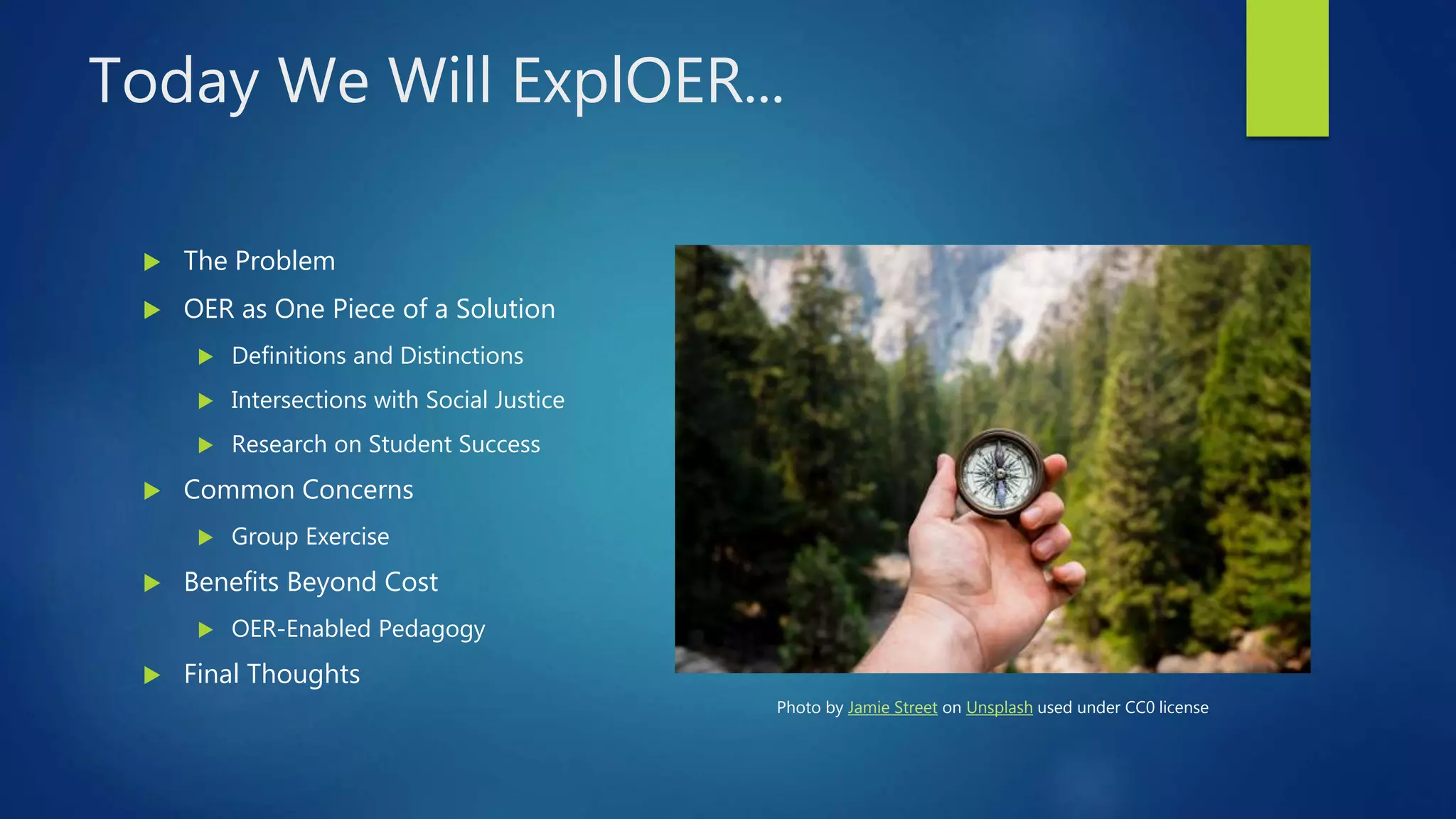
Photo by Jamie Street on Unsplash used under CC0 license
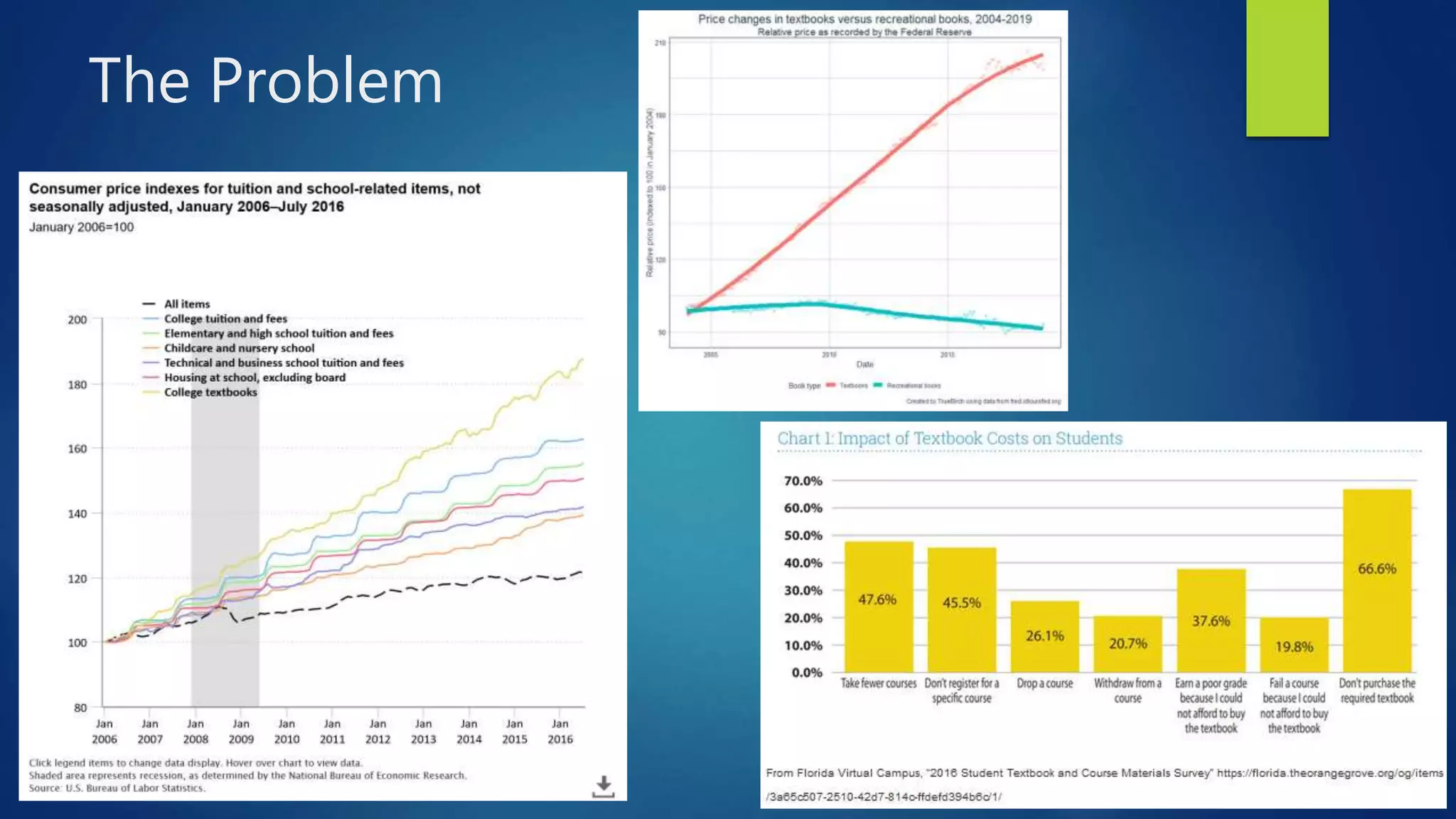
The Problem
OER as One Piece of a Solution: Definitions
and Distinctions
 Open Educational Resources (OER) – UNESCO definition:
 “teaching, learning or research materials that are in the public domain or
released with intellectual property licenses that facilitate the free use,
adaptation and distribution of resources”
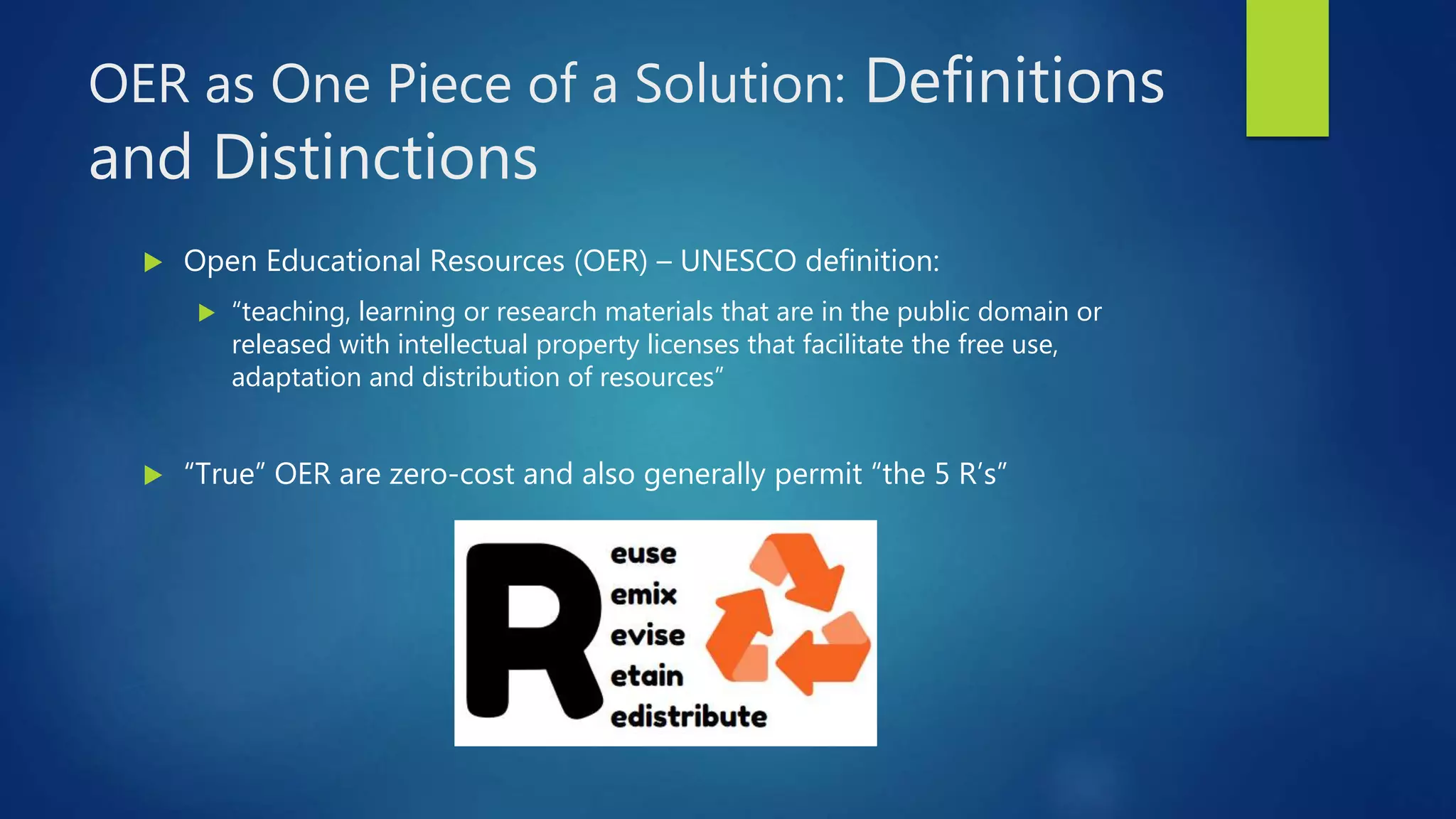
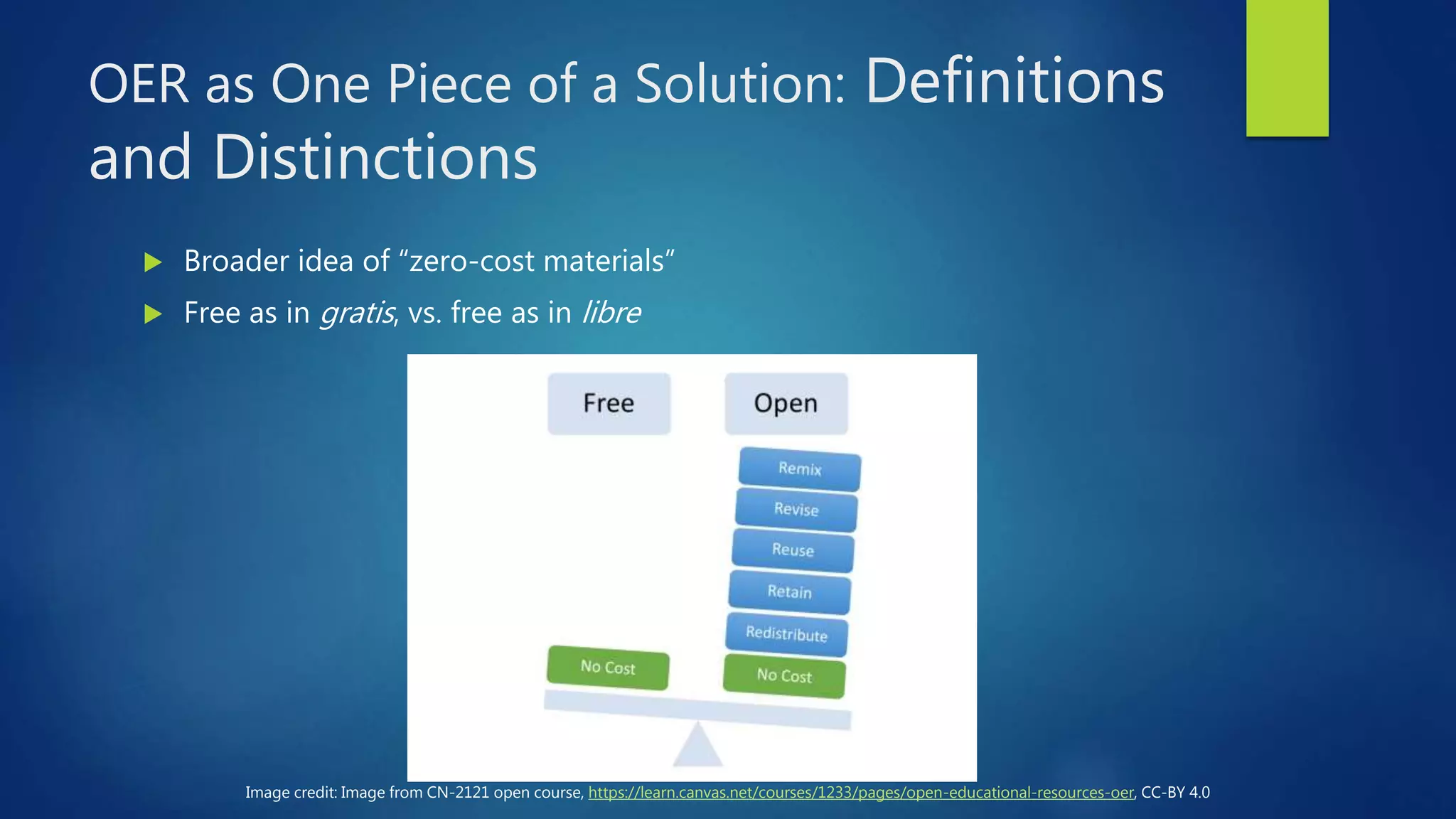
 “True” OER are zero-cost and also generally permit “the 5 R’s”
OER as One Piece of a Solution: Definitions
and Distinctions
 Broader idea of “zero-cost materials”
 Free as in gratis, vs. free as in libre
Image credit: Image from CN-2121 open course, https://learn.canvas.net/courses/1233/pages/open-educational-resources-oer, CC-BY 4.0
OER as One Piece of a Solution:
Intersections with Social Justice
“Sure, you could be the super-prepared student who knows how
to work the system and get them *all* as rentals — but not every
student can be first in line at the bookstore. And the ones at the
back of the line — guess their socio-economic class and first
generation status?”
Caulfield, M. (2015, November 9). Asking what students spend on textbooks is the wrong questions. Hapgood.us. Retrieved from
https://hapgood.us/2015/11/09/asking-what-students-spend-on-textbooks-is-the-wrong-question/
OER as One Piece of a Solution:
Research on Student Success
 2015 study; compared outcomes of OER vs. non-OER students:
 Lower course withdrawal rate (6% vs. 21%)
 Significantly higher enrollment intensity
 No statistical difference in course achievement/grade
 “This is by far the largest study of its kind conducted to date. ...Students whose
faculty chose OER generally performed as well or better than students whose
faculty assigned commercial textbooks.”
 Fischer, L., Hilton, J., Robinson, T. J., & Wiley, D. A. (2015). A multi-institutional study of the impact of open textbook adoption on
the learning outcomes of post-secondary students. Journal of Computing in Higher Education, 27(3), 159-172.
doi:10.1007/s12528-015-9101-x
OER as One Piece of a Solution:
Research on Student Success
 2016 study; in “Z courses” (zero materials cost), students were:
 Significantly less likely to withdraw from a course
 More likely to receive a C or higher in the course
 “These improved student success rates translate into more students
moving forward toward graduation without repeating courses”
 Hilton, J., Fischer, L., Wiley, D., & Williams, L. (2016). Maintaining momentum toward graduation: OER and the course
throughput rate. International Review of Research in Open and Distributed Learning, 17(6).
http://www.irrodl.org/index.php/irrodl/article/view/2686/3967
OER as One Piece of a Solution:
Research on Student Success
 2018 study; students:
 Reported overall quality of their learning experience in OER course was higher
 Found OER materials more relevant, easier to navigate, and better aligned with
learning objectives
 Saved $66-121 per course ($6.5 million net saving across 32 institutions in 2 yrs)
 Low-income students reported using these savings to cover tuition, rent, child care,
learning materials, and courses that can help them stay in school.
 “OER can be an important tool in helping more students—and particularly low-
income and underrepresented students---afford college, engage actively in their
learning, persist in their studies, and ultimately complete.”
 Griffiths, R., Gardner, S., Lundh, P., Shear, L., Ball, A., Mislevy, J., Wang, S., Desrochers, D., Staisloff, R. (2018). Participant
Experiences and Financial Impacts: Findings from Year 2 of Achieving the Dream’s OER Degree Initiative. Menlo Park, CA:
SRI International.
OER as One Piece of a Solution:
Research on Student Success
 2018 study; compared outcomes of OER vs. non-OER students:
 Decrease in Drop/Fail/Withdrawal (DFW) through B grades
 Increase in B+ through A grades
 Greater positive effects in under-served or higher-risk populations: Pell-eligible
students, non-white students, part-time students
 “This research suggests OER is an equity strategy for higher education:
providing all students with access to course materials on the first day of
class serves to level the academic playing field in course settings.”
 Colvard, N. B., Watson, C. E., & Park, H. (2018). The impact of open educational resources on various student
success metrics. International Journal of Teaching and Learning in Higher Education, 30(2): 262-276.
Benefits Beyond Cost
 Happy students (seriously)
 Enhanced performance & retention
 Institutional recruitment tool
 Customization
 Speed of updates
 OER-Enabled Pedagogy
OER-Enabled Pedagogy
 Term proposed by David Wiley,
Lumen Learning, and John Levi Hilton
III, Associate Professor of Religious
Education at Brigham Young
University
 Defined as “the set of teaching and
learning practices that are only
possible or practical in the context of
the 5R permissions that are
characteristic of OER”
Source:
http://www.irrodl.org/index.php/irrodl/article/view/3601
Photo by Jon Tyson on Unsplash used
under CC0 license
OER-Enabled Pedagogy
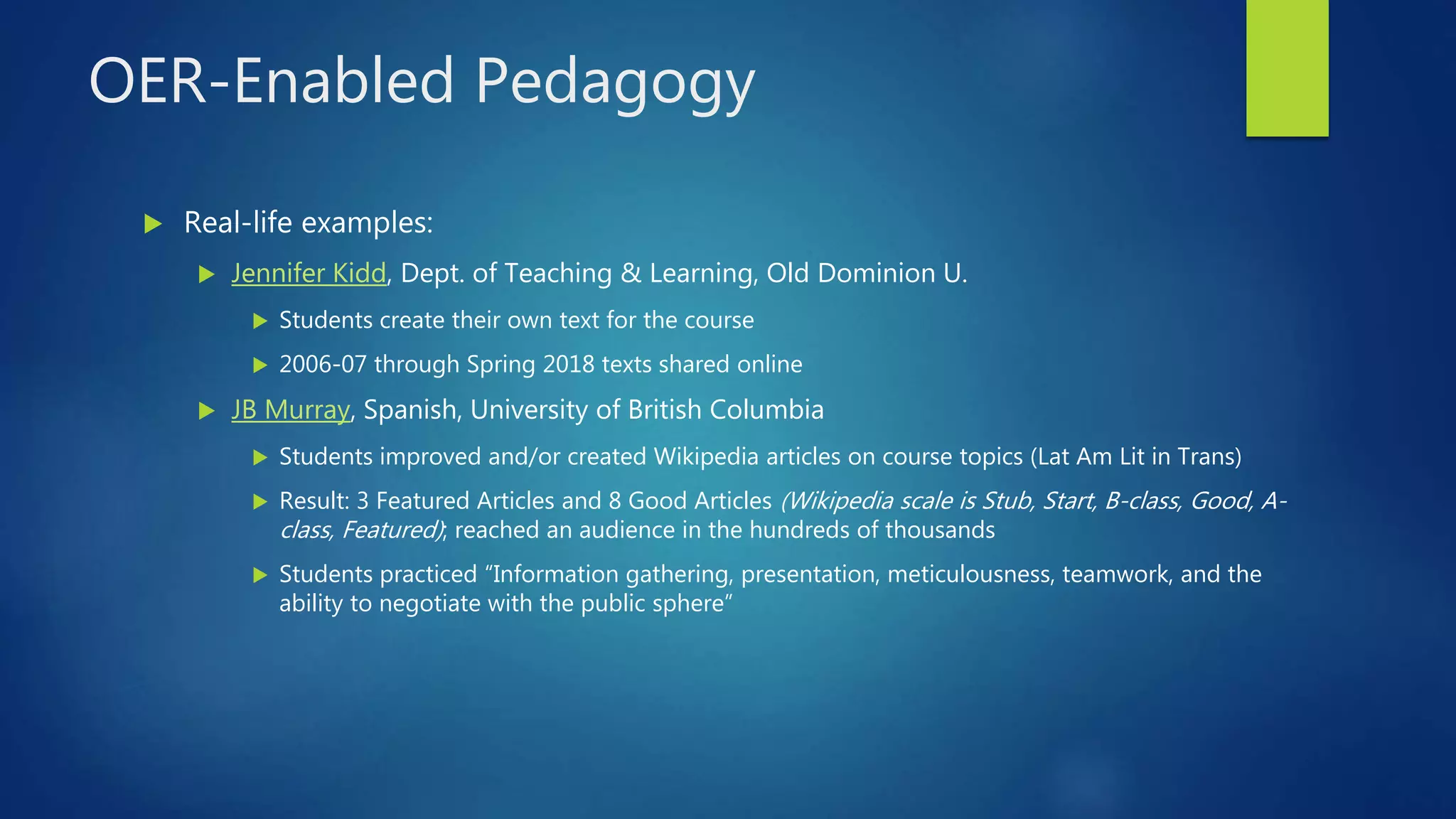
 Real-life examples:
 Jennifer Kidd, Dept. of Teaching & Learning, Old Dominion U.
 Students create their own text for the course
 2006-07 through Spring 2018 texts shared online
 JB Murray, Spanish, University of British Columbia
 Students improved and/or created Wikipedia articles on course topics (Lat Am Lit in Trans)
 Result: 3 Featured Articles and 8 Good Articles (Wikipedia scale is Stub, Start, B-class, Good, A-
class, Featured); reached an audience in the hundreds of thousands
 Students practiced “Information gathering, presentation, meticulousness, teamwork, and the
ability to negotiate with the public sphere”
OER-Enabled Pedagogy
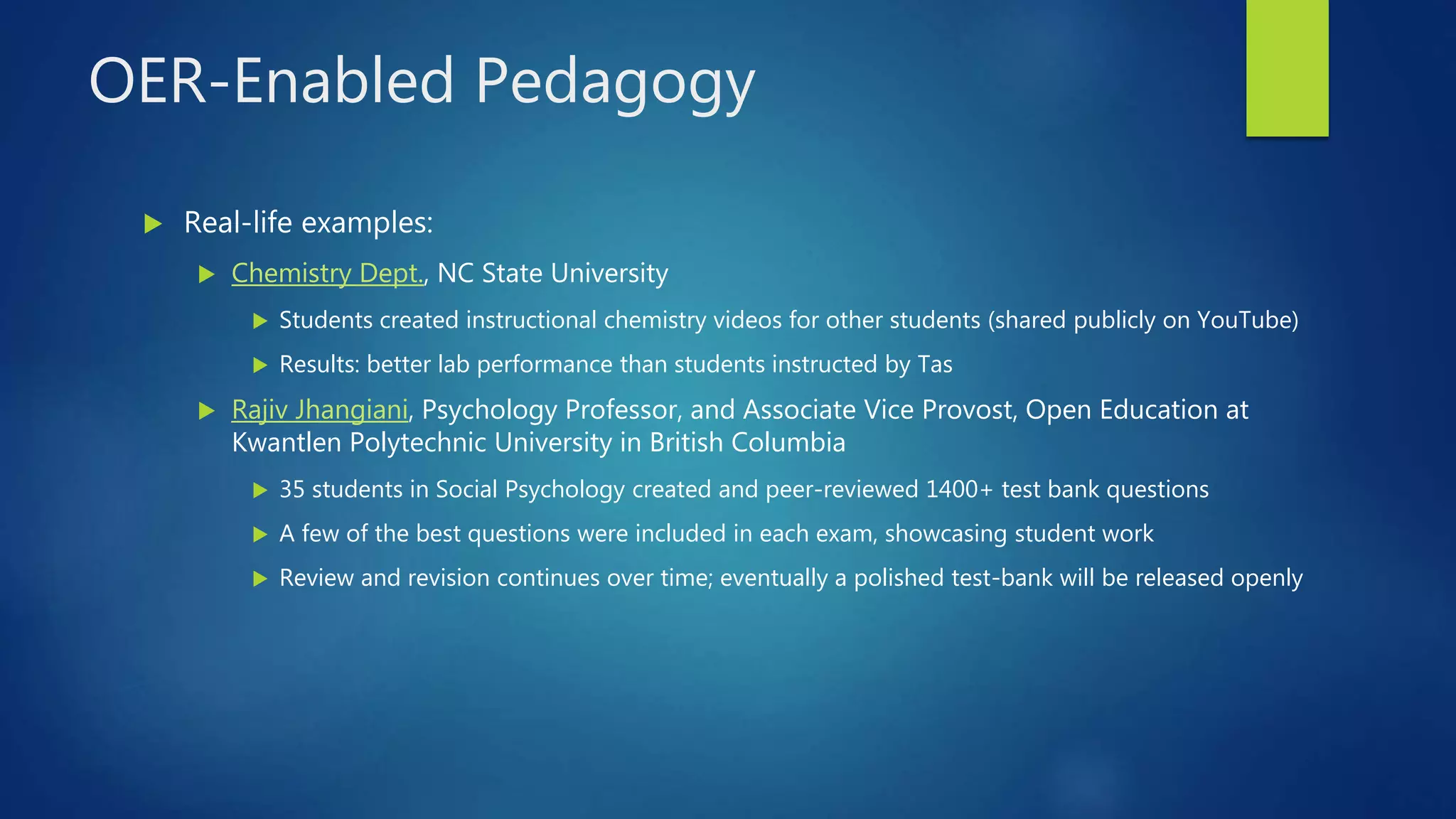
 Real-life examples:
 Chemistry Dept., NC State University
 Students created instructional chemistry videos for other students (shared publicly on YouTube)
 Results: better lab performance than students instructed by Tas
 Rajiv Jhangiani, Psychology Professor, and Associate Vice Provost, Open Education at
Kwantlen Polytechnic University in British Columbia
 35 students in Social Psychology created and peer-reviewed 1400+ test bank questions
 A few of the best questions were included in each exam, showcasing student work
 Review and revision continues over time; eventually a polished test-bank will be released openly
OER-Enabled Pedagogy
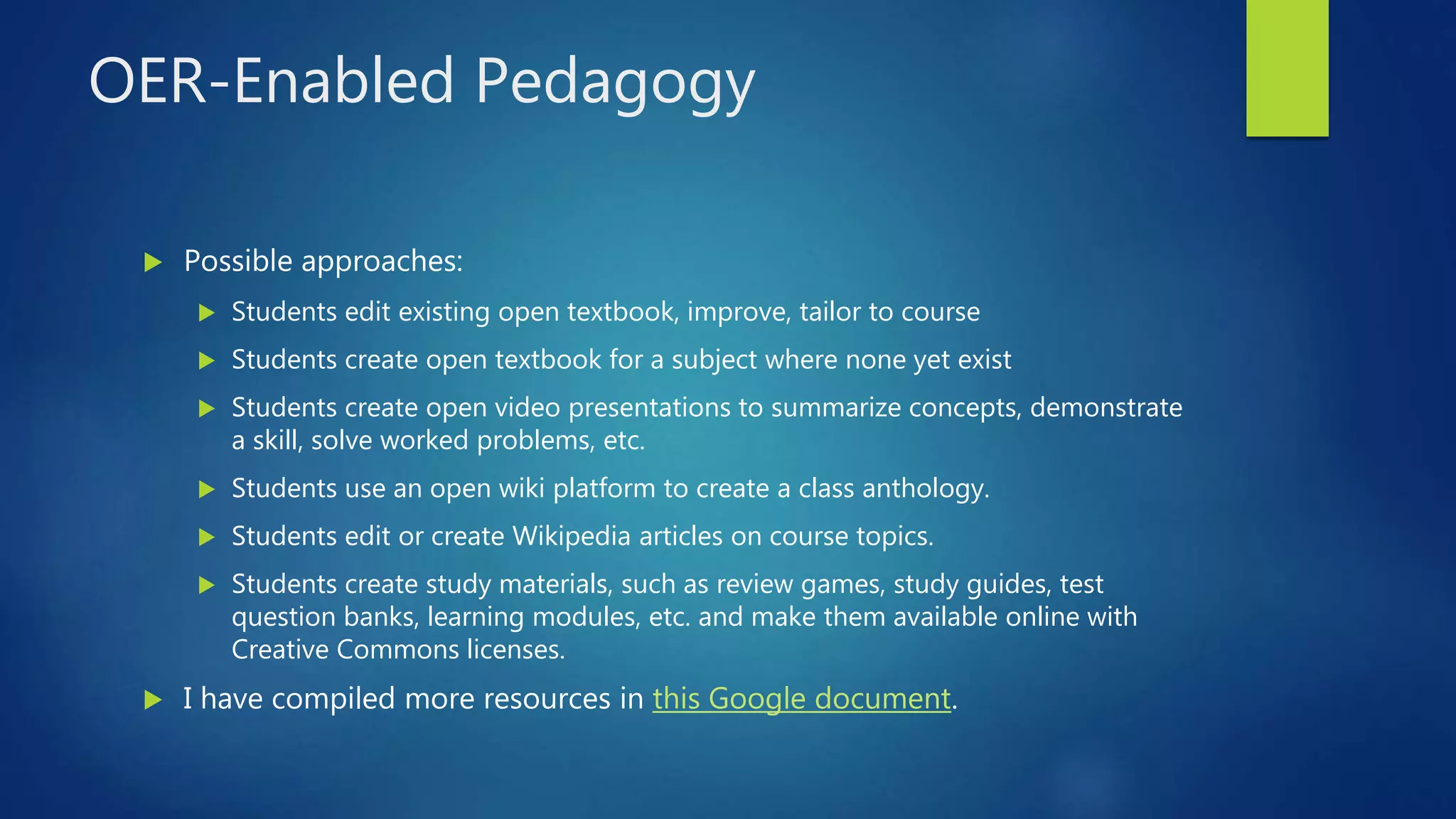
 Possible approaches:
 Students edit existing open textbook, improve, tailor to course
 Students create open textbook for a subject where none yet exist
 Students create open video presentations to summarize concepts, demonstrate
a skill, solve worked problems, etc.
 Students use an open wiki platform to create a class anthology.
 Students edit or create Wikipedia articles on course topics.
 Students create study materials, such as review games, study guides, test
question banks, learning modules, etc. and make them available online with
Creative Commons licenses.
 I have compiled more resources in this Google document.
OER-Enabled Pedagogy
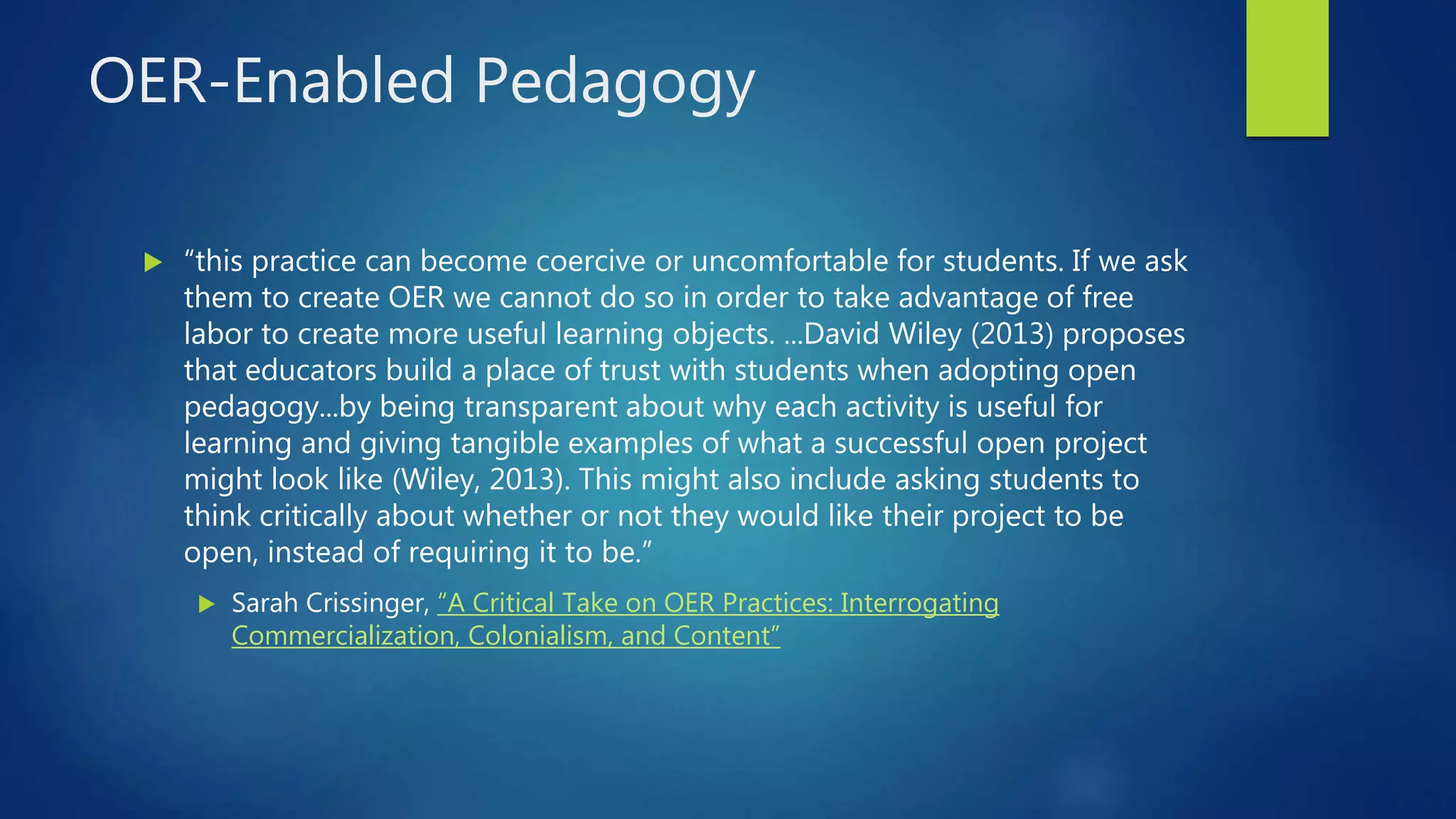
 “this practice can become coercive or uncomfortable for students. If we ask
them to create OER we cannot do so in order to take advantage of free
labor to create more useful learning objects. ...David Wiley (2013) proposes
that educators build a place of trust with students when adopting open
pedagogy...by being transparent about why each activity is useful for
learning and giving tangible examples of what a successful open project
might look like (Wiley, 2013). This might also include asking students to
think critically about whether or not they would like their project to be
open, instead of requiring it to be.”
 Sarah Crissinger, “A Critical Take on OER Practices: Interrogating
Commercialization, Colonialism, and Content”
Common Concerns
“Although students may welcome free
content, cost is just one factor faculty
consider when selecting materials for a
course. A variety of factors...help them to
determine which materials are the best
option for achieving the best learning
outcomes.”
SIIA, Selecting Quality Course Materials for Higher
Education
Photo by Ekaterina Kuznetsova on Unsplash used under CC0 license
Evaluating Quality: Tools
 Achieve OER Rubrics
I. Degree of Alignment to Standards
II. Quality of Explanation of the Subject
Matter
III. Utility of Materials Designed To
Support Teaching
IV. Quality of Assessment
V. Quality of Technological Interactivity
VI. Quality of Instructional Tasks and
Practice Exercises
VII. Opportunities for Deeper Learning
VIII. Assurance of Accessibility
 Instructional Materials Toolkit from
Software & Information Industry
Association (SIIA) and Association of
American Publishers (AAP)
 Selecting Quality Course Materials for
Higher Education;
 Identifying Quality Course Materials;
 Also K-12-specific checklists and an FAQ
on OER;
 From the Software & Information
Industry Association (SIIA) and the
Association of American Publishers (AAP)
 BC Open Textbooks Review Criteria
Group Exercise
Photo by Larisa Birta on Unsplash used under CC0 license
Final Thoughts
Photo by Juan Rumimpunu on Unsplash used under CC0 license
Thank You! Questions?
 Erin Owens
Associate Professor, SHSU
936-294-4567
eowens@shsu.edu
 Online Guide: OER and Open-Access
Resources for Teaching
https://shsulibraryguides.org/OER
 These slides will be available at this
address after today’s conference!
Photo by Howard Riminton
on Unsplash, used under CC0
license

ExplOERing the Possibilities of Open Educational Resources

  • 1.
    ExplOERing the Possibilities ofOpen Educational Resources PRESENTED BY ERIN OWENS, ASSOCIATE PROFESSOR SHSU TEACHING & LEARNING CONFERENCE, 15 AUG 2019
  • 2.
    Today We WillExplOER...  The Problem  OER as One Piece of a Solution  Definitions and Distinctions  Intersections with Social Justice  Research on Student Success  Common Concerns  Group Exercise  Benefits Beyond Cost  OER-Enabled Pedagogy  Final Thoughts Photo by Jamie Street on Unsplash used under CC0 license
  • 3.
  • 4.
    OER as OnePiece of a Solution: Definitions and Distinctions  Open Educational Resources (OER) – UNESCO definition:  “teaching, learning or research materials that are in the public domain or released with intellectual property licenses that facilitate the free use, adaptation and distribution of resources”  “True” OER are zero-cost and also generally permit “the 5 R’s”
  • 5.
    OER as OnePiece of a Solution: Definitions and Distinctions  Broader idea of “zero-cost materials”  Free as in gratis, vs. free as in libre Image credit: Image from CN-2121 open course, https://learn.canvas.net/courses/1233/pages/open-educational-resources-oer, CC-BY 4.0
  • 6.
    OER as OnePiece of a Solution: Intersections with Social Justice “Sure, you could be the super-prepared student who knows how to work the system and get them *all* as rentals — but not every student can be first in line at the bookstore. And the ones at the back of the line — guess their socio-economic class and first generation status?” Caulfield, M. (2015, November 9). Asking what students spend on textbooks is the wrong questions. Hapgood.us. Retrieved from https://hapgood.us/2015/11/09/asking-what-students-spend-on-textbooks-is-the-wrong-question/
  • 7.
    OER as OnePiece of a Solution: Research on Student Success  2015 study; compared outcomes of OER vs. non-OER students:  Lower course withdrawal rate (6% vs. 21%)  Significantly higher enrollment intensity  No statistical difference in course achievement/grade  “This is by far the largest study of its kind conducted to date. ...Students whose faculty chose OER generally performed as well or better than students whose faculty assigned commercial textbooks.”  Fischer, L., Hilton, J., Robinson, T. J., & Wiley, D. A. (2015). A multi-institutional study of the impact of open textbook adoption on the learning outcomes of post-secondary students. Journal of Computing in Higher Education, 27(3), 159-172. doi:10.1007/s12528-015-9101-x
  • 8.
    OER as OnePiece of a Solution: Research on Student Success  2016 study; in “Z courses” (zero materials cost), students were:  Significantly less likely to withdraw from a course  More likely to receive a C or higher in the course  “These improved student success rates translate into more students moving forward toward graduation without repeating courses”  Hilton, J., Fischer, L., Wiley, D., & Williams, L. (2016). Maintaining momentum toward graduation: OER and the course throughput rate. International Review of Research in Open and Distributed Learning, 17(6). http://www.irrodl.org/index.php/irrodl/article/view/2686/3967
  • 9.
    OER as OnePiece of a Solution: Research on Student Success  2018 study; students:  Reported overall quality of their learning experience in OER course was higher  Found OER materials more relevant, easier to navigate, and better aligned with learning objectives  Saved $66-121 per course ($6.5 million net saving across 32 institutions in 2 yrs)  Low-income students reported using these savings to cover tuition, rent, child care, learning materials, and courses that can help them stay in school.  “OER can be an important tool in helping more students—and particularly low- income and underrepresented students---afford college, engage actively in their learning, persist in their studies, and ultimately complete.”  Griffiths, R., Gardner, S., Lundh, P., Shear, L., Ball, A., Mislevy, J., Wang, S., Desrochers, D., Staisloff, R. (2018). Participant Experiences and Financial Impacts: Findings from Year 2 of Achieving the Dream’s OER Degree Initiative. Menlo Park, CA: SRI International.
  • 10.
    OER as OnePiece of a Solution: Research on Student Success  2018 study; compared outcomes of OER vs. non-OER students:  Decrease in Drop/Fail/Withdrawal (DFW) through B grades  Increase in B+ through A grades  Greater positive effects in under-served or higher-risk populations: Pell-eligible students, non-white students, part-time students  “This research suggests OER is an equity strategy for higher education: providing all students with access to course materials on the first day of class serves to level the academic playing field in course settings.”  Colvard, N. B., Watson, C. E., & Park, H. (2018). The impact of open educational resources on various student success metrics. International Journal of Teaching and Learning in Higher Education, 30(2): 262-276.
  • 11.
    Benefits Beyond Cost Happy students (seriously)  Enhanced performance & retention  Institutional recruitment tool  Customization  Speed of updates  OER-Enabled Pedagogy
  • 12.
    OER-Enabled Pedagogy  Termproposed by David Wiley, Lumen Learning, and John Levi Hilton III, Associate Professor of Religious Education at Brigham Young University  Defined as “the set of teaching and learning practices that are only possible or practical in the context of the 5R permissions that are characteristic of OER” Source: http://www.irrodl.org/index.php/irrodl/article/view/3601 Photo by Jon Tyson on Unsplash used under CC0 license
  • 13.
    OER-Enabled Pedagogy  Real-lifeexamples:  Jennifer Kidd, Dept. of Teaching & Learning, Old Dominion U.  Students create their own text for the course  2006-07 through Spring 2018 texts shared online  JB Murray, Spanish, University of British Columbia  Students improved and/or created Wikipedia articles on course topics (Lat Am Lit in Trans)  Result: 3 Featured Articles and 8 Good Articles (Wikipedia scale is Stub, Start, B-class, Good, A- class, Featured); reached an audience in the hundreds of thousands  Students practiced “Information gathering, presentation, meticulousness, teamwork, and the ability to negotiate with the public sphere”
  • 14.
    OER-Enabled Pedagogy  Real-lifeexamples:  Chemistry Dept., NC State University  Students created instructional chemistry videos for other students (shared publicly on YouTube)  Results: better lab performance than students instructed by Tas  Rajiv Jhangiani, Psychology Professor, and Associate Vice Provost, Open Education at Kwantlen Polytechnic University in British Columbia  35 students in Social Psychology created and peer-reviewed 1400+ test bank questions  A few of the best questions were included in each exam, showcasing student work  Review and revision continues over time; eventually a polished test-bank will be released openly
  • 15.
    OER-Enabled Pedagogy  Possibleapproaches:  Students edit existing open textbook, improve, tailor to course  Students create open textbook for a subject where none yet exist  Students create open video presentations to summarize concepts, demonstrate a skill, solve worked problems, etc.  Students use an open wiki platform to create a class anthology.  Students edit or create Wikipedia articles on course topics.  Students create study materials, such as review games, study guides, test question banks, learning modules, etc. and make them available online with Creative Commons licenses.  I have compiled more resources in this Google document.
  • 16.
    OER-Enabled Pedagogy  “thispractice can become coercive or uncomfortable for students. If we ask them to create OER we cannot do so in order to take advantage of free labor to create more useful learning objects. ...David Wiley (2013) proposes that educators build a place of trust with students when adopting open pedagogy...by being transparent about why each activity is useful for learning and giving tangible examples of what a successful open project might look like (Wiley, 2013). This might also include asking students to think critically about whether or not they would like their project to be open, instead of requiring it to be.”  Sarah Crissinger, “A Critical Take on OER Practices: Interrogating Commercialization, Colonialism, and Content”
  • 17.
    Common Concerns “Although studentsmay welcome free content, cost is just one factor faculty consider when selecting materials for a course. A variety of factors...help them to determine which materials are the best option for achieving the best learning outcomes.” SIIA, Selecting Quality Course Materials for Higher Education Photo by Ekaterina Kuznetsova on Unsplash used under CC0 license
  • 18.
    Evaluating Quality: Tools Achieve OER Rubrics I. Degree of Alignment to Standards II. Quality of Explanation of the Subject Matter III. Utility of Materials Designed To Support Teaching IV. Quality of Assessment V. Quality of Technological Interactivity VI. Quality of Instructional Tasks and Practice Exercises VII. Opportunities for Deeper Learning VIII. Assurance of Accessibility  Instructional Materials Toolkit from Software & Information Industry Association (SIIA) and Association of American Publishers (AAP)  Selecting Quality Course Materials for Higher Education;  Identifying Quality Course Materials;  Also K-12-specific checklists and an FAQ on OER;  From the Software & Information Industry Association (SIIA) and the Association of American Publishers (AAP)  BC Open Textbooks Review Criteria
  • 19.
    Group Exercise Photo byLarisa Birta on Unsplash used under CC0 license
  • 20.
    Final Thoughts Photo byJuan Rumimpunu on Unsplash used under CC0 license
  • 21.
    Thank You! Questions? Erin Owens Associate Professor, SHSU 936-294-4567 eowens@shsu.edu  Online Guide: OER and Open-Access Resources for Teaching https://shsulibraryguides.org/OER  These slides will be available at this address after today’s conference! Photo by Howard Riminton on Unsplash, used under CC0 license

Editor's Notes

  • #4 I want to address the problem in a nutshell, but without belaboring the point. College textbook costs have risen at a far greater rate than other educational costs in our society, faster than the rate of inflation. And it’s not publishing in general, because the costs of recreational books have actually decreased slightly as textbooks have skyrocketed. These costs have a real impact on students, who choose to skip courses, drop courses, or earn poor grades due to textbook costs.
  • #7 Essentially, textbook costs disproportionately impact marginalized student populations. This quote highlights one issue: students of lower socioeconomic status facing greater challenges in competing for used and rented books. Those same students are also less likely to have family members who are able to assist with purchasing costly books. They may not even arrive at school with appropriate expectations, if their parents did not attend college and could not tell them about the costs and the options. I’d like to highlight another issue specific to electronic commercial textbooks, which are generally very locked-down and provide few options for printing large quantities of material. So students who lack reliable computer and internet access at home will again be disproportionately impacted. With an open textbook, the content is still digital, but students face zero restrictions for printing the entire book to take home with them and use in an analog way. So, again I don’t want to belabor the point, but I want to be clear: We might all encounter certain students who make us feel like adopting free textbooks just means they can upgrade their smart phones sooner or buy more $5-lattes at Starbucks. But we shouldn’t overlook the other students, for whom a free textbook might make the difference in whether or not they have grocery money for the first month of classes. Carefully and thoughtfully choosing the right zero-cost materials may help to level some parts of the playing field for these students and improve their chances of completing college successfully.
  • #12 Customization: Reorganize content to better fit your approach; Delete specific sections or chapters; Edit or create new sections; Rajiv Jhangiani (Psychology Professor, and Associate Vice Provost, Open Education at Kwantlen Polytechnic University in British Columbia) points out that this can actually be seen as “an increase in academic freedom!” http://thatpsychprof.com/a-faculty-perspective-on-open-textbooks/
  • #13 Brief definition / explanation
  • #15 This ongoing revision actually ties into the related concept of “renewable assignments.” In many cases, student assignments are disposable, in the sense that they are essentially thrown away after they are graded. Renewable assignments, in contrast, have a continuing life and engage students in more meaningful work as they add some value to the world and/or provide a foundation for future students to learn from (https://openedgroup.org/doer-fellows-renewable-assignments)
  • #17 I will add one critical note on OER-enabled pedagogy that I think it is important to represent.
  • #18 Authorship? Professional vetting and peer review of content? Availability of supplemental materials? Overall quality? Discuss who creates open resources and why. Key sources for professionally vetted open material: OpenStax, Open SUNY, other university-affiliated OER repositories Key source for instructor reviews of open material: Open Textbook Library
  • #19 Obviously there are poor quality OER out there, but there are poor quality commercial materials out there, too. Educators should have a system for evaluating any new instructional materials before adoption.
  • #21 I hope this exercise has illustrated that open textbooks and quality textbooks are not mutually exclusive. It’s also worth remembering that there is no “ideal” textbook; we always make trade-offs when we select one book, and we should focus on whether the content is “good enough,” presuming the students do have access to other tools – like our teaching! (Rajiv Jhangiani, http://thatpsychprof.com/a-faculty-perspective-on-open-textbooks/) Wrapping up with some final thoughts... We do need to be sensitive to accessibility, to the digital divide, and to the deep inequity that exists in our population. “Digital” is not a silver bullet; “zero-cost” is not a panacea. But when selected carefully and used thoughtfully, OER can be one piece of the puzzle to addressing the monetary problems that plague our students, while also introducing some additional benefits and opportunities for education.