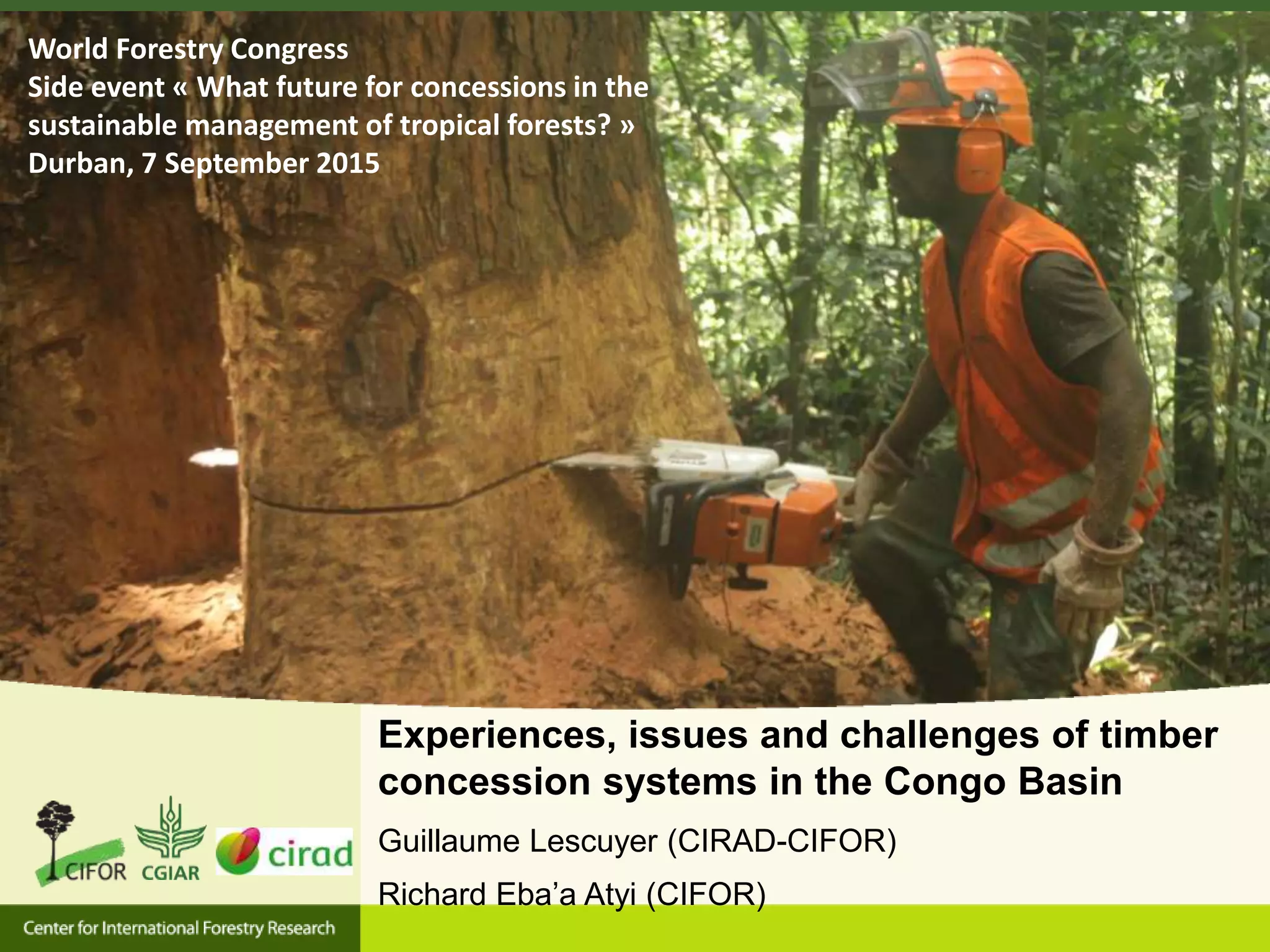
Experiences, issues and challenges of timber
concession systems in the Congo Basin
Guillaume Lescuyer (CIRAD-CIFOR)
Richard Eba’a Atyi (CIFOR)
World Forestry Congress
Side event « What future for concessions in the
sustainable management of tropical forests? »
Durban, 7 September 2015
After the Rio summit: the timber concession
becomes the main model for Sustainable Forest
Management
 An heritage from colonies: State as the owner of land and
resources + « command and control »
 1980s: Design of the Tropical Forest Action Plans
 1990s: Review of the institutional and regulatory frameworks
in all Congo Basin countries → establishment of the forest
management approach and of the logging concessions for
SFM
 A financial and technical support from international partners
to SFM and to (large) logging companies
Concessions and law enforcement -
Contributions of the FLEGT Action Plan to
implement public policy
 End of 1990s: control of law compliance instead of monitoring
SFM (that depends on multiple, complex and varying criteria)
→ 2003: FLEGT Action Plan
 VPA signed in 2009-10 by Congo, Cameroon, CAR
 EUTR officially enforced since March 2013
 Other importing countries fostered similar approaches: USA,
Australia, Japan and China
Concessions and sustainability –
Contributions of market-driven certification
 1993: FSC certification elaborated by conservation NGOs to
supplant the boycott for importing tropical timber.
 Mid-1990s: logging companies drafted a professional code of
ethics, but without monitoring and auditing processes.
 Several companies chose the FSC scheme in the 2000s:
• Securing their (public and private) European markets;
• Financial and technical supports by international NGOs and funders;
• FSC branch in Yaoundé in 2005, now in Brazzaville.
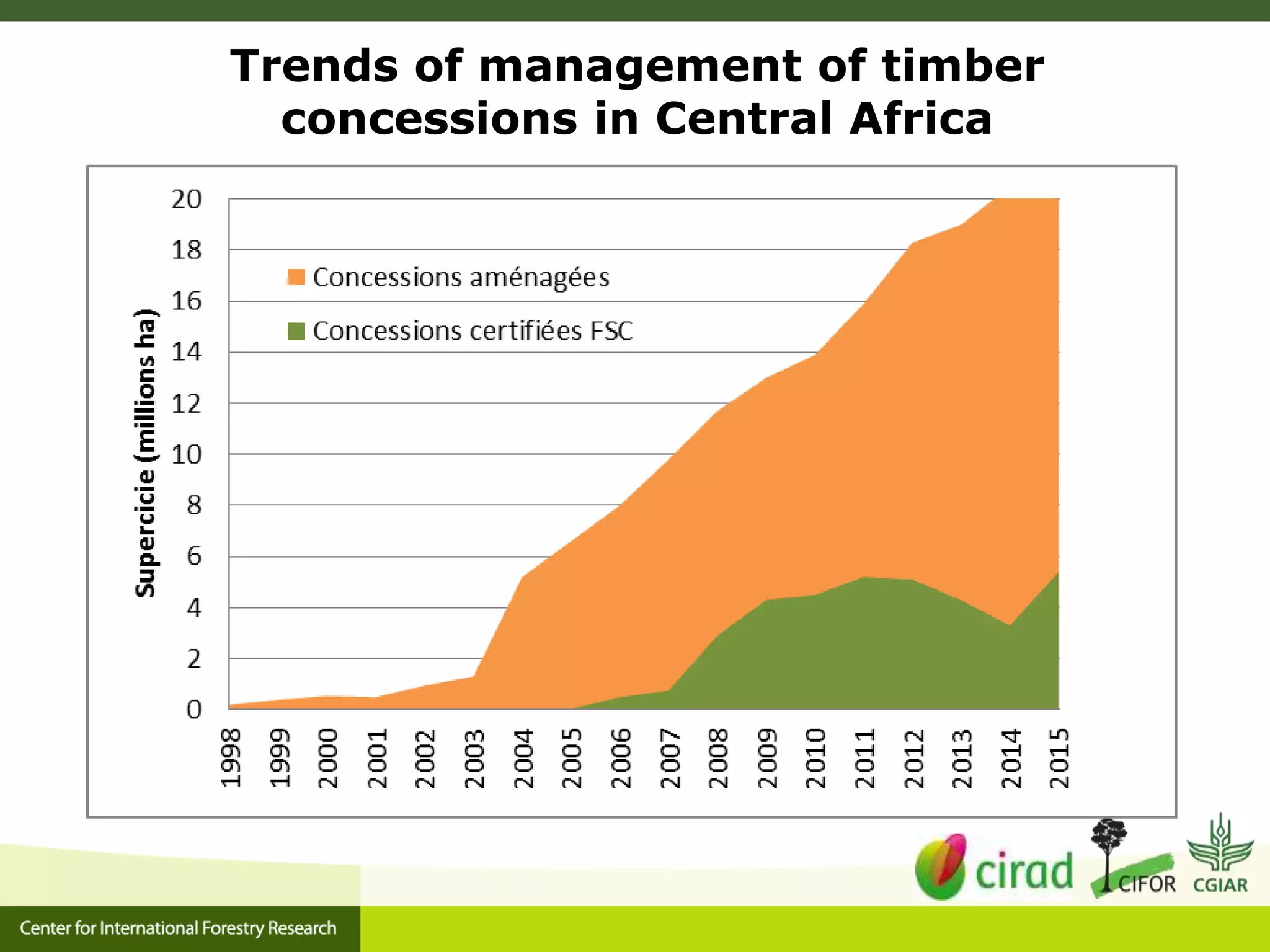
Trends of management of timber
concessions in Central Africa
A model that faces internal constraints:
Ecological limits
 A low deforestation rate in Congo Basin, but can it be
attributed to logging concessions ?
 Concerns about regeneration of timber species and
ecosystems
• Several types of forest ecosystems badly recover from
industrial timber exploitation
• Official cutting cycles are too short to allow a sufficient
regeneration of the most harvested timber species
(http://www.coforchange.eu/)
A model that faces internal constraints:
Social limits
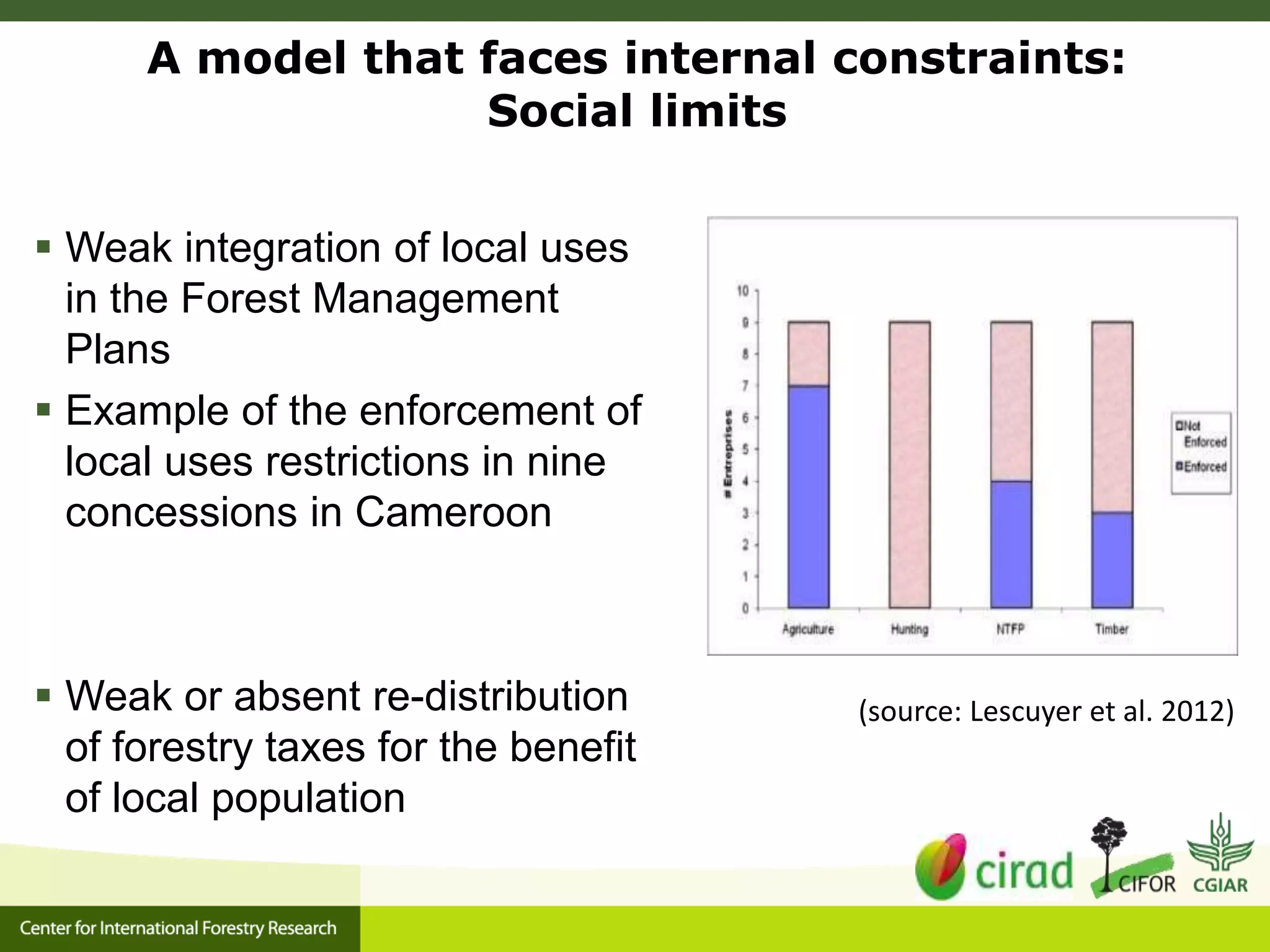
 Weak integration of local uses
in the Forest Management
Plans
 Example of the enforcement of
local uses restrictions in nine
concessions in Cameroon
 Weak or absent re-distribution
of forestry taxes for the benefit
of local population
(source: Lescuyer et al. 2012)
A model that faces internal constraints:
Financial limits
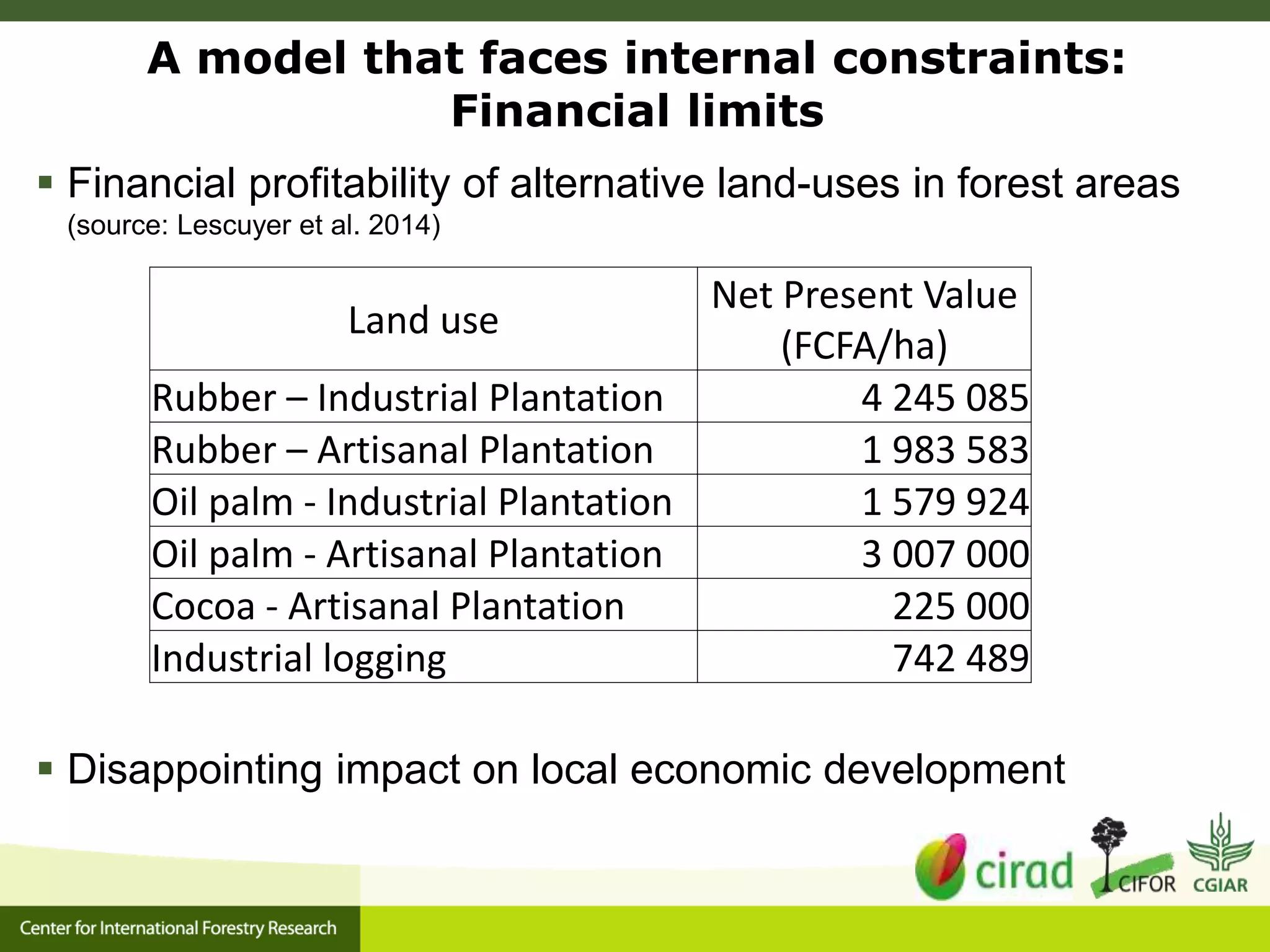
 Financial profitability of alternative land-uses in forest areas
(source: Lescuyer et al. 2014)
 Disappointing impact on local economic development
Land use
Net Present Value
(FCFA/ha)
Rubber – Industrial Plantation 4 245 085
Rubber – Artisanal Plantation 1 983 583
Oil palm - Industrial Plantation 1 579 924
Oil palm - Artisanal Plantation 3 007 000
Cocoa - Artisanal Plantation 225 000
Industrial logging 742 489
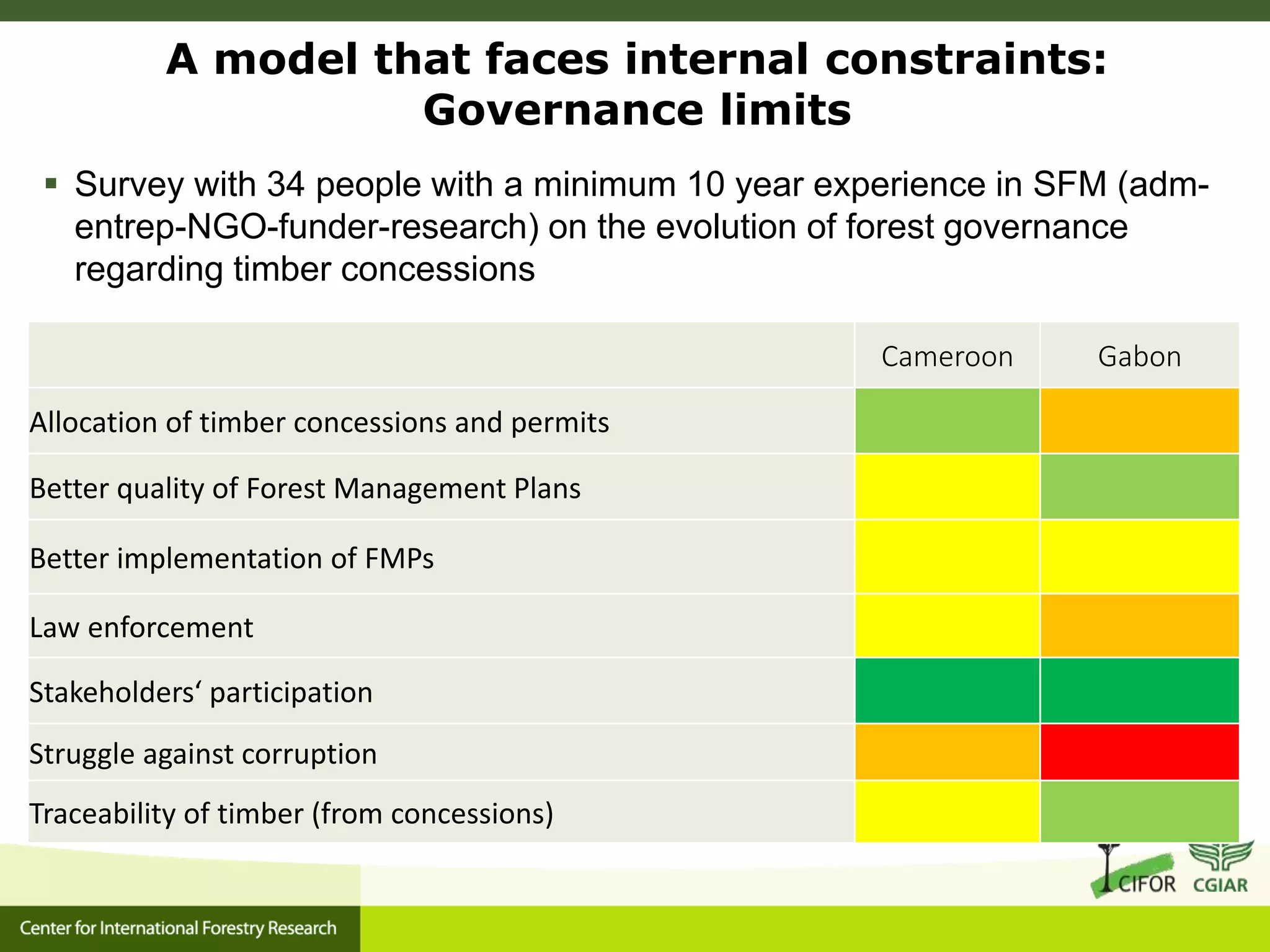
 Survey with 34 people with a minimum 10 year experience in SFM (adm-
entrep-NGO-funder-research) on the evolution of forest governance
regarding timber concessions
A model that faces internal constraints:
Governance limits
Cameroon Gabon
Allocation of timber concessions and permits
Better quality of Forest Management Plans
Better implementation of FMPs
Law enforcement
Stakeholders‘ participation
Struggle against corruption
Traceability of timber (from concessions)
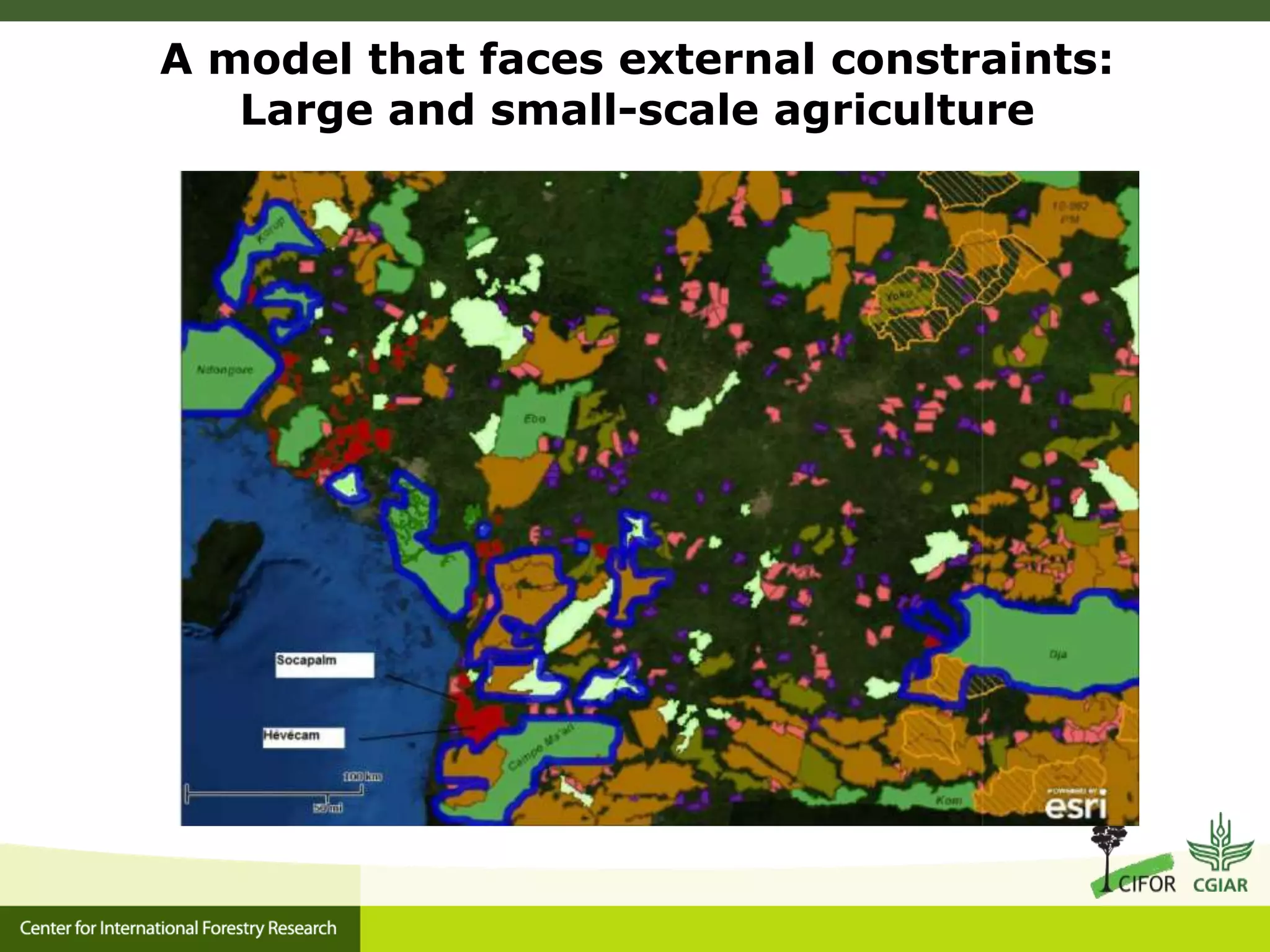
A model that faces external constraints:
Large and small-scale agriculture
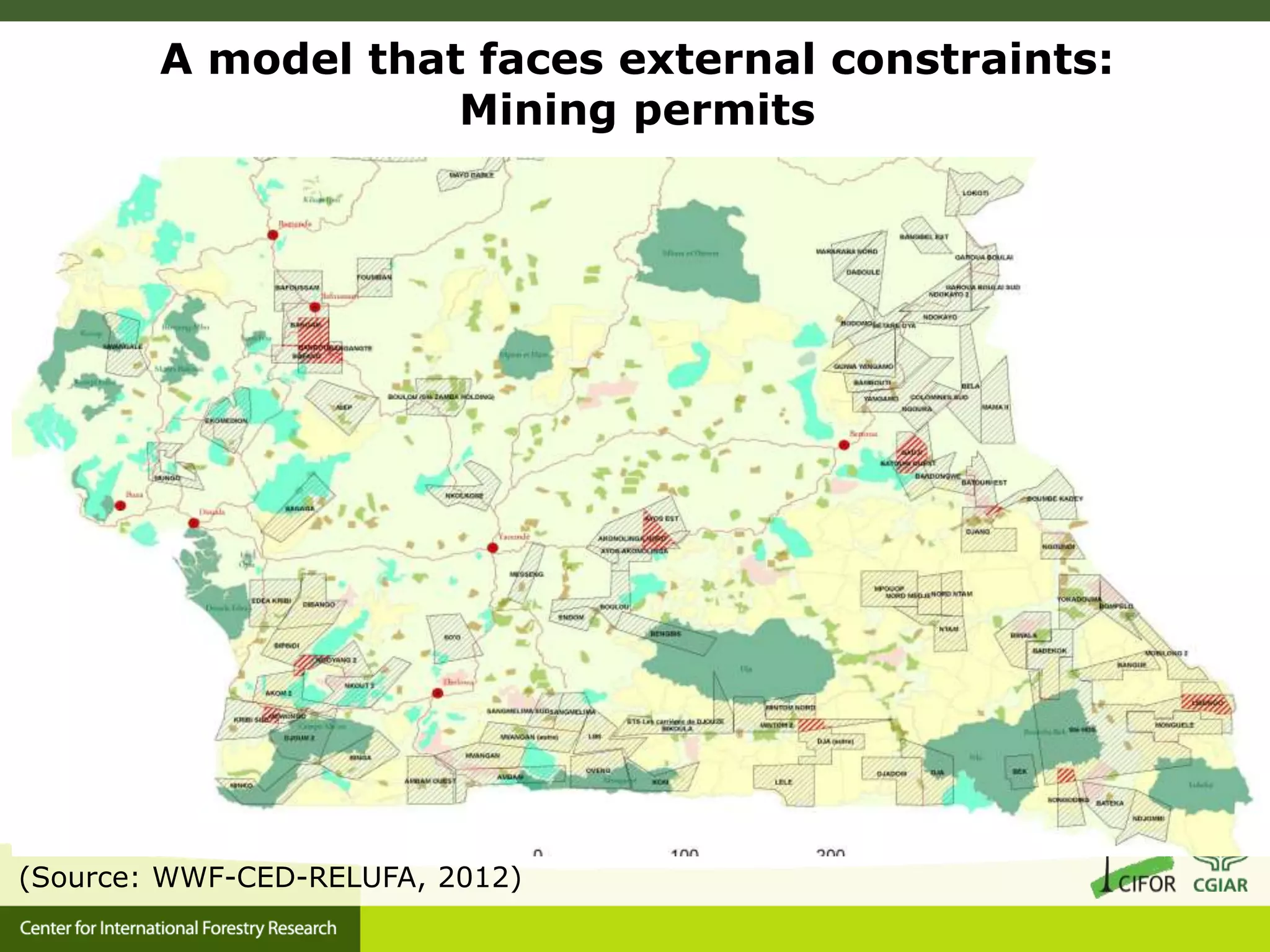
(Source: WWF-CED-RELUFA, 2012)
A model that faces external constraints:
Mining permits
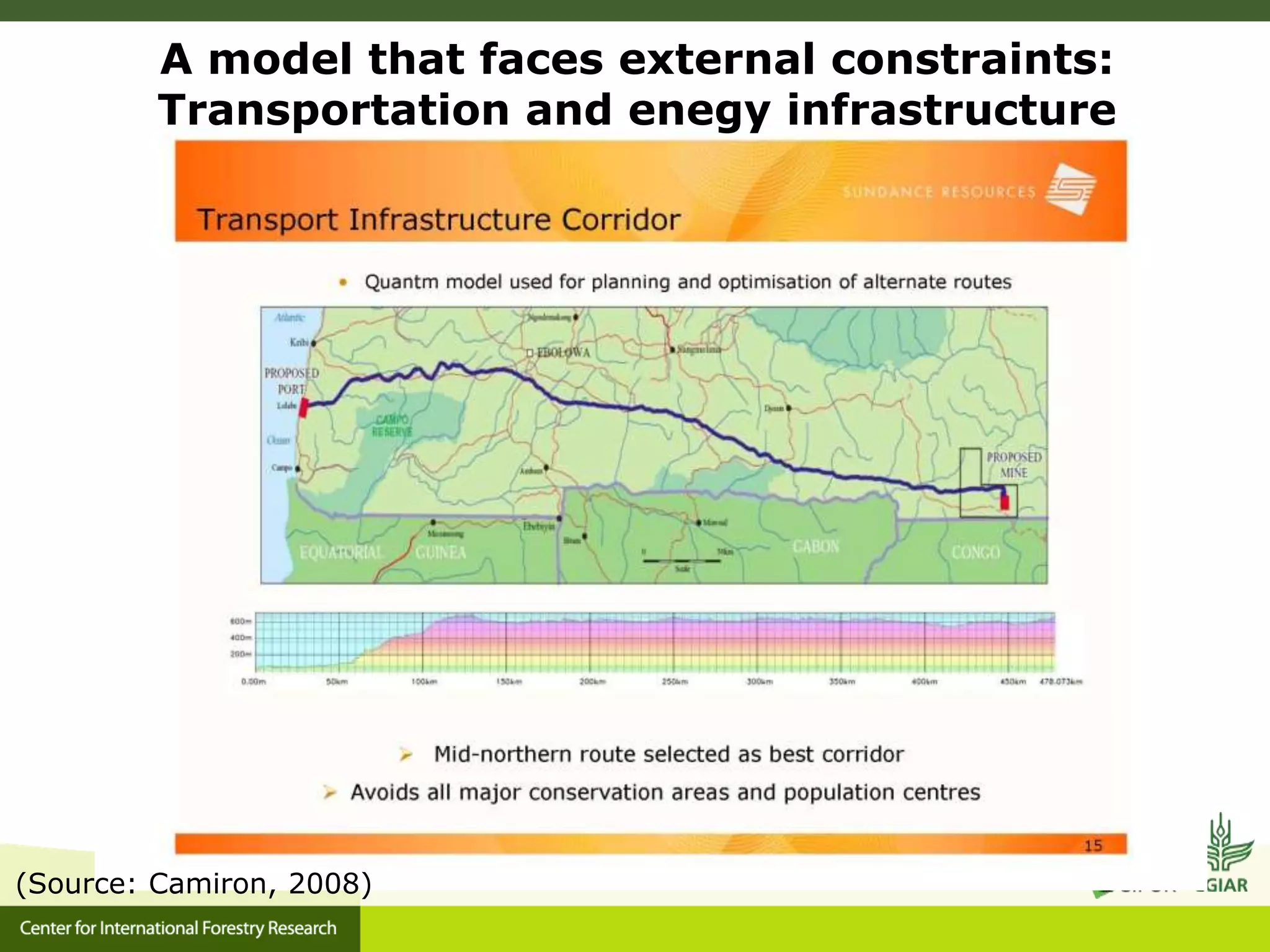
(Source: Camiron, 2008)
A model that faces external constraints:
Transportation and enegy infrastructure
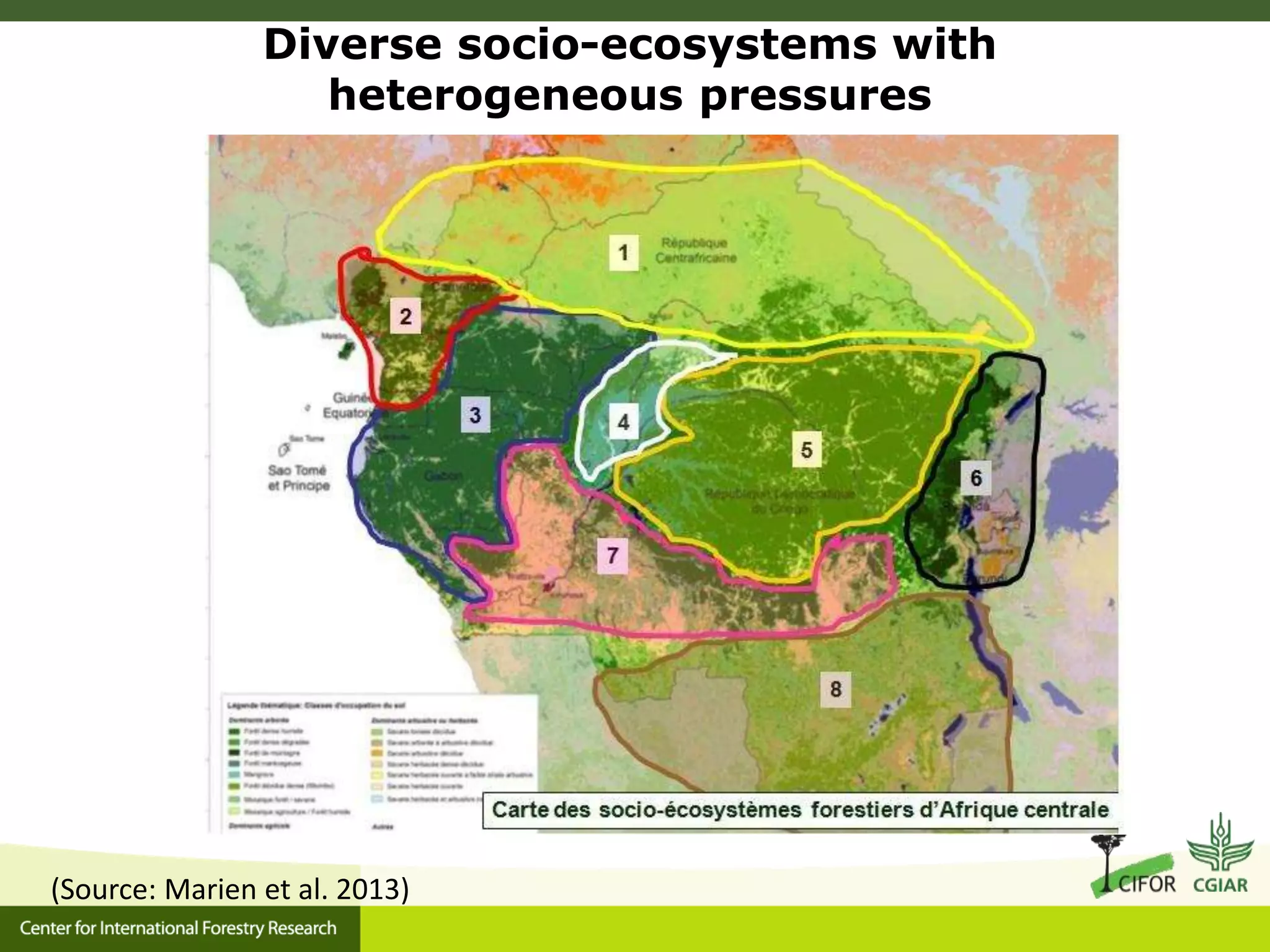
Diverse socio-ecosystems with
heterogeneous pressures
(Source: Marien et al. 2013)
What future for logging concessions in
Central Africa?
 A SFM model with mitigated outcomes, but other models for
forest land-use (CBNRM, small-scale permits, public
management) do not really do better.
 Economic development will occur at the expense of forest
areas, with an irresistible decrease and degradation of the
permanent forest domain.
 3 major challenges for timber concessions:
• Strengthen the law and sustainability compliance of timber
production.
• Promote multiple-use forest management in the timber
concessions, and build on complementarities with local uses
• Link forest management of the concession area with economic
dynamics at the micro and meso scales: timber concession
becomes the driver of a sustainable development landscape
Merci de votre
attention
lescuyer@cirad.fr
r.atyi@cgiar.org

Experiences, issues and challenges of timber concession systems in the Congo Basin

  • 1.
    Experiences, issues andchallenges of timber concession systems in the Congo Basin Guillaume Lescuyer (CIRAD-CIFOR) Richard Eba’a Atyi (CIFOR) World Forestry Congress Side event « What future for concessions in the sustainable management of tropical forests? » Durban, 7 September 2015
  • 2.
    After the Riosummit: the timber concession becomes the main model for Sustainable Forest Management  An heritage from colonies: State as the owner of land and resources + « command and control »  1980s: Design of the Tropical Forest Action Plans  1990s: Review of the institutional and regulatory frameworks in all Congo Basin countries → establishment of the forest management approach and of the logging concessions for SFM  A financial and technical support from international partners to SFM and to (large) logging companies
  • 3.
    Concessions and lawenforcement - Contributions of the FLEGT Action Plan to implement public policy  End of 1990s: control of law compliance instead of monitoring SFM (that depends on multiple, complex and varying criteria) → 2003: FLEGT Action Plan  VPA signed in 2009-10 by Congo, Cameroon, CAR  EUTR officially enforced since March 2013  Other importing countries fostered similar approaches: USA, Australia, Japan and China
  • 4.
    Concessions and sustainability– Contributions of market-driven certification  1993: FSC certification elaborated by conservation NGOs to supplant the boycott for importing tropical timber.  Mid-1990s: logging companies drafted a professional code of ethics, but without monitoring and auditing processes.  Several companies chose the FSC scheme in the 2000s: • Securing their (public and private) European markets; • Financial and technical supports by international NGOs and funders; • FSC branch in Yaoundé in 2005, now in Brazzaville.
  • 5.
    Trends of managementof timber concessions in Central Africa
  • 6.
    A model thatfaces internal constraints: Ecological limits  A low deforestation rate in Congo Basin, but can it be attributed to logging concessions ?  Concerns about regeneration of timber species and ecosystems • Several types of forest ecosystems badly recover from industrial timber exploitation • Official cutting cycles are too short to allow a sufficient regeneration of the most harvested timber species (http://www.coforchange.eu/)
  • 7.
    A model thatfaces internal constraints: Social limits  Weak integration of local uses in the Forest Management Plans  Example of the enforcement of local uses restrictions in nine concessions in Cameroon  Weak or absent re-distribution of forestry taxes for the benefit of local population (source: Lescuyer et al. 2012)
  • 8.
    A model thatfaces internal constraints: Financial limits  Financial profitability of alternative land-uses in forest areas (source: Lescuyer et al. 2014)  Disappointing impact on local economic development Land use Net Present Value (FCFA/ha) Rubber – Industrial Plantation 4 245 085 Rubber – Artisanal Plantation 1 983 583 Oil palm - Industrial Plantation 1 579 924 Oil palm - Artisanal Plantation 3 007 000 Cocoa - Artisanal Plantation 225 000 Industrial logging 742 489
  • 9.
     Survey with34 people with a minimum 10 year experience in SFM (adm- entrep-NGO-funder-research) on the evolution of forest governance regarding timber concessions A model that faces internal constraints: Governance limits Cameroon Gabon Allocation of timber concessions and permits Better quality of Forest Management Plans Better implementation of FMPs Law enforcement Stakeholders‘ participation Struggle against corruption Traceability of timber (from concessions)
  • 10.
    A model thatfaces external constraints: Large and small-scale agriculture
  • 11.
    (Source: WWF-CED-RELUFA, 2012) Amodel that faces external constraints: Mining permits
  • 12.
    (Source: Camiron, 2008) Amodel that faces external constraints: Transportation and enegy infrastructure
  • 13.
    Diverse socio-ecosystems with heterogeneouspressures (Source: Marien et al. 2013)
  • 14.
    What future forlogging concessions in Central Africa?  A SFM model with mitigated outcomes, but other models for forest land-use (CBNRM, small-scale permits, public management) do not really do better.  Economic development will occur at the expense of forest areas, with an irresistible decrease and degradation of the permanent forest domain.  3 major challenges for timber concessions: • Strengthen the law and sustainability compliance of timber production. • Promote multiple-use forest management in the timber concessions, and build on complementarities with local uses • Link forest management of the concession area with economic dynamics at the micro and meso scales: timber concession becomes the driver of a sustainable development landscape
  • 15.

Editor's Notes

  • #10 Avancée réelle, moyenne, faible, nulle, régression