Can we manage forests for
multiple uses in the Congo
Basin?

Robert Nasi, Alain Billand, Manuel Guariguata
Yaoundé, 22/05/2013
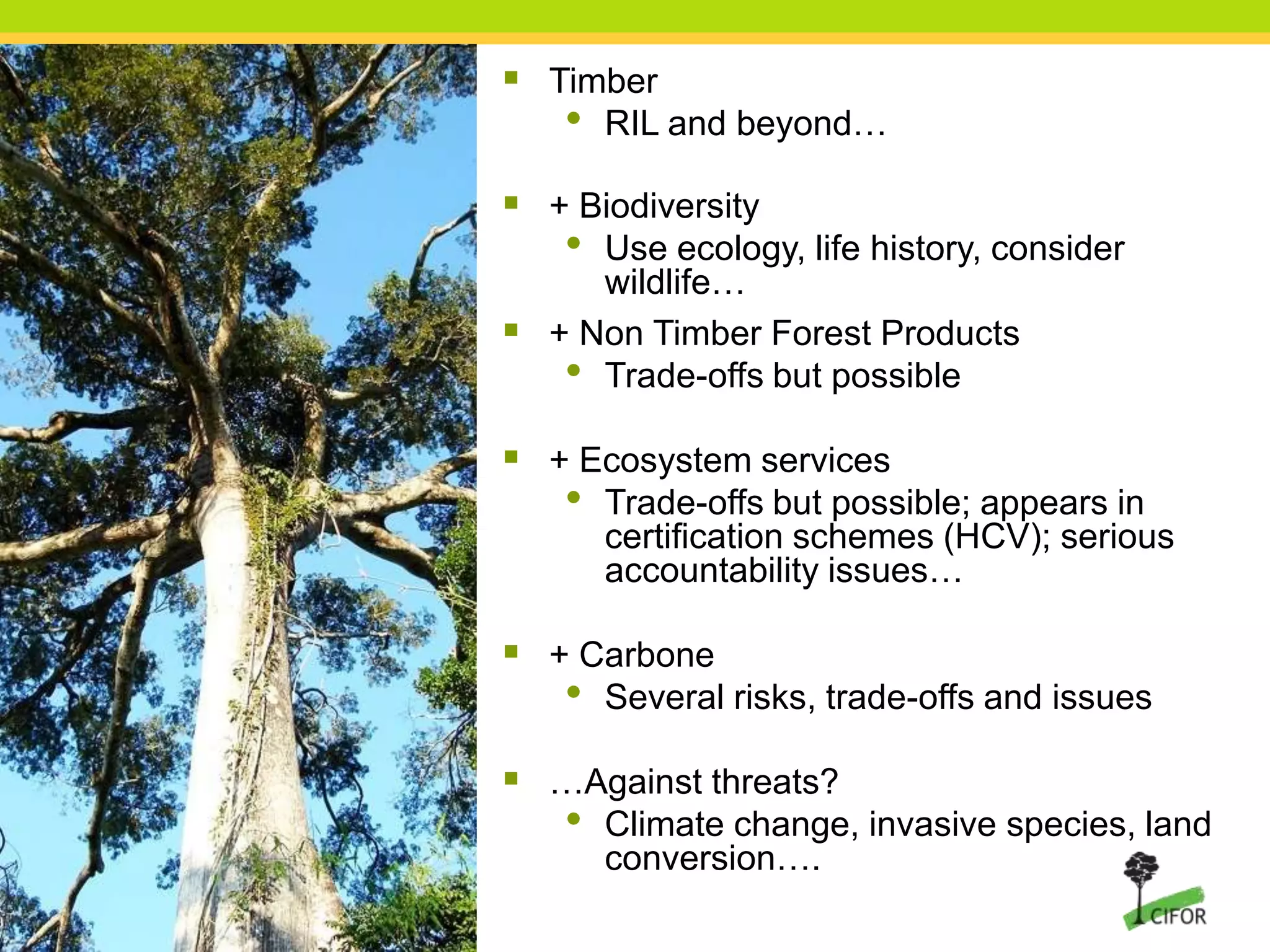
 Timber

•

RIL and beyond…

 + Biodiversity

•

Use ecology, life history, consider
wildlife…
 + Non Timber Forest Products
• Trade-offs but possible

 + Ecosystem services

•

Trade-offs but possible; appears in
certification schemes (HCV); serious
accountability issues…

 + Carbone

•

Several risks, trade-offs and issues

 …Against threats?

•

Climate change, invasive species, land
conversion….
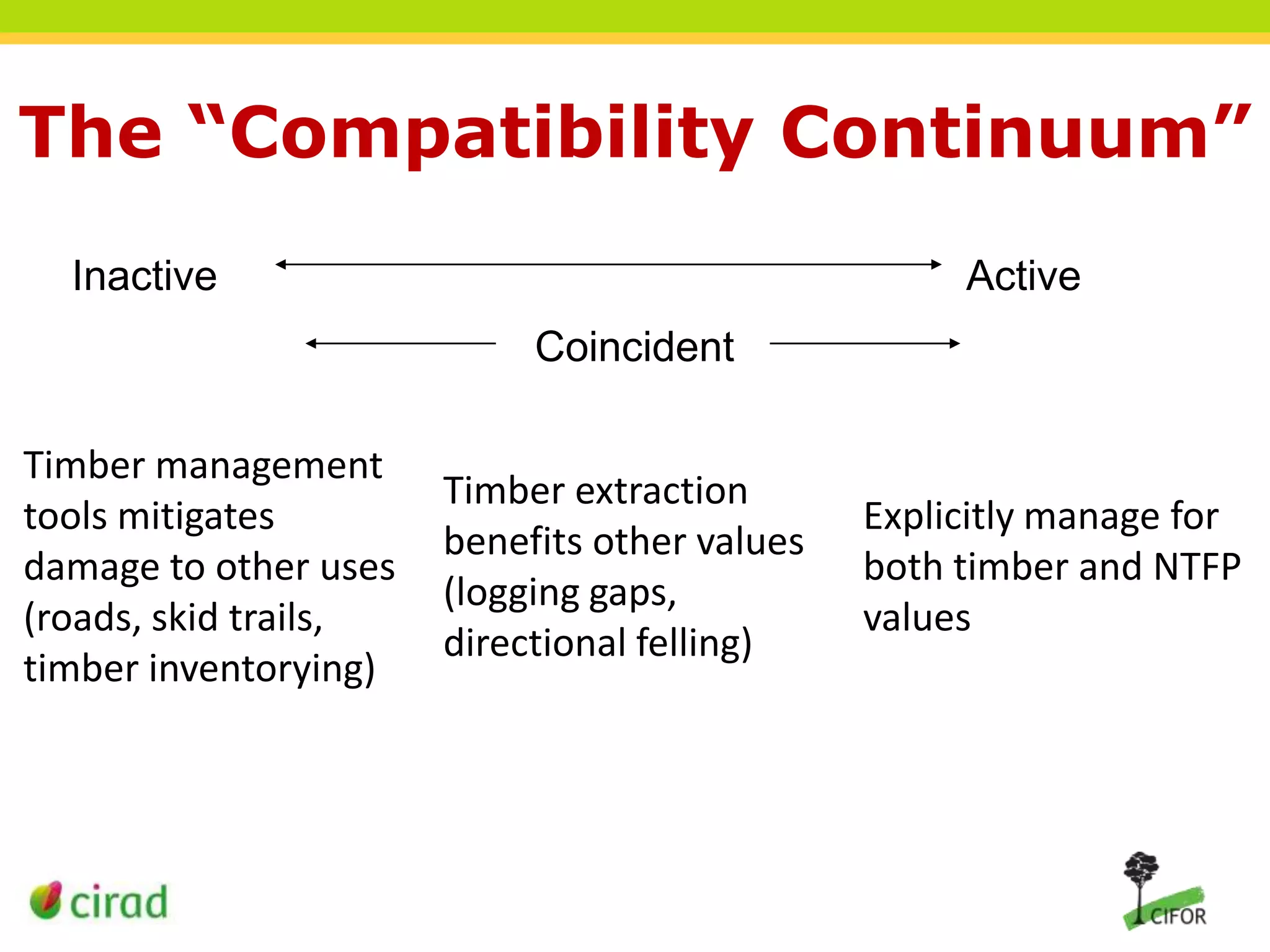
The “Compatibility Continuum”
Inactive

Active
Coincident

Timber management
tools mitigates
damage to other uses
(roads, skid trails,
timber inventorying)

Timber extraction
benefits other values
(logging gaps,
directional felling)

Explicitly manage for
both timber and NTFP
values
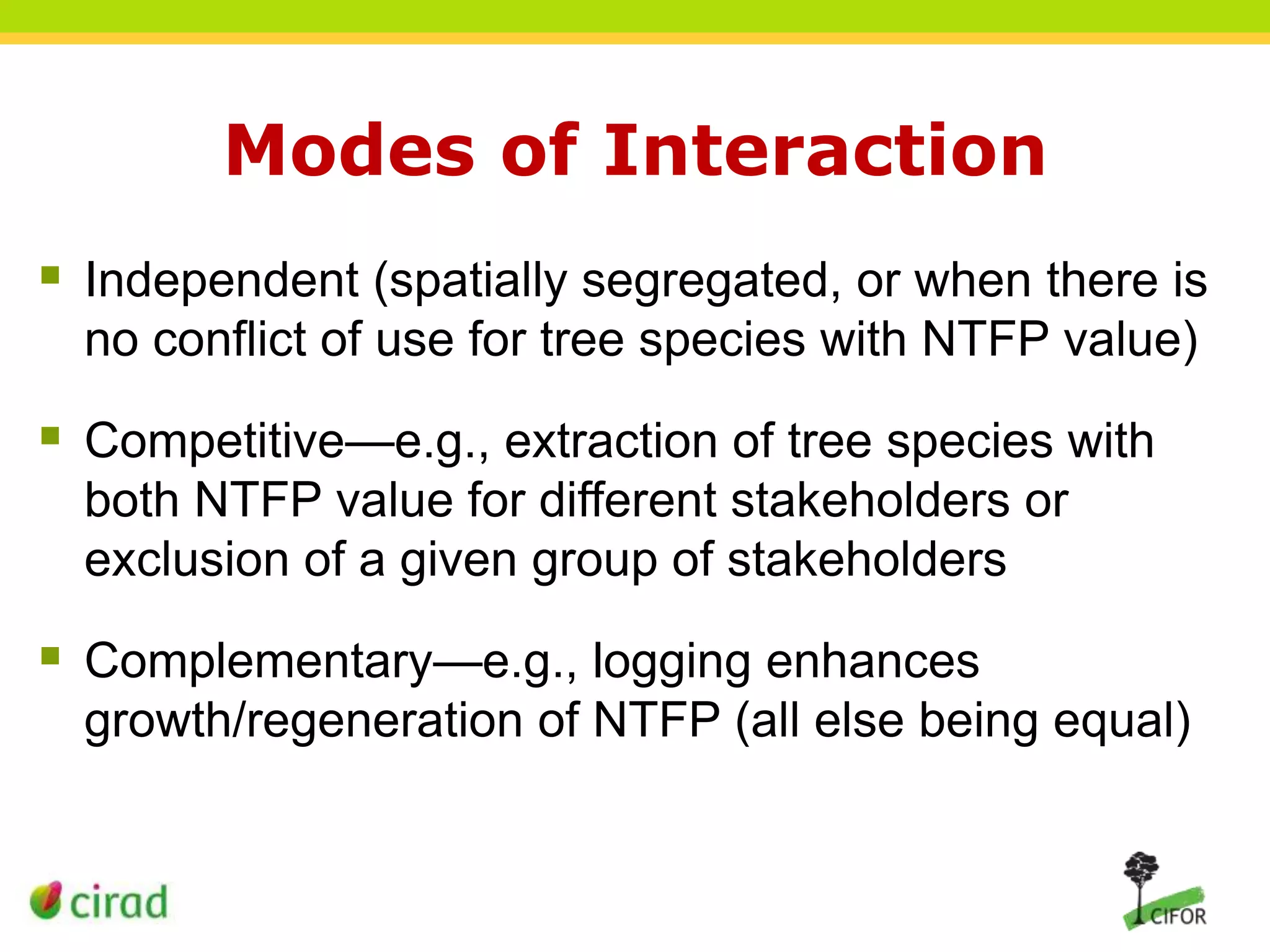
Modes of Interaction
 Independent (spatially segregated, or when there is
no conflict of use for tree species with NTFP value)

 Competitive—e.g., extraction of tree species with
both NTFP value for different stakeholders or
exclusion of a given group of stakeholders

 Complementary—e.g., logging enhances
growth/regeneration of NTFP (all else being equal)
Main Issues
 Many tropical tree species have both timber and
non-timber values that accrue to different
stakeholders

 Current certification schemes diverge for timber
and NTFPs

 Forestry education and training biased towards
timber

 Legal and regulatory frameworks dictated
separately for timber and NTFPs

 Best harvesting practices/management protocols
for NTFPs have little validation
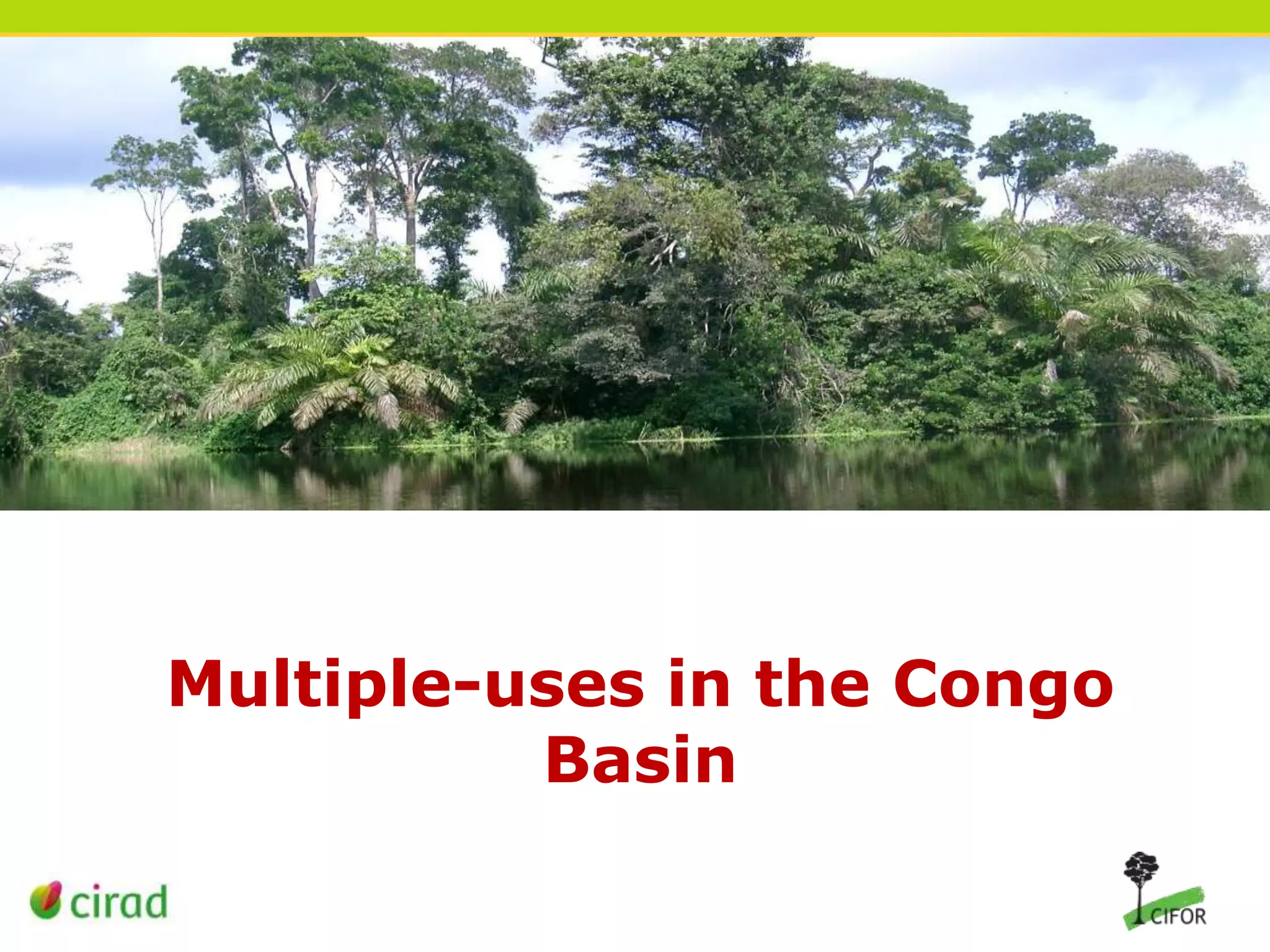
Multiple-uses in the Congo
Basin
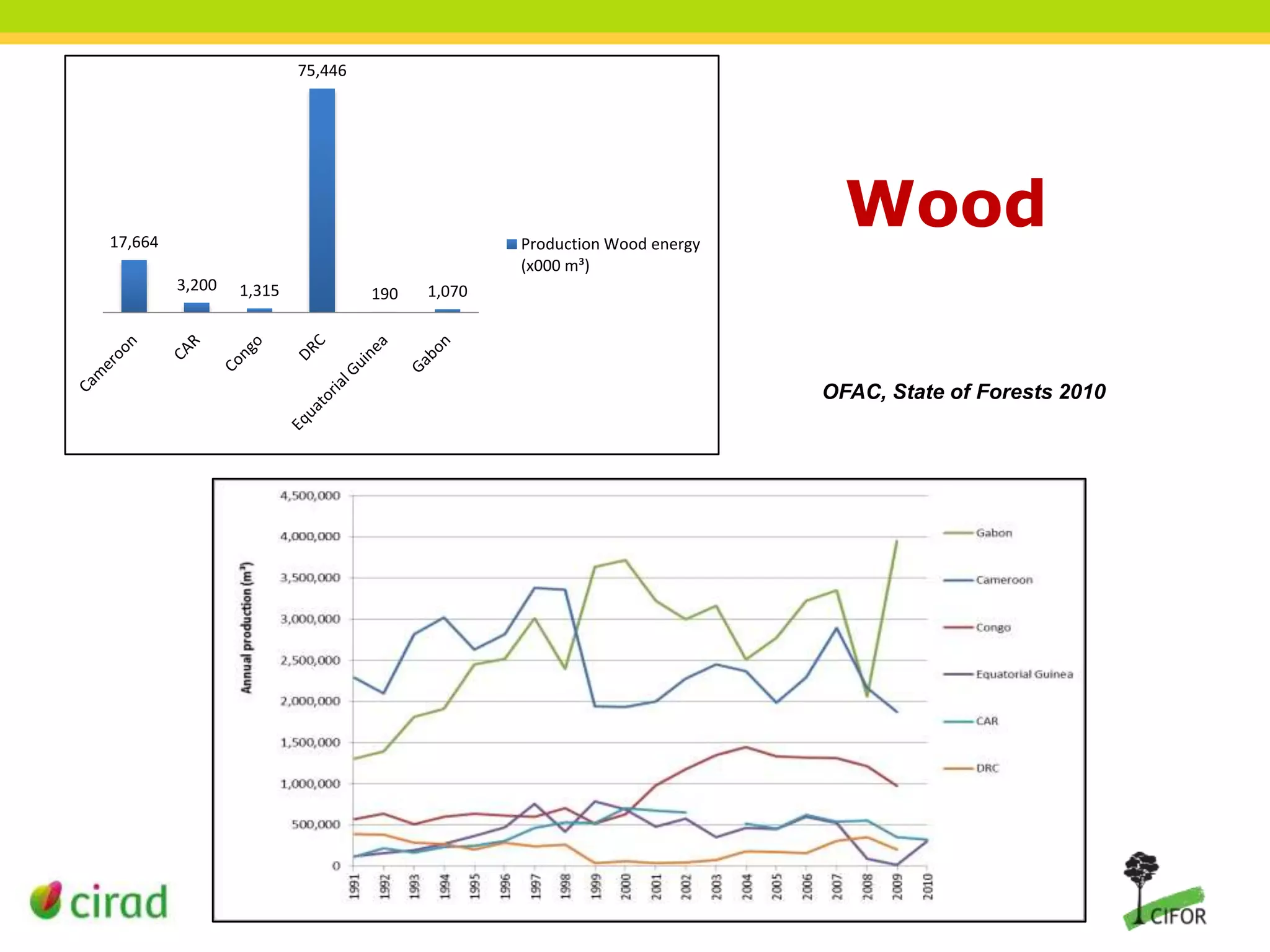
75,446

17,664

Production Wood energy
(x000 m³)
3,200

1,315

190

Wood

1,070

OFAC, State of Forests 2010
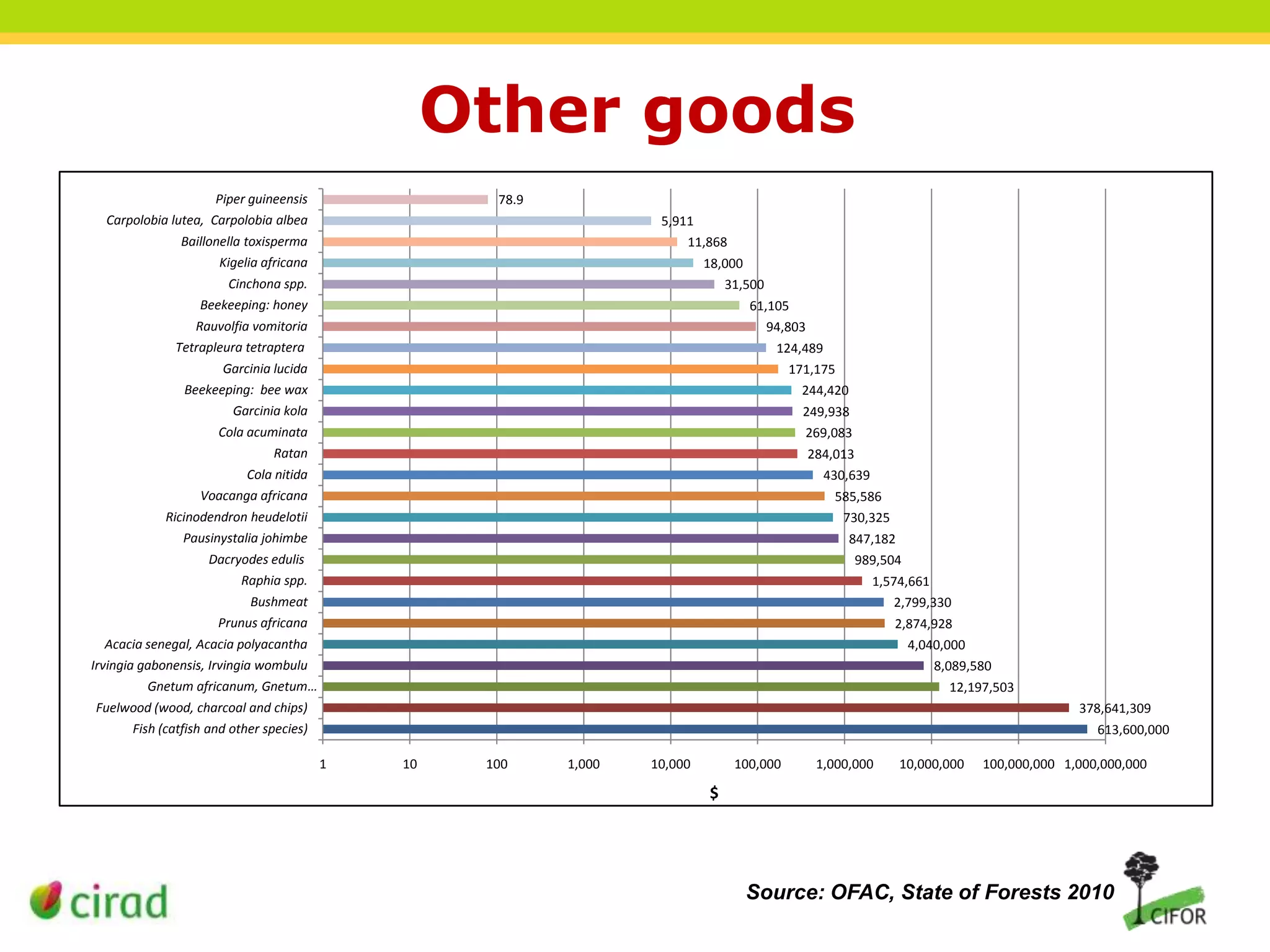
Other goods
Piper guineensis
Carpolobia lutea, Carpolobia albea
Baillonella toxisperma
Kigelia africana
Cinchona spp.
Beekeeping: honey
Rauvolfia vomitoria
Tetrapleura tetraptera
Garcinia lucida
Beekeeping: bee wax
Garcinia kola
Cola acuminata
Ratan
Cola nitida
Voacanga africana
Ricinodendron heudelotii
Pausinystalia johimbe
Dacryodes edulis
Raphia spp.
Bushmeat
Prunus africana
Acacia senegal, Acacia polyacantha
Irvingia gabonensis, Irvingia wombulu
Gnetum africanum, Gnetum…
Fuelwood (wood, charcoal and chips)
Fish (catfish and other species)

78.9
5,911
11,868
18,000
31,500
61,105
94,803
124,489
171,175
244,420
249,938
269,083
284,013
430,639
585,586
730,325
847,182
989,504
1,574,661
2,799,330
2,874,928
4,040,000
8,089,580
12,197,503
378,641,309
613,600,000
1

10

100

1,000

10,000

100,000

1,000,000

10,000,000

100,000,000 1,000,000,000

$

Source: OFAC, State of Forests 2010
Timber, management and
biodiversity
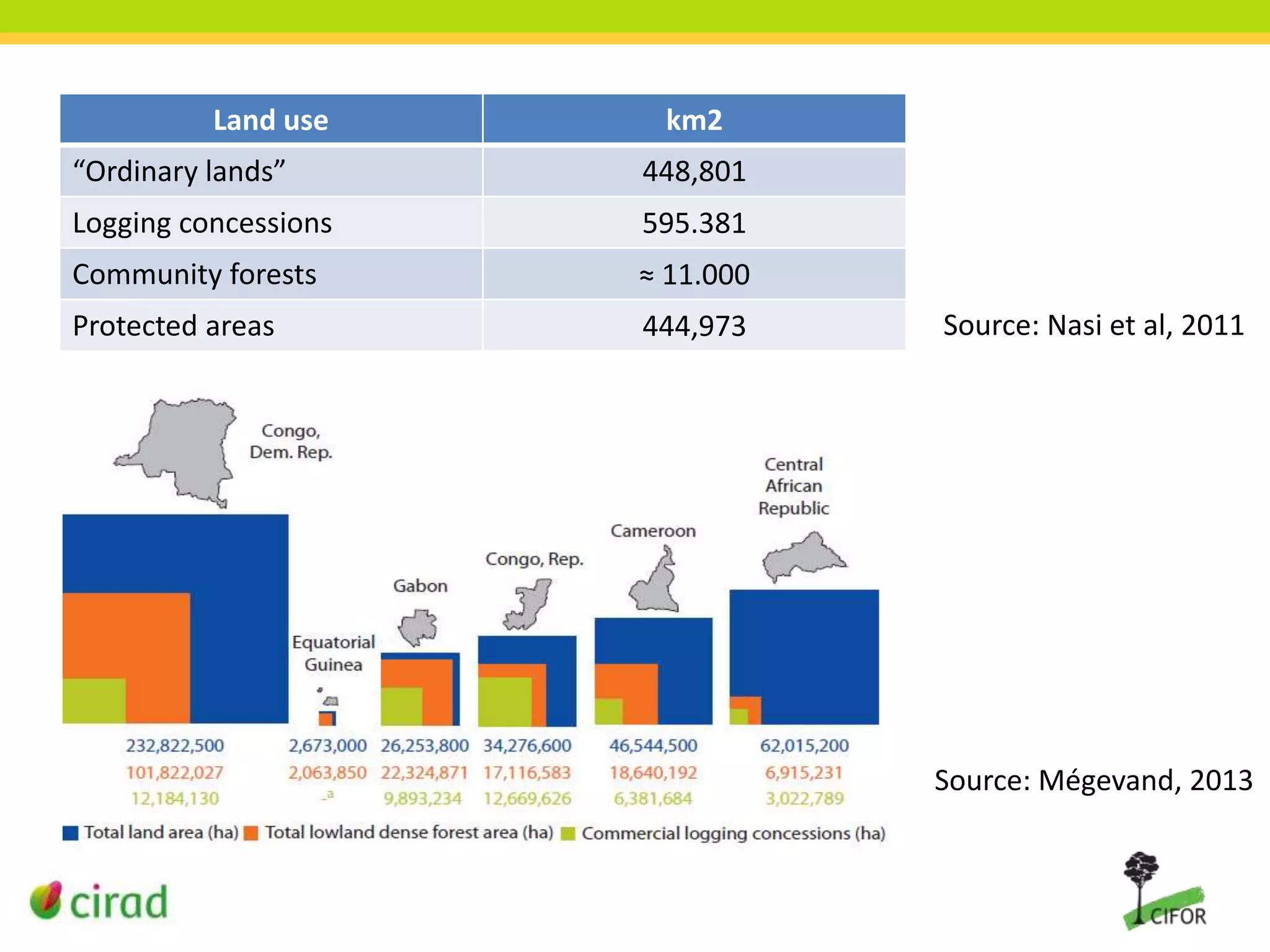
Land use

km2

“Ordinary lands”

448,801

Logging concessions

595.381

Community forests

≈ 11.000

Protected areas

444,973

Source: Nasi et al, 2011

Source: Mégevand, 2013
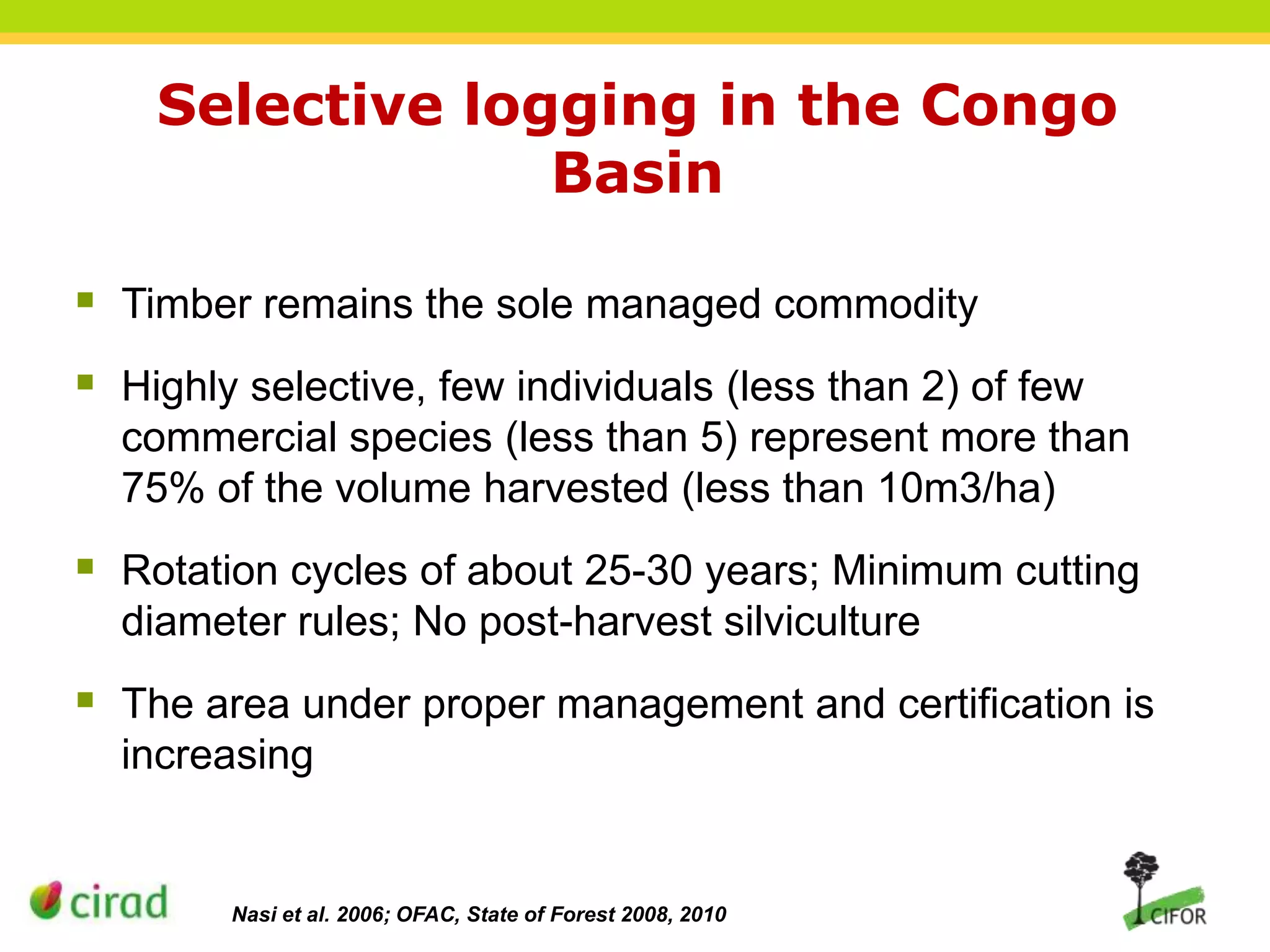
Selective logging in the Congo
Basin
 Timber remains the sole managed commodity
 Highly selective, few individuals (less than 2) of few
commercial species (less than 5) represent more than
75% of the volume harvested (less than 10m3/ha)

 Rotation cycles of about 25-30 years; Minimum cutting
diameter rules; No post-harvest silviculture

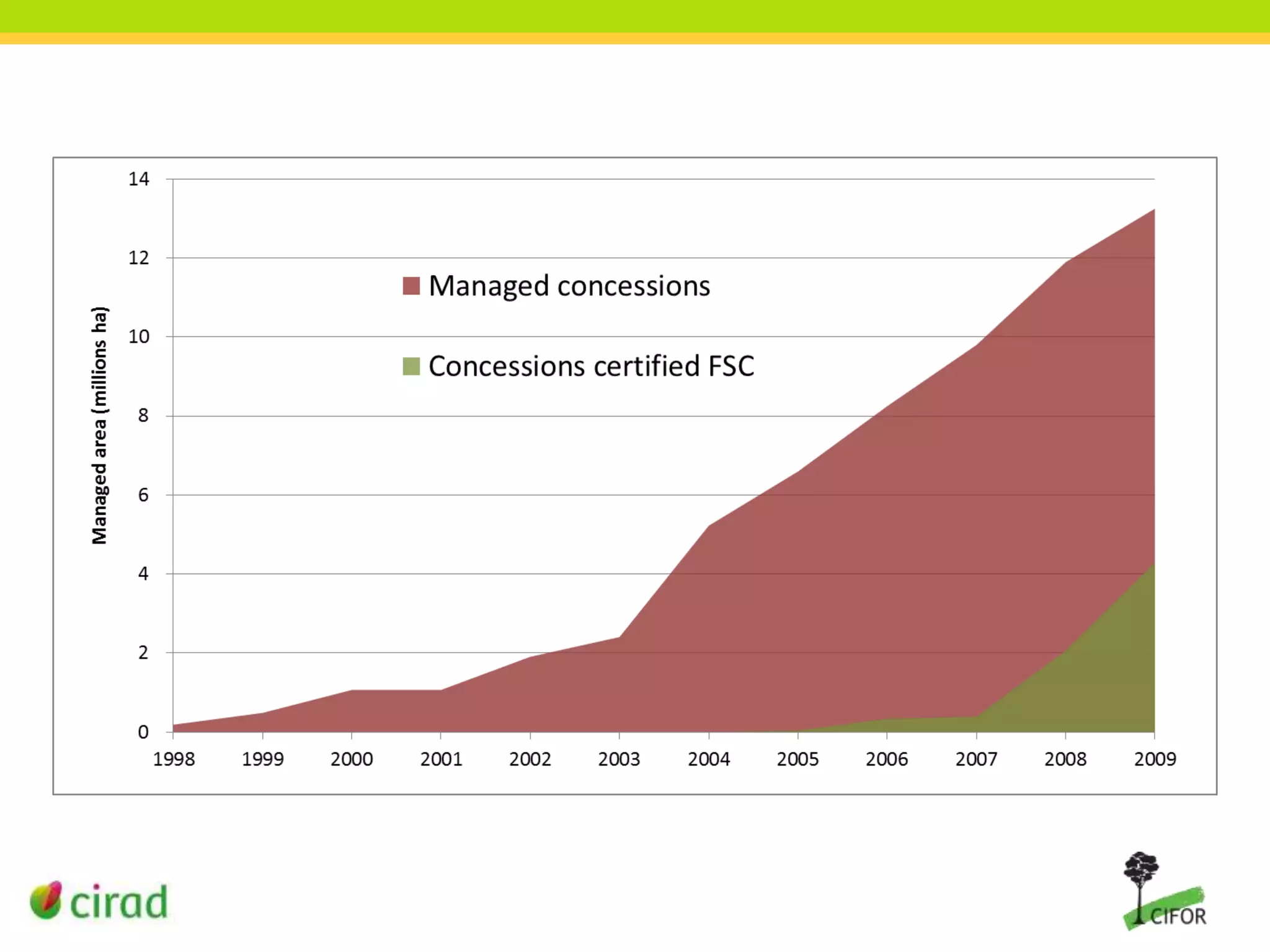
 The area under proper management and certification is
increasing

Nasi et al. 2006; OFAC, State of Forest 2008, 2010
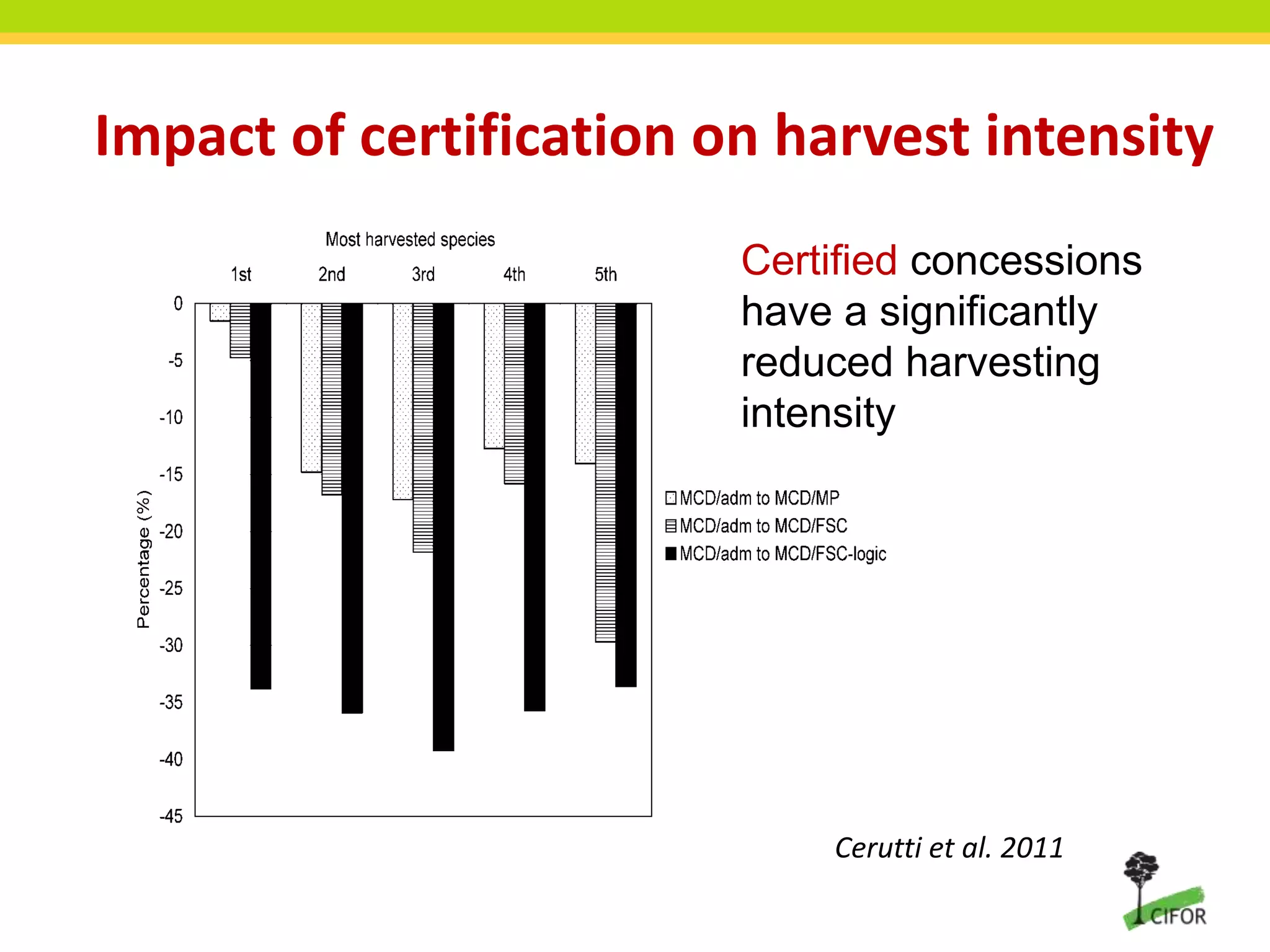
Impact of certification on harvest intensity
Certified concessions
have a significantly
reduced harvesting
intensity

Cerutti et al. 2011
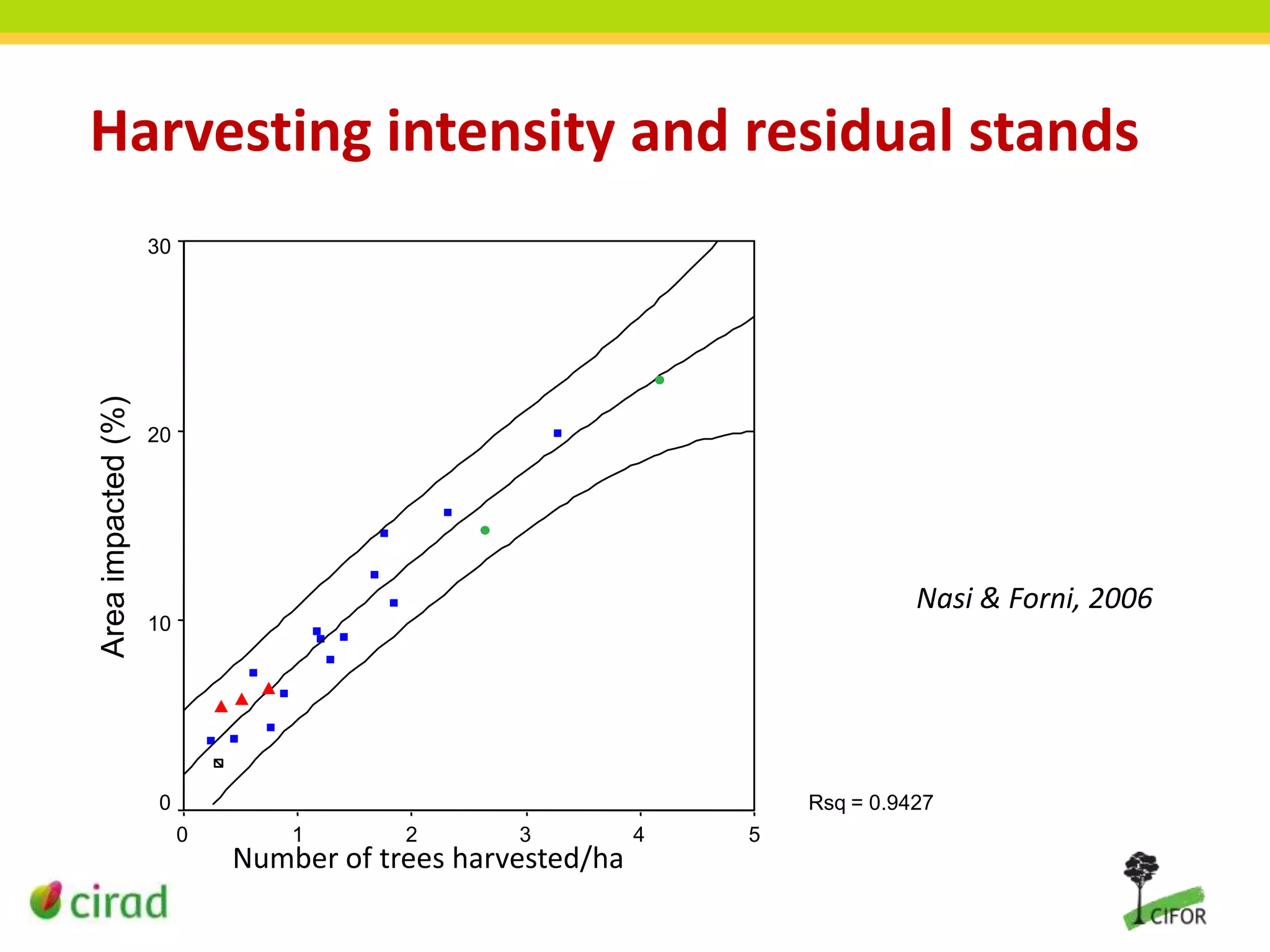
Harvesting intensity and residual stands

Area impacted (%)

30

20

Nasi & Forni, 2006

10

0

Rsq = 0.9427
0

1

2

3

Number of trees harvested/ha

4

5
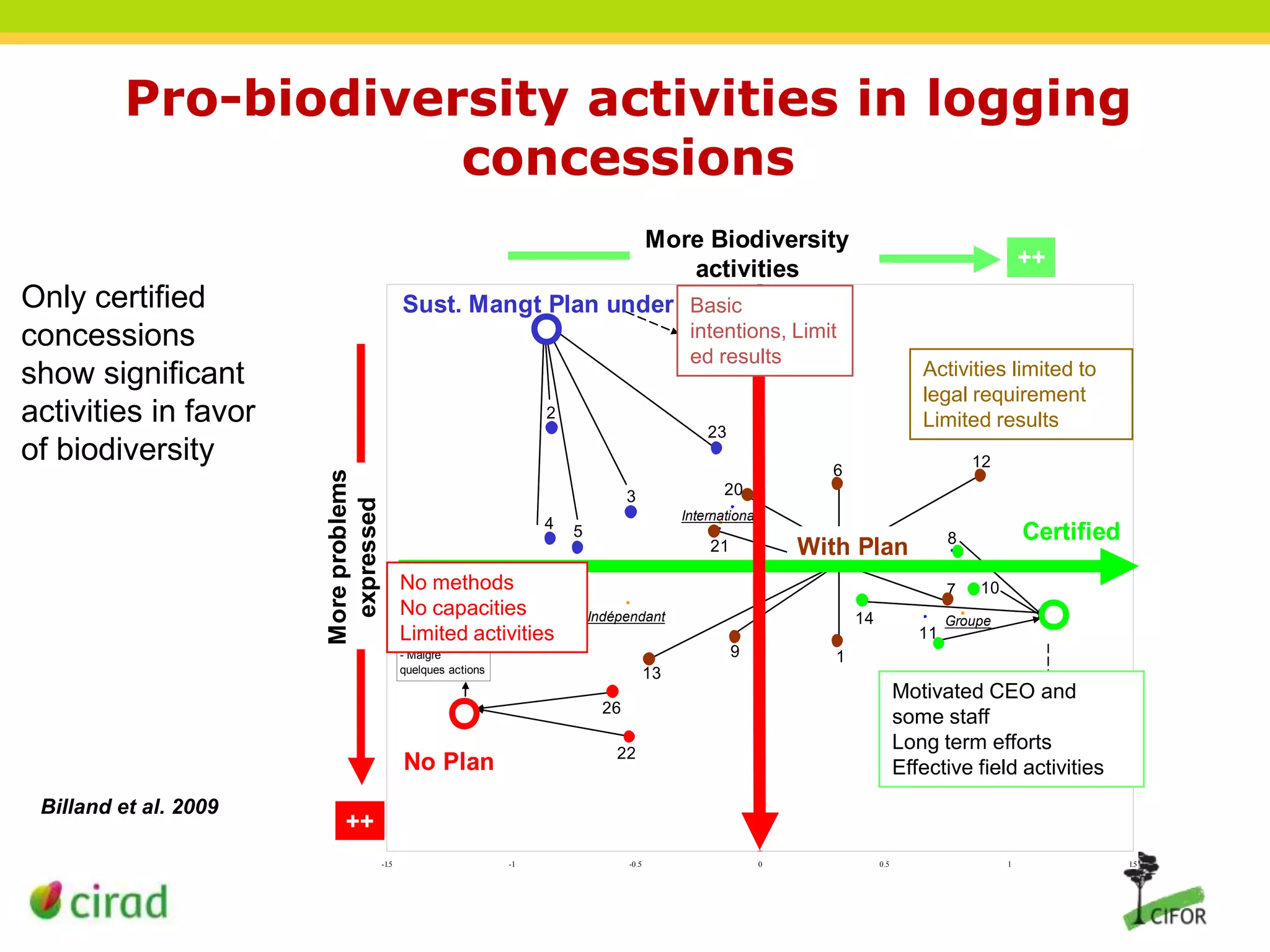
Pro-biodiversity activities in logging
concessions
Graphique symétrique

More Biodiversity
(axes F1 et F2 : 54.36 %)
- activities
Actions concrètes +
Sust. Mangt Plan under way
Basic
Aménagement en cours

1.5

Only certified
concessions
show significant
activities in favor
of biodiversity

++

intentions, Limit
ed results

Pas encore
de résultats

Activities limited to
legal requirement
Limited results

1

2
23

More problems
expressed
F2 (10.12 %)

20

3
4

International

5

0

No methods
- Ni les méthodes
No capacities
- Ni les capacités
Limited activities
actuellement

7
Indépendant

9

- Malgré
quelques actions

-0.5

14

11

Groupe

Certifié

13
Vise la and
Motivated --CEOcertification
Souhaite maintenir
some staffses efforts
- > 30 essences
Long term exploitéees
efforts
Effective field activities

Non aménagé

22

No Plan

-1

10

1

26

Billand et al. 2009

Certified

8

With Plan
Aménagé

21

+

Difficultés rencontrées

12

6

0.5

++
-1.5
-1.5

-1

-0.5

0

F1 (44.24 %)

0.5

1

1.5
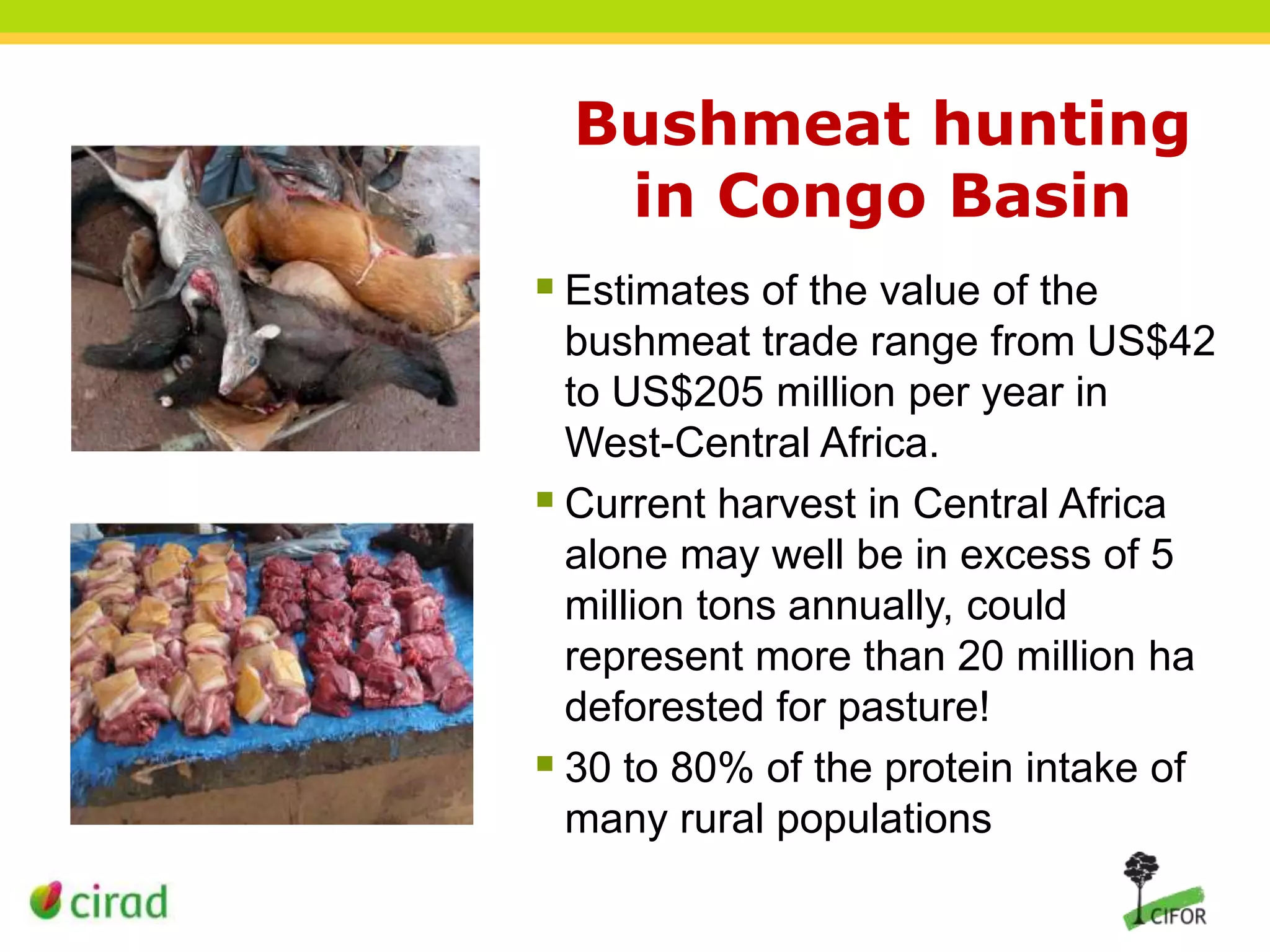
Bushmeat hunting
in Congo Basin
 Estimates of the value of the
bushmeat trade range from US$42
to US$205 million per year in
West-Central Africa.
 Current harvest in Central Africa
alone may well be in excess of 5
million tons annually, could
represent more than 20 million ha
deforested for pasture!
 30 to 80% of the protein intake of
many rural populations
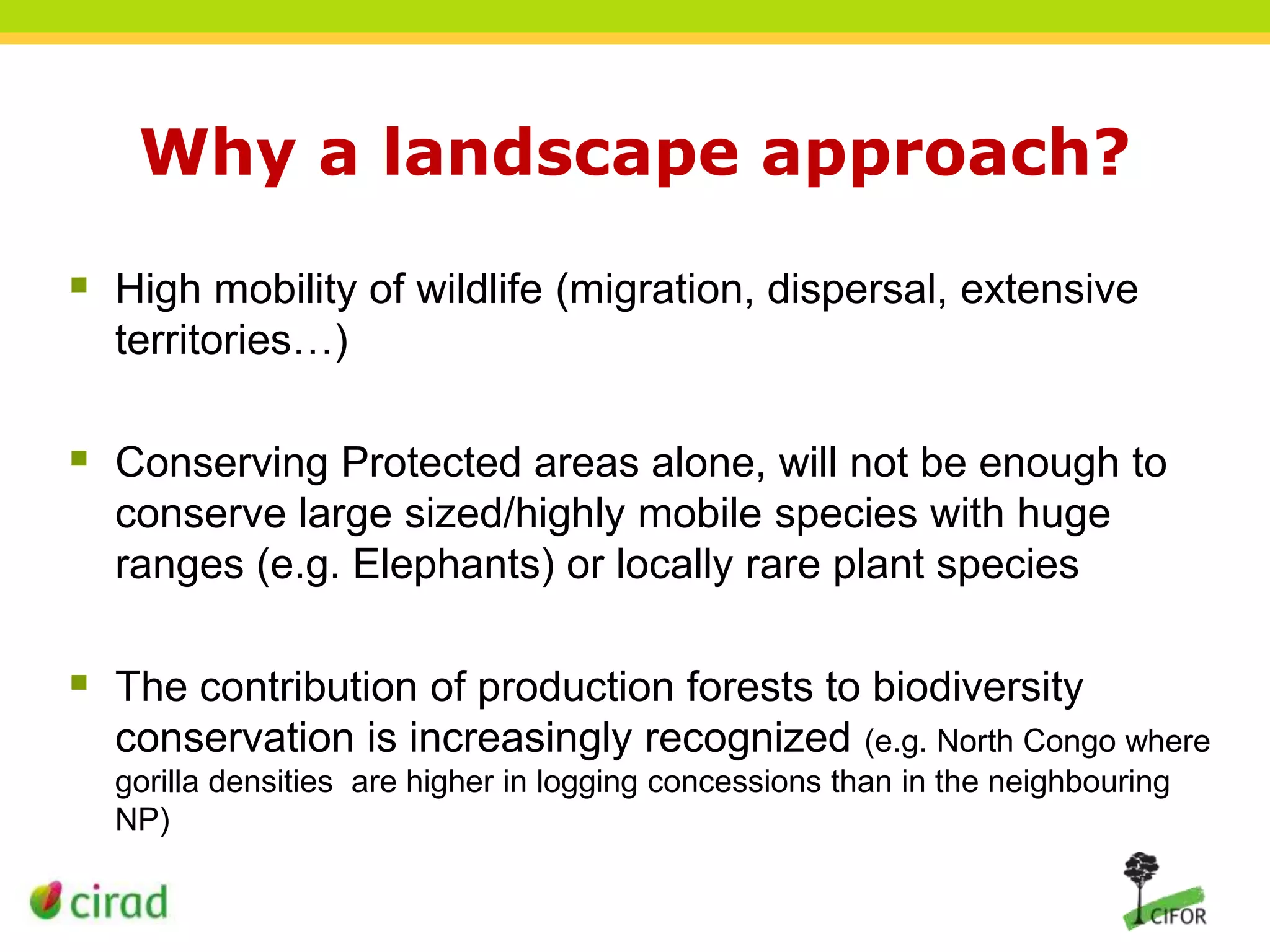
Why a landscape approach?
 High mobility of wildlife (migration, dispersal, extensive
territories…)

 Conserving Protected areas alone, will not be enough to
conserve large sized/highly mobile species with huge
ranges (e.g. Elephants) or locally rare plant species

 The contribution of production forests to biodiversity
conservation is increasingly recognized (e.g. North Congo where
gorilla densities are higher in logging concessions than in the neighbouring
NP)
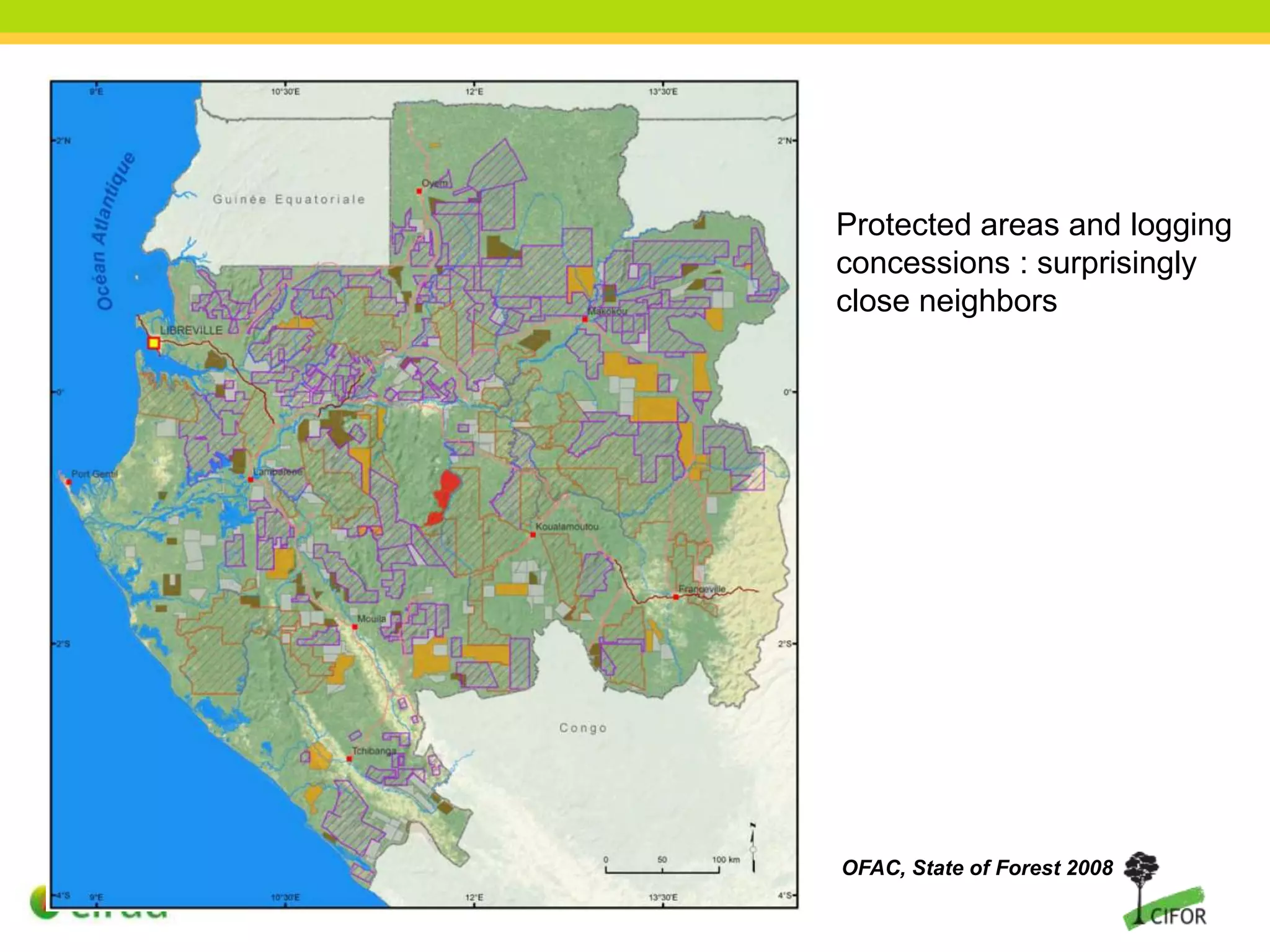
Protected areas and logging
concessions : surprisingly
close neighbors

OFAC, State of Forest 2008
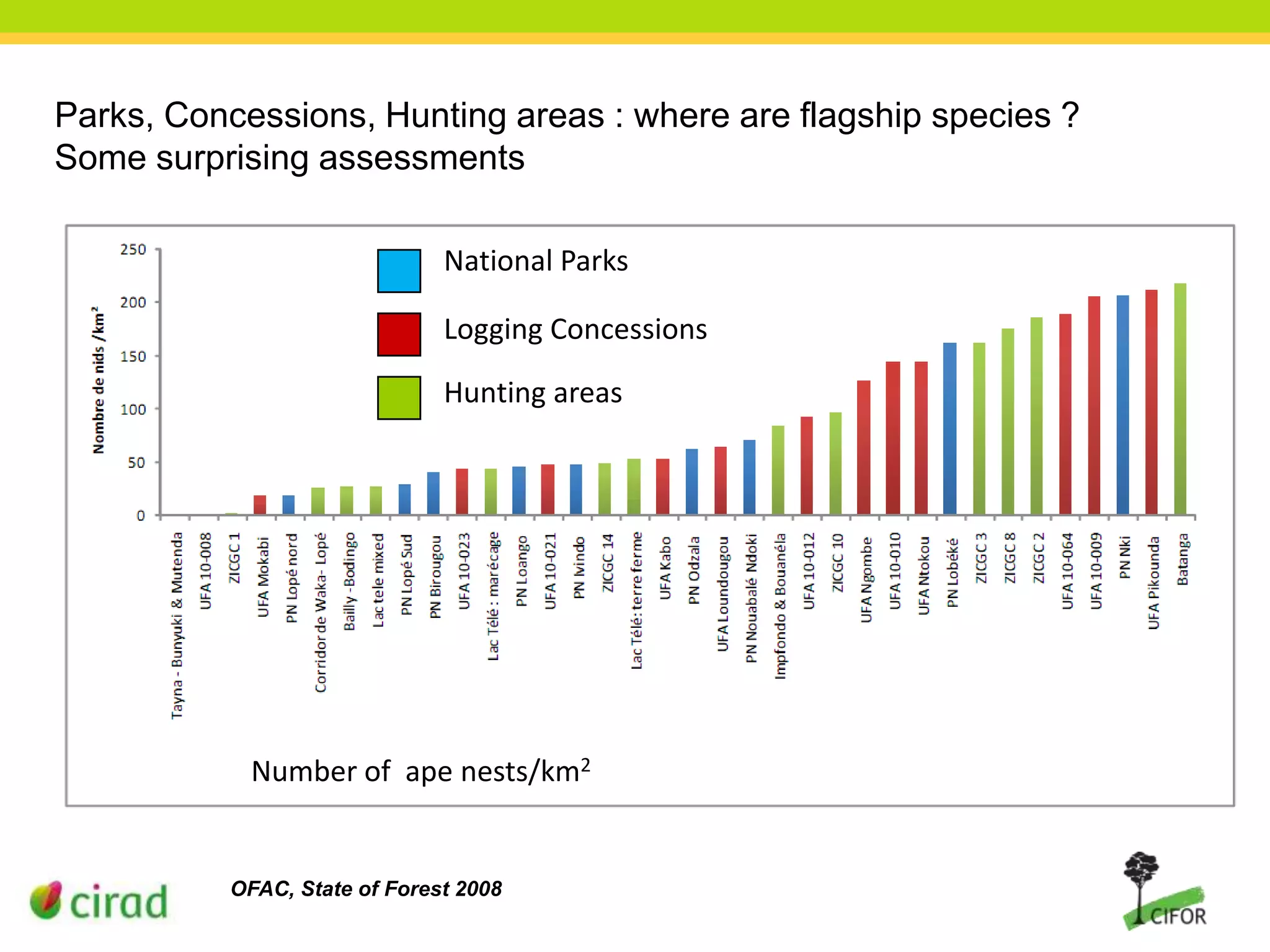
Parks, Concessions, Hunting areas : where are flagship species ?
Some surprising assessments
National Parks
Logging Concessions
Hunting areas

Number of ape nests/km2

OFAC, State of Forest 2008
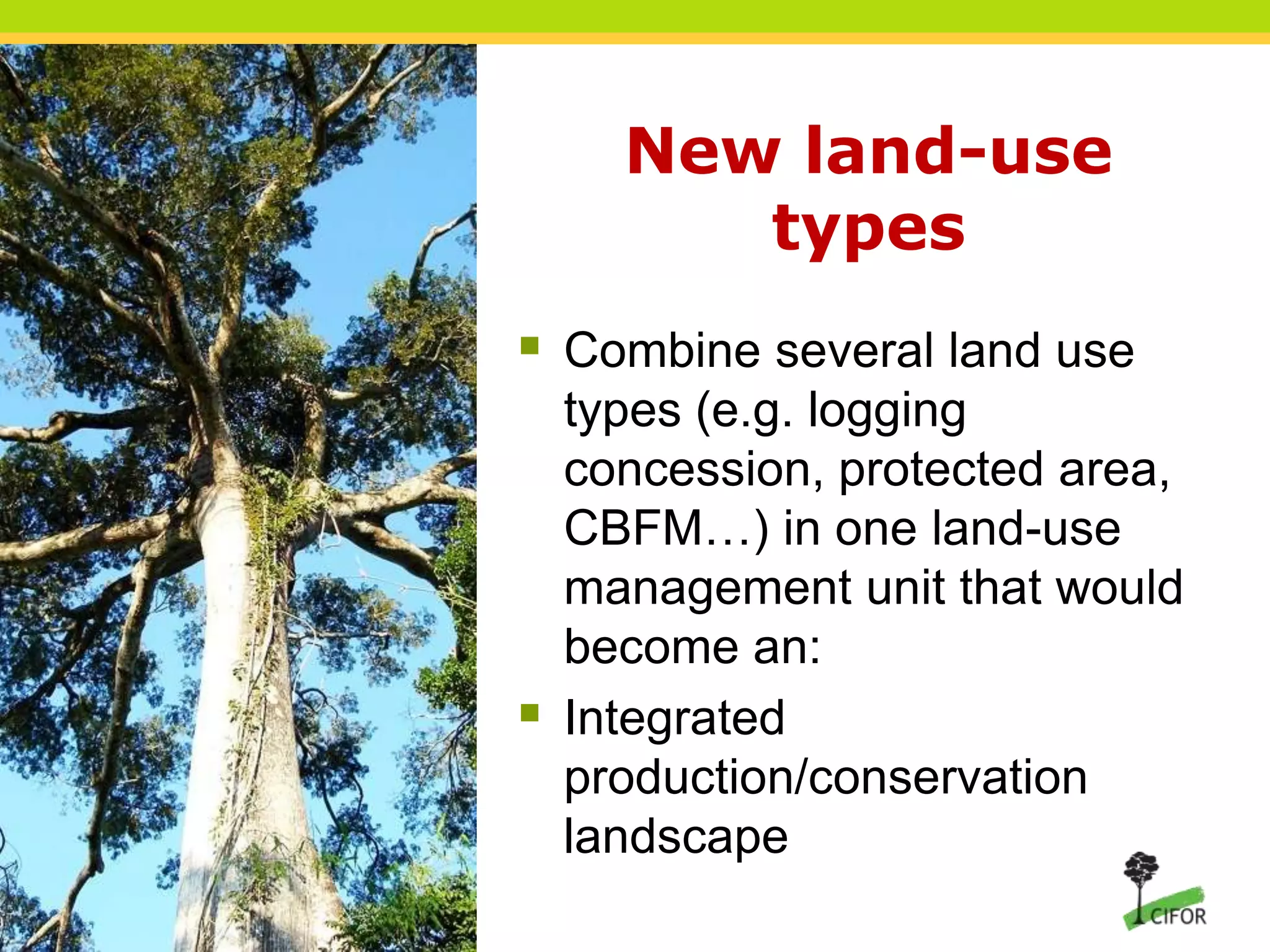
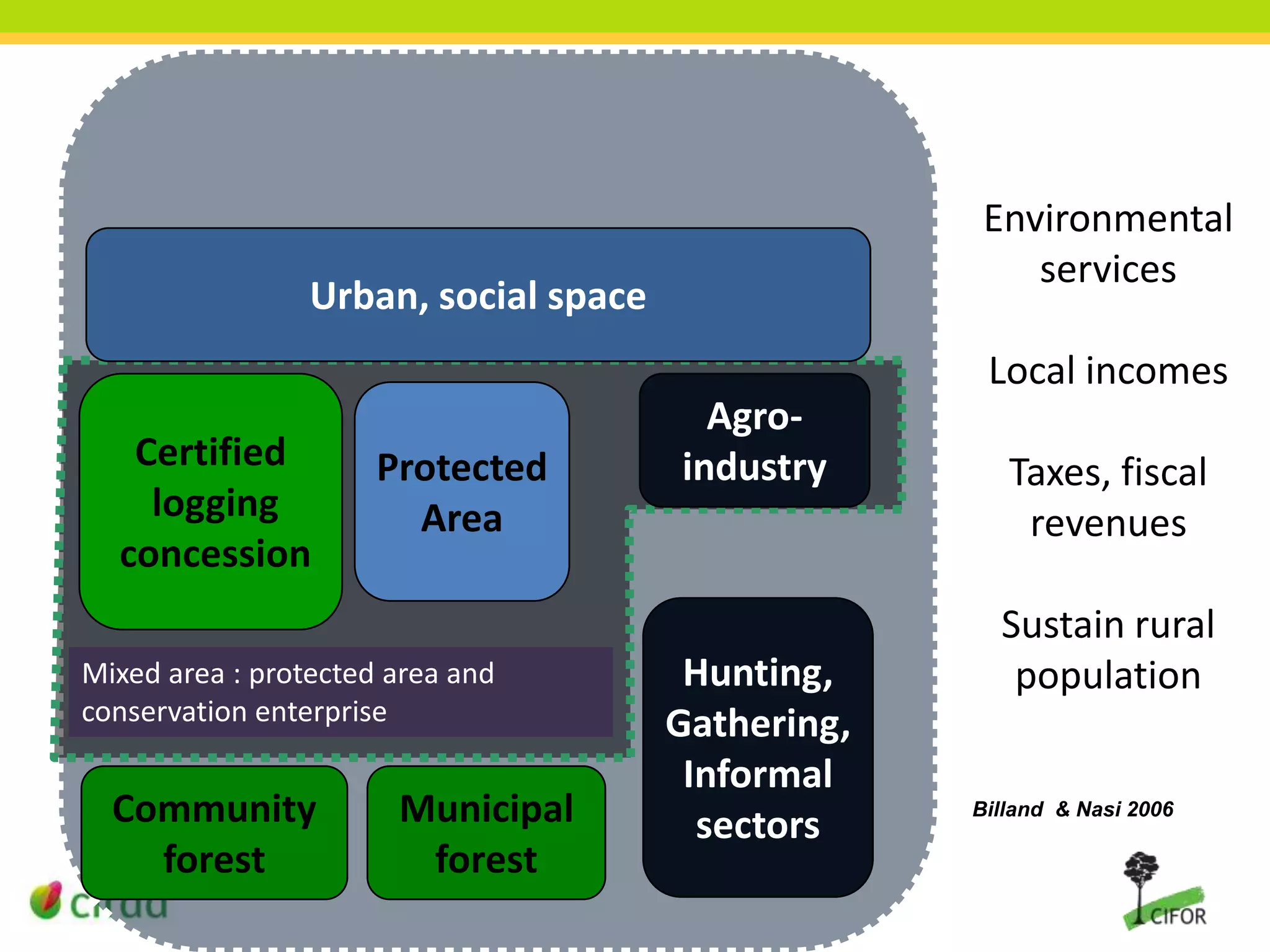
New land-use
types
 Combine several land use



types (e.g. logging
concession, protected area,
CBFM…) in one land-use
management unit that would
become an:
Integrated
production/conservation
landscape
Environmental
services

Urban, social space

Local incomes
Certified
logging
concession

Protected
Area

Mixed area : protected area and
conservation enterprise

Community
forest

Municipal
forest

Agroindustry

Hunting,
Gathering,
Informal
sectors

Taxes, fiscal
revenues

Sustain rural
population
Billand & Nasi 2006
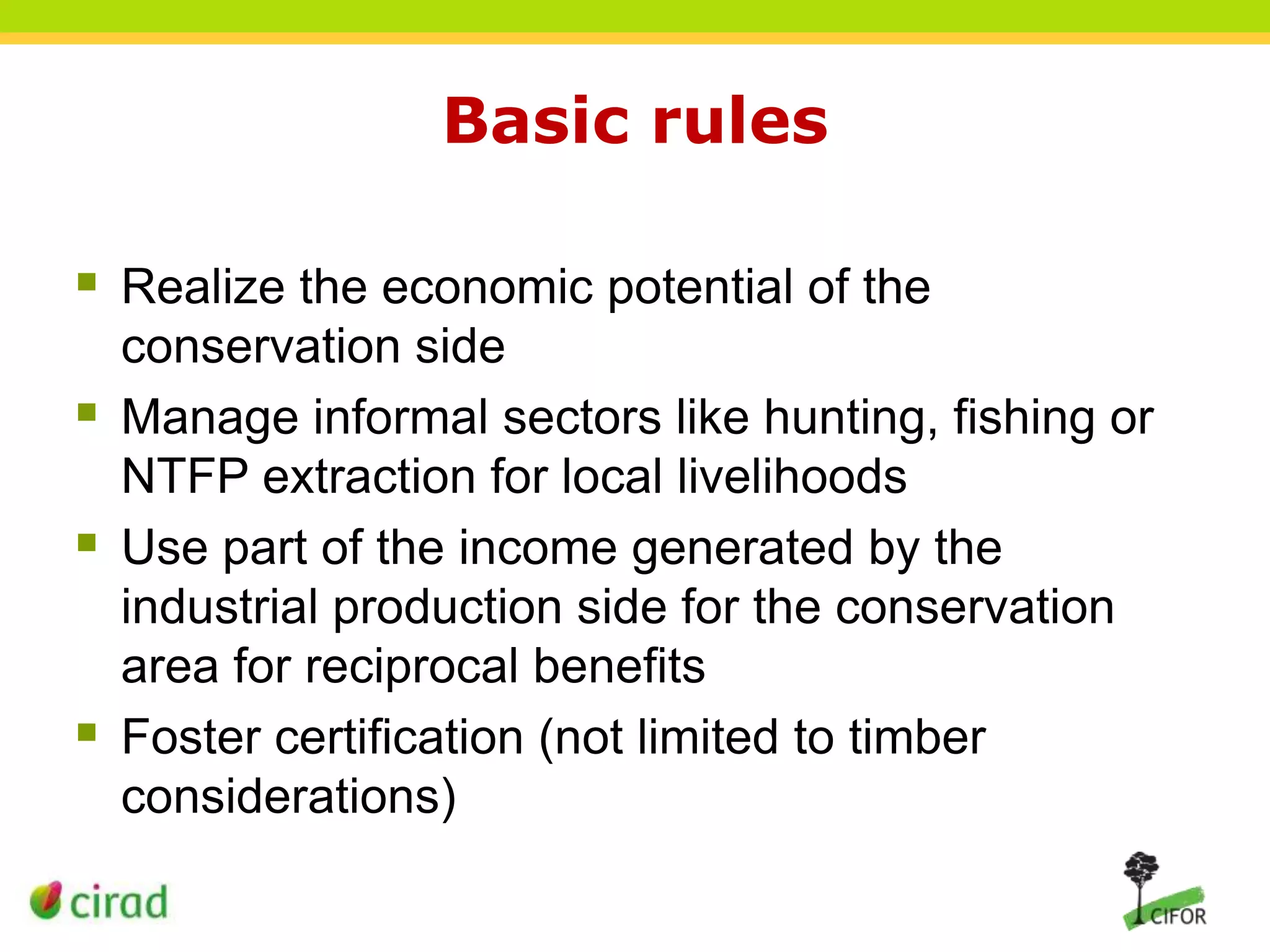
Basic rules
 Realize the economic potential of the





conservation side
Manage informal sectors like hunting, fishing or
NTFP extraction for local livelihoods
Use part of the income generated by the
industrial production side for the conservation
area for reciprocal benefits
Foster certification (not limited to timber
considerations)
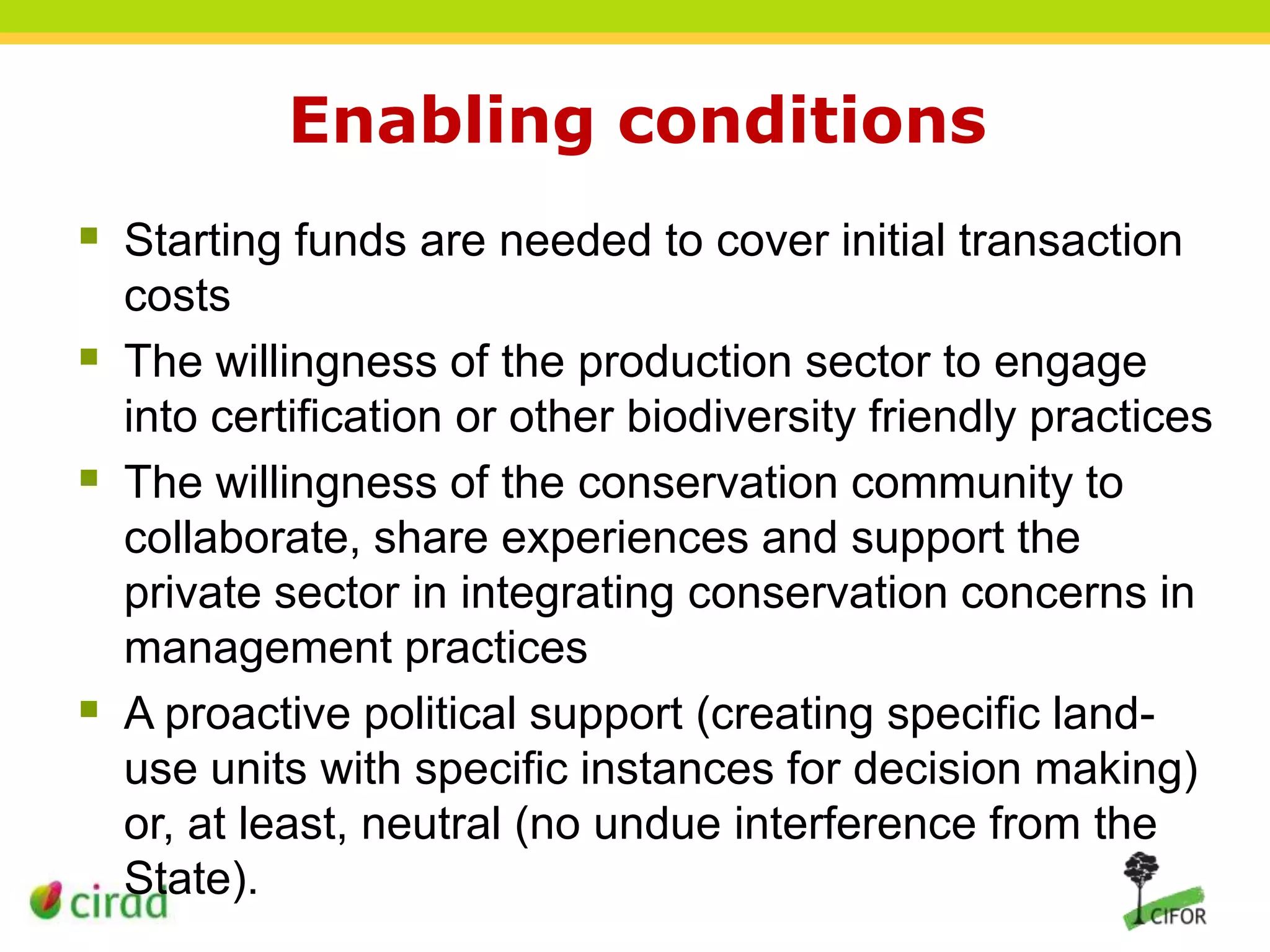
Enabling conditions
 Starting funds are needed to cover initial transaction
costs
 The willingness of the production sector to engage
into certification or other biodiversity friendly practices
 The willingness of the conservation community to
collaborate, share experiences and support the
private sector in integrating conservation concerns in
management practices
 A proactive political support (creating specific landuse units with specific instances for decision making)
or, at least, neutral (no undue interference from the
State).
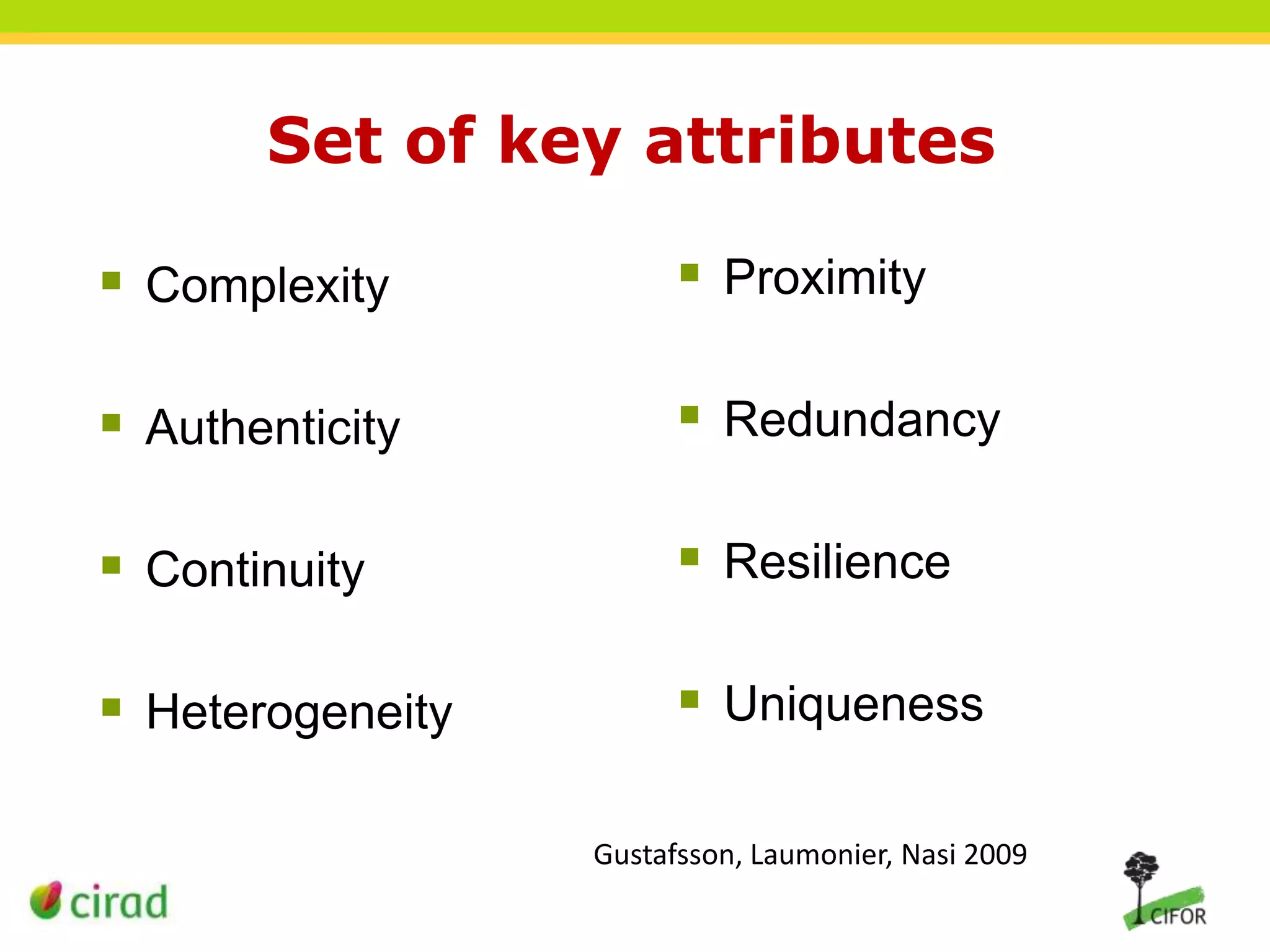
Set of key attributes
 Complexity

 Proximity

 Authenticity

 Redundancy

 Continuity

 Resilience

 Heterogeneity

 Uniqueness
Gustafsson, Laumonier, Nasi 2009
Management principles
 Maintain landscape heterogeneity
 Maintain large structurally complex patches of








natural vegetation
Create buffers around sensitive areas
Maintain or create corridors and stepping stones
Use appropriate disturbance regimes in
management
Maintain functional diversity
Manage for keystone species
Consider endemic, rare and threatened species
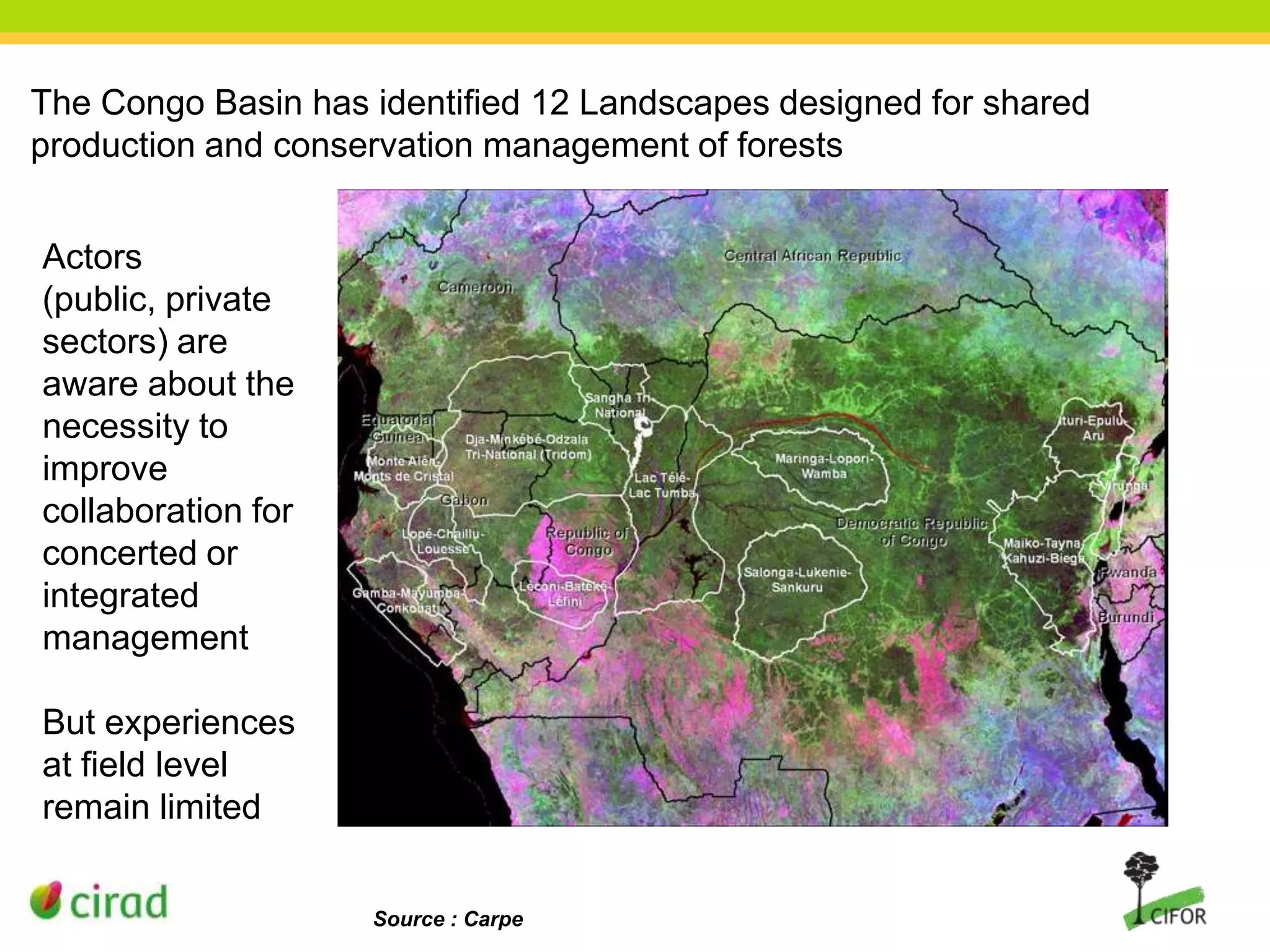
The Congo Basin has identified 12 Landscapes designed for shared
production and conservation management of forests
Actors
(public, private
sectors) are
aware about the
necessity to
improve
collaboration for
concerted or
integrated
management
But experiences
at field level
remain limited
Source : Carpe
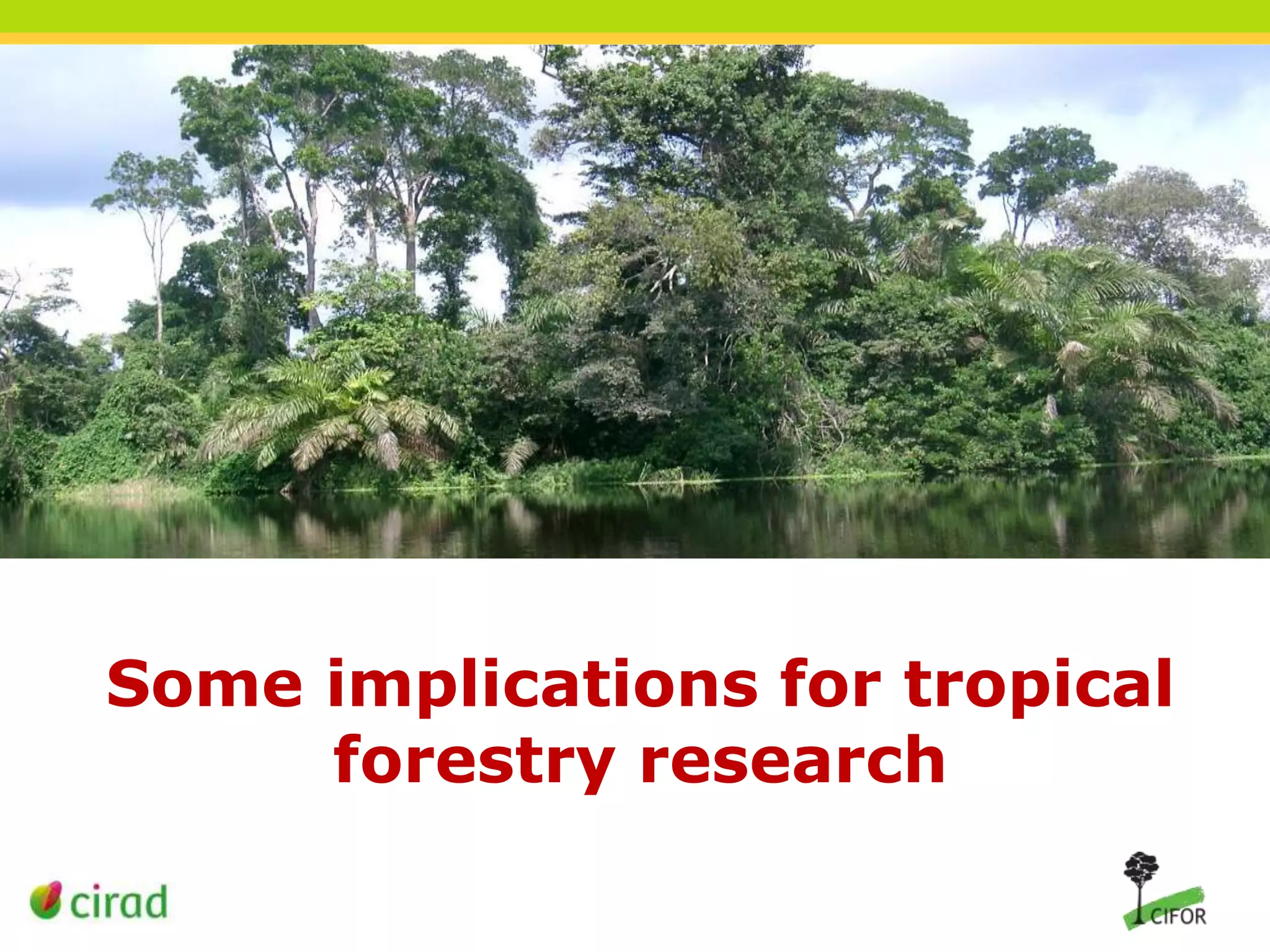
Some implications for tropical
forestry research
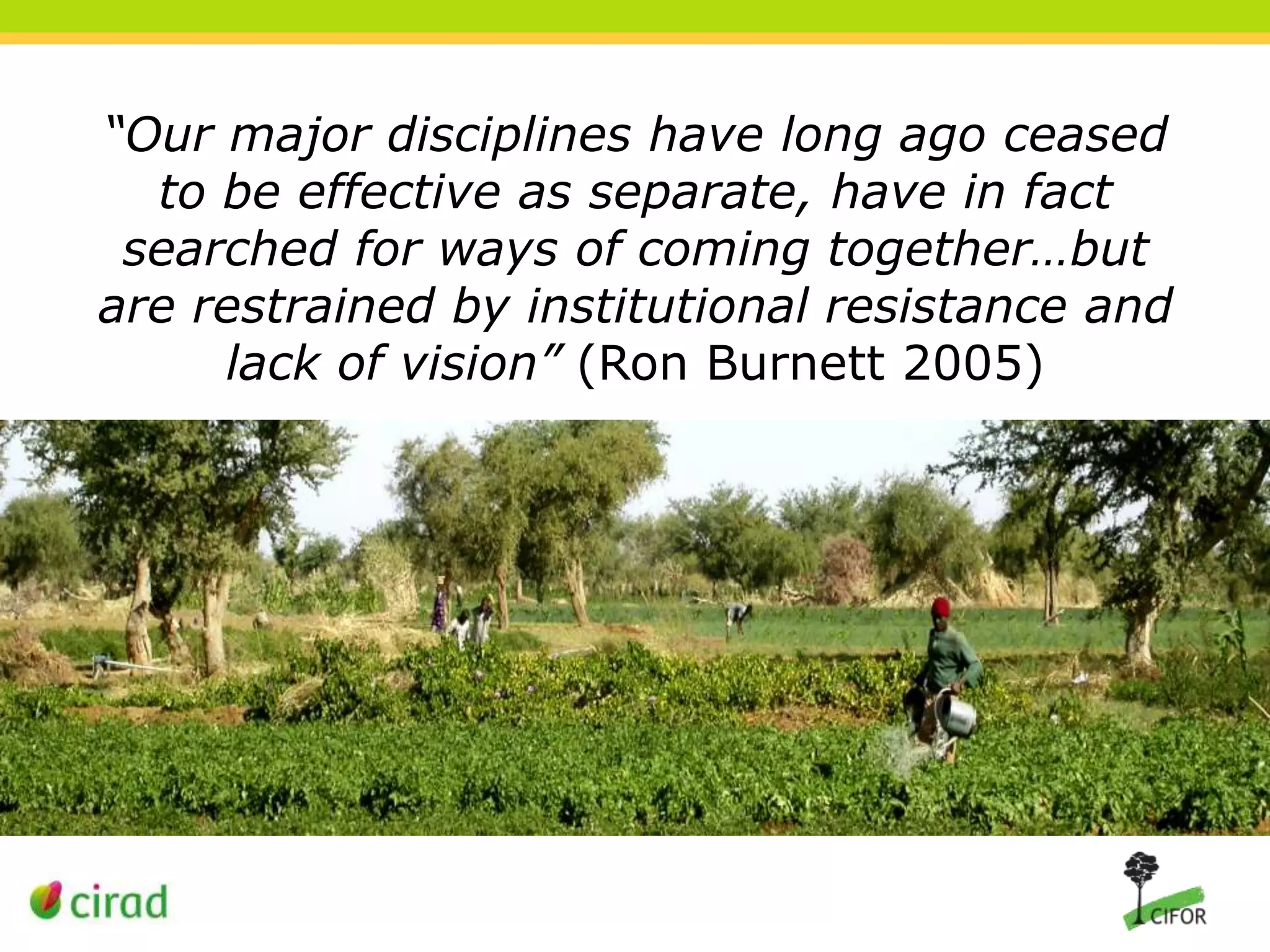
“Our major disciplines have long ago ceased
to be effective as separate, have in fact
searched for ways of coming together…but
are restrained by institutional resistance and
lack of vision” (Ron Burnett 2005)
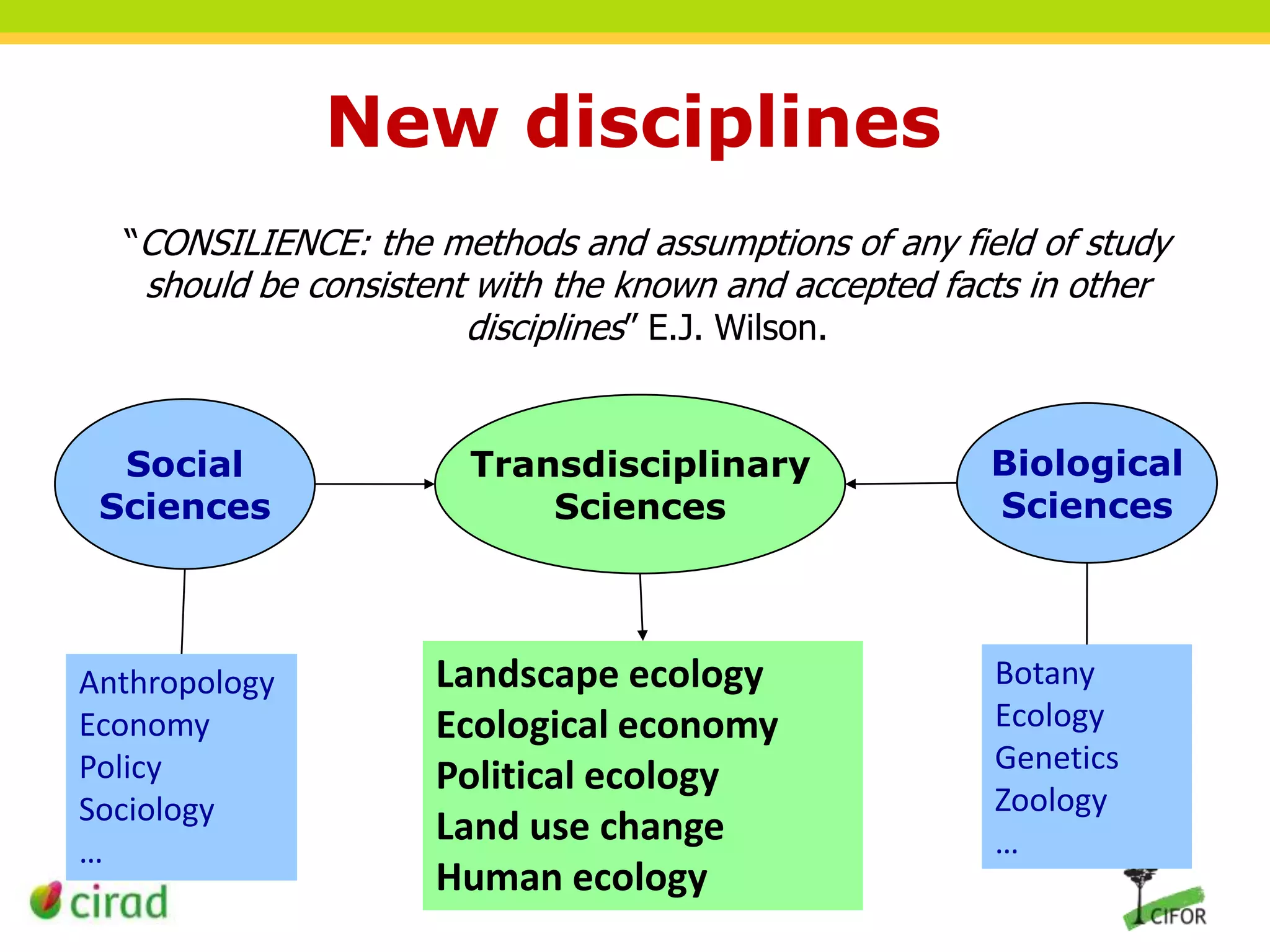
New disciplines
“CONSILIENCE: the methods and assumptions of any field of study

should be consistent with the known and accepted facts in other
disciplines” E.J. Wilson.

Social
Sciences

Anthropology
Economy
Policy
Sociology
…

Transdisciplinary
Sciences

Landscape ecology
Ecological economy
Political ecology
Land use change
Human ecology

Biological
Sciences

Botany
Ecology
Genetics
Zoology
…
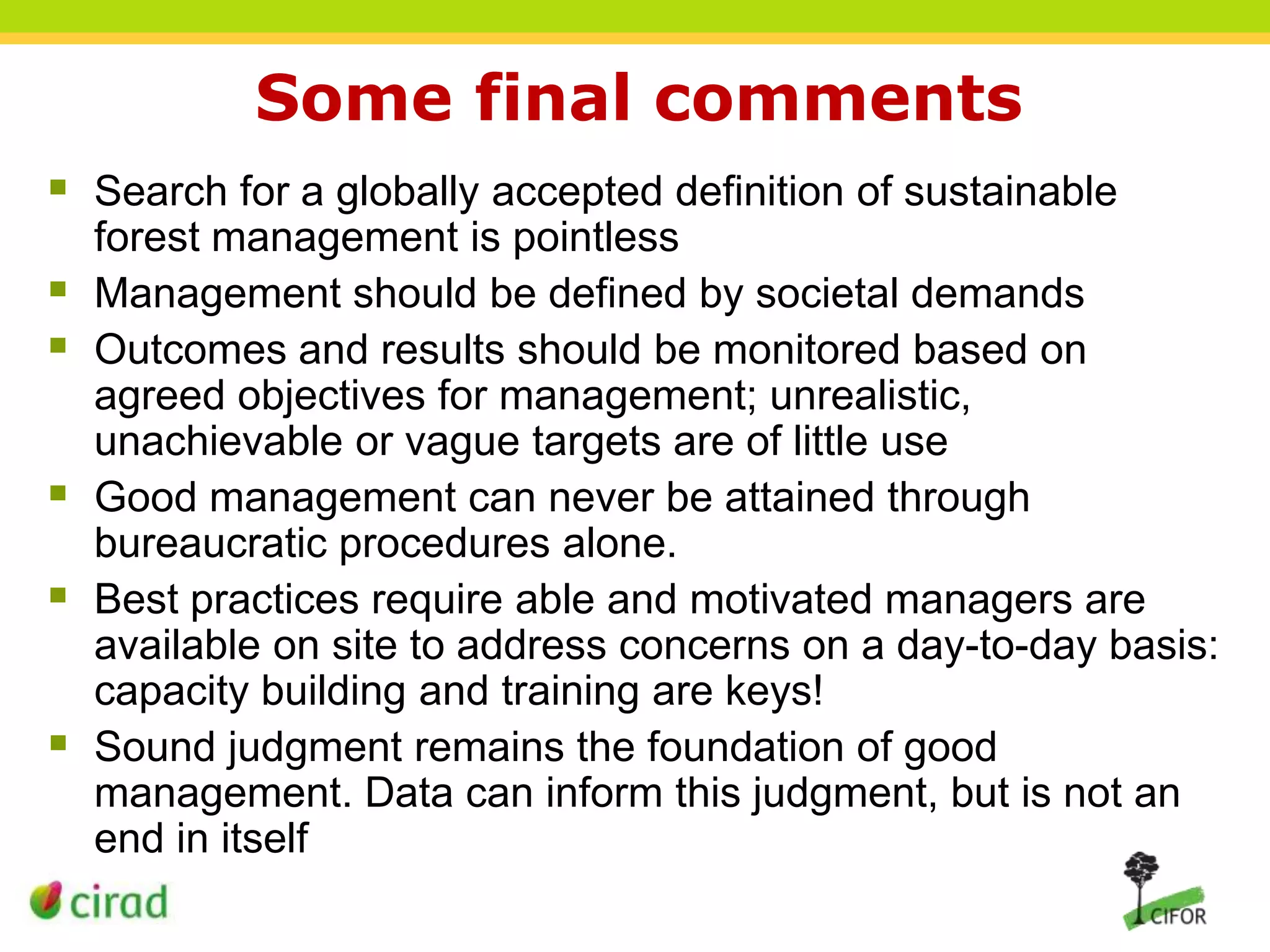
Some final comments
 Search for a globally accepted definition of sustainable







forest management is pointless
Management should be defined by societal demands
Outcomes and results should be monitored based on
agreed objectives for management; unrealistic,
unachievable or vague targets are of little use
Good management can never be attained through
bureaucratic procedures alone.
Best practices require able and motivated managers are
available on site to address concerns on a day-to-day basis:
capacity building and training are keys!
Sound judgment remains the foundation of good
management. Data can inform this judgment, but is not an
end in itself
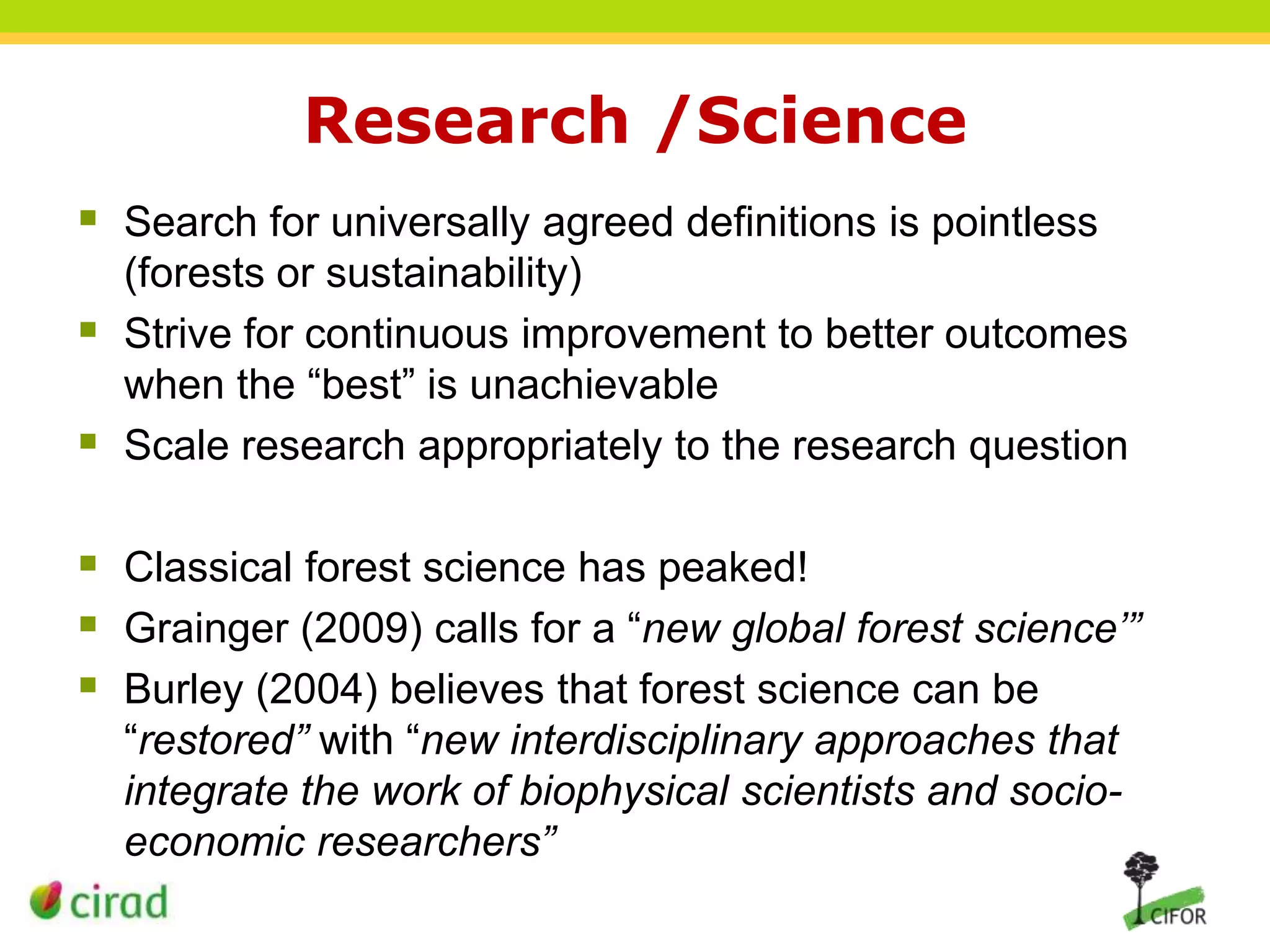
Research /Science
 Search for universally agreed definitions is pointless




(forests or sustainability)
Strive for continuous improvement to better outcomes
when the “best” is unachievable
Scale research appropriately to the research question

 Classical forest science has peaked!
 Grainger (2009) calls for a “new global forest science’”
 Burley (2004) believes that forest science can be
“restored” with “new interdisciplinary approaches that
integrate the work of biophysical scientists and socioeconomic researchers”

Can we manage forests for multiple uses in the Congo Basin?

  • 1.
    Can we manageforests for multiple uses in the Congo Basin? Robert Nasi, Alain Billand, Manuel Guariguata Yaoundé, 22/05/2013
  • 2.
     Timber • RIL andbeyond…  + Biodiversity • Use ecology, life history, consider wildlife…  + Non Timber Forest Products • Trade-offs but possible  + Ecosystem services • Trade-offs but possible; appears in certification schemes (HCV); serious accountability issues…  + Carbone • Several risks, trade-offs and issues  …Against threats? • Climate change, invasive species, land conversion….
  • 3.
    The “Compatibility Continuum” Inactive Active Coincident Timbermanagement tools mitigates damage to other uses (roads, skid trails, timber inventorying) Timber extraction benefits other values (logging gaps, directional felling) Explicitly manage for both timber and NTFP values
  • 4.
    Modes of Interaction Independent (spatially segregated, or when there is no conflict of use for tree species with NTFP value)  Competitive—e.g., extraction of tree species with both NTFP value for different stakeholders or exclusion of a given group of stakeholders  Complementary—e.g., logging enhances growth/regeneration of NTFP (all else being equal)
  • 5.
    Main Issues  Manytropical tree species have both timber and non-timber values that accrue to different stakeholders  Current certification schemes diverge for timber and NTFPs  Forestry education and training biased towards timber  Legal and regulatory frameworks dictated separately for timber and NTFPs  Best harvesting practices/management protocols for NTFPs have little validation
  • 6.
  • 7.
    75,446 17,664 Production Wood energy (x000m³) 3,200 1,315 190 Wood 1,070 OFAC, State of Forests 2010
  • 8.
    Other goods Piper guineensis Carpolobialutea, Carpolobia albea Baillonella toxisperma Kigelia africana Cinchona spp. Beekeeping: honey Rauvolfia vomitoria Tetrapleura tetraptera Garcinia lucida Beekeeping: bee wax Garcinia kola Cola acuminata Ratan Cola nitida Voacanga africana Ricinodendron heudelotii Pausinystalia johimbe Dacryodes edulis Raphia spp. Bushmeat Prunus africana Acacia senegal, Acacia polyacantha Irvingia gabonensis, Irvingia wombulu Gnetum africanum, Gnetum… Fuelwood (wood, charcoal and chips) Fish (catfish and other species) 78.9 5,911 11,868 18,000 31,500 61,105 94,803 124,489 171,175 244,420 249,938 269,083 284,013 430,639 585,586 730,325 847,182 989,504 1,574,661 2,799,330 2,874,928 4,040,000 8,089,580 12,197,503 378,641,309 613,600,000 1 10 100 1,000 10,000 100,000 1,000,000 10,000,000 100,000,000 1,000,000,000 $ Source: OFAC, State of Forests 2010
  • 9.
  • 10.
    Land use km2 “Ordinary lands” 448,801 Loggingconcessions 595.381 Community forests ≈ 11.000 Protected areas 444,973 Source: Nasi et al, 2011 Source: Mégevand, 2013
  • 11.
    Selective logging inthe Congo Basin  Timber remains the sole managed commodity  Highly selective, few individuals (less than 2) of few commercial species (less than 5) represent more than 75% of the volume harvested (less than 10m3/ha)  Rotation cycles of about 25-30 years; Minimum cutting diameter rules; No post-harvest silviculture  The area under proper management and certification is increasing Nasi et al. 2006; OFAC, State of Forest 2008, 2010
  • 13.
    Impact of certificationon harvest intensity Certified concessions have a significantly reduced harvesting intensity Cerutti et al. 2011
  • 14.
    Harvesting intensity andresidual stands Area impacted (%) 30 20 Nasi & Forni, 2006 10 0 Rsq = 0.9427 0 1 2 3 Number of trees harvested/ha 4 5
  • 15.
    Pro-biodiversity activities inlogging concessions Graphique symétrique More Biodiversity (axes F1 et F2 : 54.36 %) - activities Actions concrètes + Sust. Mangt Plan under way Basic Aménagement en cours 1.5 Only certified concessions show significant activities in favor of biodiversity ++ intentions, Limit ed results Pas encore de résultats Activities limited to legal requirement Limited results 1 2 23 More problems expressed F2 (10.12 %) 20 3 4 International 5 0 No methods - Ni les méthodes No capacities - Ni les capacités Limited activities actuellement 7 Indépendant 9 - Malgré quelques actions -0.5 14 11 Groupe Certifié 13 Vise la and Motivated --CEOcertification Souhaite maintenir some staffses efforts - > 30 essences Long term exploitéees efforts Effective field activities Non aménagé 22 No Plan -1 10 1 26 Billand et al. 2009 Certified 8 With Plan Aménagé 21 + Difficultés rencontrées 12 6 0.5 ++ -1.5 -1.5 -1 -0.5 0 F1 (44.24 %) 0.5 1 1.5
  • 16.
    Bushmeat hunting in CongoBasin  Estimates of the value of the bushmeat trade range from US$42 to US$205 million per year in West-Central Africa.  Current harvest in Central Africa alone may well be in excess of 5 million tons annually, could represent more than 20 million ha deforested for pasture!  30 to 80% of the protein intake of many rural populations
  • 17.
    Why a landscapeapproach?  High mobility of wildlife (migration, dispersal, extensive territories…)  Conserving Protected areas alone, will not be enough to conserve large sized/highly mobile species with huge ranges (e.g. Elephants) or locally rare plant species  The contribution of production forests to biodiversity conservation is increasingly recognized (e.g. North Congo where gorilla densities are higher in logging concessions than in the neighbouring NP)
  • 18.
    Protected areas andlogging concessions : surprisingly close neighbors OFAC, State of Forest 2008
  • 19.
    Parks, Concessions, Huntingareas : where are flagship species ? Some surprising assessments National Parks Logging Concessions Hunting areas Number of ape nests/km2 OFAC, State of Forest 2008
  • 20.
    New land-use types  Combineseveral land use  types (e.g. logging concession, protected area, CBFM…) in one land-use management unit that would become an: Integrated production/conservation landscape
  • 21.
    Environmental services Urban, social space Localincomes Certified logging concession Protected Area Mixed area : protected area and conservation enterprise Community forest Municipal forest Agroindustry Hunting, Gathering, Informal sectors Taxes, fiscal revenues Sustain rural population Billand & Nasi 2006
  • 22.
    Basic rules  Realizethe economic potential of the    conservation side Manage informal sectors like hunting, fishing or NTFP extraction for local livelihoods Use part of the income generated by the industrial production side for the conservation area for reciprocal benefits Foster certification (not limited to timber considerations)
  • 23.
    Enabling conditions  Startingfunds are needed to cover initial transaction costs  The willingness of the production sector to engage into certification or other biodiversity friendly practices  The willingness of the conservation community to collaborate, share experiences and support the private sector in integrating conservation concerns in management practices  A proactive political support (creating specific landuse units with specific instances for decision making) or, at least, neutral (no undue interference from the State).
  • 24.
    Set of keyattributes  Complexity  Proximity  Authenticity  Redundancy  Continuity  Resilience  Heterogeneity  Uniqueness Gustafsson, Laumonier, Nasi 2009
  • 25.
    Management principles  Maintainlandscape heterogeneity  Maintain large structurally complex patches of       natural vegetation Create buffers around sensitive areas Maintain or create corridors and stepping stones Use appropriate disturbance regimes in management Maintain functional diversity Manage for keystone species Consider endemic, rare and threatened species
  • 26.
    The Congo Basinhas identified 12 Landscapes designed for shared production and conservation management of forests Actors (public, private sectors) are aware about the necessity to improve collaboration for concerted or integrated management But experiences at field level remain limited Source : Carpe
  • 27.
    Some implications fortropical forestry research
  • 28.
    “Our major disciplineshave long ago ceased to be effective as separate, have in fact searched for ways of coming together…but are restrained by institutional resistance and lack of vision” (Ron Burnett 2005)
  • 29.
    New disciplines “CONSILIENCE: themethods and assumptions of any field of study should be consistent with the known and accepted facts in other disciplines” E.J. Wilson. Social Sciences Anthropology Economy Policy Sociology … Transdisciplinary Sciences Landscape ecology Ecological economy Political ecology Land use change Human ecology Biological Sciences Botany Ecology Genetics Zoology …
  • 31.
    Some final comments Search for a globally accepted definition of sustainable      forest management is pointless Management should be defined by societal demands Outcomes and results should be monitored based on agreed objectives for management; unrealistic, unachievable or vague targets are of little use Good management can never be attained through bureaucratic procedures alone. Best practices require able and motivated managers are available on site to address concerns on a day-to-day basis: capacity building and training are keys! Sound judgment remains the foundation of good management. Data can inform this judgment, but is not an end in itself
  • 32.
    Research /Science  Searchfor universally agreed definitions is pointless   (forests or sustainability) Strive for continuous improvement to better outcomes when the “best” is unachievable Scale research appropriately to the research question  Classical forest science has peaked!  Grainger (2009) calls for a “new global forest science’”  Burley (2004) believes that forest science can be “restored” with “new interdisciplinary approaches that integrate the work of biophysical scientists and socioeconomic researchers”

Editor's Notes

  • #17 Photos: Bushmeat catch; bushmeat market, Nathalie Vanvliet