Expansion Joint by Nivedit Mathur  &  Manik Deshpande NISH-IN  MLD-IN
This presentation consists of:- Introduction. Definition and Application. Working Principle. Metallic versus Non-Metallic types. General considerations for calculating expansion values.  Case wise methodology:- I – For Straight Duct. II – For Inclined Duct. III – For Pre-heater downcomer duct. IV – For Duct with connecting equipments. V – For Duct subjected to different temperatures. VI – For Expansion Joint located nearer to process damper. VII – For Duct subjected to transverse/angular expansion. Exercises.
Introduction:-   The reasons for organizing this presentation are:- To minimize expansion joint problem/failure at project sites. To minimize PL5 dependencies on Plant Utilities. To establish a common platform interms of understanding expansion joint terminology, calculation, behavior and documentation.
Definition and Application:- Expansion Joint is an flexible connector designed to perform the following four major task:- To allow expansion and contraction of the duct due to temperature changes. To provide isolation of a component to minimize the effects of vibration and noise. To allow movement of component during process operation. To aid in installation or removal of large components and erection tolerances.
Definition and Application: Axial Elongation – Dimensional lengthening of  the expansion joint along its longitudinal axis. Axial Compression – Dimensional shortening of  the expansion joint along its longitudinal axis. Lateral Movement – Relative displacement of the two ends  of the expansion joint perpendicular to  its longitudinal axis. Angular Movement – Displacement of the longitudinal axis of  the expansion joint from its initial straight line position into a circular arc.
Working Principle:-   Non Metallic Type – Works on the basis of fabric as flexible element formed into one or maximum two convolution. Metallic Type – Works on the basis of thin metallic sheets as flexible element formed into multiple convolutions.
Metallic versus Non-Metallic Type: Temperature  Standard rubber joints have an upper range to 230-deg F. Standard metal joints are designed up to 420-deg F to 1800-deg F. Movements Rubber joints absorbs far greater lateral movements when compared to metal joints Similar face to face dimensions. Spring Rates  – Defined as the total force required to move an expansion joint by one inch in any direction. Rubber Joints – Low spring rate. Metal Joints – High spring rate. Gas Tightness at all temperature Rubber Joints – Lower Metal Joints - Higher
Basic Consideration:- Temperature for calculation (T) = design - minimum ambient temperature(If not insulated) and Temperature =design (IF insulated). Thermal coefficient (a) = 12x10^-6. Length(L): Length can be calculated from the 1 st  fixed support to expansion  joint center and Expansion joint center to 2 nd  Fixed Support. No need to consider any margin for values of expansion joint as it is calculated for design temperature.
Basic Consideration:- If movements acts in same direction then the movements value should be subtracted and vice versa... For those expansion joints which comes with connecting equipment the movements due to corresponding Connecting equipment also has to be considered. 1. For Cyclone, Temperature should be skin temperature  2. For ESP and other Connecting equipment, movements will be specified in      the OL drawings.  3. For mill and cooler as per respective department there will be no movements. For tall elevators and chain conveyors expansion values given in the respective OL/ Supplier drgs to be considered Formula:- Increase in length = aTL
Case wise Methodology: I – For Straight Duct.
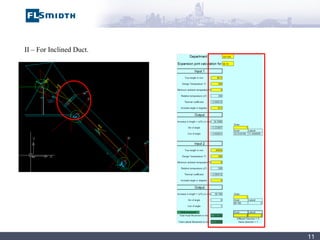
II – For Inclined Duct.
III – For Pre-heater downcomer duct. Two different values of temperature must be considered for calculation For Cyclone Temperature should be skin temperature III – For Pre-heater downcomer duct. Total axial movement is 35.145+12.48=47.625~50mm
IV – For Duct with connecting equipments. Movement due to connecting equipment must be taken in to consideration. Resultant movement
V – For Duct subjected to different temperatures. Two different temperature condition on the same duct. Two different temperature condition on the same duct.
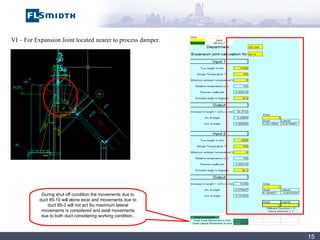
VI – For Expansion Joint located nearer to process damper. During shut off condition the movements due to duct 85-10 will alone exist and movements due to duct 85-3 will not act So maximum lateral movements is considered and axial movements due to both duct considering working condition. .
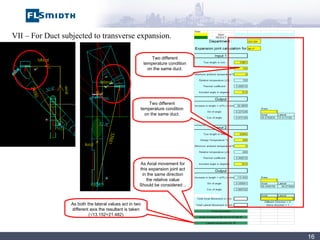
VII – For Duct subjected to transverse expansion. As Axial movement for this expansion joint act in the same direction the relative value Should be considered  . . As both the lateral values act in two different axis the resultant is taken (√13.152+21.482) Two different temperature condition on the same duct. Two different temperature condition on the same duct.
VIII – Special Case. In cases like this where the slide support is placed you have to check the moment acting on the fixed support. Resultant movement
Exercise
Thank you.

Expansion Joints

  • 1.
    Expansion Joint byNivedit Mathur & Manik Deshpande NISH-IN MLD-IN
  • 2.
    This presentation consistsof:- Introduction. Definition and Application. Working Principle. Metallic versus Non-Metallic types. General considerations for calculating expansion values. Case wise methodology:- I – For Straight Duct. II – For Inclined Duct. III – For Pre-heater downcomer duct. IV – For Duct with connecting equipments. V – For Duct subjected to different temperatures. VI – For Expansion Joint located nearer to process damper. VII – For Duct subjected to transverse/angular expansion. Exercises.
  • 3.
    Introduction:- The reasons for organizing this presentation are:- To minimize expansion joint problem/failure at project sites. To minimize PL5 dependencies on Plant Utilities. To establish a common platform interms of understanding expansion joint terminology, calculation, behavior and documentation.
  • 4.
    Definition and Application:-Expansion Joint is an flexible connector designed to perform the following four major task:- To allow expansion and contraction of the duct due to temperature changes. To provide isolation of a component to minimize the effects of vibration and noise. To allow movement of component during process operation. To aid in installation or removal of large components and erection tolerances.
  • 5.
    Definition and Application:Axial Elongation – Dimensional lengthening of the expansion joint along its longitudinal axis. Axial Compression – Dimensional shortening of the expansion joint along its longitudinal axis. Lateral Movement – Relative displacement of the two ends of the expansion joint perpendicular to its longitudinal axis. Angular Movement – Displacement of the longitudinal axis of the expansion joint from its initial straight line position into a circular arc.
  • 6.
    Working Principle:- Non Metallic Type – Works on the basis of fabric as flexible element formed into one or maximum two convolution. Metallic Type – Works on the basis of thin metallic sheets as flexible element formed into multiple convolutions.
  • 7.
    Metallic versus Non-MetallicType: Temperature Standard rubber joints have an upper range to 230-deg F. Standard metal joints are designed up to 420-deg F to 1800-deg F. Movements Rubber joints absorbs far greater lateral movements when compared to metal joints Similar face to face dimensions. Spring Rates – Defined as the total force required to move an expansion joint by one inch in any direction. Rubber Joints – Low spring rate. Metal Joints – High spring rate. Gas Tightness at all temperature Rubber Joints – Lower Metal Joints - Higher
  • 8.
    Basic Consideration:- Temperaturefor calculation (T) = design - minimum ambient temperature(If not insulated) and Temperature =design (IF insulated). Thermal coefficient (a) = 12x10^-6. Length(L): Length can be calculated from the 1 st fixed support to expansion joint center and Expansion joint center to 2 nd Fixed Support. No need to consider any margin for values of expansion joint as it is calculated for design temperature.
  • 9.
    Basic Consideration:- Ifmovements acts in same direction then the movements value should be subtracted and vice versa... For those expansion joints which comes with connecting equipment the movements due to corresponding Connecting equipment also has to be considered. 1. For Cyclone, Temperature should be skin temperature 2. For ESP and other Connecting equipment, movements will be specified in the OL drawings. 3. For mill and cooler as per respective department there will be no movements. For tall elevators and chain conveyors expansion values given in the respective OL/ Supplier drgs to be considered Formula:- Increase in length = aTL
  • 10.
    Case wise Methodology:I – For Straight Duct.
  • 11.
    II – ForInclined Duct.
  • 12.
    III – ForPre-heater downcomer duct. Two different values of temperature must be considered for calculation For Cyclone Temperature should be skin temperature III – For Pre-heater downcomer duct. Total axial movement is 35.145+12.48=47.625~50mm
  • 13.
    IV – ForDuct with connecting equipments. Movement due to connecting equipment must be taken in to consideration. Resultant movement
  • 14.
    V – ForDuct subjected to different temperatures. Two different temperature condition on the same duct. Two different temperature condition on the same duct.
  • 15.
    VI – ForExpansion Joint located nearer to process damper. During shut off condition the movements due to duct 85-10 will alone exist and movements due to duct 85-3 will not act So maximum lateral movements is considered and axial movements due to both duct considering working condition. .
  • 16.
    VII – ForDuct subjected to transverse expansion. As Axial movement for this expansion joint act in the same direction the relative value Should be considered . . As both the lateral values act in two different axis the resultant is taken (√13.152+21.482) Two different temperature condition on the same duct. Two different temperature condition on the same duct.
  • 17.
    VIII – SpecialCase. In cases like this where the slide support is placed you have to check the moment acting on the fixed support. Resultant movement
  • 18.
  • 19.