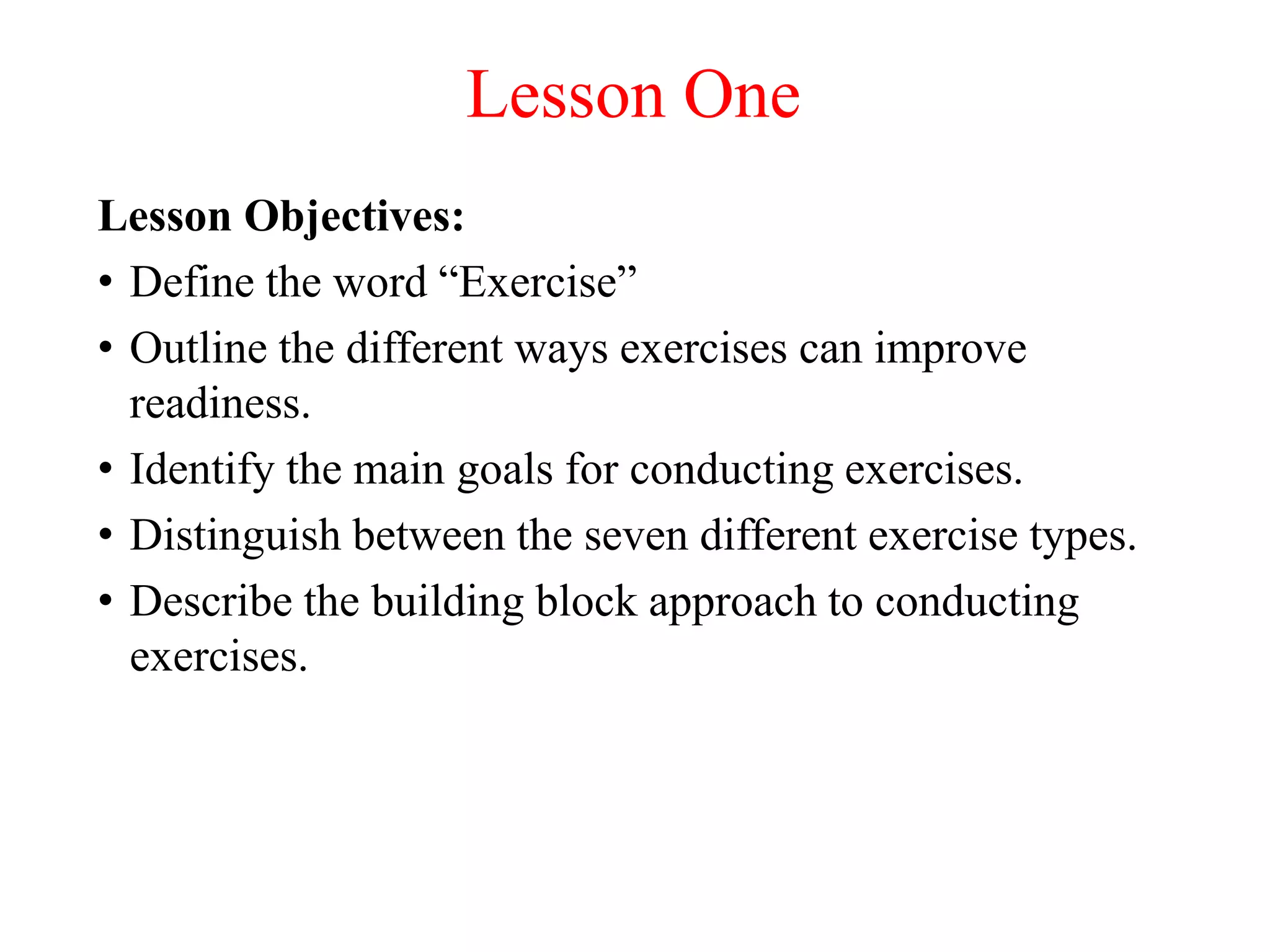
Conducting Exercises in Emergency
          Management
Lesson One
Lesson Objectives:
• Define the word “Exercise”
• Outline the different ways exercises can improve
  readiness.
• Identify the main goals for conducting exercises.
• Distinguish between the seven different exercise types.
• Describe the building block approach to conducting
  exercises.
Rationale for Conducting Exercises
• Definition(s) - Exercise:
   – Something done or performed as a means of practice or
     training.
   – A putting into action, use, operation, or effect.
• Exercises Improve Readiness By:
   – Providing the opportunity to evaluate agency operations
     and plans.
   – Allowing the demonstration of community resolve in the
     event of a catastrophic event.
• The main goals for conducting exercises are:
   –   Clarify roles and responsibilities.
   –   Identify resource gaps.
   –   Develop and improve interagency coordination.
   –   Improve individual performances.
   –   Identify opportunities for improvement.
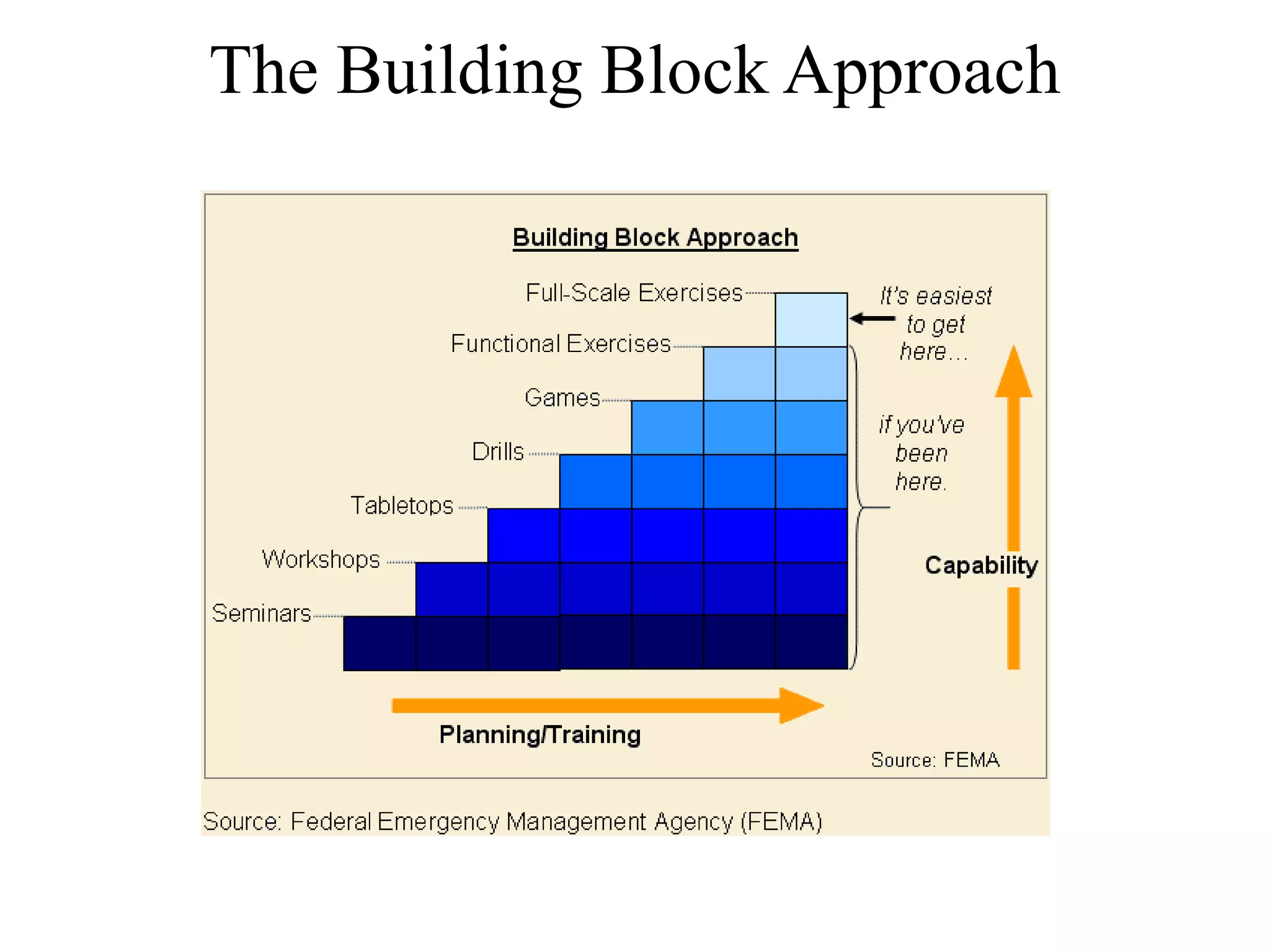
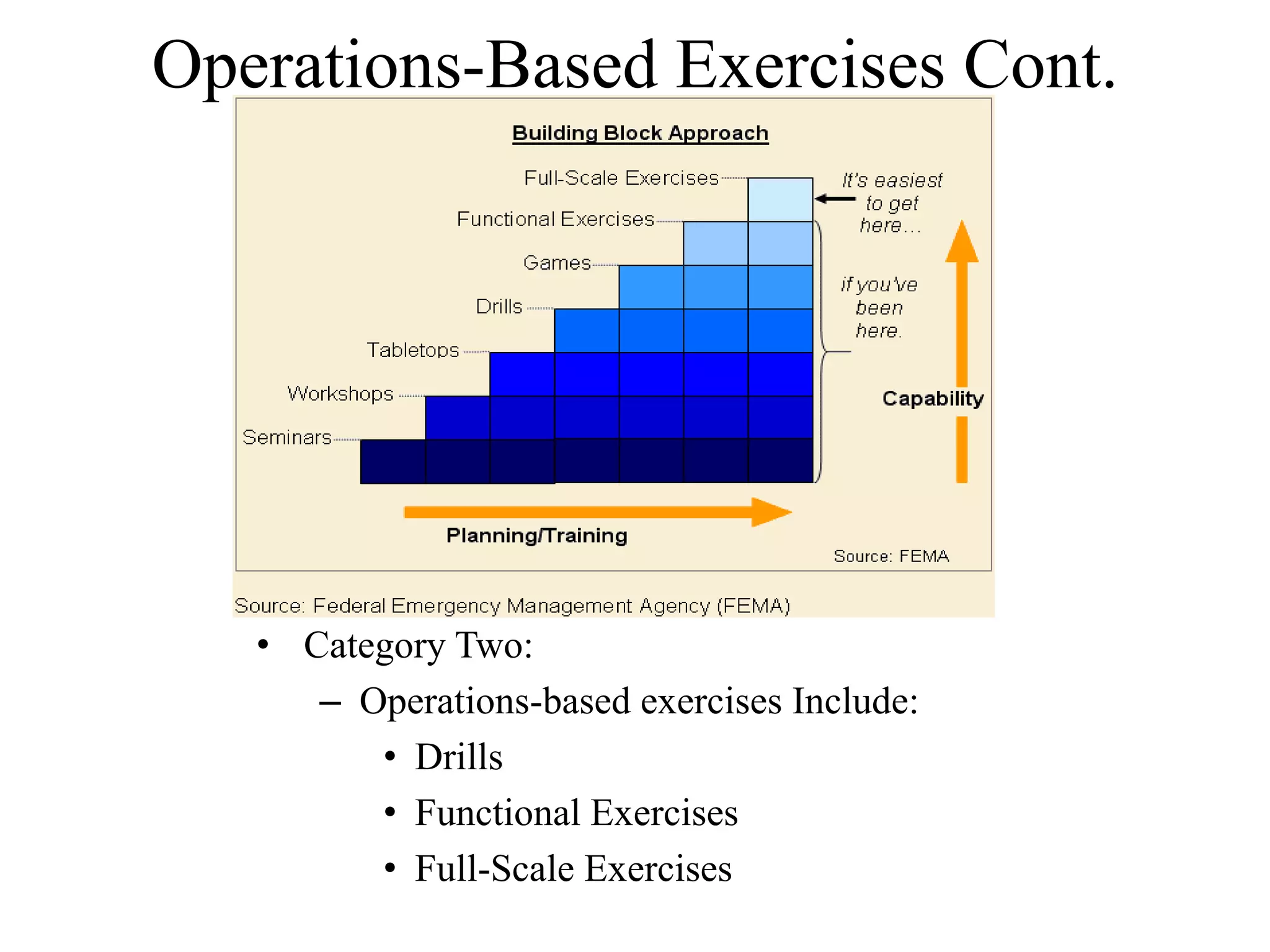
The Building Block Approach
• Typically, exercises range widely in cost, size, scope,
  complexity, purpose, and approach.
• Exercise should be planned in a cycle that increases in
  complexity. Each successive exercise should build on
  the scale and experience of the previous one.
• In the building block approach, there are seven
  accepted types of exercises. Each of the seven types
  fall into one of two categories: Discussion-based
  exercises and Operations-based exercises.
The Building Block Approach
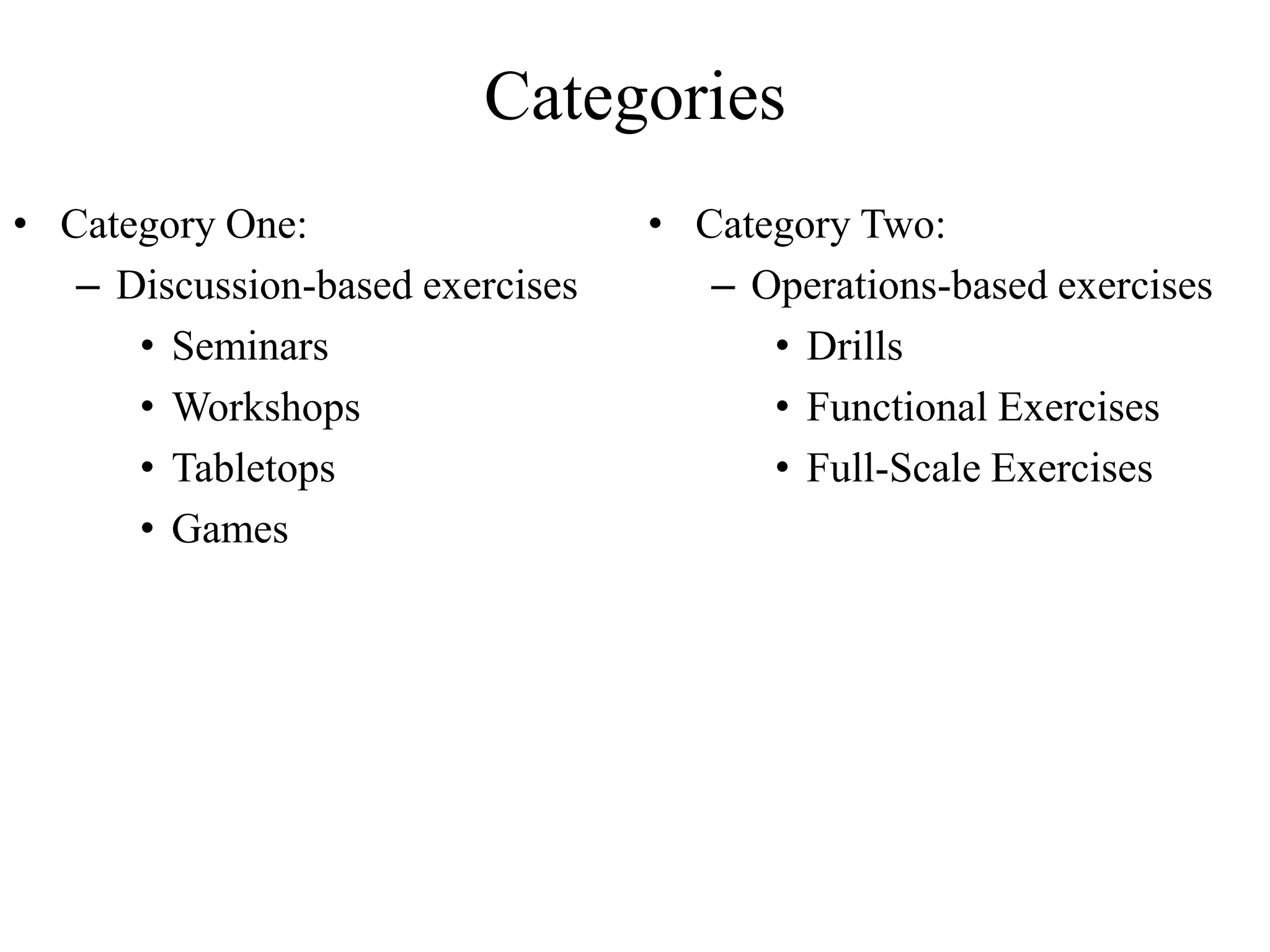
Categories
• Category One:                   • Category Two:
   – Discussion-based exercises      – Operations-based exercises
      • Seminars                        • Drills
      • Workshops                       • Functional Exercises
      • Tabletops                       • Full-Scale Exercises
      • Games
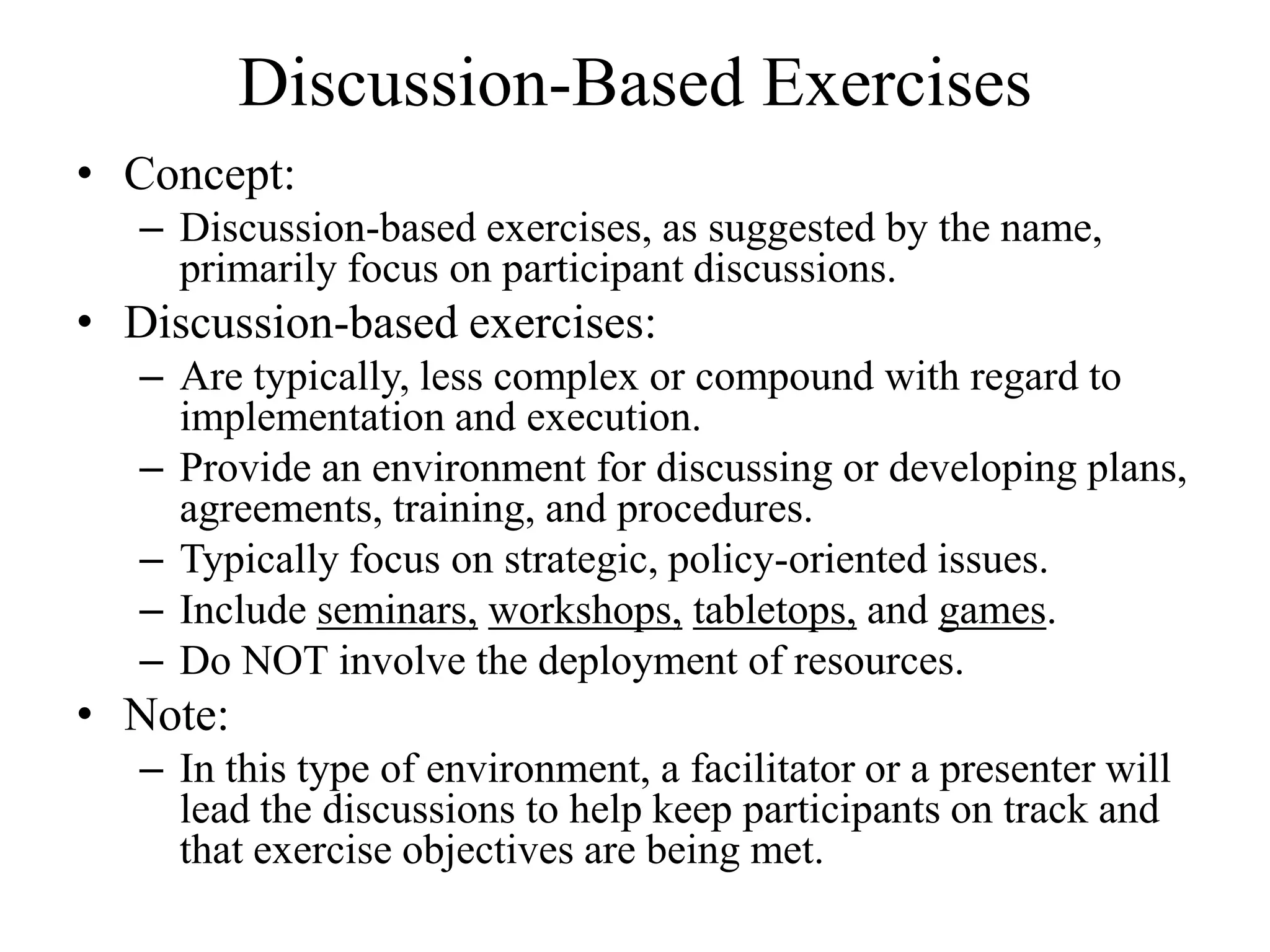
Discussion-Based Exercises
• Concept:
   – Discussion-based exercises, as suggested by the name,
     primarily focus on participant discussions.
• Discussion-based exercises:
   – Are typically, less complex or compound with regard to
     implementation and execution.
   – Provide an environment for discussing or developing plans,
     agreements, training, and procedures.
   – Typically focus on strategic, policy-oriented issues.
   – Include seminars, workshops, tabletops, and games.
   – Do NOT involve the deployment of resources.
• Note:
   – In this type of environment, a facilitator or a presenter will
     lead the discussions to help keep participants on track and
     that exercise objectives are being met.
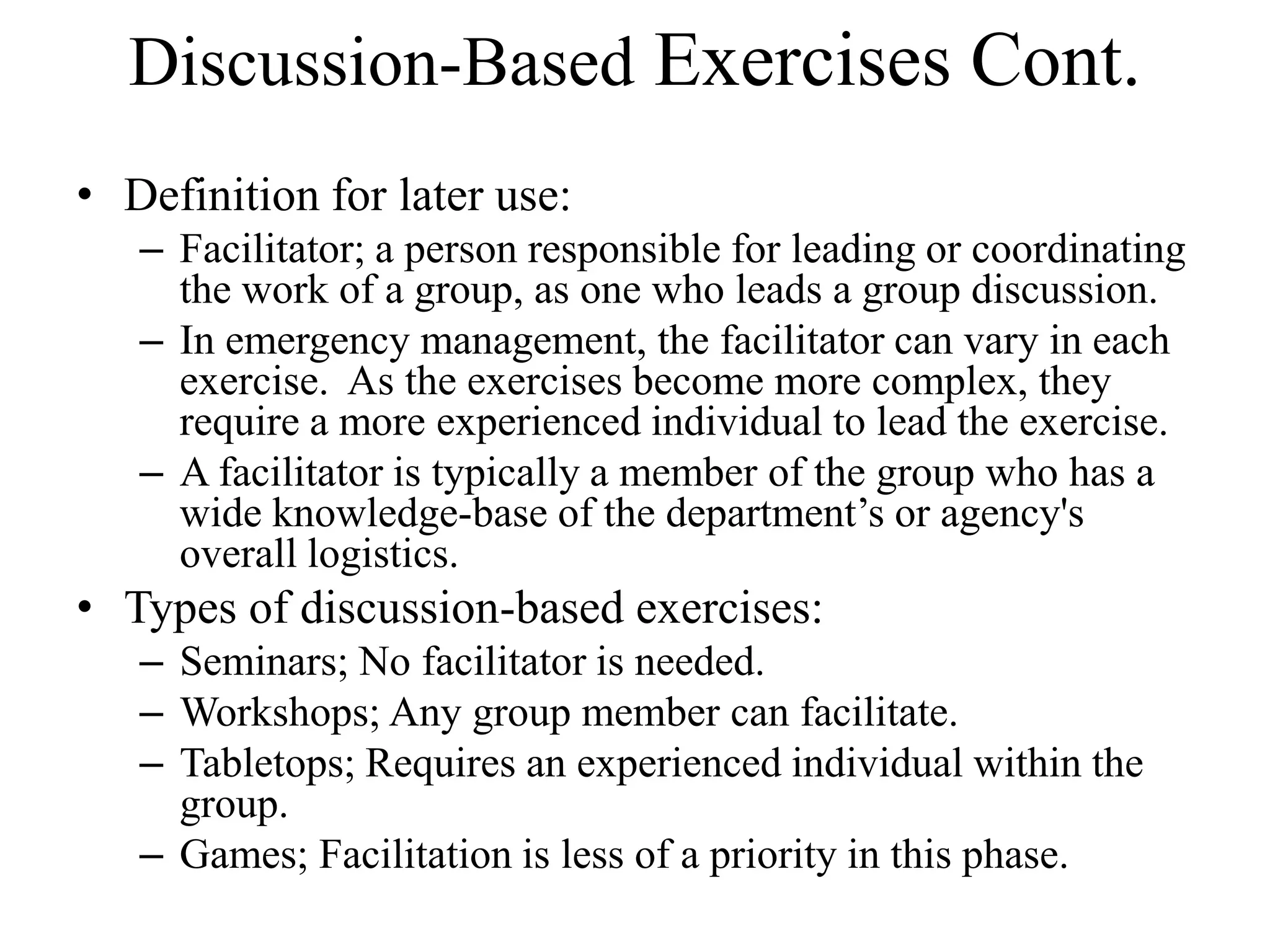
Discussion-Based Exercises Cont.
• Definition for later use:
   – Facilitator; a person responsible for leading or coordinating
     the work of a group, as one who leads a group discussion.
   – In emergency management, the facilitator can vary in each
     exercise. As the exercises become more complex, they
     require a more experienced individual to lead the exercise.
   – A facilitator is typically a member of the group who has a
     wide knowledge-base of the department’s or agency's
     overall logistics.
• Types of discussion-based exercises:
   – Seminars; No facilitator is needed.
   – Workshops; Any group member can facilitate.
   – Tabletops; Requires an experienced individual within the
     group.
   – Games; Facilitation is less of a priority in this phase.
Discussion-Based Exercises Cont.
Discussion-Based Personnel:
• Presenters – Deliver the exercise presentation.
• Facilitators/Moderators – Lead group discussion.
• Controllers – Interpret rules and provide players
  with information.
• Evaluators – Observe and collect exercise data.
• Players – Discuss issues based on professional
  knowledge.
• Observers/VIPs – View but do not participate in
  exercise.
Seminars
• Concept:
   – A seminar is an informal discussion-based exercise led by a
     presenter or facilitator, used to teach or orientate
     participants.
• Seminar Goals:
   – Introduce participants to new or existing plans, policies, or
     procedures.
   – Explore or assess interagency capabilities or inter-
     jurisdictional operations.
   – Construct a common framework of understanding.
• Behavior Characteristics:
   – Casual atmosphere.
   – Few time constraints.
   – Lecture-based
Workshops
• Concept:
   – A workshop is a formal discussion-based exercise led by a
     facilitator or presenter, used to build or achieve a product.
• Workshop Goals:
   – Develop new ideas, processes, or procedures.
   – Develop a written product as a group in coordinated
     activities.
   – Obtain consensus, agreement, or compromise.
• Behavior Characteristics:
   – Workshops require more participant discussion than a
     lecture-based seminar.
   – Break-out sessions are commonly used to explore parts of
     an issue with smaller groups.
Tabletop Exercises
• Concept:
  – Tabletop exercises (TTX) involve senior staff, elected
    or appointed officials, or other key personnel in an
    informal group discussion centered on a hypothetical
    scenario.
• Goals:
  – Identify strengths and shortfalls.
  – Enhance understanding of new concepts.
  – Seek to change existing attitudes and perspectives.
• Behavior Characteristics:
  – Requires an experienced facilitator.
  – In-depth discussions.
  – Slow-paced problem solving.
Games
• Concept:
   – In the world of Emergency Management, a game is a
     simulation of operations using rules, data, and procedures
     designed to depict an actual or assumed real-life situation.
• Goals:
   – In a game, participants:
      • Explore the processes and consequences of decision-making.
      • Conduct “what-if” analyses of existing plans.
      • Test existing and potential strategies.
• Behavior Characteristics:
   – This does not involve the use of actual resources.
   – Simulations typically included two or more teams.
   – Includes models and simulations of increasing complexity
     as the game progresses.
Operations-Based Exercises
• Operations-based exercise:
  – Involve deployment of resources and personnel.
  – Are more complex than discussion-based types.
  – Require execution of plans, policies, agreements,
    and procedures.
  – Clarify roles and responsibilities.
  – Improve individual and team performances.
  – Include drills and both functional and full-scale
    exercises.
Operations-Based Exercises Cont.


   • Category Two:
      – Operations-based exercises Include:
         • Drills
         • Functional Exercises
         • Full-Scale Exercises
Drills
• Concept:
  – Drills consist of supervised activity that tests a specific
    operation or function of a single agency.
• Goals:
  –   Obtain training on new equipment.
  –   Test and assess new procedures.
  –   Practice and maintain role skills.
  –   Prepare and plan for future complex exercises.
• Behavior Characteristics:
  – Immediate feedback.
  – Realistic but isolated environment.
Functional Exercises
• Concepts:
  – A functional exercise (FE) is a single or multi-agency
    activity designed to evaluate capabilities and multiple
    functions using simulated response.
• Goals:
  – Evaluate the management of Emergency Operations
    Centers, command post, and headquarters.
  – Assess the adequacy of response plans and resources.
• Behavior Characteristics:
  – Simulated deployment of resources and personnel.
  – Rapid problem solving.
  – Highly stressful environment.
Functional Exercises Cont.
• This format is applicable where the activity is
  capable of being effectively evaluated in isolation
  from other emergency management activity.
• In contrast to the Full-Scale Exercise, the
  objective of the Functional Exercise is to:
   – Demonstrate the execution of specific plans and
     procedures,
   – Directly apply established policy, plans, and
     procedures under emergency conditions, within or by a
     particular functional team(s).
• Most deployment of resources is simulated.
Functional Exercises Cont.

• Differences between drills and Functional
  Exercises.
  – Drills involve a single function; Functional
    Exercises involve multiple functions.
  – Drills involve actual deployment of resources and
    personnel; Functional exercises use simulation.
Full-Scale Exercises

• Concept:
  – Full-Scale Exercises (FSE) are high-stressed multi-
    agency, multi-jurisdictional activities involving actual
    deployment of resources in a coordinated response, as
    if a real incident had occurred.
  – Goals:
     • Assess plans and procedures under crisis conditions.
     • Evaluate coordinated responses under crisis conditions.
  – Behavior/Conduct Characteristics:
     • Mobilization of units, personnel, equipment, and gear.
     • Highly stressful, realistic environment.
     • Includes scripted exercise scenarios.

Lesson 1 introduction

  • 1.
    Conducting Exercises inEmergency Management
  • 2.
    Lesson One Lesson Objectives: •Define the word “Exercise” • Outline the different ways exercises can improve readiness. • Identify the main goals for conducting exercises. • Distinguish between the seven different exercise types. • Describe the building block approach to conducting exercises.
  • 3.
    Rationale for ConductingExercises • Definition(s) - Exercise: – Something done or performed as a means of practice or training. – A putting into action, use, operation, or effect. • Exercises Improve Readiness By: – Providing the opportunity to evaluate agency operations and plans. – Allowing the demonstration of community resolve in the event of a catastrophic event. • The main goals for conducting exercises are: – Clarify roles and responsibilities. – Identify resource gaps. – Develop and improve interagency coordination. – Improve individual performances. – Identify opportunities for improvement.
  • 4.
    The Building BlockApproach • Typically, exercises range widely in cost, size, scope, complexity, purpose, and approach. • Exercise should be planned in a cycle that increases in complexity. Each successive exercise should build on the scale and experience of the previous one. • In the building block approach, there are seven accepted types of exercises. Each of the seven types fall into one of two categories: Discussion-based exercises and Operations-based exercises.
  • 5.
  • 6.
    Categories • Category One: • Category Two: – Discussion-based exercises – Operations-based exercises • Seminars • Drills • Workshops • Functional Exercises • Tabletops • Full-Scale Exercises • Games
  • 7.
    Discussion-Based Exercises • Concept: – Discussion-based exercises, as suggested by the name, primarily focus on participant discussions. • Discussion-based exercises: – Are typically, less complex or compound with regard to implementation and execution. – Provide an environment for discussing or developing plans, agreements, training, and procedures. – Typically focus on strategic, policy-oriented issues. – Include seminars, workshops, tabletops, and games. – Do NOT involve the deployment of resources. • Note: – In this type of environment, a facilitator or a presenter will lead the discussions to help keep participants on track and that exercise objectives are being met.
  • 8.
    Discussion-Based Exercises Cont. •Definition for later use: – Facilitator; a person responsible for leading or coordinating the work of a group, as one who leads a group discussion. – In emergency management, the facilitator can vary in each exercise. As the exercises become more complex, they require a more experienced individual to lead the exercise. – A facilitator is typically a member of the group who has a wide knowledge-base of the department’s or agency's overall logistics. • Types of discussion-based exercises: – Seminars; No facilitator is needed. – Workshops; Any group member can facilitate. – Tabletops; Requires an experienced individual within the group. – Games; Facilitation is less of a priority in this phase.
  • 9.
    Discussion-Based Exercises Cont. Discussion-BasedPersonnel: • Presenters – Deliver the exercise presentation. • Facilitators/Moderators – Lead group discussion. • Controllers – Interpret rules and provide players with information. • Evaluators – Observe and collect exercise data. • Players – Discuss issues based on professional knowledge. • Observers/VIPs – View but do not participate in exercise.
  • 10.
    Seminars • Concept: – A seminar is an informal discussion-based exercise led by a presenter or facilitator, used to teach or orientate participants. • Seminar Goals: – Introduce participants to new or existing plans, policies, or procedures. – Explore or assess interagency capabilities or inter- jurisdictional operations. – Construct a common framework of understanding. • Behavior Characteristics: – Casual atmosphere. – Few time constraints. – Lecture-based
  • 11.
    Workshops • Concept: – A workshop is a formal discussion-based exercise led by a facilitator or presenter, used to build or achieve a product. • Workshop Goals: – Develop new ideas, processes, or procedures. – Develop a written product as a group in coordinated activities. – Obtain consensus, agreement, or compromise. • Behavior Characteristics: – Workshops require more participant discussion than a lecture-based seminar. – Break-out sessions are commonly used to explore parts of an issue with smaller groups.
  • 12.
    Tabletop Exercises • Concept: – Tabletop exercises (TTX) involve senior staff, elected or appointed officials, or other key personnel in an informal group discussion centered on a hypothetical scenario. • Goals: – Identify strengths and shortfalls. – Enhance understanding of new concepts. – Seek to change existing attitudes and perspectives. • Behavior Characteristics: – Requires an experienced facilitator. – In-depth discussions. – Slow-paced problem solving.
  • 13.
    Games • Concept: – In the world of Emergency Management, a game is a simulation of operations using rules, data, and procedures designed to depict an actual or assumed real-life situation. • Goals: – In a game, participants: • Explore the processes and consequences of decision-making. • Conduct “what-if” analyses of existing plans. • Test existing and potential strategies. • Behavior Characteristics: – This does not involve the use of actual resources. – Simulations typically included two or more teams. – Includes models and simulations of increasing complexity as the game progresses.
  • 14.
    Operations-Based Exercises • Operations-basedexercise: – Involve deployment of resources and personnel. – Are more complex than discussion-based types. – Require execution of plans, policies, agreements, and procedures. – Clarify roles and responsibilities. – Improve individual and team performances. – Include drills and both functional and full-scale exercises.
  • 15.
    Operations-Based Exercises Cont. • Category Two: – Operations-based exercises Include: • Drills • Functional Exercises • Full-Scale Exercises
  • 16.
    Drills • Concept: – Drills consist of supervised activity that tests a specific operation or function of a single agency. • Goals: – Obtain training on new equipment. – Test and assess new procedures. – Practice and maintain role skills. – Prepare and plan for future complex exercises. • Behavior Characteristics: – Immediate feedback. – Realistic but isolated environment.
  • 17.
    Functional Exercises • Concepts: – A functional exercise (FE) is a single or multi-agency activity designed to evaluate capabilities and multiple functions using simulated response. • Goals: – Evaluate the management of Emergency Operations Centers, command post, and headquarters. – Assess the adequacy of response plans and resources. • Behavior Characteristics: – Simulated deployment of resources and personnel. – Rapid problem solving. – Highly stressful environment.
  • 18.
    Functional Exercises Cont. •This format is applicable where the activity is capable of being effectively evaluated in isolation from other emergency management activity. • In contrast to the Full-Scale Exercise, the objective of the Functional Exercise is to: – Demonstrate the execution of specific plans and procedures, – Directly apply established policy, plans, and procedures under emergency conditions, within or by a particular functional team(s). • Most deployment of resources is simulated.
  • 19.
    Functional Exercises Cont. •Differences between drills and Functional Exercises. – Drills involve a single function; Functional Exercises involve multiple functions. – Drills involve actual deployment of resources and personnel; Functional exercises use simulation.
  • 20.
    Full-Scale Exercises • Concept: – Full-Scale Exercises (FSE) are high-stressed multi- agency, multi-jurisdictional activities involving actual deployment of resources in a coordinated response, as if a real incident had occurred. – Goals: • Assess plans and procedures under crisis conditions. • Evaluate coordinated responses under crisis conditions. – Behavior/Conduct Characteristics: • Mobilization of units, personnel, equipment, and gear. • Highly stressful, realistic environment. • Includes scripted exercise scenarios.