Presented	
  by:	
  
Ed	
  Wendlandt	
  
President	


EMERGENCY	
  RESPONSE	
  
MANAGEMENT	
  CONSULTING	
  LTD.	
  
www.ermcglobal.com	
  
May	
  3,	
  2013	
  
2013	
  Suncor	
  Contractors	
  
Safety	
  Professionals	
  
AppreciaHon	
  Day	
  
Exercise	
  Planning:	
  
IntegraHng	
  Stakeholders	
  
INTRODUCTION
Ed Wendlandt, CD, MSc – President of ERMC
•  Joined ERMC in 2003
•  Emergency & crisis management expertise with 20+
years experience
•  Oil & Gas, Chemical, Nuclear, Mining, Utilities, Gov’t,
Agri-Products, Post-Secondary Education & more
•  Hazard/Risk Assessments, Mitigation planing
•  ER Plan Development, Training, Exercises
•  Develop mutual aid models
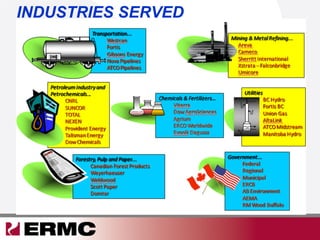
INDUSTRIES SERVED
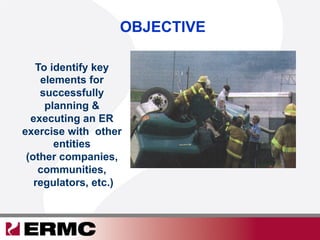
To identify key
elements for
successfully
planning &
executing an ER
exercise with other
entities
(other companies,
communities,
regulators, etc.)
OBJECTIVE
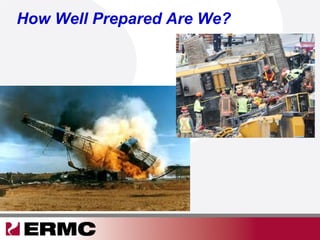
How Well Prepared Are We?
How Well Prepared Are We for
Mother Nature?
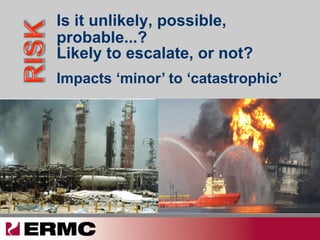
Is it unlikely, possible,
probable...?
Impacts ‘minor’ to ‘catastrophic’
Likely to escalate, or not?
ASSUMPTIONS???
1.  Hazard & Risk Assessment
2.  Functional Emergency Response Plan
3.  Emergency Management organization
4.  Conducted training for our people
5.  We exercise our plans
We have:
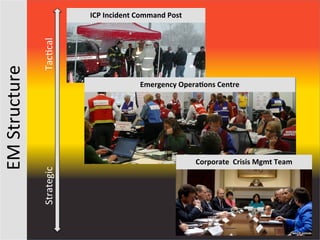
 EM	
  Structure	
  
Strategic	
  Tac:cal	
  
ICP	
  Incident	
  Command	
  Post	
  
Emergency	
  OperaHons	
  Centre	
  
Corporate	
  	
  Crisis	
  Mgmt	
  Team	
  
ASSUMPTIONS???
1.  Shared information on our plans
2.  Identified how we can support each
other (resources)
3.  Trained together
4.  Participated in exercises together
We have:
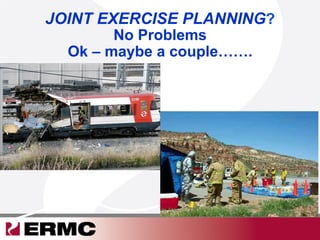
JOINT EXERCISE PLANNING?
No Problems
Ok – maybe a couple…….
• Purpose
• Achievability
• Involvement
• Realism
• Exercise Planning Team
• Communications
PRINCIPLES – EXERCISE DESIGN
Purpose
PRINCIPLES – PURPOSE
Why do you want to conduct an exercise?
What do you want to accomplish?
Achievability
PRINCIPLES – ACHIEVABILITY
Can you accomplish this?
Commitment from senior
management of all organizations?
Time?
Resources?
Funding?
Involvement
Who will participate?
Field Responders from which
organizations?
Site EOC?
Mutual Aid?
Emergency Services?
Other industry responders?
Non-Government Organizations?
PRINCIPLES – INVOLVEMENT
Realism
Credibility of the exercise goes a long way.
Don’t over complicate it or make it too easy
Your exercise will likely be much shorter than the
real event so you need to sometimes manipulate
the incident .
PRINCIPLES – REALISM
Exercise Planning Team
Who from the organization will plan?
Site management staff ?
Health & Safety Personnel?
Contractors?
Other stakeholders?
PRINCIPLES – PLANNING TEAM
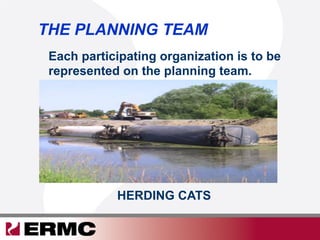
Each participating organization is to be
represented on the planning team.
THE PLANNING TEAM
HERDING CATS
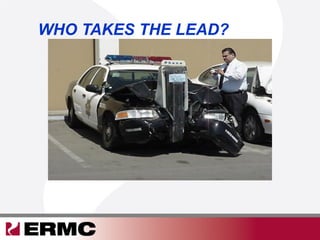
WHO TAKES THE LEAD?
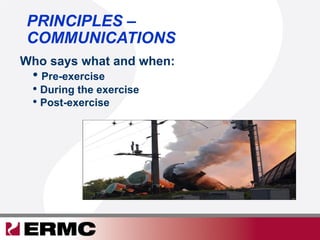
Who says what and when:
• Pre-exercise
• During the exercise
• Post-exercise
PRINCIPLES –
COMMUNICATIONS
QUESTION
What are some of the challenges you have
experienced or you would envision in planning
an exercise involving several companies/
organizations ?
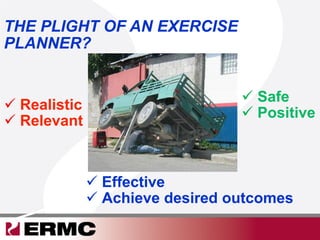
THE PLIGHT OF AN EXERCISE
PLANNER?
 Realistic
 Relevant
 Safe
 Positive
 Effective
 Achieve desired outcomes
1.  Set objectives
2.  Develop project timeline
3.  Develop scenario
4.  Determine resource requirements
5.  Develop exercise instructions
EXERCISE PLANNING
CHECKLIST
EXERCISE PLANNING
CHECKLIST
6.  Liaise and coordinate
7.  Conduct a rehearsal
8.  Pre-exercise activities
9.  Conduct exercise
10.  Conduct post-exercise activities
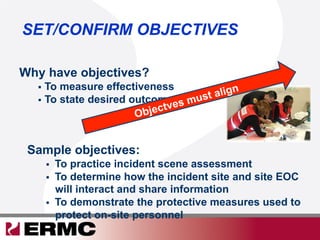
SET/CONFIRM OBJECTIVES
Why have objectives?
  To measure effectiveness
  To state desired outcomes
Sample objectives:
  To practice incident scene assessment
  To determine how the incident site and site EOC
will interact and share information
  To demonstrate the protective measures used to
protect on-site personnel
Objectves must align
DEVELOP PROJECT TIMELINE
A Useful Tool!
•  Consider planning time (months, not weeks)
•  Work back from the exercise date
•  Ensure dates and milestones are realistic
•  This is a project – make a plan. Milestones, planning
meetings and reporting
•  Present and get buy-in
Crack the whip!!!
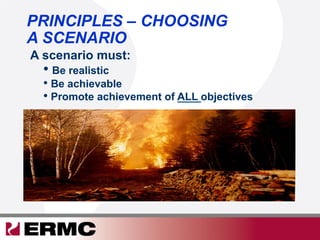
A scenario must:
• Be realistic
• Be achievable
• Promote achievement of ALL objectives
PRINCIPLES – CHOOSING
A SCENARIO
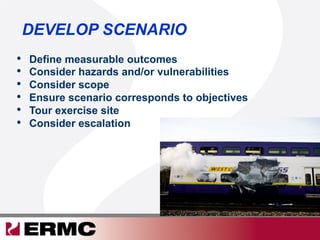
DEVELOP SCENARIO
•  Define measurable outcomes
•  Consider hazards and/or vulnerabilities
•  Consider scope
•  Ensure scenario corresponds to objectives
•  Tour exercise site
•  Consider escalation
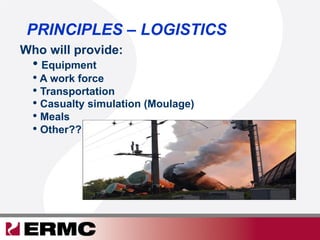
Who will provide:
• Equipment
• A work force
• Transportation
• Casualty simulation (Moulage)
• Meals
• Other??
PRINCIPLES – LOGISTICS
DEVELOP EXERCISE
INSTRUCTIONS
•  General Instruction – for participants
•  Evaluator and Observer instructions
  Above instructions identify objectives, scope,
participants, exercise staff, general conduct,
timings, communication, administration, safety
•  Master Sequence of Events List
LIAISE AND COORDINATE
•  A never ending process!
•  Includes securing/confirming resources
•  Updating key participants
•  Updating senior management
Follow up, follow up, follow up…
REHEARSAL
•  Confirm the setup requirements
•  Using the Master Sequence of Events List, explore
possible outcomes of exercise actions
•  Conduct a walk-through rehearsal with exercise
staff at the exercise site close to the exercise date
•  Contingencies?
•  Give yourself adequate time to make adjustments
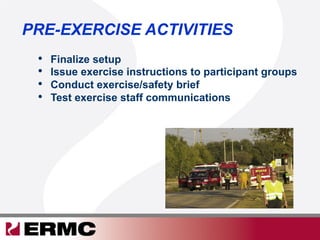
PRE-EXERCISE ACTIVITIES
•  Finalize setup
•  Issue exercise instructions to participant groups
•  Conduct exercise/safety brief
•  Test exercise staff communications
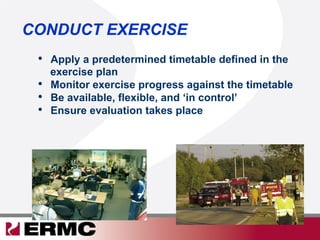
CONDUCT EXERCISE
•  Apply a predetermined timetable defined in the
exercise plan
•  Monitor exercise progress against the timetable
•  Be available, flexible, and ‘in control’
•  Ensure evaluation takes place
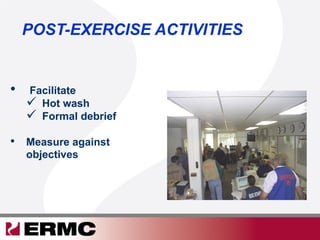
POST-EXERCISE ACTIVITIES
•  Facilitate
  Hot wash
  Formal debrief
•  Measure against
objectives
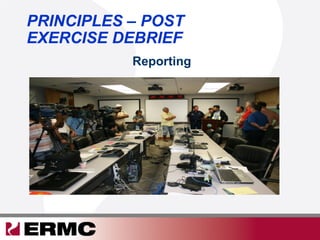
Reporting
PRINCIPLES – POST
EXERCISE DEBRIEF
THANK YOU
Contact
ERMC – Emergency Response Management Consulting Ltd
www.ermcglobal.com
Ed Wendlandt – President
e-mail: ewendlandt@ermcglobal.com
Also primary sponsor of Disaster Forum
www.disasterforum.ca

Suncor suppliers 2013 conf exercise planning

  • 1.
    Presented  by:   Ed  Wendlandt   President       EMERGENCY  RESPONSE   MANAGEMENT  CONSULTING  LTD.   www.ermcglobal.com   May  3,  2013   2013  Suncor  Contractors   Safety  Professionals   AppreciaHon  Day   Exercise  Planning:   IntegraHng  Stakeholders  
  • 2.
    INTRODUCTION Ed Wendlandt, CD,MSc – President of ERMC •  Joined ERMC in 2003 •  Emergency & crisis management expertise with 20+ years experience •  Oil & Gas, Chemical, Nuclear, Mining, Utilities, Gov’t, Agri-Products, Post-Secondary Education & more •  Hazard/Risk Assessments, Mitigation planing •  ER Plan Development, Training, Exercises •  Develop mutual aid models
  • 3.
  • 4.
    To identify key elementsfor successfully planning & executing an ER exercise with other entities (other companies, communities, regulators, etc.) OBJECTIVE
  • 5.
  • 6.
    How Well PreparedAre We for Mother Nature?
  • 7.
    Is it unlikely,possible, probable...? Impacts ‘minor’ to ‘catastrophic’ Likely to escalate, or not?
  • 8.
    ASSUMPTIONS??? 1.  Hazard &Risk Assessment 2.  Functional Emergency Response Plan 3.  Emergency Management organization 4.  Conducted training for our people 5.  We exercise our plans We have:
  • 9.
     EM  Structure   Strategic  Tac:cal   ICP  Incident  Command  Post   Emergency  OperaHons  Centre   Corporate    Crisis  Mgmt  Team  
  • 10.
    ASSUMPTIONS??? 1.  Shared informationon our plans 2.  Identified how we can support each other (resources) 3.  Trained together 4.  Participated in exercises together We have:
  • 11.
    JOINT EXERCISE PLANNING? NoProblems Ok – maybe a couple…….
  • 12.
  • 13.
    Purpose PRINCIPLES – PURPOSE Whydo you want to conduct an exercise? What do you want to accomplish?
  • 14.
    Achievability PRINCIPLES – ACHIEVABILITY Canyou accomplish this? Commitment from senior management of all organizations? Time? Resources? Funding?
  • 15.
    Involvement Who will participate? FieldResponders from which organizations? Site EOC? Mutual Aid? Emergency Services? Other industry responders? Non-Government Organizations? PRINCIPLES – INVOLVEMENT
  • 16.
    Realism Credibility of theexercise goes a long way. Don’t over complicate it or make it too easy Your exercise will likely be much shorter than the real event so you need to sometimes manipulate the incident . PRINCIPLES – REALISM
  • 17.
    Exercise Planning Team Whofrom the organization will plan? Site management staff ? Health & Safety Personnel? Contractors? Other stakeholders? PRINCIPLES – PLANNING TEAM
  • 18.
    Each participating organizationis to be represented on the planning team. THE PLANNING TEAM HERDING CATS
  • 19.
  • 20.
    Who says whatand when: • Pre-exercise • During the exercise • Post-exercise PRINCIPLES – COMMUNICATIONS
  • 21.
    QUESTION What are someof the challenges you have experienced or you would envision in planning an exercise involving several companies/ organizations ?
  • 22.
    THE PLIGHT OFAN EXERCISE PLANNER?  Realistic  Relevant  Safe  Positive  Effective  Achieve desired outcomes
  • 23.
    1.  Set objectives 2. Develop project timeline 3.  Develop scenario 4.  Determine resource requirements 5.  Develop exercise instructions EXERCISE PLANNING CHECKLIST
  • 24.
    EXERCISE PLANNING CHECKLIST 6.  Liaiseand coordinate 7.  Conduct a rehearsal 8.  Pre-exercise activities 9.  Conduct exercise 10.  Conduct post-exercise activities
  • 25.
    SET/CONFIRM OBJECTIVES Why haveobjectives?   To measure effectiveness   To state desired outcomes Sample objectives:   To practice incident scene assessment   To determine how the incident site and site EOC will interact and share information   To demonstrate the protective measures used to protect on-site personnel Objectves must align
  • 26.
    DEVELOP PROJECT TIMELINE AUseful Tool! •  Consider planning time (months, not weeks) •  Work back from the exercise date •  Ensure dates and milestones are realistic •  This is a project – make a plan. Milestones, planning meetings and reporting •  Present and get buy-in Crack the whip!!!
  • 27.
    A scenario must: • Berealistic • Be achievable • Promote achievement of ALL objectives PRINCIPLES – CHOOSING A SCENARIO
  • 28.
    DEVELOP SCENARIO •  Definemeasurable outcomes •  Consider hazards and/or vulnerabilities •  Consider scope •  Ensure scenario corresponds to objectives •  Tour exercise site •  Consider escalation
  • 29.
    Who will provide: • Equipment • Awork force • Transportation • Casualty simulation (Moulage) • Meals • Other?? PRINCIPLES – LOGISTICS
  • 30.
    DEVELOP EXERCISE INSTRUCTIONS •  GeneralInstruction – for participants •  Evaluator and Observer instructions   Above instructions identify objectives, scope, participants, exercise staff, general conduct, timings, communication, administration, safety •  Master Sequence of Events List
  • 31.
    LIAISE AND COORDINATE • A never ending process! •  Includes securing/confirming resources •  Updating key participants •  Updating senior management Follow up, follow up, follow up…
  • 32.
    REHEARSAL •  Confirm thesetup requirements •  Using the Master Sequence of Events List, explore possible outcomes of exercise actions •  Conduct a walk-through rehearsal with exercise staff at the exercise site close to the exercise date •  Contingencies? •  Give yourself adequate time to make adjustments
  • 33.
    PRE-EXERCISE ACTIVITIES •  Finalizesetup •  Issue exercise instructions to participant groups •  Conduct exercise/safety brief •  Test exercise staff communications
  • 34.
    CONDUCT EXERCISE •  Applya predetermined timetable defined in the exercise plan •  Monitor exercise progress against the timetable •  Be available, flexible, and ‘in control’ •  Ensure evaluation takes place
  • 35.
    POST-EXERCISE ACTIVITIES •  Facilitate  Hot wash   Formal debrief •  Measure against objectives
  • 36.
  • 37.
  • 38.
    Contact ERMC – EmergencyResponse Management Consulting Ltd www.ermcglobal.com Ed Wendlandt – President e-mail: ewendlandt@ermcglobal.com Also primary sponsor of Disaster Forum www.disasterforum.ca