EDM 448 Midterm Objectives
Retrieved From (Academic Papers on Porter’s Strategy, n.d.)
 Be able to provide an exercise example for each of the 4 purposes for emergency
exercises, as described in chapter 1 of the McCreight textbook.
(1) to validate the assumptions and procedures of the emergency operations plan
(2) to help identify real gaps in vulnerability assessments and capability determinations
(including assessments of available resources and suitable staffing)
(3) to enable verification of staff preparedness and training for all-hazard emergencies
(4) to provide realistic opportunity to verify emergency readiness. - ex no notice ex.
Page. 2
 Be able to describe the difference between preparedness and readiness.
Preparedness: is planning, development of SOPs, specification of roles and responsibilities,
staging of equipment, training staff, connecting integral systems, and exhibiting masterful
awareness of required actions and tasks related to an emergency response function.
-Deals with all the preliminary training, standard operating procedures (SOPs),
equipment practice, and performing of the routines of emergency response
Readiness: is the actual demonstration and execution of essential emergency functions and tasks
at the highest possible level of effectiveness in an actual crisis or in realistic emergency exercise
situations.
-is the actual demonstration of emergency response capability under deployed conditions
to respond effectively to all-hazard crisis.
page. 2
 Be able to describe the difference between an Emergency Operations Plan (EOP)
and an Exercise Plan (ExPlan)
 DIFFERENCES: the objectives of each. EOP provides the pre-disaster guidance
outlining what safety measures and protective actions can be completed given an
emergency situation. EXPlan outlines how a group of emergency works and first
responders will be expected to handle and overcome an emergency situation.
 Roles and responsibilities are delineated by EOPs and ExPlans are designed to test them.
 Page 5
Emergency Operations Plan (EOP): intended to provide an overall guide outlining major
facilities, buildings, risk zones, and expected hazards for which the managing or governing,
organization is responsible to safeguard.
Objective 1: identify the risk and hazard issues for the territorial space that the
organization, group, business, or government retains for responsibility to protect and safeguard.
Provide guidance to inhabitants, employees, visitors, and all who enter the risk domain and
territory bored by the EOP on what to do and how to behave in different risk, hazard, or crisis
situations.
Outline steps necessary for reacting to an emergency event and they will usually identify
which organizational unit is primarily responsible for responding to the crisis and getting it under
control. Written in two ways: innocent unsuspecting victims OR highly trying and skilled
workers and responders.
Exercise Plan (ExPlan): is an outline of how the emergency rescue workers and first responders
decide to handle the crisis. It may involve well-known situation like orderly evacuation of a
dormitory or office building for a bomb threat. Or it can be complex and unexpected how to
protect workers on upper floors from toxic fumes in air handling system or evacuate a major
railway from tanker spill of chlorine gas.
 Be able to explain the difference between a discussion-based exercise and an
operations-based exercise.
DISCUSSION-BASED: “Discussion-based exercises include seminars, workshops, tabletop
exercises (TTXs), and games. These types of exercises can be used to familiarize players with, or
develop new, plans, policies, agreements, and procedures. Discussion-based exercises focus on
strategic, policy-oriented issues. Facilitators and/or presenters usually lead the discussion,
keeping participants on track towards meeting exercise objectives.”
OPERATIONS BASED: “Operations-based exercises include drills, functional exercises (FEs),
and full-scale exercises (FSEs). These exercises can be used to validate plans, policies,
agreements, and procedures; clarify roles and responsibilities; and identify resource gaps.
Operations-based exercises are c
haracterized by actual reaction to an exercise scenario, such as initiating communications or
mobilizing personnel and resources.”
 Be able to explain the importance of engaging electedand appointed officials in the
exercise process.
o “Engaging elected and appointed officials in the exercise process is critical
because they provide both the strategic direction for the exercise program, as well
as specific guidance for individual exercises. As representatives of the public,
elected and appointed officials ensure that exercise program priorities are
supported at the highest level and align to whole community needs and priorities.
Elected and appointed officials should be engaged early and often in an exercise
program, starting with the development of exercise program priorities at the
TEPW. In developing individual exercises, the exercise planning team should
continue to engage their appropriate elected and appointed officials throughout
the exercise planning cycle in order to ensure the leaders ’vision for the exercise is
achieved.”
 Given a listed objective, be able to identify problematic elements for evaluation
based on the 4 pitfalls.
o Tests the operational requirements, key tasks, assumptions, equipment,
technologies, procedures, and response operations outlines in emergency plans.
o Evaluation Issues: p. 114
▪ Evaluation template
▪ Evaluator training
▪ ENDEX vs. stop action
▪ Interviews vs. Observations
▪ Hotwash capture vs. Intensive follow-up
▪ Quicklook vs. AAR
▪ Assessing controllers/directors and players
▪ Report writing and recommendations
EXERCISE DESIGN OBJECTIVES ARE: p. 49
• Confirm individual/team training
• Demonstrate key performance functions
• Verify man-technology interface/operations
• Assess problem solving
• Examine response readiness metrics
• Observe extended/novel stress incidents
• Evaluate target capabilities
• Determine issues and read for further tests.
“Evaluation is the cornerstone of an exercise and must be considered throughout all phases of the
exercise planning cycle, beginning when the exercise planning team meets to establish objectives
and initiate exercise design. Effective evaluation assesses performance against exercise
objectives, and identifies and documents strengths and areas for improvement relative to core
capabilities.”
“It is important to develop exercise evaluation requirements early in the design process, as they
will guide development of the exercise scenario, discussion questions, and/or MSEL. Evaluation
requirements clearly articulate what will be evaluated during the exercise and how exercise play
will be assessed. This information is documented in the EEGs.
Once the exercise planning team aligns objectives to core capabilities, it identifies which
capability targets and critical tasks for each core capability are being addressed by the exercise.
Capability targets are the performance thresholds for each core capability; they state the exact
amount of capability that players aim to achieve. Generally, these targets are based on targets
identified as part of an organization’s or jurisdiction’s THIRA or other threat and hazard
identification or risk assessment process. Critical tasks are the distinct elements required to
perform a core capability. Critical tasks may be derived from Mission Area Frameworks,
organizational operations plans or SOPs, or discipline-specific standards.”
 Given an exercise topic and purpose, be able to describe the actions that would
occur for a specific design step.
DESIGN STEPS:
(1) Review Emergency Plan: review of plan and prior exercises, outside experts, if no history
determine critical emergency functions that need to be tested to establish baseline. p. 18
(2) Conduct Needs Review and select Design/Eval Team: Identify specific capability needs or
short falls based upon known or suspected gaps in mission performance that need to be
strengthened or improved as well as selection of a competent design team to help identify tasks,
functions, behaviors, and other activities to demonstrate that identified problems and weaknesses
have been addressed. P. 18
(3) Examine Capability: evaluate the expected capability of the emergency staff and first
responders in handling the task, function, or situation challenge that forms the basis of the
exercise. MOST CRITICAL STEP because 1) verify levels of responder training, 2) establish a
baseline of actual performance, and 3) confirm that this task is currently being performed at a
level of quality and effectiveness that is less than optimal. P. 19
(4) Determine Exercise Type, Scope and Purpose: Pick the type of exercise that best fits the the
situation and decide whether the exercise structure chosen allows first responders to actually
demonstrate their skills in handling the emergency. p. 20
(5) Devise Exercise Structure & Schedule: How long will it take? It is also where exercise
objectives are determines. P. 20-21
(6) Devise MSEL: Master Scenario Event List will summarize the overall exercise objectives,
outline the tasks and functions to be tested and specifics the messages and injects and tankers to
be assigned and their timed introduction into the exercise. Describes timing, scheduling of
events, defines controllers and evaluations and how messages will be translated. P. 21
(7) Scenario Taskers Injects: New situations, problems, or requirements or new facts designed to
further complicate the actions of first responders and challenge them in the performance of both
basic and routine tasks as well as more complex and ambiguous issues. p. 24
(8) Expected Outcomes Actions Metrics: requires planners to devise metrics and expected
outcomes for each taster and inject that allow evaluators, trainees, political officials and other
observers to see how assigned and unfolding taskers will be handled. p. 24
(9) Message Options Structure Management: careful consideration of how certain ongoing and
complex tasks that will likely cover several hours or days to complete can be simulated so that
these difficult-to-conclude tasks are and challenges are incorporated into the exercise. p. 26
(10) Conduct & Evaluate Exercise: evaluators compile their notes and observations, including
interviews with key players and expert observers to enable an overall assessment of the exercise
to be drafted. p. 26
(11) Hotwash Quicklook: LAST STEP: unstructured discussion. 60-90 mins is effective.
Involves designers, controllers, response cell, staff, observers, and responders. Bring out 3-4
major findings or issues that evaluators and exercise controllers felt were accomplished or
revealed by the exercise. P. 26-27
(12) AAR: summarizes the exercise and highlights the major insights and lessons gathered from
the exercise experience. p. 27
(13) Make Revisions to Emergency Plan:
 Be able to provide an example of a progressive exercise plan (HSEEP).
DEFINITION: “A progressive exercise program is a series of exercises tied to a set of common
program priorities. Each exercise builds on previous exercises using more sophisticated
simulation techniques or requiring more preparation time, personnel, and planning.”
“These priorities guide the overall direction of a progressive exercise program, where individual
exercises are anchored to a common set of priorities or objectives and build toward an increasing
level of complexity over time.”
“Progressive Planning Approach. A progressive approach includes the use of various exercises
aligned to a common set of exercise program priorities and objectives with an increasing level of
complexity over time. Progressive exercise planning does not imply a linear progression of
exercise types.”
“Using a Progressive Approach. A progressive exercise program management approach includes
exercises anchored to a common set of objectives, built toward an increasing level of complexity
over time, and involves the participation of multiple entities.”
 Given a type of exercise, be able to identify examples from three categories of
resources (budget, staffing and other), required to facilitate the exercise (HSEEP).
EX: “Exercise program managers should also consider other resources that can support
exercises. Such resources can include:
• Information technology (e.g., modeling and simulation capabilities)
• Exercise tools and resources (e.g., document templates)
• Materials from previous exercises
• Training courses
• Mutual aid agreements, memoranda of understanding, and memoranda of agreement
• Technical assistance
• Equipment or props (e.g., smoke machines)”
“Managing Exercise Program Resources. An effective exercise program utilizes the full range of
available resources for exercise budgets, program staffing, and other resources.”
 Be able to describe one strength and one weakness for each type of exercise.
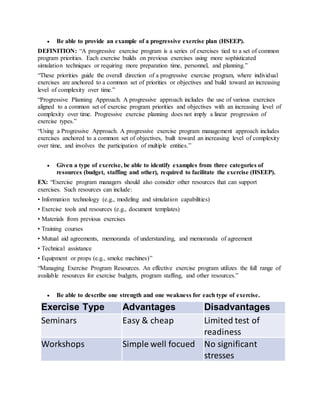
Exercise Type Advantages Disadvantages
Seminars Easy & cheap Limited test of
readiness
Workshops Simple well focued No significant
stresses
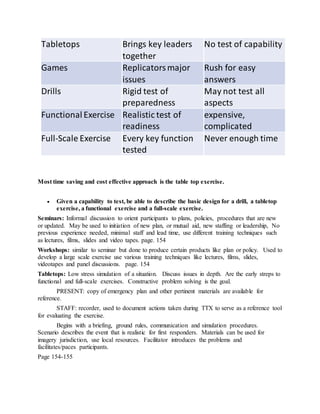
Tabletops Brings key leaders
together
No test of capability
Games Replicatorsmajor
issues
Rush for easy
answers
Drills Rigid test of
preparedness
May not test all
aspects
Functional Exercise Realistic test of
readiness
expensive,
complicated
Full-Scale Exercise Every key function
tested
Never enough time
Most time saving and cost effective approach is the table top exercise.
 Given a capability to test, be able to describe the basic design for a drill, a tabletop
exercise, a functional exercise and a full-scale exercise.
Seminars: Informal discussion to orient participants to plans, policies, procedures that are new
or updated. May be used to initiation of new plan, or mutual aid, new staffing or leadership, No
previous experience needed, minimal staff and lead time, use different training techniques such
as lectures, films, slides and video tapes. page. 154
Workshops: similar to seminar but done to produce certain products like plan or policy. Used to
develop a large scale exercise use various training techniques like lectures, films, slides,
videotapes and panel discussions. page. 154
Tabletops: Low stress simulation of a situation. Discuss issues in depth. Are the early streps to
functional and full-scale exercises. Constructive problem solving is the goal.
PRESENT: copy of emergency plan and other pertinent materials are available for
reference.
STAFF: recorder, used to document actions taken during TTX to serve as a reference tool
for evaluating the exercise.
Begins with a briefing, ground rules, communication and simulation procedures.
Scenario describes the event that is realistic for first responders. Materials can be used for
imagery jurisdiction, use local resources. Facilitator introduces the problems and
facilitates/paces participants.
Page 154-155
Games: Simulation of operations that use rules, data, procedures to depict a real life situation.
Two or more teams in a competitive environment. More complex then TTX. Goal is to explore
the decision making process. Decisions turn into a sequence of events and participants explore
the consequences of their decisions.
Page. 155
Drills: use repetition to instruct thoroughly. Test personnel training, response time, interagency
cooperation and resources, work force and equipment capabilities. Start after orientation with an
understand of the agency.
DRILL CATEGORIES: notification, communication, command post and evacuation
General briefing sets the scene, and reviews the purpose and objectives. Personnel report in
person or by phone to drill site or contact location. Both planned and spontaneous messages
sustain the drill’s actions.
page. 155-156
Functional Exercise: purpose is to test and evaluate the capabilities of an emergency response
system. Events are depicted. Time transitions advance activities. The objectives of the Exercise
determine its organization. Some are announced in advance while others are no notice.
Participants are briefed for objectives, procedures, time frame and recording requirements.
Coordinate responses for reaction can be prescript or developed by the simulation cell.
Page. 156
Full-Scale Exercise: purpose is to test and evaluate a major portion of the emergency operations
plan in an interactive manner over an extended period. Involve multiple agencies or more than
one day. Objectives are specified. Simulated event. DIFFERENT THEN DRILL because field
personnel actually respond to the locations. Includes all activities of the EOC and simulates
victims, equipment and workforce. EOC coordinates. Combines the planned and spontaneous
messages from a Functional Exercise with actions in the field. MOST COMPLEX, COSTLY,
REALISTIC and carries significant risks for safety, security and must be constantly managed.
Page 156
 Be able to list the types of documents used during the exercise process.
o Emergency Operations Plan: intended to provide an overall guide outlining
major facilities, buildings, risk zones, and expected hazards for which the
managing or governing, organization is responsible to safeguard
▪ Identify the scope, purpose, assumptions, capabilities, vulnerabilities, at-
risk infrastructures, emergency tasks, response operations, EOC duties and
special situational annexes related to a government business college
campus or other public facility
o SOPs:
o Policies, Plans, Procedures:
o SitMan, MSEL, C/EE Handbook, EEGs
Exercise Plan (ExPlan): is an outline of how the emergency rescue workers and
first responders decide to handle the crisis. It may involve well-known situation like orderly
evacuation of a dormitory or office building for a bomb threat. Or it can be complex and
unexpected how to protect workers on upper floors from toxic fumes in air handling system or
evacuate a major railway from tanker spill of chlorine gas.
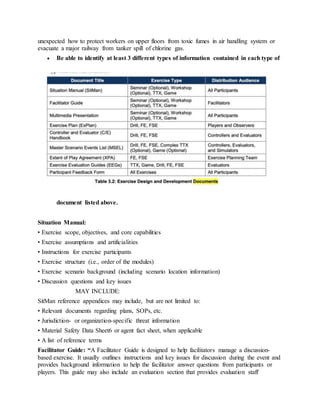
 Be able to identify at least 3 different types of information contained in each type of
document listed above.
Situation Manual:
• Exercise scope, objectives, and core capabilities
• Exercise assumptions and artificialities
• Instructions for exercise participants
• Exercise structure (i.e., order of the modules)
• Exercise scenario background (including scenario location information)
• Discussion questions and key issues
MAY INCLUDE:
SitMan reference appendices may include, but are not limited to:
• Relevant documents regarding plans, SOPs, etc.
• Jurisdiction- or organization-specific threat information
• Material Safety Data Sheet6 or agent fact sheet, when applicable
• A list of reference terms
Facilitator Guide: “A Facilitator Guide is designed to help facilitators manage a discussion-
based exercise. It usually outlines instructions and key issues for discussion during the event and
provides background information to help the facilitator answer questions from participants or
players. This guide may also include an evaluation section that provides evaluation staff
members with guidance and instructions on evaluation or observation methodology to be used as
well as essential materials required to execute their specific functions.”
Multimedia Presentation: Multimedia presentations are often used to illustrate the general
scenario for participants. They are given at the Start of Exercise (StartEx) and support the
SitMan. The presentation should concisely summarize information contained in the written
documentation. Like the SitMan, the multimedia presentation is also divided into distinct,
chronologically segmented modules that, when combined, create the entire scenario.
This presentation typically contains, at a minimum, the following information:
• Introduction
• Exercise scope, objectives, and core capabilities
• Exercise play rules and administrative information
• Modules that describe the scenario
The presentations are intended to help focus and drive the exercise as well as add realism. A/V
enhancements to a presentation include video or sounds that convey information to participants.
ExPlan: ExPlans are general information documents that help operations-based exercises run
smoothly by providing participants with a synopsis of the exercise. They are published and
distributed to the participating organizations following development of most of the critical
elements of the exercise. In addition to addressing exercise objectives and scope, ExPlans assign
activities and responsibilities for exercise planning, conduct, and evaluation. The ExPlan is
intended to be seen by the exercise players and observers—therefore, it does not contain detailed
scenario information that may reduce the realism of the exercise. Players and observers should
review all elements of the ExPlan prior to exercise participation.
An ExPlan typically contains the following sections:
• Exercise scope, objectives, and core capabilities
• Participant roles and responsibilities
• Rules of conduct
• Safety issues, notably real emergency codes and phrases, safety controller responsibilities,
prohibited activities, and weapons policies
• Logistics
• Security of and access to the exercise site
• Communications (e.g., radio frequencies or channels)
• Duration, date, and time of exercise and schedule of events
• Maps and directions
Player Handout
The Player Handout provides key information to exercise players. A Player Handout can
supplement the SitMan or ExPlan by providing a quick-reference guide to logistics, agenda or
schedule, and key contact data for players.
Controller and Evaluator Handbook: (C/E)
The C/E Handbook describes the roles and responsibilities of exercise controllers and evaluators
and the procedures they should follow. Because the C/E Handbook contains information about
the scenario and about exercise administration, it is distributed to only those individuals
designated as controllers or evaluators. The C/E Handbook may supplement the ExPlan or be a
standalone document. When used as a supplement, it points readers to the ExPlan for more
general exercise information, such as participant lists, activity schedules, required briefings, and
the roles and responsibilities of specific participants. Used as a standalone document, it should
include the basic information contained in the ExPlan, and detailed scenario information.
The C/E Handbook usually contains the following sections:
• Assignments, roles, and responsibilities of group or individual controllers and evaluators
• Detailed scenario information
• Exercise safety plan
• Controller communications plan (e.g., a phone list, a call-down tree, instructions for the use of
radio channels)
• Evaluation instructions
The Controller portion of the C/E Handbook, sometimes known as Control Staff Instructions
(COSIN), provides guidelines for control and simulation support and establishes a management
structure for these activities. This section provides guidance for controllers, simulators, and
evaluators on procedures and responsibilities for exercise control, simulation, and support. The
Evaluation portion of the C/E Handbook, sometimes known as the EvalPlan, provides evaluation
staff members with guidance and instructions on evaluation or observation methodology to be
used, as well as essential materials required to execute their specific functions.
Controller and Evaluator Packets
While C/E Handbooks contain detailed information that should be read and understood well in
advance of the exercise, Controller Packets and Evaluator Packets are provided immediately
prior to an exercise to controllers and evaluators respectively. The packets contain key
information from the C/E Handbook and additional information specific to the functional area in
which the given controller or evaluator will be working. This information is needed during
exercise play in order to carry out control and evaluation responsibilities.
Both Controller Packets and Evaluator Packets should contain the following:
• Essential C/E Handbook information
• Ground truth document, detailing key elements of the exercise scenario (primarily used for
prevention-focused exercises)
• MSEL, including injects and events for each responsible controller and evaluator
• Appropriate EEGs
• Maps and directions
MasterScenario Events List (MSEL): A MSEL is typically used during operations-based or
complex discussion-based exercises and contains a chronological listing of the events that drive
exercise play. Each MSEL entry should contain the following at a minimum:
• Designated scenario time
• Event synopsis
• Controller responsible for delivering the inject, with controller or evaluator special instructions
(if applicable)
• Intended player (i.e., agency or individual player for whom the MSEL event is intended)
• Expected participant response (i.e., player response expected upon inject delivery)
• Objective, core capability, capability target, and/or critical task to be addressed (if applicable)
• Notes section (for controllers and evaluators to track actual events against those listed in the
MSEL, with special instructions for individual controllers and evaluators)
Scenario timelines listed in a MSEL should be as realistic as possible and based on input from
SMEs. If the activity occurs sooner than the MSEL writers anticipated, then controllers and
evaluators should note the time it occurred, but play should not be interrupted.
Controllers delivering MSEL injects will either be co-located with players in the venue of play,
or they will reside in a SimCell. A SimCell is a location from which controllers deliver messages
representing actions, activities, and conversations of an individual, agency, or organization that is
not participating in the exercise but would likely be actively involved during a real incident.
Prior to StartEx, the mechanisms for introducing injects into exercise play should be tested to
ensure that controllers are aware of the procedures for delivering MSEL injects and that any
systems that will be used to deliver them are functioning properly.
The three types of descriptive MSEL events that support exercise play include:
1. Contextual injects introduced to a player by a controller help build the exercise operating
environment and/or keep exercise play moving. For example, if the exercise is designed to test
information-sharing capabilities, a MSEL inject can be developed to direct an actor to portray a
suspect by behaving suspiciously in front of a law enforcement player.
2. Expected action events reserve a place in the MSEL timeline and notify controllers when a
response action would typically take place. For example, during an FSE involving a chemical
agent, establishing decontamination is an expected action that the players will take without the
prompting of an inject.
3. Contingency injects are provided by a controller or simulator to players to ensure play moves
forward to adequately evaluate performance of activities. For example, if a simulated secondary
device is placed at an incident scene during a terrorism response exercise, but is not discovered, a
controller may want to prompt an actor to approach a player and state that he or she witnessed
suspicious activity close to the device location. This should prompt the responder to discover the
device, resulting in subsequent execution of the desired notification procedures.
MSELs are typically produced in long formats, short formats, or both. Short-form MSELs
usually list injects in a single row in a spreadsheet format. These can be used as a quick-
reference guide during exercise play or projected onto a large screen in a control cell or SimCell.
Long-form MSELs are used when greater detail is necessary; they include more detailed
descriptions, exact scripting language for actors and simulators, and more detailed descriptions
of expected actions.
Extent of Play Agreement: (XPA): XPAs can be used to define the organizations participating
in the exercise as well as their extent of play (e.g., one fire station for 8 hours, county Emergency
Operations Center [EOC] activated at level A for 24/7 exercise operations). These agreements
are formed between exercise participants and the exercise sponsor, and can be vital to the
planning of an exercise, recruitment of evaluators, and development of support requirements.
Exercise Evaluation Guides (EEGs): EEGs are intended to help evaluators collect relevant
exercise observations. These documents are aligned to objectives, and document the related core
capability, capability target(s), and critical tasks. Each EEG provides evaluators with information
on what they should expect to see demonstrated or hear discussed. For more information on
EEGs, see Chapter 5: Evaluation.
Participant Feedback Form: At the end of an exercise, participants may receive a Participant
Feedback Form that asks for input regarding observed strengths and areas for improvement that
players identified during the exercise. Providing Participant Feedback Forms to players during
the exercise wrap up activities allows them to provide their insights into decisions made and
actions taken. A Participant Feedback Form also provides players the opportunity to provide
constructive criticism about the design, control, or logistics of the exercise to help enhance the
of future exercises. At a minimum, the questions on the Participant Feedback Form solicit the
following:
• Strengths and areas for improvement pertaining to the implementation of participating agencies
and organizations ’policies, plans, and SOPs; and
• Impressions about exercise conduct and logistics.
Information collected from feedback forms contributes to the issues, observations,
recommendations, and corrective actions in the AAR/IP. Feedback forms can be supplemented
by the conduct of a Hot Wash immediately following the exercise, during which facilitators,
controllers, and evaluators capture participant perspectives on the key strengths and areas for
improvement identified during the exercise.
 Be able to identify actions that you would take to plan an exercise.
o involves planning for the critical elements of exercise conduct: logistics, control,
and evaluation.
o HSEEP PAGE 3-20 to 3-25
o Thorough planning and organization prior to an exercise is imperative to effective
and successful exercise evaluation. As described above, the exercise planning
team identifies evaluation elements early in the exercise design process.
Additionally, during exercise development, an evaluation team organizes itself
appropriately and develops a comprehensive plan to address how the exercise will
be evaluated.
Materials:
McCreight textbook, chapters 1-4
HSEEP Document
Wednesday night presentations
References
(Academic Papers on Porter’s Strategy, n.d.). Freelancing | Academic
Home. https://discountdealson.com/

Nurse prac

  • 1.
    EDM 448 MidtermObjectives Retrieved From (Academic Papers on Porter’s Strategy, n.d.)  Be able to provide an exercise example for each of the 4 purposes for emergency exercises, as described in chapter 1 of the McCreight textbook. (1) to validate the assumptions and procedures of the emergency operations plan (2) to help identify real gaps in vulnerability assessments and capability determinations (including assessments of available resources and suitable staffing) (3) to enable verification of staff preparedness and training for all-hazard emergencies (4) to provide realistic opportunity to verify emergency readiness. - ex no notice ex. Page. 2  Be able to describe the difference between preparedness and readiness. Preparedness: is planning, development of SOPs, specification of roles and responsibilities, staging of equipment, training staff, connecting integral systems, and exhibiting masterful awareness of required actions and tasks related to an emergency response function. -Deals with all the preliminary training, standard operating procedures (SOPs), equipment practice, and performing of the routines of emergency response Readiness: is the actual demonstration and execution of essential emergency functions and tasks at the highest possible level of effectiveness in an actual crisis or in realistic emergency exercise situations. -is the actual demonstration of emergency response capability under deployed conditions to respond effectively to all-hazard crisis. page. 2  Be able to describe the difference between an Emergency Operations Plan (EOP) and an Exercise Plan (ExPlan)  DIFFERENCES: the objectives of each. EOP provides the pre-disaster guidance outlining what safety measures and protective actions can be completed given an emergency situation. EXPlan outlines how a group of emergency works and first responders will be expected to handle and overcome an emergency situation.  Roles and responsibilities are delineated by EOPs and ExPlans are designed to test them.  Page 5 Emergency Operations Plan (EOP): intended to provide an overall guide outlining major facilities, buildings, risk zones, and expected hazards for which the managing or governing, organization is responsible to safeguard. Objective 1: identify the risk and hazard issues for the territorial space that the organization, group, business, or government retains for responsibility to protect and safeguard. Provide guidance to inhabitants, employees, visitors, and all who enter the risk domain and territory bored by the EOP on what to do and how to behave in different risk, hazard, or crisis situations.
  • 2.
    Outline steps necessaryfor reacting to an emergency event and they will usually identify which organizational unit is primarily responsible for responding to the crisis and getting it under control. Written in two ways: innocent unsuspecting victims OR highly trying and skilled workers and responders. Exercise Plan (ExPlan): is an outline of how the emergency rescue workers and first responders decide to handle the crisis. It may involve well-known situation like orderly evacuation of a dormitory or office building for a bomb threat. Or it can be complex and unexpected how to protect workers on upper floors from toxic fumes in air handling system or evacuate a major railway from tanker spill of chlorine gas.  Be able to explain the difference between a discussion-based exercise and an operations-based exercise. DISCUSSION-BASED: “Discussion-based exercises include seminars, workshops, tabletop exercises (TTXs), and games. These types of exercises can be used to familiarize players with, or develop new, plans, policies, agreements, and procedures. Discussion-based exercises focus on strategic, policy-oriented issues. Facilitators and/or presenters usually lead the discussion, keeping participants on track towards meeting exercise objectives.” OPERATIONS BASED: “Operations-based exercises include drills, functional exercises (FEs), and full-scale exercises (FSEs). These exercises can be used to validate plans, policies, agreements, and procedures; clarify roles and responsibilities; and identify resource gaps. Operations-based exercises are c haracterized by actual reaction to an exercise scenario, such as initiating communications or mobilizing personnel and resources.”  Be able to explain the importance of engaging electedand appointed officials in the exercise process. o “Engaging elected and appointed officials in the exercise process is critical because they provide both the strategic direction for the exercise program, as well as specific guidance for individual exercises. As representatives of the public, elected and appointed officials ensure that exercise program priorities are supported at the highest level and align to whole community needs and priorities. Elected and appointed officials should be engaged early and often in an exercise program, starting with the development of exercise program priorities at the TEPW. In developing individual exercises, the exercise planning team should continue to engage their appropriate elected and appointed officials throughout the exercise planning cycle in order to ensure the leaders ’vision for the exercise is achieved.”  Given a listed objective, be able to identify problematic elements for evaluation based on the 4 pitfalls. o Tests the operational requirements, key tasks, assumptions, equipment, technologies, procedures, and response operations outlines in emergency plans. o Evaluation Issues: p. 114 ▪ Evaluation template
  • 3.
    ▪ Evaluator training ▪ENDEX vs. stop action ▪ Interviews vs. Observations ▪ Hotwash capture vs. Intensive follow-up ▪ Quicklook vs. AAR ▪ Assessing controllers/directors and players ▪ Report writing and recommendations EXERCISE DESIGN OBJECTIVES ARE: p. 49 • Confirm individual/team training • Demonstrate key performance functions • Verify man-technology interface/operations • Assess problem solving • Examine response readiness metrics • Observe extended/novel stress incidents • Evaluate target capabilities • Determine issues and read for further tests. “Evaluation is the cornerstone of an exercise and must be considered throughout all phases of the exercise planning cycle, beginning when the exercise planning team meets to establish objectives and initiate exercise design. Effective evaluation assesses performance against exercise objectives, and identifies and documents strengths and areas for improvement relative to core capabilities.” “It is important to develop exercise evaluation requirements early in the design process, as they will guide development of the exercise scenario, discussion questions, and/or MSEL. Evaluation requirements clearly articulate what will be evaluated during the exercise and how exercise play will be assessed. This information is documented in the EEGs. Once the exercise planning team aligns objectives to core capabilities, it identifies which capability targets and critical tasks for each core capability are being addressed by the exercise. Capability targets are the performance thresholds for each core capability; they state the exact amount of capability that players aim to achieve. Generally, these targets are based on targets identified as part of an organization’s or jurisdiction’s THIRA or other threat and hazard identification or risk assessment process. Critical tasks are the distinct elements required to perform a core capability. Critical tasks may be derived from Mission Area Frameworks, organizational operations plans or SOPs, or discipline-specific standards.”  Given an exercise topic and purpose, be able to describe the actions that would occur for a specific design step. DESIGN STEPS:
  • 4.
    (1) Review EmergencyPlan: review of plan and prior exercises, outside experts, if no history determine critical emergency functions that need to be tested to establish baseline. p. 18 (2) Conduct Needs Review and select Design/Eval Team: Identify specific capability needs or short falls based upon known or suspected gaps in mission performance that need to be strengthened or improved as well as selection of a competent design team to help identify tasks, functions, behaviors, and other activities to demonstrate that identified problems and weaknesses have been addressed. P. 18 (3) Examine Capability: evaluate the expected capability of the emergency staff and first responders in handling the task, function, or situation challenge that forms the basis of the exercise. MOST CRITICAL STEP because 1) verify levels of responder training, 2) establish a baseline of actual performance, and 3) confirm that this task is currently being performed at a level of quality and effectiveness that is less than optimal. P. 19 (4) Determine Exercise Type, Scope and Purpose: Pick the type of exercise that best fits the the situation and decide whether the exercise structure chosen allows first responders to actually demonstrate their skills in handling the emergency. p. 20 (5) Devise Exercise Structure & Schedule: How long will it take? It is also where exercise objectives are determines. P. 20-21 (6) Devise MSEL: Master Scenario Event List will summarize the overall exercise objectives, outline the tasks and functions to be tested and specifics the messages and injects and tankers to be assigned and their timed introduction into the exercise. Describes timing, scheduling of events, defines controllers and evaluations and how messages will be translated. P. 21 (7) Scenario Taskers Injects: New situations, problems, or requirements or new facts designed to further complicate the actions of first responders and challenge them in the performance of both basic and routine tasks as well as more complex and ambiguous issues. p. 24 (8) Expected Outcomes Actions Metrics: requires planners to devise metrics and expected outcomes for each taster and inject that allow evaluators, trainees, political officials and other observers to see how assigned and unfolding taskers will be handled. p. 24 (9) Message Options Structure Management: careful consideration of how certain ongoing and complex tasks that will likely cover several hours or days to complete can be simulated so that these difficult-to-conclude tasks are and challenges are incorporated into the exercise. p. 26 (10) Conduct & Evaluate Exercise: evaluators compile their notes and observations, including interviews with key players and expert observers to enable an overall assessment of the exercise to be drafted. p. 26 (11) Hotwash Quicklook: LAST STEP: unstructured discussion. 60-90 mins is effective. Involves designers, controllers, response cell, staff, observers, and responders. Bring out 3-4 major findings or issues that evaluators and exercise controllers felt were accomplished or revealed by the exercise. P. 26-27 (12) AAR: summarizes the exercise and highlights the major insights and lessons gathered from the exercise experience. p. 27 (13) Make Revisions to Emergency Plan:
  • 5.
     Be ableto provide an example of a progressive exercise plan (HSEEP). DEFINITION: “A progressive exercise program is a series of exercises tied to a set of common program priorities. Each exercise builds on previous exercises using more sophisticated simulation techniques or requiring more preparation time, personnel, and planning.” “These priorities guide the overall direction of a progressive exercise program, where individual exercises are anchored to a common set of priorities or objectives and build toward an increasing level of complexity over time.” “Progressive Planning Approach. A progressive approach includes the use of various exercises aligned to a common set of exercise program priorities and objectives with an increasing level of complexity over time. Progressive exercise planning does not imply a linear progression of exercise types.” “Using a Progressive Approach. A progressive exercise program management approach includes exercises anchored to a common set of objectives, built toward an increasing level of complexity over time, and involves the participation of multiple entities.”  Given a type of exercise, be able to identify examples from three categories of resources (budget, staffing and other), required to facilitate the exercise (HSEEP). EX: “Exercise program managers should also consider other resources that can support exercises. Such resources can include: • Information technology (e.g., modeling and simulation capabilities) • Exercise tools and resources (e.g., document templates) • Materials from previous exercises • Training courses • Mutual aid agreements, memoranda of understanding, and memoranda of agreement • Technical assistance • Equipment or props (e.g., smoke machines)” “Managing Exercise Program Resources. An effective exercise program utilizes the full range of available resources for exercise budgets, program staffing, and other resources.”  Be able to describe one strength and one weakness for each type of exercise. Exercise Type Advantages Disadvantages Seminars Easy & cheap Limited test of readiness Workshops Simple well focued No significant stresses
  • 6.
    Tabletops Brings keyleaders together No test of capability Games Replicatorsmajor issues Rush for easy answers Drills Rigid test of preparedness May not test all aspects Functional Exercise Realistic test of readiness expensive, complicated Full-Scale Exercise Every key function tested Never enough time Most time saving and cost effective approach is the table top exercise.  Given a capability to test, be able to describe the basic design for a drill, a tabletop exercise, a functional exercise and a full-scale exercise. Seminars: Informal discussion to orient participants to plans, policies, procedures that are new or updated. May be used to initiation of new plan, or mutual aid, new staffing or leadership, No previous experience needed, minimal staff and lead time, use different training techniques such as lectures, films, slides and video tapes. page. 154 Workshops: similar to seminar but done to produce certain products like plan or policy. Used to develop a large scale exercise use various training techniques like lectures, films, slides, videotapes and panel discussions. page. 154 Tabletops: Low stress simulation of a situation. Discuss issues in depth. Are the early streps to functional and full-scale exercises. Constructive problem solving is the goal. PRESENT: copy of emergency plan and other pertinent materials are available for reference. STAFF: recorder, used to document actions taken during TTX to serve as a reference tool for evaluating the exercise. Begins with a briefing, ground rules, communication and simulation procedures. Scenario describes the event that is realistic for first responders. Materials can be used for imagery jurisdiction, use local resources. Facilitator introduces the problems and facilitates/paces participants. Page 154-155
  • 7.
    Games: Simulation ofoperations that use rules, data, procedures to depict a real life situation. Two or more teams in a competitive environment. More complex then TTX. Goal is to explore the decision making process. Decisions turn into a sequence of events and participants explore the consequences of their decisions. Page. 155 Drills: use repetition to instruct thoroughly. Test personnel training, response time, interagency cooperation and resources, work force and equipment capabilities. Start after orientation with an understand of the agency. DRILL CATEGORIES: notification, communication, command post and evacuation General briefing sets the scene, and reviews the purpose and objectives. Personnel report in person or by phone to drill site or contact location. Both planned and spontaneous messages sustain the drill’s actions. page. 155-156 Functional Exercise: purpose is to test and evaluate the capabilities of an emergency response system. Events are depicted. Time transitions advance activities. The objectives of the Exercise determine its organization. Some are announced in advance while others are no notice. Participants are briefed for objectives, procedures, time frame and recording requirements. Coordinate responses for reaction can be prescript or developed by the simulation cell. Page. 156 Full-Scale Exercise: purpose is to test and evaluate a major portion of the emergency operations plan in an interactive manner over an extended period. Involve multiple agencies or more than one day. Objectives are specified. Simulated event. DIFFERENT THEN DRILL because field personnel actually respond to the locations. Includes all activities of the EOC and simulates victims, equipment and workforce. EOC coordinates. Combines the planned and spontaneous messages from a Functional Exercise with actions in the field. MOST COMPLEX, COSTLY, REALISTIC and carries significant risks for safety, security and must be constantly managed. Page 156  Be able to list the types of documents used during the exercise process. o Emergency Operations Plan: intended to provide an overall guide outlining major facilities, buildings, risk zones, and expected hazards for which the managing or governing, organization is responsible to safeguard ▪ Identify the scope, purpose, assumptions, capabilities, vulnerabilities, at- risk infrastructures, emergency tasks, response operations, EOC duties and special situational annexes related to a government business college campus or other public facility o SOPs: o Policies, Plans, Procedures: o SitMan, MSEL, C/EE Handbook, EEGs Exercise Plan (ExPlan): is an outline of how the emergency rescue workers and first responders decide to handle the crisis. It may involve well-known situation like orderly evacuation of a dormitory or office building for a bomb threat. Or it can be complex and
  • 8.
    unexpected how toprotect workers on upper floors from toxic fumes in air handling system or evacuate a major railway from tanker spill of chlorine gas.  Be able to identify at least 3 different types of information contained in each type of document listed above. Situation Manual: • Exercise scope, objectives, and core capabilities • Exercise assumptions and artificialities • Instructions for exercise participants • Exercise structure (i.e., order of the modules) • Exercise scenario background (including scenario location information) • Discussion questions and key issues MAY INCLUDE: SitMan reference appendices may include, but are not limited to: • Relevant documents regarding plans, SOPs, etc. • Jurisdiction- or organization-specific threat information • Material Safety Data Sheet6 or agent fact sheet, when applicable • A list of reference terms Facilitator Guide: “A Facilitator Guide is designed to help facilitators manage a discussion- based exercise. It usually outlines instructions and key issues for discussion during the event and provides background information to help the facilitator answer questions from participants or players. This guide may also include an evaluation section that provides evaluation staff
  • 9.
    members with guidanceand instructions on evaluation or observation methodology to be used as well as essential materials required to execute their specific functions.” Multimedia Presentation: Multimedia presentations are often used to illustrate the general scenario for participants. They are given at the Start of Exercise (StartEx) and support the SitMan. The presentation should concisely summarize information contained in the written documentation. Like the SitMan, the multimedia presentation is also divided into distinct, chronologically segmented modules that, when combined, create the entire scenario. This presentation typically contains, at a minimum, the following information: • Introduction • Exercise scope, objectives, and core capabilities • Exercise play rules and administrative information • Modules that describe the scenario The presentations are intended to help focus and drive the exercise as well as add realism. A/V enhancements to a presentation include video or sounds that convey information to participants. ExPlan: ExPlans are general information documents that help operations-based exercises run smoothly by providing participants with a synopsis of the exercise. They are published and distributed to the participating organizations following development of most of the critical elements of the exercise. In addition to addressing exercise objectives and scope, ExPlans assign activities and responsibilities for exercise planning, conduct, and evaluation. The ExPlan is intended to be seen by the exercise players and observers—therefore, it does not contain detailed scenario information that may reduce the realism of the exercise. Players and observers should review all elements of the ExPlan prior to exercise participation. An ExPlan typically contains the following sections: • Exercise scope, objectives, and core capabilities • Participant roles and responsibilities • Rules of conduct • Safety issues, notably real emergency codes and phrases, safety controller responsibilities, prohibited activities, and weapons policies • Logistics • Security of and access to the exercise site • Communications (e.g., radio frequencies or channels) • Duration, date, and time of exercise and schedule of events • Maps and directions Player Handout The Player Handout provides key information to exercise players. A Player Handout can supplement the SitMan or ExPlan by providing a quick-reference guide to logistics, agenda or schedule, and key contact data for players. Controller and Evaluator Handbook: (C/E)
  • 10.
    The C/E Handbookdescribes the roles and responsibilities of exercise controllers and evaluators and the procedures they should follow. Because the C/E Handbook contains information about the scenario and about exercise administration, it is distributed to only those individuals designated as controllers or evaluators. The C/E Handbook may supplement the ExPlan or be a standalone document. When used as a supplement, it points readers to the ExPlan for more general exercise information, such as participant lists, activity schedules, required briefings, and the roles and responsibilities of specific participants. Used as a standalone document, it should include the basic information contained in the ExPlan, and detailed scenario information. The C/E Handbook usually contains the following sections: • Assignments, roles, and responsibilities of group or individual controllers and evaluators • Detailed scenario information • Exercise safety plan • Controller communications plan (e.g., a phone list, a call-down tree, instructions for the use of radio channels) • Evaluation instructions The Controller portion of the C/E Handbook, sometimes known as Control Staff Instructions (COSIN), provides guidelines for control and simulation support and establishes a management structure for these activities. This section provides guidance for controllers, simulators, and evaluators on procedures and responsibilities for exercise control, simulation, and support. The Evaluation portion of the C/E Handbook, sometimes known as the EvalPlan, provides evaluation staff members with guidance and instructions on evaluation or observation methodology to be used, as well as essential materials required to execute their specific functions. Controller and Evaluator Packets While C/E Handbooks contain detailed information that should be read and understood well in advance of the exercise, Controller Packets and Evaluator Packets are provided immediately prior to an exercise to controllers and evaluators respectively. The packets contain key information from the C/E Handbook and additional information specific to the functional area in which the given controller or evaluator will be working. This information is needed during exercise play in order to carry out control and evaluation responsibilities. Both Controller Packets and Evaluator Packets should contain the following: • Essential C/E Handbook information • Ground truth document, detailing key elements of the exercise scenario (primarily used for prevention-focused exercises) • MSEL, including injects and events for each responsible controller and evaluator • Appropriate EEGs • Maps and directions MasterScenario Events List (MSEL): A MSEL is typically used during operations-based or complex discussion-based exercises and contains a chronological listing of the events that drive exercise play. Each MSEL entry should contain the following at a minimum:
  • 11.
    • Designated scenariotime • Event synopsis • Controller responsible for delivering the inject, with controller or evaluator special instructions (if applicable) • Intended player (i.e., agency or individual player for whom the MSEL event is intended) • Expected participant response (i.e., player response expected upon inject delivery) • Objective, core capability, capability target, and/or critical task to be addressed (if applicable) • Notes section (for controllers and evaluators to track actual events against those listed in the MSEL, with special instructions for individual controllers and evaluators) Scenario timelines listed in a MSEL should be as realistic as possible and based on input from SMEs. If the activity occurs sooner than the MSEL writers anticipated, then controllers and evaluators should note the time it occurred, but play should not be interrupted. Controllers delivering MSEL injects will either be co-located with players in the venue of play, or they will reside in a SimCell. A SimCell is a location from which controllers deliver messages representing actions, activities, and conversations of an individual, agency, or organization that is not participating in the exercise but would likely be actively involved during a real incident. Prior to StartEx, the mechanisms for introducing injects into exercise play should be tested to ensure that controllers are aware of the procedures for delivering MSEL injects and that any systems that will be used to deliver them are functioning properly. The three types of descriptive MSEL events that support exercise play include: 1. Contextual injects introduced to a player by a controller help build the exercise operating environment and/or keep exercise play moving. For example, if the exercise is designed to test information-sharing capabilities, a MSEL inject can be developed to direct an actor to portray a suspect by behaving suspiciously in front of a law enforcement player. 2. Expected action events reserve a place in the MSEL timeline and notify controllers when a response action would typically take place. For example, during an FSE involving a chemical agent, establishing decontamination is an expected action that the players will take without the prompting of an inject. 3. Contingency injects are provided by a controller or simulator to players to ensure play moves forward to adequately evaluate performance of activities. For example, if a simulated secondary device is placed at an incident scene during a terrorism response exercise, but is not discovered, a controller may want to prompt an actor to approach a player and state that he or she witnessed suspicious activity close to the device location. This should prompt the responder to discover the device, resulting in subsequent execution of the desired notification procedures. MSELs are typically produced in long formats, short formats, or both. Short-form MSELs usually list injects in a single row in a spreadsheet format. These can be used as a quick- reference guide during exercise play or projected onto a large screen in a control cell or SimCell. Long-form MSELs are used when greater detail is necessary; they include more detailed descriptions, exact scripting language for actors and simulators, and more detailed descriptions of expected actions.
  • 12.
    Extent of PlayAgreement: (XPA): XPAs can be used to define the organizations participating in the exercise as well as their extent of play (e.g., one fire station for 8 hours, county Emergency Operations Center [EOC] activated at level A for 24/7 exercise operations). These agreements are formed between exercise participants and the exercise sponsor, and can be vital to the planning of an exercise, recruitment of evaluators, and development of support requirements. Exercise Evaluation Guides (EEGs): EEGs are intended to help evaluators collect relevant exercise observations. These documents are aligned to objectives, and document the related core capability, capability target(s), and critical tasks. Each EEG provides evaluators with information on what they should expect to see demonstrated or hear discussed. For more information on EEGs, see Chapter 5: Evaluation. Participant Feedback Form: At the end of an exercise, participants may receive a Participant Feedback Form that asks for input regarding observed strengths and areas for improvement that players identified during the exercise. Providing Participant Feedback Forms to players during the exercise wrap up activities allows them to provide their insights into decisions made and actions taken. A Participant Feedback Form also provides players the opportunity to provide constructive criticism about the design, control, or logistics of the exercise to help enhance the of future exercises. At a minimum, the questions on the Participant Feedback Form solicit the following: • Strengths and areas for improvement pertaining to the implementation of participating agencies and organizations ’policies, plans, and SOPs; and • Impressions about exercise conduct and logistics. Information collected from feedback forms contributes to the issues, observations, recommendations, and corrective actions in the AAR/IP. Feedback forms can be supplemented by the conduct of a Hot Wash immediately following the exercise, during which facilitators, controllers, and evaluators capture participant perspectives on the key strengths and areas for improvement identified during the exercise.  Be able to identify actions that you would take to plan an exercise. o involves planning for the critical elements of exercise conduct: logistics, control, and evaluation. o HSEEP PAGE 3-20 to 3-25 o Thorough planning and organization prior to an exercise is imperative to effective and successful exercise evaluation. As described above, the exercise planning team identifies evaluation elements early in the exercise design process. Additionally, during exercise development, an evaluation team organizes itself appropriately and develops a comprehensive plan to address how the exercise will be evaluated. Materials: McCreight textbook, chapters 1-4 HSEEP Document Wednesday night presentations References
  • 13.
    (Academic Papers onPorter’s Strategy, n.d.). Freelancing | Academic Home. https://discountdealson.com/