
1
Search 
Engine 
Op0miza0on 
• The 
2 
Search 
Landscape 
• 
How 
Search 
Engines 
Work 
• 
Building 
Op0mized 
Websites 
• 
Conduc0ng 
Keyword 
Research 
• 
Link 
Building 
Strategies 
• 
Social 
Media 
& 
the 
Web’s 
Influencers
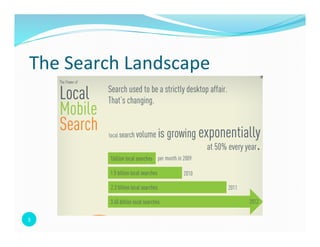
The 
Search 
Landscape 
3
4
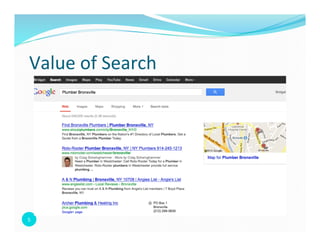
Value 
of 
Search 
5
Market 
Share 
(US) 
6 
ComScore Inc.
7
8
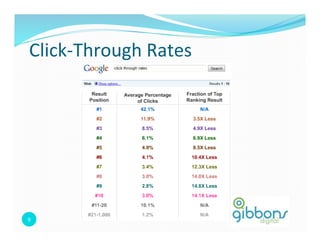
Click-­‐Through 
Rates 
9
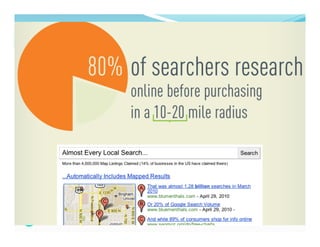
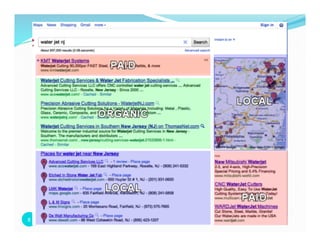
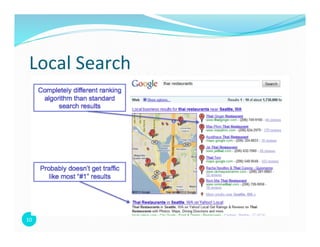
Local 
Search 
10
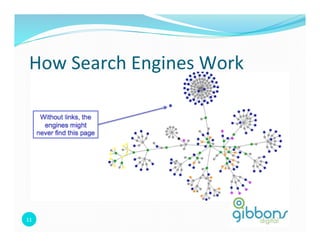
How 
Search 
Engines 
Work 
11
Key 
Components 
of 
Google’s 
Algorithm 
— Freshness 
of 
Content 
— Website 
Op0miza0on 
— Links 
back 
to 
your 
website 
— Social 
Media 
Ac0vity 
12 
12
Freshness 
of 
Content 
— Publish 
new 
pages 
in 
different 
formats 
and 
post 
them 
to 
different 
sec0ons 
of 
your 
site 
— SlideShares, 
video 
content, 
and 
new 
landing 
pages. 
13 
— make 
sure 
you’re 
properly 
adding 
the 
right 
meta 
informa0on 
to 
visual 
media 
formats, 
or 
else 
you 
might 
not 
get 
as 
much 
value 
from 
what 
you 
publish.
Freshness 
of 
Content 
— Best 
prac0ce 
is 
to 
publish 
at 
least 
one 
piece 
of 
content 
a 
day 
— Once 
you 
develop 
a 
solid 
base 
of 
blog 
posts, 
conglomerate 
relevant 
posts 
into 
an 
14 
e-­‐book. 
Conversely, 
you 
might 
want 
to 
start 
with 
an 
e-­‐book 
made 
up 
of 
content 
that 
can 
be 
broken 
down 
into 
blog 
posts. 
— Once 
it 
is 
compiled, 
gate 
the 
content 
in 
your 
e-­‐book 
to 
capture 
new 
leads. 
Then, 
you 
can 
slowly 
release 
its 
content 
on 
your 
blog.
Freshness 
of 
Content 
— Having 
a 
live 
social 
media 
feed 
on 
your 
website 
allows 
your 
site 
to 
constantly 
speak 
with 
search 
engines. 
By 
having 
new 
tweets 
or 
Facebook 
posts 
consistently 
upda0ng 
on 
your 
homepage 
or 
relevant 
webpage, 
search 
engines 
will 
understand 
the 
new, 
valuable 
informa0on 
that 
you’re 
pu`ng 
out 
and 
will 
likely 
want 
to 
crawl 
to 
your 
site. 
15
16
17
Freshness 
of 
Content 
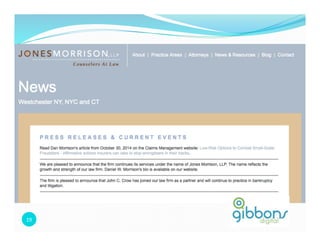
— A 
press 
sec0on 
is 
another 
good 
outlet 
to 
post 
fresh 
content. 
Upda0ng 
your 
site 
with 
content 
about 
your 
company 
and 
employees 
helps 
consumers 
understand 
what’s 
happening 
within 
your 
business 
and 
industry. 
Similarly, 
search 
engines 
view 
the 
new 
pages 
as 
new 
content, 
which 
will 
boost 
your 
page 
rank. 
18
19
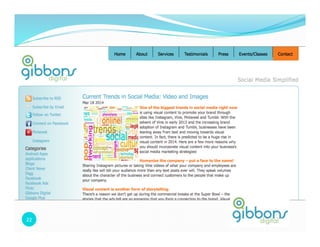
Blog 
— Set-­‐up 
a 
blog 
– 
Wordpress 
is 
common 
blogging 
plaborm 
— Plan 
your 
content 
categories 
— Posts 
consistently 
– 
1 
per 
month 
minimum 
— Posts 
should 
be 
300 
– 
400 
words 
— Include 
images 
20
Blog 
Content 
— Answer 
industry 
ques0ons 
— Comment 
on 
industry 
news 
— Provide 
how-­‐to 
based 
content 
— Encourage 
readers 
to 
comment 
21
22
Website 
Op0miza0on 
23
Onpage 
Optmiza0on 
— Understand 
your 
keywords 
— Op0mize 
your 
website 
— Claim/set-­‐up 
your 
Google 
business 
lis0ng 
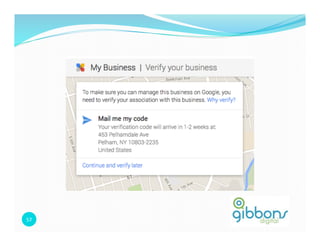
24
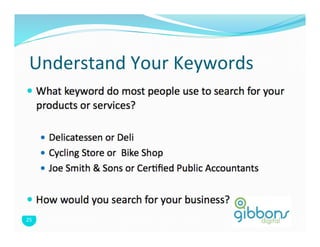
Understand 
Your 
Keywords 
25
26
27
28
29
30
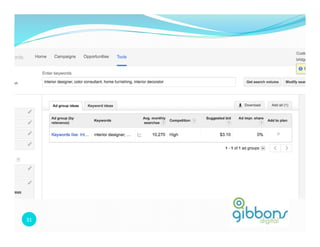
31
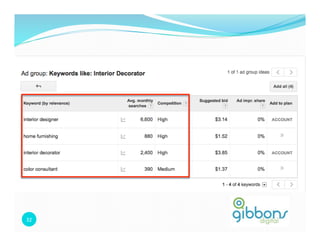
32
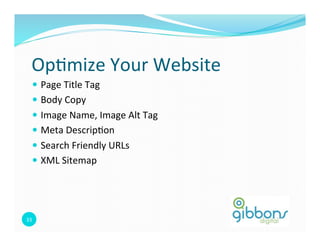
Op0mize 
Your 
Website 
— Page 
Title 
Tag 
— Body 
Copy 
— Image 
Name, 
Image 
Alt 
Tag 
— Meta 
Descrip0on 
— Search 
Friendly 
URLs 
— XML 
Sitemap 
33
34
35
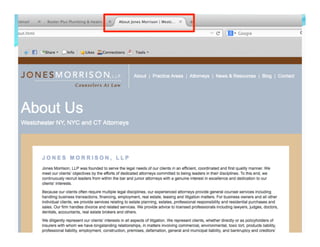
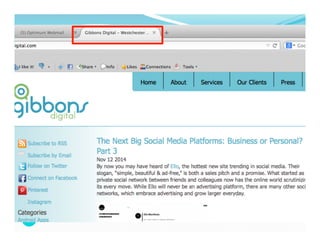
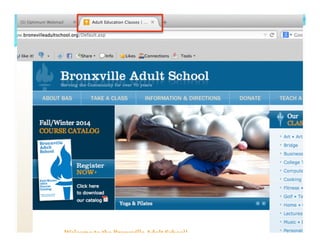
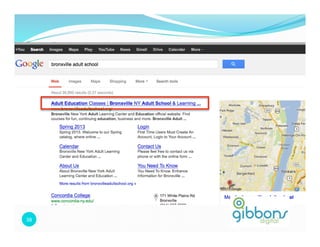
Page 
Title 
in 
Google 
Results 
36
37
38
Use 
of 
keywords 
39
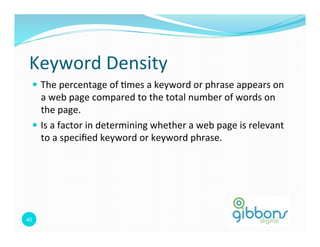
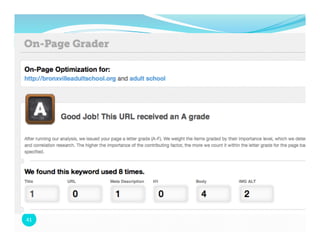
Keyword 
Density 
— The 
percentage 
of 
0mes 
a 
keyword 
or 
phrase 
appears 
on 
a 
web 
page 
compared 
to 
the 
total 
number 
of 
words 
on 
the 
page. 
— Is 
a 
factor 
in 
determining 
whether 
a 
web 
page 
is 
relevant 
to 
a 
specified 
keyword 
or 
keyword 
phrase. 
40
41
42
43
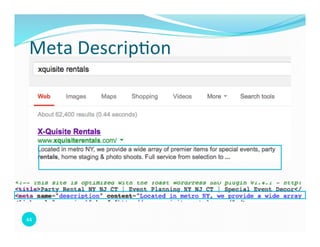
Meta 
Descrip0on 
44
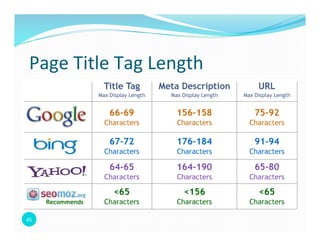
Page 
Title 
Tag 
Length 
45
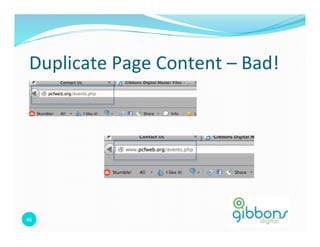
Duplicate 
Page 
Content 
– 
Bad! 
46
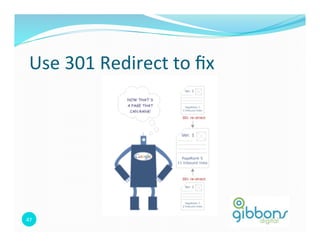
Use 
301 
Redirect 
to 
fix 
47
Duplicate 
Page 
Titles 
— See 
demo 
48
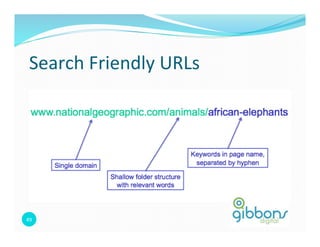
Search 
Friendly 
URLs 
49
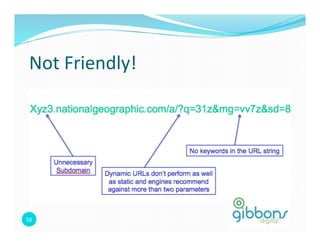
Not 
Friendly! 
50
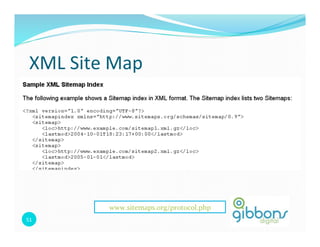
XML 
Site 
Map 
51 
www.sitemaps.org/protocol.php
Google 
Business 
Lis0ng 
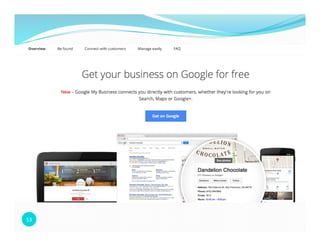
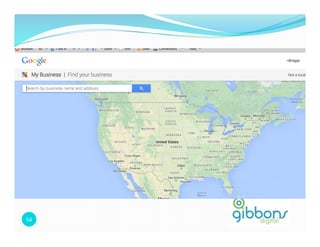
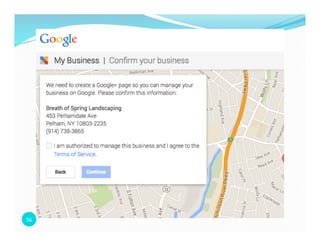
h"p://www.google.com/business/ 
52
53
54
55
56
57
Link 
Building 
— If 
another 
website 
links 
to 
you, 
this 
is 
considered 
an 
external 
link 
to 
your 
site. 
— May 
SEO 
experts 
think 
that 
ge`ng 
external 
links 
is 
the 
single 
most 
important 
objec0ve 
for 
amaining 
high 
rankings. 
— Having 
sites 
link 
to 
your 
website 
shows 
that 
you 
are 
a 
trusted, 
relevant 
site. 
58
Alexa.com 
59
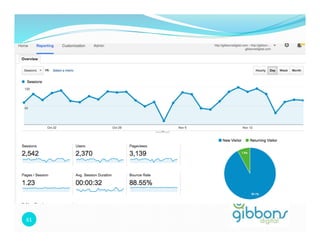
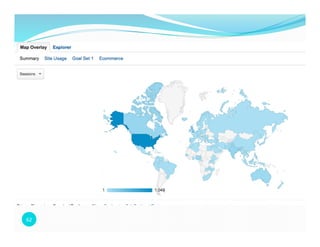
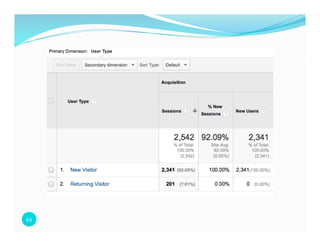
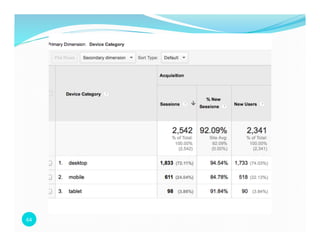
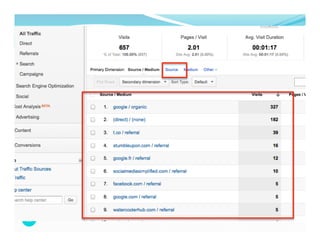
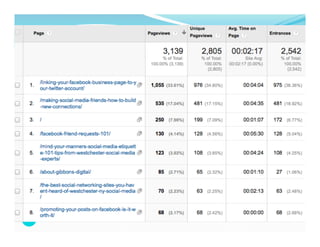
Goggle 
Analy0cs 
60
61
62
63
64
65
66
Social 
Media 
67
Social 
Media 
— Google 
has 
made 
it 
known 
that 
social 
media 
ac0vity 
in 
included 
in 
it’s 
algorithm 
— SMO 
is 
the 
distribu0on 
of 
social 
objects 
(videos, 
blog 
posts, 
tweets, 
Facebook 
updates) 
so 
that 
they’re 
op0mized 
to 
rise 
to 
the 
top 
of 
any 
related 
search 
query, 
where 
and 
when 
it 
is 
performed. 
— SEO 
+ 
SMO 
= 
Amplified 
findability 
in 
the 
tradi0onal 
and 
social 
web. 
68
It’s 
Huge 
— Facebook: 
1.23 
billion 
ac0ve 
users 
— Twimer: 
500 
million 
ac0ve 
users 
— LinkedIn: 
238 
million 
users 
— YouTube: 
1 
billion 
users 
(4 
billion 
views 
per 
day!) 
— Pinterest: 
70 
million 
users 
— Google+: 
300 
million 
monthly 
users 
— Instagram: 
100 
million 
users, 
4 
billion 
photos 
— Blogs: 
66 
million 
blogs, 
346 
million 
people 
readers 
each 
day 
69
It’s 
Growing 
— U.S. 
adults 
who 
use 
social 
media 
sites 
has 
risen 
from 
8% 
to 
72% 
since 
2005. 
That’s 
an 
800% 
increase. 
70 
(Pew 
Research 
Center) 
— Roughly 
81% 
of 
SMBs 
are 
using 
social 
media, 
according 
to 
a 
LinkedIn 
study 
released 
Feb 
2014, 
and 
of 
those 
that 
use 
social, 
94% 
do 
so 
for 
marke0ng 
purposes.
It’s 
Real-­‐Time 
— Reveal 
the 
human 
side 
of 
a 
company, 
give 
it 
personality 
— Provide 
useful 
informa0on 
that 
people 
won’t 
get 
elsewhere 
(or 
at 
least 
not 
as 
quickly) 
— Respond 
to 
comments, 
complaints, 
requests 
real-­‐0me 
— Have 
a 
plaborm 
for 
announcing 
news, 
promo0ons, 
events 
— Generate 
new 
business 
leads 
71
Ge`ng 
Started 
— Create 
your 
plan 
– 
align 
with 
off-­‐line 
marke0ng 
calendar 
— Iden0fy 
the 
most 
important 
keywords 
for 
your 
business. 
Use 
these 
consistently 
in 
all 
posts, 
tweets, 
updates. 
— Set-­‐up 
your 
profiles 
and 
pages 
and 
start 
pos0ng 
72 
— Ensure 
you 
have 
a 
consistent 
design/branding 
across 
all 
plaborms 
— Measure 
and 
adjust 
– 
traffic, 
comments, 
leads, 
etc.
Ge`ng 
Started 
— Map 
out 
your 
strategy 
— Define 
your 
business 
goals 
and 
objec0ves 
for 
social 
media 
73 
— Increase 
sales, 
brand 
awareness, 
engagement, 
drive 
traffic 
to 
your 
website, 
create 
a 
community 
on 
your 
page 
— Iden0fy 
your 
compe00on 
and 
what 
dis0nguishes 
you 
from 
your 
compe00on 
— Define 
target 
audiences 
and 
key 
messages 
— Define 
categories/topics 
for 
social 
media 
updates
Ge`ng 
Started 
— Create 
your 
plan 
– 
align 
with 
off-­‐line 
marke0ng 
calendar 
— Iden0fy 
the 
most 
important 
keywords 
for 
your 
business. 
Use 
these 
consistently 
in 
all 
posts, 
tweets, 
updates. 
— Set-­‐up 
your 
profiles 
and 
pages 
and 
start 
pos0ng 
74 
— Ensure 
you 
have 
a 
consistent 
design/branding 
across 
all 
plaborms 
— Measure 
and 
adjust 
– 
traffic, 
comments, 
leads, 
etc.
Social 
Media 
Plan 
— Create 
your 
Content 
Calendar 
For 
Pos0ng 
75 
— Define 
5-­‐6 
content 
categories 
— Set-­‐up 
a 
3-­‐month 
calendar 
— Add 
your 
key 
offline 
events 
and 
any 
milestones, 
holidays, 
etc., 
— Align 
with 
your 
marke0ng 
calendar 
— Content 
should 
be 
a 
mix 
of 
original 
content/images, 
news 
updates 
and 
curated 
content/images
76
Social 
Media 
Plan 
— Set-­‐up 
Google 
Analy0cs 
to 
monitor 
web 
traffic 
— Measure 
and 
adjust 
– 
traffic, 
comments, 
leads, 
etc. 
— Facebook 
insights, 
and 
all 
other 
channels 
have 
analy0cs 
77
78
79
80
81
82
83
84
85
Thank 
You! 
86 
Slideshare.net/gibbonsdigital 
Bridget 
Gibbons 
bridget@gibbonsdigital.com 
Gibbonsdigital.com 
@gibbonsdigital 
u.com/gibbonsdigital

Search Engine Optimization Basics

  • 1.
  • 2.
    Search Engine Op0miza0on • The 2 Search Landscape • How Search Engines Work • Building Op0mized Websites • Conduc0ng Keyword Research • Link Building Strategies • Social Media & the Web’s Influencers
  • 3.
  • 4.
  • 5.
  • 6.
    Market Share (US) 6 ComScore Inc.
  • 7.
  • 8.
  • 9.
  • 10.
  • 11.
  • 12.
    Key Components of Google’s Algorithm — Freshness of Content — Website Op0miza0on — Links back to your website — Social Media Ac0vity 12 12
  • 13.
    Freshness of Content — Publish new pages in different formats and post them to different sec0ons of your site — SlideShares, video content, and new landing pages. 13 — make sure you’re properly adding the right meta informa0on to visual media formats, or else you might not get as much value from what you publish.
  • 14.
    Freshness of Content — Best prac0ce is to publish at least one piece of content a day — Once you develop a solid base of blog posts, conglomerate relevant posts into an 14 e-­‐book. Conversely, you might want to start with an e-­‐book made up of content that can be broken down into blog posts. — Once it is compiled, gate the content in your e-­‐book to capture new leads. Then, you can slowly release its content on your blog.
  • 15.
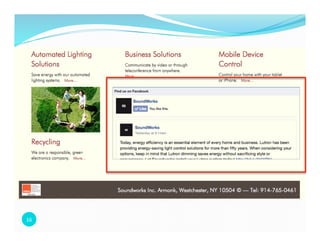
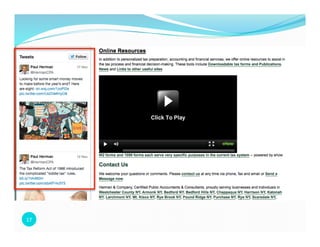
    Freshness of Content — Having a live social media feed on your website allows your site to constantly speak with search engines. By having new tweets or Facebook posts consistently upda0ng on your homepage or relevant webpage, search engines will understand the new, valuable informa0on that you’re pu`ng out and will likely want to crawl to your site. 15
  • 16.
  • 17.
  • 18.
    Freshness of Content — A press sec0on is another good outlet to post fresh content. Upda0ng your site with content about your company and employees helps consumers understand what’s happening within your business and industry. Similarly, search engines view the new pages as new content, which will boost your page rank. 18
  • 19.
  • 20.
    Blog — Set-­‐up a blog – Wordpress is common blogging plaborm — Plan your content categories — Posts consistently – 1 per month minimum — Posts should be 300 – 400 words — Include images 20
  • 21.
    Blog Content —Answer industry ques0ons — Comment on industry news — Provide how-­‐to based content — Encourage readers to comment 21
  • 22.
  • 23.
  • 24.
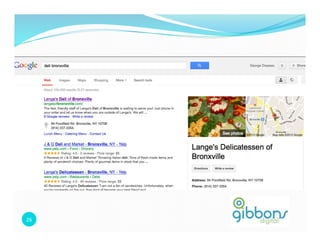
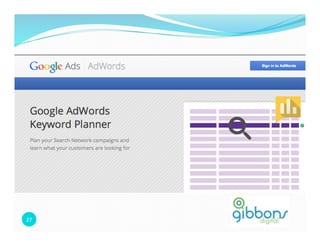
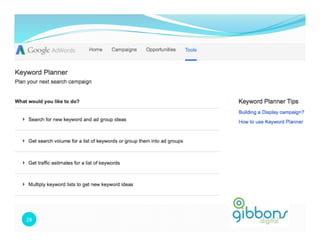
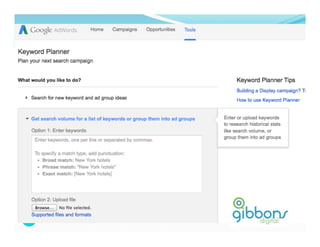
    Onpage Optmiza0on —Understand your keywords — Op0mize your website — Claim/set-­‐up your Google business lis0ng 24
  • 25.
  • 26.
  • 27.
  • 28.
  • 29.
  • 30.
  • 31.
  • 32.
  • 33.
    Op0mize Your Website — Page Title Tag — Body Copy — Image Name, Image Alt Tag — Meta Descrip0on — Search Friendly URLs — XML Sitemap 33
  • 34.
  • 35.
  • 36.
    Page Title in Google Results 36
  • 37.
  • 38.
  • 39.
  • 40.
    Keyword Density —The percentage of 0mes a keyword or phrase appears on a web page compared to the total number of words on the page. — Is a factor in determining whether a web page is relevant to a specified keyword or keyword phrase. 40
  • 41.
  • 42.
  • 43.
  • 44.
  • 45.
    Page Title Tag Length 45
  • 46.
  • 47.
    Use 301 Redirect to fix 47
  • 48.
    Duplicate Page Titles — See demo 48
  • 49.
  • 50.
  • 51.
    XML Site Map 51 www.sitemaps.org/protocol.php
  • 52.
    Google Business Lis0ng h"p://www.google.com/business/ 52
  • 53.
  • 54.
  • 55.
  • 56.
  • 57.
  • 58.
    Link Building —If another website links to you, this is considered an external link to your site. — May SEO experts think that ge`ng external links is the single most important objec0ve for amaining high rankings. — Having sites link to your website shows that you are a trusted, relevant site. 58
  • 59.
  • 60.
  • 61.
  • 62.
  • 63.
  • 64.
  • 65.
  • 66.
  • 67.
  • 68.
    Social Media —Google has made it known that social media ac0vity in included in it’s algorithm — SMO is the distribu0on of social objects (videos, blog posts, tweets, Facebook updates) so that they’re op0mized to rise to the top of any related search query, where and when it is performed. — SEO + SMO = Amplified findability in the tradi0onal and social web. 68
  • 69.
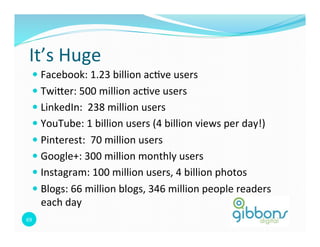
    It’s Huge —Facebook: 1.23 billion ac0ve users — Twimer: 500 million ac0ve users — LinkedIn: 238 million users — YouTube: 1 billion users (4 billion views per day!) — Pinterest: 70 million users — Google+: 300 million monthly users — Instagram: 100 million users, 4 billion photos — Blogs: 66 million blogs, 346 million people readers each day 69
  • 70.
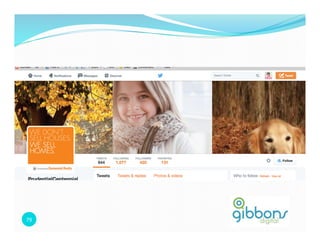
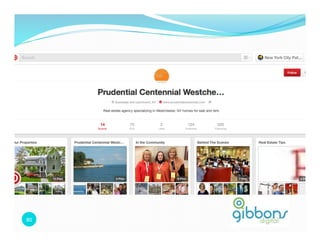
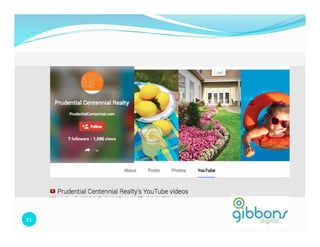
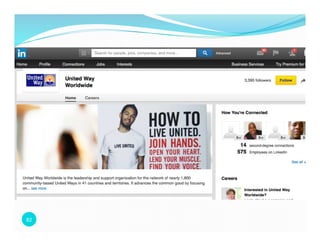
    It’s Growing —U.S. adults who use social media sites has risen from 8% to 72% since 2005. That’s an 800% increase. 70 (Pew Research Center) — Roughly 81% of SMBs are using social media, according to a LinkedIn study released Feb 2014, and of those that use social, 94% do so for marke0ng purposes.
  • 71.
    It’s Real-­‐Time —Reveal the human side of a company, give it personality — Provide useful informa0on that people won’t get elsewhere (or at least not as quickly) — Respond to comments, complaints, requests real-­‐0me — Have a plaborm for announcing news, promo0ons, events — Generate new business leads 71
  • 72.
    Ge`ng Started —Create your plan – align with off-­‐line marke0ng calendar — Iden0fy the most important keywords for your business. Use these consistently in all posts, tweets, updates. — Set-­‐up your profiles and pages and start pos0ng 72 — Ensure you have a consistent design/branding across all plaborms — Measure and adjust – traffic, comments, leads, etc.
  • 73.
    Ge`ng Started —Map out your strategy — Define your business goals and objec0ves for social media 73 — Increase sales, brand awareness, engagement, drive traffic to your website, create a community on your page — Iden0fy your compe00on and what dis0nguishes you from your compe00on — Define target audiences and key messages — Define categories/topics for social media updates
  • 74.
    Ge`ng Started —Create your plan – align with off-­‐line marke0ng calendar — Iden0fy the most important keywords for your business. Use these consistently in all posts, tweets, updates. — Set-­‐up your profiles and pages and start pos0ng 74 — Ensure you have a consistent design/branding across all plaborms — Measure and adjust – traffic, comments, leads, etc.
  • 75.
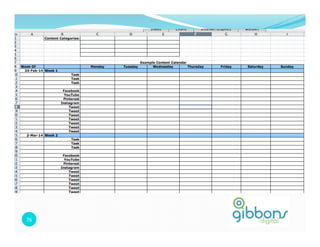
    Social Media Plan — Create your Content Calendar For Pos0ng 75 — Define 5-­‐6 content categories — Set-­‐up a 3-­‐month calendar — Add your key offline events and any milestones, holidays, etc., — Align with your marke0ng calendar — Content should be a mix of original content/images, news updates and curated content/images
  • 76.
  • 77.
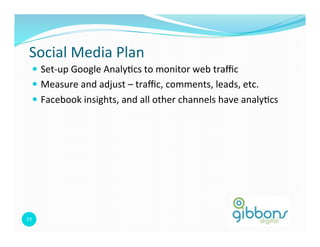
    Social Media Plan — Set-­‐up Google Analy0cs to monitor web traffic — Measure and adjust – traffic, comments, leads, etc. — Facebook insights, and all other channels have analy0cs 77
  • 78.
  • 79.
  • 80.
  • 81.
  • 82.
  • 83.
  • 84.
  • 85.
  • 86.
    Thank You! 86 Slideshare.net/gibbonsdigital Bridget Gibbons bridget@gibbonsdigital.com Gibbonsdigital.com @gibbonsdigital u.com/gibbonsdigital