Models for
supply chain
collaboration
Saturday, November 7, 2015 1CHIN KOK POH COPYRIGHT 2015
CPFR Overview
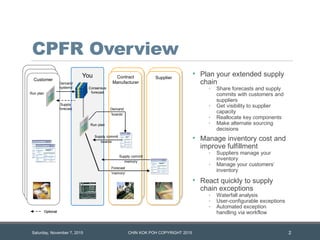
• Plan your extended supply
chain
◦ Share forecasts and supply
commits with customers and
suppliers
◦ Get visibility to supplier
capacity
◦ Reallocate key components
◦ Make alternate sourcing
decisions
• Manage inventory cost and
improve fulfillment
◦ Suppliers manage your
inventory
◦ Manage your customers’
inventory
• React quickly to supply
chain exceptions
◦ Waterfall analysis
◦ User-configurable exceptions
◦ Automated exception
handling via workflow
Contract
Manufacturer
You SupplierCustomer
Run plan
Optional
Forecast
‘memory’
Supply commit
‘boards’
Supply commit
‘memory’
Demand
‘boards’
Run plan
Demand
‘systems’
Supply
forecast
Consensus
forecast
Saturday, November 7, 2015 2CHIN KOK POH COPYRIGHT 2015
VICS CPFR Model
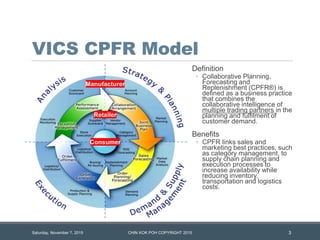
Definition
◦ Collaborative Planning,
Forecasting and
Replenishment (CPFR®) is
defined as a business practice
that combines the
collaborative intelligence of
multiple trading partners in the
planning and fulfilment of
customer demand.
Benefits
◦ CPFR links sales and
marketing best practices, such
as category management, to
supply chain planning and
execution processes to
increase availability while
reducing inventory,
transportation and logistics
costs.
Saturday, November 7, 2015 3
Manufacturer
Retailer
Consumer
CHIN KOK POH COPYRIGHT 2015
RFID In Action
Saturday, November 7, 2015 CHIN KOK POH COPYRIGHT 2015 4
RFID readers and antennas
A RFID reader consist of an antenna (or more) and an interrogator
Saturday, November 7, 2015 CHIN KOK POH COPYRIGHT 2015 5
Using barcode and RFID
across the supply chain
Saturday, November 7, 2015 CHIN KOK POH COPYRIGHT 2015 6
CHALLENGES
Supply chain has
small objects at either
end and big objects
(containers) in the
middle.
Shipper and retailer
lose track of their
goods in the middle.
Long range
technology is needed
for this ‘middle’
transportation domain.
Short range small
asset technologies at
either end.
Distribution
Center
ITEM
PACKAGE
TRANSPORT UNIT
PALLET
CONTAINER
MOVEMENT VEHICLE
Bar Code
Satellite
Active RF
Passive RF
FactorySupplier Customer
RTLS Video
How Real Time Location System (RTLS) can be implemented using Wi-Fi triangulation
Saturday, November 7, 2015 CHIN KOK POH COPYRIGHT 2015 7
Advanced
ICT
Integration
COMMUNICATIONS ENABLED
BUSINESS PROCESS (CEBP)
Saturday, November 7, 2015 CHIN KOK POH COPYRIGHT 2015 8
CEBP: Integrating ICT to
Business applications
Communications Enabled Business
ProcessUnified CommunicationsCommunications
Unified
Commu-
nications
Business
Process
Internet
and PSTN
gateway
CEBP
Process-Centric
Equipment-Centric
Hardware
Software
Saturday, November 7, 2015 9CHIN KOK POH COPYRIGHT 2015

CPFR - Model for Supply Chain Co-ordination

  • 1.
    Models for supply chain collaboration Saturday,November 7, 2015 1CHIN KOK POH COPYRIGHT 2015
  • 2.
    CPFR Overview • Planyour extended supply chain ◦ Share forecasts and supply commits with customers and suppliers ◦ Get visibility to supplier capacity ◦ Reallocate key components ◦ Make alternate sourcing decisions • Manage inventory cost and improve fulfillment ◦ Suppliers manage your inventory ◦ Manage your customers’ inventory • React quickly to supply chain exceptions ◦ Waterfall analysis ◦ User-configurable exceptions ◦ Automated exception handling via workflow Contract Manufacturer You SupplierCustomer Run plan Optional Forecast ‘memory’ Supply commit ‘boards’ Supply commit ‘memory’ Demand ‘boards’ Run plan Demand ‘systems’ Supply forecast Consensus forecast Saturday, November 7, 2015 2CHIN KOK POH COPYRIGHT 2015
  • 3.
    VICS CPFR Model Definition ◦Collaborative Planning, Forecasting and Replenishment (CPFR®) is defined as a business practice that combines the collaborative intelligence of multiple trading partners in the planning and fulfilment of customer demand. Benefits ◦ CPFR links sales and marketing best practices, such as category management, to supply chain planning and execution processes to increase availability while reducing inventory, transportation and logistics costs. Saturday, November 7, 2015 3 Manufacturer Retailer Consumer CHIN KOK POH COPYRIGHT 2015
  • 4.
    RFID In Action Saturday,November 7, 2015 CHIN KOK POH COPYRIGHT 2015 4
  • 5.
    RFID readers andantennas A RFID reader consist of an antenna (or more) and an interrogator Saturday, November 7, 2015 CHIN KOK POH COPYRIGHT 2015 5
  • 6.
    Using barcode andRFID across the supply chain Saturday, November 7, 2015 CHIN KOK POH COPYRIGHT 2015 6 CHALLENGES Supply chain has small objects at either end and big objects (containers) in the middle. Shipper and retailer lose track of their goods in the middle. Long range technology is needed for this ‘middle’ transportation domain. Short range small asset technologies at either end. Distribution Center ITEM PACKAGE TRANSPORT UNIT PALLET CONTAINER MOVEMENT VEHICLE Bar Code Satellite Active RF Passive RF FactorySupplier Customer
  • 7.
    RTLS Video How RealTime Location System (RTLS) can be implemented using Wi-Fi triangulation Saturday, November 7, 2015 CHIN KOK POH COPYRIGHT 2015 7
  • 8.
    Advanced ICT Integration COMMUNICATIONS ENABLED BUSINESS PROCESS(CEBP) Saturday, November 7, 2015 CHIN KOK POH COPYRIGHT 2015 8
  • 9.
    CEBP: Integrating ICTto Business applications Communications Enabled Business ProcessUnified CommunicationsCommunications Unified Commu- nications Business Process Internet and PSTN gateway CEBP Process-Centric Equipment-Centric Hardware Software Saturday, November 7, 2015 9CHIN KOK POH COPYRIGHT 2015