
Excellence in Engineering
An Initiative of
Shivnandani Industries Pvt Ltd
&
Jagdamb Janaki Nawal Janaki Society
By
Col Mukteshwar Prasad(Retd),
MTech,FIE(I),FIETE,FISLE,FInstOD,AMCSI
Introduction
• Main Function of
– science
• Observe
• Discover
• Formulate the laws of nature
Approach for excellence in science is same except
• Infrastructure facilities
• Environment
– Technology
• Deal with means of application of science
• Scientific content
– Universal
– Application conditioned by environment of application
Excellence in Technology is location specific
Introduction
• Main Function of
– Engineering
• Convert resources available in
– Goods needed by society
– Services
• Realistic and optimal solution besides due Weightage to
existing parameters involved in
– Scientific
– Technological
– Economic
– Social
– Ethical
– Management
– political
• Excellence in Engineering
– Look at various parameters
– Synthesize
– Optimize
Excellence in engineering not confused with
Excellence in Science, Technology and even
leadership in other discipline/profession in
society vis-a vis Engineering
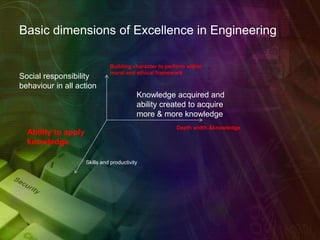
Basic dimensions of Excellence in Engineering
Knowledge acquired and
ability created to acquire
more & more knowledge
Social responsibility
behaviour in all action
Ability to apply
knowledge
Building character to perform within
moral and ethical framework
Skills and productivity
Depth width &knowledge
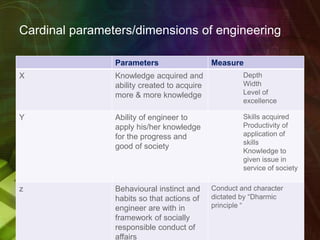
Cardinal parameters/dimensions of engineering
Parameters Measure
X Knowledge acquired and
ability created to acquire
more & more knowledge
Depth
Width
Level of
excellence
Y Ability of engineer to
apply his/her knowledge
for the progress and
good of society
Skills acquired
Productivity of
application of
skills
Knowledge to
given issue in
service of society
z Behavioural instinct and
habits so that actions of
engineer are with in
framework of socially
responsible conduct of
affairs
Conduct and character
dictated by “Dharmic
principle “
Cardinal dimensions of Engineering
• “Dharma is that which upholds, nourishes or supports the stability of
the society ,maintains social order and secures the general well
being and progress of mankind”
Supreme court
• “Each one of us must become aware of our higher self. We are links
of a great past to a great future. We should ignite our dormant inner
energy and let it guide our lives. The radiance of such minds
embarked on constructive endeavour will bring peace, prosperity
and bliss to this nation.”
A P J Abdul Kalam
(Relevant to Third dimension)
Sustainable regime essential for engineering
excellence
• How “sustainability” can be built in ultimate goal of development
(improvement in quality of life in society)?
– For the purpose Engineer’s goal is to convert available resources in to
goods and services
– Hence preserving natural resources undisturbed is
• Neither practical
• Nor engineering reality
• Not synonymous with zero degradation
– Successful development lead to
• Disturbance of nature
• Hence sustainability
– Endeavour to minimise degradation
– make up degradation in best acceptable form
» As fast as possible
» With the help of rapid development in
» Science
» technology
» engineering
• World commission on “Environment and development” or Brundtland
commission through Seminal 1987 Report “Our common future”
brought term “Sustainable Development”
• Development towards” meeting the needs of the present generation
without compromising the needs generations of the future towards”
Hence Engineering excellence must ensure all engineering activities
are to be carried in a sustainable regime i.e. sustainable
development
Quality Assurance essential for engineering
excellence
• Quality :“Totality of features and characteristics of an entity (a product or
service)that bears on its ability to satisfy the stated or implied needs”
• stated or implied needs
– Optimising three dimensions
– Sustainability
– Equity worked out from socio-techno-economic consideration
• Achieved through
– Process of standardisation at
• National level
• Regional level
• Assessment of quality on the basis of standards arrived at considerations
– socio-techno-economic
– Scientific
– Technological
– Engineering
– Even political
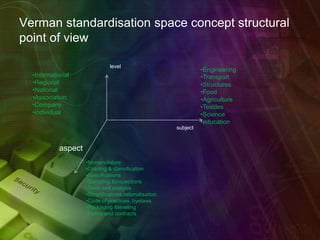
Verman standardisation space concept structural
point of view
•Engineering
•Transport
•Structures
•Food
•Agriculture
•Textiles
•Science
•education
•International
•Regional
•National
•Association
•Company
•individual
aspect
level
•Nomenclature
•Grading & classification
•Specifications
•Sampling &inspections
•Tests and analysis
•Simplifications,rationalisation
•Code of practices, byelaws
•Packaging &leveling
•Forms and contracts
subject
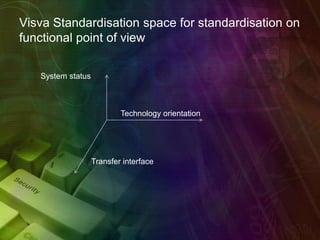
Visva Standardisation space for standardisation on
functional point of view
Technology orientation
System status
Transfer interface
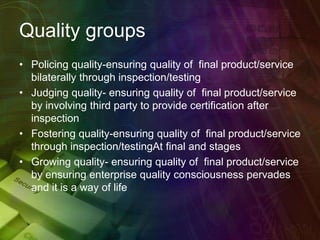
Quality groups
• Policing quality-ensuring quality of final product/service
bilaterally through inspection/testing
• Judging quality- ensuring quality of final product/service
by involving third party to provide certification after
inspection
• Fostering quality-ensuring quality of final product/service
through inspection/testingAt final and stages
• Growing quality- ensuring quality of final product/service
by ensuring enterprise quality consciousness pervades
and it is a way of life
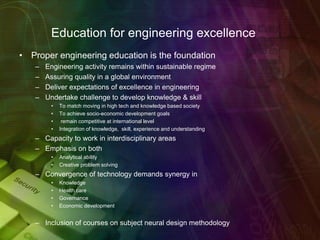
Education for engineering excellence
• Proper engineering education is the foundation
– Engineering activity remains within sustainable regime
– Assuring quality in a global environment
– Deliver expectations of excellence in engineering
– Undertake challenge to develop knowledge & skill
• To match moving in high tech and knowledge based society
• To achieve socio-economic development goals
• remain competitive at international level
• Integration of knowledge, skill, experience and understanding
– Capacity to work in interdisciplinary areas
– Emphasis on both
• Analytical ability
• Creative problem solving
– Convergence of technology demands synergy in
• Knowledge
• Health care
• Governance
• Economic development
– Inclusion of courses on subject neural design methodology
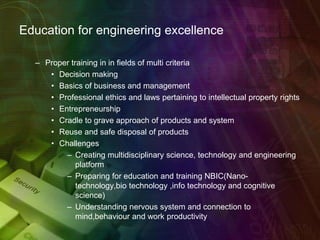
Education for engineering excellence
– Proper training in in fields of multi criteria
• Decision making
• Basics of business and management
• Professional ethics and laws pertaining to intellectual property rights
• Entrepreneurship
• Cradle to grave approach of products and system
• Reuse and safe disposal of products
• Challenges
– Creating multidisciplinary science, technology and engineering
platform
– Preparing for education and training NBIC(Nano-
technology,bio technology ,info technology and cognitive
science)
– Understanding nervous system and connection to
mind,behaviour and work productivity
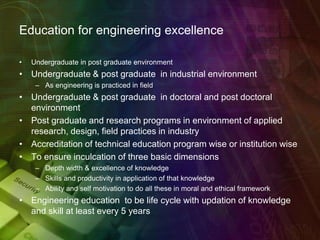
Education for engineering excellence
• Undergraduate in post graduate environment
• Undergraduate & post graduate in industrial environment
– As engineering is practiced in field
• Undergraduate & post graduate in doctoral and post doctoral
environment
• Post graduate and research programs in environment of applied
research, design, field practices in industry
• Accreditation of technical education program wise or institution wise
• To ensure inculcation of three basic dimensions
– Depth width & excellence of knowledge
– Skills and productivity in application of that knowledge
– Ability and self motivation to do all these in moral and ethical framework
• Engineering education to be life cycle with updation of knowledge
and skill at least every 5 years
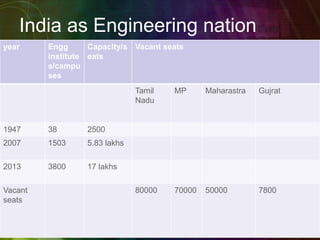
India as Engineering nation
year Engg
institute
s/campu
ses
Capacity/s
eats
Vacant seats
Tamil
Nadu
MP Maharastra Gujrat
1947 38 2500
2007 1503 5.83 lakhs
2013 3800 17 lakhs
Vacant
seats
80000 70000 50000 7800
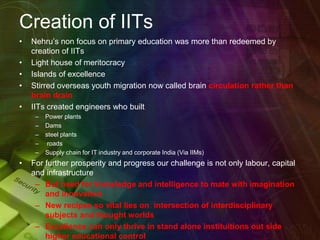
Creation of IITs
• Nehru’s non focus on primary education was more than redeemed by
creation of IITs
• Light house of meritocracy
• Islands of excellence
• Stirred overseas youth migration now called brain circulation rather than
brain drain
• IITs created engineers who built
– Power plants
– Dams
– steel plants
– roads
– Supply chain for IT industry and corporate India (Via IIMs)
• For further prosperity and progress our challenge is not only labour, capital
and infrastructure
– But need for knowledge and intelligence to mate with imagination
and innovation
– New recipes so vital lies on intersection of interdisciplinary
subjects and thought worlds
– Excellence can only thrive in stand alone instituitions out side
higher educational control
Creation of IITs
• Convert IITs in multidisciplinary campus which will be
– More vibrant
– Creative and effective at
• Research and teaching
– Adding MBA has diluted IITs and are not comparable to IIMs hence
need for re focus
– But for process of creativity –Reading of Biography of Michelangelo by
Irving Stone is a necessity for an engineer
– Biography of Duke of Marlborough by Winston Churchill for MBA
– Must offer undergraduate degree in medicine,law,philosophy, literature
because life is not solving a sum but painting a picture
• Country can not sustain greatness without great university like Nalanda and
Taxila
• No university can sustain without research
• No research is truly creative or impactful without being informed,influenced,and
shaped by multiple discipline
– Turn IITs in multiple disciplinary university
India as Engineering nation
• “Capacity created in anticipation of demand remained unutilized because
economy failed us”
• “Engg education was ramped up to a rate that was not sustainable .Also quality
was not maintained”
Ranjan Banerjee,Forbes Marshal Chair Prof at IIT Bombay
• All colleges are not equal
– Quality of teaching staff
– Curricula update to industry requirement
• AICTE pre requisite as below are huge
– Land
– Buildings
– Labs
– Library
– University of affiliation
– Hiring teachers
In a business plan improvement comes in 5th and 6th year
In a large Private Engg Colleges facilities and teachers are fudged
Comparatively situation in State run Govt Colleges are worst due to
work/maintenance by PWD,resatrictions and politics in hiring teachers and
inadequate funds and unsaid unethical pracices
India as Engineering nation
• Antidote is higher investment in higher professional education
• Stop looking at commercial phenomena and look at quality
• Industry is mark driven
– Neither student nor employer appreciate skill of engineer
– Hence since higher role is not appreciated students study for marks
– University exam and marks mania is rampant
• Engg colleges do not train engineers but mass manufacture
• IT service hiring never placed premium on acquisition of Engg skills and
slogan “We can do it cheap” has done greatest damage.
Road ahead
• Let us make Engg a joyful and creative pursuit
• They should have ability to change lives
• We must kindle curiosity and exploration
• Human problems are complex and excellence in engg demands
knowledge of
– Sociology
– Economics
– History
– Design aesthetic sense
• They must have knowledge ,resources , skills in identifying
right resources ,tools to be used and finally strong
fundamentals
• Engg being multidisciplinary Engg be unified discipline rather
than artificial branch boundaries
• Bridge the gap of shortage of global good engineers

Excellence in engineering

  • 1.
    Excellence in Engineering AnInitiative of Shivnandani Industries Pvt Ltd & Jagdamb Janaki Nawal Janaki Society By Col Mukteshwar Prasad(Retd), MTech,FIE(I),FIETE,FISLE,FInstOD,AMCSI
  • 2.
    Introduction • Main Functionof – science • Observe • Discover • Formulate the laws of nature Approach for excellence in science is same except • Infrastructure facilities • Environment – Technology • Deal with means of application of science • Scientific content – Universal – Application conditioned by environment of application Excellence in Technology is location specific
  • 3.
    Introduction • Main Functionof – Engineering • Convert resources available in – Goods needed by society – Services • Realistic and optimal solution besides due Weightage to existing parameters involved in – Scientific – Technological – Economic – Social – Ethical – Management – political
  • 4.
    • Excellence inEngineering – Look at various parameters – Synthesize – Optimize Excellence in engineering not confused with Excellence in Science, Technology and even leadership in other discipline/profession in society vis-a vis Engineering
  • 5.
    Basic dimensions ofExcellence in Engineering Knowledge acquired and ability created to acquire more & more knowledge Social responsibility behaviour in all action Ability to apply knowledge Building character to perform within moral and ethical framework Skills and productivity Depth width &knowledge
  • 6.
    Cardinal parameters/dimensions ofengineering Parameters Measure X Knowledge acquired and ability created to acquire more & more knowledge Depth Width Level of excellence Y Ability of engineer to apply his/her knowledge for the progress and good of society Skills acquired Productivity of application of skills Knowledge to given issue in service of society z Behavioural instinct and habits so that actions of engineer are with in framework of socially responsible conduct of affairs Conduct and character dictated by “Dharmic principle “
  • 7.
    Cardinal dimensions ofEngineering • “Dharma is that which upholds, nourishes or supports the stability of the society ,maintains social order and secures the general well being and progress of mankind” Supreme court • “Each one of us must become aware of our higher self. We are links of a great past to a great future. We should ignite our dormant inner energy and let it guide our lives. The radiance of such minds embarked on constructive endeavour will bring peace, prosperity and bliss to this nation.” A P J Abdul Kalam (Relevant to Third dimension)
  • 8.
    Sustainable regime essentialfor engineering excellence • How “sustainability” can be built in ultimate goal of development (improvement in quality of life in society)? – For the purpose Engineer’s goal is to convert available resources in to goods and services – Hence preserving natural resources undisturbed is • Neither practical • Nor engineering reality • Not synonymous with zero degradation – Successful development lead to • Disturbance of nature • Hence sustainability – Endeavour to minimise degradation – make up degradation in best acceptable form » As fast as possible » With the help of rapid development in » Science » technology » engineering
  • 9.
    • World commissionon “Environment and development” or Brundtland commission through Seminal 1987 Report “Our common future” brought term “Sustainable Development” • Development towards” meeting the needs of the present generation without compromising the needs generations of the future towards” Hence Engineering excellence must ensure all engineering activities are to be carried in a sustainable regime i.e. sustainable development
  • 10.
    Quality Assurance essentialfor engineering excellence • Quality :“Totality of features and characteristics of an entity (a product or service)that bears on its ability to satisfy the stated or implied needs” • stated or implied needs – Optimising three dimensions – Sustainability – Equity worked out from socio-techno-economic consideration • Achieved through – Process of standardisation at • National level • Regional level • Assessment of quality on the basis of standards arrived at considerations – socio-techno-economic – Scientific – Technological – Engineering – Even political
  • 11.
    Verman standardisation spaceconcept structural point of view •Engineering •Transport •Structures •Food •Agriculture •Textiles •Science •education •International •Regional •National •Association •Company •individual aspect level •Nomenclature •Grading & classification •Specifications •Sampling &inspections •Tests and analysis •Simplifications,rationalisation •Code of practices, byelaws •Packaging &leveling •Forms and contracts subject
  • 12.
    Visva Standardisation spacefor standardisation on functional point of view Technology orientation System status Transfer interface
  • 13.
    Quality groups • Policingquality-ensuring quality of final product/service bilaterally through inspection/testing • Judging quality- ensuring quality of final product/service by involving third party to provide certification after inspection • Fostering quality-ensuring quality of final product/service through inspection/testingAt final and stages • Growing quality- ensuring quality of final product/service by ensuring enterprise quality consciousness pervades and it is a way of life
  • 14.
    Education for engineeringexcellence • Proper engineering education is the foundation – Engineering activity remains within sustainable regime – Assuring quality in a global environment – Deliver expectations of excellence in engineering – Undertake challenge to develop knowledge & skill • To match moving in high tech and knowledge based society • To achieve socio-economic development goals • remain competitive at international level • Integration of knowledge, skill, experience and understanding – Capacity to work in interdisciplinary areas – Emphasis on both • Analytical ability • Creative problem solving – Convergence of technology demands synergy in • Knowledge • Health care • Governance • Economic development – Inclusion of courses on subject neural design methodology
  • 15.
    Education for engineeringexcellence – Proper training in in fields of multi criteria • Decision making • Basics of business and management • Professional ethics and laws pertaining to intellectual property rights • Entrepreneurship • Cradle to grave approach of products and system • Reuse and safe disposal of products • Challenges – Creating multidisciplinary science, technology and engineering platform – Preparing for education and training NBIC(Nano- technology,bio technology ,info technology and cognitive science) – Understanding nervous system and connection to mind,behaviour and work productivity
  • 16.
    Education for engineeringexcellence • Undergraduate in post graduate environment • Undergraduate & post graduate in industrial environment – As engineering is practiced in field • Undergraduate & post graduate in doctoral and post doctoral environment • Post graduate and research programs in environment of applied research, design, field practices in industry • Accreditation of technical education program wise or institution wise • To ensure inculcation of three basic dimensions – Depth width & excellence of knowledge – Skills and productivity in application of that knowledge – Ability and self motivation to do all these in moral and ethical framework • Engineering education to be life cycle with updation of knowledge and skill at least every 5 years
  • 17.
    India as Engineeringnation year Engg institute s/campu ses Capacity/s eats Vacant seats Tamil Nadu MP Maharastra Gujrat 1947 38 2500 2007 1503 5.83 lakhs 2013 3800 17 lakhs Vacant seats 80000 70000 50000 7800
  • 18.
    Creation of IITs •Nehru’s non focus on primary education was more than redeemed by creation of IITs • Light house of meritocracy • Islands of excellence • Stirred overseas youth migration now called brain circulation rather than brain drain • IITs created engineers who built – Power plants – Dams – steel plants – roads – Supply chain for IT industry and corporate India (Via IIMs) • For further prosperity and progress our challenge is not only labour, capital and infrastructure – But need for knowledge and intelligence to mate with imagination and innovation – New recipes so vital lies on intersection of interdisciplinary subjects and thought worlds – Excellence can only thrive in stand alone instituitions out side higher educational control
  • 19.
    Creation of IITs •Convert IITs in multidisciplinary campus which will be – More vibrant – Creative and effective at • Research and teaching – Adding MBA has diluted IITs and are not comparable to IIMs hence need for re focus – But for process of creativity –Reading of Biography of Michelangelo by Irving Stone is a necessity for an engineer – Biography of Duke of Marlborough by Winston Churchill for MBA – Must offer undergraduate degree in medicine,law,philosophy, literature because life is not solving a sum but painting a picture • Country can not sustain greatness without great university like Nalanda and Taxila • No university can sustain without research • No research is truly creative or impactful without being informed,influenced,and shaped by multiple discipline – Turn IITs in multiple disciplinary university
  • 20.
    India as Engineeringnation • “Capacity created in anticipation of demand remained unutilized because economy failed us” • “Engg education was ramped up to a rate that was not sustainable .Also quality was not maintained” Ranjan Banerjee,Forbes Marshal Chair Prof at IIT Bombay • All colleges are not equal – Quality of teaching staff – Curricula update to industry requirement • AICTE pre requisite as below are huge – Land – Buildings – Labs – Library – University of affiliation – Hiring teachers In a business plan improvement comes in 5th and 6th year In a large Private Engg Colleges facilities and teachers are fudged Comparatively situation in State run Govt Colleges are worst due to work/maintenance by PWD,resatrictions and politics in hiring teachers and inadequate funds and unsaid unethical pracices
  • 21.
    India as Engineeringnation • Antidote is higher investment in higher professional education • Stop looking at commercial phenomena and look at quality • Industry is mark driven – Neither student nor employer appreciate skill of engineer – Hence since higher role is not appreciated students study for marks – University exam and marks mania is rampant • Engg colleges do not train engineers but mass manufacture • IT service hiring never placed premium on acquisition of Engg skills and slogan “We can do it cheap” has done greatest damage.
  • 22.
    Road ahead • Letus make Engg a joyful and creative pursuit • They should have ability to change lives • We must kindle curiosity and exploration • Human problems are complex and excellence in engg demands knowledge of – Sociology – Economics – History – Design aesthetic sense • They must have knowledge ,resources , skills in identifying right resources ,tools to be used and finally strong fundamentals • Engg being multidisciplinary Engg be unified discipline rather than artificial branch boundaries • Bridge the gap of shortage of global good engineers