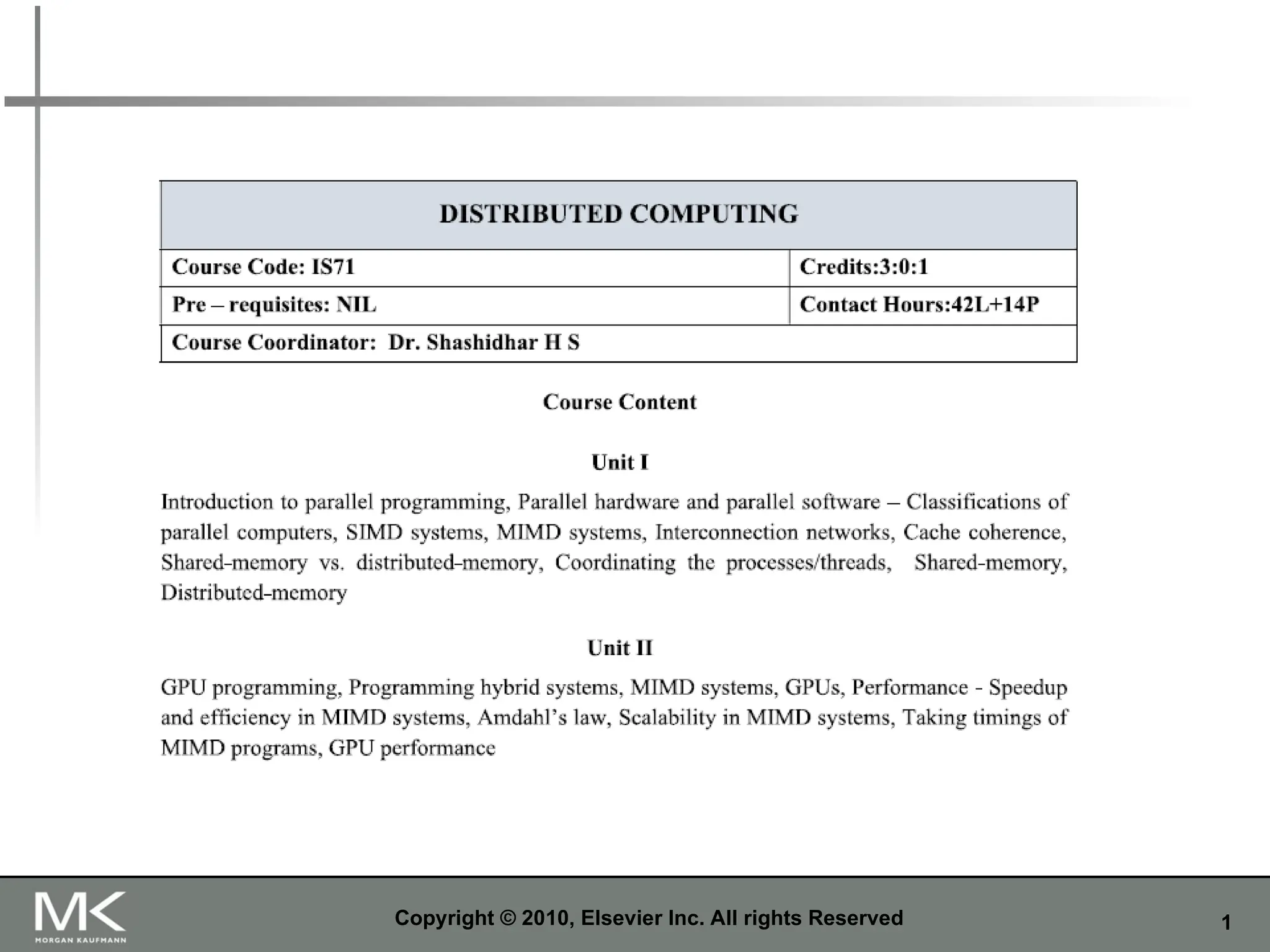
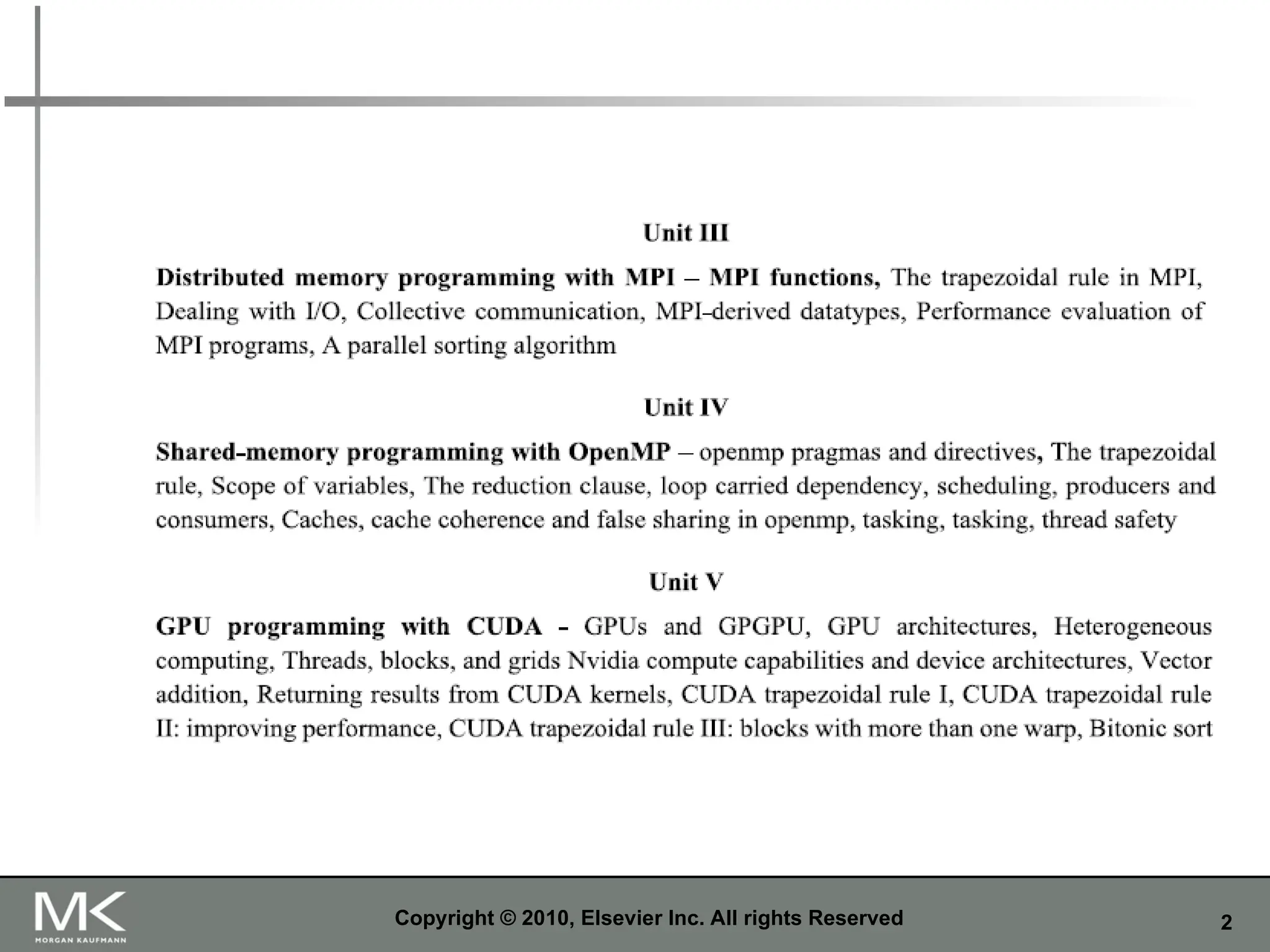
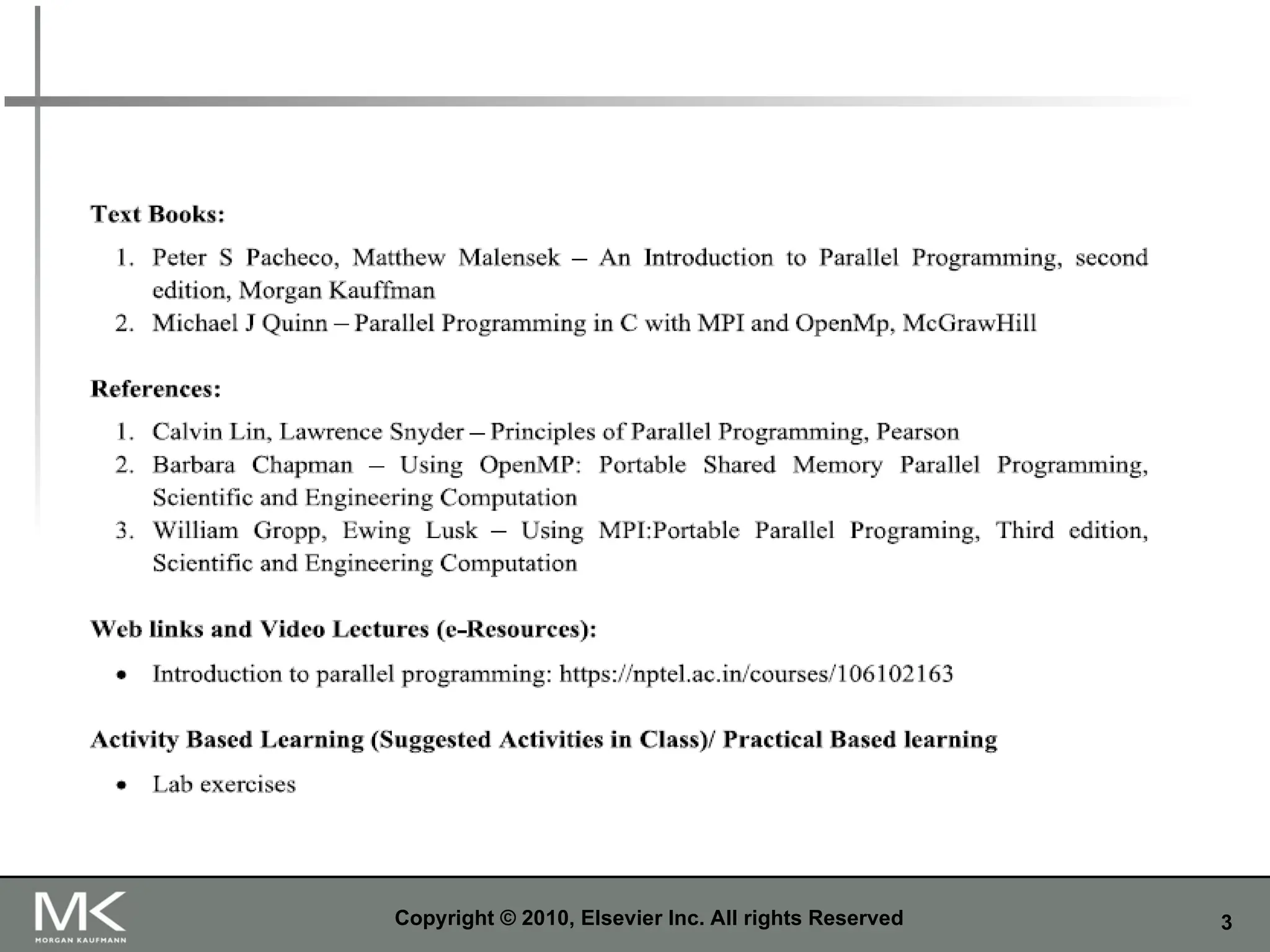
1
Copyright © 2010, Elsevier Inc. All rights Reserved
2
Copyright © 2010, Elsevier Inc. All rights Reserved
3
Copyright © 2010, Elsevier Inc. All rights Reserved
4
#
Chapter
Subtitle
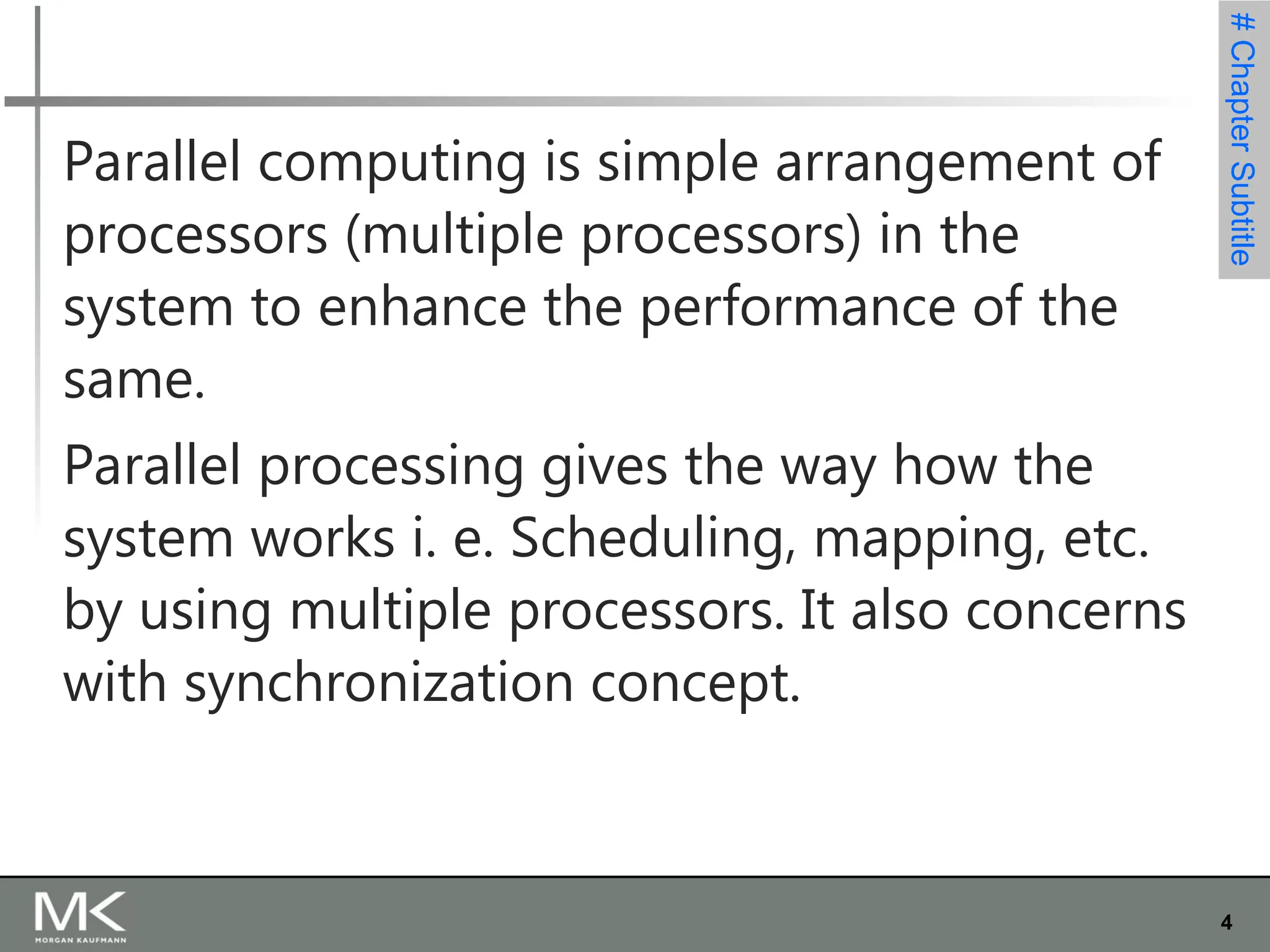
Parallel computing is simple arrangement of
processors (multiple processors) in the
system to enhance the performance of the
same.
Parallel processing gives the way how the
system works i. e. Scheduling, mapping, etc.
by using multiple processors. It also concerns
with synchronization concept.
5
#
Chapter
Subtitle
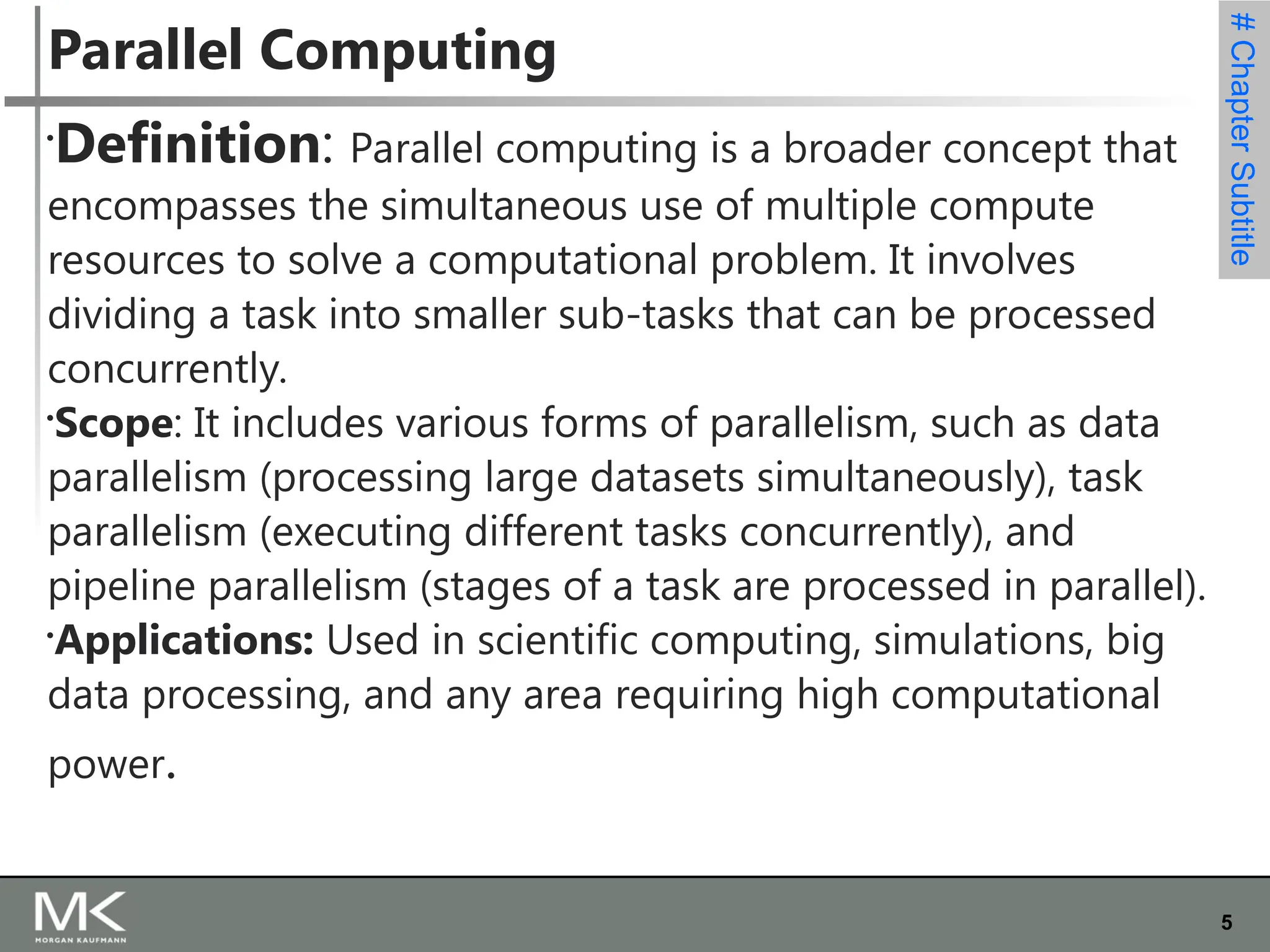
Parallel Computing

Definition: Parallel computing is a broader concept that
encompasses the simultaneous use of multiple compute
resources to solve a computational problem. It involves
dividing a task into smaller sub-tasks that can be processed
concurrently.

Scope: It includes various forms of parallelism, such as data
parallelism (processing large datasets simultaneously), task
parallelism (executing different tasks concurrently), and
pipeline parallelism (stages of a task are processed in parallel).

Applications: Used in scientific computing, simulations, big
data processing, and any area requiring high computational
power.
6
#
Chapter
Subtitle
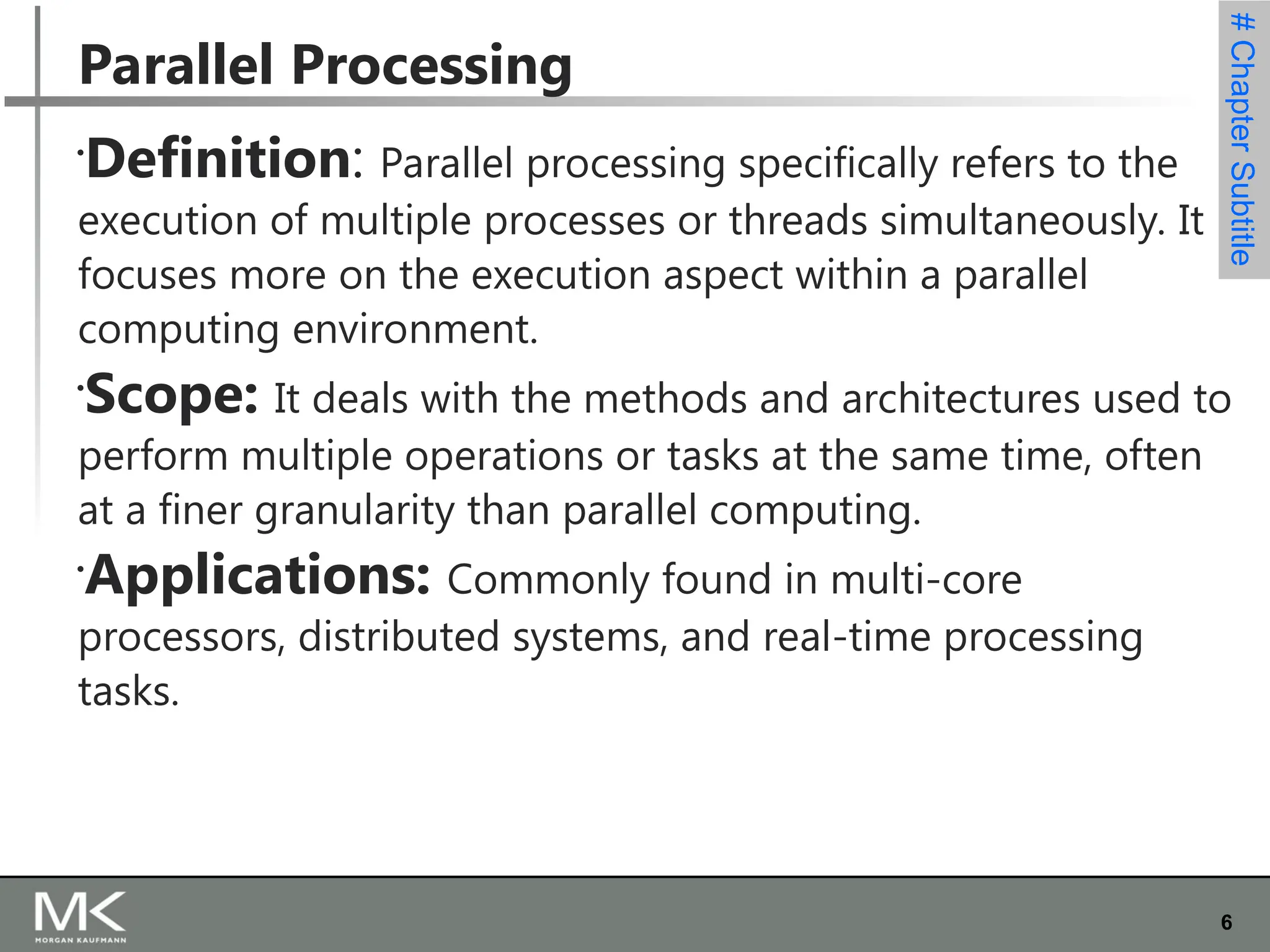
Parallel Processing

Definition: Parallel processing specifically refers to the
execution of multiple processes or threads simultaneously. It
focuses more on the execution aspect within a parallel
computing environment.

Scope: It deals with the methods and architectures used to
perform multiple operations or tasks at the same time, often
at a finer granularity than parallel computing.

Applications: Commonly found in multi-core
processors, distributed systems, and real-time processing
tasks.
7
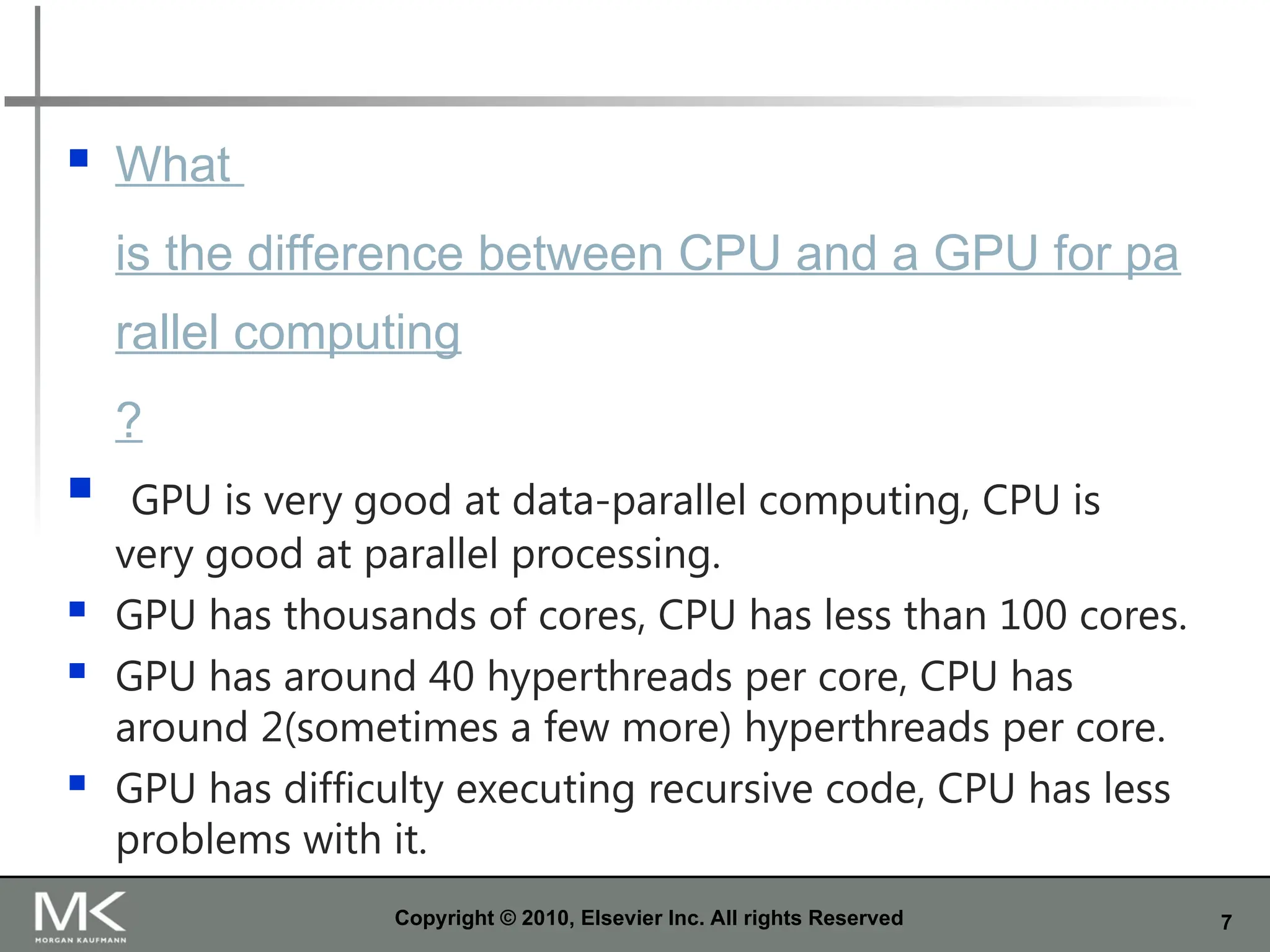
 What
is the difference between CPU and a GPU for pa
rallel computing
?
 GPU is very good at data-parallel computing, CPU is
very good at parallel processing.
 GPU has thousands of cores, CPU has less than 100 cores.
 GPU has around 40 hyperthreads per core, CPU has
around 2(sometimes a few more) hyperthreads per core.
 GPU has difficulty executing recursive code, CPU has less
problems with it.
Copyright © 2010, Elsevier Inc. All rights Reserved
8
Copyright © 2010, Elsevier Inc. All rights Reserved
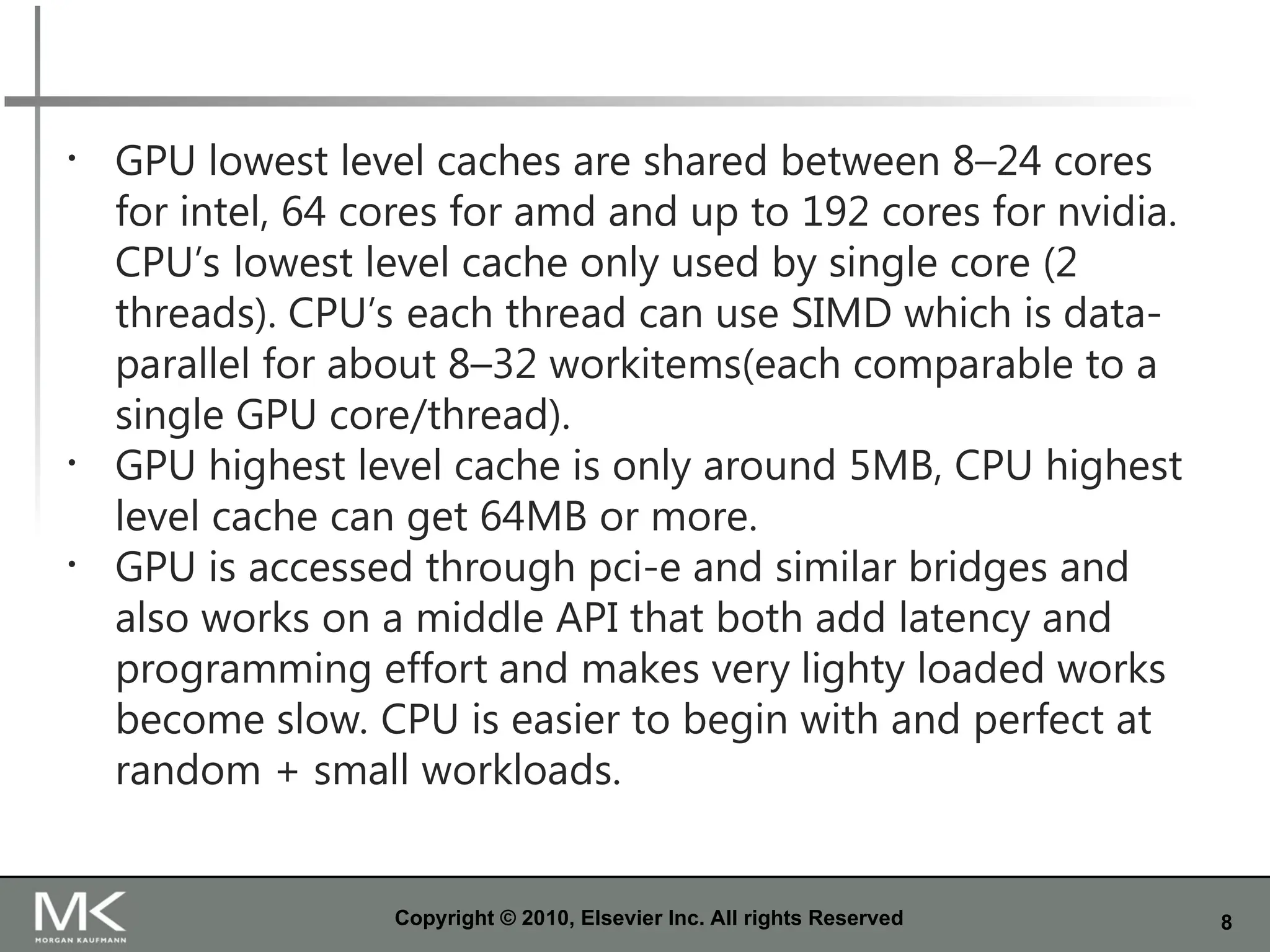
• GPU lowest level caches are shared between 8–24 cores
for intel, 64 cores for amd and up to 192 cores for nvidia.
CPU’s lowest level cache only used by single core (2
threads). CPU’s each thread can use SIMD which is data-
parallel for about 8–32 workitems(each comparable to a
single GPU core/thread).
• GPU highest level cache is only around 5MB, CPU highest
level cache can get 64MB or more.
• GPU is accessed through pci-e and similar bridges and
also works on a middle API that both add latency and
programming effort and makes very lighty loaded works
become slow. CPU is easier to begin with and perfect at
random + small workloads.
9
Copyright © 2010, Elsevier Inc. All rights Reserved
• GPU has considerably higher compute per electricity energy
than CPU.
• GPU is for high throughput, CPU is for low latency.
• Integrated GPUs still use internal pci-e connection to get
commands from CPU but gets data from RAM directly so
there is still some added latency in there.
• With APIs like CUDA/OpenCL, GPU has addressable local
memories and registers that are much faster than lowest
level caches. This makes inter-core communication easier in
coding. Even number of available(and addressable like an
array) private registers per core is much higher than that of a
CPU. (256 vs 32)
• GPU’s single core is very lightweight compared to a single
CPU core. 1 CPU core has 8–16 such pipelines while 1 GPU
“SM/CU” has 64/128/192 pipelines and should be called a
“core”.
10
Threads
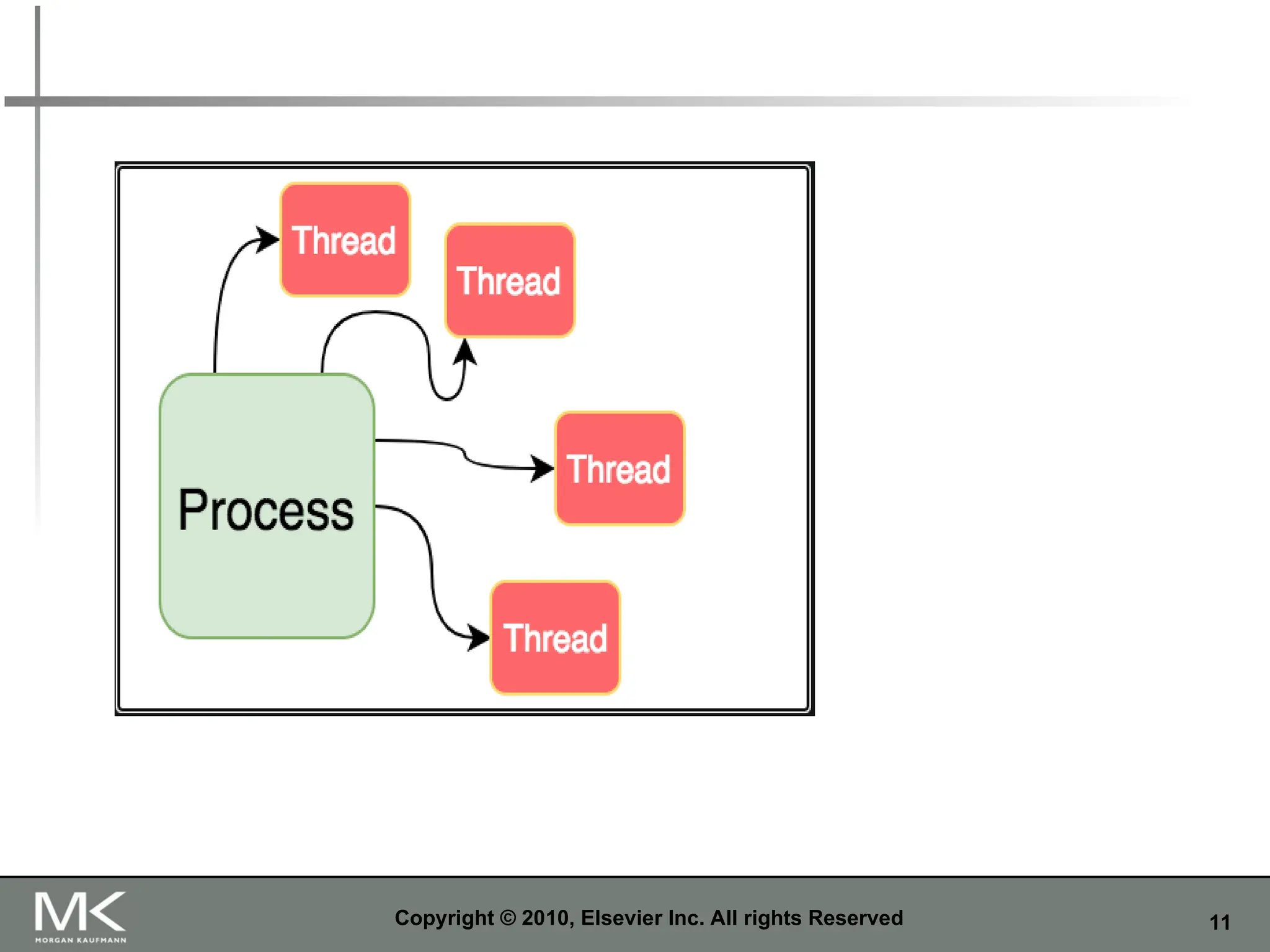
 Threads are contained within processes.
 They allow programmers to divide their
programs into (more or less) independent
tasks.
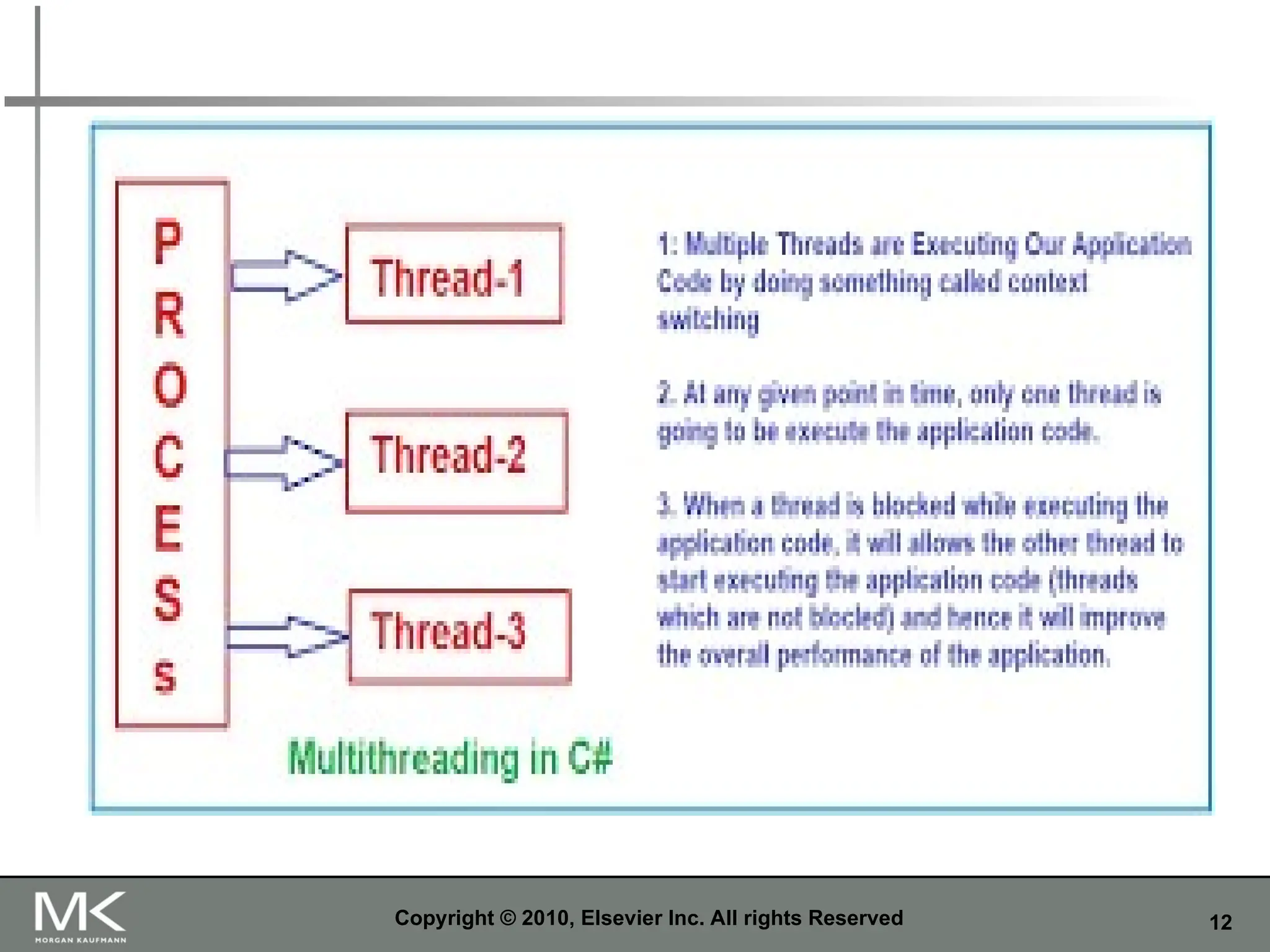
 The hope is that when one thread blocks
because it is waiting on a resource,
another will have work to do and can run.
Copyright © 2010, Elsevier Inc. All rights Reserved
11
Copyright © 2010, Elsevier Inc. All rights Reserved
12
Copyright © 2010, Elsevier Inc. All rights Reserved
13
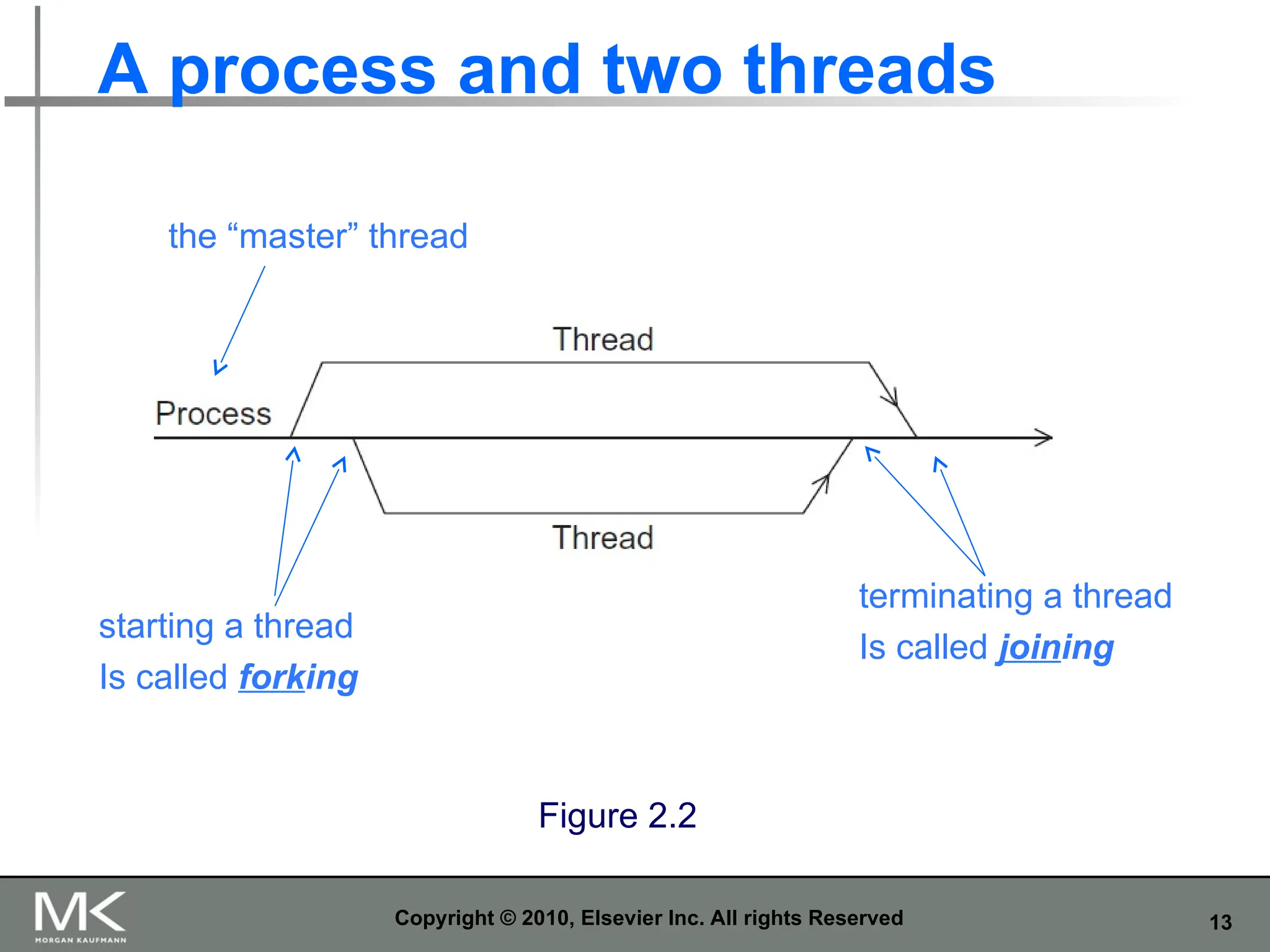
A process and two threads
Copyright © 2010, Elsevier Inc. All rights Reserved
Figure 2.2
the “master” thread
starting a thread
Is called forking
terminating a thread
Is called joining
14
#
Chapter
Subtitle
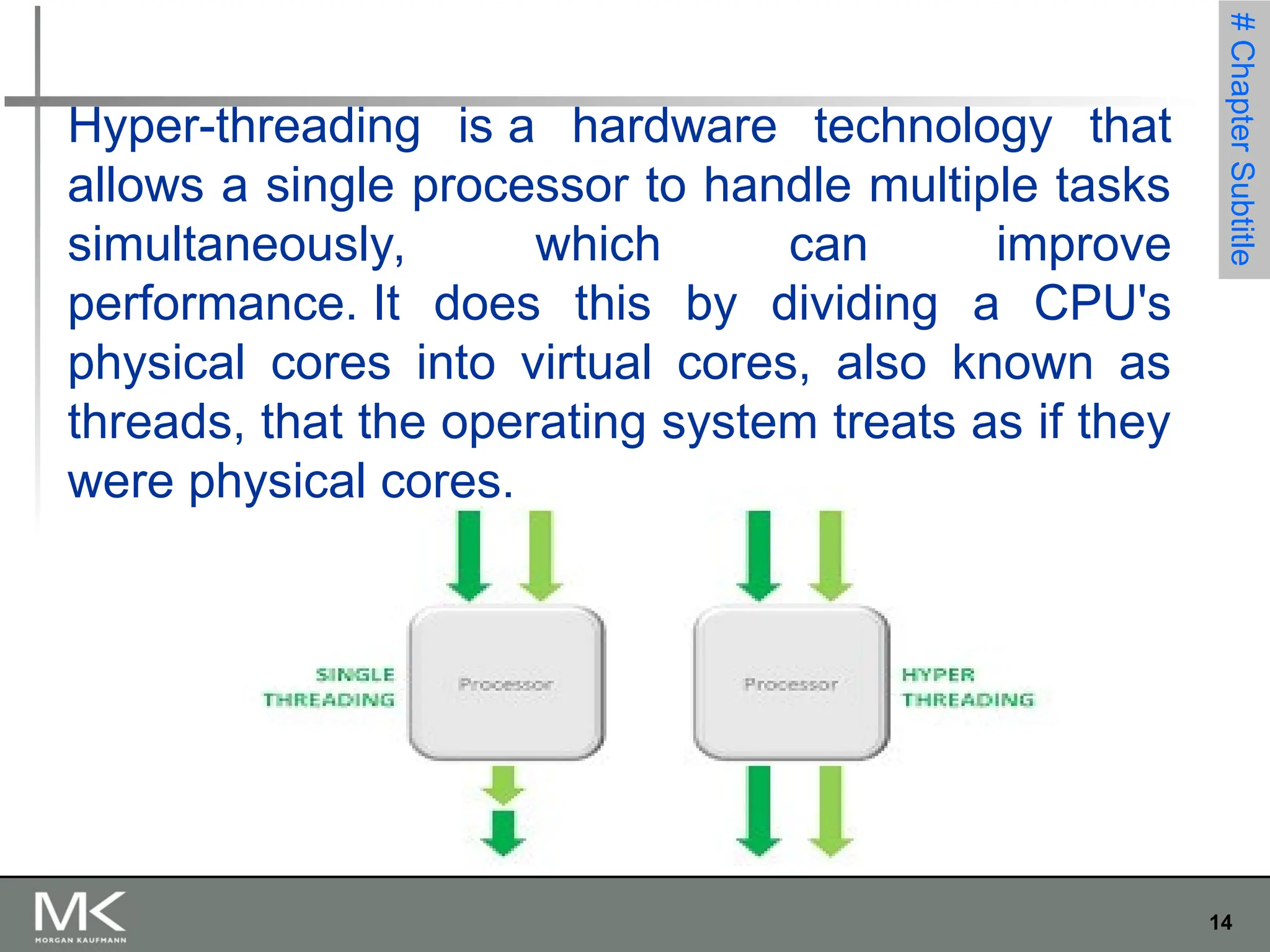
Hyper-threading is a hardware technology that
allows a single processor to handle multiple tasks
simultaneously, which can improve
performance. It does this by dividing a CPU's
physical cores into virtual cores, also known as
threads, that the operating system treats as if they
were physical cores.
15
#
Chapter
Subtitle
Parallelism is the ability to execute multiple tasks
or operations simultaneously, rather than
sequentially. Parallelism can be achieved at
different levels, such as hardware, software, or
network. For example, you can use multiple cores
or processors, threads or processes, or
asynchronous or non-blocking operations to run
parallel tasks.
16
Copyright © 2010, Elsevier Inc. All rights Reserved
•Threads
A programming concept that involves
creating, running, and terminating threads
within a process. Threads share memory
and file handlers.
•Pthreads
A library that provides tools to manage
threads, including functions for creating,
terminating, and joining threads. Pthreads
is an Application Programming Interface
(API) that can be used for shared memory
programming.
17
• One of the main reasons to use parallelism for
API’s(Application Programming Interface) is to
improve the performance and scalability of your
applications.
• By sending and receiving multiple requests and
responses at the same time, you can reduce the
waiting time and increase the throughput of your
applications.
• For example, fetch data from several APIs,
Why use parallelism for APIs?
18
• Another reason to use parallelism for APIs is to
handle complex or dynamic scenarios that require
coordination or synchronization among multiple
APIs.
• For example, Perform a transaction.
This can make your applications more reliable and
consistent.
Why use parallelism for APIs?
19
Changing times
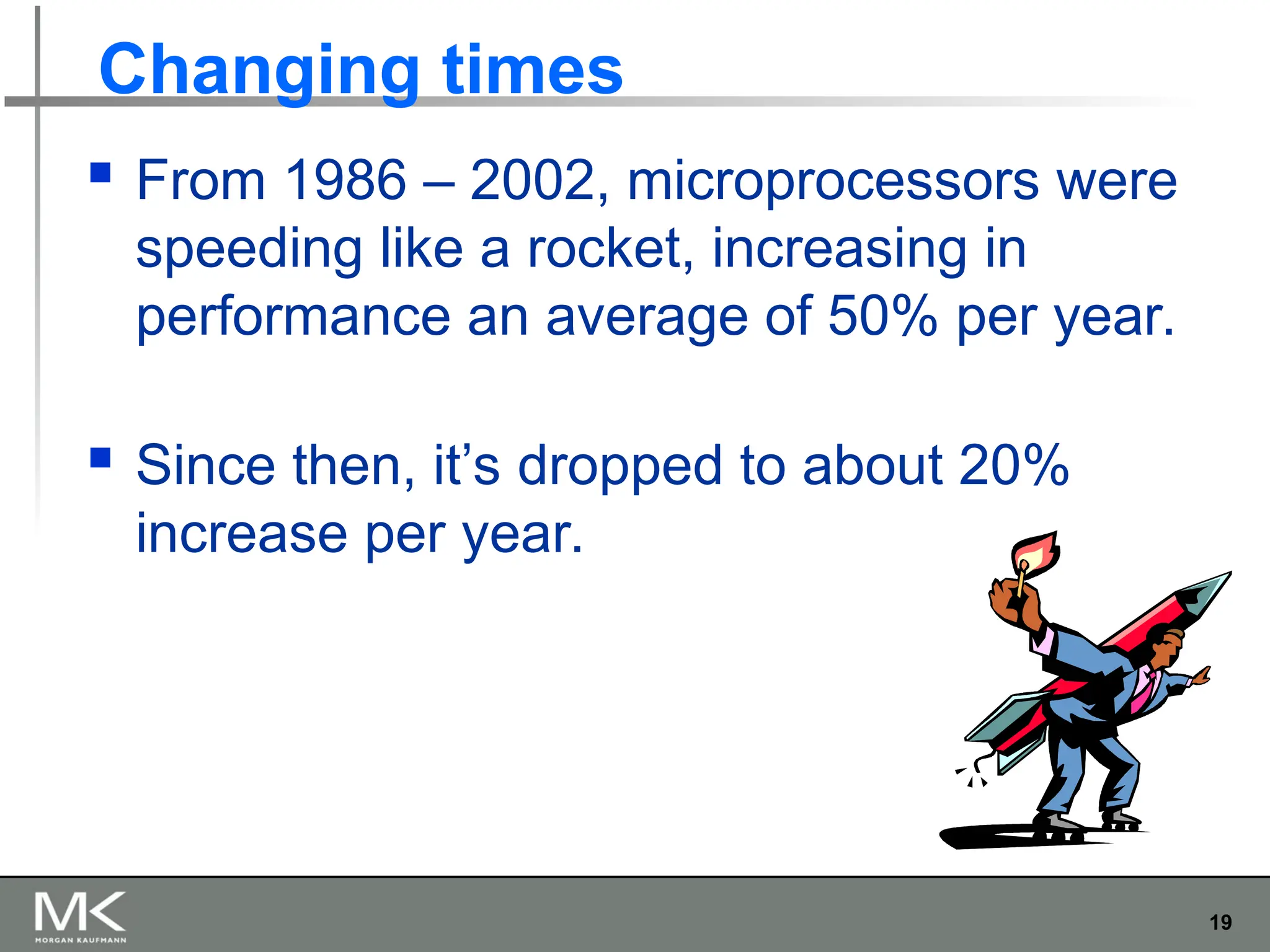
 From 1986 – 2002, microprocessors were
speeding like a rocket, increasing in
performance an average of 50% per year.
 Since then, it’s dropped to about 20%
increase per year.
20
An intelligent solution
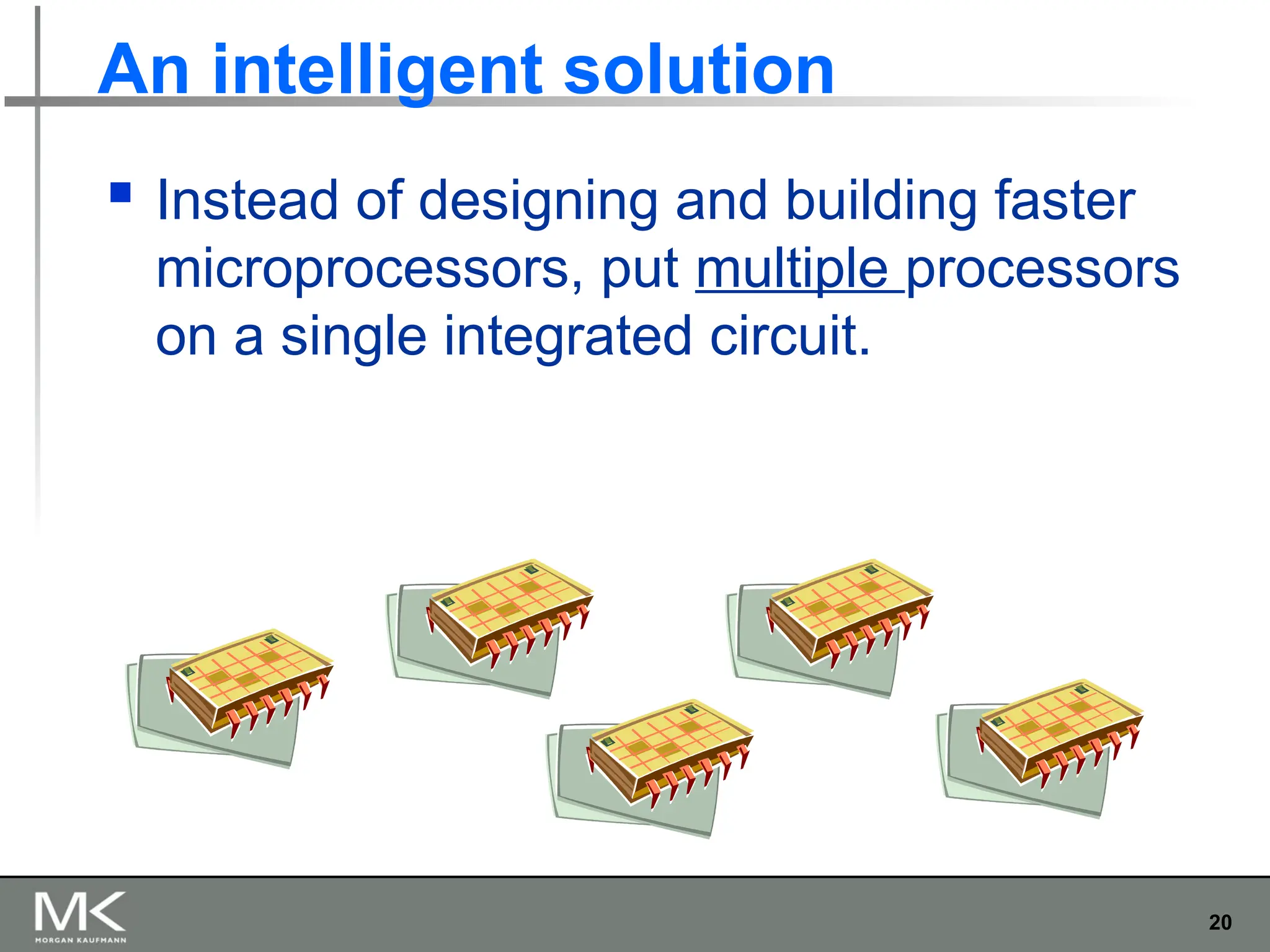
 Instead of designing and building faster
microprocessors, put multiple processors
on a single integrated circuit.
21
Now it’s up to the programmers
 Adding more processors doesn’t help
much if programmers aren’t aware of
them…
 … or don’t know how to use them.
 Serial programs don’t benefit from this
approach (in most cases).
22
Why we need ever-increasing
performance
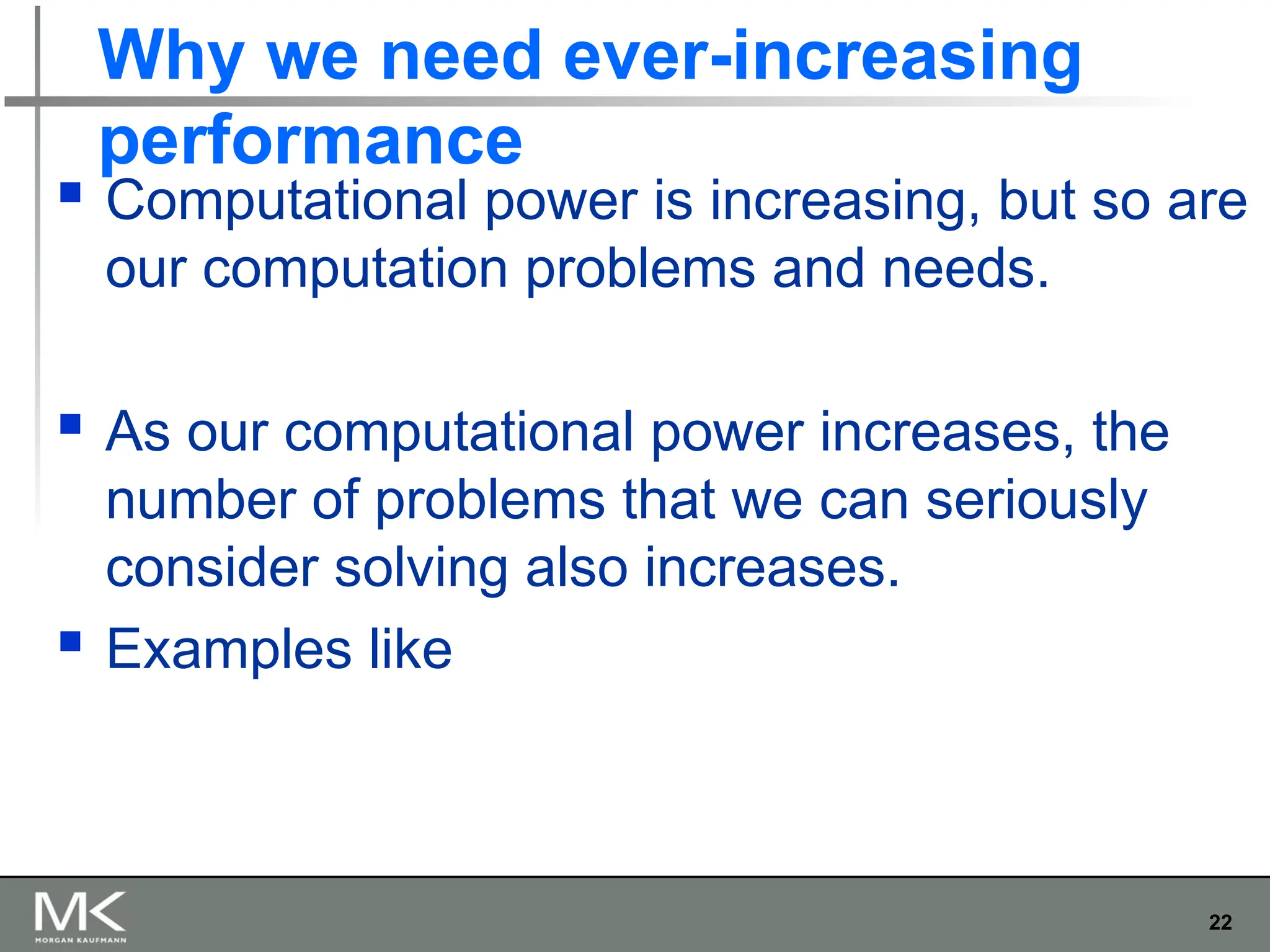
 Computational power is increasing, but so are
our computation problems and needs.
 As our computational power increases, the
number of problems that we can seriously
consider solving also increases.
 Examples like
23
Climate modeling
In order to better understand climate change, we
need far more accurate computer models, models
that include interactions between the atmosphere, the
oceans, solid land, and the ice caps at the poles.
24
Protein folding
It’s believed that misfolded proteins may be involved in dis
eases such as Huntington’s, Parkinson’s, and Alzheimer’s,
but our ability to study configurations of complex molecules
such as proteins is severely limited by our current
computational power.
25
Drug discovery
There are many drugs that are effective in treating a relatively
small fraction of those suffering from some disease. It’s
possible that we can devise alternative treatments by careful
analysis of the genomes of the individuals for whom the known
treatment is ineffective. This, however, will involve extensive
computational analysis of genomes.
26
Energy research
Increased computational power will make it possible to
program much more detailed models of technologies such
as wind turbines, solar cells, and batteries. These programs
may provide the information needed to construct far more
efficient clean energy sources.
27
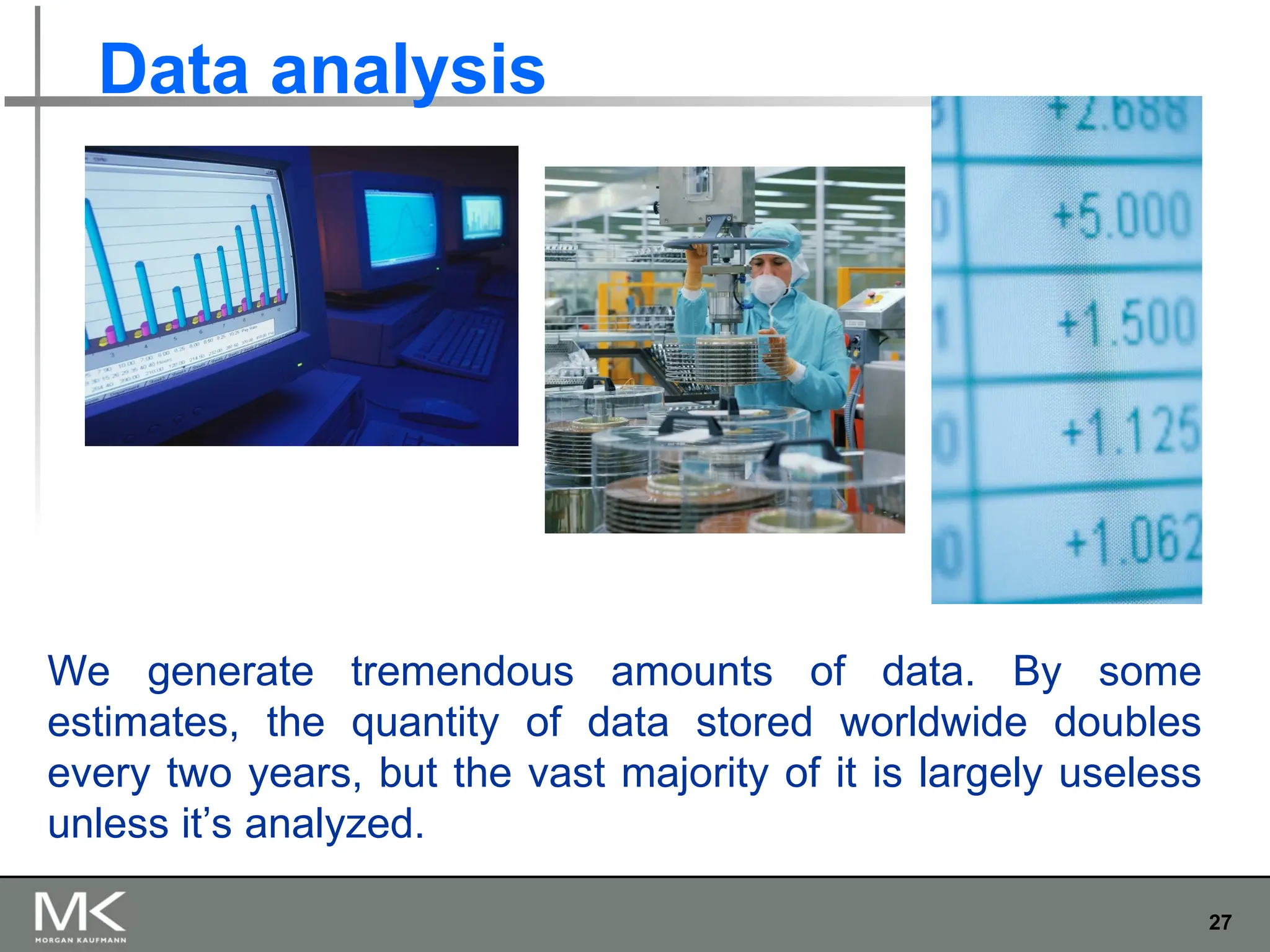
Data analysis
We generate tremendous amounts of data. By some
estimates, the quantity of data stored worldwide doubles
every two years, but the vast majority of it is largely useless
unless it’s analyzed.
28
Why we’re building parallel
systems
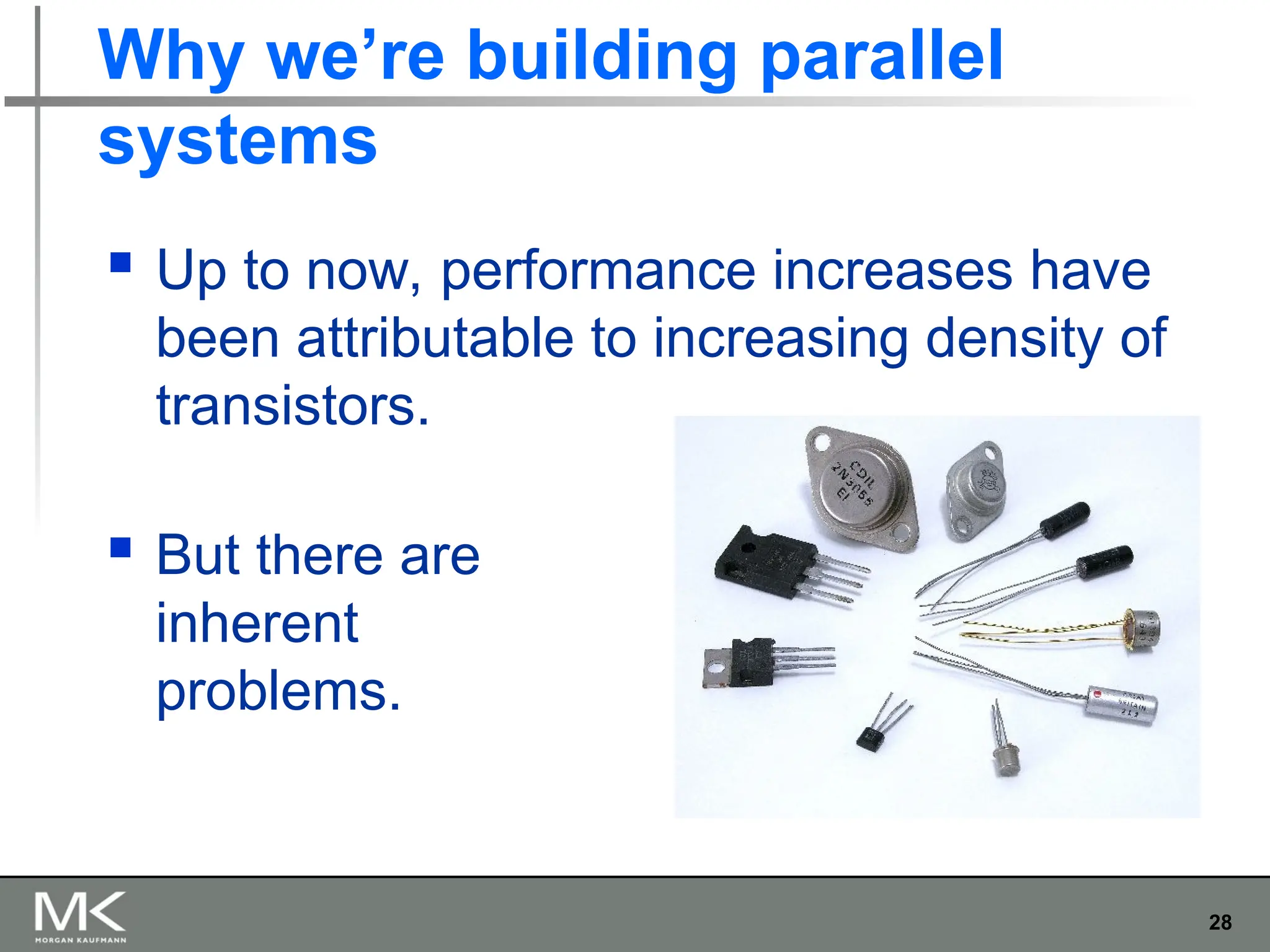
 Up to now, performance increases have
been attributable to increasing density of
transistors.
 But there are
inherent
problems.
29
A little physics lesson
 Smaller transistors = faster processors.
 Faster processors = increased power
consumption.
 Increased power consumption = increased
heat.
 Increased heat = unreliable processors.
30
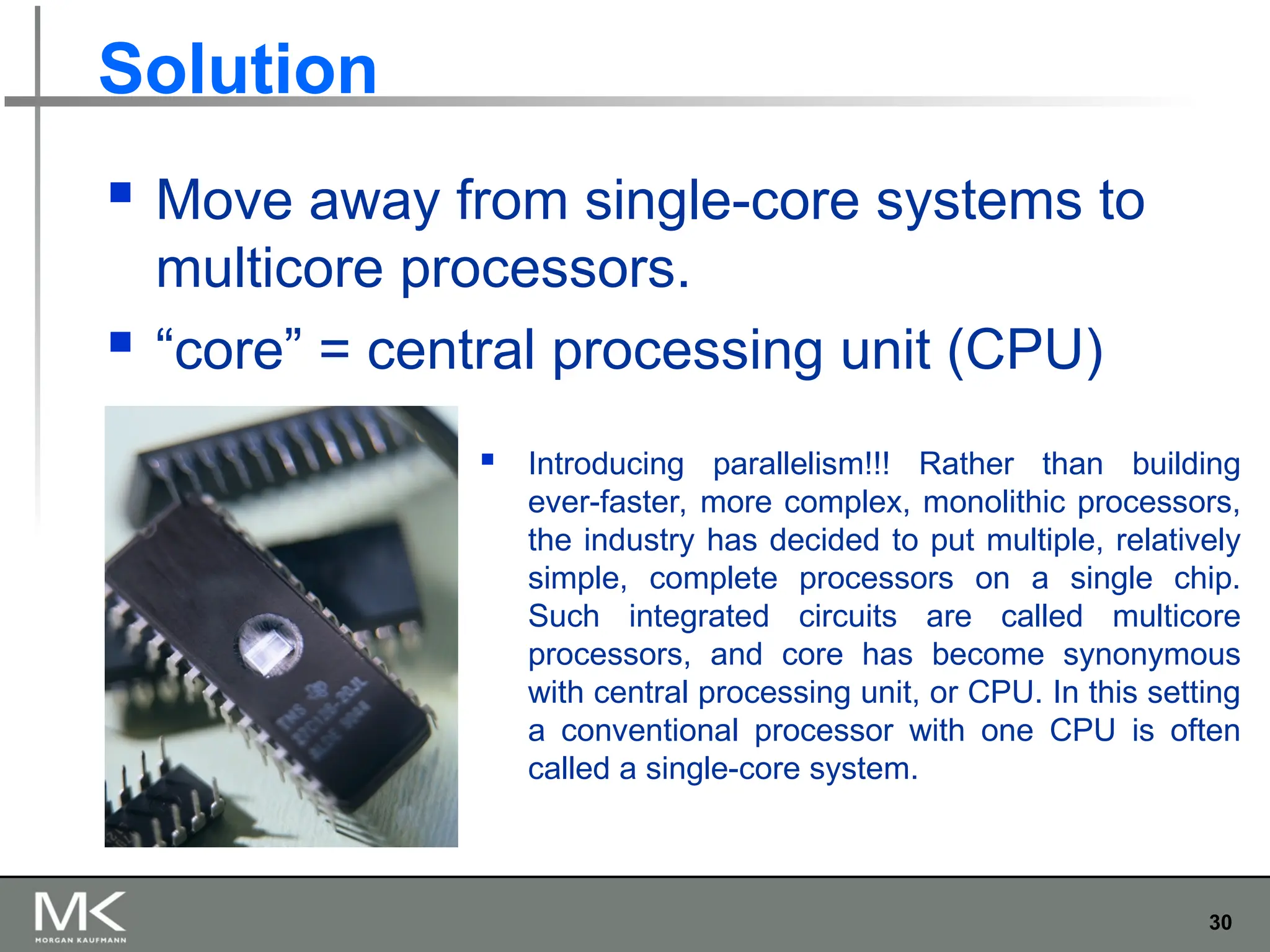
Solution
 Move away from single-core systems to
multicore processors.
 “core” = central processing unit (CPU)
 Introducing parallelism!!! Rather than building
ever-faster, more complex, monolithic processors,
the industry has decided to put multiple, relatively
simple, complete processors on a single chip.
Such integrated circuits are called multicore
processors, and core has become synonymous
with central processing unit, or CPU. In this setting
a conventional processor with one CPU is often
called a single-core system.
31
Why we need to write parallel
programs
 Running multiple instances of a serial
program often isn’t very useful.
 Think of running multiple instances of your
favorite game.
 What you really want is for
it to run faster.
32
Approaches to the serial problem
 Rewrite serial programs so that they’re
parallel.
 Write translation programs that
automatically convert serial programs into
parallel programs.
 This is very difficult to do.
 Success has been limited.
33
More problems
 Some coding constructs can be
recognized by an automatic program
generator, and converted to a parallel
construct.
 However, it’s likely that the result will be a
very inefficient program.
 Sometimes the best parallel solution is to
step back and devise an entirely new
algorithm.
34
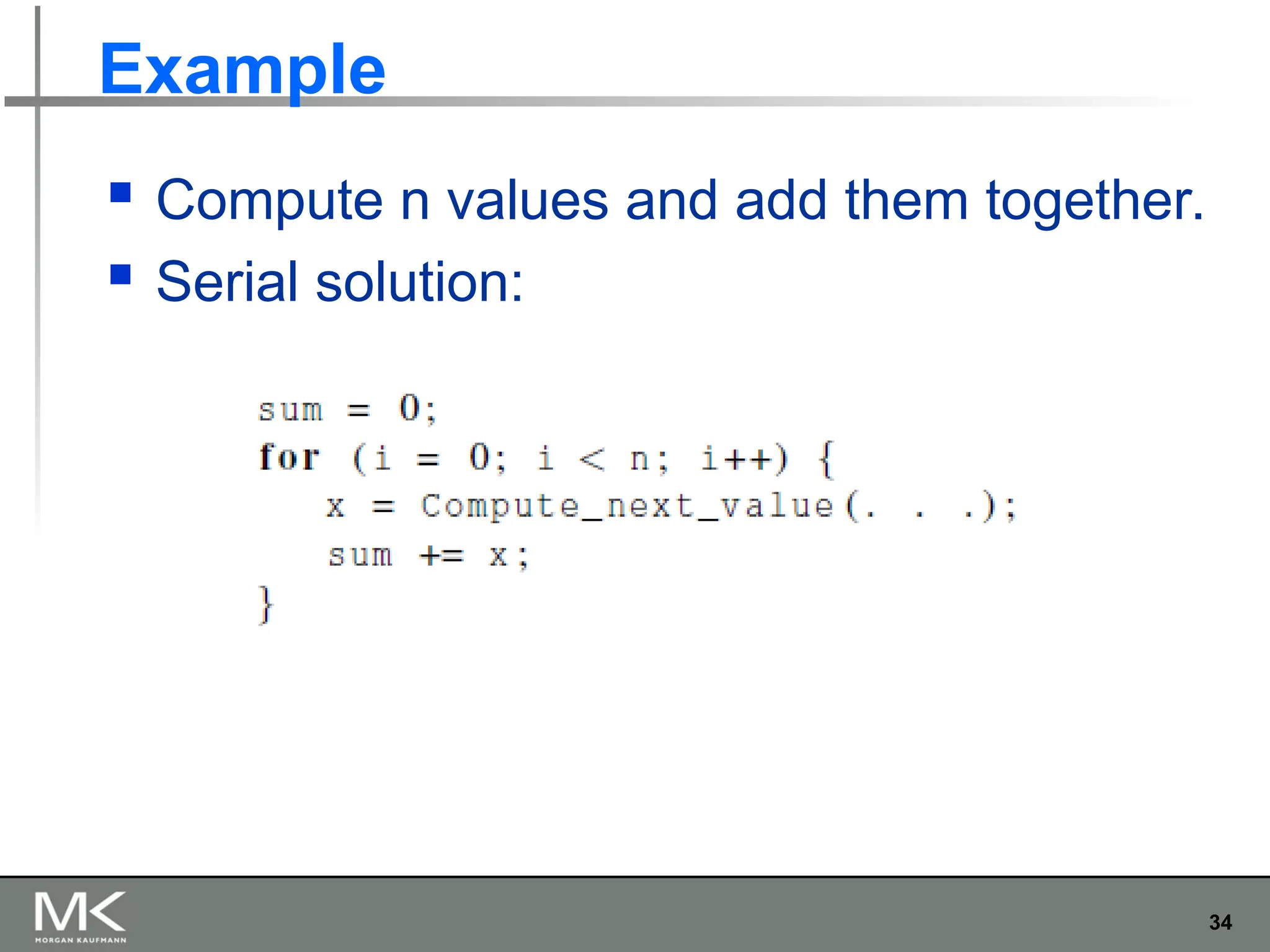
Example
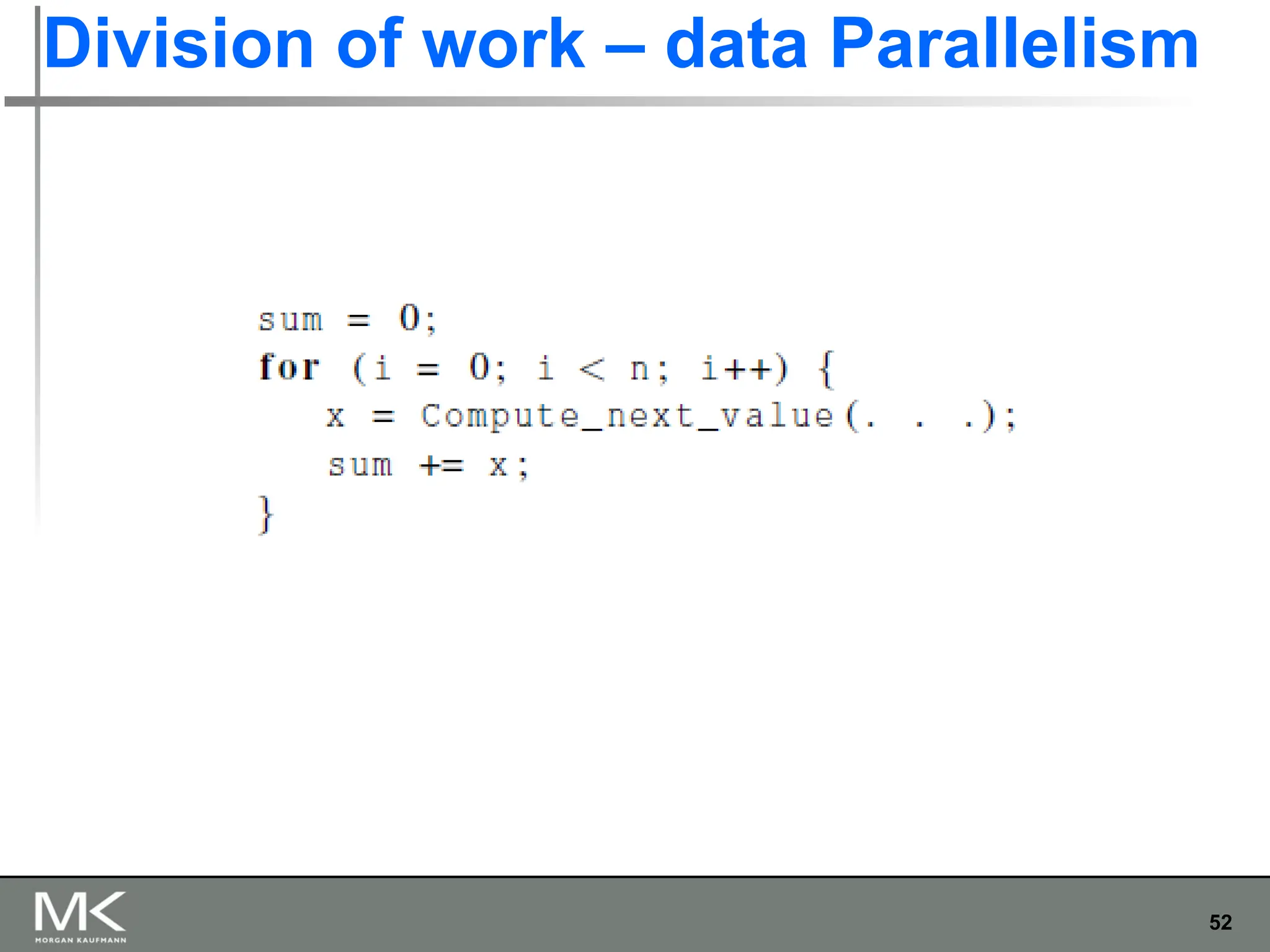
 Compute n values and add them together.
 Serial solution:
35
Example (cont.)
 We have p cores, p much smaller than n.
 Each core performs a partial sum of
approximately n/p values.
Each core uses it’s own private variables
and executes this block of code independently of the other cores.
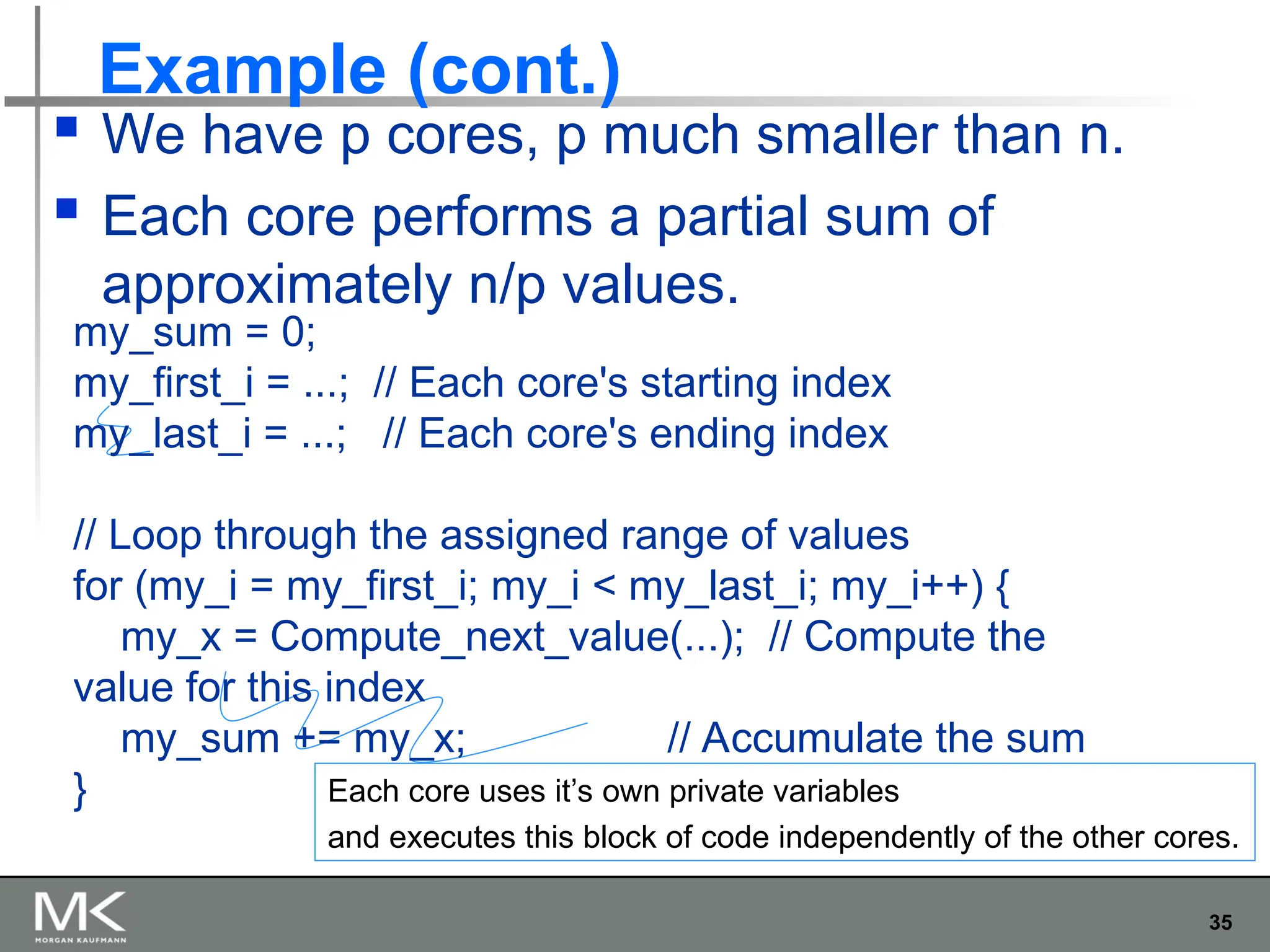
my_sum = 0;
my_first_i = ...; // Each core's starting index
my_last_i = ...; // Each core's ending index
// Loop through the assigned range of values
for (my_i = my_first_i; my_i < my_last_i; my_i++) {
my_x = Compute_next_value(...); // Compute the
value for this index
my_sum += my_x; // Accumulate the sum
}
36
Example (cont.)
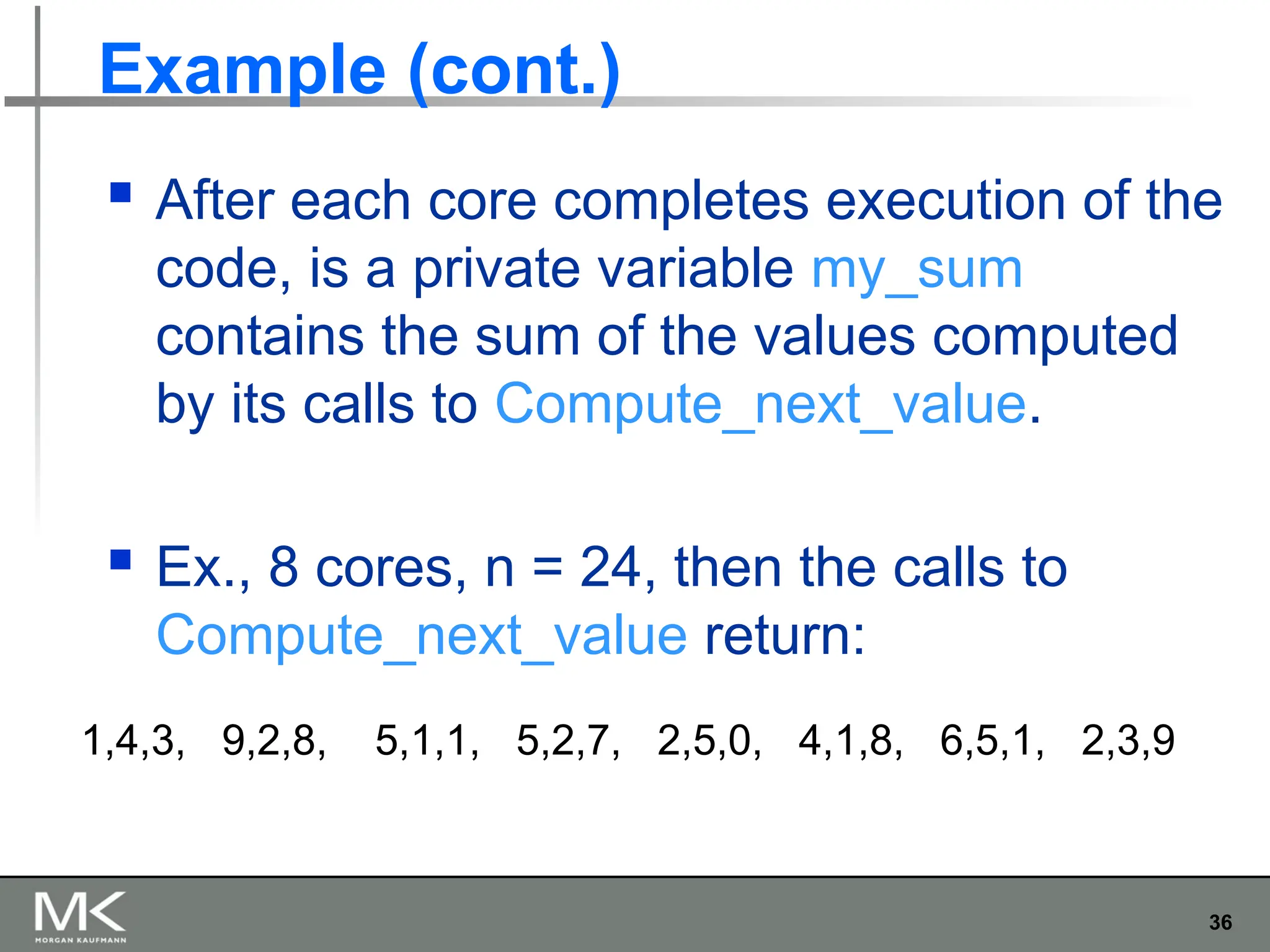
 After each core completes execution of the
code, is a private variable my_sum
contains the sum of the values computed
by its calls to Compute_next_value.
 Ex., 8 cores, n = 24, then the calls to
Compute_next_value return:
1,4,3, 9,2,8, 5,1,1, 5,2,7, 2,5,0, 4,1,8, 6,5,1, 2,3,9
37
Example (cont.)
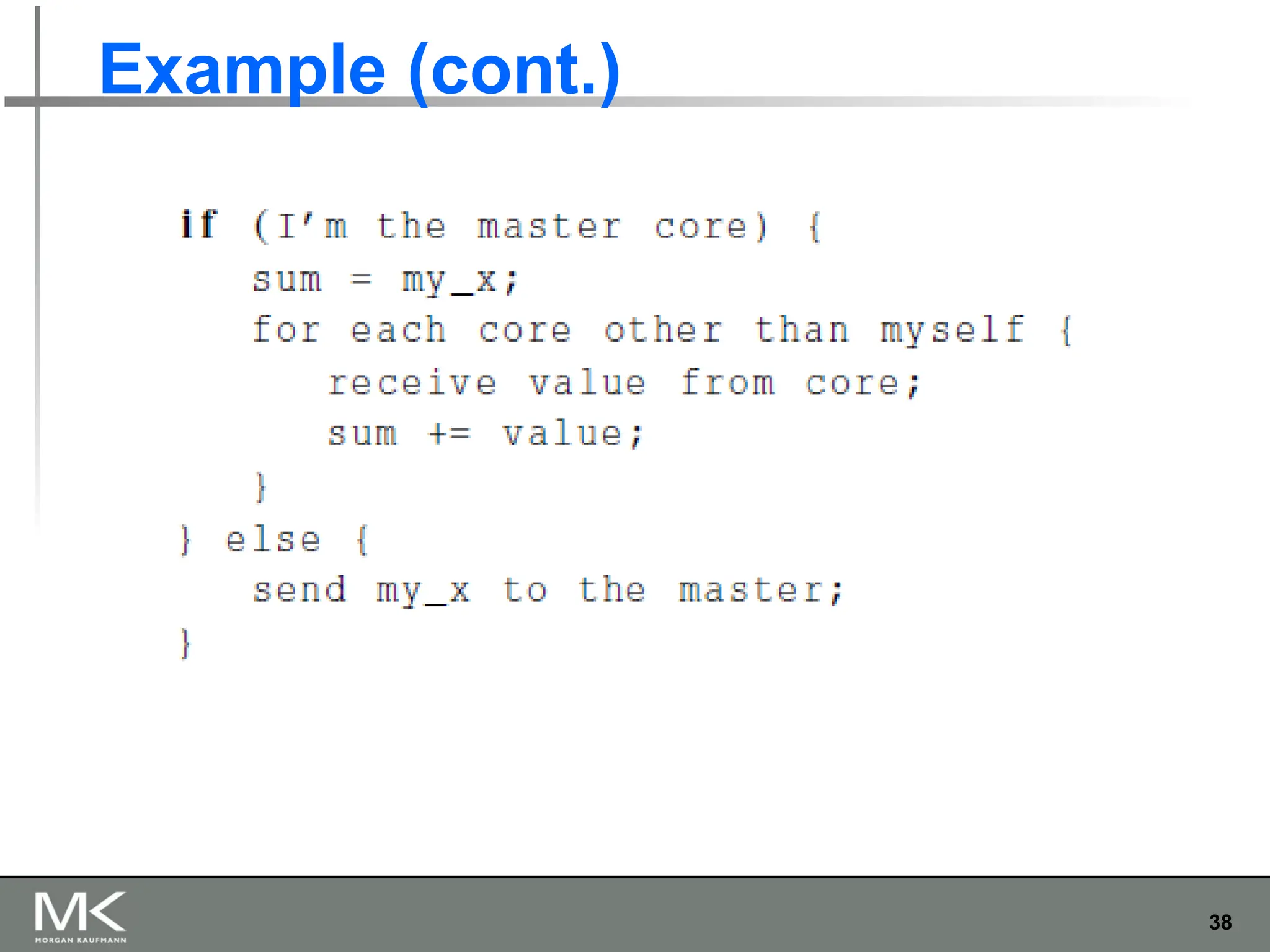
 Once all the cores are done computing
their private my_sum, they form a global
sum by sending results to a designated
“master” core which adds the final result.
38
Example (cont.)
39
Example (cont.)
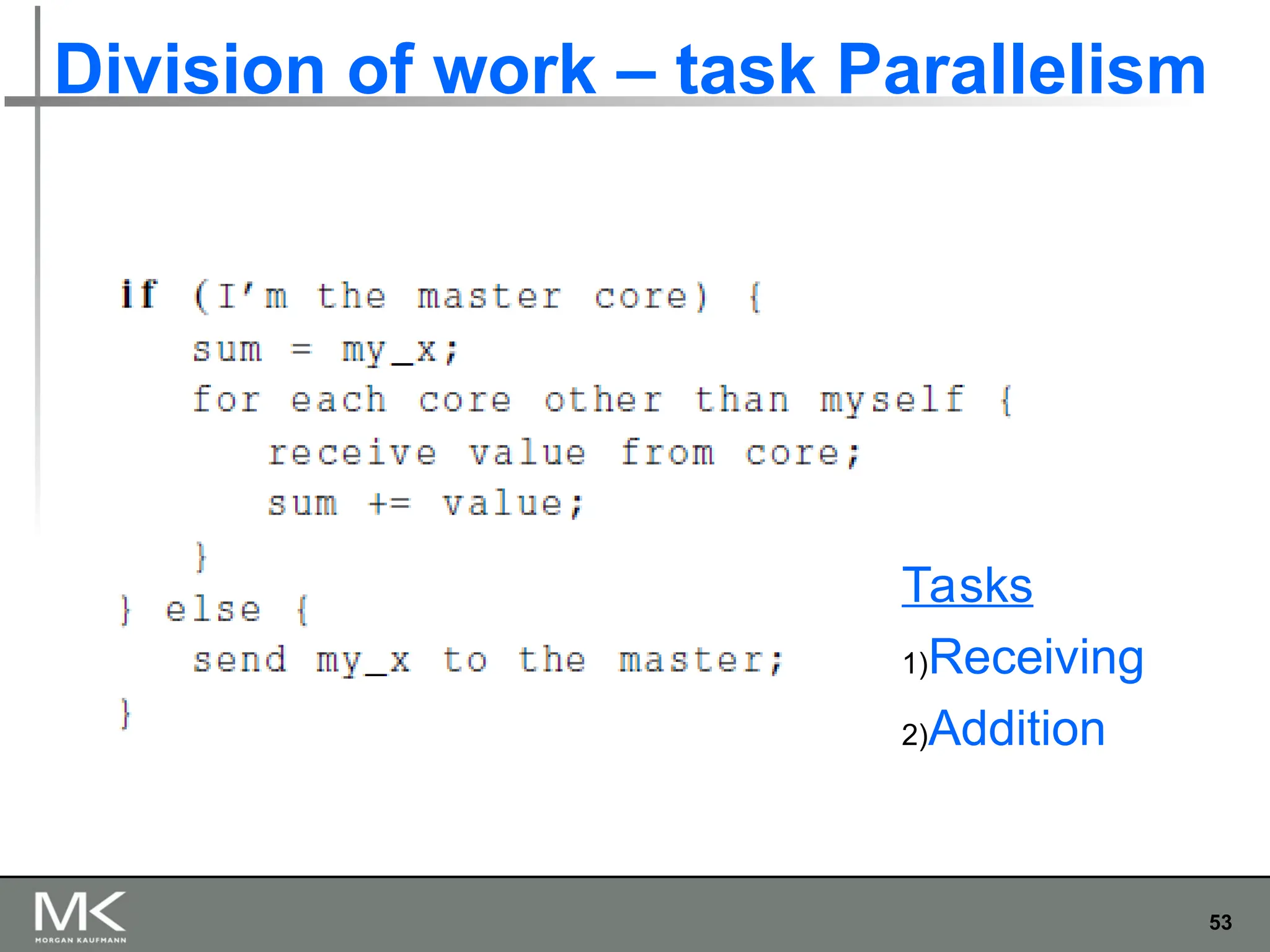
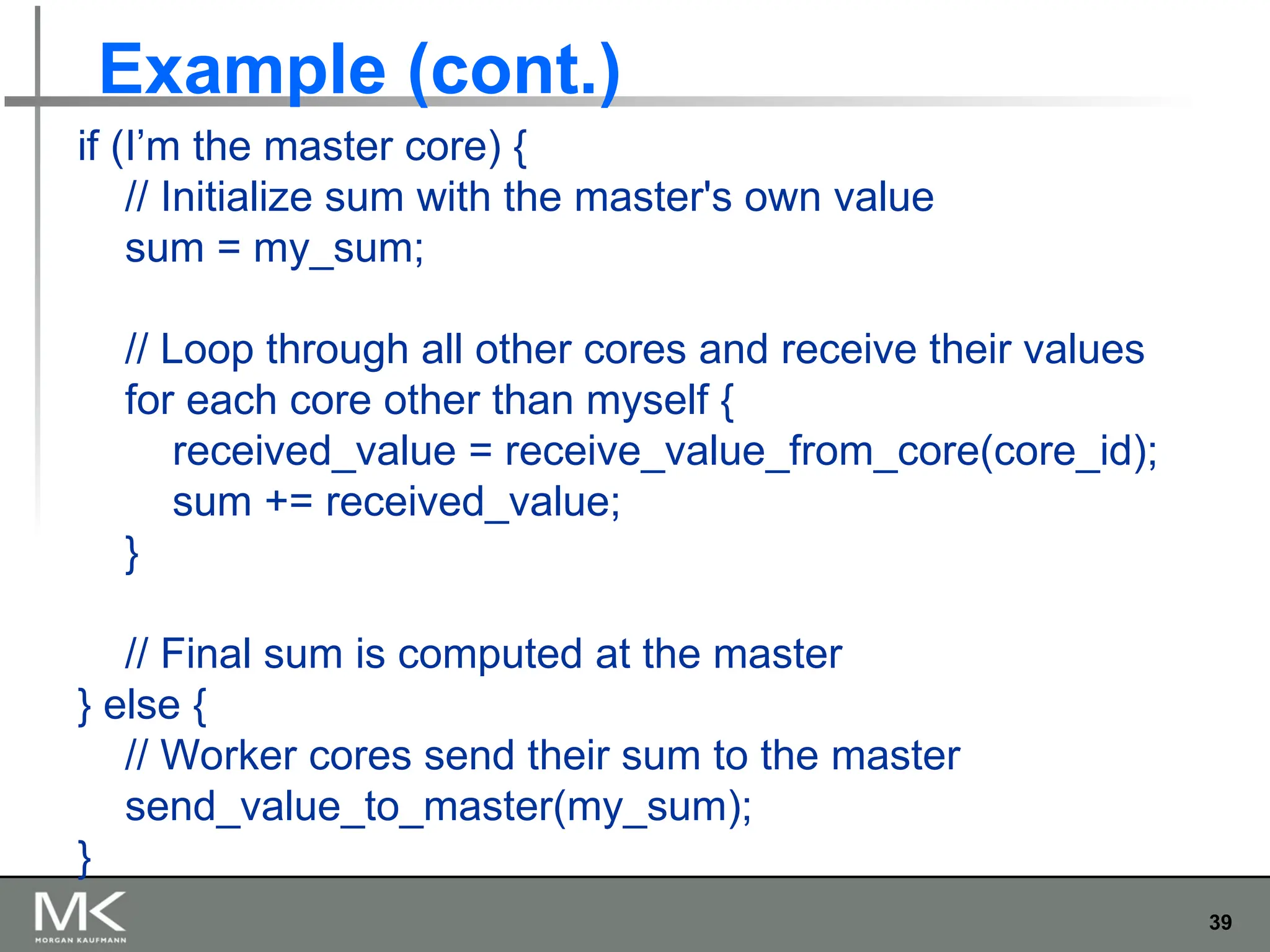
if (I’m the master core) {
// Initialize sum with the master's own value
sum = my_sum;
// Loop through all other cores and receive their values
for each core other than myself {
received_value = receive_value_from_core(core_id);
sum += received_value;
}
// Final sum is computed at the master
} else {
// Worker cores send their sum to the master
send_value_to_master(my_sum);
}
40
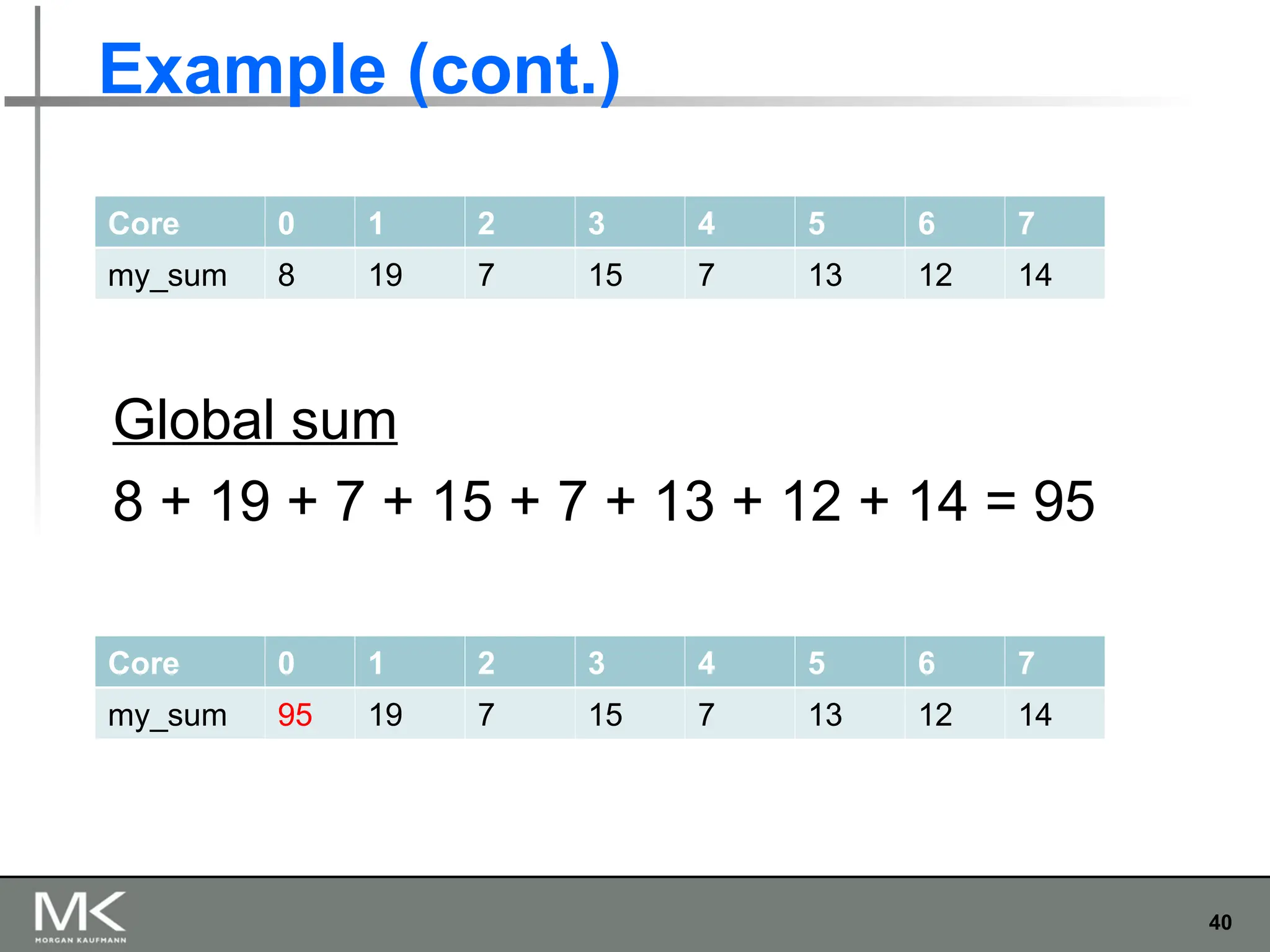
Example (cont.)
Core 0 1 2 3 4 5 6 7
my_sum 8 19 7 15 7 13 12 14
Global sum
8 + 19 + 7 + 15 + 7 + 13 + 12 + 14 = 95
Core 0 1 2 3 4 5 6 7
my_sum 95 19 7 15 7 13 12 14
41
But wait!
There’s a much better way
to compute the global sum.
42
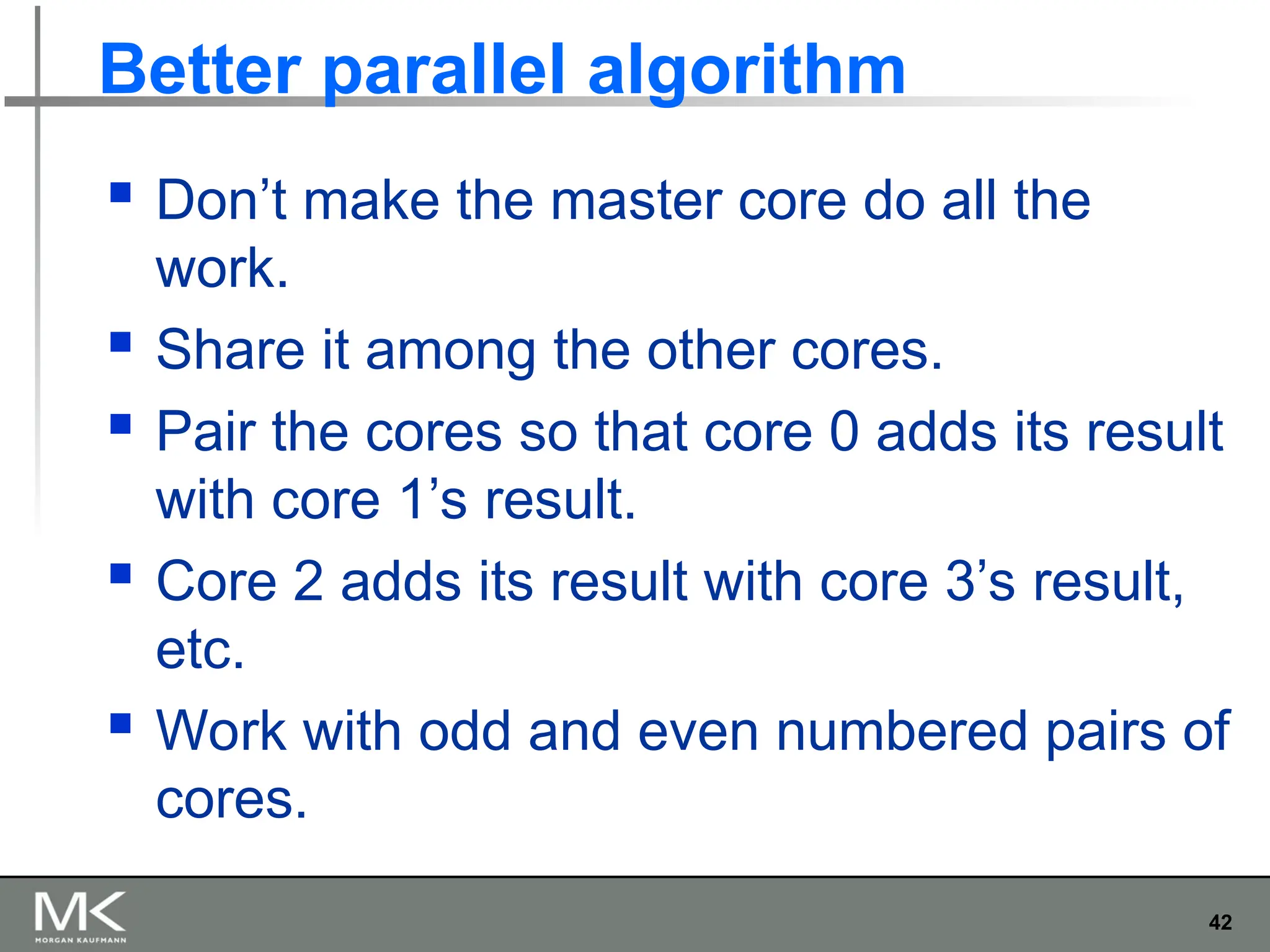
Better parallel algorithm
 Don’t make the master core do all the
work.
 Share it among the other cores.
 Pair the cores so that core 0 adds its result
with core 1’s result.
 Core 2 adds its result with core 3’s result,
etc.
 Work with odd and even numbered pairs of
cores.
43
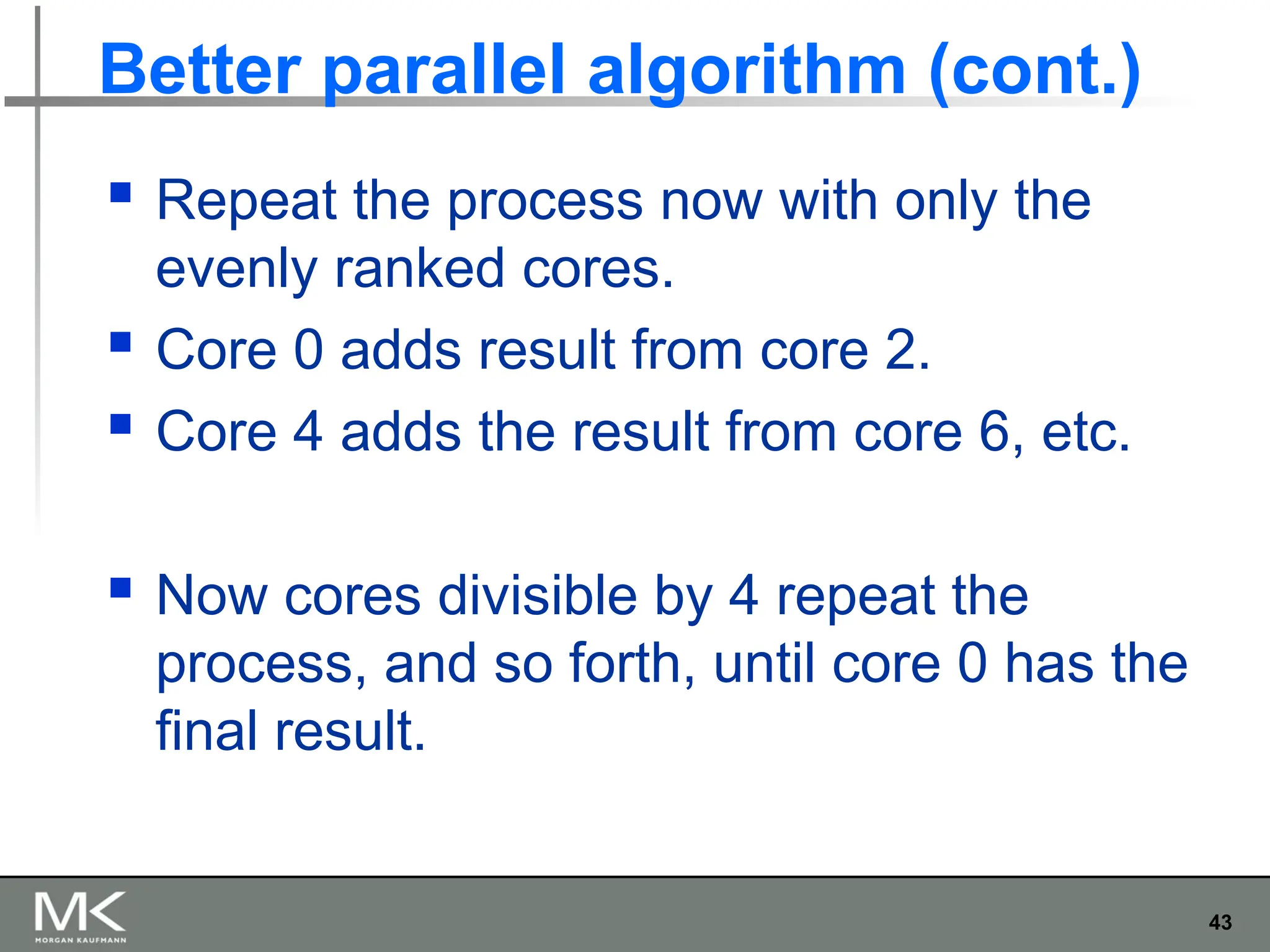
Better parallel algorithm (cont.)
 Repeat the process now with only the
evenly ranked cores.
 Core 0 adds result from core 2.
 Core 4 adds the result from core 6, etc.
 Now cores divisible by 4 repeat the
process, and so forth, until core 0 has the
final result.
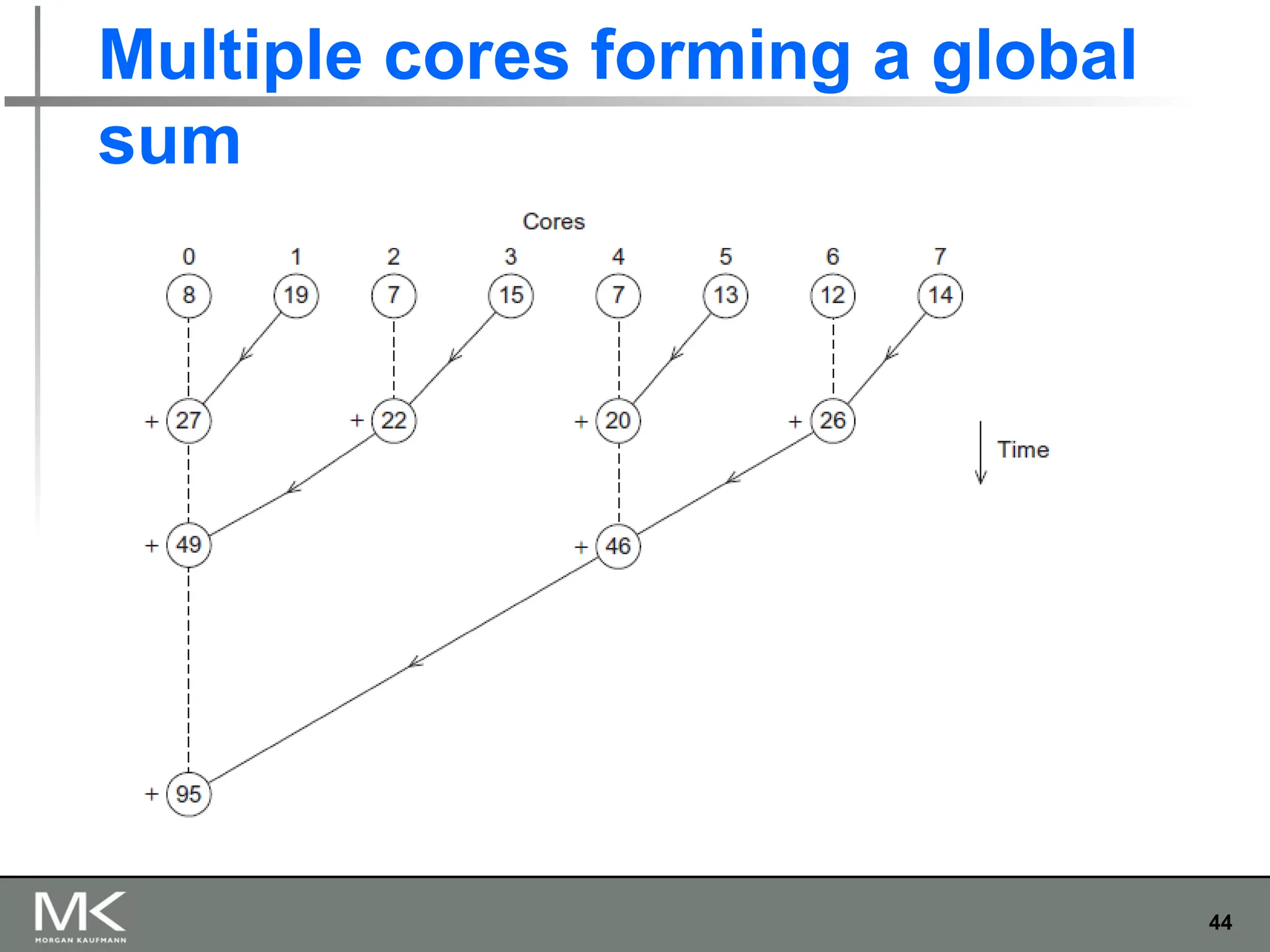
44
Multiple cores forming a global
sum
45
Analysis
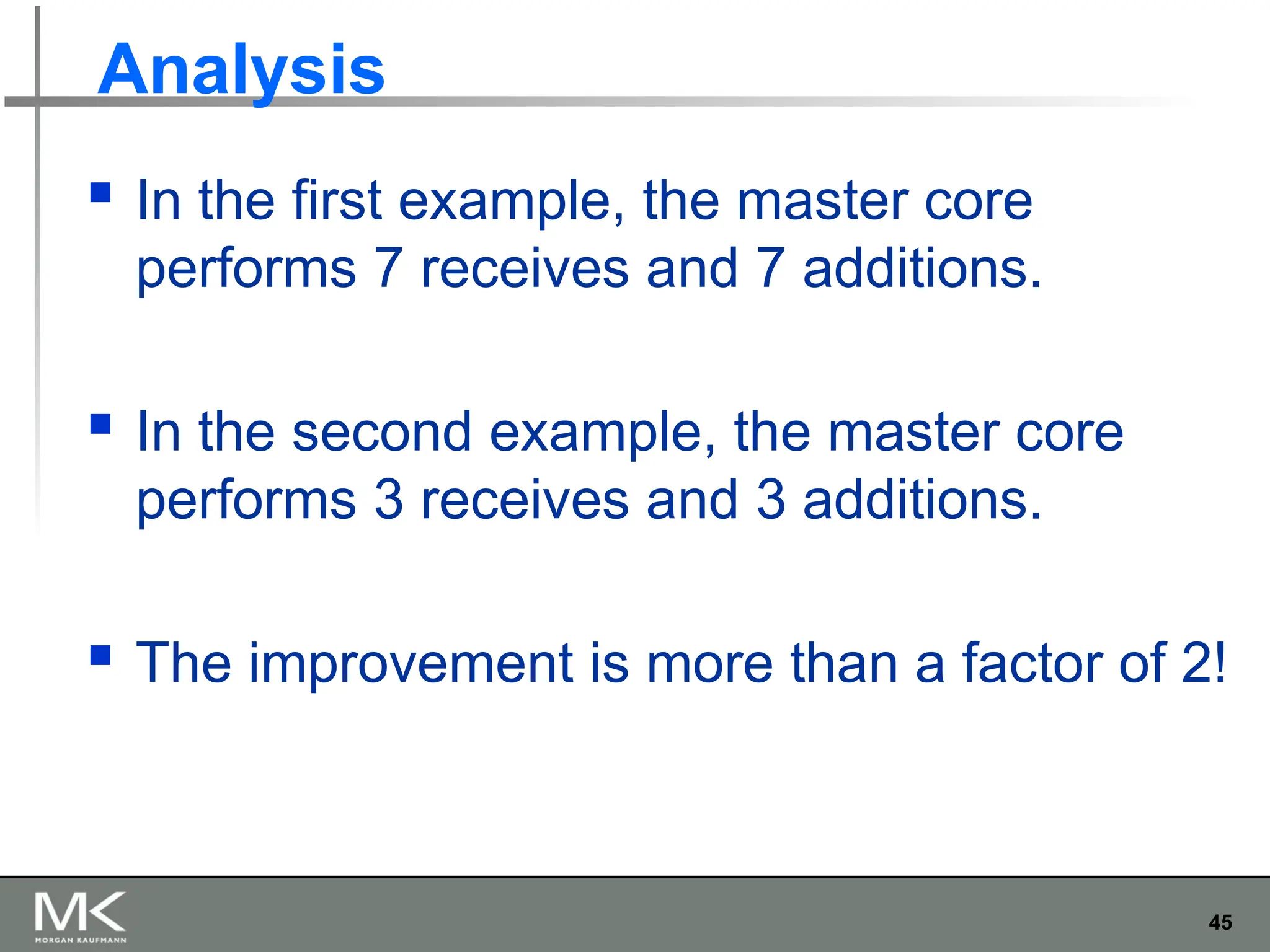
 In the first example, the master core
performs 7 receives and 7 additions.
 In the second example, the master core
performs 3 receives and 3 additions.
 The improvement is more than a factor of 2!
46
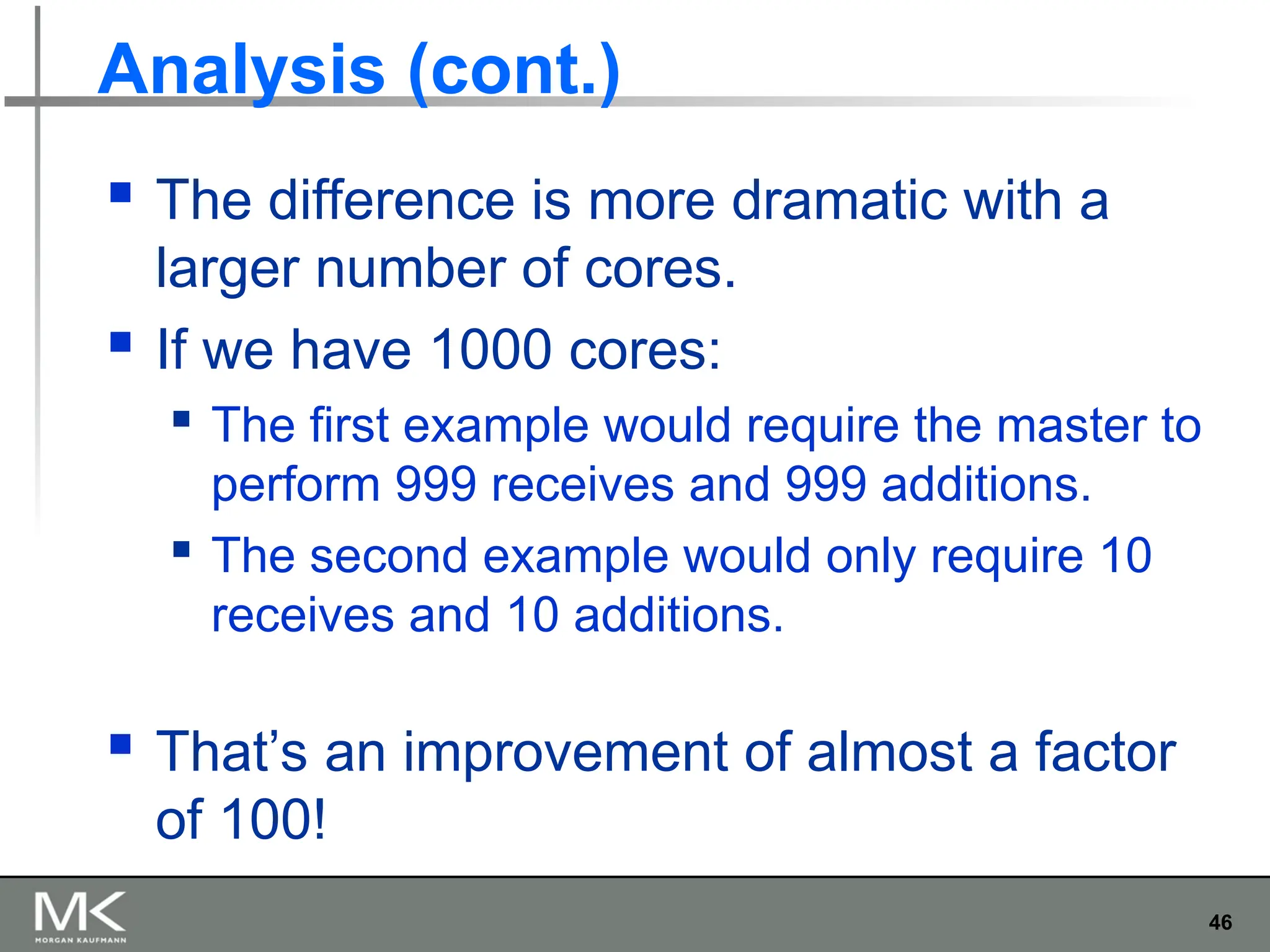
Analysis (cont.)
 The difference is more dramatic with a
larger number of cores.
 If we have 1000 cores:
 The first example would require the master to
perform 999 receives and 999 additions.
 The second example would only require 10
receives and 10 additions.
 That’s an improvement of almost a factor
of 100!
47
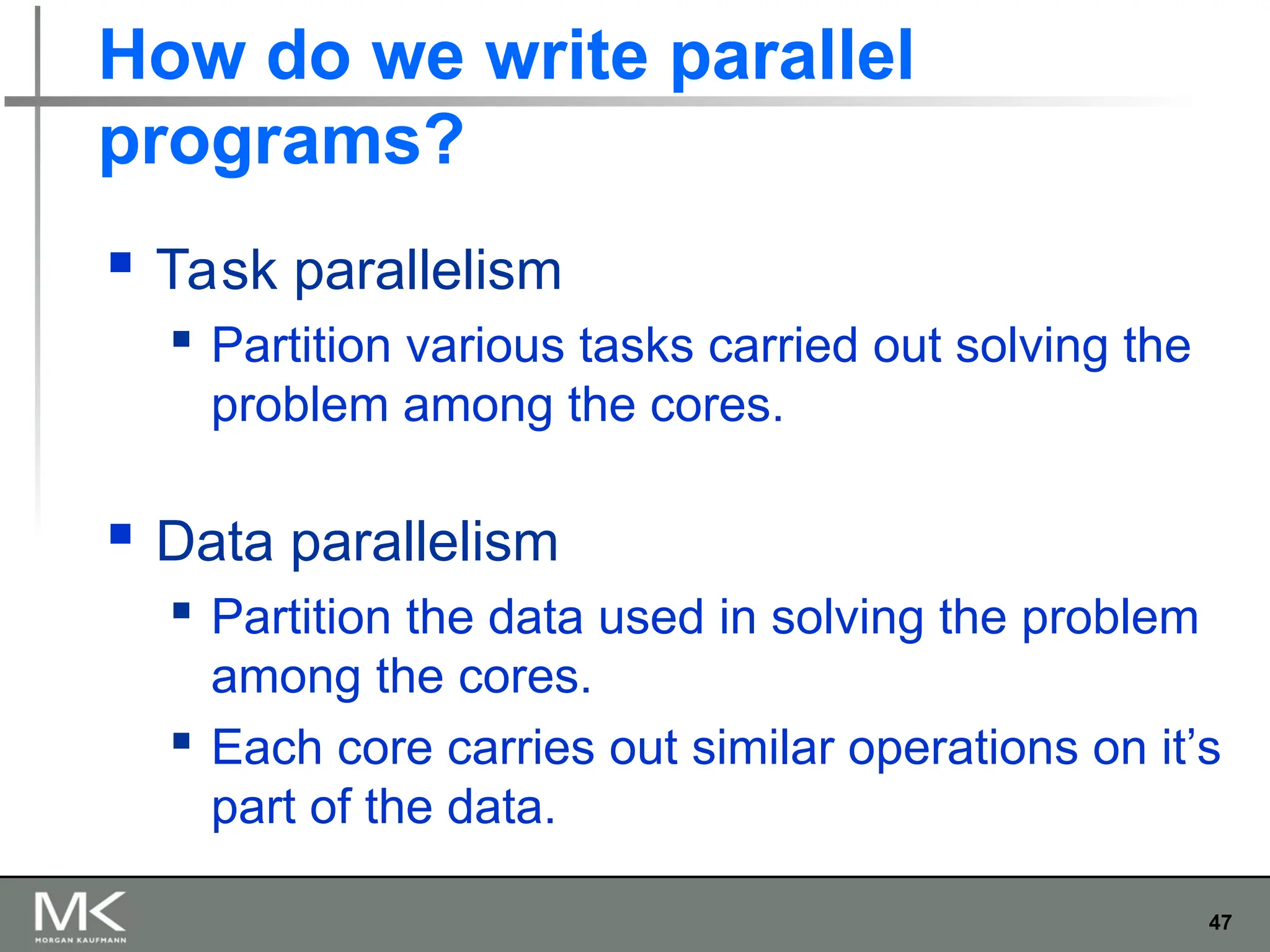
How do we write parallel
programs?
 Task parallelism
 Partition various tasks carried out solving the
problem among the cores.
 Data parallelism
 Partition the data used in solving the problem
among the cores.
 Each core carries out similar operations on it’s
part of the data.
48
Professor P
15 questions
300 exams
49
Professor P’s grading assistants
TA#1
TA#2 TA#3
50
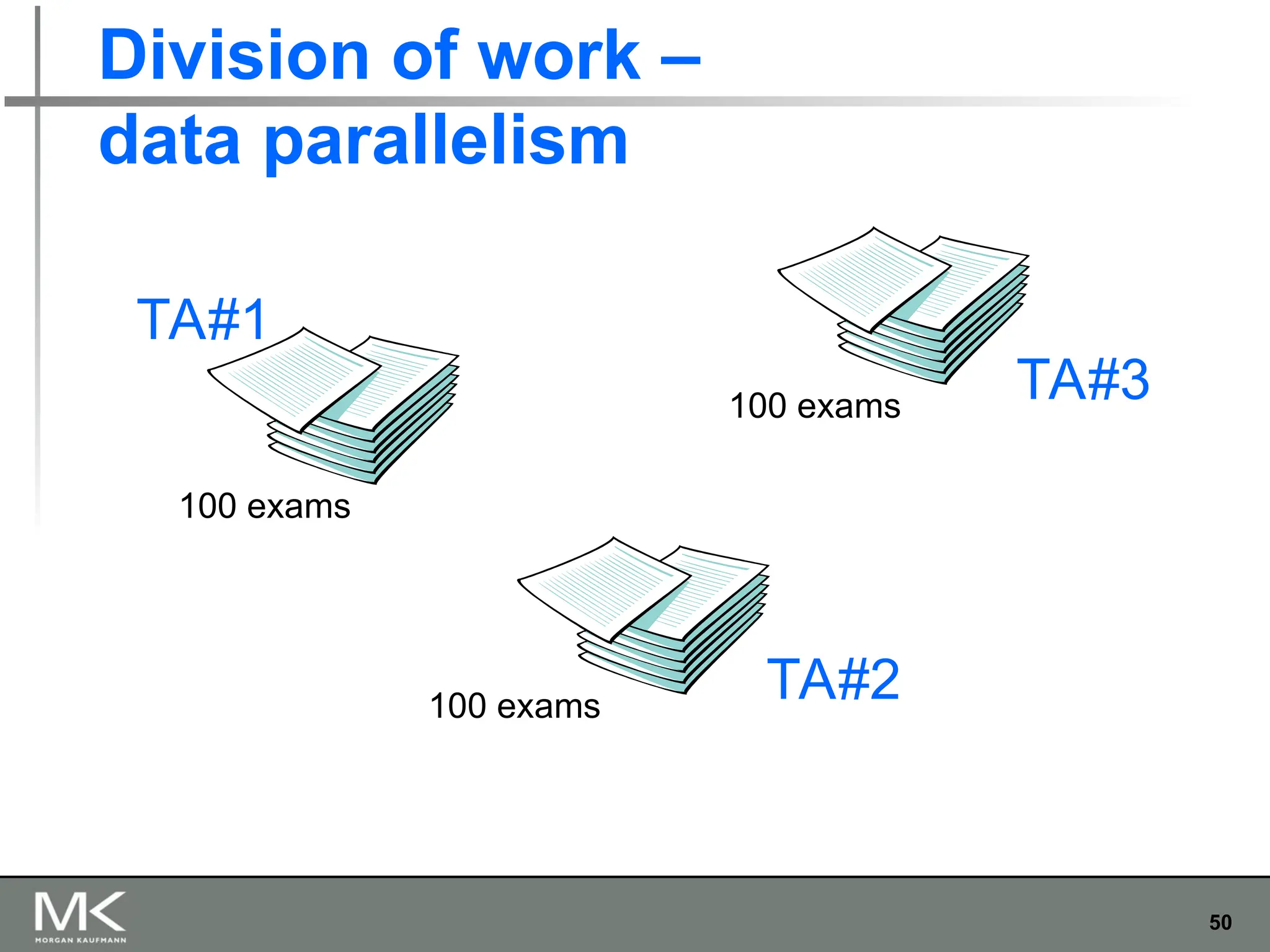
Division of work –
data parallelism
TA#1
TA#2
TA#3
100 exams
100 exams
100 exams
51
Division of work –
task parallelism
TA#1
TA#2
TA#3
Questions 1 - 5
Questions 6 - 10
Questions 11 - 15
52
Division of work – data Parallelism
53
Division of work – task Parallelism
Tasks
1)Receiving
2)Addition
54
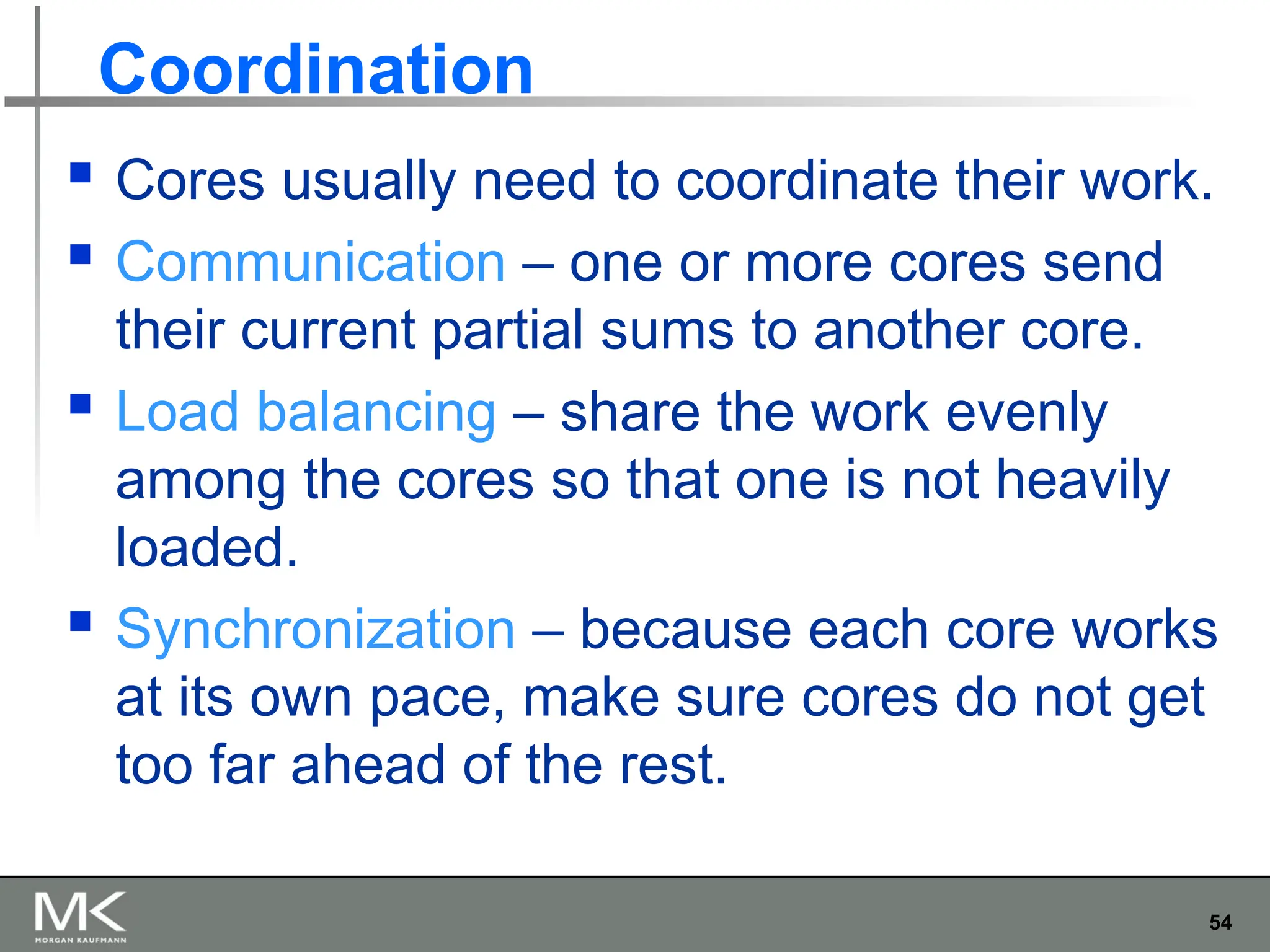
Coordination
 Cores usually need to coordinate their work.
 Communication – one or more cores send
their current partial sums to another core.
 Load balancing – share the work evenly
among the cores so that one is not heavily
loaded.
 Synchronization – because each core works
at its own pace, make sure cores do not get
too far ahead of the rest.
55
What we’ll be doing
 Learning to write programs that are
explicitly parallel.
 Using the C language.
 Using three different extensions to C.
 Message-Passing Interface (MPI)
 Posix Threads (Pthreads)
 OpenMP
56
Type of parallel systems
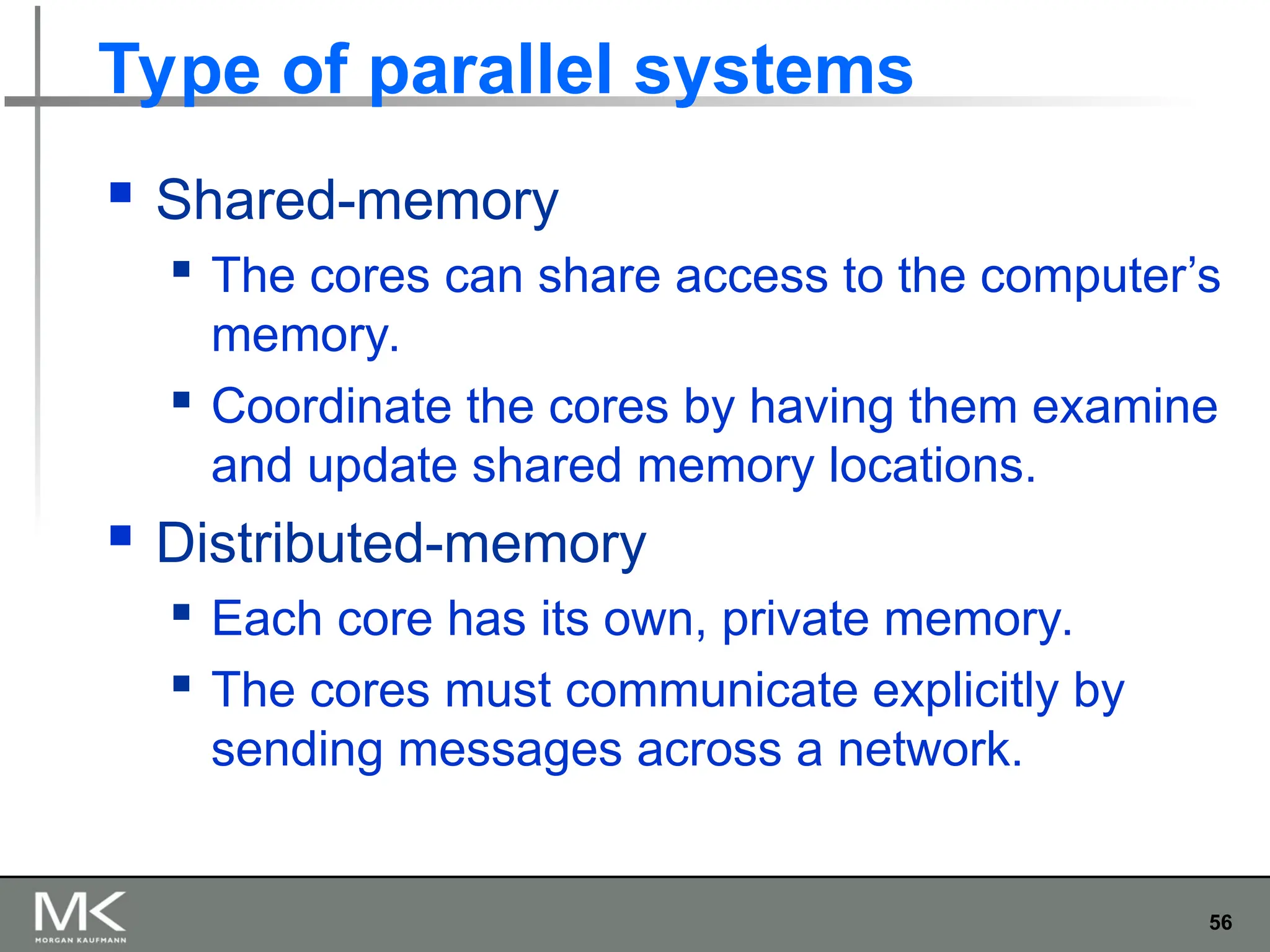
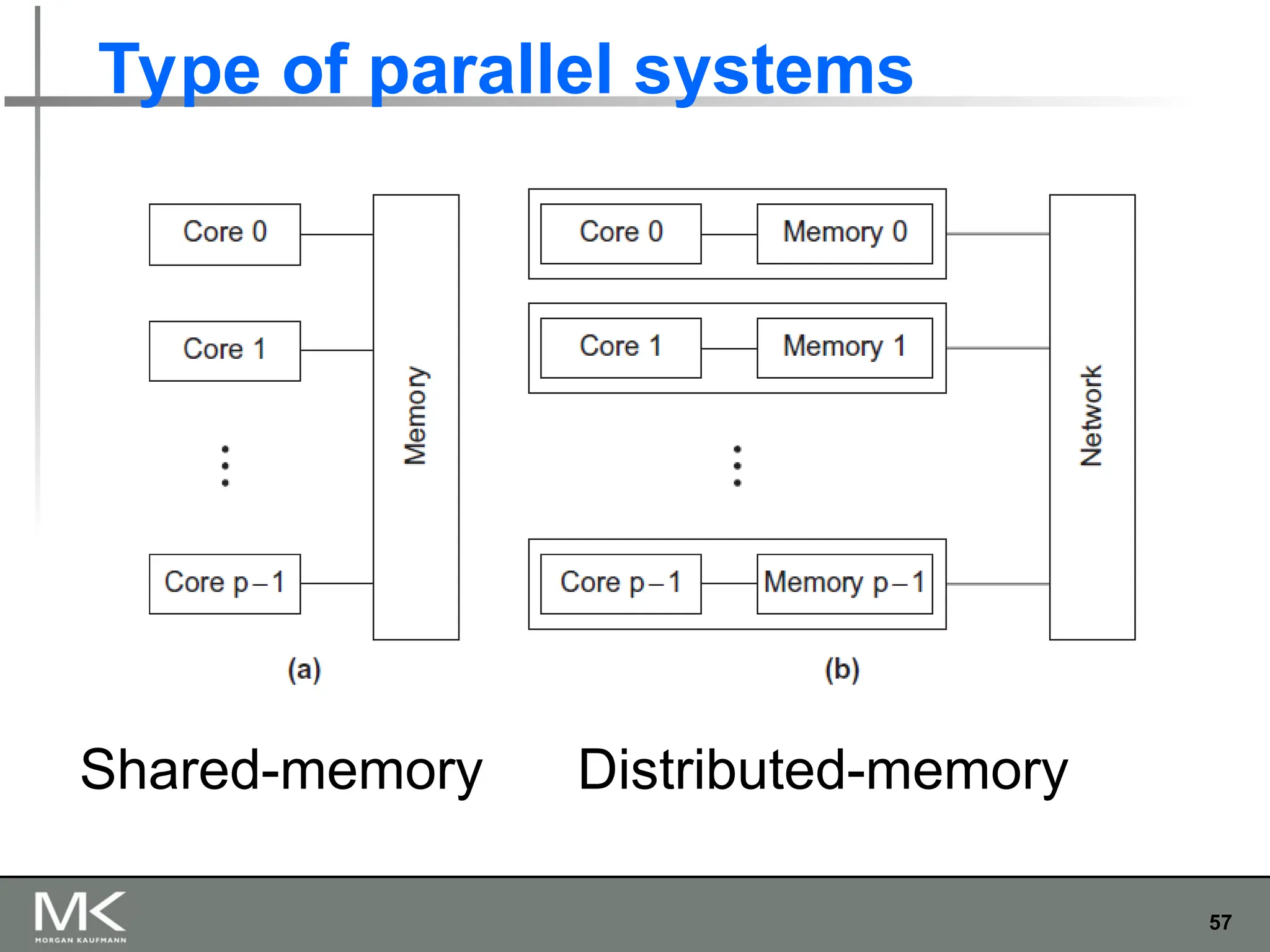
 Shared-memory
 The cores can share access to the computer’s
memory.
 Coordinate the cores by having them examine
and update shared memory locations.
 Distributed-memory
 Each core has its own, private memory.
 The cores must communicate explicitly by
sending messages across a network.
57
Type of parallel systems
Shared-memory Distributed-memory
58
Terminology
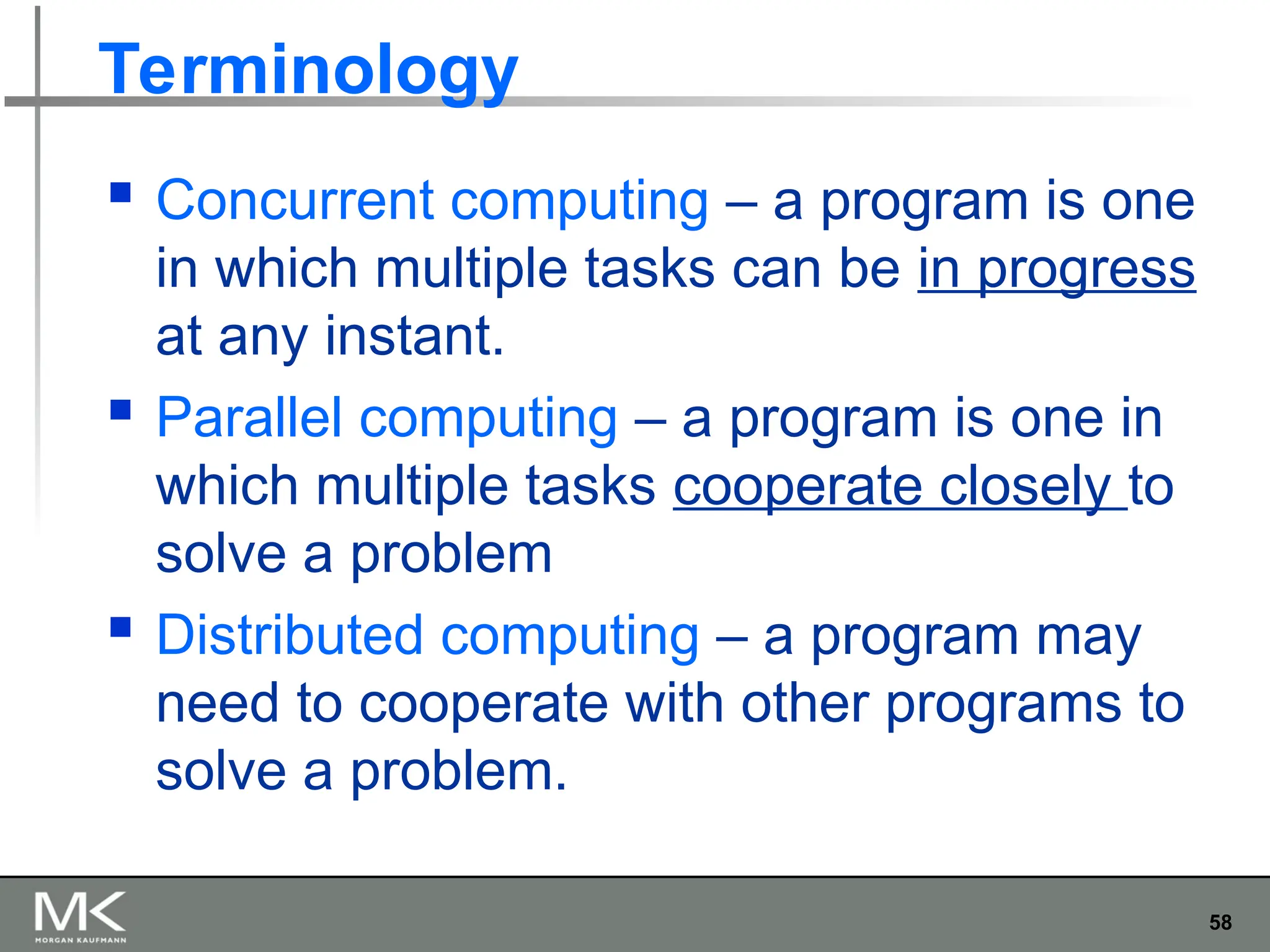
 Concurrent computing – a program is one
in which multiple tasks can be in progress
at any instant.
 Parallel computing – a program is one in
which multiple tasks cooperate closely to
solve a problem
 Distributed computing – a program may
need to cooperate with other programs to
solve a problem.
59
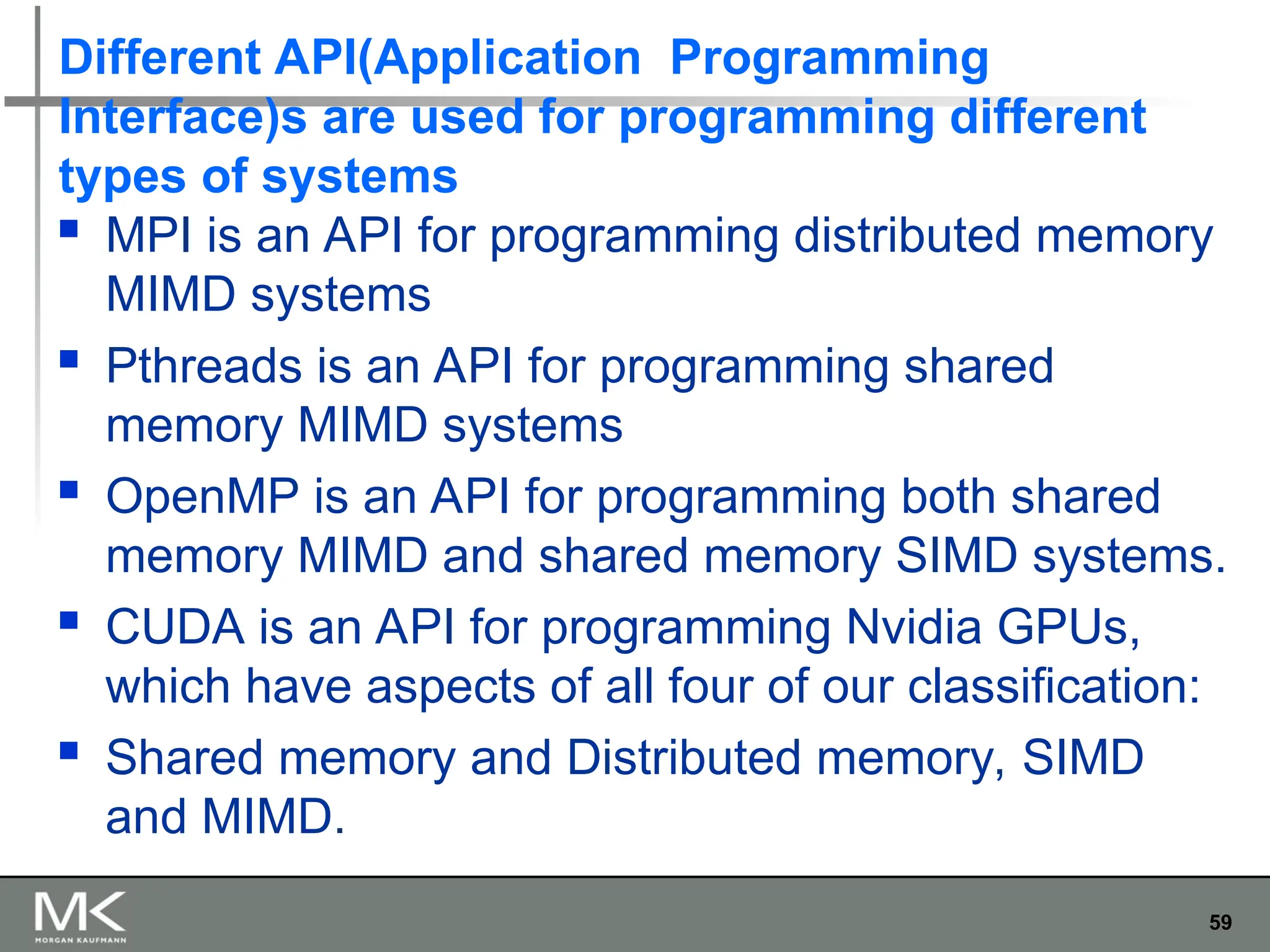
Different API(Application Programming
Interface)s are used for programming different
types of systems
 MPI is an API for programming distributed memory
MIMD systems
 Pthreads is an API for programming shared
memory MIMD systems
 OpenMP is an API for programming both shared
memory MIMD and shared memory SIMD systems.
 CUDA is an API for programming Nvidia GPUs,
which have aspects of all four of our classification:
 Shared memory and Distributed memory, SIMD
and MIMD.
60
Concurrent,Parallel,Distributed
 In concurrent computing, a program is one in which
multiple tasks can be in progress at any instant.
 In parallel computing, a program is one in which
multiple tasks cooperate closely to solve a problem.
 In distributed computing, a program may need to
cooperate with other programs to solve a problem.
So parallel and distributed programs are concurrent,
but a program such as a multitasking operating
system is also concurrent.
61
In parallel programming, APIs (Application
Programming Interfaces) can be called
simultaneously to improve performance and
speed up processes. This is done by executing
multiple API calls at the same time instead of
sequentially
62
Some benefits of using parallel APIs:
•Faster response times
•Parallel APIs can lead to faster response times,
which can improve the user experience.
•Optimized resource utilization
•Parallel APIs can optimize resource utilization by
enabling simultaneous data retrieval.
•Handling complex scenarios
•Parallel APIs can handle complex or dynamic
scenarios that require coordination or
synchronization among multiple APIs

Chapter_1_16_10_2024.pptPeter S Pacheco, Matthew Malensek – An Introduction to Parallel Programming, second edition, Morgan Kauffman

  • 1.
    1 Copyright © 2010,Elsevier Inc. All rights Reserved
  • 2.
    2 Copyright © 2010,Elsevier Inc. All rights Reserved
  • 3.
    3 Copyright © 2010,Elsevier Inc. All rights Reserved
  • 4.
    4 # Chapter Subtitle Parallel computing issimple arrangement of processors (multiple processors) in the system to enhance the performance of the same. Parallel processing gives the way how the system works i. e. Scheduling, mapping, etc. by using multiple processors. It also concerns with synchronization concept.
  • 5.
    5 # Chapter Subtitle Parallel Computing  Definition: Parallelcomputing is a broader concept that encompasses the simultaneous use of multiple compute resources to solve a computational problem. It involves dividing a task into smaller sub-tasks that can be processed concurrently.  Scope: It includes various forms of parallelism, such as data parallelism (processing large datasets simultaneously), task parallelism (executing different tasks concurrently), and pipeline parallelism (stages of a task are processed in parallel).  Applications: Used in scientific computing, simulations, big data processing, and any area requiring high computational power.
  • 6.
    6 # Chapter Subtitle Parallel Processing  Definition: Parallelprocessing specifically refers to the execution of multiple processes or threads simultaneously. It focuses more on the execution aspect within a parallel computing environment.  Scope: It deals with the methods and architectures used to perform multiple operations or tasks at the same time, often at a finer granularity than parallel computing.  Applications: Commonly found in multi-core processors, distributed systems, and real-time processing tasks.
  • 7.
    7  What is thedifference between CPU and a GPU for pa rallel computing ?  GPU is very good at data-parallel computing, CPU is very good at parallel processing.  GPU has thousands of cores, CPU has less than 100 cores.  GPU has around 40 hyperthreads per core, CPU has around 2(sometimes a few more) hyperthreads per core.  GPU has difficulty executing recursive code, CPU has less problems with it. Copyright © 2010, Elsevier Inc. All rights Reserved
  • 8.
    8 Copyright © 2010,Elsevier Inc. All rights Reserved • GPU lowest level caches are shared between 8–24 cores for intel, 64 cores for amd and up to 192 cores for nvidia. CPU’s lowest level cache only used by single core (2 threads). CPU’s each thread can use SIMD which is data- parallel for about 8–32 workitems(each comparable to a single GPU core/thread). • GPU highest level cache is only around 5MB, CPU highest level cache can get 64MB or more. • GPU is accessed through pci-e and similar bridges and also works on a middle API that both add latency and programming effort and makes very lighty loaded works become slow. CPU is easier to begin with and perfect at random + small workloads.
  • 9.
    9 Copyright © 2010,Elsevier Inc. All rights Reserved • GPU has considerably higher compute per electricity energy than CPU. • GPU is for high throughput, CPU is for low latency. • Integrated GPUs still use internal pci-e connection to get commands from CPU but gets data from RAM directly so there is still some added latency in there. • With APIs like CUDA/OpenCL, GPU has addressable local memories and registers that are much faster than lowest level caches. This makes inter-core communication easier in coding. Even number of available(and addressable like an array) private registers per core is much higher than that of a CPU. (256 vs 32) • GPU’s single core is very lightweight compared to a single CPU core. 1 CPU core has 8–16 such pipelines while 1 GPU “SM/CU” has 64/128/192 pipelines and should be called a “core”.
  • 10.
    10 Threads  Threads arecontained within processes.  They allow programmers to divide their programs into (more or less) independent tasks.  The hope is that when one thread blocks because it is waiting on a resource, another will have work to do and can run. Copyright © 2010, Elsevier Inc. All rights Reserved
  • 11.
    11 Copyright © 2010,Elsevier Inc. All rights Reserved
  • 12.
    12 Copyright © 2010,Elsevier Inc. All rights Reserved
  • 13.
    13 A process andtwo threads Copyright © 2010, Elsevier Inc. All rights Reserved Figure 2.2 the “master” thread starting a thread Is called forking terminating a thread Is called joining
  • 14.
    14 # Chapter Subtitle Hyper-threading is ahardware technology that allows a single processor to handle multiple tasks simultaneously, which can improve performance. It does this by dividing a CPU's physical cores into virtual cores, also known as threads, that the operating system treats as if they were physical cores.
  • 15.
    15 # Chapter Subtitle Parallelism is theability to execute multiple tasks or operations simultaneously, rather than sequentially. Parallelism can be achieved at different levels, such as hardware, software, or network. For example, you can use multiple cores or processors, threads or processes, or asynchronous or non-blocking operations to run parallel tasks.
  • 16.
    16 Copyright © 2010,Elsevier Inc. All rights Reserved •Threads A programming concept that involves creating, running, and terminating threads within a process. Threads share memory and file handlers. •Pthreads A library that provides tools to manage threads, including functions for creating, terminating, and joining threads. Pthreads is an Application Programming Interface (API) that can be used for shared memory programming.
  • 17.
    17 • One ofthe main reasons to use parallelism for API’s(Application Programming Interface) is to improve the performance and scalability of your applications. • By sending and receiving multiple requests and responses at the same time, you can reduce the waiting time and increase the throughput of your applications. • For example, fetch data from several APIs, Why use parallelism for APIs?
  • 18.
    18 • Another reasonto use parallelism for APIs is to handle complex or dynamic scenarios that require coordination or synchronization among multiple APIs. • For example, Perform a transaction. This can make your applications more reliable and consistent. Why use parallelism for APIs?
  • 19.
    19 Changing times  From1986 – 2002, microprocessors were speeding like a rocket, increasing in performance an average of 50% per year.  Since then, it’s dropped to about 20% increase per year.
  • 20.
    20 An intelligent solution Instead of designing and building faster microprocessors, put multiple processors on a single integrated circuit.
  • 21.
    21 Now it’s upto the programmers  Adding more processors doesn’t help much if programmers aren’t aware of them…  … or don’t know how to use them.  Serial programs don’t benefit from this approach (in most cases).
  • 22.
    22 Why we needever-increasing performance  Computational power is increasing, but so are our computation problems and needs.  As our computational power increases, the number of problems that we can seriously consider solving also increases.  Examples like
  • 23.
    23 Climate modeling In orderto better understand climate change, we need far more accurate computer models, models that include interactions between the atmosphere, the oceans, solid land, and the ice caps at the poles.
  • 24.
    24 Protein folding It’s believedthat misfolded proteins may be involved in dis eases such as Huntington’s, Parkinson’s, and Alzheimer’s, but our ability to study configurations of complex molecules such as proteins is severely limited by our current computational power.
  • 25.
    25 Drug discovery There aremany drugs that are effective in treating a relatively small fraction of those suffering from some disease. It’s possible that we can devise alternative treatments by careful analysis of the genomes of the individuals for whom the known treatment is ineffective. This, however, will involve extensive computational analysis of genomes.
  • 26.
    26 Energy research Increased computationalpower will make it possible to program much more detailed models of technologies such as wind turbines, solar cells, and batteries. These programs may provide the information needed to construct far more efficient clean energy sources.
  • 27.
    27 Data analysis We generatetremendous amounts of data. By some estimates, the quantity of data stored worldwide doubles every two years, but the vast majority of it is largely useless unless it’s analyzed.
  • 28.
    28 Why we’re buildingparallel systems  Up to now, performance increases have been attributable to increasing density of transistors.  But there are inherent problems.
  • 29.
    29 A little physicslesson  Smaller transistors = faster processors.  Faster processors = increased power consumption.  Increased power consumption = increased heat.  Increased heat = unreliable processors.
  • 30.
    30 Solution  Move awayfrom single-core systems to multicore processors.  “core” = central processing unit (CPU)  Introducing parallelism!!! Rather than building ever-faster, more complex, monolithic processors, the industry has decided to put multiple, relatively simple, complete processors on a single chip. Such integrated circuits are called multicore processors, and core has become synonymous with central processing unit, or CPU. In this setting a conventional processor with one CPU is often called a single-core system.
  • 31.
    31 Why we needto write parallel programs  Running multiple instances of a serial program often isn’t very useful.  Think of running multiple instances of your favorite game.  What you really want is for it to run faster.
  • 32.
    32 Approaches to theserial problem  Rewrite serial programs so that they’re parallel.  Write translation programs that automatically convert serial programs into parallel programs.  This is very difficult to do.  Success has been limited.
  • 33.
    33 More problems  Somecoding constructs can be recognized by an automatic program generator, and converted to a parallel construct.  However, it’s likely that the result will be a very inefficient program.  Sometimes the best parallel solution is to step back and devise an entirely new algorithm.
  • 34.
    34 Example  Compute nvalues and add them together.  Serial solution:
  • 35.
    35 Example (cont.)  Wehave p cores, p much smaller than n.  Each core performs a partial sum of approximately n/p values. Each core uses it’s own private variables and executes this block of code independently of the other cores. my_sum = 0; my_first_i = ...; // Each core's starting index my_last_i = ...; // Each core's ending index // Loop through the assigned range of values for (my_i = my_first_i; my_i < my_last_i; my_i++) { my_x = Compute_next_value(...); // Compute the value for this index my_sum += my_x; // Accumulate the sum }
  • 36.
    36 Example (cont.)  Aftereach core completes execution of the code, is a private variable my_sum contains the sum of the values computed by its calls to Compute_next_value.  Ex., 8 cores, n = 24, then the calls to Compute_next_value return: 1,4,3, 9,2,8, 5,1,1, 5,2,7, 2,5,0, 4,1,8, 6,5,1, 2,3,9
  • 37.
    37 Example (cont.)  Onceall the cores are done computing their private my_sum, they form a global sum by sending results to a designated “master” core which adds the final result.
  • 38.
  • 39.
    39 Example (cont.) if (I’mthe master core) { // Initialize sum with the master's own value sum = my_sum; // Loop through all other cores and receive their values for each core other than myself { received_value = receive_value_from_core(core_id); sum += received_value; } // Final sum is computed at the master } else { // Worker cores send their sum to the master send_value_to_master(my_sum); }
  • 40.
    40 Example (cont.) Core 01 2 3 4 5 6 7 my_sum 8 19 7 15 7 13 12 14 Global sum 8 + 19 + 7 + 15 + 7 + 13 + 12 + 14 = 95 Core 0 1 2 3 4 5 6 7 my_sum 95 19 7 15 7 13 12 14
  • 41.
    41 But wait! There’s amuch better way to compute the global sum.
  • 42.
    42 Better parallel algorithm Don’t make the master core do all the work.  Share it among the other cores.  Pair the cores so that core 0 adds its result with core 1’s result.  Core 2 adds its result with core 3’s result, etc.  Work with odd and even numbered pairs of cores.
  • 43.
    43 Better parallel algorithm(cont.)  Repeat the process now with only the evenly ranked cores.  Core 0 adds result from core 2.  Core 4 adds the result from core 6, etc.  Now cores divisible by 4 repeat the process, and so forth, until core 0 has the final result.
  • 44.
  • 45.
    45 Analysis  In thefirst example, the master core performs 7 receives and 7 additions.  In the second example, the master core performs 3 receives and 3 additions.  The improvement is more than a factor of 2!
  • 46.
    46 Analysis (cont.)  Thedifference is more dramatic with a larger number of cores.  If we have 1000 cores:  The first example would require the master to perform 999 receives and 999 additions.  The second example would only require 10 receives and 10 additions.  That’s an improvement of almost a factor of 100!
  • 47.
    47 How do wewrite parallel programs?  Task parallelism  Partition various tasks carried out solving the problem among the cores.  Data parallelism  Partition the data used in solving the problem among the cores.  Each core carries out similar operations on it’s part of the data.
  • 48.
  • 49.
    49 Professor P’s gradingassistants TA#1 TA#2 TA#3
  • 50.
    50 Division of work– data parallelism TA#1 TA#2 TA#3 100 exams 100 exams 100 exams
  • 51.
    51 Division of work– task parallelism TA#1 TA#2 TA#3 Questions 1 - 5 Questions 6 - 10 Questions 11 - 15
  • 52.
    52 Division of work– data Parallelism
  • 53.
    53 Division of work– task Parallelism Tasks 1)Receiving 2)Addition
  • 54.
    54 Coordination  Cores usuallyneed to coordinate their work.  Communication – one or more cores send their current partial sums to another core.  Load balancing – share the work evenly among the cores so that one is not heavily loaded.  Synchronization – because each core works at its own pace, make sure cores do not get too far ahead of the rest.
  • 55.
    55 What we’ll bedoing  Learning to write programs that are explicitly parallel.  Using the C language.  Using three different extensions to C.  Message-Passing Interface (MPI)  Posix Threads (Pthreads)  OpenMP
  • 56.
    56 Type of parallelsystems  Shared-memory  The cores can share access to the computer’s memory.  Coordinate the cores by having them examine and update shared memory locations.  Distributed-memory  Each core has its own, private memory.  The cores must communicate explicitly by sending messages across a network.
  • 57.
    57 Type of parallelsystems Shared-memory Distributed-memory
  • 58.
    58 Terminology  Concurrent computing– a program is one in which multiple tasks can be in progress at any instant.  Parallel computing – a program is one in which multiple tasks cooperate closely to solve a problem  Distributed computing – a program may need to cooperate with other programs to solve a problem.
  • 59.
    59 Different API(Application Programming Interface)sare used for programming different types of systems  MPI is an API for programming distributed memory MIMD systems  Pthreads is an API for programming shared memory MIMD systems  OpenMP is an API for programming both shared memory MIMD and shared memory SIMD systems.  CUDA is an API for programming Nvidia GPUs, which have aspects of all four of our classification:  Shared memory and Distributed memory, SIMD and MIMD.
  • 60.
    60 Concurrent,Parallel,Distributed  In concurrentcomputing, a program is one in which multiple tasks can be in progress at any instant.  In parallel computing, a program is one in which multiple tasks cooperate closely to solve a problem.  In distributed computing, a program may need to cooperate with other programs to solve a problem. So parallel and distributed programs are concurrent, but a program such as a multitasking operating system is also concurrent.
  • 61.
    61 In parallel programming,APIs (Application Programming Interfaces) can be called simultaneously to improve performance and speed up processes. This is done by executing multiple API calls at the same time instead of sequentially
  • 62.
    62 Some benefits ofusing parallel APIs: •Faster response times •Parallel APIs can lead to faster response times, which can improve the user experience. •Optimized resource utilization •Parallel APIs can optimize resource utilization by enabling simultaneous data retrieval. •Handling complex scenarios •Parallel APIs can handle complex or dynamic scenarios that require coordination or synchronization among multiple APIs