Class 15 EWRT 1B
AGENDA
O Presentation: Terms
O Peer Revision: You must have
two copies of your essay. If you
do not, you may leave now and
return in one hour for our class
discussion.
O Discussion: “The Passing of
Grandison” and “Transformation”
O Author Introduction: David
Henry Hwang
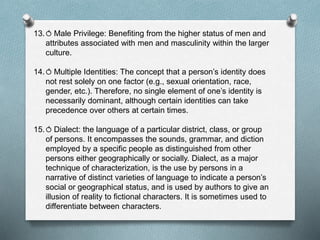
13.⥀ Male Privilege: Benefiting from the higher status of men and
attributes associated with men and masculinity within the larger
culture.
14.⥀ Multiple Identities: The concept that a person’s identity does
not rest solely on one factor (e.g., sexual orientation, race,
gender, etc.). Therefore, no single element of one’s identity is
necessarily dominant, although certain identities can take
precedence over others at certain times.
15.⥀ Dialect: the language of a particular district, class, or group
of persons. It encompasses the sounds, grammar, and diction
employed by a specific people as distinguished from other
persons either geographically or socially. Dialect, as a major
technique of characterization, is the use by persons in a
narrative of distinct varieties of language to indicate a person’s
social or geographical status, and is used by authors to give an
illusion of reality to fictional characters. It is sometimes used to
differentiate between characters.
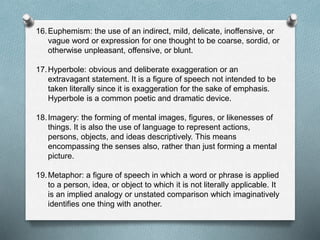
16.Euphemism: the use of an indirect, mild, delicate, inoffensive, or
vague word or expression for one thought to be coarse, sordid, or
otherwise unpleasant, offensive, or blunt.
17.Hyperbole: obvious and deliberate exaggeration or an
extravagant statement. It is a figure of speech not intended to be
taken literally since it is exaggeration for the sake of emphasis.
Hyperbole is a common poetic and dramatic device.
18.Imagery: the forming of mental images, figures, or likenesses of
things. It is also the use of language to represent actions,
persons, objects, and ideas descriptively. This means
encompassing the senses also, rather than just forming a mental
picture.
19.Metaphor: a figure of speech in which a word or phrase is applied
to a person, idea, or object to which it is not literally applicable. It
is an implied analogy or unstated comparison which imaginatively
identifies one thing with another.
20. Novel: a lengthy fictitious prose narrative portraying
characters and presenting an organized series of
events and settings. Novels are accounts of life and
involve conflict, characters, action, settings, plot,
and theme. This is considered the third stage of the
development of imagination fiction, following the
epic and the romance.
21. Pathos: A quality of a play’s action that stimulates
the audience to feel pity for a character. Pathos is
always an aspect of tragedy, and may be present in
comedy as well.
22. Personification: a figure of speech in which
abstractions, animals, ideas, and inanimate objects
are endowed with human form, character, traits, or
sensibilities.
23. Protagonist: the leading character of a drama, novel, etc. This is
not always the hero, but is always the principal and central
character whose rival is the antagonist.
24. Scene: the place where some act or event occurs. Sometimes
the term is used for an incident or situation in real life. It is also
the division of an act of a play or a unit of dramatic action in
which a single point is made or one effect obtained.
25. Drama: A prose or verse composition, especially one telling a
serious story, that is intended for representation by actors
impersonating the characters and performing the dialogue and
action. A serious narrative work or program for television, radio,
or the cinema.
Terms Exam 3
ODay: Class 16
OFormat: matching, fill in the
blank, multiple choice, and
definition writing.
ONumber 25 to get 25.
Essay 3: Peer Revision Day
1. Get into pairs and exchange papers
2. Quickly read your essay aloud to your partner.
3. Reread your partner’s essay silently. Write a
one-sentence summary of the essay’s thesis in
the margin, near the thesis.
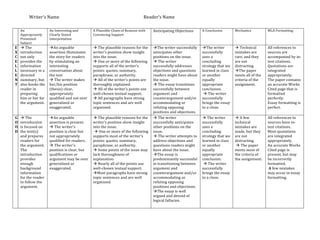
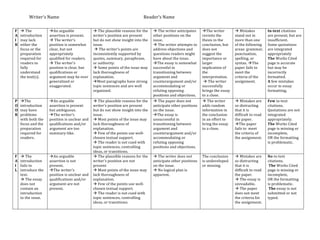
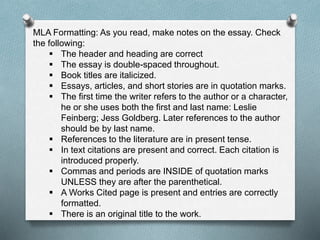
4. Carefully and thoughtfully, mark the rubric to
show the writer where he or she is successful
or needs work.
5. Then perform the MLA work on slide 11
MLA Formatting: As you read, make notes on the essay. Check
the following:
 The header and heading are correct
 The essay is double-spaced throughout.
 Book titles are italicized.
 Essays, articles, and short stories are in quotation marks.
 The first time the writer refers to the author or a character,
he or she uses both the first and last name: Leslie
Feinberg; Jess Goldberg. Later references to the author
should be by last name.
 References to the literature are in present tense.
 In text citations are present and correct. Each citation is
introduced properly.
 Commas and periods are INSIDE of quotation marks
UNLESS they are after the parenthetical.
 A Works Cited page is present and entries are correctly
formatted.
 There is an original title to the work.
OReaders: when you finish,
return the draft and the
completed rubric to the
writer.
OWriters: read the
comments and revise your
essay accordingly.
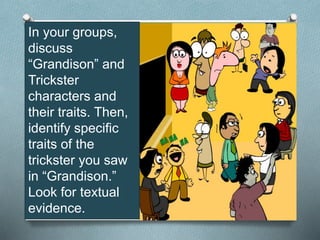
In your groups,
discuss
“Grandison” and
Trickster
characters and
their traits. Then,
identify specific
traits of the
trickster you saw
in “Grandison.”
Look for textual
evidence.
“The Passing of
Grandison”
OWho can offer
a brief
summary of
Grandison?
OWho can offer a
brief summary of
“Transformations
of the Trickster”?
“Transformations
of the Trickster”
Traits of the Trickster
possible traits of the trickster
• Deceitful (“truth-eluding ambiguity” according to Lock) : The
trickster uses trickery to bring about change. According to Lock,
the trickster “shifts and disguises the boundaries, undoes and
redraws the traditional connections” (III).
• Self-Serving: The trickster often feels that he or she has been
wronged and is therefore justified in taking action to bring about
change and/or to defeat “the enemy.”
• Shape Shifter: The trickster may change forms, sex, and so forth
as an element of surprise to his victim. The change may also be
psychological instead of (or in addition to) a visual change.
According to Lock, “Trickster is not gendered—only cultural
perceptions of the freedom and mobility necessary to be trickster.
Thus, premodern tricksters were imagined as primarily masculine,
though with gender-changing abilities” (III)
Cultural Hero:
The trickster may be idealized as a cultural hero when, as the
agent of transformation, he or she overturns a cruel or unfair
leader or political/social system or reverses the fortunes of the
more powerful party. According to Helen Lock, this characteristic
separates the fool from the trickster. “The true trickster’s trickery
calls into question fundamental assumptions about the way the
world is organized, and reveals the possibility of transforming
them (even if for ignoble [shameful] ends)” (Lock III). Michael J.
Carroll includes cultural hero as an attribute as well; he
characterizes the trickster as “a transformer who makes the world
habitable for humans by ridding it of monsters or who provides
those things [such as fire] that make human society possible
(“Levi-Strauss, Freud, and the Trickster” 305). Hardy
characterizes the trickster as the source of unexpected changes in
a world where change is not always comfortable and as a symbol
of the uncertain world in which we live.
• Solitary creature: Many tricksters are solitary animals (or
humans), working alone rather than with a partner or within a
group – to undertake change. Michael P. Carroll notes that
“Ravens are usually sighted singly or at most in pairs; coyotes
forage independently…; hares have long been noted for their
solitariness…Spiders generally associate with members of their
own species on only two occasions: when they are born and
when they mate” (“Trickster as Selfish Buffoon” 115).
• Physically, intellectually, or socially weak creature: The
trickster is often portrayed as a much weaker character than his
prey, and yet through cleverness and trickery, he is able to
overcome all obstacles and prevail. In some cases the trickster
may appear to be weaker physically in order to confuse his
prey (false frailty).
• Special tools: The trickster may have special tools or
abilities that enable him to perform his acts. Often these tools
include magic and/or supernatural powers.
• Teacher: The trickster is a purveyor of life lessons through
the stories, from manners to ethics. T
• “Trickster discourse is the process whereby language
negotiates the boundaries of the crossblood’s world,
deconstructing the fixed, authoritative beliefs and definitions
that Vizenor has called “terminal creeds” (Bearheart xiv)”
(Qtd. In Lock III).
• Some “tricksters work to transform the limitations and
boundaries of language in ways that can have real-world
consequences for the ethnic American” (Lock III).
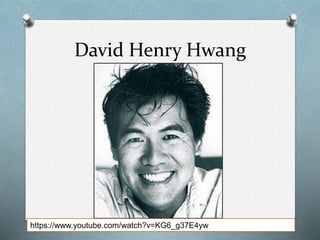
David Henry Hwang
https://www.youtube.com/watch?v=KG6_g37E4yw
O Study: Vocab/terms for Exam 3
O Finish Chinglish
O Read: Defining the Trickster:
This is posted under "Secondary
Readings." It is very brief and
easy reading.
O Post # 19: QHQ Using either or
both "Transformation of the
Trickster” and “Defining the
Trickster,” discuss Chinglish by
identifying traits of the trickster
that correspond to characters,
motivations, and outcomes in
the play. Use textual evidence!
Revise Essay 3 and
submit it through
Kaizena before our
next meeting.

Ewrt1b class15

  • 1.
  • 2.
    AGENDA O Presentation: Terms OPeer Revision: You must have two copies of your essay. If you do not, you may leave now and return in one hour for our class discussion. O Discussion: “The Passing of Grandison” and “Transformation” O Author Introduction: David Henry Hwang
  • 3.
    13.⥀ Male Privilege:Benefiting from the higher status of men and attributes associated with men and masculinity within the larger culture. 14.⥀ Multiple Identities: The concept that a person’s identity does not rest solely on one factor (e.g., sexual orientation, race, gender, etc.). Therefore, no single element of one’s identity is necessarily dominant, although certain identities can take precedence over others at certain times. 15.⥀ Dialect: the language of a particular district, class, or group of persons. It encompasses the sounds, grammar, and diction employed by a specific people as distinguished from other persons either geographically or socially. Dialect, as a major technique of characterization, is the use by persons in a narrative of distinct varieties of language to indicate a person’s social or geographical status, and is used by authors to give an illusion of reality to fictional characters. It is sometimes used to differentiate between characters.
  • 4.
    16.Euphemism: the useof an indirect, mild, delicate, inoffensive, or vague word or expression for one thought to be coarse, sordid, or otherwise unpleasant, offensive, or blunt. 17.Hyperbole: obvious and deliberate exaggeration or an extravagant statement. It is a figure of speech not intended to be taken literally since it is exaggeration for the sake of emphasis. Hyperbole is a common poetic and dramatic device. 18.Imagery: the forming of mental images, figures, or likenesses of things. It is also the use of language to represent actions, persons, objects, and ideas descriptively. This means encompassing the senses also, rather than just forming a mental picture. 19.Metaphor: a figure of speech in which a word or phrase is applied to a person, idea, or object to which it is not literally applicable. It is an implied analogy or unstated comparison which imaginatively identifies one thing with another.
  • 5.
    20. Novel: alengthy fictitious prose narrative portraying characters and presenting an organized series of events and settings. Novels are accounts of life and involve conflict, characters, action, settings, plot, and theme. This is considered the third stage of the development of imagination fiction, following the epic and the romance. 21. Pathos: A quality of a play’s action that stimulates the audience to feel pity for a character. Pathos is always an aspect of tragedy, and may be present in comedy as well. 22. Personification: a figure of speech in which abstractions, animals, ideas, and inanimate objects are endowed with human form, character, traits, or sensibilities.
  • 6.
    23. Protagonist: theleading character of a drama, novel, etc. This is not always the hero, but is always the principal and central character whose rival is the antagonist. 24. Scene: the place where some act or event occurs. Sometimes the term is used for an incident or situation in real life. It is also the division of an act of a play or a unit of dramatic action in which a single point is made or one effect obtained. 25. Drama: A prose or verse composition, especially one telling a serious story, that is intended for representation by actors impersonating the characters and performing the dialogue and action. A serious narrative work or program for television, radio, or the cinema.
  • 7.
    Terms Exam 3 ODay:Class 16 OFormat: matching, fill in the blank, multiple choice, and definition writing. ONumber 25 to get 25.
  • 8.
    Essay 3: PeerRevision Day 1. Get into pairs and exchange papers 2. Quickly read your essay aloud to your partner. 3. Reread your partner’s essay silently. Write a one-sentence summary of the essay’s thesis in the margin, near the thesis. 4. Carefully and thoughtfully, mark the rubric to show the writer where he or she is successful or needs work. 5. Then perform the MLA work on slide 11
  • 11.
    MLA Formatting: Asyou read, make notes on the essay. Check the following:  The header and heading are correct  The essay is double-spaced throughout.  Book titles are italicized.  Essays, articles, and short stories are in quotation marks.  The first time the writer refers to the author or a character, he or she uses both the first and last name: Leslie Feinberg; Jess Goldberg. Later references to the author should be by last name.  References to the literature are in present tense.  In text citations are present and correct. Each citation is introduced properly.  Commas and periods are INSIDE of quotation marks UNLESS they are after the parenthetical.  A Works Cited page is present and entries are correctly formatted.  There is an original title to the work.
  • 12.
    OReaders: when youfinish, return the draft and the completed rubric to the writer. OWriters: read the comments and revise your essay accordingly.
  • 13.
    In your groups, discuss “Grandison”and Trickster characters and their traits. Then, identify specific traits of the trickster you saw in “Grandison.” Look for textual evidence.
  • 14.
    “The Passing of Grandison” OWhocan offer a brief summary of Grandison? OWho can offer a brief summary of “Transformations of the Trickster”? “Transformations of the Trickster”
  • 15.
    Traits of theTrickster
  • 16.
    possible traits ofthe trickster • Deceitful (“truth-eluding ambiguity” according to Lock) : The trickster uses trickery to bring about change. According to Lock, the trickster “shifts and disguises the boundaries, undoes and redraws the traditional connections” (III). • Self-Serving: The trickster often feels that he or she has been wronged and is therefore justified in taking action to bring about change and/or to defeat “the enemy.” • Shape Shifter: The trickster may change forms, sex, and so forth as an element of surprise to his victim. The change may also be psychological instead of (or in addition to) a visual change. According to Lock, “Trickster is not gendered—only cultural perceptions of the freedom and mobility necessary to be trickster. Thus, premodern tricksters were imagined as primarily masculine, though with gender-changing abilities” (III)
  • 17.
    Cultural Hero: The trickstermay be idealized as a cultural hero when, as the agent of transformation, he or she overturns a cruel or unfair leader or political/social system or reverses the fortunes of the more powerful party. According to Helen Lock, this characteristic separates the fool from the trickster. “The true trickster’s trickery calls into question fundamental assumptions about the way the world is organized, and reveals the possibility of transforming them (even if for ignoble [shameful] ends)” (Lock III). Michael J. Carroll includes cultural hero as an attribute as well; he characterizes the trickster as “a transformer who makes the world habitable for humans by ridding it of monsters or who provides those things [such as fire] that make human society possible (“Levi-Strauss, Freud, and the Trickster” 305). Hardy characterizes the trickster as the source of unexpected changes in a world where change is not always comfortable and as a symbol of the uncertain world in which we live.
  • 18.
    • Solitary creature:Many tricksters are solitary animals (or humans), working alone rather than with a partner or within a group – to undertake change. Michael P. Carroll notes that “Ravens are usually sighted singly or at most in pairs; coyotes forage independently…; hares have long been noted for their solitariness…Spiders generally associate with members of their own species on only two occasions: when they are born and when they mate” (“Trickster as Selfish Buffoon” 115). • Physically, intellectually, or socially weak creature: The trickster is often portrayed as a much weaker character than his prey, and yet through cleverness and trickery, he is able to overcome all obstacles and prevail. In some cases the trickster may appear to be weaker physically in order to confuse his prey (false frailty).
  • 19.
    • Special tools:The trickster may have special tools or abilities that enable him to perform his acts. Often these tools include magic and/or supernatural powers. • Teacher: The trickster is a purveyor of life lessons through the stories, from manners to ethics. T • “Trickster discourse is the process whereby language negotiates the boundaries of the crossblood’s world, deconstructing the fixed, authoritative beliefs and definitions that Vizenor has called “terminal creeds” (Bearheart xiv)” (Qtd. In Lock III). • Some “tricksters work to transform the limitations and boundaries of language in ways that can have real-world consequences for the ethnic American” (Lock III).
  • 20.
  • 21.
    O Study: Vocab/termsfor Exam 3 O Finish Chinglish O Read: Defining the Trickster: This is posted under "Secondary Readings." It is very brief and easy reading. O Post # 19: QHQ Using either or both "Transformation of the Trickster” and “Defining the Trickster,” discuss Chinglish by identifying traits of the trickster that correspond to characters, motivations, and outcomes in the play. Use textual evidence! Revise Essay 3 and submit it through Kaizena before our next meeting.