AGENDA
Vocab Exam Re-take or Make-up
Class Countdown
Presentation: Terms List #4
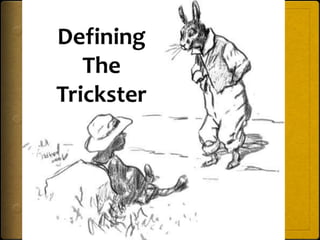
Discussion: Trickster Characters
from our reading
In-class writing: Essay 4: Outline
and thesis.
Assessing Homework Responses
 Class 18: Exam Make-up or Retake Test
 Friday, week 10:
 Essay revision due by noon
 Class 19: Film
 Friday week 11:
 Self assessment due before noon.
 Class 20: Wrapping up the course
 Class 21: Final
 Final Exam Comprehensive Terms test
 Research Paper: Essay #4 due before class
8. Trans: Abbreviation for transgender, transsexual, or some other form of
trans identity. “Trans” can invoke notions of transcending beyond,
existing between, or crossing over borders.
9. Transgender: An umbrella term used to describe people who do not fit
into traditional gender categories, including transsexuals, transvestites
or cross-dressers, intersexuals or hermaphrodites, and sometimes, even
people who identify as butch or femme. Can invoke notions of
transcending beyond, existing between or crossing over borders.
10. Transition: The period when one is changing from living as one sex or
gender to a different conception of sex or gender. Transitioning is
complicated, multi-step process that may include surgically and/or
hormonally altering one’s body.
Terms
11. Transsexuals: People who indicate that they are of one gender trapped in the
body of the other gender. A person who has altered or intends to alter her/hir/his
anatomy, either through surgery, hormones, or other means, to better match
her/hir/his chosen gender identity. This group of people is often divided into pre-
op (operative), post-op, or non-op transsexuals. Due to cost, not all transsexuals
can have genital surgery. Others do not feel that surgery is necessary, but still
remain a transsexual identity.
a. Non-operative: People who do not intend to change their primary sex
characteristics, either because of a lack of a desire or the inability to do so.
They may or may not alter their secondary sex characteristics through the use
of hormones.
b. Pre-operative: People who have started the procedure to reassign their
primary sex characteristics, but have not yet had the surgery. This covers both
those people who have just begun the procedure and those who are very close
to the actual surgery.
c. Post-operative: People who have had the actual genital surgery done. These
12. Transphobia:
 The fear or hatred of transgender and transsexual
people. Like biphobia, this term was created to call
attention to the ways prejudice against trans people
differs from prejudice against other queer people.
There is often transphobia in lesbian, gay and
bisexual communities, as well as heterosexual or
straight communities.
13. Persona: a character in drama or fiction or the part any one
sustains in the world or in a book. Persona also denotes the
“I” who speaks in a poem or novel.
14. Plot: a plan or scheme to accomplish a purpose. In literature,
this is the arrangement of events to achieve an intended
effect consisting of a series of carefully devised and
interrelated actions that progresses through a struggle of
opposing forces, called conflict, to a climax and a
denouement (final resolution). This is different from story or
story line, which is the order of events as they occur.
15. Point of view: a specified position or method of consideration
and appraisal. It may also be an attitude, judgment, or
opinion. In literature, physical point of view has to do with the
position in time and space from which a writer approaches,
views, and describes his or her material. Mental point of view
involves an author’s feeling and attitude toward his or her
subject. Personal point of view concerns the relation through
which a writer narrates or discusses a subject, whether first,
second, or third person.
16. Prose : the ordinary form of spoken and written language
whose unit is the sentence, rather than the line as it is in
poetry. The term applies to all expressions in language that
do not have a regular rhythmic pattern.
Which, from our reading, are trickster or trickster-like
characters? Which are trickster tales? What characteristics
make them tricksters? How do we know?
Stone Butch Blues
Passing
Chinglish
"Uncle Willie”
"Passing" and "Who's Passing as Who”
"Recitatif”
"The Passing of Grandison” "Leaves from the Mental Portfolio of an
Eurasian”
Gentleman's Agreement”
"Racial Passing”
The Prompt
 For this essay, consider trickster tales and trickster or
trickster-like characters from our reading. Do they meet
the criteria to be categorized as “tricksters”? Which
measuring stick do we use to determine if they do or
not? Who or what are they in a modern society? When
and why do they appear? Is there a relationship between
tricksters and gender and ethnicity? Do these modern
tricksters, as Lock asserts, help us “better understand
ourselves, and the perhaps subconscious aspects of
ourselves that respond to the trickster’s unsettling and
transformative behavior”? How? Or, do these trickster
tales and trickster or trickster-like characters serve
another purpose? Which?
Break it down!
 Do the trickster characters from our reading meet the criteria to be
categorized as “tricksters”?
 Which measuring stick do we use to determine if they are or not?
 Who or what are they in a modern society?
 When and why do they appear?
 Is there a relationship between tricksters and gender and ethnicity?
 Do these tricksters, as Lock asserts, help us “better understand ourselves,
and the perhaps subconscious aspects of ourselves that respond to the
trickster’s unsettling and transformative behavior”? How?
 Or, do these trickster tales and trickster or trickster-like characters serve
another purpose? Which?
Do the trickster characters from our reading
meet the criteria to be categorized as
“tricksters”?
 How do we answer this? Which
measuring stick do we use to determine
if they do or not?
 How do we convince others that these
are indeed modern tricksters?
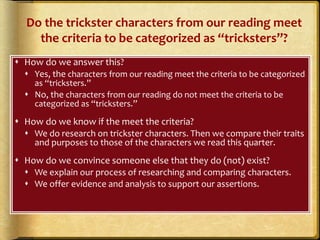
Do the trickster characters from our reading meet
the criteria to be categorized as “tricksters”?
 How do we answer this?
 Yes, the characters from our reading meet the criteria to be categorized
as “tricksters.”
 No, the characters from our reading do not meet the criteria to be
categorized as “tricksters.”
 How do we know if the meet the criteria?
 We do research on trickster characters. Then we compare their traits
and purposes to those of the characters we read this quarter.
 How do we convince someone else that they do (not) exist?
 We explain our process of researching and comparing characters.
 We offer evidence and analysis to support our assertions.
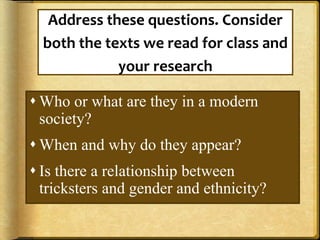
Address these questions. Consider
both the texts we read for class and
your research
 Who or what are they in a modern
society?
 When and why do they appear?
 Is there a relationship between
tricksters and gender and ethnicity?
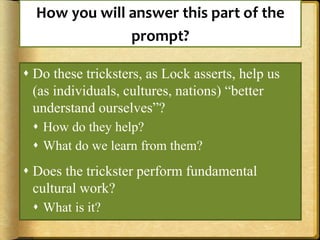
How you will answer this part of the
prompt?
 Do these tricksters, as Lock asserts, help us
(as individuals, cultures, nations) “better
understand ourselves”?
 How do they help?
 What do we learn from them?
 Does the trickster perform fundamental
cultural work?
 What is it?
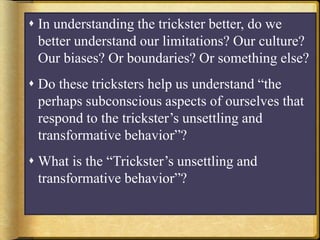
 In understanding the trickster better, do we
better understand our limitations? Our culture?
Our biases? Or boundaries? Or something else?
 Do these tricksters help us understand “the
perhaps subconscious aspects of ourselves that
respond to the trickster’s unsettling and
transformative behavior”?
 What is the “Trickster’s unsettling and
transformative behavior”?
 What “subconscious aspects of ourselves
[do] respond to the trickster’s unsettling
and transformative behavior”?
 How do tricksters help us (as individuals,
cultures, nations) understand subconscious
aspects of ourselves?
 How does understanding the subconscious
aspects of ourselves differ from the
conscious learning that tricksters promote?
Or, do these trickster tales and
trickster or trickster-like
characters serve another purpose?
Which purpose do they serve?
How do you know?
The Prompt
 For this essay, consider trickster tales and trickster or
trickster-like characters from our reading. Do they meet
the criteria to be categorized as “tricksters”? Which
measuring stick do we use to determine if they do or
not? Who or what are they in a modern society? When
and why do they appear? Is there a relationship between
tricksters and gender and ethnicity? Do these modern
tricksters, as Lock asserts, help us “better understand
ourselves, and the perhaps subconscious aspects of
ourselves that respond to the trickster’s unsettling and
transformative behavior”? How? Or, do these trickster
tales and trickster or trickster-like characters serve
another purpose? Which?
The Prompt the Thesis
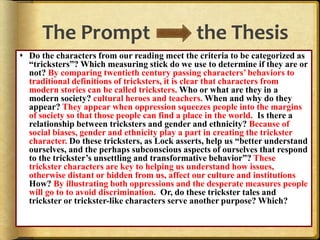
 Do the characters from our reading meet the criteria to be categorized as
“tricksters”? Which measuring stick do we use to determine if they are or
not? By comparing twentieth century passing characters’ behaviors to
traditional definitions of tricksters, it is clear that characters from
modern stories can be called tricksters. Who or what are they in a
modern society? cultural heroes and teachers. When and why do they
appear? They appear when oppression squeezes people into the margins
of society so that those people can find a place in the world. Is there a
relationship between tricksters and gender and ethnicity? Because of
social biases, gender and ethnicity play a part in creating the trickster
character. Do these tricksters, as Lock asserts, help us “better understand
ourselves, and the perhaps subconscious aspects of ourselves that respond
to the trickster’s unsettling and transformative behavior”? These
trickster characters are key to helping us understand how issues,
otherwise distant or hidden from us, affect our culture and institutions
How? By illustrating both oppressions and the desperate measures people
will go to to avoid discrimination. Or, do these trickster tales and
trickster or trickster-like characters serve another purpose? Which?
The Thesis
 By comparing twentieth century passing characters’
behaviors to traditional definitions of tricksters, it is
clear modern tricksters exist in our literature as cultural
heroes and teachers. They appear when oppression
squeezes people into the margins of society, forcing those
people to find a safe place in the world; Because of social
biases, gender and ethnicity play a part in creating these
trickster characters, many of whom are key to helping us
understand how issues, otherwise distant or hidden from
us, affect our culture and institutions. These trickster
characters illustrate both oppressive behaviors and the
desperate measures people will go to to escape them.
The Prompt: Try it!
 For this essay, consider trickster tales and trickster or
trickster-like characters from our reading. Do they meet
the criteria to be categorized as “tricksters”? Which
measuring stick do we use to determine if they do or
not? Who or what are they in a modern society? When
and why do they appear? Is there a relationship between
tricksters and gender and ethnicity? Do these modern
tricksters, as Lock asserts, help us “better understand
ourselves, and the perhaps subconscious aspects of
ourselves that respond to the trickster’s unsettling and
transformative behavior”? How? Or, do these trickster
tales and trickster or trickster-like characters serve
another purpose? Which?
The blogging post points (150) require self-assessment.
Consider three aspects of your responses: First, how many of
the posts did you make? Second, what was the quality of your
response? Third, how timely were your submissions? Write a
short essay justifying your grade. This is an essay like any
other, so make sure you have an intro, a thesis, body
paragraphs, a counterargument if appropriate, and a
conclusion. Due before Friday at noon of week 11.
Self-Assessment
Are there remnants of this early definition of
the trickster in our modern day characters?
Which?
 “Everywhere one looks among premodern peoples, there
are tricky mythical beings alike enough to entice any
human mind to create a category for them once it had
met two or three. They are beings of the beginning,
working in some complex relationship with the High God;
transformers, helping to bring the present human world
into being; performers of heroic acts on behalf of men,
yet in their original form. or in some later form, foolish,
obscene, laughable, yet indomitable” (Robert D. Pelton,
The Trickster in West Africa 15).
Does this definition resonate with us in
terms of our modern trickster characters?
How?
 According to [Paul] Radin, “Trickster is at one
and the same time creator and destroyer,
giver and negator, he who dupes others and
who is always duped himself. . . . He
possesses no values, moral or social, is at the
mercy of his passions and appetites, yet
through his actions all values come into
being” (xxiii).
Do we see our trickster characters in
this more contemporary definition?
Who?
 [The trickster] actually is immoral (or at least amoral)
and blasphemous and rebellious, and his interest in
entering the societal game is not to provide the safety-
valve that makes it tolerable, but to question,
manipulate, and disrupt its rules. He is the consummate
mover of goalposts, constantly redrawing the
boundaries of the possible. In fact, the trickster
suggests, says Hyde, “a method by which a stranger or
underling can enter the game, change its rules, and win
a piece of the action (204)” (Hyde qtd. in Lock).
Can we revise this idea to
apply it to our texts or
characters?
 “Not just any rogue or anti-hero can properly be termed a
trickster. The true trickster’s trickery calls into question
fundamental assumptions about the way the world is
organized, and reveals the possibility of transforming them
(even if often for ignoble ends). In this regard it is not
surprising that innovative uses have been made of the
modern incarnation of the trickster in American novels
produced by writers of dual ethnic or cultural backgrounds,
in whose worlds boundaries have continually to be mediated
and assumptions challenged” (Lock).
Are our modern passers “a more
sophisticated trickster”?
 The self-reflexivity associated with the [contemporary
trickster] is absent in the ancient “unconscious”
trickster, like Wakdjunkaga, whose hands fought each
other and who was unaware that his anus was part of
his own body. The contemporary trickster, by
contrast, is largely self-aware, unlike his/her archaic
counterpart. “[T]he pressures of experience produce
from that somewhat witless character a more
sophisticated trickster” (Lock).
A New Age of Tricksters?
Are they tricky? Or in
Earnest?
 [A] new age brings a transmutation and a new
repertoire of tricks. In fact, we may now have
reached the stage of ultimate ambiguity, where the
trickster’s self-awareness and self-reflexivity call
into question even what is a trick and what is in
earnest, or on what side of the boundary truth lies,
if indeed there are any more “sides” or any
unequivocal truths (Lock).
Post #23 Outline and
thesis for Essay #4
Study: Terms
Submit: Essay
revisions through
Kaizena before Friday
at noon of week 10
Read: Sui Sin Far
“Leaves from the
Mental Portfolio of an
Eurasian”

Ewrt 1 b class 18

  • 2.
    AGENDA Vocab Exam Re-takeor Make-up Class Countdown Presentation: Terms List #4 Discussion: Trickster Characters from our reading In-class writing: Essay 4: Outline and thesis. Assessing Homework Responses
  • 3.
     Class 18:Exam Make-up or Retake Test  Friday, week 10:  Essay revision due by noon  Class 19: Film  Friday week 11:  Self assessment due before noon.  Class 20: Wrapping up the course  Class 21: Final  Final Exam Comprehensive Terms test  Research Paper: Essay #4 due before class
  • 6.
    8. Trans: Abbreviationfor transgender, transsexual, or some other form of trans identity. “Trans” can invoke notions of transcending beyond, existing between, or crossing over borders. 9. Transgender: An umbrella term used to describe people who do not fit into traditional gender categories, including transsexuals, transvestites or cross-dressers, intersexuals or hermaphrodites, and sometimes, even people who identify as butch or femme. Can invoke notions of transcending beyond, existing between or crossing over borders. 10. Transition: The period when one is changing from living as one sex or gender to a different conception of sex or gender. Transitioning is complicated, multi-step process that may include surgically and/or hormonally altering one’s body.
  • 7.
    Terms 11. Transsexuals: Peoplewho indicate that they are of one gender trapped in the body of the other gender. A person who has altered or intends to alter her/hir/his anatomy, either through surgery, hormones, or other means, to better match her/hir/his chosen gender identity. This group of people is often divided into pre- op (operative), post-op, or non-op transsexuals. Due to cost, not all transsexuals can have genital surgery. Others do not feel that surgery is necessary, but still remain a transsexual identity. a. Non-operative: People who do not intend to change their primary sex characteristics, either because of a lack of a desire or the inability to do so. They may or may not alter their secondary sex characteristics through the use of hormones. b. Pre-operative: People who have started the procedure to reassign their primary sex characteristics, but have not yet had the surgery. This covers both those people who have just begun the procedure and those who are very close to the actual surgery. c. Post-operative: People who have had the actual genital surgery done. These
  • 8.
    12. Transphobia:  Thefear or hatred of transgender and transsexual people. Like biphobia, this term was created to call attention to the ways prejudice against trans people differs from prejudice against other queer people. There is often transphobia in lesbian, gay and bisexual communities, as well as heterosexual or straight communities.
  • 9.
    13. Persona: acharacter in drama or fiction or the part any one sustains in the world or in a book. Persona also denotes the “I” who speaks in a poem or novel. 14. Plot: a plan or scheme to accomplish a purpose. In literature, this is the arrangement of events to achieve an intended effect consisting of a series of carefully devised and interrelated actions that progresses through a struggle of opposing forces, called conflict, to a climax and a denouement (final resolution). This is different from story or story line, which is the order of events as they occur.
  • 10.
    15. Point ofview: a specified position or method of consideration and appraisal. It may also be an attitude, judgment, or opinion. In literature, physical point of view has to do with the position in time and space from which a writer approaches, views, and describes his or her material. Mental point of view involves an author’s feeling and attitude toward his or her subject. Personal point of view concerns the relation through which a writer narrates or discusses a subject, whether first, second, or third person. 16. Prose : the ordinary form of spoken and written language whose unit is the sentence, rather than the line as it is in poetry. The term applies to all expressions in language that do not have a regular rhythmic pattern.
  • 12.
    Which, from ourreading, are trickster or trickster-like characters? Which are trickster tales? What characteristics make them tricksters? How do we know? Stone Butch Blues Passing Chinglish "Uncle Willie” "Passing" and "Who's Passing as Who” "Recitatif” "The Passing of Grandison” "Leaves from the Mental Portfolio of an Eurasian” Gentleman's Agreement” "Racial Passing”
  • 14.
    The Prompt  Forthis essay, consider trickster tales and trickster or trickster-like characters from our reading. Do they meet the criteria to be categorized as “tricksters”? Which measuring stick do we use to determine if they do or not? Who or what are they in a modern society? When and why do they appear? Is there a relationship between tricksters and gender and ethnicity? Do these modern tricksters, as Lock asserts, help us “better understand ourselves, and the perhaps subconscious aspects of ourselves that respond to the trickster’s unsettling and transformative behavior”? How? Or, do these trickster tales and trickster or trickster-like characters serve another purpose? Which?
  • 15.
    Break it down! Do the trickster characters from our reading meet the criteria to be categorized as “tricksters”?  Which measuring stick do we use to determine if they are or not?  Who or what are they in a modern society?  When and why do they appear?  Is there a relationship between tricksters and gender and ethnicity?  Do these tricksters, as Lock asserts, help us “better understand ourselves, and the perhaps subconscious aspects of ourselves that respond to the trickster’s unsettling and transformative behavior”? How?  Or, do these trickster tales and trickster or trickster-like characters serve another purpose? Which?
  • 16.
    Do the trickstercharacters from our reading meet the criteria to be categorized as “tricksters”?  How do we answer this? Which measuring stick do we use to determine if they do or not?  How do we convince others that these are indeed modern tricksters?
  • 17.
    Do the trickstercharacters from our reading meet the criteria to be categorized as “tricksters”?  How do we answer this?  Yes, the characters from our reading meet the criteria to be categorized as “tricksters.”  No, the characters from our reading do not meet the criteria to be categorized as “tricksters.”  How do we know if the meet the criteria?  We do research on trickster characters. Then we compare their traits and purposes to those of the characters we read this quarter.  How do we convince someone else that they do (not) exist?  We explain our process of researching and comparing characters.  We offer evidence and analysis to support our assertions.
  • 18.
    Address these questions.Consider both the texts we read for class and your research  Who or what are they in a modern society?  When and why do they appear?  Is there a relationship between tricksters and gender and ethnicity?
  • 19.
    How you willanswer this part of the prompt?  Do these tricksters, as Lock asserts, help us (as individuals, cultures, nations) “better understand ourselves”?  How do they help?  What do we learn from them?  Does the trickster perform fundamental cultural work?  What is it?
  • 20.
     In understandingthe trickster better, do we better understand our limitations? Our culture? Our biases? Or boundaries? Or something else?  Do these tricksters help us understand “the perhaps subconscious aspects of ourselves that respond to the trickster’s unsettling and transformative behavior”?  What is the “Trickster’s unsettling and transformative behavior”?
  • 21.
     What “subconsciousaspects of ourselves [do] respond to the trickster’s unsettling and transformative behavior”?  How do tricksters help us (as individuals, cultures, nations) understand subconscious aspects of ourselves?  How does understanding the subconscious aspects of ourselves differ from the conscious learning that tricksters promote?
  • 22.
    Or, do thesetrickster tales and trickster or trickster-like characters serve another purpose? Which purpose do they serve? How do you know?
  • 23.
    The Prompt  Forthis essay, consider trickster tales and trickster or trickster-like characters from our reading. Do they meet the criteria to be categorized as “tricksters”? Which measuring stick do we use to determine if they do or not? Who or what are they in a modern society? When and why do they appear? Is there a relationship between tricksters and gender and ethnicity? Do these modern tricksters, as Lock asserts, help us “better understand ourselves, and the perhaps subconscious aspects of ourselves that respond to the trickster’s unsettling and transformative behavior”? How? Or, do these trickster tales and trickster or trickster-like characters serve another purpose? Which?
  • 24.
    The Prompt theThesis  Do the characters from our reading meet the criteria to be categorized as “tricksters”? Which measuring stick do we use to determine if they are or not? By comparing twentieth century passing characters’ behaviors to traditional definitions of tricksters, it is clear that characters from modern stories can be called tricksters. Who or what are they in a modern society? cultural heroes and teachers. When and why do they appear? They appear when oppression squeezes people into the margins of society so that those people can find a place in the world. Is there a relationship between tricksters and gender and ethnicity? Because of social biases, gender and ethnicity play a part in creating the trickster character. Do these tricksters, as Lock asserts, help us “better understand ourselves, and the perhaps subconscious aspects of ourselves that respond to the trickster’s unsettling and transformative behavior”? These trickster characters are key to helping us understand how issues, otherwise distant or hidden from us, affect our culture and institutions How? By illustrating both oppressions and the desperate measures people will go to to avoid discrimination. Or, do these trickster tales and trickster or trickster-like characters serve another purpose? Which?
  • 25.
    The Thesis  Bycomparing twentieth century passing characters’ behaviors to traditional definitions of tricksters, it is clear modern tricksters exist in our literature as cultural heroes and teachers. They appear when oppression squeezes people into the margins of society, forcing those people to find a safe place in the world; Because of social biases, gender and ethnicity play a part in creating these trickster characters, many of whom are key to helping us understand how issues, otherwise distant or hidden from us, affect our culture and institutions. These trickster characters illustrate both oppressive behaviors and the desperate measures people will go to to escape them.
  • 26.
    The Prompt: Tryit!  For this essay, consider trickster tales and trickster or trickster-like characters from our reading. Do they meet the criteria to be categorized as “tricksters”? Which measuring stick do we use to determine if they do or not? Who or what are they in a modern society? When and why do they appear? Is there a relationship between tricksters and gender and ethnicity? Do these modern tricksters, as Lock asserts, help us “better understand ourselves, and the perhaps subconscious aspects of ourselves that respond to the trickster’s unsettling and transformative behavior”? How? Or, do these trickster tales and trickster or trickster-like characters serve another purpose? Which?
  • 27.
    The blogging postpoints (150) require self-assessment. Consider three aspects of your responses: First, how many of the posts did you make? Second, what was the quality of your response? Third, how timely were your submissions? Write a short essay justifying your grade. This is an essay like any other, so make sure you have an intro, a thesis, body paragraphs, a counterargument if appropriate, and a conclusion. Due before Friday at noon of week 11. Self-Assessment
  • 29.
    Are there remnantsof this early definition of the trickster in our modern day characters? Which?  “Everywhere one looks among premodern peoples, there are tricky mythical beings alike enough to entice any human mind to create a category for them once it had met two or three. They are beings of the beginning, working in some complex relationship with the High God; transformers, helping to bring the present human world into being; performers of heroic acts on behalf of men, yet in their original form. or in some later form, foolish, obscene, laughable, yet indomitable” (Robert D. Pelton, The Trickster in West Africa 15).
  • 30.
    Does this definitionresonate with us in terms of our modern trickster characters? How?  According to [Paul] Radin, “Trickster is at one and the same time creator and destroyer, giver and negator, he who dupes others and who is always duped himself. . . . He possesses no values, moral or social, is at the mercy of his passions and appetites, yet through his actions all values come into being” (xxiii).
  • 31.
    Do we seeour trickster characters in this more contemporary definition? Who?  [The trickster] actually is immoral (or at least amoral) and blasphemous and rebellious, and his interest in entering the societal game is not to provide the safety- valve that makes it tolerable, but to question, manipulate, and disrupt its rules. He is the consummate mover of goalposts, constantly redrawing the boundaries of the possible. In fact, the trickster suggests, says Hyde, “a method by which a stranger or underling can enter the game, change its rules, and win a piece of the action (204)” (Hyde qtd. in Lock).
  • 32.
    Can we revisethis idea to apply it to our texts or characters?  “Not just any rogue or anti-hero can properly be termed a trickster. The true trickster’s trickery calls into question fundamental assumptions about the way the world is organized, and reveals the possibility of transforming them (even if often for ignoble ends). In this regard it is not surprising that innovative uses have been made of the modern incarnation of the trickster in American novels produced by writers of dual ethnic or cultural backgrounds, in whose worlds boundaries have continually to be mediated and assumptions challenged” (Lock).
  • 33.
    Are our modernpassers “a more sophisticated trickster”?  The self-reflexivity associated with the [contemporary trickster] is absent in the ancient “unconscious” trickster, like Wakdjunkaga, whose hands fought each other and who was unaware that his anus was part of his own body. The contemporary trickster, by contrast, is largely self-aware, unlike his/her archaic counterpart. “[T]he pressures of experience produce from that somewhat witless character a more sophisticated trickster” (Lock).
  • 34.
    A New Ageof Tricksters? Are they tricky? Or in Earnest?  [A] new age brings a transmutation and a new repertoire of tricks. In fact, we may now have reached the stage of ultimate ambiguity, where the trickster’s self-awareness and self-reflexivity call into question even what is a trick and what is in earnest, or on what side of the boundary truth lies, if indeed there are any more “sides” or any unequivocal truths (Lock).
  • 35.
    Post #23 Outlineand thesis for Essay #4 Study: Terms Submit: Essay revisions through Kaizena before Friday at noon of week 10 Read: Sui Sin Far “Leaves from the Mental Portfolio of an Eurasian”