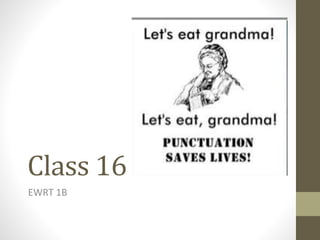
Class 16
EWRT 1B
AGENDA
• Exam 3: Terms
• Quarter Countdown
• Change Teams
• Exam #4 Terms
• Presentation: Introduction to
Essay #4 Discussion: Chinglish:
• "Defining the Trickster" and Locke:
"Transformation of the Trickster.”
• In-class writing: Evaluating a
passing character as a Trickster
Character.
Exam 3: Vocab and Terms
15 minutes
• Answer all 25 questions;
there are questions on the
back.
• Extra credit to anyone who
can identify one or both of
the authors of these two
examples that I used to
demonstrate figurative
language.
• “All the world’s a stage”
• The apparition of these
faces in the crowd; Petals
on a wet, black bough.
• Class 17: Library Workshop
• Class 18: Exam Make-up or Retake Test
• Friday, week 10:
• Essay revision due by noon
• Class 19: Film
• Class 20: Wrapping up the course
• Friday, week 11:
• Self assessment due before noon.
• Class 21: Final
• Final Exam Comprehensive Terms test
• Research Paper: Essay #4 due before class
TermsforExam4:A ComprehensiveTest
1. Gender Identity: The sense of “being” male or “being” female. For some
people, gender identity is in accord with physical anatomy. For
transgender people, gender identity may differ from physical anatomy or
expected social roles. It is important to note that gender identity,
biological sex, and sexual orientation are not necessarily linked.
2. Heterosexism: The concept that heterosexuality is natural, normal,
superior and required. A system of beliefs about the superiority of
heterosexuals or heterosexuality evidenced in the exclusion, by omission
or design, of gay, lesbian and bisexual persons in assumptions,
communication, policies, procedures, events, or activities.
3. Heterosexual: A person who is primarily and/or exclusively attracted to
members of a gender or sex that is seen to be “opposite” or other than
the one with which they identify or are identified.
4. Homosexual: A person who is primarily and /or exclusively attracted to
members of what they identify as their own sex or gender. Because the
term possesses connotations of disease and abnormality, some people do
not like to identify as homosexual. Still others do not feel that it accurately
defines their chosen identity.
5. Lesbian: One who identifies as a woman who is primarily or exclusively
attracted to others who identify as women.
6. Sex Reassignment (SRS): A surgical procedure that modifies one’s primary
and/or secondary sex characteristics. This process was formerly called a
“sex change operation,” a phrase now considered offensive.
7. Sexual Orientation: A person’s emotional, physical and sexual attraction
and the expression of that attraction with other individuals. Some of the
better-known labels or categories include “bisexual,” “multisexual,”
“pansexual,” “omnisexual,” “lesbian,” “gay” (“homosexual” is a more
clinical term), or “heterosexual.”
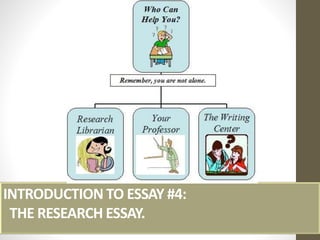
INTRODUCTION TO ESSAY #4:
THE RESEARCH ESSAY.
Introduction to Essay #4:
The Research Essay.
• Trickster characters have existed in stories from
most cultures since the earliest times. The long-
lasting appeal of this archetype (a recurring
symbol of a recurring model) emphasizes the
cultural need to acknowledge that all is not what
it seems to be, that we need to be on the lookout
for those who would fool us. It is not hard to
account for the appeal of tricksters—they are fun
in their radical assault on the status quo, yet their
trickery also strikes a deeper chord for most
people.
As societies have evolved, the cultural function of the trickster has
been reinvented: who or what are they in a modern society? When
and why do they appear?
Helen Lock, in her essay “Transformations of the Trickster,” writes,
Contentious issues include the status of the archaic archetypal
tricksters (were they mortal or divine? can a god be a trickster?), the
relation of tricksters to gender and to ethnicity, and the vexed question
of whether modern tricksters exist at all. In one sense it does seem
entirely appropriate that these embodiments of ambiguity (no dispute
there, at least) should remain so elusive. However, it is still important
to address these tricky questions because the trickster performs such
fundamental cultural work: in understanding the trickster better, we
better understand ourselves, and the perhaps subconscious aspects
of ourselves that respond to the trickster’s unsettling and
transformative behavior.
Topic:
For this essay, consider trickster tales and trickster or trickster-
like characters from our reading. Do they meet the criteria to
be categorized as “tricksters”? Which measuring stick do we
use to determine if they are or not? Who or what are they in a
modern society? When and why do they appear? Is there a
relationship between tricksters and gender and ethnicity? Do
these modern tricksters, as Lock asserts, help us “better
understand ourselves, and the perhaps subconscious aspects of
ourselves that respond to the trickster’s unsettling and
transformative behavior”? How? Or, do these trickster tales
and trickster or trickster-like characters serve another purpose?
Which?
Length: Your finished text should be between five
and seven pages, excluding the Works Cited page.
The Works Cited page for this research project must contain at
least three NEW secondary source entries. These cannot include
articles we read in class. Two of these must be from either books
or articles from a scholarly journal; the other may be a website or
an article from a popular magazine or periodical, such as Time,
National Geographic, or the LA Times. You must also cite any
primary or secondary texts you use that we read in class.
Remember, you can also draw on your own experiences and
knowledge to discuss, explain, and analyze the texts you choose
to support your assertion.
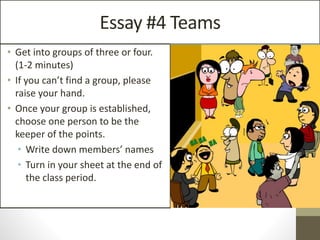
Essay #4 Teams
• Get into groups of three or four.
(1-2 minutes)
• If you can’t find a group, please
raise your hand.
• Once your group is established,
choose one person to be the
keeper of the points.
• Write down members’ names
• Turn in your sheet at the end of
the class period.
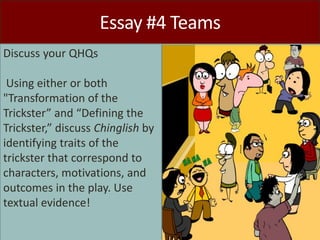
Essay #4 Teams
Discuss your QHQs
Using either or both
"Transformation of the
Trickster” and “Defining the
Trickster,” discuss Chinglish by
identifying traits of the
trickster that correspond to
characters, motivations, and
outcomes in the play. Use
textual evidence!
TraitsoftheTrickster
Review
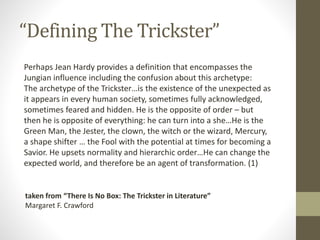
“Defining The Trickster”
Perhaps Jean Hardy provides a definition that encompasses the
Jungian influence including the confusion about this archetype:
The archetype of the Trickster…is the existence of the unexpected as
it appears in every human society, sometimes fully acknowledged,
sometimes feared and hidden. He is the opposite of order – but
then he is opposite of everything: he can turn into a she…He is the
Green Man, the Jester, the clown, the witch or the wizard, Mercury,
a shape shifter … the Fool with the potential at times for becoming a
Savior. He upsets normality and hierarchic order…He can change the
expected world, and therefore be an agent of transformation. (1)
taken from “There Is No Box: The Trickster in Literature”
Margaret F. Crawford
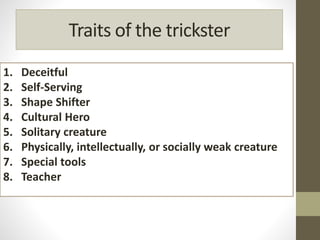
Traits of the trickster
1. Deceitful
2. Self-Serving
3. Shape Shifter
4. Cultural Hero
5. Solitary creature
6. Physically, intellectually, or socially weak creature
7. Special tools
8. Teacher
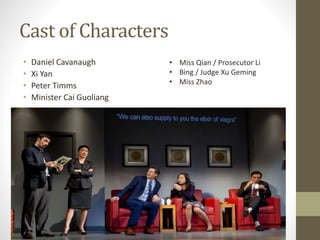
Cast of Characters
• Daniel Cavanaugh
• Xi Yan
• Peter Timms
• Minister Cai Guoliang
• Miss Qian / Prosecutor Li
• Bing / Judge Xu Geming
• Miss Zhao
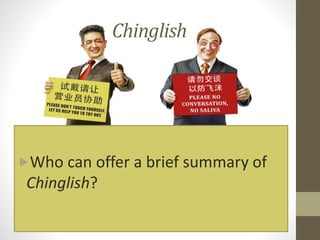
Chinglish
Who can offer a brief summary of
Chinglish?
QHQs
• Q: How was the relationship really between Xi and
her husband?
• Q: Why does Qian interpret if his English translations
are wrong?
• Q: Does Qian’s translation influence Cai’s decision?
• Q. Though comedic relief is a great way of portraying
these ideas and misconnections, does this type of
play bring together two different cultures?
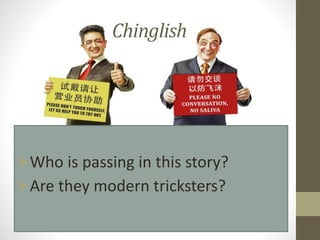
Chinglish
Who is passing in this story?
Are they modern tricksters?
QHQs
• Q: How many characters display trickster traits in
Chinglish, and what is their motive?
• Q: How many traits of trickster does Daniel
Cavanaugh have?
• Q: What are the trickster abilities that Xi
demonstrates and how does this affect the outcome
of the play?
• Q. Is the play Chinglish relevant in today’s society
and do people use these acts of being a trickster and
misunderstanding to their benefit?
Readings to Consider
• Novels
• Stone Butch Blues by Leslie Feinberg
• Passing by Nella Larsen
• Drama
• Chinglish by David Henry Hwang
• Short Stories
• "Uncle Willie" by Maya Angelou
• "Passing" and "Who's Passing as Who" by Langston Hughes
• "Recitatif" by Toni Morrison
• "The Passing of Grandison" by Charles Chesnutt
In Class Writing: Passing
Characters as Trickster Character:
1. Choose a new passing character: How can we envision him or
her as a Trickster character?
2. Which of the definitions does he or she fit?
3. What are his or her goals as a trickster?
4. How many ways is he or she fooling people?
5. What is his or her motivation?
6. What are the outcomes?
7. Does the passing character help us “better understand
ourselves, and the perhaps subconscious aspects of ourselves
that respond to the trickster’s unsettling and transformative
behavior”? How? Or does she/he serve another purpose?
Which?
• We have a sense of the what a trickster
tale/character is from the reading we have done in
the last couple of days, but to get a better idea of
both that and ways to approach a paper on the
topic, we will work with the librarian to start our
research. We will be looking for information about
conventional definitions that we can connect to (or
disconnect from) the passing characters we have
been reading about. Then, you can do some
research to find an interesting angle to use: outlaw
tricksters, gender tricksters, female tricksters.
Homework
• Study: Terms for make-up test class 18
• Post #20: Discuss one or more characters
from our course reading in terms of one of the
traits we discussed in class today. For example,
consider Jack as deceitful or Clare or Irene as
self-serving; Jess Goldberg as a “shape shifter”
or “cultural hero”; maybe even the Iowans as
“teachers.” Any of these characters might be
discussed as “agents of change.”
• Prepare for the Library workshop: Consider
who and what you might consider as a focus.
Remember, you must read before you will
know what you are looking for; otherwise, it
wouldn’t be a research paper.

Ewrt1b class16 qhq

  • 1.
  • 2.
    AGENDA • Exam 3:Terms • Quarter Countdown • Change Teams • Exam #4 Terms • Presentation: Introduction to Essay #4 Discussion: Chinglish: • "Defining the Trickster" and Locke: "Transformation of the Trickster.” • In-class writing: Evaluating a passing character as a Trickster Character.
  • 3.
    Exam 3: Vocaband Terms 15 minutes • Answer all 25 questions; there are questions on the back. • Extra credit to anyone who can identify one or both of the authors of these two examples that I used to demonstrate figurative language. • “All the world’s a stage” • The apparition of these faces in the crowd; Petals on a wet, black bough.
  • 4.
    • Class 17:Library Workshop • Class 18: Exam Make-up or Retake Test • Friday, week 10: • Essay revision due by noon • Class 19: Film • Class 20: Wrapping up the course • Friday, week 11: • Self assessment due before noon. • Class 21: Final • Final Exam Comprehensive Terms test • Research Paper: Essay #4 due before class
  • 5.
    TermsforExam4:A ComprehensiveTest 1. GenderIdentity: The sense of “being” male or “being” female. For some people, gender identity is in accord with physical anatomy. For transgender people, gender identity may differ from physical anatomy or expected social roles. It is important to note that gender identity, biological sex, and sexual orientation are not necessarily linked. 2. Heterosexism: The concept that heterosexuality is natural, normal, superior and required. A system of beliefs about the superiority of heterosexuals or heterosexuality evidenced in the exclusion, by omission or design, of gay, lesbian and bisexual persons in assumptions, communication, policies, procedures, events, or activities. 3. Heterosexual: A person who is primarily and/or exclusively attracted to members of a gender or sex that is seen to be “opposite” or other than the one with which they identify or are identified.
  • 6.
    4. Homosexual: Aperson who is primarily and /or exclusively attracted to members of what they identify as their own sex or gender. Because the term possesses connotations of disease and abnormality, some people do not like to identify as homosexual. Still others do not feel that it accurately defines their chosen identity. 5. Lesbian: One who identifies as a woman who is primarily or exclusively attracted to others who identify as women. 6. Sex Reassignment (SRS): A surgical procedure that modifies one’s primary and/or secondary sex characteristics. This process was formerly called a “sex change operation,” a phrase now considered offensive. 7. Sexual Orientation: A person’s emotional, physical and sexual attraction and the expression of that attraction with other individuals. Some of the better-known labels or categories include “bisexual,” “multisexual,” “pansexual,” “omnisexual,” “lesbian,” “gay” (“homosexual” is a more clinical term), or “heterosexual.”
  • 7.
    INTRODUCTION TO ESSAY#4: THE RESEARCH ESSAY.
  • 8.
    Introduction to Essay#4: The Research Essay. • Trickster characters have existed in stories from most cultures since the earliest times. The long- lasting appeal of this archetype (a recurring symbol of a recurring model) emphasizes the cultural need to acknowledge that all is not what it seems to be, that we need to be on the lookout for those who would fool us. It is not hard to account for the appeal of tricksters—they are fun in their radical assault on the status quo, yet their trickery also strikes a deeper chord for most people.
  • 9.
    As societies haveevolved, the cultural function of the trickster has been reinvented: who or what are they in a modern society? When and why do they appear? Helen Lock, in her essay “Transformations of the Trickster,” writes, Contentious issues include the status of the archaic archetypal tricksters (were they mortal or divine? can a god be a trickster?), the relation of tricksters to gender and to ethnicity, and the vexed question of whether modern tricksters exist at all. In one sense it does seem entirely appropriate that these embodiments of ambiguity (no dispute there, at least) should remain so elusive. However, it is still important to address these tricky questions because the trickster performs such fundamental cultural work: in understanding the trickster better, we better understand ourselves, and the perhaps subconscious aspects of ourselves that respond to the trickster’s unsettling and transformative behavior.
  • 10.
    Topic: For this essay,consider trickster tales and trickster or trickster- like characters from our reading. Do they meet the criteria to be categorized as “tricksters”? Which measuring stick do we use to determine if they are or not? Who or what are they in a modern society? When and why do they appear? Is there a relationship between tricksters and gender and ethnicity? Do these modern tricksters, as Lock asserts, help us “better understand ourselves, and the perhaps subconscious aspects of ourselves that respond to the trickster’s unsettling and transformative behavior”? How? Or, do these trickster tales and trickster or trickster-like characters serve another purpose? Which?
  • 11.
    Length: Your finishedtext should be between five and seven pages, excluding the Works Cited page. The Works Cited page for this research project must contain at least three NEW secondary source entries. These cannot include articles we read in class. Two of these must be from either books or articles from a scholarly journal; the other may be a website or an article from a popular magazine or periodical, such as Time, National Geographic, or the LA Times. You must also cite any primary or secondary texts you use that we read in class. Remember, you can also draw on your own experiences and knowledge to discuss, explain, and analyze the texts you choose to support your assertion.
  • 12.
    Essay #4 Teams •Get into groups of three or four. (1-2 minutes) • If you can’t find a group, please raise your hand. • Once your group is established, choose one person to be the keeper of the points. • Write down members’ names • Turn in your sheet at the end of the class period.
  • 13.
    Essay #4 Teams Discussyour QHQs Using either or both "Transformation of the Trickster” and “Defining the Trickster,” discuss Chinglish by identifying traits of the trickster that correspond to characters, motivations, and outcomes in the play. Use textual evidence!
  • 14.
  • 15.
    “Defining The Trickster” PerhapsJean Hardy provides a definition that encompasses the Jungian influence including the confusion about this archetype: The archetype of the Trickster…is the existence of the unexpected as it appears in every human society, sometimes fully acknowledged, sometimes feared and hidden. He is the opposite of order – but then he is opposite of everything: he can turn into a she…He is the Green Man, the Jester, the clown, the witch or the wizard, Mercury, a shape shifter … the Fool with the potential at times for becoming a Savior. He upsets normality and hierarchic order…He can change the expected world, and therefore be an agent of transformation. (1) taken from “There Is No Box: The Trickster in Literature” Margaret F. Crawford
  • 16.
    Traits of thetrickster 1. Deceitful 2. Self-Serving 3. Shape Shifter 4. Cultural Hero 5. Solitary creature 6. Physically, intellectually, or socially weak creature 7. Special tools 8. Teacher
  • 17.
    Cast of Characters •Daniel Cavanaugh • Xi Yan • Peter Timms • Minister Cai Guoliang • Miss Qian / Prosecutor Li • Bing / Judge Xu Geming • Miss Zhao
  • 18.
    Chinglish Who can offera brief summary of Chinglish?
  • 19.
    QHQs • Q: Howwas the relationship really between Xi and her husband? • Q: Why does Qian interpret if his English translations are wrong? • Q: Does Qian’s translation influence Cai’s decision? • Q. Though comedic relief is a great way of portraying these ideas and misconnections, does this type of play bring together two different cultures?
  • 20.
    Chinglish Who is passingin this story? Are they modern tricksters?
  • 21.
    QHQs • Q: Howmany characters display trickster traits in Chinglish, and what is their motive? • Q: How many traits of trickster does Daniel Cavanaugh have? • Q: What are the trickster abilities that Xi demonstrates and how does this affect the outcome of the play? • Q. Is the play Chinglish relevant in today’s society and do people use these acts of being a trickster and misunderstanding to their benefit?
  • 22.
    Readings to Consider •Novels • Stone Butch Blues by Leslie Feinberg • Passing by Nella Larsen • Drama • Chinglish by David Henry Hwang • Short Stories • "Uncle Willie" by Maya Angelou • "Passing" and "Who's Passing as Who" by Langston Hughes • "Recitatif" by Toni Morrison • "The Passing of Grandison" by Charles Chesnutt
  • 23.
    In Class Writing:Passing Characters as Trickster Character: 1. Choose a new passing character: How can we envision him or her as a Trickster character? 2. Which of the definitions does he or she fit? 3. What are his or her goals as a trickster? 4. How many ways is he or she fooling people? 5. What is his or her motivation? 6. What are the outcomes? 7. Does the passing character help us “better understand ourselves, and the perhaps subconscious aspects of ourselves that respond to the trickster’s unsettling and transformative behavior”? How? Or does she/he serve another purpose? Which?
  • 24.
    • We havea sense of the what a trickster tale/character is from the reading we have done in the last couple of days, but to get a better idea of both that and ways to approach a paper on the topic, we will work with the librarian to start our research. We will be looking for information about conventional definitions that we can connect to (or disconnect from) the passing characters we have been reading about. Then, you can do some research to find an interesting angle to use: outlaw tricksters, gender tricksters, female tricksters.
  • 25.
    Homework • Study: Termsfor make-up test class 18 • Post #20: Discuss one or more characters from our course reading in terms of one of the traits we discussed in class today. For example, consider Jack as deceitful or Clare or Irene as self-serving; Jess Goldberg as a “shape shifter” or “cultural hero”; maybe even the Iowans as “teachers.” Any of these characters might be discussed as “agents of change.” • Prepare for the Library workshop: Consider who and what you might consider as a focus. Remember, you must read before you will know what you are looking for; otherwise, it wouldn’t be a research paper.