Developing a Comprehensive
Framework for Reducing
Corruption Through Both
Supply Side And Demand Side
Interventions
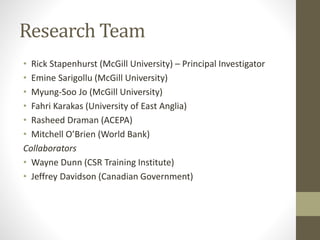
Research Team
• Rick Stapenhurst (McGill University) – Principal Investigator
• Emine Sarigollu (McGill University)
• Myung-Soo Jo (McGill University)
• Fahri Karakas (University of East Anglia)
• Rasheed Draman (ACEPA)
• Mitchell O’Brien (World Bank)
Collaborators
• Wayne Dunn (CSR Training Institute)
• Jeffrey Davidson (Canadian Government)
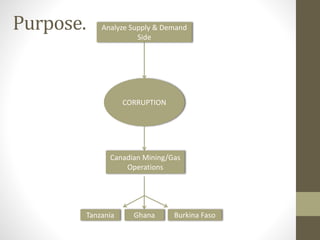
Purpose.
CORRUPTION
Analyze Supply & Demand
Side
Canadian Mining/Gas
Operations
Tanzania Ghana Burkina Faso
Objectives. 1. Link
corruption, CSR
initiatives,
stakeholder
engagement
with oversight
Objectives. 1. Link
corruption, CSR
initiatives,
stakeholder
engagement
with oversight
2. Reactivity of
corporate anti-
corruption
programs and
CSR activities
Objectives. 1. Link
corruption, CSR
initiatives,
stakeholder
engagement
with oversight
2. Reactivity of
corporate anti-
corruption
programs and
CSR activities
3. Examine role
of host
government
Objectives. 1. Link
corruption, CSR
initiatives,
stakeholder
engagement
with oversight
2. Reactivity of
corporate anti-
corruption
programs and
CSR activities
3. Examine role
of host
government
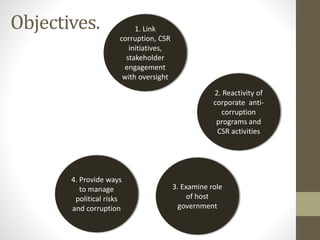
4. Provide ways
to manage
political risks
and corruption
Objectives. 1. Link
corruption, CSR
initiatives,
stakeholder
engagement
with oversight
2. Reactivity of
corporate anti-
corruption
programs and
CSR activities
3. Examine role
of host
government
4. Provide ways
to manage
political risks
and corruption
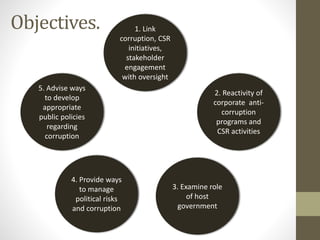
5. Advise ways
to develop
appropriate
public policies
regarding
corruption
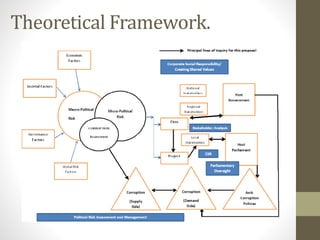
Theoretical Framework.
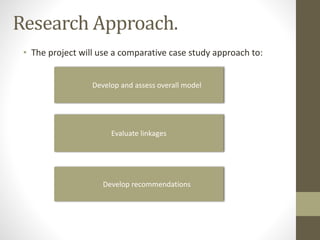
• The project will use a comparative case study approach to:
Research Approach.
Develop and assess overall model
Evaluate linkages
Develop recommendations
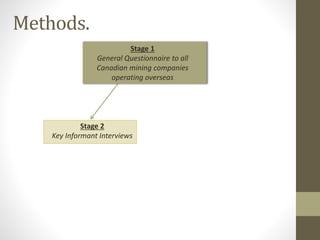
Methods.
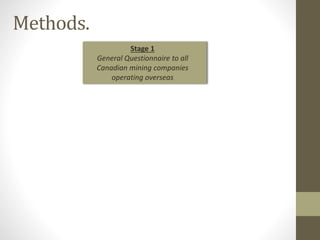
Stage 1
General Questionnaire to all
Canadian mining companies
operating overseas
Methods.
Stage 2
Key Informant Interviews
Stage 1
General Questionnaire to all
Canadian mining companies
operating overseas
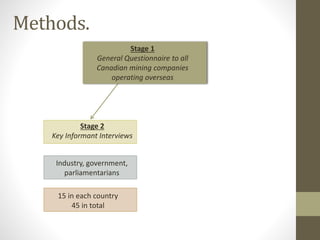
Methods.
Stage 2
Key Informant Interviews
15 in each country
45 in total
Stage 1
General Questionnaire to all
Canadian mining companies
operating overseas
Industry, government,
parliamentarians
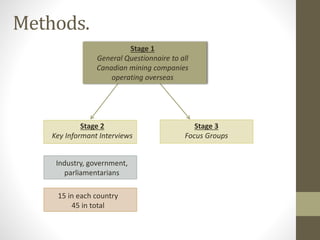
Methods.
Stage 2
Key Informant Interviews
15 in each country
45 in total
Stage 1
General Questionnaire to all
Canadian mining companies
operating overseas
Stage 3
Focus Groups
Industry, government,
parliamentarians
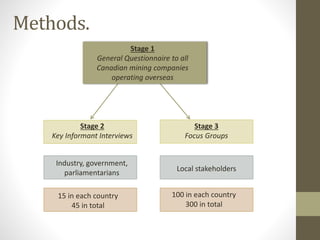
Methods.
Stage 2
Key Informant Interviews
15 in each country
45 in total
Stage 1
General Questionnaire to all
Canadian mining companies
operating overseas
Stage 3
Focus Groups
100 in each country
300 in total
Local stakeholders
Industry, government,
parliamentarians
Expected outcomes.
Social OutcomesSocial Outcomes
1. Help extractive companies better
assess micro-political risks
2. Develop successful and proactive
corporate policies to mitigate
corruption
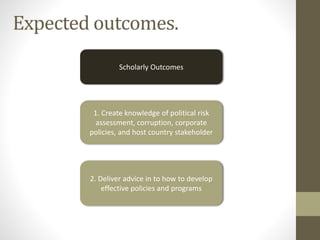
Expected outcomes.
Scholarly Outcomes
1. Create knowledge of political risk
assessment, corruption, corporate
policies, and host country stakeholder
2. Deliver advice in to how to develop
effective policies and programs
Dissemination.
Two Validation
Seminars/
Workshop in West
and East Africa
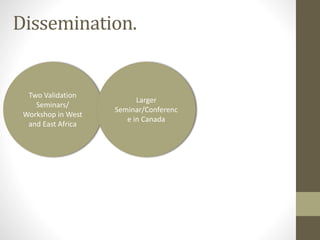
Dissemination.
Two Validation
Seminars/
Workshop in West
and East Africa
Larger
Seminar/Conferenc
e in Canada
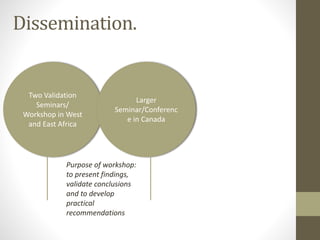
Dissemination.
Two Validation
Seminars/
Workshop in West
and East Africa
Larger
Seminar/Conferenc
e in Canada
Purpose of workshop:
to present findings,
validate conclusions
and to develop
practical
recommendations
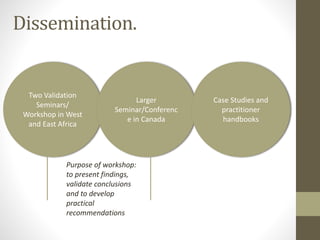
Dissemination.
Two Validation
Seminars/
Workshop in West
and East Africa
Larger
Seminar/Conferenc
e in Canada
Case Studies and
practitioner
handbooks
Purpose of workshop:
to present findings,
validate conclusions
and to develop
practical
recommendations
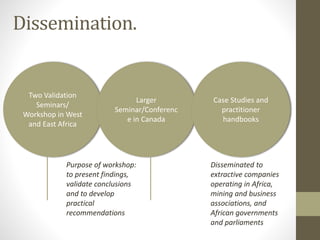
Dissemination.
Two Validation
Seminars/
Workshop in West
and East Africa
Larger
Seminar/Conferenc
e in Canada
Case Studies and
practitioner
handbooks
Purpose of workshop:
to present findings,
validate conclusions
and to develop
practical
recommendations
Disseminated to
extractive companies
operating in Africa,
mining and business
associations, and
African governments
and parliaments

Comprehensive framework for reducing corruption

  • 1.
    Developing a Comprehensive Frameworkfor Reducing Corruption Through Both Supply Side And Demand Side Interventions
  • 2.
    Research Team • RickStapenhurst (McGill University) – Principal Investigator • Emine Sarigollu (McGill University) • Myung-Soo Jo (McGill University) • Fahri Karakas (University of East Anglia) • Rasheed Draman (ACEPA) • Mitchell O’Brien (World Bank) Collaborators • Wayne Dunn (CSR Training Institute) • Jeffrey Davidson (Canadian Government)
  • 3.
    Purpose. CORRUPTION Analyze Supply &Demand Side Canadian Mining/Gas Operations Tanzania Ghana Burkina Faso
  • 4.
    Objectives. 1. Link corruption,CSR initiatives, stakeholder engagement with oversight
  • 5.
    Objectives. 1. Link corruption,CSR initiatives, stakeholder engagement with oversight 2. Reactivity of corporate anti- corruption programs and CSR activities
  • 6.
    Objectives. 1. Link corruption,CSR initiatives, stakeholder engagement with oversight 2. Reactivity of corporate anti- corruption programs and CSR activities 3. Examine role of host government
  • 7.
    Objectives. 1. Link corruption,CSR initiatives, stakeholder engagement with oversight 2. Reactivity of corporate anti- corruption programs and CSR activities 3. Examine role of host government 4. Provide ways to manage political risks and corruption
  • 8.
    Objectives. 1. Link corruption,CSR initiatives, stakeholder engagement with oversight 2. Reactivity of corporate anti- corruption programs and CSR activities 3. Examine role of host government 4. Provide ways to manage political risks and corruption 5. Advise ways to develop appropriate public policies regarding corruption
  • 9.
  • 10.
    • The projectwill use a comparative case study approach to: Research Approach. Develop and assess overall model Evaluate linkages Develop recommendations
  • 11.
    Methods. Stage 1 General Questionnaireto all Canadian mining companies operating overseas
  • 12.
    Methods. Stage 2 Key InformantInterviews Stage 1 General Questionnaire to all Canadian mining companies operating overseas
  • 13.
    Methods. Stage 2 Key InformantInterviews 15 in each country 45 in total Stage 1 General Questionnaire to all Canadian mining companies operating overseas Industry, government, parliamentarians
  • 14.
    Methods. Stage 2 Key InformantInterviews 15 in each country 45 in total Stage 1 General Questionnaire to all Canadian mining companies operating overseas Stage 3 Focus Groups Industry, government, parliamentarians
  • 15.
    Methods. Stage 2 Key InformantInterviews 15 in each country 45 in total Stage 1 General Questionnaire to all Canadian mining companies operating overseas Stage 3 Focus Groups 100 in each country 300 in total Local stakeholders Industry, government, parliamentarians
  • 16.
    Expected outcomes. Social OutcomesSocialOutcomes 1. Help extractive companies better assess micro-political risks 2. Develop successful and proactive corporate policies to mitigate corruption
  • 17.
    Expected outcomes. Scholarly Outcomes 1.Create knowledge of political risk assessment, corruption, corporate policies, and host country stakeholder 2. Deliver advice in to how to develop effective policies and programs
  • 18.
  • 19.
    Dissemination. Two Validation Seminars/ Workshop inWest and East Africa Larger Seminar/Conferenc e in Canada
  • 20.
    Dissemination. Two Validation Seminars/ Workshop inWest and East Africa Larger Seminar/Conferenc e in Canada Purpose of workshop: to present findings, validate conclusions and to develop practical recommendations
  • 21.
    Dissemination. Two Validation Seminars/ Workshop inWest and East Africa Larger Seminar/Conferenc e in Canada Case Studies and practitioner handbooks Purpose of workshop: to present findings, validate conclusions and to develop practical recommendations
  • 22.
    Dissemination. Two Validation Seminars/ Workshop inWest and East Africa Larger Seminar/Conferenc e in Canada Case Studies and practitioner handbooks Purpose of workshop: to present findings, validate conclusions and to develop practical recommendations Disseminated to extractive companies operating in Africa, mining and business associations, and African governments and parliaments