
Evolutionary and Swarm Computing
   for scaling up the Semantic Web

Christophe Guéret (@cgueret), Stefan Schlobach, Kathrin Dentler,
                Martijn Schut, and Gusz Eiben


        24th Benelux Conference on Artificial Intelligence
          Maastricht University, October 25-26, 2012


                                                              1/18
What are we going to talk about?
 Linked Data

 Changing our point of view on
soundness and completeness

 Consider optimisation as an
alternative to logical deduction
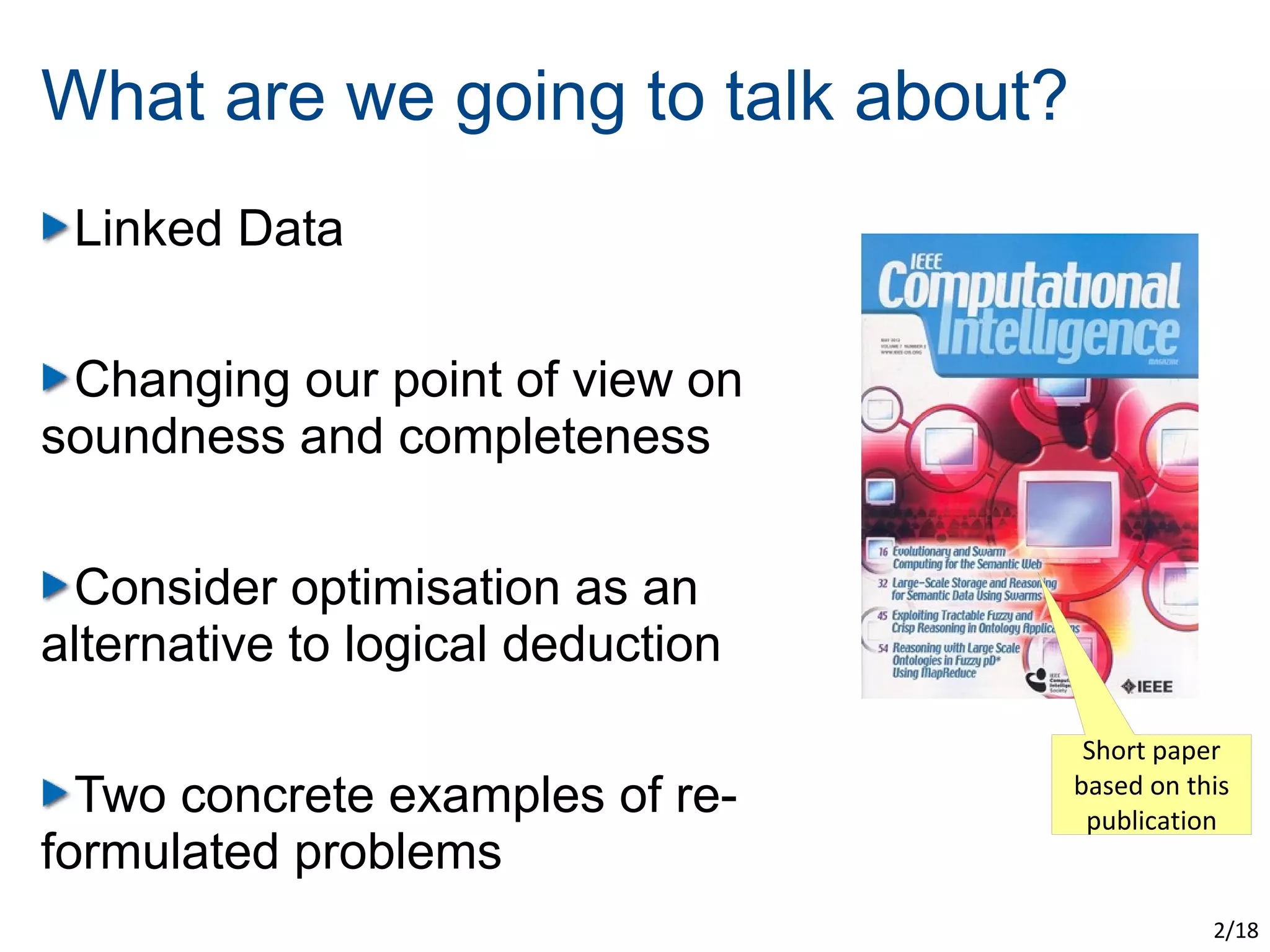
                                    Short paper
  Two concrete examples of re-     based on this
                                    publication
formulated problems
                                              2/18
When solutions do not (quite) fit the problem ...


                                                                    3/18
                             Copyright: sfllaw (Flickr, image 222795669)
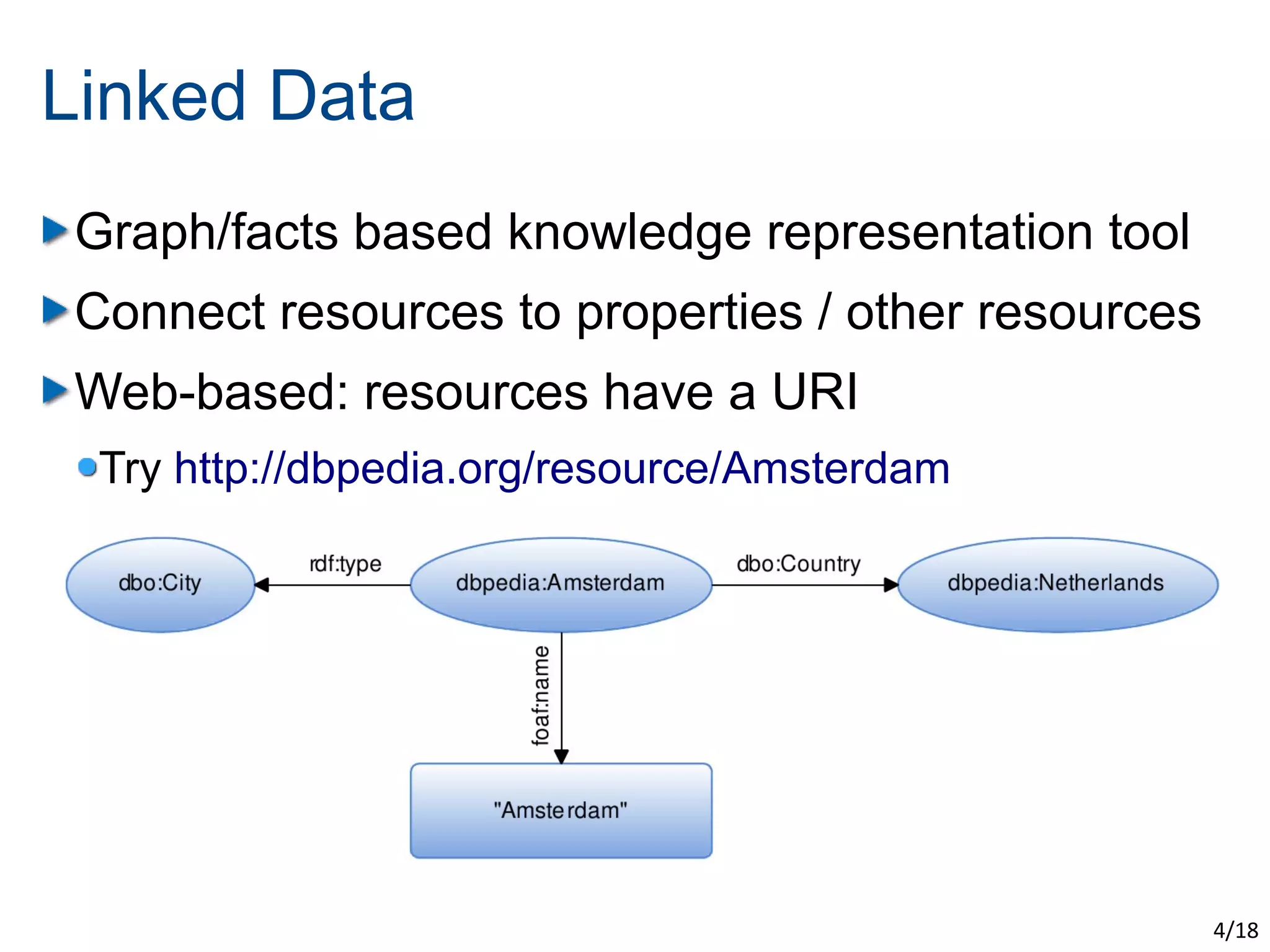
Linked Data
Graph/facts based knowledge representation tool
Connect resources to properties / other resources
Web-based: resources have a URI
 Try http://dbpedia.org/resource/Amsterdam


                                                    4/18
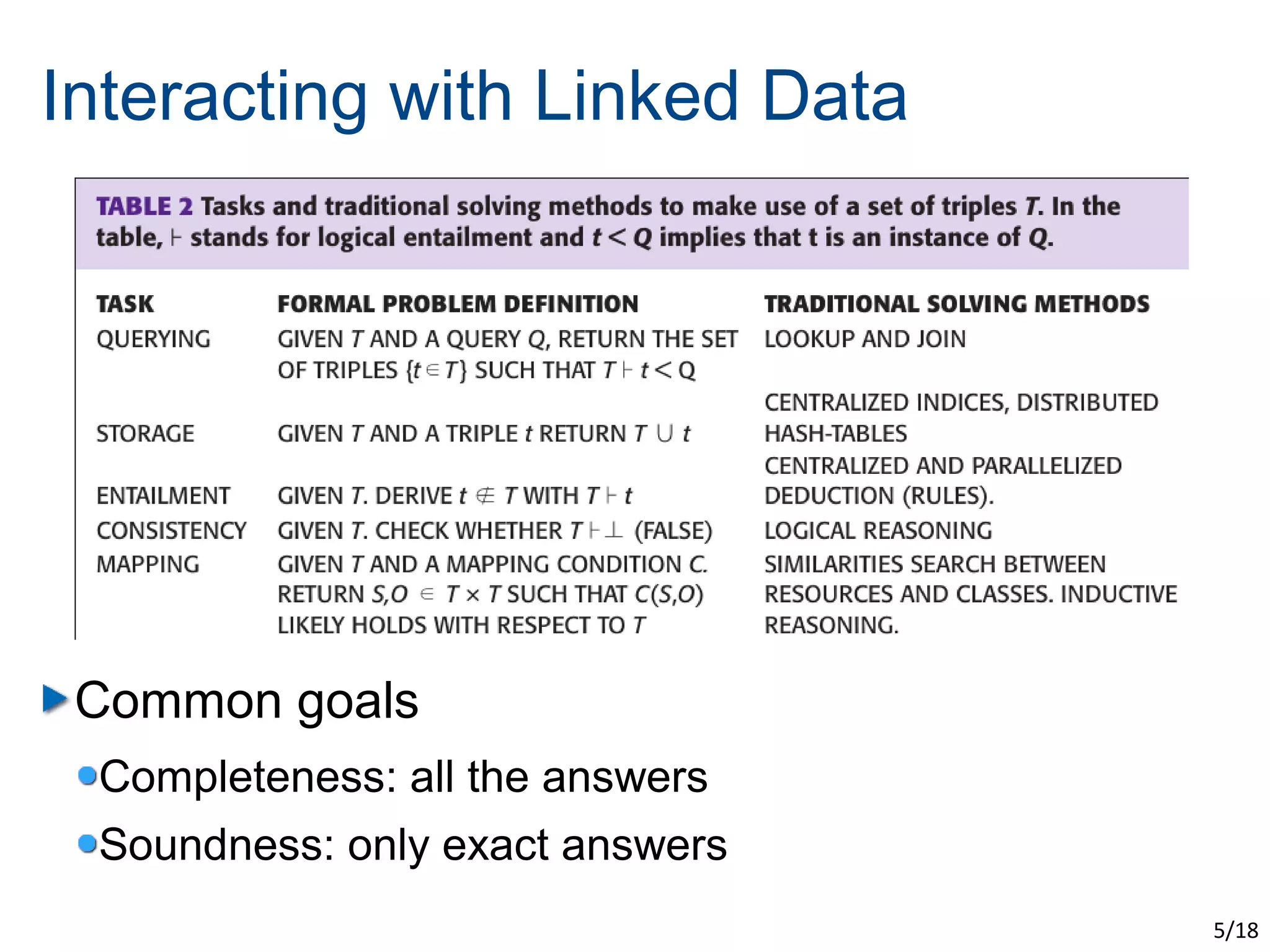
Interacting with Linked Data


 Common goals
 Completeness: all the answers
 Soundness: only exact answers
                                 5/18
Motivation
 In the context of Web data ?
  Issues with scale
  Issues with lack of consistency
  Issues with contextualised views over the World


 Revise the goals
  As many answers as possible (or needed)
  Answers as accurate as possible (or needed)


                                                    6/18
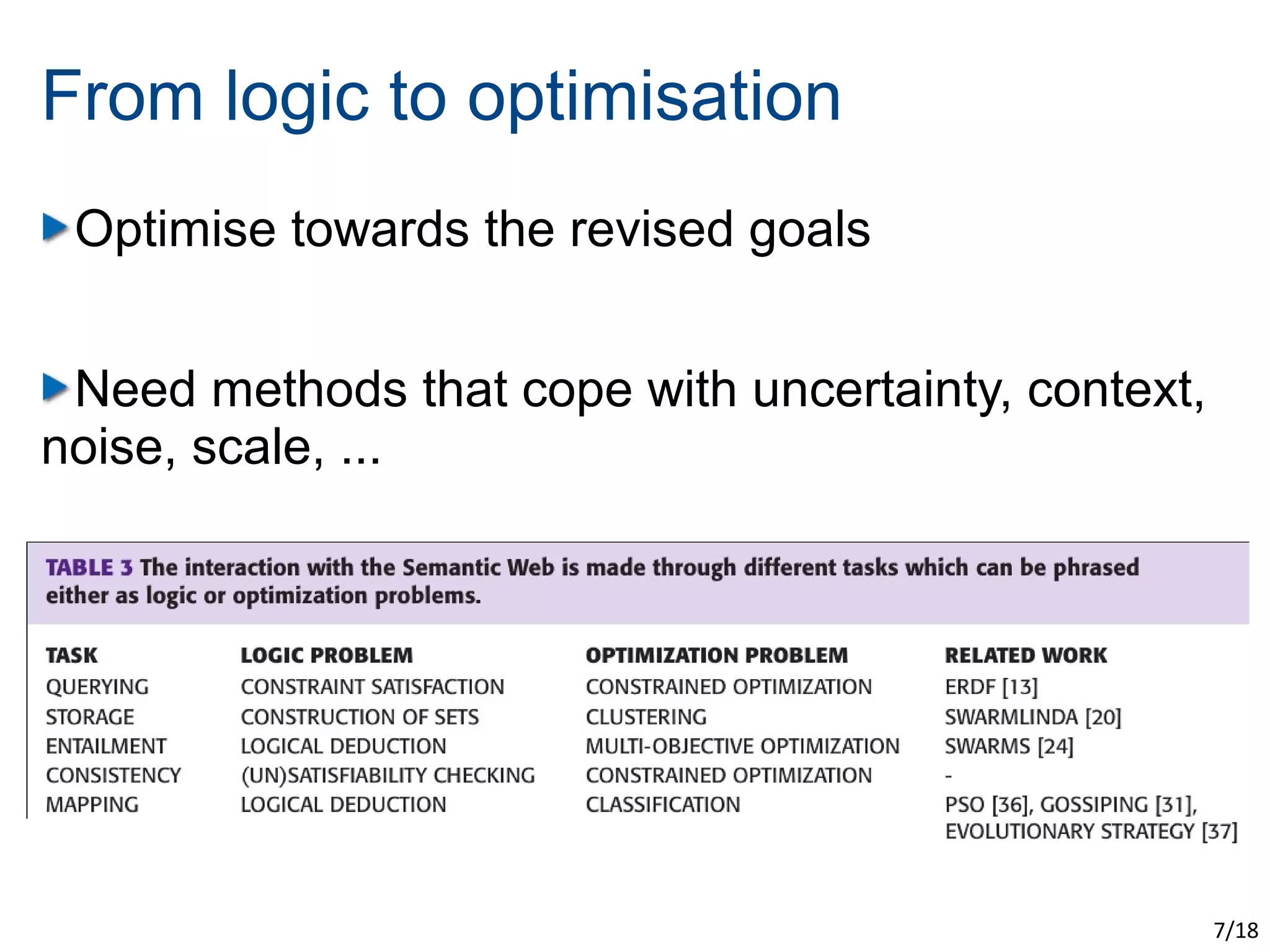
From logic to optimisation
 Optimise towards the revised goals


 Need methods that cope with uncertainty, context,
noise, scale, ...


                                                     7/18
Answering queries over the data


                                                             8/18
                  Copyright: jepoirrier (Flickr, image 829293711)
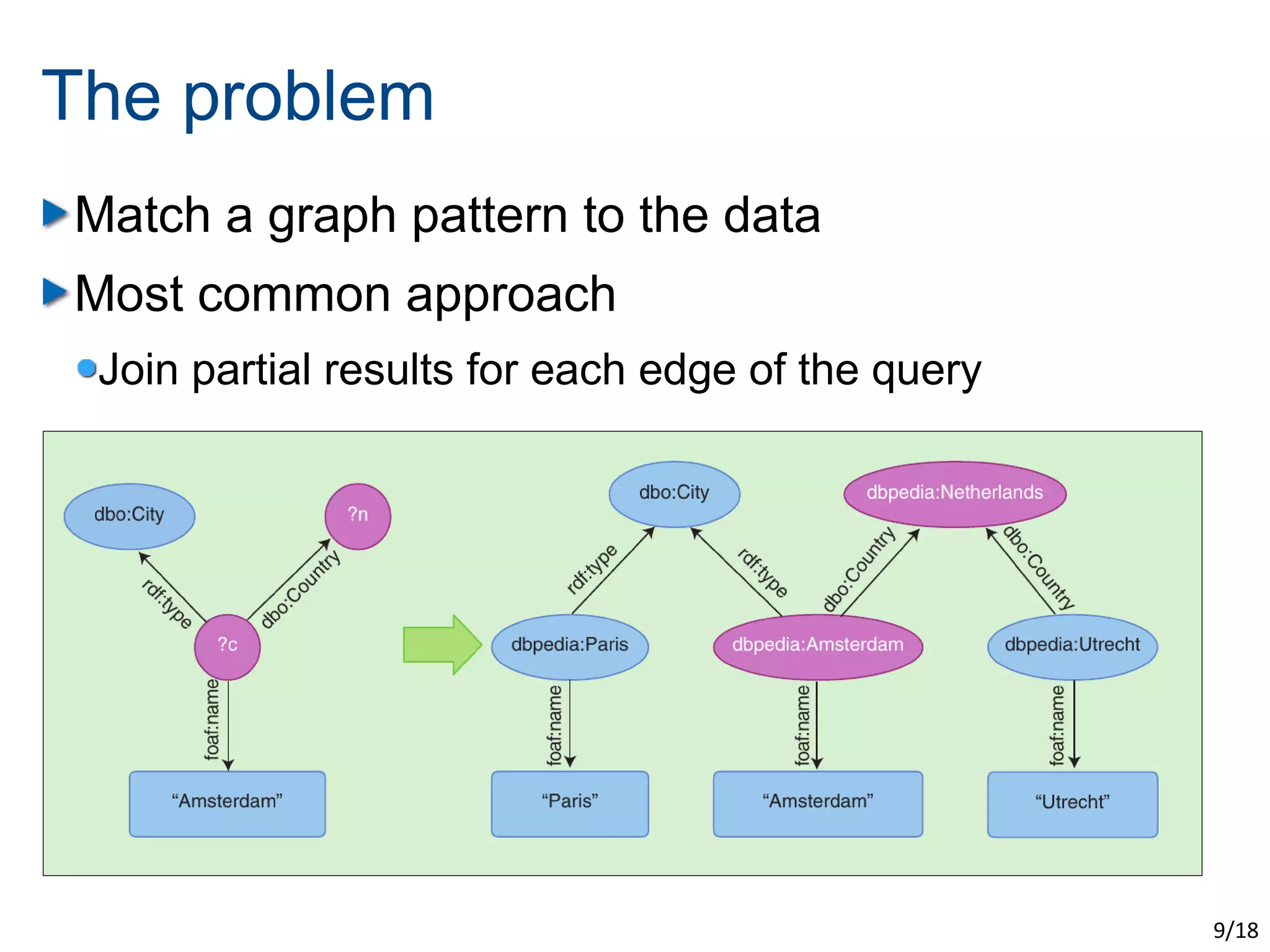
The problem
Match a graph pattern to the data
Most common approach
 Join partial results for each edge of the query


                                                   9/18
Solving approaches
Logic-based
 Find all the answers matching all of the query pattern


Optimisation
 Find answers matching as much of the query as possible


Important implications of the optimisation
 Only some of the answers will be found
 Some of the answers found will be partially true

                                                          10/18
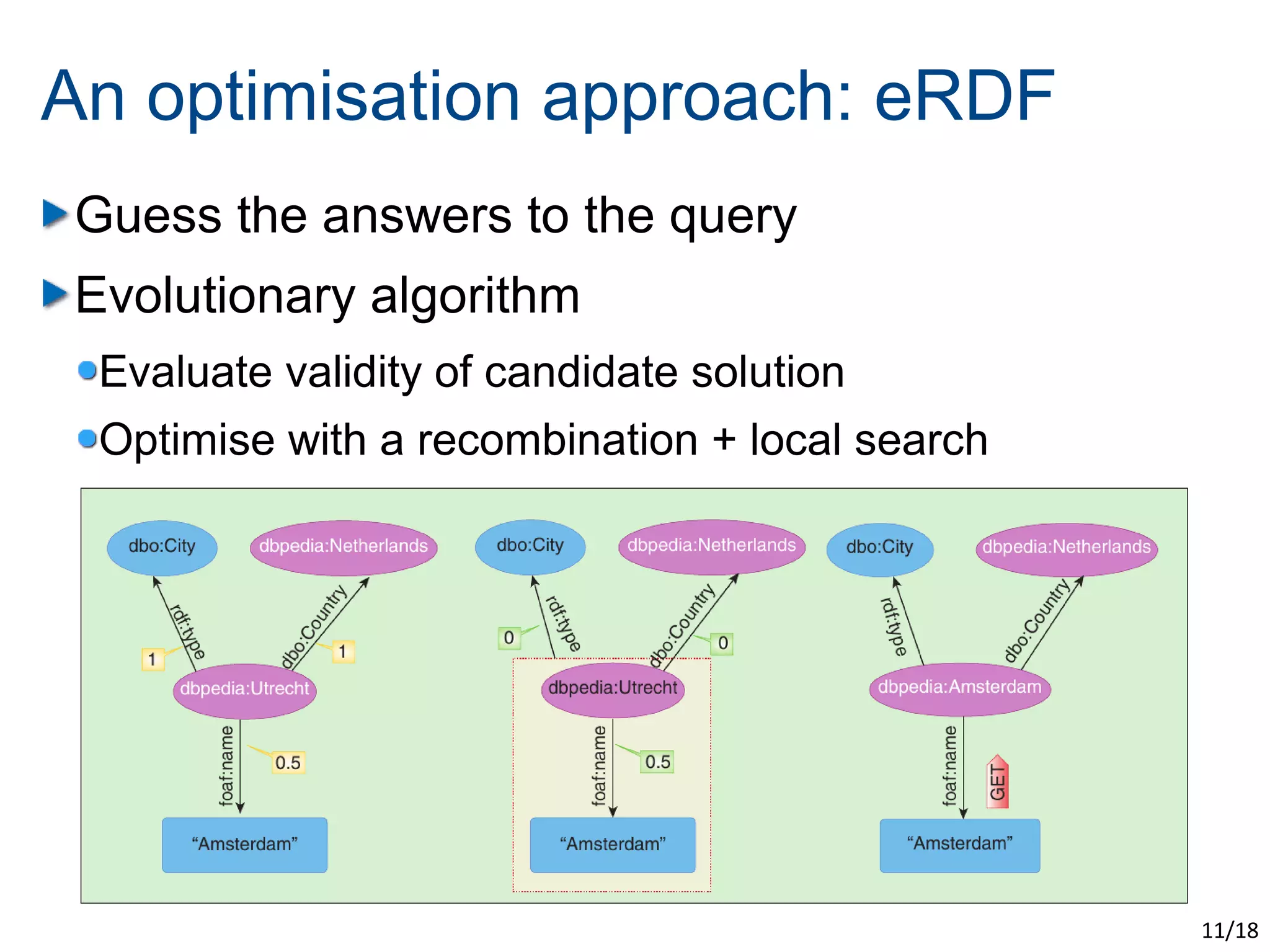
An optimisation approach: eRDF
Guess the answers to the query
Evolutionary algorithm
 Evaluate validity of candidate solution
 Optimise with a recombination + local search


                                                11/18
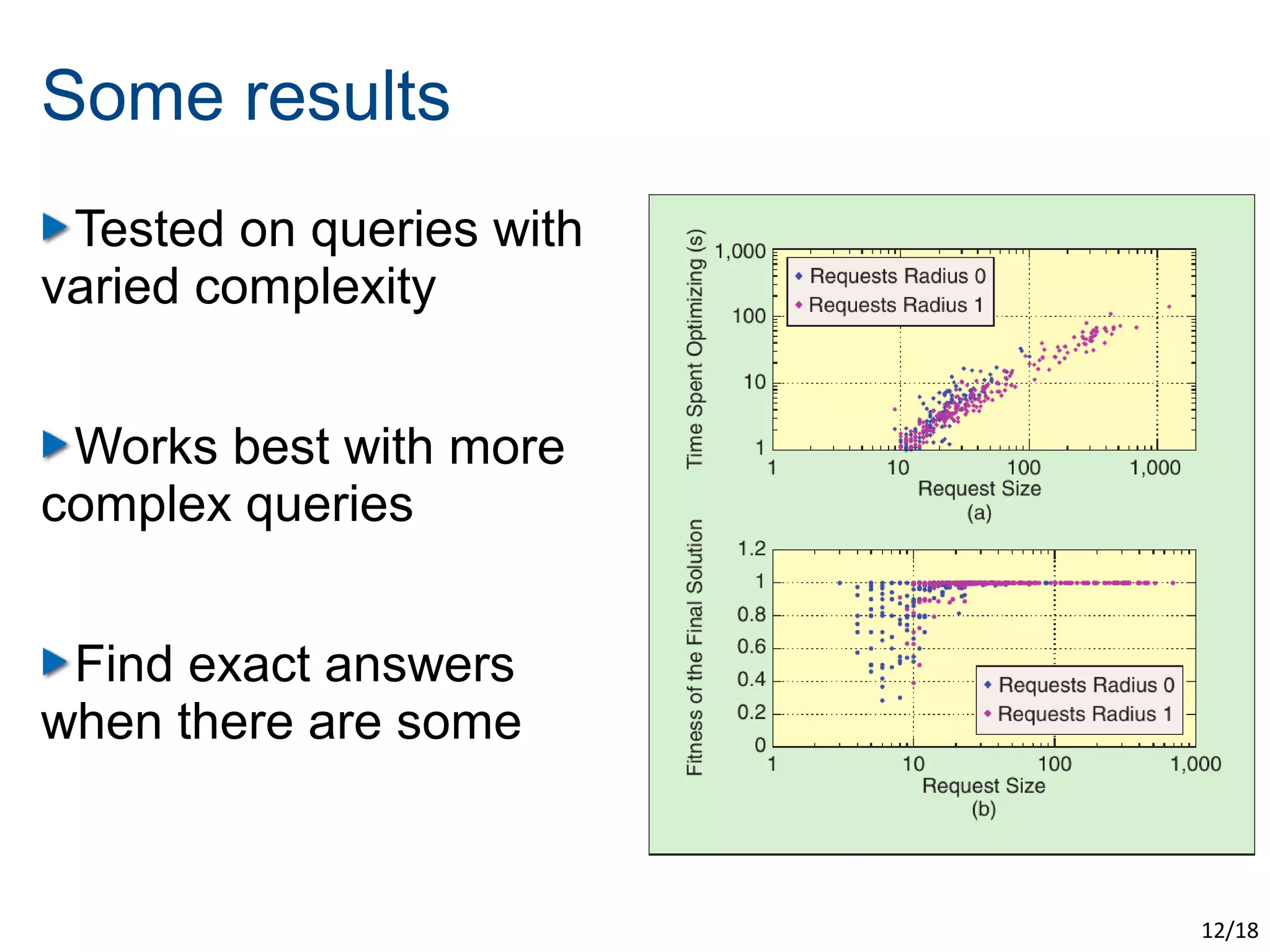
Some results
 Tested on queries with
varied complexity


 Works best with more
complex queries


 Find exact answers
when there are some


                          12/18
Finding implicit facts in the data


            Copyright:                                                 13/18
                         givingnot@rocketmail.com (Flickr, image 6990161491)
The problem
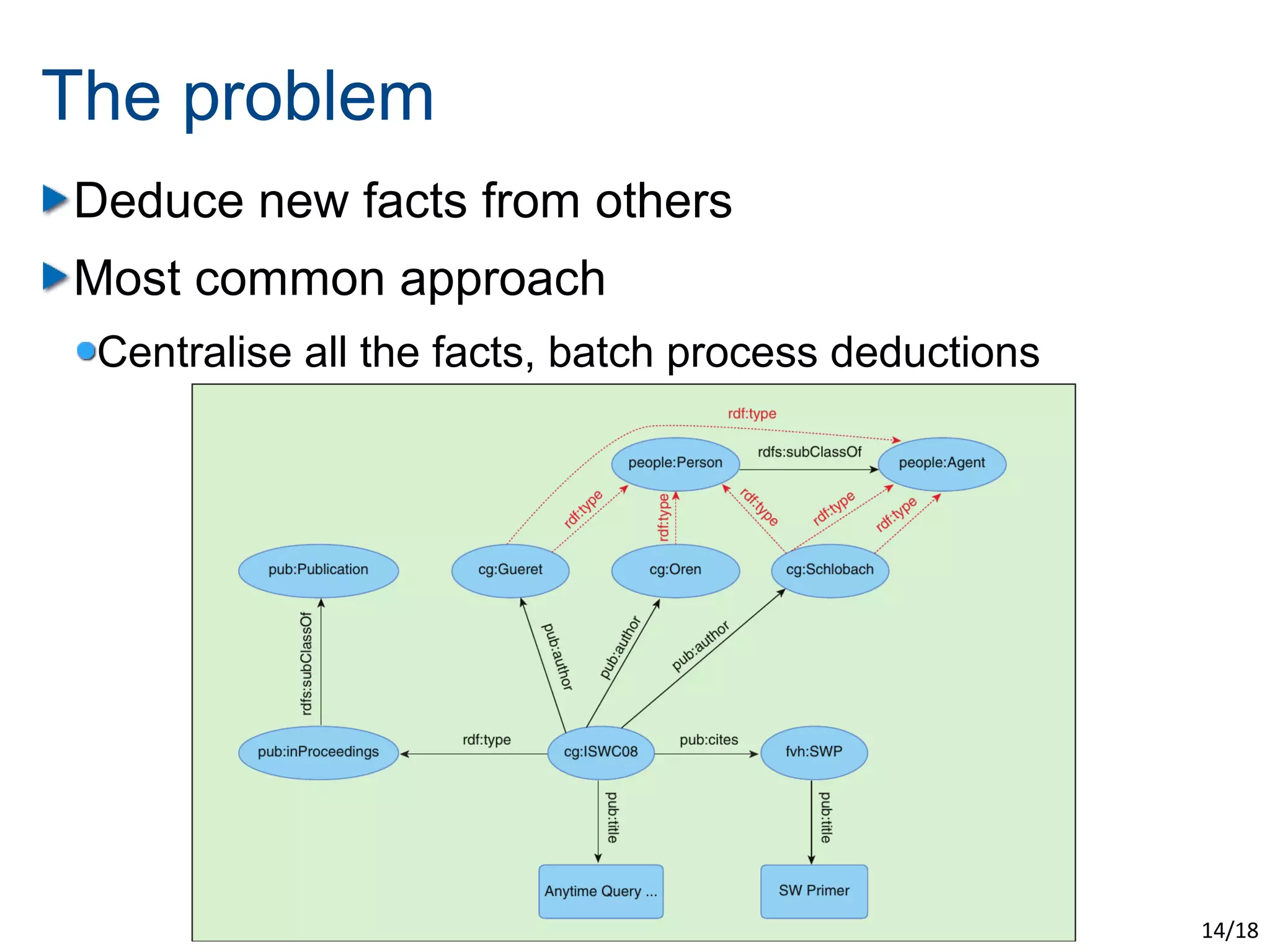
Deduce new facts from others
Most common approach
 Centralise all the facts, batch process deductions


                                                      14/18
Solving approaches
Logic-based
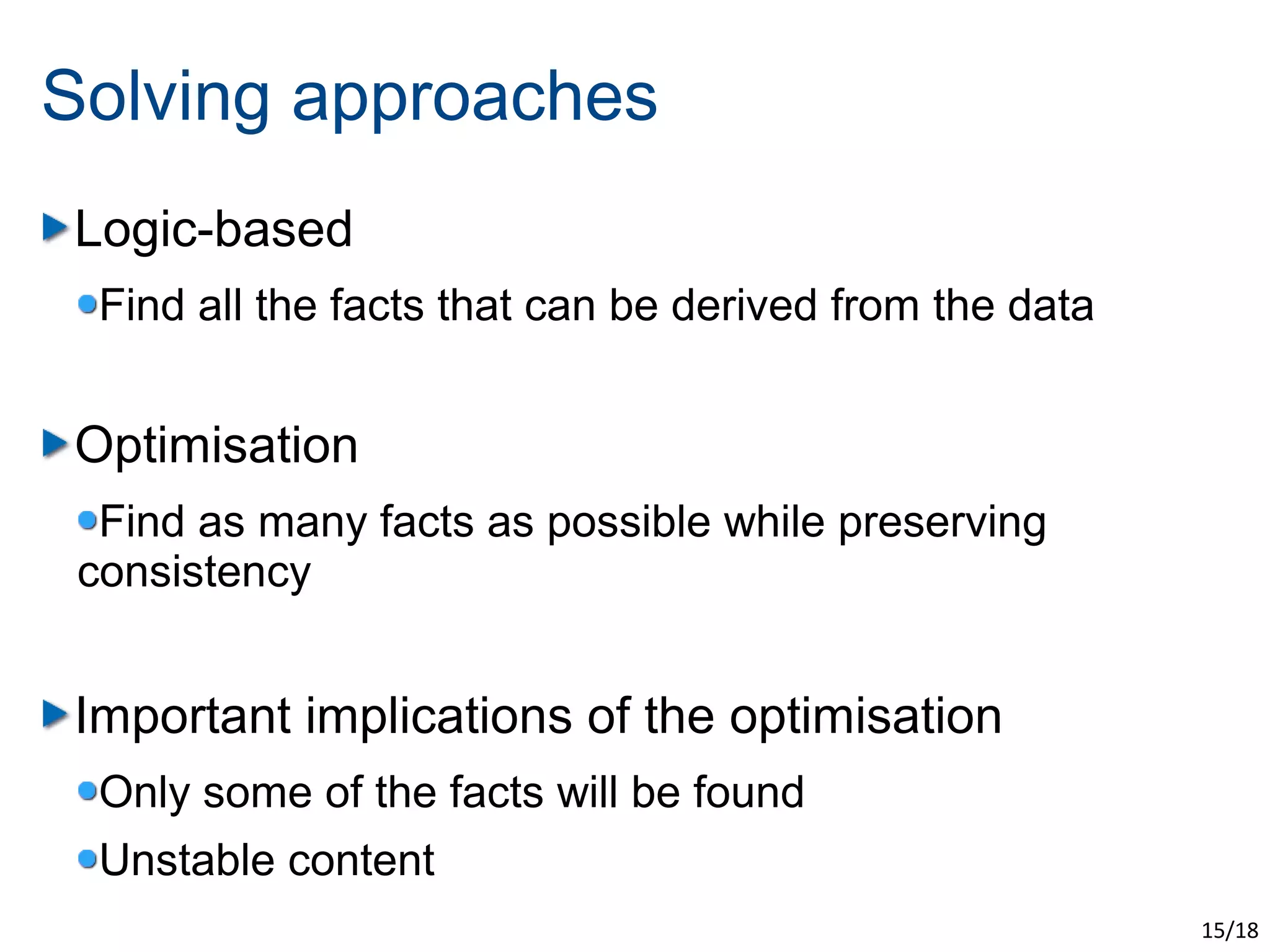
  Find all the facts that can be derived from the data


Optimisation
  Find as many facts as possible while preserving
 consistency


Important implications of the optimisation
  Only some of the facts will be found
  Unstable content
                                                         15/18
An optimisation approach: Swarms
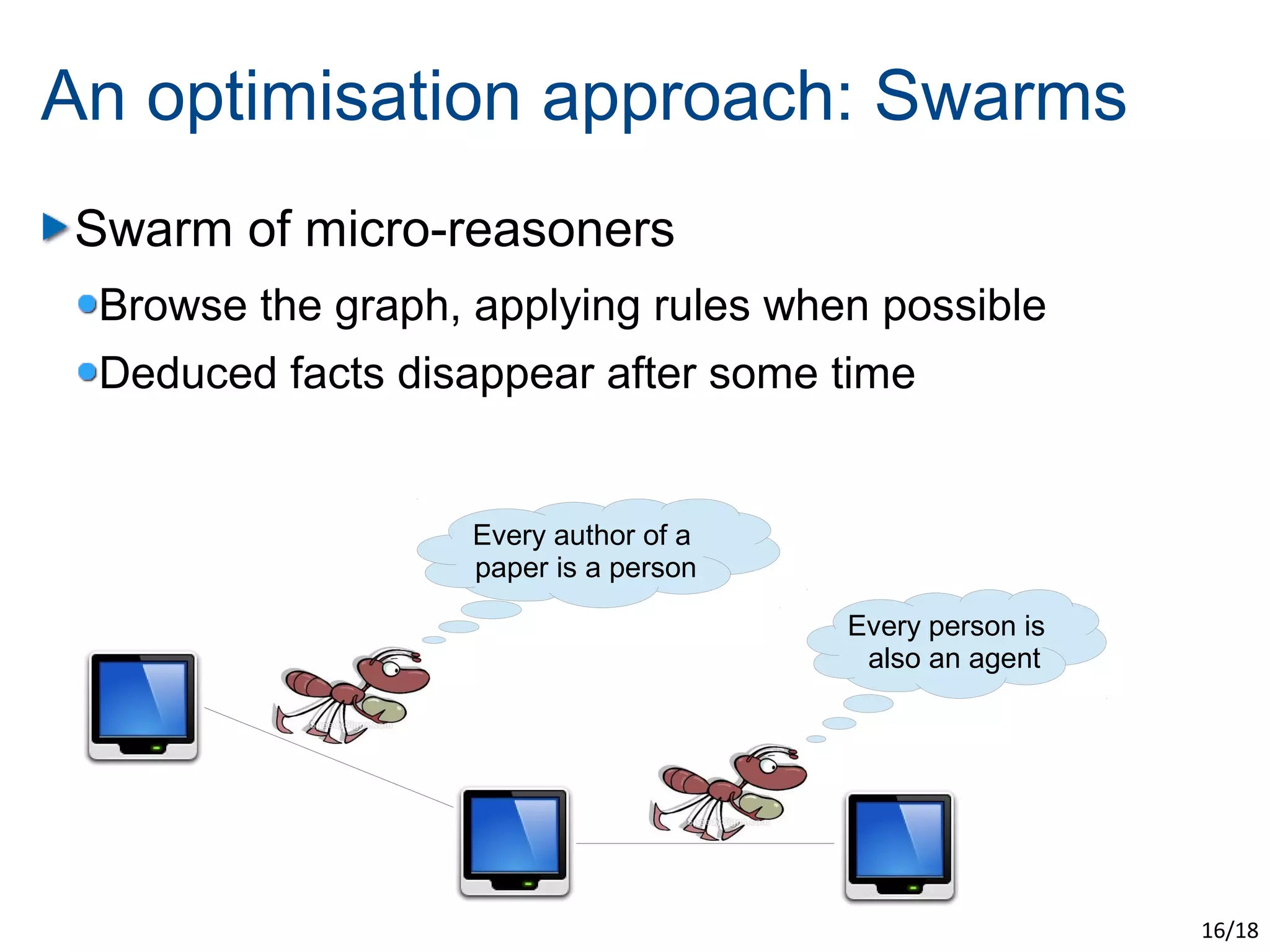
Swarm of micro-reasoners
 Browse the graph, applying rules when possible
 Deduced facts disappear after some time


                   Every author of a
                   paper is a person

                                       Every person is
                                        also an agent


                                                         16/18
Some results
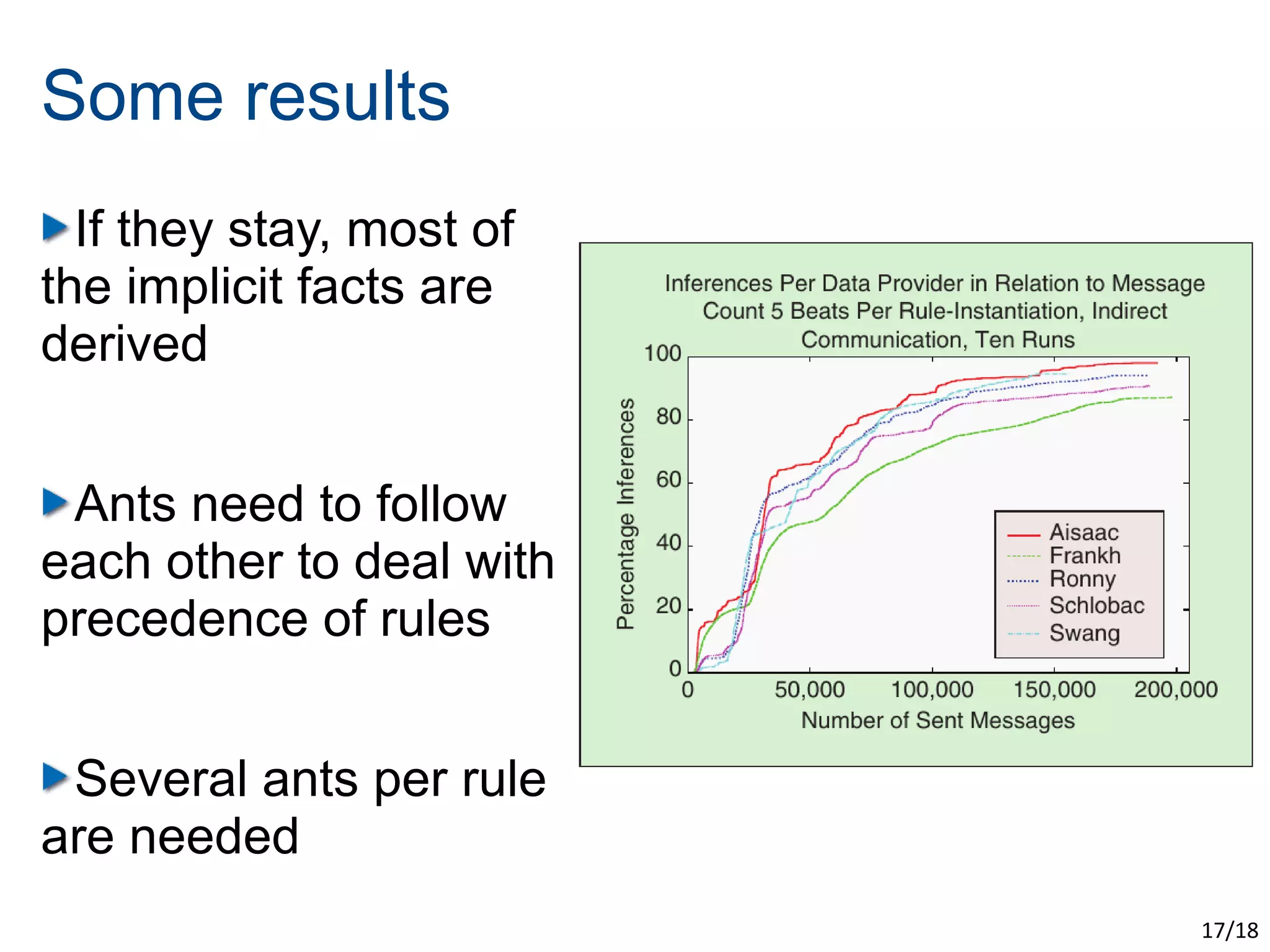
  If they stay, most of
the implicit facts are
derived


 Ants need to follow
each other to deal with
precedence of rules


 Several ants per rule
are needed
                          17/18
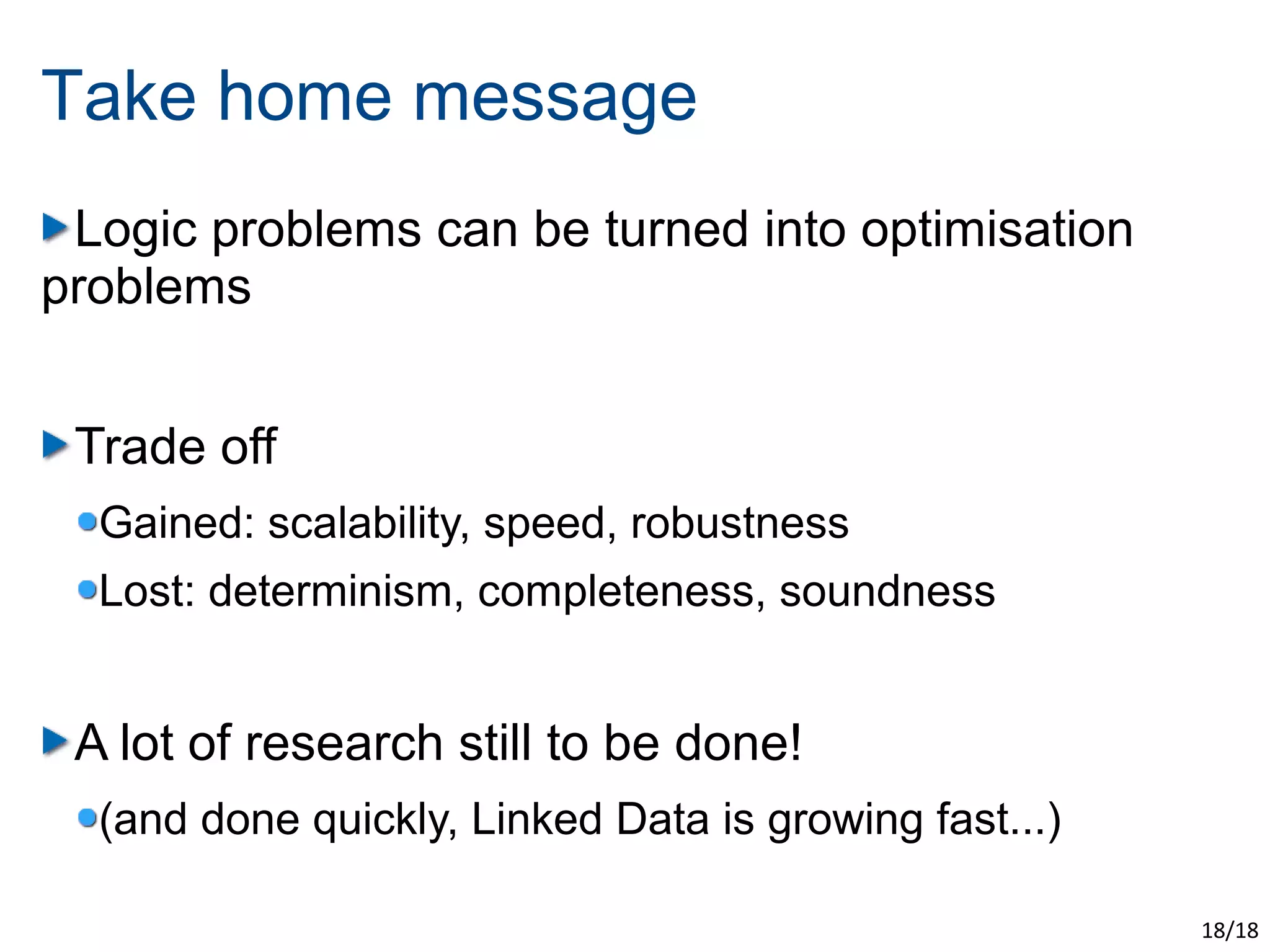
Take home message
 Logic problems can be turned into optimisation
problems


 Trade off
  Gained: scalability, speed, robustness
  Lost: determinism, completeness, soundness


 A lot of research still to be done!
  (and done quickly, Linked Data is growing fast...)

                                                       18/18

Evolutionary and Swarm Computing for scaling up the Semantic Web

  • 1.
    Evolutionary and SwarmComputing for scaling up the Semantic Web Christophe Guéret (@cgueret), Stefan Schlobach, Kathrin Dentler, Martijn Schut, and Gusz Eiben 24th Benelux Conference on Artificial Intelligence Maastricht University, October 25-26, 2012 1/18
  • 2.
    What are wegoing to talk about? Linked Data Changing our point of view on soundness and completeness Consider optimisation as an alternative to logical deduction Short paper Two concrete examples of re- based on this publication formulated problems 2/18
  • 3.
    When solutions donot (quite) fit the problem ... 3/18 Copyright: sfllaw (Flickr, image 222795669)
  • 4.
    Linked Data Graph/facts basedknowledge representation tool Connect resources to properties / other resources Web-based: resources have a URI Try http://dbpedia.org/resource/Amsterdam 4/18
  • 5.
    Interacting with LinkedData Common goals Completeness: all the answers Soundness: only exact answers 5/18
  • 6.
    Motivation In thecontext of Web data ? Issues with scale Issues with lack of consistency Issues with contextualised views over the World Revise the goals As many answers as possible (or needed) Answers as accurate as possible (or needed) 6/18
  • 7.
    From logic tooptimisation Optimise towards the revised goals Need methods that cope with uncertainty, context, noise, scale, ... 7/18
  • 8.
    Answering queries overthe data 8/18 Copyright: jepoirrier (Flickr, image 829293711)
  • 9.
    The problem Match agraph pattern to the data Most common approach Join partial results for each edge of the query 9/18
  • 10.
    Solving approaches Logic-based Findall the answers matching all of the query pattern Optimisation Find answers matching as much of the query as possible Important implications of the optimisation Only some of the answers will be found Some of the answers found will be partially true 10/18
  • 11.
    An optimisation approach:eRDF Guess the answers to the query Evolutionary algorithm Evaluate validity of candidate solution Optimise with a recombination + local search 11/18
  • 12.
    Some results Testedon queries with varied complexity Works best with more complex queries Find exact answers when there are some 12/18
  • 13.
    Finding implicit factsin the data Copyright: 13/18 givingnot@rocketmail.com (Flickr, image 6990161491)
  • 14.
    The problem Deduce newfacts from others Most common approach Centralise all the facts, batch process deductions 14/18
  • 15.
    Solving approaches Logic-based Find all the facts that can be derived from the data Optimisation Find as many facts as possible while preserving consistency Important implications of the optimisation Only some of the facts will be found Unstable content 15/18
  • 16.
    An optimisation approach:Swarms Swarm of micro-reasoners Browse the graph, applying rules when possible Deduced facts disappear after some time Every author of a paper is a person Every person is also an agent 16/18
  • 17.
    Some results If they stay, most of the implicit facts are derived Ants need to follow each other to deal with precedence of rules Several ants per rule are needed 17/18
  • 18.
    Take home message Logic problems can be turned into optimisation problems Trade off Gained: scalability, speed, robustness Lost: determinism, completeness, soundness A lot of research still to be done! (and done quickly, Linked Data is growing fast...) 18/18