The Evolution and Impact of 
Hidden Mobile Threats: 
Why Your Organization Needs 
a Multi-Level Security Solution
THE EVOLUTION AND IMPACT OF HIDDEN MOBILE THREATS: WHY YOUR ORGANIZATION NEEDS A MULTI-LEVEL SECURITY SOLUTION PAGE 2 
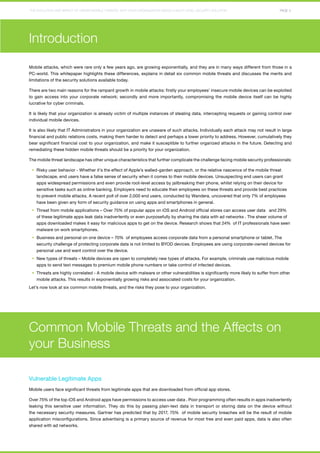
Table of Contents 
Introduction 3 
Common Mobile Threats and the Affects on your Business 3 
Vulnerable Legitimate Apps 3 
Jailbreaking 4 
Outdated OS 4 
Malware and Malicious Apps 4 
Compromised Wi-Fi Hotspots 5 
Phishing 5 
Threat Correlation 5 
Solution: A Multi-level Predictive Approach to Security 6 
Conclusion 7
THE EVOLUTION AND IMPACT OF HIDDEN MOBILE THREATS: WHY YOUR ORGANIZATION NEEDS A MULTI-LEVEL SECURITY SOLUTION PAGE 3 
Introduction 
Mobile attacks, which were rare only a few years ago, are growing exponentially, and they are in many ways different from those in a 
PC-world. This whitepaper highlights these differences, explains in detail six common mobile threats and discusses the merits and 
limitations of the security solutions available today. 
There are two main reasons for the rampant growth in mobile attacks: firstly your employees’ insecure mobile devices can be exploited 
to gain access into your corporate network; secondly and more importantly, compromising the mobile device itself can be highly 
lucrative for cyber criminals. 
It is likely that your organization is already victim of multiple instances of stealing data, intercepting requests or gaining control over 
individual mobile devices. 
It is also likely that IT Administrators in your organization are unaware of such attacks. Individually each attack may not result in large 
financial and public relations costs, making them harder to detect and perhaps a lower priority to address. However, cumulatively they 
bear significant financial cost to your organization, and make it susceptible to further organized attacks in the future. Detecting and 
remediating these hidden mobile threats should be a priority for your organization. 
The mobile threat landscape has other unique characteristics that further complicate the challenge facing mobile security professionals: 
§§ Risky user behavior - Whether it’s the effect of Apple’s walled-garden approach, or the relative nascence of the mobile threat 
landscape, end users have a false sense of security when it comes to their mobile devices. Unsuspecting end users can grant 
apps widespread permissions and even provide root-level access by jailbreaking their phone, whilst relying on their device for 
sensitive tasks such as online banking. Employers need to educate their employees on these threats and provide best practices 
to prevent mobile attacks. A recent poll of over 2,000 end users, conducted by Wandera, uncovered that only 7% of employees 
have been given any form of security guidance on using apps and smartphones in general. 
§§ Threat from mobile applications – Over 75% of popular apps on iOS and Android official stores can access user data and 29% 
of these legitimate apps leak data inadvertently or even purposefully by sharing the data with ad networks . The sheer volume of 
apps downloaded makes it easy for malicious apps to get on the device. Research shows that 24% of IT professionals have seen 
malware on work smartphones. 
§§ Business and personal on one device – 70% of employees access corporate data from a personal smartphone or tablet. The 
security challenge of protecting corporate data is not limited to BYOD devices. Employees are using corporate-owned devices for 
personal use and want control over the device. 
§§ New types of threats – Mobile devices are open to completely new types of attacks. For example, criminals use malicious mobile 
apps to send text messages to premium mobile phone numbers or take control of infected devices. 
§§ Threats are highly correlated - A mobile device with malware or other vulnerabilities is significantly more likely to suffer from other 
mobile attacks. This results in exponentially growing risks and associated costs for your organization. 
Let’s now look at six common mobile threats, and the risks they pose to your organization. 
Common Mobile Threats and the Affects on 
your Business 
Vulnerable Legitimate Apps 
Mobile users face significant threats from legitimate apps that are downloaded from official app stores. 
Over 75% of the top iOS and Android apps have permissions to access user data . Poor programming often results in apps inadvertently 
leaking this sensitive user information. They do this by passing plain-text data in transport or storing data on the device without 
the necessary security measures. Gartner has predicted that by 2017, 75% of mobile security breaches will be the result of mobile 
application misconfigurations. Since advertising is a primary source of revenue for most free and even paid apps, data is also often 
shared with ad networks.
THE EVOLUTION AND IMPACT OF HIDDEN MOBILE THREATS: WHY YOUR ORGANIZATION NEEDS A MULTI-LEVEL SECURITY SOLUTION PAGE 4 
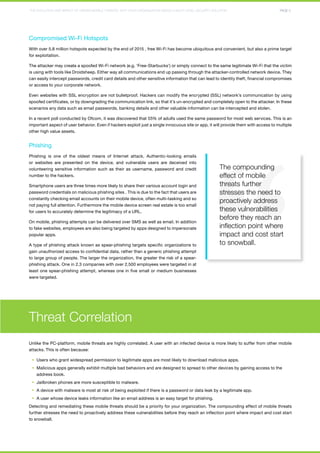
As an example of a vulnerable legitimate app, a recent version of the popular Starbucks 
iOS app, which is used to make payments and accrue rewards, transmitted user data in 
the clear. It exposed customers’ usernames, e-mail addresses, passwords, and certain 
location data. 
Similarly, research done in January 2014 by IO Active Labs discovered that, of the 40 home 
banking apps from the top banks in the world, 20% were vulnerable to man-in-the-middle 
(MiTM) attacks and 40% leaked sensitive information like activation codes through plain-text 
requests, or exposing data through the device logs. These results were surprising 
75% of mobile 
security breaches 
will be the result of 
mobile application 
misconfigurations 
according to Gartner 
given the size and resources of the financial institutions and the focus from cyber criminals 
on mobile banking malware. 
Jailbreaking 
It is never safe to have a jailbroken device in your corporate network. Jailbreaking, or rooting is the process of removing the security 
limitations imposed by the Operating System vendor. Jailbreaking permits root access to the OS file system allowing the download of 
applications, which are not permitted through the official app stores. Jailbreaking also provides all apps, including malicious ones, with 
access to data owned by other applications. 
End users often jailbreak a device in order to gain access to a capability or app that is not officially supported, or to unlock their phone 
so that it can be used with other carriers. It is possible that the employee may not even know that their device has been jailbroken. As 
an example, Pangu is a jailbreak for iOS 7.1 that uses an expired enterprise certificate, and can potentially be injected without the user’s 
knowledge. 
Outdated OS 
In the cat and mouse game of OS vendor patching of known vulnerabilities whilst hackers race to exploit them, a device running an 
outdated OS is by definition vulnerable and presents a significant risk of being compromised. 
There are more than 11,000 different combinations of Android devices and Android Operating Systems in existence. This fragmentation 
creates a management headache and a security issue whereby many devices remain with outdated OSs. This is also a challenge on 
the iOS platform. Evidence suggests that 24% of iPhone users were on an older OS, even 5 months after the release of the new iOS7 . 
In an enterprise setting, IT departments sometimes choose to implement a phased approach to OS upgrades for their mobile device 
fleets to keep in step with releases to their MDMs and this staggered approach also creates devices with outdated OSs. 
Malware and Malicious Apps 
Mobile malware is malicious software designed to steal personal information stored on the 
55% of adults use the 
device or gain control over the device. Most mobile malware spreads via malicious apps 
same password for 
that persist on the device and gain extensive permissions. 
most web services 
Google’s Android platform is most vulnerable to malware due to the level of control the 
platform provides developers and the ability to download apps from 3rd party stores that 
are not vetted by Google. 
However, the iOS platform is not completely worry-free either. For example, a flaw found recently in Apple’s iOS allowed hackers 
to intercept email and other communications that were meant to be encrypted. Other techniques that hackers employ on the iOS 
platform are malicious profiles or rogue certificates. A malicious profile can overwrite system functionality such as MDM software or 
mobile carrier settings, and be used to bypass various security measures and potentially intercept all data packets. Hackers can also 
gain access to a developer certificate or enterprise certificate, allowing a malicious app to be installed directly without going through 
Apple’s app store. Finally, as discussed earlier, a jailbroken iOS device removes all the security limitations imposed by Apple making it 
extremely vulnerable to malware attacks. 
The top categories in mobile malware include: 
§§ Premium Service Abuser – Sends text messages to premium mobile phone numbers, racking up unauthorized charges. 
§§ Information Theft – Similar to adware and some legitimate apps, this type of malware leaks sensitive information. The intent is 
almost always to find sensitive information that can be sold or exploited for other attacks such as phishing or mobile banking 
fraud. 
§§ Malicious Downloader – Downloads malicious apps and files, its main objective is to download more malware. 
Numerous malicious apps contain multiple types of threats and mechanisms for spreading. As an example, a Trojan named Obad sends 
messages to premium rate numbers, downloads and installs other malware, and uses Bluetooth to install itself on other devices.
THE EVOLUTION AND IMPACT OF HIDDEN MOBILE THREATS: WHY YOUR ORGANIZATION NEEDS A MULTI-LEVEL SECURITY SOLUTION PAGE 5 
Compromised Wi-Fi Hotspots 
With over 5.8 million hotspots expected by the end of 2015 , free Wi-Fi has become ubiquitous and convenient, but also a prime target 
for exploitation. 
The attacker may create a spoofed Wi-Fi network (e.g. ‘Free-Starbucks’) or simply connect to the same legitimate Wi-Fi that the victim 
is using with tools like Droidsheep. Either way all communications end up passing through the attacker-controlled network device. They 
can easily intercept passwords, credit card details and other sensitive information that can lead to identity theft, financial compromises 
or access to your corporate network. 
Even websites with SSL encryption are not bulletproof. Hackers can modify the encrypted (SSL) network’s communication by using 
spoofed certificates, or by downgrading the communication link, so that it’s un-encrypted and completely open to the attacker. In these 
scenarios any data such as email passwords, banking details and other valuable information can be intercepted and stolen. 
In a recent poll conducted by Ofcom, it was discovered that 55% of adults used the same password for most web services. This is an 
important aspect of user behavior. Even if hackers exploit just a single innocuous site or app, it will provide them with access to multiple 
other high value assets. 
Phishing 
Phishing is one of the oldest means of Internet attack. Authentic-looking emails 
or websites are presented on the device, and vulnerable users are deceived into 
volunteering sensitive information such as their as username, password and credit 
number to the hackers. 
Smartphone users are three times more likely to share their various account login and 
password credentials on malicious phishing sites . This is due to the fact that users are 
constantly checking email accounts on their mobile device, often multi-tasking and so 
not paying full attention. Furthermore the mobile device screen real estate is too small 
for users to accurately determine the legitimacy of a URL. 
On mobile, phishing attempts can be delivered over SMS as well as email. In addition 
to fake websites, employees are also being targeted by apps designed to impersonate 
popular apps. 
A type of phishing attack known as spear-phishing targets specific organizations to 
gain unauthorized access to confidential data, rather than a generic phishing attempt 
to large group of people. The larger the organization, the greater the risk of a spear-phishing 
attack. One in 2.3 companies with over 2,500 employees were targeted in at 
least one spear-phishing attempt, whereas one in five small or medium businesses 
were targeted. 
Threat Correlation 
The compounding 
effect of mobile 
threats further 
stresses the need to 
proactively address 
these vulnerabilities 
before they reach an 
inflection point where 
impact and cost start 
to snowball. 
Unlike the PC-platform, mobile threats are highly correlated. A user with an infected device is more likely to suffer from other mobile 
attacks. This is often because: 
§§ Users who grant widespread permission to legitimate apps are most likely to download malicious apps. 
§§ Malicious apps generally exhibit multiple bad behaviors and are designed to spread to other devices by gaining access to the 
address book. 
§§ Jailbroken phones are more susceptible to malware. 
§§ A device with malware is most at risk of being exploited if there is a password or data leak by a legitimate app. 
§§ A user whose device leaks information like an email address is an easy target for phishing. 
Detecting and remediating these mobile threats should be a priority for your organization. The compounding effect of mobile threats 
further stresses the need to proactively address these vulnerabilities before they reach an inflection point where impact and cost start 
to snowball.
THE EVOLUTION AND IMPACT OF HIDDEN MOBILE THREATS: WHY YOUR ORGANIZATION NEEDS A MULTI-LEVEL SECURITY SOLUTION PAGE 6 
Solution: A Multi-level Predictive Approach 
to Security 
We have addressed the challenges to businesses when it comes to mobile security in detail. Now let’s discuss possible solutions. 
Several fragmented security solutions exist to address the different mobile threats that enterprises face today. 
App reputation lists provide information on the risks associated with apps on your employees’ devices. However, with the constantly 
changing landscape of both mobile threats and the frequent updating of legitimate apps, a list-based approach has limitations in 
detecting the latest threats. Similarly, anti-virus (AV) solutions and malware scanners are reactive to the latest attacks and cannot adapt 
to the changing and interconnected threat landscape. 
App wrappers and enterprise app stores adopt a whitelist approach allowing employees to only download pre-approved apps. These 
‘locked-down’ solutions are typically not feasible for BYOD devices. Employees also expect more control over corporate-owned 
devices and a whitelist approach can result in a negative experience. On average, smartphone users are downloading 15 apps each 
quarter . Not all apps are compatible with these approaches and it’s inefficient to maintain lists that require IT managers to decide what 
apps to approve and go through manual steps to add and remove those apps. 
Secure containers that provide full auditing and true SSO are quite effective in protecting some corporate data, but do not provide any 
protection outside of the container and typically also result in a negative user experience. 
With weaknesses evident in current solutions, the most effective security solutions today should utilize algorithms to detect patterns 
that signal malicious or risky behavior. 
Wandera Secure offers such a predictive solution, with two key differentiators that ensure the most comprehensive and reliable threat 
detection: 
§§ Multi-level: Wandera’s cloud gateway sits in the path of mobile data in between employee devices and the Internet, and scans all 
the data in the network in real time. This data is combined with heartbeats (device configurations, apps, events and logs) from the 
mobile device as well as databases of malicious sites and rogue apps. This approach provides maximum visibility into various 
type of malware, risks and data leaks. 
§§ Correlation: Wandera’s proprietary algorithms correlate data processed from these multiple sources to determine severity and 
deliver a recommended remediation plan for each identified threat. Machine learning is an important aspect of data processing, 
as it allows for the detection of unanticipated correlations, which are predictive of malicious or risky behavior. It also identifies 
and signals outliers and anomalies. 
Let’s take a look at concrete examples where data from the network and on the device are correlated in order to identify malicious 
behavior: 
§§ Malware: Anomalous behavior such as launch of a backdoor VPN to a suspect IP address is detected on a device. In parallel, 
network traffic identifies a specific app being used at the time, and correlates these two incidents to identify the app as 
malicious. 
§§ Leaky apps: Multiple data leak attributes can be detected such as password, userid, corporate email, geolocation, credit card, 
social security number, date of birth, contact book upload, and device UDID. 
§§ Outdated OS: Records the Operating System version on the device intermittently. You can set policies that prohibit or restrict 
network access as well as actively monitoring the device and the network for known vulnerabilities specific to the version of the 
Operating System on the device.
THE EVOLUTION AND IMPACT OF HIDDEN MOBILE THREATS: WHY YOUR ORGANIZATION NEEDS A MULTI-LEVEL SECURITY SOLUTION PAGE 7 
Conclusion 
To summarize, we have reviewed in detail the cost and impact of new mobile device attacks, with an analysis of the unique characteristics 
of the emerging threat landscape. We have gone on to describe six commonly used mobile threats and considered the impact on 
today’s interconnected and always-on organizations from these hidden risks. Your organization faces a real risk from hackers stealing 
data or gaining control over employee mobile devices. Preventing these attacks should be a top priority, however we can see they 
present a unique set of challenges. 
This paper has investigated the impacts and interdependencies of threat correlations, which can reach an inflection point and snowball, 
causing very significant damage to your company, its staff and its reputation. Lastly we have looked at the rigid security solutions 
available in today’s market to combat these threats and advocated a security solution that is multi-level (looking at multiple data 
sources) and also relies on correlation technologies (to identify increasingly complex threats). These two approaches should be 
incorporated as standard for any mobile security solution to be able to combat the evolving, high impact and hidden threats in today’s 
mobile environments. 
About Wandera 
Wandera is the world’s first Mobile Data Gateway, ensuring a secure and productive mobile Internet experience for businesses. Founded in 2012 and 
headquartered in San Francisco and London, Wandera is backed by leading venture capitalists Bessemer Venture Partners. 
For more information visit www.wandera.com 
Wandera US 180 Sansome Street, San Francisco, CA 94104 T +1 (415) 275 0636 E info@wandera.com 
Wandera UK 55 Bryanston Street, London, W1H 7AA T +44 (0) 203 301 2660 E info@wandera.com

Evolutionand impactofhiddenmobilethreats wandera

  • 1.
    The Evolution andImpact of Hidden Mobile Threats: Why Your Organization Needs a Multi-Level Security Solution
  • 2.
    THE EVOLUTION ANDIMPACT OF HIDDEN MOBILE THREATS: WHY YOUR ORGANIZATION NEEDS A MULTI-LEVEL SECURITY SOLUTION PAGE 2 Table of Contents Introduction 3 Common Mobile Threats and the Affects on your Business 3 Vulnerable Legitimate Apps 3 Jailbreaking 4 Outdated OS 4 Malware and Malicious Apps 4 Compromised Wi-Fi Hotspots 5 Phishing 5 Threat Correlation 5 Solution: A Multi-level Predictive Approach to Security 6 Conclusion 7
  • 3.
    THE EVOLUTION ANDIMPACT OF HIDDEN MOBILE THREATS: WHY YOUR ORGANIZATION NEEDS A MULTI-LEVEL SECURITY SOLUTION PAGE 3 Introduction Mobile attacks, which were rare only a few years ago, are growing exponentially, and they are in many ways different from those in a PC-world. This whitepaper highlights these differences, explains in detail six common mobile threats and discusses the merits and limitations of the security solutions available today. There are two main reasons for the rampant growth in mobile attacks: firstly your employees’ insecure mobile devices can be exploited to gain access into your corporate network; secondly and more importantly, compromising the mobile device itself can be highly lucrative for cyber criminals. It is likely that your organization is already victim of multiple instances of stealing data, intercepting requests or gaining control over individual mobile devices. It is also likely that IT Administrators in your organization are unaware of such attacks. Individually each attack may not result in large financial and public relations costs, making them harder to detect and perhaps a lower priority to address. However, cumulatively they bear significant financial cost to your organization, and make it susceptible to further organized attacks in the future. Detecting and remediating these hidden mobile threats should be a priority for your organization. The mobile threat landscape has other unique characteristics that further complicate the challenge facing mobile security professionals: §§ Risky user behavior - Whether it’s the effect of Apple’s walled-garden approach, or the relative nascence of the mobile threat landscape, end users have a false sense of security when it comes to their mobile devices. Unsuspecting end users can grant apps widespread permissions and even provide root-level access by jailbreaking their phone, whilst relying on their device for sensitive tasks such as online banking. Employers need to educate their employees on these threats and provide best practices to prevent mobile attacks. A recent poll of over 2,000 end users, conducted by Wandera, uncovered that only 7% of employees have been given any form of security guidance on using apps and smartphones in general. §§ Threat from mobile applications – Over 75% of popular apps on iOS and Android official stores can access user data and 29% of these legitimate apps leak data inadvertently or even purposefully by sharing the data with ad networks . The sheer volume of apps downloaded makes it easy for malicious apps to get on the device. Research shows that 24% of IT professionals have seen malware on work smartphones. §§ Business and personal on one device – 70% of employees access corporate data from a personal smartphone or tablet. The security challenge of protecting corporate data is not limited to BYOD devices. Employees are using corporate-owned devices for personal use and want control over the device. §§ New types of threats – Mobile devices are open to completely new types of attacks. For example, criminals use malicious mobile apps to send text messages to premium mobile phone numbers or take control of infected devices. §§ Threats are highly correlated - A mobile device with malware or other vulnerabilities is significantly more likely to suffer from other mobile attacks. This results in exponentially growing risks and associated costs for your organization. Let’s now look at six common mobile threats, and the risks they pose to your organization. Common Mobile Threats and the Affects on your Business Vulnerable Legitimate Apps Mobile users face significant threats from legitimate apps that are downloaded from official app stores. Over 75% of the top iOS and Android apps have permissions to access user data . Poor programming often results in apps inadvertently leaking this sensitive user information. They do this by passing plain-text data in transport or storing data on the device without the necessary security measures. Gartner has predicted that by 2017, 75% of mobile security breaches will be the result of mobile application misconfigurations. Since advertising is a primary source of revenue for most free and even paid apps, data is also often shared with ad networks.
  • 4.
    THE EVOLUTION ANDIMPACT OF HIDDEN MOBILE THREATS: WHY YOUR ORGANIZATION NEEDS A MULTI-LEVEL SECURITY SOLUTION PAGE 4 As an example of a vulnerable legitimate app, a recent version of the popular Starbucks iOS app, which is used to make payments and accrue rewards, transmitted user data in the clear. It exposed customers’ usernames, e-mail addresses, passwords, and certain location data. Similarly, research done in January 2014 by IO Active Labs discovered that, of the 40 home banking apps from the top banks in the world, 20% were vulnerable to man-in-the-middle (MiTM) attacks and 40% leaked sensitive information like activation codes through plain-text requests, or exposing data through the device logs. These results were surprising 75% of mobile security breaches will be the result of mobile application misconfigurations according to Gartner given the size and resources of the financial institutions and the focus from cyber criminals on mobile banking malware. Jailbreaking It is never safe to have a jailbroken device in your corporate network. Jailbreaking, or rooting is the process of removing the security limitations imposed by the Operating System vendor. Jailbreaking permits root access to the OS file system allowing the download of applications, which are not permitted through the official app stores. Jailbreaking also provides all apps, including malicious ones, with access to data owned by other applications. End users often jailbreak a device in order to gain access to a capability or app that is not officially supported, or to unlock their phone so that it can be used with other carriers. It is possible that the employee may not even know that their device has been jailbroken. As an example, Pangu is a jailbreak for iOS 7.1 that uses an expired enterprise certificate, and can potentially be injected without the user’s knowledge. Outdated OS In the cat and mouse game of OS vendor patching of known vulnerabilities whilst hackers race to exploit them, a device running an outdated OS is by definition vulnerable and presents a significant risk of being compromised. There are more than 11,000 different combinations of Android devices and Android Operating Systems in existence. This fragmentation creates a management headache and a security issue whereby many devices remain with outdated OSs. This is also a challenge on the iOS platform. Evidence suggests that 24% of iPhone users were on an older OS, even 5 months after the release of the new iOS7 . In an enterprise setting, IT departments sometimes choose to implement a phased approach to OS upgrades for their mobile device fleets to keep in step with releases to their MDMs and this staggered approach also creates devices with outdated OSs. Malware and Malicious Apps Mobile malware is malicious software designed to steal personal information stored on the 55% of adults use the device or gain control over the device. Most mobile malware spreads via malicious apps same password for that persist on the device and gain extensive permissions. most web services Google’s Android platform is most vulnerable to malware due to the level of control the platform provides developers and the ability to download apps from 3rd party stores that are not vetted by Google. However, the iOS platform is not completely worry-free either. For example, a flaw found recently in Apple’s iOS allowed hackers to intercept email and other communications that were meant to be encrypted. Other techniques that hackers employ on the iOS platform are malicious profiles or rogue certificates. A malicious profile can overwrite system functionality such as MDM software or mobile carrier settings, and be used to bypass various security measures and potentially intercept all data packets. Hackers can also gain access to a developer certificate or enterprise certificate, allowing a malicious app to be installed directly without going through Apple’s app store. Finally, as discussed earlier, a jailbroken iOS device removes all the security limitations imposed by Apple making it extremely vulnerable to malware attacks. The top categories in mobile malware include: §§ Premium Service Abuser – Sends text messages to premium mobile phone numbers, racking up unauthorized charges. §§ Information Theft – Similar to adware and some legitimate apps, this type of malware leaks sensitive information. The intent is almost always to find sensitive information that can be sold or exploited for other attacks such as phishing or mobile banking fraud. §§ Malicious Downloader – Downloads malicious apps and files, its main objective is to download more malware. Numerous malicious apps contain multiple types of threats and mechanisms for spreading. As an example, a Trojan named Obad sends messages to premium rate numbers, downloads and installs other malware, and uses Bluetooth to install itself on other devices.
  • 5.
    THE EVOLUTION ANDIMPACT OF HIDDEN MOBILE THREATS: WHY YOUR ORGANIZATION NEEDS A MULTI-LEVEL SECURITY SOLUTION PAGE 5 Compromised Wi-Fi Hotspots With over 5.8 million hotspots expected by the end of 2015 , free Wi-Fi has become ubiquitous and convenient, but also a prime target for exploitation. The attacker may create a spoofed Wi-Fi network (e.g. ‘Free-Starbucks’) or simply connect to the same legitimate Wi-Fi that the victim is using with tools like Droidsheep. Either way all communications end up passing through the attacker-controlled network device. They can easily intercept passwords, credit card details and other sensitive information that can lead to identity theft, financial compromises or access to your corporate network. Even websites with SSL encryption are not bulletproof. Hackers can modify the encrypted (SSL) network’s communication by using spoofed certificates, or by downgrading the communication link, so that it’s un-encrypted and completely open to the attacker. In these scenarios any data such as email passwords, banking details and other valuable information can be intercepted and stolen. In a recent poll conducted by Ofcom, it was discovered that 55% of adults used the same password for most web services. This is an important aspect of user behavior. Even if hackers exploit just a single innocuous site or app, it will provide them with access to multiple other high value assets. Phishing Phishing is one of the oldest means of Internet attack. Authentic-looking emails or websites are presented on the device, and vulnerable users are deceived into volunteering sensitive information such as their as username, password and credit number to the hackers. Smartphone users are three times more likely to share their various account login and password credentials on malicious phishing sites . This is due to the fact that users are constantly checking email accounts on their mobile device, often multi-tasking and so not paying full attention. Furthermore the mobile device screen real estate is too small for users to accurately determine the legitimacy of a URL. On mobile, phishing attempts can be delivered over SMS as well as email. In addition to fake websites, employees are also being targeted by apps designed to impersonate popular apps. A type of phishing attack known as spear-phishing targets specific organizations to gain unauthorized access to confidential data, rather than a generic phishing attempt to large group of people. The larger the organization, the greater the risk of a spear-phishing attack. One in 2.3 companies with over 2,500 employees were targeted in at least one spear-phishing attempt, whereas one in five small or medium businesses were targeted. Threat Correlation The compounding effect of mobile threats further stresses the need to proactively address these vulnerabilities before they reach an inflection point where impact and cost start to snowball. Unlike the PC-platform, mobile threats are highly correlated. A user with an infected device is more likely to suffer from other mobile attacks. This is often because: §§ Users who grant widespread permission to legitimate apps are most likely to download malicious apps. §§ Malicious apps generally exhibit multiple bad behaviors and are designed to spread to other devices by gaining access to the address book. §§ Jailbroken phones are more susceptible to malware. §§ A device with malware is most at risk of being exploited if there is a password or data leak by a legitimate app. §§ A user whose device leaks information like an email address is an easy target for phishing. Detecting and remediating these mobile threats should be a priority for your organization. The compounding effect of mobile threats further stresses the need to proactively address these vulnerabilities before they reach an inflection point where impact and cost start to snowball.
  • 6.
    THE EVOLUTION ANDIMPACT OF HIDDEN MOBILE THREATS: WHY YOUR ORGANIZATION NEEDS A MULTI-LEVEL SECURITY SOLUTION PAGE 6 Solution: A Multi-level Predictive Approach to Security We have addressed the challenges to businesses when it comes to mobile security in detail. Now let’s discuss possible solutions. Several fragmented security solutions exist to address the different mobile threats that enterprises face today. App reputation lists provide information on the risks associated with apps on your employees’ devices. However, with the constantly changing landscape of both mobile threats and the frequent updating of legitimate apps, a list-based approach has limitations in detecting the latest threats. Similarly, anti-virus (AV) solutions and malware scanners are reactive to the latest attacks and cannot adapt to the changing and interconnected threat landscape. App wrappers and enterprise app stores adopt a whitelist approach allowing employees to only download pre-approved apps. These ‘locked-down’ solutions are typically not feasible for BYOD devices. Employees also expect more control over corporate-owned devices and a whitelist approach can result in a negative experience. On average, smartphone users are downloading 15 apps each quarter . Not all apps are compatible with these approaches and it’s inefficient to maintain lists that require IT managers to decide what apps to approve and go through manual steps to add and remove those apps. Secure containers that provide full auditing and true SSO are quite effective in protecting some corporate data, but do not provide any protection outside of the container and typically also result in a negative user experience. With weaknesses evident in current solutions, the most effective security solutions today should utilize algorithms to detect patterns that signal malicious or risky behavior. Wandera Secure offers such a predictive solution, with two key differentiators that ensure the most comprehensive and reliable threat detection: §§ Multi-level: Wandera’s cloud gateway sits in the path of mobile data in between employee devices and the Internet, and scans all the data in the network in real time. This data is combined with heartbeats (device configurations, apps, events and logs) from the mobile device as well as databases of malicious sites and rogue apps. This approach provides maximum visibility into various type of malware, risks and data leaks. §§ Correlation: Wandera’s proprietary algorithms correlate data processed from these multiple sources to determine severity and deliver a recommended remediation plan for each identified threat. Machine learning is an important aspect of data processing, as it allows for the detection of unanticipated correlations, which are predictive of malicious or risky behavior. It also identifies and signals outliers and anomalies. Let’s take a look at concrete examples where data from the network and on the device are correlated in order to identify malicious behavior: §§ Malware: Anomalous behavior such as launch of a backdoor VPN to a suspect IP address is detected on a device. In parallel, network traffic identifies a specific app being used at the time, and correlates these two incidents to identify the app as malicious. §§ Leaky apps: Multiple data leak attributes can be detected such as password, userid, corporate email, geolocation, credit card, social security number, date of birth, contact book upload, and device UDID. §§ Outdated OS: Records the Operating System version on the device intermittently. You can set policies that prohibit or restrict network access as well as actively monitoring the device and the network for known vulnerabilities specific to the version of the Operating System on the device.
  • 7.
    THE EVOLUTION ANDIMPACT OF HIDDEN MOBILE THREATS: WHY YOUR ORGANIZATION NEEDS A MULTI-LEVEL SECURITY SOLUTION PAGE 7 Conclusion To summarize, we have reviewed in detail the cost and impact of new mobile device attacks, with an analysis of the unique characteristics of the emerging threat landscape. We have gone on to describe six commonly used mobile threats and considered the impact on today’s interconnected and always-on organizations from these hidden risks. Your organization faces a real risk from hackers stealing data or gaining control over employee mobile devices. Preventing these attacks should be a top priority, however we can see they present a unique set of challenges. This paper has investigated the impacts and interdependencies of threat correlations, which can reach an inflection point and snowball, causing very significant damage to your company, its staff and its reputation. Lastly we have looked at the rigid security solutions available in today’s market to combat these threats and advocated a security solution that is multi-level (looking at multiple data sources) and also relies on correlation technologies (to identify increasingly complex threats). These two approaches should be incorporated as standard for any mobile security solution to be able to combat the evolving, high impact and hidden threats in today’s mobile environments. About Wandera Wandera is the world’s first Mobile Data Gateway, ensuring a secure and productive mobile Internet experience for businesses. Founded in 2012 and headquartered in San Francisco and London, Wandera is backed by leading venture capitalists Bessemer Venture Partners. For more information visit www.wandera.com Wandera US 180 Sansome Street, San Francisco, CA 94104 T +1 (415) 275 0636 E info@wandera.com Wandera UK 55 Bryanston Street, London, W1H 7AA T +44 (0) 203 301 2660 E info@wandera.com