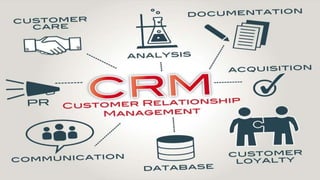
Customer Relationship Management
The expression customer relationship management (CRM) has only been in use since the
early 1990s.
 A relatively immature business or organizational practice
A consensus has not yet emerged about what counts as CRM
Most people would understand that CRM means customer relationship management, others
have used the acronym to mean customer relationship marketing.
Information technology (IT) companies have tended to use the term CRM to describe the
software applications that automate the marketing, selling and service functions of
businesses.
What is a relationship?
The ‘ R ’ of CRM stands for ‘ relationship
But what do we really mean by the expression ‘ relationship?
Personal relationship ???
At the very least a relationship involves interaction over time.
If there is only a one-off transaction ????
A relationship is composed of a series of interactive episodes between dyadic parties over
time.
What is a relationship?
Episodes are time bound (they have a beginning and an end) and are nameable.
Within a sales representative - customer relationship it is often possible to identify a
number of discrete episodes,
Making a purchase, Enquiring about a product, Making a sales call, Negotiating terms,
dealing with a complaint, Resolving an invoicing dispute etc.
Each episode in turn is composed of a series of interactions.
Interaction consists of action and response to that action. Within each episode, each
participant will act towards, and interact with, the other. The content of each episode is a
range of communicative behaviors including speech, deeds (actions) and body language.
What is a relationship?
Some authorities think that it is insufficient to define a relationship as interaction over time.
Jim Barnes –Author, “Secrets of Customer Relationship Management”, suggests that there
needs to be some emotional content to the interaction.
This implies some type of affective connection, attachment or bond.
Similarly, a relationship has been said to exist only when the parties move from a state of
independence to dependence or interdependence. E.g.– repeat purchase
Conclude from this that a relationship is a social construct.
A relationship exists if people believe that a relationship exists and they act accordingly.
It is also apparent that relationships can be unilateral or reciprocal; either one or both of the
parties may believe they are in a relationship.
Change within Relationships / Stages of relationship
Dwyer has identified five general phases through which customer–supplier relationships can
evolve.
1. Awareness - each party comes to the attention of the other as a possible exchange partner
2. Exploration - investigation and testing during which the parties explore each others ’
capabilities and performance.
3. Expansion - increasing interdependence
4. Commitment - increased adaptation and mutually understood roles and goals
5. Dissolution – closure
Change within Relationships
The model of relationship development highlights two attributes
These attributes have been the subject of a considerable amount of research – Trust and
Commitment
Trust - One party may trust the other party’s:
Benevolence : a belief that one party acts in the interests of the other
Honesty : a belief that the other party’s word is reliable or credible
Competence : a belief that the other party has the necessary expertise to perform as
required.
Change within Relationships
Commitment
Commitment is an essential ingredient for successful, long-term, relationships.
Morgan and Hunt define relationship commitment as
Commitment is shown by ‘ an exchange partner believing that an ongoing relationship
with another is so important as to warrant maximum effort to maintain it; that is, the
committed party believes the relationship is worth working on to ensure that it endures
indefinitely.’
Commitment arises from trust, shared values, and the belief that partners will be difficult to
replace.
Relationship Quality
Research into relationship quality generally cites trust and commitment as
core attributes of a high quality relationship.
Other attributes have also been identified, including relationship satisfaction,
mutual goals and cooperative norms.
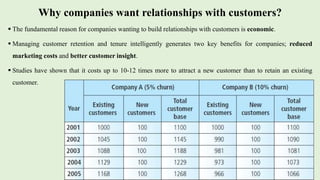
Why companies want relationships with customers?
 The fundamental reason for companies wanting to build relationships with customers is economic.
 Managing customer retention and tenure intelligently generates two key benefits for companies; reduced
marketing costs and better customer insight.
 Studies have shown that it costs up to 10-12 times more to attract a new customer than to retain an existing
customer.
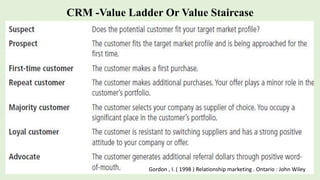
CRM -Value Ladder Or Value Staircase
Gordon , I. ( 1998 ) Relationship marketing . Ontario : John Wiley
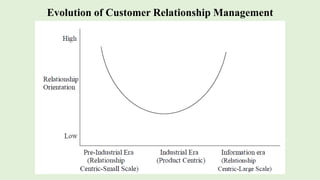
Evolution of Customer Relationship Management
 Rapid advances in technology
 Intensive competition in most markets – acquisition cost, lifetime value of
customers.
 Growing importance of the service sector, and
 Adoption of total quality management programs
Evolution of Customer Relationship Management
One of the broader approaches to CRM emerged from the research conducted by academics
at the Centre for Relationship Marketing and Service Management at the Cranfield
University, U.K.
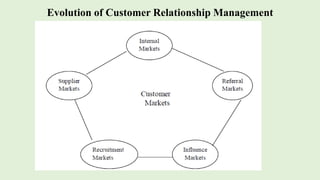
The broadened view of relationship marketing addresses a total of six key market domains,
not just the traditional customer market.
Evolution of Customer Relationship Management
Customer markets – existing and prospective customers as well as intermediaries.
Referral markets – existing customers who recommend to other prospects, and referral
sources or multipliers‘ such as doctors who refer patients to a hospital or a consultant who
recommends a specific IT solution,
Influence markets – government, consumer groups, business press and financial analysts.
Recruitment markets – for attracting the right employees to the organization,
Supplier markets – suppliers of raw materials, components, services, etc., and
Internal markets - the organization including internal departments and staff.
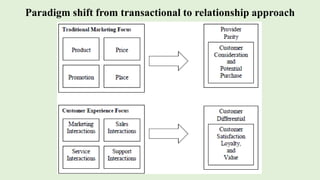
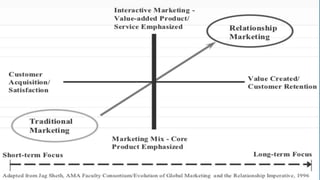
Paradigm shift from transactional to relationship approach
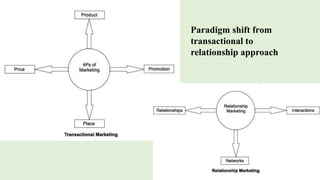
Paradigm shift from
transactional to
relationship approach
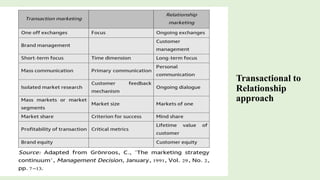
Transactional to
Relationship
approach
Paradigm shift from transactional to relationship approach
https://www.ted.com/talks/joseph_pine_what_consumers_want?language=en#t-17952
Marketing versus CMR
Evolution of CRM
Transactional versus Relationship Marketing
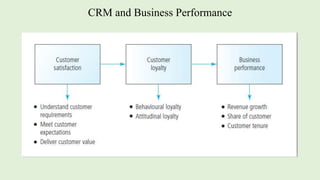
CRM and Business Performance
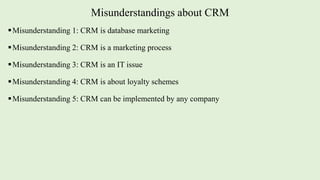
Misunderstandings about CRM
Misunderstanding 1: CRM is database marketing
Misunderstanding 2: CRM is a marketing process
Misunderstanding 3: CRM is an IT issue
Misunderstanding 4: CRM is about loyalty schemes
Misunderstanding 5: CRM can be implemented by any company
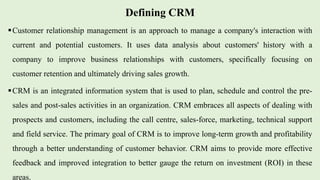
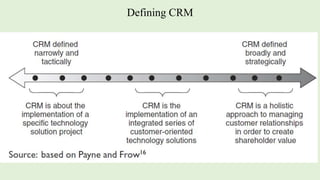
Defining CRM
Customer relationship management is an approach to manage a company's interaction with
current and potential customers. It uses data analysis about customers' history with a
company to improve business relationships with customers, specifically focusing on
customer retention and ultimately driving sales growth.
CRM is an integrated information system that is used to plan, schedule and control the pre-
sales and post-sales activities in an organization. CRM embraces all aspects of dealing with
prospects and customers, including the call centre, sales-force, marketing, technical support
and field service. The primary goal of CRM is to improve long-term growth and profitability
through a better understanding of customer behavior. CRM aims to provide more effective
feedback and improved integration to better gauge the return on investment (ROI) in these
areas.
Customer Relationship Management
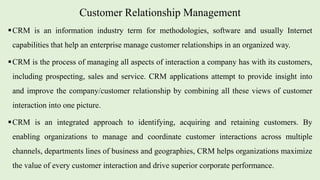
CRM is an information industry term for methodologies, software and usually Internet
capabilities that help an enterprise manage customer relationships in an organized way.
CRM is the process of managing all aspects of interaction a company has with its customers,
including prospecting, sales and service. CRM applications attempt to provide insight into
and improve the company/customer relationship by combining all these views of customer
interaction into one picture.
CRM is an integrated approach to identifying, acquiring and retaining customers. By
enabling organizations to manage and coordinate customer interactions across multiple
channels, departments lines of business and geographies, CRM helps organizations maximize
the value of every customer interaction and drive superior corporate performance.
Defining CRM
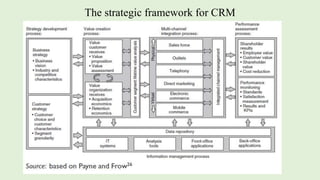
The strategic framework for CRM
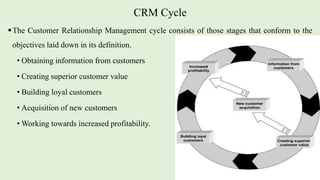
CRM Cycle
The Customer Relationship Management cycle consists of those stages that conform to the
objectives laid down in its definition.
• Obtaining information from customers
• Creating superior customer value
• Building loyal customers
• Acquisition of new customers
• Working towards increased profitability.
Hawkins Cooker Limited
Hawkins Cooker Limited is the largest selling cookers and kitchen utensils manufacturer of
India. The company claims to be highly customer sensitive. It also claims to have pioneered
many unique customer-centric initiatives. Once, a customer sent a letter to the company just to
share his happiness of having used its pressure cooker for 25 years without any trouble. The
customer service department responded the customer by gifting him a new Hawkins pressure
cooker. Similarly, Hawkins does not manufacture pressure pans which all other manufacturers
do just because the company does not find the concept of pressure pans safe enough to use as
they may lead to safety problems.
Stakeholders in CRM
Companies
Customers and partners of those companies
Vendors of CRM software
CRM application service providers (ASPs)
Vendors of CRM hardware and infrastructure
Management consultants
Stakeholders in CRM
There are four principal stakeholders who play a major role in the entire process of Customer
Relationship Management:
Customers: Customers, of course, are the most important persons in the CRM design for
whose delight the whole exercise is conducted.
Employees: They are the set of people who execute the CRM design. They include those
right from the frontline staff who actually executes to the top management who designs the
CRM.
Suppliers: They are the part of system who provide input to a company’s value chain.
Partners: They are the creators of additional value for the customers.
Type of CRM
 Strategic
 Strategic CRM is a core customer-centric business strategy that aims at winning and keeping profitable
customers
 Operational
 Operational CRM focuses on the automation of customer-facing processes such as selling, marketing and
customer service
 Analytical
 Analytical CRM focuses on the intelligent mining of customer-related data for strategic or tactical purposes
 Collaborative
 Collaborative CRM applies technology across organizational boundaries with a view to optimizing company,
partner and customer value
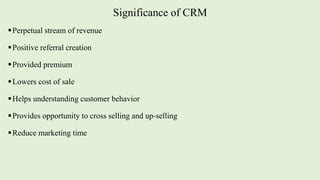
Significance of CRM
Perpetual stream of revenue
Positive referral creation
Provided premium
Lowers cost of sale
Helps understanding customer behavior
Provides opportunity to cross selling and up-selling
Reduce marketing time
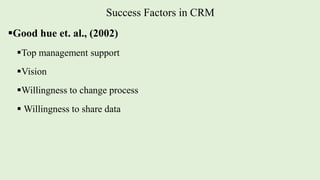
Success Factors in CRM
Good hue et. al., (2002)
Top management support
Vision
Willingness to change process
 Willingness to share data
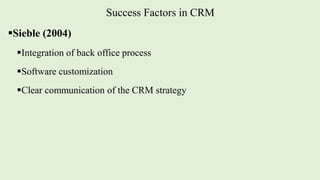
Success Factors in CRM
Sieble (2004)
Integration of back office process
Software customization
Clear communication of the CRM strategy
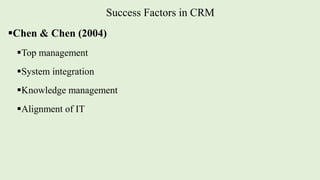
Success Factors in CRM
Chen & Chen (2004)
Top management
System integration
Knowledge management
Alignment of IT
Success Factors in CRM
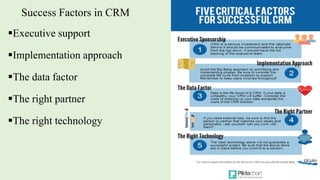
Executive support
Implementation approach
The data factor
The right partner
The right technology
BPCL’s Customer-centric Programmes
Until mid-nineties, Indian oil marketing companies were indifferent towards their customers
and services. With the deregulation of oil industry in April 2002, Indian players realized that
they needed to become more customer-focused. The Bharat Petroleum Corporation Limited
(BPCL), one of the navratnas, has taken several path-breaking initiatives to build relationships
with its customers. First, it has restructured the organization into Strategic Business Units
(SBUs) to become more flexible and customer-focused in all its businesses. The two initiatives
that paid off well was (i) setting up a team of coaches to train the employees and (ii) formation
of a team at the top that would be aware of to and accountable for all the changes that the
company would go through.
BPCL’s Customer-centric Programmes
The company also opened multiple customer-contact channels, and pioneered the scheme of
“Pure for Sure”, which later imitated by other industry players, to impart confidence among
the customers and assured them about the purity of the fuel. It also launched few customized
offerings. The launch of “Petro” card again was a customer-centric initiative aimed at
rewarding the loyal customers. The company also had “Smart Fleet” card programme for fleet
owners and companies. Initially, the scheme did not work as desired because of the dealers
'approach, but subsequently it successfully implemented those that demonstrated its
commitment towards customers.
LIC’s Customer Relationship Initiative
The insurance industry in India has come a long way since liberalization of the sector.
Opening of the sector has changed the market structure from monopoly to oligopoly. LIC was
supposed to be the biggest loser of this policy initiative. But LIC did start an initiative to
“keep the customers for life” approach. Life insurance industry today has over 14 players and
has been more customized in marketing, product planning, etc. LIC quickly realized the
importance of customer relationship and roped in WIPRO and IBM for its Customer
Relationship Management project. The project is supposed to guide its future marketing with a
customer-centric face and is the largest of its kind in India. It was aimed at studying the
consumers, their behavior towards the company and its policies.
LIC’s Customer Relationship Initiative
It would also find out the number of customers going for loans, paying premium within the
due date and those defaulting in premium payment. Based upon the consumer behavior of
over 150 million policyholders, LIC will chalk out its new marketing plans. Few of the new
market-based launches has been a result of this initiative. LIC has introduced a full-fledged
information center and customer relations department to help policyholders.
Tesco CRM: Case Study
• The Tesco (British supermarket chain Tesco) Clubcard is Tesco’s way of rewarding its most
loyal customers. For every pound you spend online or in-store, you’ll get a point. These
points, when accumulated, can be traded in for Tesco Clubcard ‘vouchers’ (for instance, 150
points gets you a £1.50 voucher).
• A voucher can then be traded in for rewards, such as an afternoon at Cineworld with the kids
(a timeless experience), or an evening at Pizza Express (enjoy it while you can). Clubcard
holders can also collect points at Tesco fuel stations, and by filling out feedback surveys
online.
• What’s in it for Tesco? Returning customers that are invested in the brand, and whose
opinion Tesco can leverage to continue improving its growing basket of offerings.
Apple CRM
• Let’s take Apple ID as an example.
• If you’ve ever used iTunes (Apple’s online music streaming service), you’ll have an Apple
ID – and if you’ve ever used an Apple device, you’ll have had to register it using an Apple
ID, too.
• These unique IDs synchronise across devices, remember music and film selections, and
provide personalized recommendations based on what’s you've been watching or listening
to. For the user, it offers convenience. And for Apple, it’s a constantly updating data set,
telling the company exactly what its customers like and allowing for effortless, targeted
marketing.
Uber CRM: Case Study
• Well, CRM is a good place to start – and for Uber, it’s industry-leading CRM software
provider Salesforce that’s powering the ride-sharing giant’s strategy. Salesforce helps Uber
extract data from people engaging with its brand on social media. With this system in place,
Uber can reply with speed to customer complaints, and track all its interactions with the
public from an intuitive dashboard.
• And, of course, it runs its own loyalty program. Uber Rewards lets you earn points every
time you ride or eat with Uber, and redeem them across its increasing range of services. It’s a
textbook example of how Uber is incentivizing customers to keep relying on its brand, as it
continues to branch out.
McDonald's CRM: Case Study
• McDonald’s partners with Astute Solutions, allowing the restaurant chain greater insights
into consumer feedback and satisfaction levels. Being able to assess restaurants by region, or
even individually, means that McDonald's can quickly spot potential customer relationship
issues, and resolve them before they become a serious problem.
• And, with Astute Solutions, McDonald’s can also:
• Provide both its franchisees and corporate managers with live access to customer
information
• Integrate data from its dynamic network of restaurants into an effective CRM tool
• Increase the accuracy of its reporting, and inform more intelligent decision-making
McDonald's CRM: Case Study
• As Christopher Garrity, McDonald’s’ own Senior Director of Customer Satisfaction,
advocates:
• “CRM [is a] critically important function for any large company. It’s clear that Astute
understands the important role it plays, and meets the ever-changing needs of our prime
customers through continued innovation.”

CRM_Intro.pptx

  • 2.
    Customer Relationship Management Theexpression customer relationship management (CRM) has only been in use since the early 1990s.  A relatively immature business or organizational practice A consensus has not yet emerged about what counts as CRM Most people would understand that CRM means customer relationship management, others have used the acronym to mean customer relationship marketing. Information technology (IT) companies have tended to use the term CRM to describe the software applications that automate the marketing, selling and service functions of businesses.
  • 3.
    What is arelationship? The ‘ R ’ of CRM stands for ‘ relationship But what do we really mean by the expression ‘ relationship? Personal relationship ??? At the very least a relationship involves interaction over time. If there is only a one-off transaction ???? A relationship is composed of a series of interactive episodes between dyadic parties over time.
  • 4.
    What is arelationship? Episodes are time bound (they have a beginning and an end) and are nameable. Within a sales representative - customer relationship it is often possible to identify a number of discrete episodes, Making a purchase, Enquiring about a product, Making a sales call, Negotiating terms, dealing with a complaint, Resolving an invoicing dispute etc. Each episode in turn is composed of a series of interactions. Interaction consists of action and response to that action. Within each episode, each participant will act towards, and interact with, the other. The content of each episode is a range of communicative behaviors including speech, deeds (actions) and body language.
  • 5.
    What is arelationship? Some authorities think that it is insufficient to define a relationship as interaction over time. Jim Barnes –Author, “Secrets of Customer Relationship Management”, suggests that there needs to be some emotional content to the interaction. This implies some type of affective connection, attachment or bond. Similarly, a relationship has been said to exist only when the parties move from a state of independence to dependence or interdependence. E.g.– repeat purchase Conclude from this that a relationship is a social construct. A relationship exists if people believe that a relationship exists and they act accordingly. It is also apparent that relationships can be unilateral or reciprocal; either one or both of the parties may believe they are in a relationship.
  • 6.
    Change within Relationships/ Stages of relationship Dwyer has identified five general phases through which customer–supplier relationships can evolve. 1. Awareness - each party comes to the attention of the other as a possible exchange partner 2. Exploration - investigation and testing during which the parties explore each others ’ capabilities and performance. 3. Expansion - increasing interdependence 4. Commitment - increased adaptation and mutually understood roles and goals 5. Dissolution – closure
  • 7.
    Change within Relationships Themodel of relationship development highlights two attributes These attributes have been the subject of a considerable amount of research – Trust and Commitment Trust - One party may trust the other party’s: Benevolence : a belief that one party acts in the interests of the other Honesty : a belief that the other party’s word is reliable or credible Competence : a belief that the other party has the necessary expertise to perform as required.
  • 8.
    Change within Relationships Commitment Commitmentis an essential ingredient for successful, long-term, relationships. Morgan and Hunt define relationship commitment as Commitment is shown by ‘ an exchange partner believing that an ongoing relationship with another is so important as to warrant maximum effort to maintain it; that is, the committed party believes the relationship is worth working on to ensure that it endures indefinitely.’ Commitment arises from trust, shared values, and the belief that partners will be difficult to replace.
  • 9.
    Relationship Quality Research intorelationship quality generally cites trust and commitment as core attributes of a high quality relationship. Other attributes have also been identified, including relationship satisfaction, mutual goals and cooperative norms.
  • 10.
    Why companies wantrelationships with customers?  The fundamental reason for companies wanting to build relationships with customers is economic.  Managing customer retention and tenure intelligently generates two key benefits for companies; reduced marketing costs and better customer insight.  Studies have shown that it costs up to 10-12 times more to attract a new customer than to retain an existing customer.
  • 11.
    CRM -Value LadderOr Value Staircase Gordon , I. ( 1998 ) Relationship marketing . Ontario : John Wiley
  • 12.
    Evolution of CustomerRelationship Management
  • 13.
    Evolution of CustomerRelationship Management  Rapid advances in technology  Intensive competition in most markets – acquisition cost, lifetime value of customers.  Growing importance of the service sector, and  Adoption of total quality management programs
  • 14.
    Evolution of CustomerRelationship Management One of the broader approaches to CRM emerged from the research conducted by academics at the Centre for Relationship Marketing and Service Management at the Cranfield University, U.K. The broadened view of relationship marketing addresses a total of six key market domains, not just the traditional customer market.
  • 15.
    Evolution of CustomerRelationship Management
  • 16.
    Evolution of CustomerRelationship Management Customer markets – existing and prospective customers as well as intermediaries. Referral markets – existing customers who recommend to other prospects, and referral sources or multipliers‘ such as doctors who refer patients to a hospital or a consultant who recommends a specific IT solution, Influence markets – government, consumer groups, business press and financial analysts. Recruitment markets – for attracting the right employees to the organization, Supplier markets – suppliers of raw materials, components, services, etc., and Internal markets - the organization including internal departments and staff.
  • 17.
    Paradigm shift fromtransactional to relationship approach
  • 19.
    Paradigm shift from transactionalto relationship approach
  • 20.
  • 21.
    Paradigm shift fromtransactional to relationship approach https://www.ted.com/talks/joseph_pine_what_consumers_want?language=en#t-17952 Marketing versus CMR Evolution of CRM Transactional versus Relationship Marketing
  • 22.
    CRM and BusinessPerformance
  • 23.
    Misunderstandings about CRM Misunderstanding1: CRM is database marketing Misunderstanding 2: CRM is a marketing process Misunderstanding 3: CRM is an IT issue Misunderstanding 4: CRM is about loyalty schemes Misunderstanding 5: CRM can be implemented by any company
  • 24.
    Defining CRM Customer relationshipmanagement is an approach to manage a company's interaction with current and potential customers. It uses data analysis about customers' history with a company to improve business relationships with customers, specifically focusing on customer retention and ultimately driving sales growth. CRM is an integrated information system that is used to plan, schedule and control the pre- sales and post-sales activities in an organization. CRM embraces all aspects of dealing with prospects and customers, including the call centre, sales-force, marketing, technical support and field service. The primary goal of CRM is to improve long-term growth and profitability through a better understanding of customer behavior. CRM aims to provide more effective feedback and improved integration to better gauge the return on investment (ROI) in these areas.
  • 25.
    Customer Relationship Management CRMis an information industry term for methodologies, software and usually Internet capabilities that help an enterprise manage customer relationships in an organized way. CRM is the process of managing all aspects of interaction a company has with its customers, including prospecting, sales and service. CRM applications attempt to provide insight into and improve the company/customer relationship by combining all these views of customer interaction into one picture. CRM is an integrated approach to identifying, acquiring and retaining customers. By enabling organizations to manage and coordinate customer interactions across multiple channels, departments lines of business and geographies, CRM helps organizations maximize the value of every customer interaction and drive superior corporate performance.
  • 26.
  • 27.
  • 28.
    CRM Cycle The CustomerRelationship Management cycle consists of those stages that conform to the objectives laid down in its definition. • Obtaining information from customers • Creating superior customer value • Building loyal customers • Acquisition of new customers • Working towards increased profitability.
  • 29.
    Hawkins Cooker Limited HawkinsCooker Limited is the largest selling cookers and kitchen utensils manufacturer of India. The company claims to be highly customer sensitive. It also claims to have pioneered many unique customer-centric initiatives. Once, a customer sent a letter to the company just to share his happiness of having used its pressure cooker for 25 years without any trouble. The customer service department responded the customer by gifting him a new Hawkins pressure cooker. Similarly, Hawkins does not manufacture pressure pans which all other manufacturers do just because the company does not find the concept of pressure pans safe enough to use as they may lead to safety problems.
  • 30.
    Stakeholders in CRM Companies Customersand partners of those companies Vendors of CRM software CRM application service providers (ASPs) Vendors of CRM hardware and infrastructure Management consultants
  • 31.
    Stakeholders in CRM Thereare four principal stakeholders who play a major role in the entire process of Customer Relationship Management: Customers: Customers, of course, are the most important persons in the CRM design for whose delight the whole exercise is conducted. Employees: They are the set of people who execute the CRM design. They include those right from the frontline staff who actually executes to the top management who designs the CRM. Suppliers: They are the part of system who provide input to a company’s value chain. Partners: They are the creators of additional value for the customers.
  • 32.
    Type of CRM Strategic  Strategic CRM is a core customer-centric business strategy that aims at winning and keeping profitable customers  Operational  Operational CRM focuses on the automation of customer-facing processes such as selling, marketing and customer service  Analytical  Analytical CRM focuses on the intelligent mining of customer-related data for strategic or tactical purposes  Collaborative  Collaborative CRM applies technology across organizational boundaries with a view to optimizing company, partner and customer value
  • 33.
    Significance of CRM Perpetualstream of revenue Positive referral creation Provided premium Lowers cost of sale Helps understanding customer behavior Provides opportunity to cross selling and up-selling Reduce marketing time
  • 34.
    Success Factors inCRM Good hue et. al., (2002) Top management support Vision Willingness to change process  Willingness to share data
  • 35.
    Success Factors inCRM Sieble (2004) Integration of back office process Software customization Clear communication of the CRM strategy
  • 36.
    Success Factors inCRM Chen & Chen (2004) Top management System integration Knowledge management Alignment of IT
  • 37.
    Success Factors inCRM Executive support Implementation approach The data factor The right partner The right technology
  • 38.
    BPCL’s Customer-centric Programmes Untilmid-nineties, Indian oil marketing companies were indifferent towards their customers and services. With the deregulation of oil industry in April 2002, Indian players realized that they needed to become more customer-focused. The Bharat Petroleum Corporation Limited (BPCL), one of the navratnas, has taken several path-breaking initiatives to build relationships with its customers. First, it has restructured the organization into Strategic Business Units (SBUs) to become more flexible and customer-focused in all its businesses. The two initiatives that paid off well was (i) setting up a team of coaches to train the employees and (ii) formation of a team at the top that would be aware of to and accountable for all the changes that the company would go through.
  • 39.
    BPCL’s Customer-centric Programmes Thecompany also opened multiple customer-contact channels, and pioneered the scheme of “Pure for Sure”, which later imitated by other industry players, to impart confidence among the customers and assured them about the purity of the fuel. It also launched few customized offerings. The launch of “Petro” card again was a customer-centric initiative aimed at rewarding the loyal customers. The company also had “Smart Fleet” card programme for fleet owners and companies. Initially, the scheme did not work as desired because of the dealers 'approach, but subsequently it successfully implemented those that demonstrated its commitment towards customers.
  • 40.
    LIC’s Customer RelationshipInitiative The insurance industry in India has come a long way since liberalization of the sector. Opening of the sector has changed the market structure from monopoly to oligopoly. LIC was supposed to be the biggest loser of this policy initiative. But LIC did start an initiative to “keep the customers for life” approach. Life insurance industry today has over 14 players and has been more customized in marketing, product planning, etc. LIC quickly realized the importance of customer relationship and roped in WIPRO and IBM for its Customer Relationship Management project. The project is supposed to guide its future marketing with a customer-centric face and is the largest of its kind in India. It was aimed at studying the consumers, their behavior towards the company and its policies.
  • 41.
    LIC’s Customer RelationshipInitiative It would also find out the number of customers going for loans, paying premium within the due date and those defaulting in premium payment. Based upon the consumer behavior of over 150 million policyholders, LIC will chalk out its new marketing plans. Few of the new market-based launches has been a result of this initiative. LIC has introduced a full-fledged information center and customer relations department to help policyholders.
  • 42.
    Tesco CRM: CaseStudy • The Tesco (British supermarket chain Tesco) Clubcard is Tesco’s way of rewarding its most loyal customers. For every pound you spend online or in-store, you’ll get a point. These points, when accumulated, can be traded in for Tesco Clubcard ‘vouchers’ (for instance, 150 points gets you a £1.50 voucher). • A voucher can then be traded in for rewards, such as an afternoon at Cineworld with the kids (a timeless experience), or an evening at Pizza Express (enjoy it while you can). Clubcard holders can also collect points at Tesco fuel stations, and by filling out feedback surveys online. • What’s in it for Tesco? Returning customers that are invested in the brand, and whose opinion Tesco can leverage to continue improving its growing basket of offerings.
  • 43.
    Apple CRM • Let’stake Apple ID as an example. • If you’ve ever used iTunes (Apple’s online music streaming service), you’ll have an Apple ID – and if you’ve ever used an Apple device, you’ll have had to register it using an Apple ID, too. • These unique IDs synchronise across devices, remember music and film selections, and provide personalized recommendations based on what’s you've been watching or listening to. For the user, it offers convenience. And for Apple, it’s a constantly updating data set, telling the company exactly what its customers like and allowing for effortless, targeted marketing.
  • 44.
    Uber CRM: CaseStudy • Well, CRM is a good place to start – and for Uber, it’s industry-leading CRM software provider Salesforce that’s powering the ride-sharing giant’s strategy. Salesforce helps Uber extract data from people engaging with its brand on social media. With this system in place, Uber can reply with speed to customer complaints, and track all its interactions with the public from an intuitive dashboard. • And, of course, it runs its own loyalty program. Uber Rewards lets you earn points every time you ride or eat with Uber, and redeem them across its increasing range of services. It’s a textbook example of how Uber is incentivizing customers to keep relying on its brand, as it continues to branch out.
  • 45.
    McDonald's CRM: CaseStudy • McDonald’s partners with Astute Solutions, allowing the restaurant chain greater insights into consumer feedback and satisfaction levels. Being able to assess restaurants by region, or even individually, means that McDonald's can quickly spot potential customer relationship issues, and resolve them before they become a serious problem. • And, with Astute Solutions, McDonald’s can also: • Provide both its franchisees and corporate managers with live access to customer information • Integrate data from its dynamic network of restaurants into an effective CRM tool • Increase the accuracy of its reporting, and inform more intelligent decision-making
  • 46.
    McDonald's CRM: CaseStudy • As Christopher Garrity, McDonald’s’ own Senior Director of Customer Satisfaction, advocates: • “CRM [is a] critically important function for any large company. It’s clear that Astute understands the important role it plays, and meets the ever-changing needs of our prime customers through continued innovation.”