The Theory
           of Evolution
06/07/12        cott
Evolution
           • A process of change
                through time


06/07/12            cott
(I) Heterotroph Hypothesis
• Is one proposed explanation for how
  life arose and evolved on primitive
  earth
• According to this hypothesis, the first
  life forms were heterotrophic and had
  to obtain their nutrients from the
  environment
   06/07/12         cott
(A)         Primitive Earth
•    Based on assumption
2.   Earth was very hot.
3.   consisted of inorganic substances
4.   Many sources of energy including heat,
     lightning, solar radiation(x-rays and U.V. rays),
5.   The atmosphere: water vapor, hydrogen,
     methane gas, and ammonia.
6.   As the earth cooled, water condensed in the
     atmosphere and rain fell forming seas
     described as “hot, thin soup”
      06/07/12              cott
(B) Synthesis of Organic Compounds

In the seas:
  – Chemical reactions formed inorganic
     substances
  – Inorganic substances bonded make
     organic substances: amino acids and
     sugar.

   06/07/12          cott
(C)                  Nutrition
•       Some of the large, complex molecules
        formed groupings or clusters called
        aggregates.

    •      Aggregates developed membranes
    •      Aggregates absorbed organic molecules
    •      Aggregates carry out first heterotrophic
           nutrition.


    06/07/12                   cott
(D)           Reproduction
1. In time, as these aggregates became more
   complex and highly organized, they
   developed the ability to reproduce
2. At the point where the ability to reproduce
   had evolved, the aggregates were
   considered to be living cells
   06/07/12           cott
(E) Heterotroph to Autotroph
1. Early heterotrophs carry out fermentation.
2. Fermentation adds carbon dioxide to the
   atmosphere
3. Heterotrophs develop the capacity to use
   carbon dioxide from the atmosphere to form
   organic compounds (photosynthesis)
4. These organisms were the first autotrophs.


   06/07/12            cott
(F) Anaerobes to Aerobes
1. Photosynthesis adds free oxygen to the
   atmosphere.
2. Over time, the capacity to use oxygen in
   respiration (aerobic) evolved in both autotrophs
   and heterotrophs
3. Present day organisms may be heterotrophic or
   autotrophic >>>>>> aerobic or anaerobic.

   06/07/12             cott
II Theory of Evolution
1. Suggests that existing forms of life
   on earth have evolved from earlier
   forms over long periods of time
2. Evolution accounts
  – differences in structures
  – differences in function, and behavior
  – changes that occur in populations
 06/07/12          cott
06/07/12   cott
Evidence of Evolution
•   Supports the theory of evolution
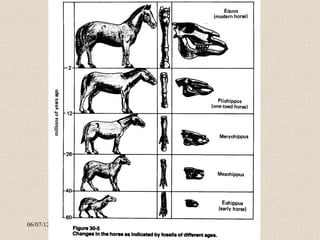
•   Geologic record
•   Comparative Cytology
•   Comparative Biochemistry
•   Comparative Anatomy
•   Comparative Embryology
    06/07/12       cott
(A) Geologic Record
• Earth’s age: 4.5 to 5 billion years old
  (age was determined by radioactive
  dating of rocks)
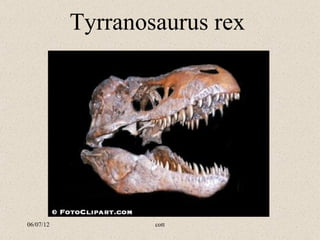
• Fossils- are the remains of traces of
  organisms that no longer exist.
  Fossils have been preserved in ice,
  sedimentary rock, amber, and tar
   06/07/12         cott
Tyrranosaurus rex


06/07/12           cott
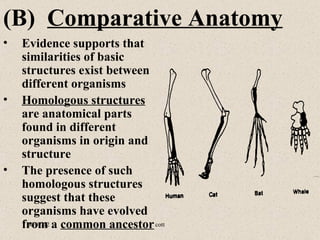
(B) Comparative Anatomy
•   Evidence supports that
    similarities of basic
    structures exist between
    different organisms
•   Homologous structures
    are anatomical parts
    found in different
    organisms in origin and
    structure
•   The presence of such
    homologous structures
    suggest that these
    organisms have evolved
    from a common ancestor cott
     06/07/12
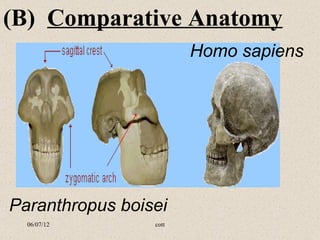
(B) Comparative Anatomy
                                    Homo sapiens


  Paranthropus boisei
   06/07/12        cott
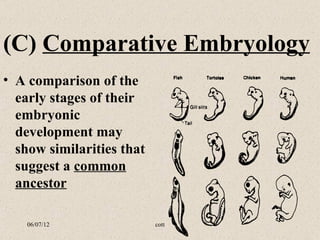
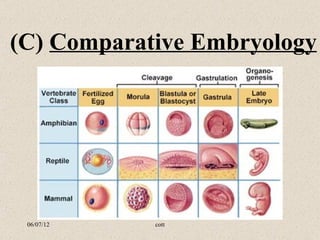
(C) Comparative Embryology
• A comparison of the
  early stages of their
  embryonic
  development may
  show similarities that
  suggest a common
  ancestor

    06/07/12               cott
(C) Comparative Embryology


 06/07/12   cott
(D) Comparative Cytology

1. All living things are made up of cells
2. Cell organelles including the cell
   membrane, ribosome's, and
   mitochondria are structurally and
   functionally similar in most
   organisms
  06/07/12         cott
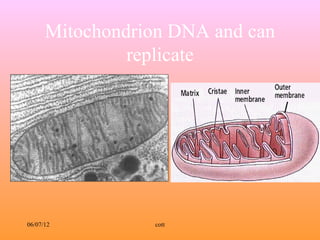
Mitochondrion DNA and can
               replicate


06/07/12         cott
06/07/12   cott
(E) Comparative Biochemistry
• All living things contain similar
  biochemical compounds
• Examples: structure and function
  of DNA, RNA, and proteins


  06/07/12        cott
(III) Theories of Evolution
• Attempts to explain the similarities
  and differences among species.

• Adaptations- features which make a
  species better suited to live and
  reproduce in its environment.
   06/07/12         cott
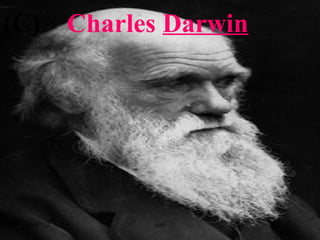
(C)         Charles Darwin


 06/07/12         cott
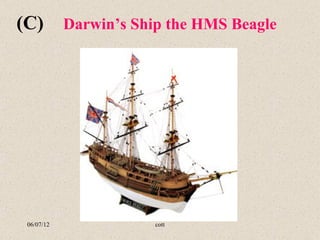
(C)         Darwin’s Ship the HMS Beagle


 06/07/12               cott
06/07/12   cott
(C)              Darwin
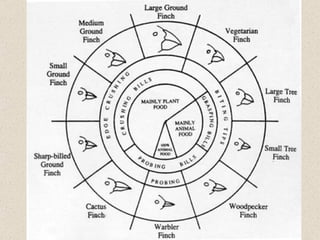
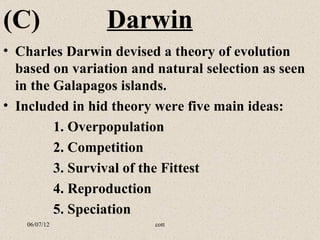
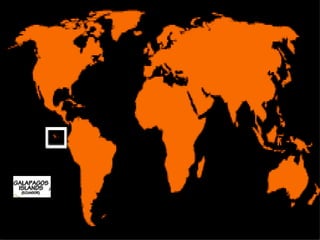
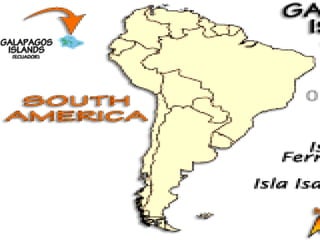
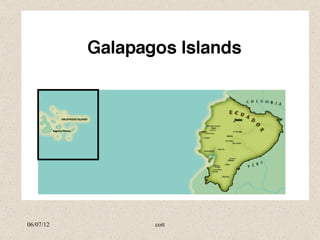
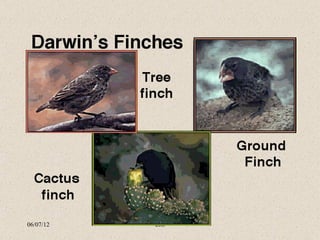
• Charles Darwin devised a theory of evolution
  based on variation and natural selection as seen
  in the Galapagos islands.
• Included in hid theory were five main ideas:
         1. Overpopulation
         2. Competition
         3. Survival of the Fittest
         4. Reproduction
         5. Speciation
   06/07/12              cott
06/07/12   cott
06/07/12   cott
06/07/12   cott
Overpopulation

     • Within a population, there
     are more offspring produced
      in each generation than can
            possibly survive

06/07/12         cott
Competition
  • Natural resources: food, water,
        and space available to a
          population is limited.
    • Many organisms with similar
     nutritional requirements, there
      must be competition between
   them for the resources needed to
                  survive
06/07/12          cott
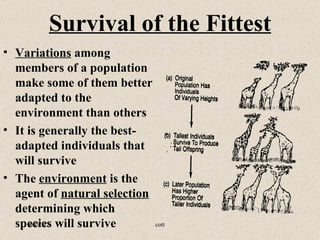
Survival of the Fittest
• Variations among
  members of a population
  make some of them better
  adapted to the
  environment than others
• It is generally the best-
  adapted individuals that
  will survive
• The environment is the
  agent of natural selection
  determining which
  species will survive
     06/07/12                cott
Reproduction

   • Individuals that survive and
    then reproduce transmit these
     variations to their offspring


06/07/12         cott
Speciation
• The development of a new species
 occurs as variations or adaptations
  accumulate in a population over
         many generations
 • Ex: caveman  present man
 06/07/12        cott
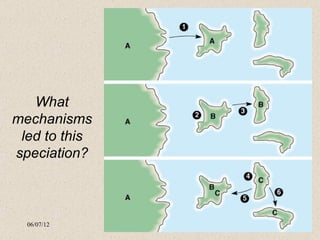
What 
mechanisms 
 led to this 
speciation?


  06/07/12      cott
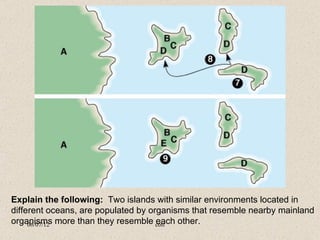
Explain the following:  Two islands with similar environments located in 
different oceans, are populated by organisms that resemble nearby mainland 
organisms more than they resemble each other.
     06/07/12                        cott
(IV) Modern Theories of Evolution


 • Includes both Darwin’s ideas of
    variation and natural selection
  and the current knowledge of the
         sources of variations.


  06/07/12       cott
(A) Sources of Variations
• Segregation and the
  recombination of genes during
  sexual reproduction
• Gene mutation occurs
  spontaneously and at random

  06/07/12       cott
(B)          Natural Selection
• Traits which are beneficial to the
  survival of an organism in a
  particular environment tend to be
  retained and passed on, and
  therefore, increase in frequency
  within a population.
  06/07/12          cott
Ex: Insects resistant to insecticides
1. Genetic make-up of some insects make them resistant
   to the effects of insecticides
2. Before the widespread use of insecticides, this trait was
   of no particular survival value
3. With the increased use of insecticides, this trait
   developed a very high survival value
4. Therefore, insects with resistance to insecticides
   survived and reproduced much more successfully than
   those lacking the trait
5. As a result, the frequency of insecticide resistance has
   increased greatly in insect populations
    06/07/12                 cott
(C) Geographic Isolation
•   Isolation of a population increases the chances
    for speciation (the development of a new
    species.)
•   Separates a small group of organisms from the
    main population with its large gene pool
    (inheritable traits).
•   Geographic isolation is caused by natural
    barriers like mountains, large bodies of water,
    and deserts.
    06/07/12             cott
06/07/12   cott
(D) Reproductive Isolation
• If the isolated population becomes so
  different from the main population that
  members of the two cannot interbreed and
  produce fertile offspring, then they have
  become two distinct species


   06/07/12          cott
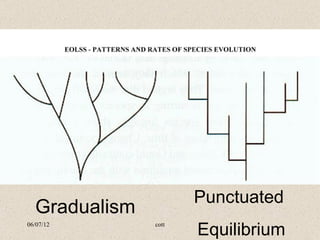
(V) Time Frame for Evolution
• There are two different theories proposed
  by scientists to address the rate of
  evolution:
  1. Gradualism- proposes that evolutionary
  change is slow, gradual, and continuous
  2. Punctuated Equilibrium- proposes that
  species have long periods of stability
  (several million years) interrupted by
  geologically brief periods of significant
  change during which a new species may
  evolve
   06/07/12          cott
Punctuated 
  Gradualism
06/07/12       cott
                      Equilibrium

Evolution

  • 1.
    The Theory of Evolution 06/07/12 cott
  • 3.
    Evolution • A process of change through time 06/07/12 cott
  • 4.
    (I) Heterotroph Hypothesis •Is one proposed explanation for how life arose and evolved on primitive earth • According to this hypothesis, the first life forms were heterotrophic and had to obtain their nutrients from the environment 06/07/12 cott
  • 5.
    (A) Primitive Earth • Based on assumption 2. Earth was very hot. 3. consisted of inorganic substances 4. Many sources of energy including heat, lightning, solar radiation(x-rays and U.V. rays), 5. The atmosphere: water vapor, hydrogen, methane gas, and ammonia. 6. As the earth cooled, water condensed in the atmosphere and rain fell forming seas described as “hot, thin soup” 06/07/12 cott
  • 6.
    (B) Synthesis ofOrganic Compounds In the seas: – Chemical reactions formed inorganic substances – Inorganic substances bonded make organic substances: amino acids and sugar. 06/07/12 cott
  • 7.
    (C) Nutrition • Some of the large, complex molecules formed groupings or clusters called aggregates. • Aggregates developed membranes • Aggregates absorbed organic molecules • Aggregates carry out first heterotrophic nutrition. 06/07/12 cott
  • 8.
    (D) Reproduction 1. In time, as these aggregates became more complex and highly organized, they developed the ability to reproduce 2. At the point where the ability to reproduce had evolved, the aggregates were considered to be living cells 06/07/12 cott
  • 9.
    (E) Heterotroph toAutotroph 1. Early heterotrophs carry out fermentation. 2. Fermentation adds carbon dioxide to the atmosphere 3. Heterotrophs develop the capacity to use carbon dioxide from the atmosphere to form organic compounds (photosynthesis) 4. These organisms were the first autotrophs. 06/07/12 cott
  • 10.
    (F) Anaerobes toAerobes 1. Photosynthesis adds free oxygen to the atmosphere. 2. Over time, the capacity to use oxygen in respiration (aerobic) evolved in both autotrophs and heterotrophs 3. Present day organisms may be heterotrophic or autotrophic >>>>>> aerobic or anaerobic. 06/07/12 cott
  • 11.
    II Theory ofEvolution 1. Suggests that existing forms of life on earth have evolved from earlier forms over long periods of time 2. Evolution accounts – differences in structures – differences in function, and behavior – changes that occur in populations 06/07/12 cott
  • 12.
  • 13.
    Evidence of Evolution • Supports the theory of evolution • Geologic record • Comparative Cytology • Comparative Biochemistry • Comparative Anatomy • Comparative Embryology 06/07/12 cott
  • 14.
    (A) Geologic Record •Earth’s age: 4.5 to 5 billion years old (age was determined by radioactive dating of rocks) • Fossils- are the remains of traces of organisms that no longer exist. Fossils have been preserved in ice, sedimentary rock, amber, and tar 06/07/12 cott
  • 15.
  • 16.
    (B) Comparative Anatomy • Evidence supports that similarities of basic structures exist between different organisms • Homologous structures are anatomical parts found in different organisms in origin and structure • The presence of such homologous structures suggest that these organisms have evolved from a common ancestor cott 06/07/12
  • 17.
    (B) Comparative Anatomy         Homo sapiens   Paranthropus boisei 06/07/12 cott
  • 18.
    (C) Comparative Embryology •A comparison of the early stages of their embryonic development may show similarities that suggest a common ancestor 06/07/12 cott
  • 19.
  • 20.
    (D) Comparative Cytology 1.All living things are made up of cells 2. Cell organelles including the cell membrane, ribosome's, and mitochondria are structurally and functionally similar in most organisms 06/07/12 cott
  • 21.
    Mitochondrion DNA andcan replicate 06/07/12 cott
  • 22.
  • 23.
    (E) Comparative Biochemistry •All living things contain similar biochemical compounds • Examples: structure and function of DNA, RNA, and proteins 06/07/12 cott
  • 24.
    (III) Theories ofEvolution • Attempts to explain the similarities and differences among species. • Adaptations- features which make a species better suited to live and reproduce in its environment. 06/07/12 cott
  • 25.
    (C) Charles Darwin 06/07/12 cott
  • 26.
    (C) Darwin’s Ship the HMS Beagle 06/07/12 cott
  • 27.
  • 28.
    (C) Darwin • Charles Darwin devised a theory of evolution based on variation and natural selection as seen in the Galapagos islands. • Included in hid theory were five main ideas: 1. Overpopulation 2. Competition 3. Survival of the Fittest 4. Reproduction 5. Speciation 06/07/12 cott
  • 29.
  • 30.
  • 31.
  • 32.
    Overpopulation • Within a population, there are more offspring produced in each generation than can possibly survive 06/07/12 cott
  • 33.
    Competition •Natural resources: food, water, and space available to a population is limited. • Many organisms with similar nutritional requirements, there must be competition between them for the resources needed to survive 06/07/12 cott
  • 34.
    Survival of theFittest • Variations among members of a population make some of them better adapted to the environment than others • It is generally the best- adapted individuals that will survive • The environment is the agent of natural selection determining which species will survive 06/07/12 cott
  • 35.
    Reproduction • Individuals that survive and then reproduce transmit these variations to their offspring 06/07/12 cott
  • 36.
    Speciation • The developmentof a new species occurs as variations or adaptations accumulate in a population over many generations • Ex: caveman  present man 06/07/12 cott
  • 37.
  • 38.
  • 39.
    (IV) Modern Theoriesof Evolution • Includes both Darwin’s ideas of variation and natural selection and the current knowledge of the sources of variations. 06/07/12 cott
  • 40.
    (A) Sources ofVariations • Segregation and the recombination of genes during sexual reproduction • Gene mutation occurs spontaneously and at random 06/07/12 cott
  • 41.
    (B) Natural Selection • Traits which are beneficial to the survival of an organism in a particular environment tend to be retained and passed on, and therefore, increase in frequency within a population. 06/07/12 cott
  • 42.
    Ex: Insects resistantto insecticides 1. Genetic make-up of some insects make them resistant to the effects of insecticides 2. Before the widespread use of insecticides, this trait was of no particular survival value 3. With the increased use of insecticides, this trait developed a very high survival value 4. Therefore, insects with resistance to insecticides survived and reproduced much more successfully than those lacking the trait 5. As a result, the frequency of insecticide resistance has increased greatly in insect populations 06/07/12 cott
  • 43.
    (C) Geographic Isolation • Isolation of a population increases the chances for speciation (the development of a new species.) • Separates a small group of organisms from the main population with its large gene pool (inheritable traits). • Geographic isolation is caused by natural barriers like mountains, large bodies of water, and deserts. 06/07/12 cott
  • 44.
  • 45.
    (D) Reproductive Isolation •If the isolated population becomes so different from the main population that members of the two cannot interbreed and produce fertile offspring, then they have become two distinct species 06/07/12 cott
  • 46.
    (V) Time Framefor Evolution • There are two different theories proposed by scientists to address the rate of evolution: 1. Gradualism- proposes that evolutionary change is slow, gradual, and continuous 2. Punctuated Equilibrium- proposes that species have long periods of stability (several million years) interrupted by geologically brief periods of significant change during which a new species may evolve 06/07/12 cott
  • 47.