CONCEPT OF
EVIDENCE – BASED
PRACTICE
MAJ JEEJA JOHN
MSc (N) I Year
INTRODUCTION
Also known as “Evidence Based Nursing”
One of the six core competencies in the QSEN initiative.
QSEN – Quality and Safety Education for Nurses.
DEFINITION OF EBP
“The EBP in Nursing is a process of locating, appraising and applying the
best evidence from the nursing and medical literature to improve the
quality of clinical nursing practices.”
( from the text book of Nursing Research and Statistics by Suresh K
Sharma)
COMPONENTS
 EBP is built on a 3-legged stool which are
Best Evidence
Clinical Expertise
Patient Preferences and Values
Purposes of EBP
It enables nurses to manage the explosion of new literature and technology
It allows nurses to enrich their clinical training and experience with up-to-date
research
Its goal is to eliminate unsound or excessively risky practices in favour of those
who have better outcomes.
It has contributed a lot towards better patient outcomes.
The ultimate goal is to provide the highest quality and most cost – efficient
nursing care possible.
To improve the quality of nursing care.
Factors that facilitate EBP
Strong organizational support
The availability of EBP mentors and resources
Collaboration among helth professionals
Participation in journal clubs
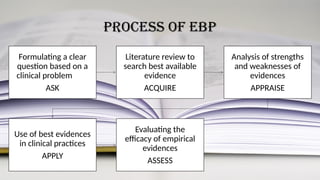
Process of EBP
Formulating a clear
question based on a
clinical problem
ASK
Literature review to
search best available
evidence
ACQUIRE
Analysis of strengths
and weaknesses of
evidences
APPRAISE
Use of best evidences
in clinical practices
APPLY
Evaluating the
efficacy of empirical
evidences
ASSESS
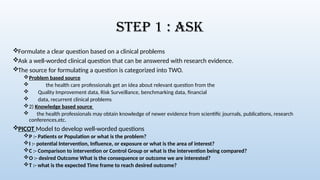
Step 1 : ASK
Formulate a clear question based on a clinical problems
Ask a well-worded clinical question that can be answered with research evidence.
The source for formulating a question is categorized into TWO.
Problem based source
 the health care professionals get an idea about relevant question from the
 Quality Improvement data, Risk Surveillance, benchmarking data, financial
 data, recurrent clinical problems
2) Knowledge based source
 the health professionals may obtain knowledge of newer evidence from scientific journals, publications, research
conferences,etc.
PICOT Model to develop well-worded questions
P :- Patients or Population or what is the problem?
I :- potential Intervention, Influence, or exposure or what is the area of interest?
C :- Comparison to intervention or Control Group or what is the intervention being compared?
O :- desired Outcome What is the consequence or outcome we are interested?
T :- what is the expected Time frame to reach desired outcome?
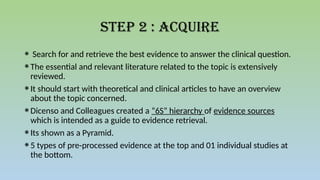
Step 2 : ACQUIRE
⁕ Search for and retrieve the best evidence to answer the clinical question.
⁕ The essential and relevant literature related to the topic is extensively
reviewed.
⁕ It should start with theoretical and clinical articles to have an overview
about the topic concerned.
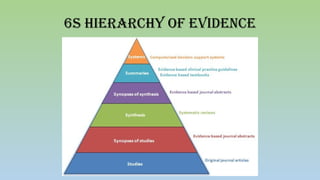
⁕ Dicenso and Colleagues created a “6S” hierarchy of evidence sources
which is intended as a guide to evidence retrieval.
⁕ Its shown as a Pyramid.
⁕ 5 types of pre-processed evidence at the top and 01 individual studies at
the bottom.
6S HIERARCHY OF EVIDENCE
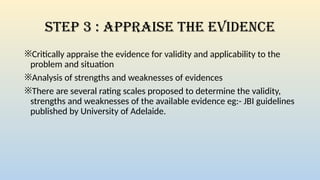
Step 3 : Appraise the Evidence
※Critically appraise the evidence for validity and applicability to the
problem and situation
※Analysis of strengths and weaknesses of evidences
※There are several rating scales proposed to determine the validity,
strengths and weaknesses of the available evidence eg:- JBI guidelines
published by University of Adelaide.
Step 4 :- Apply
Use of best evidences in clinical practices
After integrating the evidence with clinical expertise, patient
preferences and local context, apply it to clinical practice.
It is implementing useful findings in clinical practice based on valid
evidence.
Evidence is used to plan care of the patient.
Step 5 :- Assess
Evaluate the outcome of the practice change
Evaluating the efficacy of empirical evidences through self –
reflection, audit or peer assessment.
Challenges / Barriers in adopting
EBP
Nurses’ lack of research appraisal skills (research evaluation skill, access to journals are limited)
Nurses’ misperception about EBP
Heavy patient loads and lack of time
Overwhelming amount of Information available in literature and sometimes contradictory
findings can create confusion among practitioners.
Lack of knowledge of research methods
Lack of support from colleagues and organizations
Lack of confidence and authority in research arena
Shortage of resources
Nurses & administrators resistance to change.
Lack of autonomy in practice decisions
THANK YOU

Evidence based practice in nursing.pptxs

  • 1.
    CONCEPT OF EVIDENCE –BASED PRACTICE MAJ JEEJA JOHN MSc (N) I Year
  • 2.
    INTRODUCTION Also known as“Evidence Based Nursing” One of the six core competencies in the QSEN initiative. QSEN – Quality and Safety Education for Nurses.
  • 3.
    DEFINITION OF EBP “TheEBP in Nursing is a process of locating, appraising and applying the best evidence from the nursing and medical literature to improve the quality of clinical nursing practices.” ( from the text book of Nursing Research and Statistics by Suresh K Sharma)
  • 4.
    COMPONENTS  EBP isbuilt on a 3-legged stool which are Best Evidence Clinical Expertise Patient Preferences and Values
  • 5.
    Purposes of EBP Itenables nurses to manage the explosion of new literature and technology It allows nurses to enrich their clinical training and experience with up-to-date research Its goal is to eliminate unsound or excessively risky practices in favour of those who have better outcomes. It has contributed a lot towards better patient outcomes. The ultimate goal is to provide the highest quality and most cost – efficient nursing care possible. To improve the quality of nursing care.
  • 6.
    Factors that facilitateEBP Strong organizational support The availability of EBP mentors and resources Collaboration among helth professionals Participation in journal clubs
  • 7.
    Process of EBP Formulatinga clear question based on a clinical problem ASK Literature review to search best available evidence ACQUIRE Analysis of strengths and weaknesses of evidences APPRAISE Use of best evidences in clinical practices APPLY Evaluating the efficacy of empirical evidences ASSESS
  • 8.
    Step 1 :ASK Formulate a clear question based on a clinical problems Ask a well-worded clinical question that can be answered with research evidence. The source for formulating a question is categorized into TWO. Problem based source  the health care professionals get an idea about relevant question from the  Quality Improvement data, Risk Surveillance, benchmarking data, financial  data, recurrent clinical problems 2) Knowledge based source  the health professionals may obtain knowledge of newer evidence from scientific journals, publications, research conferences,etc. PICOT Model to develop well-worded questions P :- Patients or Population or what is the problem? I :- potential Intervention, Influence, or exposure or what is the area of interest? C :- Comparison to intervention or Control Group or what is the intervention being compared? O :- desired Outcome What is the consequence or outcome we are interested? T :- what is the expected Time frame to reach desired outcome?
  • 9.
    Step 2 :ACQUIRE ⁕ Search for and retrieve the best evidence to answer the clinical question. ⁕ The essential and relevant literature related to the topic is extensively reviewed. ⁕ It should start with theoretical and clinical articles to have an overview about the topic concerned. ⁕ Dicenso and Colleagues created a “6S” hierarchy of evidence sources which is intended as a guide to evidence retrieval. ⁕ Its shown as a Pyramid. ⁕ 5 types of pre-processed evidence at the top and 01 individual studies at the bottom.
  • 10.
  • 11.
    Step 3 :Appraise the Evidence ※Critically appraise the evidence for validity and applicability to the problem and situation ※Analysis of strengths and weaknesses of evidences ※There are several rating scales proposed to determine the validity, strengths and weaknesses of the available evidence eg:- JBI guidelines published by University of Adelaide.
  • 12.
    Step 4 :-Apply Use of best evidences in clinical practices After integrating the evidence with clinical expertise, patient preferences and local context, apply it to clinical practice. It is implementing useful findings in clinical practice based on valid evidence. Evidence is used to plan care of the patient.
  • 13.
    Step 5 :-Assess Evaluate the outcome of the practice change Evaluating the efficacy of empirical evidences through self – reflection, audit or peer assessment.
  • 14.
    Challenges / Barriersin adopting EBP Nurses’ lack of research appraisal skills (research evaluation skill, access to journals are limited) Nurses’ misperception about EBP Heavy patient loads and lack of time Overwhelming amount of Information available in literature and sometimes contradictory findings can create confusion among practitioners. Lack of knowledge of research methods Lack of support from colleagues and organizations Lack of confidence and authority in research arena Shortage of resources Nurses & administrators resistance to change. Lack of autonomy in practice decisions
  • 15.