Event Process
Chain (EPC)
Presented By:
Ansarullah
&
Ghulam Ishaq
Supervised By:
Sir Zarin khail
Kabul University, Computer Science Faculty , Department of IT (Master of IT class spring 2024)
Contents of the Presentation
Inttoduction Ghulam Ishaq
Literature Review ( Theoritical & Practical ) Ghulam Ishaq
Benefits of EPC Ghulam Ishaq
Applications of EPC
Ghulam Ishaq
Best Practices for EPC Modeling Ghulam Ishaq
Recent Advancements in EPC Ghulam Ishaq
Elements of EPC Ansarullah
Rules for modeling an EPC: Ansarullah
Tools for EPC Modeling Ansarullah
ARIS Express for modeling an EPC Ansarullah
Example of EPC Model using ARIS software AG (Practical) Ansarullah
Refernces
Introduction:
 An event-driven process chain (EPC) is a type of flow
chart for business process modeling.
 EPC can be used to configure enterprise resource
planning execution, and for business process improvement.
 EPC is a powerful technique used in business process modeling to
visualize business processes and workflows.
Literature Review
Theoretical :
1. EPC diagrams (Event-driven Process Chain Flowcharts) are a graph
for descriptions of business process workflows. In 1992, Professor
Scheer and his long-term colleagues in Saarland developed EPC.
Since then, the diagram has been under widespread industrial
usage.
2. The theoretical basis of EPC draws from concepts in Business
Process Management (BPM), particularly the idea of events
triggering processes.
Literature Review
Practical Applications :
1. Research has demonstrated the effectiveness of EPC in various
domains, including manufacturing, healthcare, finance, and logistics.
2. Studies by Reijers and Mansar explore the use of EPC for process
analysis and redesign. [2]
3. EPC has been integrated into enterprise software solutions like
ARIS (Architecture of Integrated Information Systems) and SAP to
support business process modeling and automation
Transparency
Benefits of EPC
Provides a clear and structured visualization of
business processes.
Enables identification of bottlenecks and
process inefficiencies.
Facilitates understanding among stakeholders. Enhances communication between business
and IT stakeholders.
Clarity Analysis
Communication
Applications of EPC:
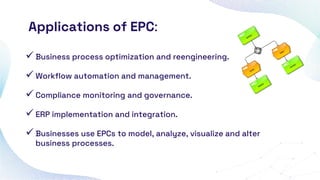
 Business process optimization and reengineering.
 Workflow automation and management.
 Compliance monitoring and governance.
 ERP implementation and integration.
 Businesses use EPCs to model, analyze, visualize and alter
business processes.
Best Practices for EPC Modeling:
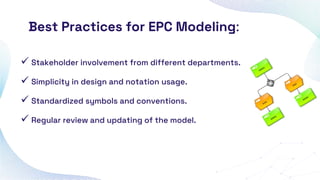
 Stakeholder involvement from different departments.
 Simplicity in design and notation usage.
 Standardized symbols and conventions.
 Regular review and updating of the model.
Recent Advancements in EPC:
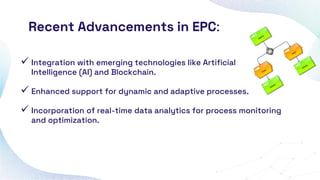
 Integration with emerging technologies like Artificial
Intelligence (AI) and Blockchain.
 Enhanced support for dynamic and adaptive processes.
 Incorporation of real-time data analytics for process monitoring
and optimization.
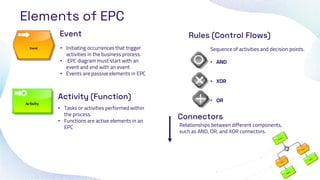
Activity (Function)
Elements of EPC
• Initiating occurrences that trigger
activities in the business process.
• EPC diagram must start with an
event and end with an event
• Events are passive elements in EPC
Sequence of activities and decision points.
• AND
• XOR
• OR
• Tasks or activities performed within
the process.
• Functions are active elements in an
EPC Relationships between different components,
such as AND, OR, and XOR connectors.
Event Rules (Control Flows)
Connectors
Rules for modeling an EPC:
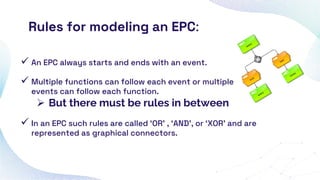
 An EPC always starts and ends with an event.
 Multiple functions can follow each event or multiple
events can follow each function.
 But there must be rules in between
 In an EPC such rules are called ‘OR’ , ‘AND’, or ‘XOR’ and are
represented as graphical connectors.
Tools for modeling an EPC:
 Various software tools available.
 ARIS, Signavio, and Microsoft Visio..
 Consideration of tool features and suitability for
organizational requirements.
ARIS Express for modeling an EPC:
 Is a free modeling tool form the market
leader Software AG
 Support the modeling of EPCs with the model
type ‘Business Model’
 Can be downloaded from the link
https://ariscommunity.com/aris-
express/download
Refernces
1. A.-W. Scheer (2002). " newtip="A.-W.Scheer(2002年)。">A.-
W.Scheer(2002年)。</trans><trans oldtip="ARIS. Vom
Geschäftsprozess zum Anwendungssystem" newtip="阿里斯。vm
Gesch ftsprozess zum Anwendungssystem">阿里斯。vm Gesch
ftsprozess zum Anwendungssystem</trans>. Springer. p.20.
2. https://www.emerald.com/insight/content/doi/10.1108/1463715
0910975561/full/html
3. https://www.zenflowchart.com/
4. https://en.wikipedia.org/wiki/Event-driven_process_chain Modern
and equipped computer lab (I)
CREDITS: This presentation template was created by
Slidesgo, and includes icons by Flaticon, and infographics
& images by Freepik
Thanks!
Do you have any questions?

Event Process Chain (EPC) Presentation.pptx

  • 1.
    Event Process Chain (EPC) PresentedBy: Ansarullah & Ghulam Ishaq Supervised By: Sir Zarin khail Kabul University, Computer Science Faculty , Department of IT (Master of IT class spring 2024)
  • 2.
    Contents of thePresentation Inttoduction Ghulam Ishaq Literature Review ( Theoritical & Practical ) Ghulam Ishaq Benefits of EPC Ghulam Ishaq Applications of EPC Ghulam Ishaq Best Practices for EPC Modeling Ghulam Ishaq Recent Advancements in EPC Ghulam Ishaq Elements of EPC Ansarullah Rules for modeling an EPC: Ansarullah Tools for EPC Modeling Ansarullah ARIS Express for modeling an EPC Ansarullah Example of EPC Model using ARIS software AG (Practical) Ansarullah Refernces
  • 3.
    Introduction:  An event-drivenprocess chain (EPC) is a type of flow chart for business process modeling.  EPC can be used to configure enterprise resource planning execution, and for business process improvement.  EPC is a powerful technique used in business process modeling to visualize business processes and workflows.
  • 4.
    Literature Review Theoretical : 1.EPC diagrams (Event-driven Process Chain Flowcharts) are a graph for descriptions of business process workflows. In 1992, Professor Scheer and his long-term colleagues in Saarland developed EPC. Since then, the diagram has been under widespread industrial usage. 2. The theoretical basis of EPC draws from concepts in Business Process Management (BPM), particularly the idea of events triggering processes.
  • 5.
    Literature Review Practical Applications: 1. Research has demonstrated the effectiveness of EPC in various domains, including manufacturing, healthcare, finance, and logistics. 2. Studies by Reijers and Mansar explore the use of EPC for process analysis and redesign. [2] 3. EPC has been integrated into enterprise software solutions like ARIS (Architecture of Integrated Information Systems) and SAP to support business process modeling and automation
  • 6.
    Transparency Benefits of EPC Providesa clear and structured visualization of business processes. Enables identification of bottlenecks and process inefficiencies. Facilitates understanding among stakeholders. Enhances communication between business and IT stakeholders. Clarity Analysis Communication
  • 7.
    Applications of EPC: Business process optimization and reengineering.  Workflow automation and management.  Compliance monitoring and governance.  ERP implementation and integration.  Businesses use EPCs to model, analyze, visualize and alter business processes.
  • 8.
    Best Practices forEPC Modeling:  Stakeholder involvement from different departments.  Simplicity in design and notation usage.  Standardized symbols and conventions.  Regular review and updating of the model.
  • 9.
    Recent Advancements inEPC:  Integration with emerging technologies like Artificial Intelligence (AI) and Blockchain.  Enhanced support for dynamic and adaptive processes.  Incorporation of real-time data analytics for process monitoring and optimization.
  • 10.
    Activity (Function) Elements ofEPC • Initiating occurrences that trigger activities in the business process. • EPC diagram must start with an event and end with an event • Events are passive elements in EPC Sequence of activities and decision points. • AND • XOR • OR • Tasks or activities performed within the process. • Functions are active elements in an EPC Relationships between different components, such as AND, OR, and XOR connectors. Event Rules (Control Flows) Connectors
  • 11.
    Rules for modelingan EPC:  An EPC always starts and ends with an event.  Multiple functions can follow each event or multiple events can follow each function.  But there must be rules in between  In an EPC such rules are called ‘OR’ , ‘AND’, or ‘XOR’ and are represented as graphical connectors.
  • 12.
    Tools for modelingan EPC:  Various software tools available.  ARIS, Signavio, and Microsoft Visio..  Consideration of tool features and suitability for organizational requirements.
  • 13.
    ARIS Express formodeling an EPC:  Is a free modeling tool form the market leader Software AG  Support the modeling of EPCs with the model type ‘Business Model’  Can be downloaded from the link https://ariscommunity.com/aris- express/download
  • 15.
    Refernces 1. A.-W. Scheer(2002). " newtip="A.-W.Scheer(2002年)。">A.- W.Scheer(2002年)。</trans><trans oldtip="ARIS. Vom Geschäftsprozess zum Anwendungssystem" newtip="阿里斯。vm Gesch ftsprozess zum Anwendungssystem">阿里斯。vm Gesch ftsprozess zum Anwendungssystem</trans>. Springer. p.20. 2. https://www.emerald.com/insight/content/doi/10.1108/1463715 0910975561/full/html 3. https://www.zenflowchart.com/ 4. https://en.wikipedia.org/wiki/Event-driven_process_chain Modern and equipped computer lab (I)
  • 16.
    CREDITS: This presentationtemplate was created by Slidesgo, and includes icons by Flaticon, and infographics & images by Freepik Thanks! Do you have any questions?