EPClets
A Lightweight and Flexible Textual Language to
Augment EPC Process Modeling
By
Malinda Kapuruge, Jun Han, Alan Colman and Ulf Rüegg
1
Outline
• Event-driven Process Chains (EPC)
• Emergence of Textual representations
• EPC Markup Language (EPML)
• Limitations of EPML
• EPClets
• Tool support
• Evaluation results
• Conclusions
2
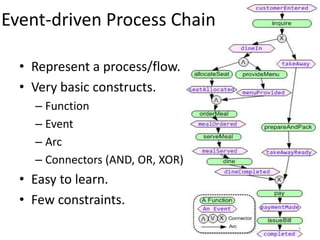
Event-driven Process Chain
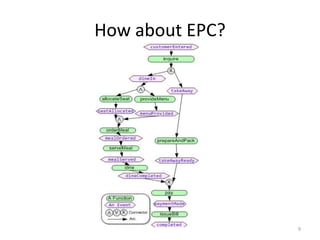
• Represent a process/flow.
• Very basic constructs.
– Function
– Event
– Arc
– Connectors (AND, OR, XOR)
• Easy to learn.
• Few constraints.
3
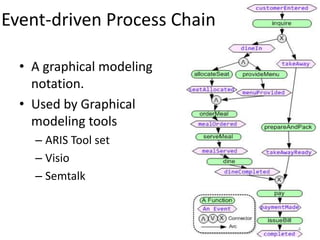
Event-driven Process Chain
• A graphical modeling
notation.
• Used by Graphical
modeling tools
– ARIS Tool set
– Visio
– Semtalk
4
In a parallel universe…
5
Textual representations are emerging
for Graphical notations…
6
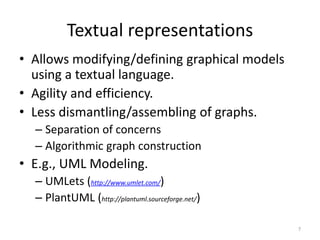
• Allows modifying/defining graphical models
using a textual language.
• Agility and efficiency.
• Less dismantling/assembling of graphs.
– Separation of concerns
– Algorithmic graph construction
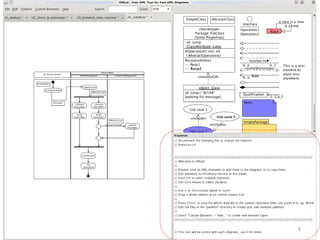
• E.g., UML Modeling.
– UMLets (http://www.umlet.com/)
– PlantUML (http://plantuml.sourceforge.net/)
7
Textual representations
8
How about EPC?
9
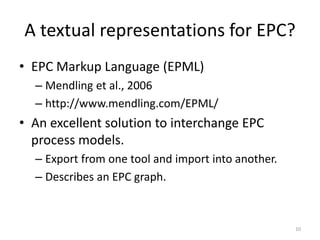
A textual representations for EPC?
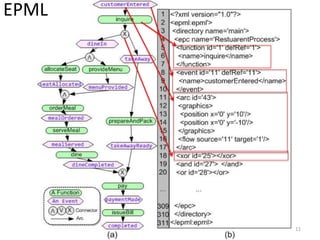
• EPC Markup Language (EPML)
– Mendling et al., 2006
– http://www.mendling.com/EPML/
• An excellent solution to interchange EPC
process models.
– Export from one tool and import into another.
– Describes an EPC graph.
10
EPML
11
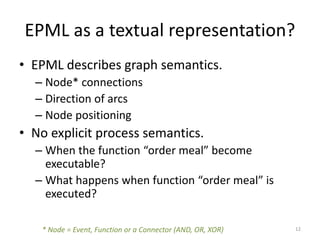
EPML as a textual representation?
• EPML describes graph semantics.
– Node* connections
– Direction of arcs
– Node positioning
• No explicit process semantics.
– When the function “order meal” become
executable?
– What happens when function “order meal” is
executed?
12* Node = Event, Function or a Connector (AND, OR, XOR)
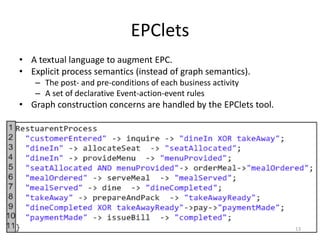
EPClets
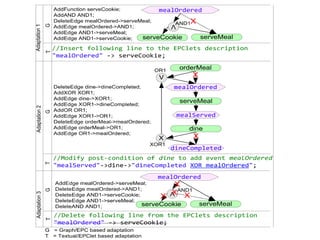
• A textual language to augment EPC.
• Explicit process semantics (instead of graph semantics).
– The post- and pre-conditions of each business activity
– A set of declarative Event-action-event rules
• Graph construction concerns are handled by the EPClets tool.
13
EPClets
• NOT an alternative to EPML.
– EPML keeps its place as an interchange format
– EPML descriptions can be exported from EPClets
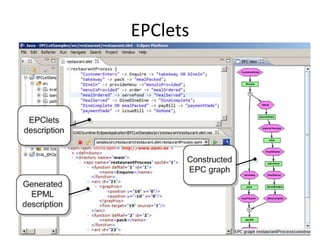
• Tool support
– An eclipse plugin
14
EPClets
15
16
EPClets
17
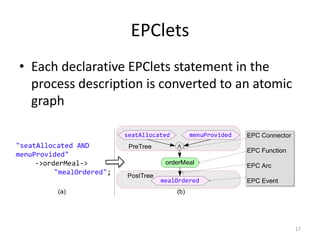
• Each declarative EPClets statement in the
process description is converted to an atomic
graph
EPClets
18
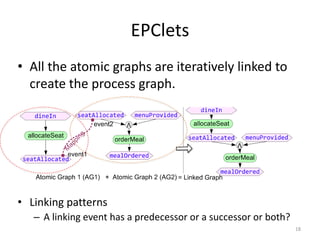
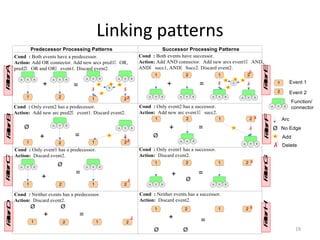
• All the atomic graphs are iteratively linked to
create the process graph.
• Linking patterns
– A linking event has a predecessor or a successor or both?
Linking patterns
19
1
V
V
2
V
V
+ =
1
V
V
2
V
V
V
X
X
X
1 2
V
V
+ =
V
V
21 X
X
1
V
V
2
+
=
1
V
V
2
X
1
+
2
=
1 2
X
X X X
X
X
X
X X
1
V
V
2
V
V
+ =
1
V
V
2
V
V
X
X
X
1 2
V
V
+ =
V
V
21 X
X
1
V
V
2
+ =
1
V
V
2 X
1
+
2
=
1 2 X
V
X X X X
X
X
X X
Ø Ø
Ø
Ø
Ø
Ø
Ø Ø
Predecessor Processing Patterns Successor Processing Patterns
PatternAPatternBPatternCPatternD
PatternFPatternEPatternGPatternH
Cond : Both events have a predecessor.
Action: Add OR connector. Add new arcs pred1→ OR,
pred2→ OR and OR→ event1. Discard event2.
Cond : Both events have successor.
Action: Add AND connector. Add new arcs event1→ AND,
AND→ succ1, AND→ Succ2. Discard event2.
Cond : Only event2 has a predecessor.
Action: Add new arc pred2→ event1. Discard event2.
Cond : Only event2 has a successor.
Action: Add new arc event1→ succ2.
Cond : Only event1 has a predecessor.
Action: Discard event2.
Cond : Only event1 has a successor.
Action: Discard event2.
Cond : Neither events has a predecessor.
Action: Discard event2.
Cond : Neither events has a successor.
Action: Discard event2.
1
2
Event 1
Event 2
V
V X
Function/
connector
Ø
Arc
X Delete
Add
No Edge
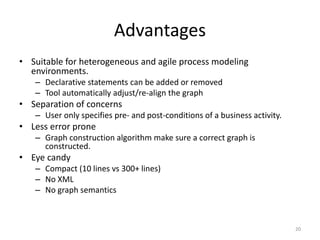
Advantages
• Suitable for heterogeneous and agile process modeling
environments.
– Declarative statements can be added or removed
– Tool automatically adjust/re-align the graph
• Separation of concerns
– User only specifies pre- and post-conditions of a business activity.
• Less error prone
– Graph construction algorithm make sure a correct graph is
constructed.
• Eye candy
– Compact (10 lines vs 300+ lines)
– No XML
– No graph semantics
20
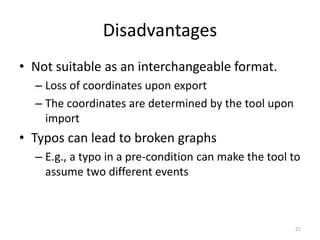
Disadvantages
• Not suitable as an interchangeable format.
– Loss of coordinates upon export
– The coordinates are determined by the tool upon
import
• Typos can lead to broken graphs
– E.g., a typo in a pre-condition can make the tool to
assume two different events
21
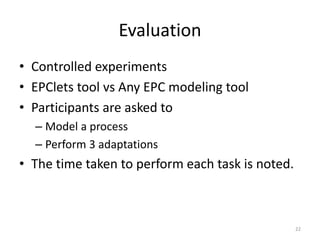
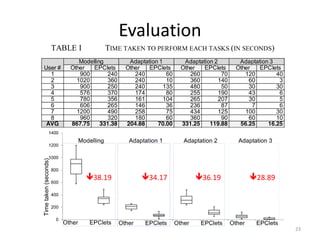
Evaluation
• Controlled experiments
• EPClets tool vs Any EPC modeling tool
• Participants are asked to
– Model a process
– Perform 3 adaptations
• The time taken to perform each task is noted.
22
Evaluation
23
38.19 34.17 36.19 28.89
Discussion
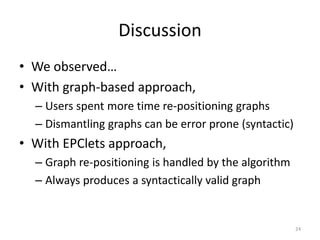
• We observed…
• With graph-based approach,
– Users spent more time re-positioning graphs
– Dismantling graphs can be error prone (syntactic)
• With EPClets approach,
– Graph re-positioning is handled by the algorithm
– Always produces a syntactically valid graph
24
Question…!
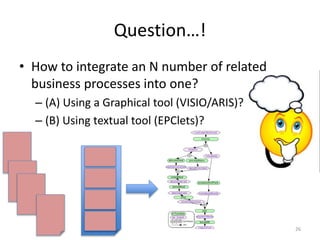
• How to integrate an N number of related
business processes into one?
– (A) Using a Graphical tool (VISIO/ARIS)?
– (B) Using textual tool (EPClets)?
26
Conclusions
• EPClets is a textual language to augment EPC
process modeling.
• EPClets provides the ability to efficiently
model and adapt EPC process models.
• EPClets separates the process specification
concerns from graph construction concerns.
• EPClets capabilities have been experimentally
evaluated.
27
28
Photo credit
• http://addictedto24.blogspot.com/
• http://imconfident.wordpress.com/
• http://wscounselblog.com/
29

EPClets - A Lightweight and Flexible Textual Language to Augment EPC Process Modeling

  • 1.
    EPClets A Lightweight andFlexible Textual Language to Augment EPC Process Modeling By Malinda Kapuruge, Jun Han, Alan Colman and Ulf Rüegg 1
  • 2.
    Outline • Event-driven ProcessChains (EPC) • Emergence of Textual representations • EPC Markup Language (EPML) • Limitations of EPML • EPClets • Tool support • Evaluation results • Conclusions 2
  • 3.
    Event-driven Process Chain •Represent a process/flow. • Very basic constructs. – Function – Event – Arc – Connectors (AND, OR, XOR) • Easy to learn. • Few constraints. 3
  • 4.
    Event-driven Process Chain •A graphical modeling notation. • Used by Graphical modeling tools – ARIS Tool set – Visio – Semtalk 4
  • 5.
    In a paralleluniverse… 5
  • 6.
    Textual representations areemerging for Graphical notations… 6
  • 7.
    • Allows modifying/defininggraphical models using a textual language. • Agility and efficiency. • Less dismantling/assembling of graphs. – Separation of concerns – Algorithmic graph construction • E.g., UML Modeling. – UMLets (http://www.umlet.com/) – PlantUML (http://plantuml.sourceforge.net/) 7 Textual representations
  • 8.
  • 9.
  • 10.
    A textual representationsfor EPC? • EPC Markup Language (EPML) – Mendling et al., 2006 – http://www.mendling.com/EPML/ • An excellent solution to interchange EPC process models. – Export from one tool and import into another. – Describes an EPC graph. 10
  • 11.
  • 12.
    EPML as atextual representation? • EPML describes graph semantics. – Node* connections – Direction of arcs – Node positioning • No explicit process semantics. – When the function “order meal” become executable? – What happens when function “order meal” is executed? 12* Node = Event, Function or a Connector (AND, OR, XOR)
  • 13.
    EPClets • A textuallanguage to augment EPC. • Explicit process semantics (instead of graph semantics). – The post- and pre-conditions of each business activity – A set of declarative Event-action-event rules • Graph construction concerns are handled by the EPClets tool. 13
  • 14.
    EPClets • NOT analternative to EPML. – EPML keeps its place as an interchange format – EPML descriptions can be exported from EPClets • Tool support – An eclipse plugin 14
  • 15.
  • 16.
  • 17.
    EPClets 17 • Each declarativeEPClets statement in the process description is converted to an atomic graph
  • 18.
    EPClets 18 • All theatomic graphs are iteratively linked to create the process graph. • Linking patterns – A linking event has a predecessor or a successor or both?
  • 19.
    Linking patterns 19 1 V V 2 V V + = 1 V V 2 V V V X X X 12 V V + = V V 21 X X 1 V V 2 + = 1 V V 2 X 1 + 2 = 1 2 X X X X X X X X X 1 V V 2 V V + = 1 V V 2 V V X X X 1 2 V V + = V V 21 X X 1 V V 2 + = 1 V V 2 X 1 + 2 = 1 2 X V X X X X X X X X Ø Ø Ø Ø Ø Ø Ø Ø Predecessor Processing Patterns Successor Processing Patterns PatternAPatternBPatternCPatternD PatternFPatternEPatternGPatternH Cond : Both events have a predecessor. Action: Add OR connector. Add new arcs pred1→ OR, pred2→ OR and OR→ event1. Discard event2. Cond : Both events have successor. Action: Add AND connector. Add new arcs event1→ AND, AND→ succ1, AND→ Succ2. Discard event2. Cond : Only event2 has a predecessor. Action: Add new arc pred2→ event1. Discard event2. Cond : Only event2 has a successor. Action: Add new arc event1→ succ2. Cond : Only event1 has a predecessor. Action: Discard event2. Cond : Only event1 has a successor. Action: Discard event2. Cond : Neither events has a predecessor. Action: Discard event2. Cond : Neither events has a successor. Action: Discard event2. 1 2 Event 1 Event 2 V V X Function/ connector Ø Arc X Delete Add No Edge
  • 20.
    Advantages • Suitable forheterogeneous and agile process modeling environments. – Declarative statements can be added or removed – Tool automatically adjust/re-align the graph • Separation of concerns – User only specifies pre- and post-conditions of a business activity. • Less error prone – Graph construction algorithm make sure a correct graph is constructed. • Eye candy – Compact (10 lines vs 300+ lines) – No XML – No graph semantics 20
  • 21.
    Disadvantages • Not suitableas an interchangeable format. – Loss of coordinates upon export – The coordinates are determined by the tool upon import • Typos can lead to broken graphs – E.g., a typo in a pre-condition can make the tool to assume two different events 21
  • 22.
    Evaluation • Controlled experiments •EPClets tool vs Any EPC modeling tool • Participants are asked to – Model a process – Perform 3 adaptations • The time taken to perform each task is noted. 22
  • 23.
  • 24.
    Discussion • We observed… •With graph-based approach, – Users spent more time re-positioning graphs – Dismantling graphs can be error prone (syntactic) • With EPClets approach, – Graph re-positioning is handled by the algorithm – Always produces a syntactically valid graph 24
  • 26.
    Question…! • How tointegrate an N number of related business processes into one? – (A) Using a Graphical tool (VISIO/ARIS)? – (B) Using textual tool (EPClets)? 26
  • 27.
    Conclusions • EPClets isa textual language to augment EPC process modeling. • EPClets provides the ability to efficiently model and adapt EPC process models. • EPClets separates the process specification concerns from graph construction concerns. • EPClets capabilities have been experimentally evaluated. 27
  • 28.
  • 29.
    Photo credit • http://addictedto24.blogspot.com/ •http://imconfident.wordpress.com/ • http://wscounselblog.com/ 29

Editor's Notes

  • #4 Some extensions have been added later. Few constraints -A function cannot be immediately followed by another function. -An event cannot be immediately followed by another event. Etc.
  • #6 Provide an overview of the approach. Highlight the expected benefits of the approach.
  • #7 Provide an overview of the approach. Highlight the expected benefits of the approach.
  • #11 Not European Pensions Management 
  • #13 Explain how the experiment has been conducted.
  • #14 Explain how the experiment has been conducted.
  • #15 Explain how the experiment has been conducted.
  • #23 Explain how the experiment has been conducted. Small number of participants: . Nielsen. 2000, Why You Only Need to Test with 5 Users. Available: http://www.nngroup.com/articles/why-you-only-need-to-test-with-5- users/
  • #25 Explain how the experiment has been conducted.