How to Be Safer Online
Presented by Dr. Joel R. Evans, RMI Distinguished Professor
Zarb School of Business, Hofstra University
joel.r.evans@hofstra.edu
www.evansonmarketing.com
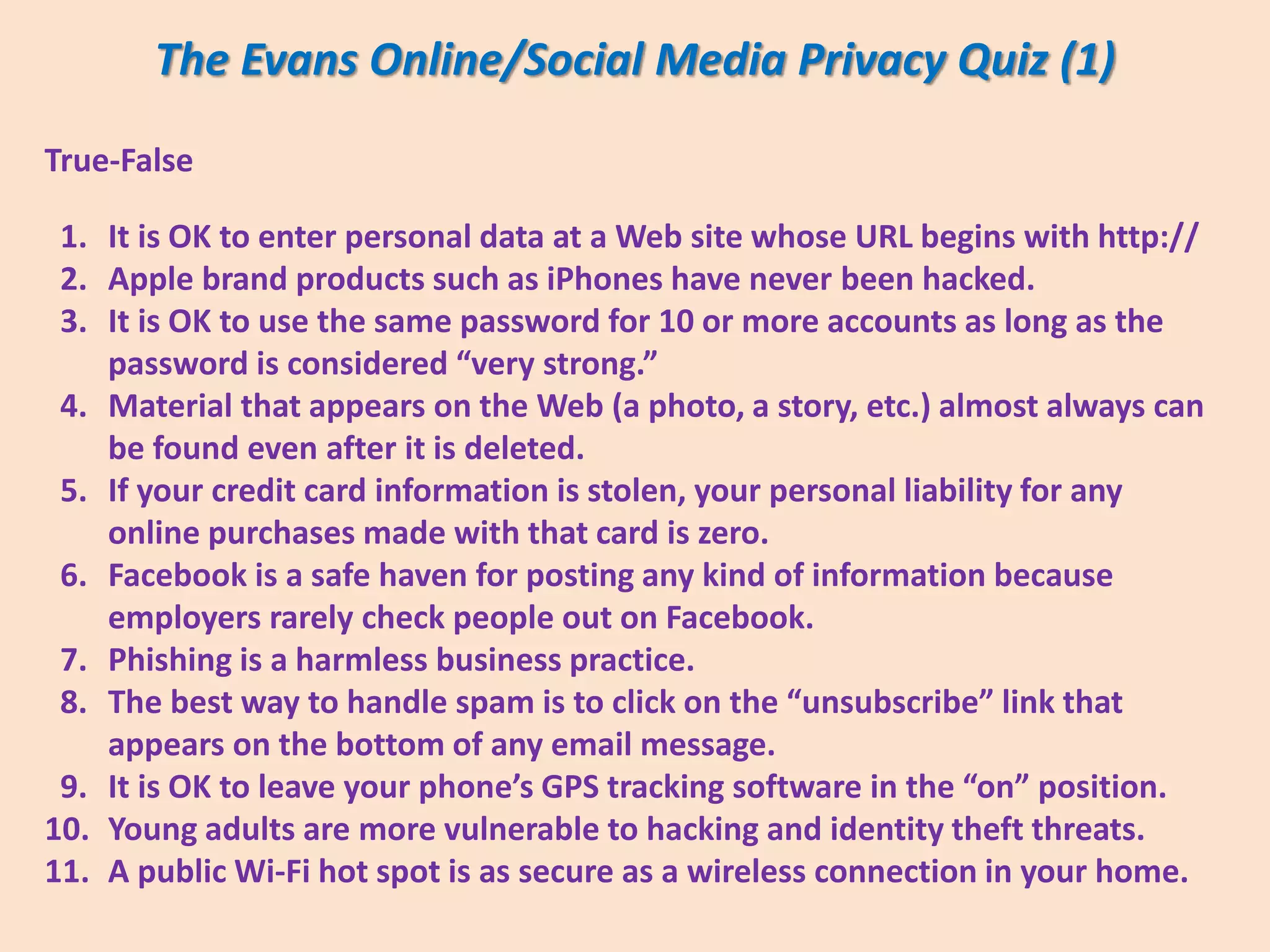
The Evans Online/Social Media Privacy Quiz (1)
True-False
1. It is OK to enter personal data at a Web site whose URL begins with http://
2. Apple brand products such as iPhones have never been hacked.
3. It is OK to use the same password for 10 or more accounts as long as the
password is considered “very strong.”
4. Material that appears on the Web (a photo, a story, etc.) almost always can
be found even after it is deleted.
5. If your credit card information is stolen, your personal liability for any
online purchases made with that card is zero.
6. Facebook is a safe haven for posting any kind of information because
employers rarely check people out on Facebook.
7. Phishing is a harmless business practice.
8. The best way to handle spam is to click on the “unsubscribe” link that
appears on the bottom of any email message.
9. It is OK to leave your phone’s GPS tracking software in the “on” position.
10. Young adults are more vulnerable to hacking and identity theft threats.
11. A public Wi-Fi hot spot is as secure as a wireless connection in your home.
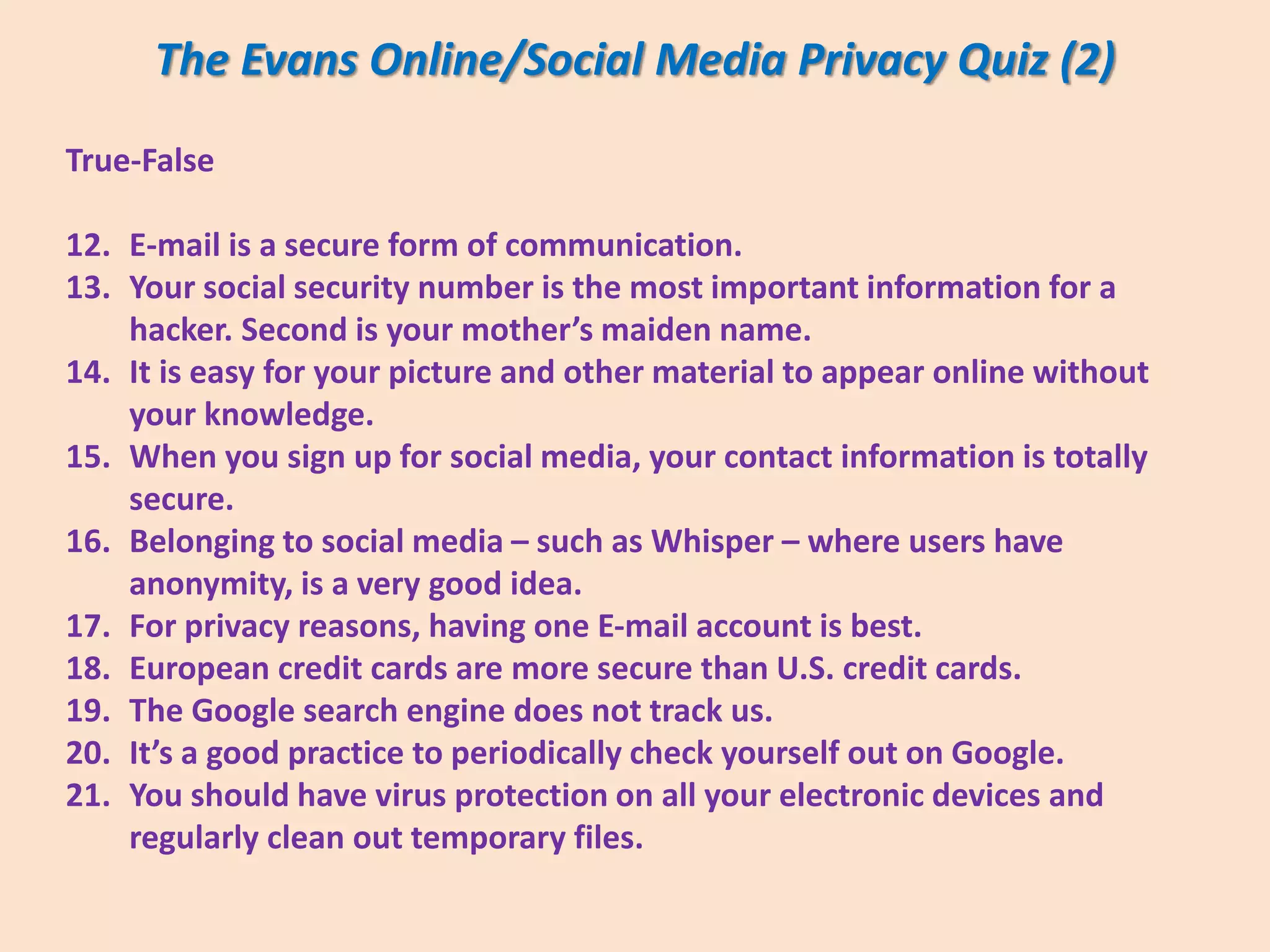
The Evans Online/Social Media Privacy Quiz (2)
True-False
12. E-mail is a secure form of communication.
13. Your social security number is the most important information for a
hacker. Second is your mother’s maiden name.
14. It is easy for your picture and other material to appear online without
your knowledge.
15. When you sign up for social media, your contact information is totally
secure.
16. Belonging to social media – such as Whisper – where users have
anonymity, is a very good idea.
17. For privacy reasons, having one E-mail account is best.
18. European credit cards are more secure than U.S. credit cards.
19. The Google search engine does not track us.
20. It’s a good practice to periodically check yourself out on Google.
21. You should have virus protection on all your electronic devices and
regularly clean out temporary files.
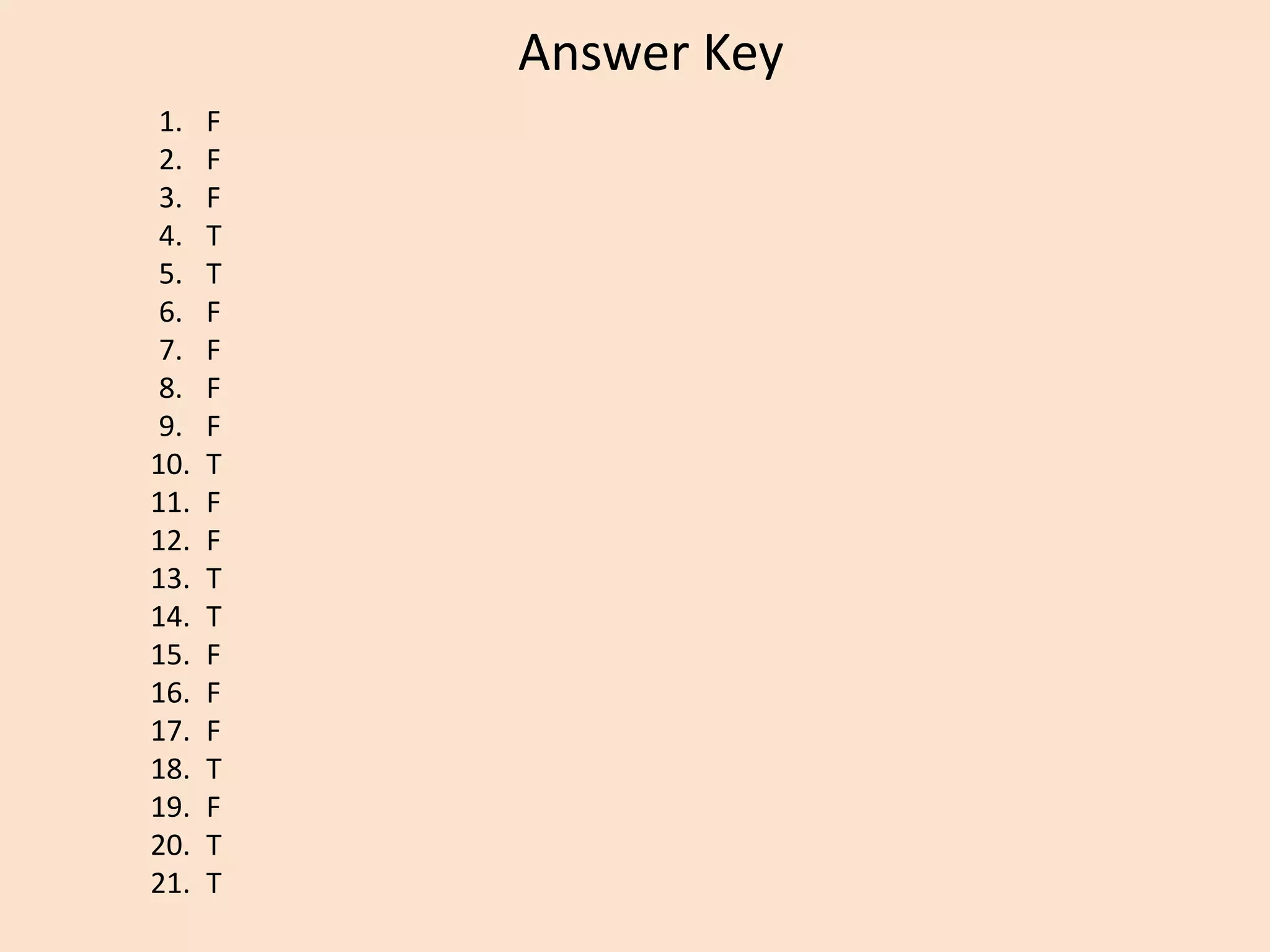
Answer Key
1. F
2. F
3. F
4. T
5. T
6. F
7. F
8. F
9. F
10. T
11. F
12. F
13. T
14. T
15. F
16. F
17. F
18. T
19. F
20. T
21. T

Evans Online Privacy Quiz

  • 1.
    How to BeSafer Online Presented by Dr. Joel R. Evans, RMI Distinguished Professor Zarb School of Business, Hofstra University joel.r.evans@hofstra.edu www.evansonmarketing.com
  • 2.
    The Evans Online/SocialMedia Privacy Quiz (1) True-False 1. It is OK to enter personal data at a Web site whose URL begins with http:// 2. Apple brand products such as iPhones have never been hacked. 3. It is OK to use the same password for 10 or more accounts as long as the password is considered “very strong.” 4. Material that appears on the Web (a photo, a story, etc.) almost always can be found even after it is deleted. 5. If your credit card information is stolen, your personal liability for any online purchases made with that card is zero. 6. Facebook is a safe haven for posting any kind of information because employers rarely check people out on Facebook. 7. Phishing is a harmless business practice. 8. The best way to handle spam is to click on the “unsubscribe” link that appears on the bottom of any email message. 9. It is OK to leave your phone’s GPS tracking software in the “on” position. 10. Young adults are more vulnerable to hacking and identity theft threats. 11. A public Wi-Fi hot spot is as secure as a wireless connection in your home.
  • 3.
    The Evans Online/SocialMedia Privacy Quiz (2) True-False 12. E-mail is a secure form of communication. 13. Your social security number is the most important information for a hacker. Second is your mother’s maiden name. 14. It is easy for your picture and other material to appear online without your knowledge. 15. When you sign up for social media, your contact information is totally secure. 16. Belonging to social media – such as Whisper – where users have anonymity, is a very good idea. 17. For privacy reasons, having one E-mail account is best. 18. European credit cards are more secure than U.S. credit cards. 19. The Google search engine does not track us. 20. It’s a good practice to periodically check yourself out on Google. 21. You should have virus protection on all your electronic devices and regularly clean out temporary files.
  • 4.
    Answer Key 1. F 2.F 3. F 4. T 5. T 6. F 7. F 8. F 9. F 10. T 11. F 12. F 13. T 14. T 15. F 16. F 17. F 18. T 19. F 20. T 21. T