• Evaluative listening is also
important for assertive behavior
as it allows you to think
through the facts and provide
objective feedback rather than
be 'hood-winked' by emotion.
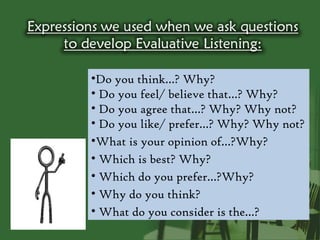
•Do you think…? Why?
• Do you feel/ believe that…? Why?
• Do you agree that…? Why? Why not?
• Do you like/ prefer…? Why? Why not?
•What is your opinion of…?Why?
• Which is best? Why?
• Which do you prefer…?Why?
• Why do you think?
• What do you consider is the…?
HIGH-LEVEL
QUESTIONS
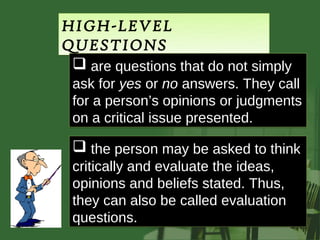
  are questions that do not simply
 ask for yes or no answers. They call
 for a person’s opinions or judgments
 on a critical issue presented.

  the person may be asked to think
 critically and evaluate the ideas,
 opinions and beliefs stated. Thus,
 they can also be called evaluation
 questions.
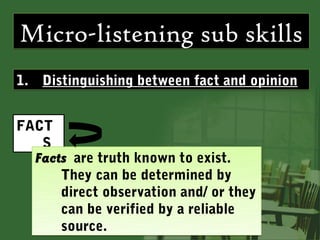
Micro-listening sub skills
1. Distinguishing between fact and opinion


FACT
   S
  Facts are truth known to exist.
      They can be determined by
      direct observation and/ or they
      can be verified by a reliable
      source.
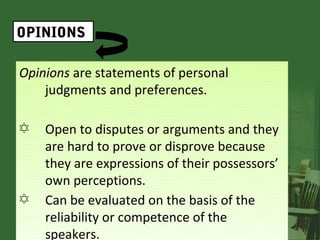
OPINIONS

Opinions are statements of personal
    judgments and preferences.

✡   Open to disputes or arguments and they
    are hard to prove or disprove because
    they are expressions of their possessors’
    own perceptions.
✡   Can be evaluated on the basis of the
    reliability or competence of the
    speakers.
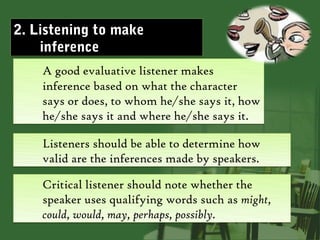
2. Listening to make
    inference
    A good evaluative listener makes
    inference based on what the character
    says or does, to whom he/she says it, how
    he/she says it and where he/she says it.

    Listeners should be able to determine how
    valid are the inferences made by speakers.

    Critical listener should note whether the
    speaker uses qualifying words such as might,
    could, would, may, perhaps, possibly.
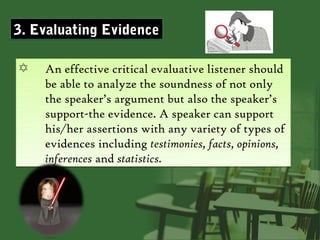
3. Evaluating Evidence

✡   An effective critical evaluative listener should
    be able to analyze the soundness of not only
    the speaker’s argument but also the speaker’s
    support-the evidence. A speaker can support
    his/her assertions with any variety of types of
    evidences including testimonies, facts, opinions,
    inferences and statistics.
To test the evidence used by the
speaker, the listener should determine
            the following:

 a. the clarity of the evidence
 b. the accuracy of the evidence
 c. reliability of the evidence
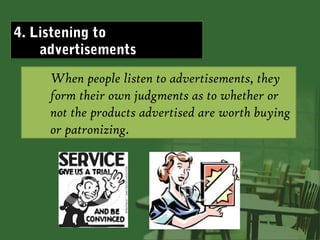
4. Listening to
    advertisements
     When people listen to advertisements, they
     form their own judgments as to whether or
     not the products advertised are worth buying
     or patronizing.
LISTENING TO JUDGE
 TRUTHFULNESS OF CLAIMS

The speakers credibility has a great
impact on the listeners. As critical
listeners, we have to be aware that a
person’s reputations in the past or at
present can influence us. However,
we should be aware of the influence of
the image and not make our decisions
solely on this basis.
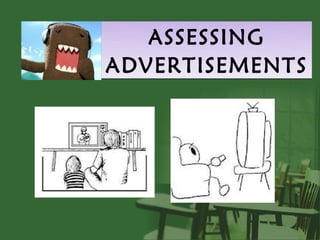
ASSESSING
ADVERTISEMENTS
Advertisements usually
appeal to our emotions. The
speaker’s may use any of a
number of appeals to win
the favour of the
listeners.
1.     ACQUISITION AND SAVINGS


            The speaker might appeal to our need for
            acquisition and savings by stressing how the
            product can save us money.
       EX: “Save as much as 25%...”
            “200 grams free…”

2. COMPANIONSHIP

     This appeal arouses in us the desire to be with
           other people.
     EX: “Be counted. Be one of the thousands of
           people who joined us.”
3. ADVENTURE

The listener’s desire to explore new worlds, see
      exciting happenings, and participate in
      different events is often stressed.
EX: “Experience our newest thrill rides.”


4. CREATIVITY


T
5. CURIOSITY
Operates on our desire for adventure, particularly
     if we are motivated to explore new territory
EX: A salesperson who keeps his product unknown
     until the near end of his presentation arouses
     our interest and often motivates us to
     continue listening.


 6. FIGHTING

      A speaker often employs the appeal to fighting by
           arousing the anger of his listeners.
      EX: “Are you happy with the judge’s decisions?”
7.
      FE
      AR
The speaker overdo a fear appeal so that the
     listener may even be threatened to believe or
     follow him/her.
EX: A religious group maintaining that a man who
     refused to listen to their preaching suffered a
     heart stroke.

8.
     GUI
A prominent advertising theme today. Working
     LT
     mothers are one of the targets of this type of
     appeal. They are encouraged to “make up”
     for their absences.
9. IMITATION

EX: Using the cosmetics endorsed by a well-known
     celebrity in order to have the same kind of
     flawless skin.


10.
      LOYALT
      Y
 This is an appeal to our sense of loyalty to our
       nation, our friends, and family and
       organization.
11. INDEPENDENCE


A devise used by some advertisers to appeal to our
     sense of independence.
EX: A liberated woman looking sophisticated using
     a certain brand of cosmetics.

 12. PERSONAL ENJOYMENT


   This is an appeal to our desire for pleasure.
   EX: An airline advertising the comfort and luxury
         of riding on its plane.
13. POWER AND AUTHORITY


The speaker may wish to appeal to the listener’s
     sense of power and authority.
EX: An auto industry convincing buyers to by large
     engines because large engines connote
     power, strength and authority.

14. PRIDE

  This is an appeal to individuals self-esteem which
        develops a positive self-concept in their
        listeners.
  EX: Coaches and manager rely heavily on the
        player’s sense of pride to “give their all” in a
        competition.
15. REVULSION


    EX: The fear of germs, a soap ad illustrating that
         the use of another brand will not wash away
         all the germs in your body in contrast with
         the brand it is endorsing which is very
         effective in washing away dirt and germs.


16. SEXUAL ATTRACTION


    EX: A handsome young actor attracted to a girl
         with long, dark and glossy hair who is using a
         hair-care product.
17. SYMPATHY


An ad depicting homeless children, battered wives,
     sexually abused children can motivate us to
     give our time, money and talents to their
     cause.
As effective critical evaluative
listeners, we should know the
appeals that the speaker or
advertisers uses. The following
questions will help us when faced
with different emotional appeals.
1.   What is the speaker’s intent?
2.   Is the speaker attempting to manipulate me?
3.   Does the speaker have honest motives?
4.   Is the speaker making promises that he/she can
     not fulfill?
5.   Who will benefit if the speakers intent is
     achieved?
6.   Does the speaker combine emotional appeal with
     reasoning?
7.   How am I responding?
8.   Am I responding on a purely emotional level?
9.   Am I allowing my emotional weaknesses to be
     exploited?
Evaluative listening

Evaluative listening

  • 4.
    • Evaluative listeningis also important for assertive behavior as it allows you to think through the facts and provide objective feedback rather than be 'hood-winked' by emotion.
  • 8.
    •Do you think…?Why? • Do you feel/ believe that…? Why? • Do you agree that…? Why? Why not? • Do you like/ prefer…? Why? Why not? •What is your opinion of…?Why? • Which is best? Why? • Which do you prefer…?Why? • Why do you think? • What do you consider is the…?
  • 9.
    HIGH-LEVEL QUESTIONS  arequestions that do not simply ask for yes or no answers. They call for a person’s opinions or judgments on a critical issue presented.  the person may be asked to think critically and evaluate the ideas, opinions and beliefs stated. Thus, they can also be called evaluation questions.
  • 10.
    Micro-listening sub skills 1.Distinguishing between fact and opinion FACT S Facts are truth known to exist. They can be determined by direct observation and/ or they can be verified by a reliable source.
  • 11.
    OPINIONS Opinions are statementsof personal judgments and preferences. ✡ Open to disputes or arguments and they are hard to prove or disprove because they are expressions of their possessors’ own perceptions. ✡ Can be evaluated on the basis of the reliability or competence of the speakers.
  • 12.
    2. Listening tomake inference A good evaluative listener makes inference based on what the character says or does, to whom he/she says it, how he/she says it and where he/she says it. Listeners should be able to determine how valid are the inferences made by speakers. Critical listener should note whether the speaker uses qualifying words such as might, could, would, may, perhaps, possibly.
  • 13.
    3. Evaluating Evidence ✡ An effective critical evaluative listener should be able to analyze the soundness of not only the speaker’s argument but also the speaker’s support-the evidence. A speaker can support his/her assertions with any variety of types of evidences including testimonies, facts, opinions, inferences and statistics.
  • 14.
    To test theevidence used by the speaker, the listener should determine the following: a. the clarity of the evidence b. the accuracy of the evidence c. reliability of the evidence
  • 15.
    4. Listening to advertisements When people listen to advertisements, they form their own judgments as to whether or not the products advertised are worth buying or patronizing.
  • 19.
    LISTENING TO JUDGE TRUTHFULNESS OF CLAIMS The speakers credibility has a great impact on the listeners. As critical listeners, we have to be aware that a person’s reputations in the past or at present can influence us. However, we should be aware of the influence of the image and not make our decisions solely on this basis.
  • 20.
  • 21.
    Advertisements usually appeal toour emotions. The speaker’s may use any of a number of appeals to win the favour of the listeners.
  • 22.
    1. ACQUISITION AND SAVINGS The speaker might appeal to our need for acquisition and savings by stressing how the product can save us money. EX: “Save as much as 25%...” “200 grams free…” 2. COMPANIONSHIP This appeal arouses in us the desire to be with other people. EX: “Be counted. Be one of the thousands of people who joined us.”
  • 23.
    3. ADVENTURE The listener’sdesire to explore new worlds, see exciting happenings, and participate in different events is often stressed. EX: “Experience our newest thrill rides.” 4. CREATIVITY T
  • 24.
    5. CURIOSITY Operates onour desire for adventure, particularly if we are motivated to explore new territory EX: A salesperson who keeps his product unknown until the near end of his presentation arouses our interest and often motivates us to continue listening. 6. FIGHTING A speaker often employs the appeal to fighting by arousing the anger of his listeners. EX: “Are you happy with the judge’s decisions?”
  • 25.
    7. FE AR The speaker overdo a fear appeal so that the listener may even be threatened to believe or follow him/her. EX: A religious group maintaining that a man who refused to listen to their preaching suffered a heart stroke. 8. GUI A prominent advertising theme today. Working LT mothers are one of the targets of this type of appeal. They are encouraged to “make up” for their absences.
  • 26.
    9. IMITATION EX: Usingthe cosmetics endorsed by a well-known celebrity in order to have the same kind of flawless skin. 10. LOYALT Y This is an appeal to our sense of loyalty to our nation, our friends, and family and organization.
  • 27.
    11. INDEPENDENCE A deviseused by some advertisers to appeal to our sense of independence. EX: A liberated woman looking sophisticated using a certain brand of cosmetics. 12. PERSONAL ENJOYMENT This is an appeal to our desire for pleasure. EX: An airline advertising the comfort and luxury of riding on its plane.
  • 28.
    13. POWER ANDAUTHORITY The speaker may wish to appeal to the listener’s sense of power and authority. EX: An auto industry convincing buyers to by large engines because large engines connote power, strength and authority. 14. PRIDE This is an appeal to individuals self-esteem which develops a positive self-concept in their listeners. EX: Coaches and manager rely heavily on the player’s sense of pride to “give their all” in a competition.
  • 29.
    15. REVULSION EX: The fear of germs, a soap ad illustrating that the use of another brand will not wash away all the germs in your body in contrast with the brand it is endorsing which is very effective in washing away dirt and germs. 16. SEXUAL ATTRACTION EX: A handsome young actor attracted to a girl with long, dark and glossy hair who is using a hair-care product.
  • 30.
    17. SYMPATHY An addepicting homeless children, battered wives, sexually abused children can motivate us to give our time, money and talents to their cause.
  • 31.
    As effective criticalevaluative listeners, we should know the appeals that the speaker or advertisers uses. The following questions will help us when faced with different emotional appeals.
  • 32.
    1. What is the speaker’s intent? 2. Is the speaker attempting to manipulate me? 3. Does the speaker have honest motives? 4. Is the speaker making promises that he/she can not fulfill? 5. Who will benefit if the speakers intent is achieved? 6. Does the speaker combine emotional appeal with reasoning? 7. How am I responding? 8. Am I responding on a purely emotional level? 9. Am I allowing my emotional weaknesses to be exploited?