An evaluation theory
tree
Mr. Luis Medina Gual
Based on: Alkin, M. (2004). Evaluation roots: tracing theorists’
views and influences. USA: Sage Publications.
Before… some questions
 ¿Cuál es la finalidad del árbol de la teoría de
evaluación?
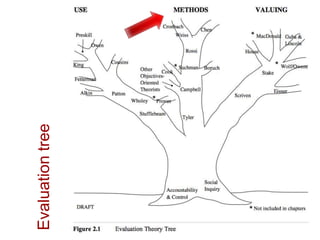
 ¿Describe la función de cada rama del “Evaluation
Theory Tree “?
 What is the difference between evaluation and
research?
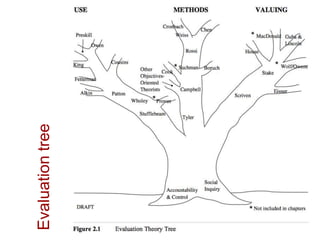
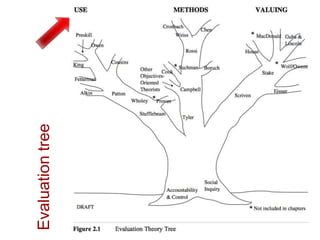
Evaluationtree
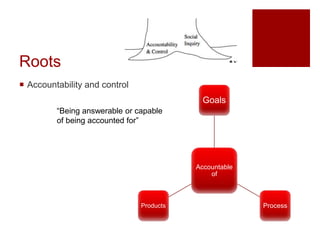
Roots
 Accountability and control
“Being answerable or capable
of being accounted for”
Accountable
of
Goals
ProcessProducts
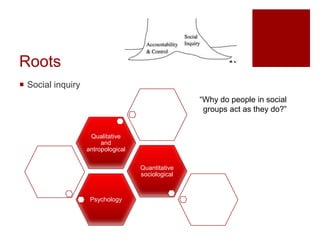
Roots
 Social inquiry
“Why do people in social
groups act as they do?”
Psychology
Quantitative
sociological
Qualitative
and
antropological
Evaluationtree
Methods
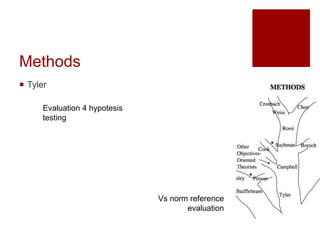
 Tyler
Evaluation 4 hypotesis
testing
Vs norm reference
evaluation
Methods
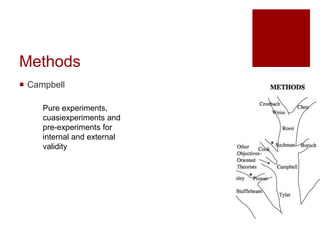
 Campbell
Pure experiments,
cuasiexperiments and
pre-experiments for
internal and external
validity
Methods
 Others
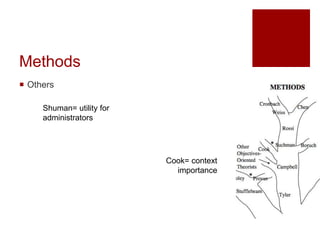
Shuman= utility for
administrators
Cook= context
importance
Methods
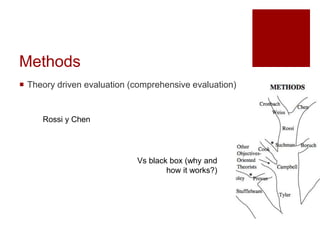
 Theory driven evaluation (comprehensive evaluation)
Rossi y Chen
Vs black box (why and
how it works?)
Methods
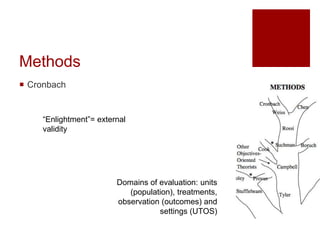
 Cronbach
“Enlightment”= external
validity
Domains of evaluation: units
(population), treatments,
observation (outcomes) and
settings (UTOS)
Evaluationtree
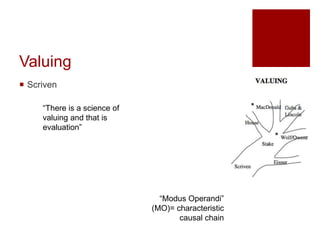
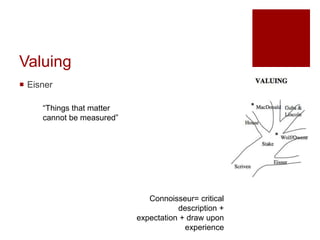
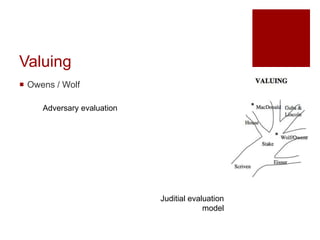
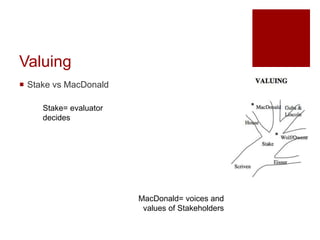
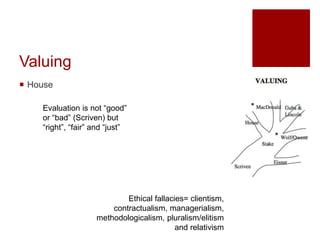
Valuing
 Scriven
“There is a science of
valuing and that is
evaluation”
“Modus Operandi”
(MO)= characteristic
causal chain
Valuing
 Eisner
“Things that matter
cannot be measured”
Connoisseur= critical
description +
expectation + draw upon
experience
Valuing
 Owens / Wolf
Adversary evaluation
Juditial evaluation
model
Valuing
 Stake vs MacDonald
Stake= evaluator
decides
MacDonald= voices and
values of Stakeholders
Valuing
 House
Evaluation is not “good”
or “bad” (Scriven) but
“right”, “fair” and “just”
Ethical fallacies= clientism,
contractualism, managerialism,
methodologicalism, pluralism/elitism
and relativism
Evaluationtree
Use
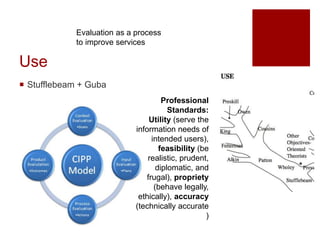
 Stufflebeam + Guba
Professional
Standards:
Utility (serve the
information needs of
intended users),
feasibility (be
realistic, prudent,
diplomatic, and
frugal), propriety
(behave legally,
ethically), accuracy
(technically accurate
)
Evaluation as a process
to improve services
Use
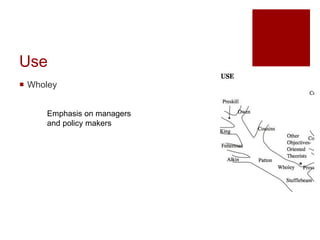
 Wholey
Emphasis on managers
and policy makers
Use
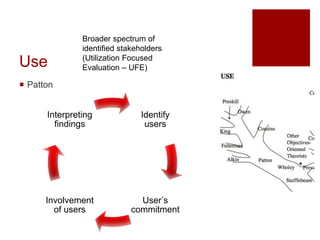
 Patton
Broader spectrum of
identified stakeholders
(Utilization Focused
Evaluation – UFE)
Identify
users
User’s
commitment
Involvement
of users
Interpreting
findings
Use
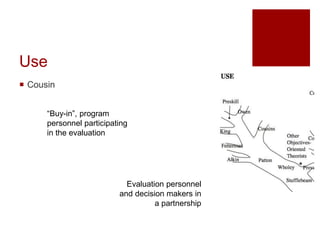
 Cousin
“Buy-in”, program
personnel participating
in the evaluation
Evaluation personnel
and decision makers in
a partnership
Use
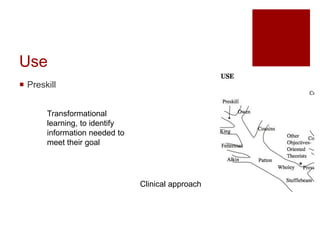
 Preskill
Transformational
learning, to identify
information needed to
meet their goal
Clinical approach
Use
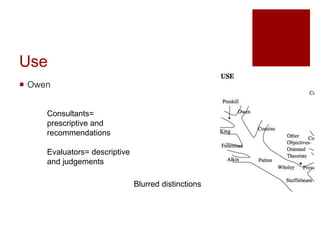
 Owen
Consultants=
prescriptive and
recommendations
Evaluators= descriptive
and judgements
Blurred distinctions
Use
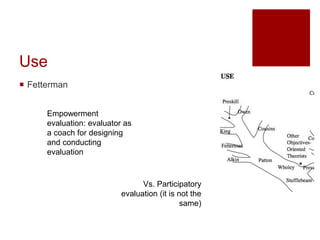
 Fetterman
Empowerment
evaluation: evaluator as
a coach for designing
and conducting
evaluation
Vs. Participatory
evaluation (it is not the
same)

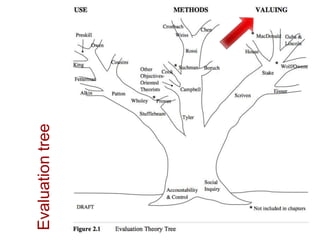
Evaluation theory tree