Target Audience
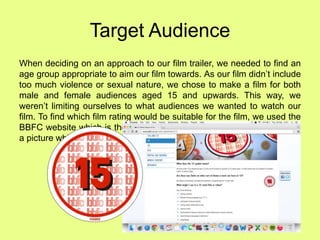
When deciding on an approach to our film trailer, we needed to find an
age group appropriate to aim our film towards. As our film didn’t include
too much violence or sexual nature, we chose to make a film for both
male and female audiences aged 15 and upwards. This way, we
weren’t limiting ourselves to what audiences we wanted to watch our
film. To find which film rating would be suitable for the film, we used the
BBFC website which is the official film rating company. I have included
a picture which best describes what a 15 rated film would look like…
Questionnaire survey
To gain audience feedback, we allowed our
classmates to watch our trailer and answer a
questionnaire with both open and closed
questions. Some were multiple choice and
others open to adding comments. Our
questionnaire consisted of ten questions and
asked the audience for their age and
gender.
The Questions
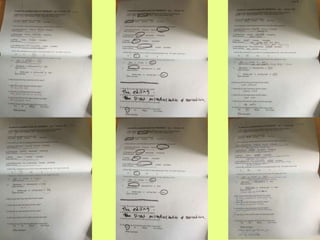
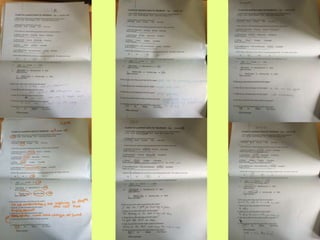
In the next two slides, I have attached
photos of the feedback that we received.
These included questions asking the
audience about things such as what genre,
the editing, camerawork, ratings, gender and
whether it would be mainstream or
independent.
The Feedback
Overall, we received positive feedback. Most of
our audience felt that the editing, soundtrack
and camera were all appropriate and suitable
for our trailer.
However, we had some mediocre responses as
some people don’t usually like these genres of
films, so they wouldn’t choose to watch it
themselves. Although the feedback wasn’t
great from some people, no one left any
negative responses. Some constructive
criticism was put forward to help improve our
Social Media
To promote our film in more ways than one, as well as
being able to receive feedback in order to be able to
maybe improve our film/trailer.
We used two three methods of doing this. Firstly, we
obviously uploaded our trailer to YouTube, allowing the
viewers to leave comments on their thoughts about the
trailer. YouTube also offers the viewers to leave a thumbs
up or thumbs down about the video. As well as YouTube,
we created a Twitter and Facebook account. Both of
these social media accounts can allow users to either
‘like’ or ‘follow’ the pages. They can also keep up to date
with what is going on with release dates and be the first
to see trailers etc. Both of these accounts are called
‘UnpaintedPathUK’. This is also another way in which we
could communicate with our audiences ourselves. Twitter
Room for improvement
One of the last questions on our questionnaire,
asked the audience what we could do to
improve our trailer. Listed here are some of the
comments that we received…
‘Soundtrack could be a little quieter as it
overpowers the voiceovers’
‘A twist could have been added to the end to
add more suspense’
‘The final title could have been bolder’.
These are all really good ways that could help
us improve our trailer if we were to make it
again. I completely agree with all the feedback
that we have been given.

Evaluation question 3

  • 2.
    Target Audience When decidingon an approach to our film trailer, we needed to find an age group appropriate to aim our film towards. As our film didn’t include too much violence or sexual nature, we chose to make a film for both male and female audiences aged 15 and upwards. This way, we weren’t limiting ourselves to what audiences we wanted to watch our film. To find which film rating would be suitable for the film, we used the BBFC website which is the official film rating company. I have included a picture which best describes what a 15 rated film would look like…
  • 3.
    Questionnaire survey To gainaudience feedback, we allowed our classmates to watch our trailer and answer a questionnaire with both open and closed questions. Some were multiple choice and others open to adding comments. Our questionnaire consisted of ten questions and asked the audience for their age and gender.
  • 4.
    The Questions In thenext two slides, I have attached photos of the feedback that we received. These included questions asking the audience about things such as what genre, the editing, camerawork, ratings, gender and whether it would be mainstream or independent.
  • 5.
    The Feedback Overall, wereceived positive feedback. Most of our audience felt that the editing, soundtrack and camera were all appropriate and suitable for our trailer. However, we had some mediocre responses as some people don’t usually like these genres of films, so they wouldn’t choose to watch it themselves. Although the feedback wasn’t great from some people, no one left any negative responses. Some constructive criticism was put forward to help improve our
  • 8.
    Social Media To promoteour film in more ways than one, as well as being able to receive feedback in order to be able to maybe improve our film/trailer. We used two three methods of doing this. Firstly, we obviously uploaded our trailer to YouTube, allowing the viewers to leave comments on their thoughts about the trailer. YouTube also offers the viewers to leave a thumbs up or thumbs down about the video. As well as YouTube, we created a Twitter and Facebook account. Both of these social media accounts can allow users to either ‘like’ or ‘follow’ the pages. They can also keep up to date with what is going on with release dates and be the first to see trailers etc. Both of these accounts are called ‘UnpaintedPathUK’. This is also another way in which we could communicate with our audiences ourselves. Twitter
  • 9.
    Room for improvement Oneof the last questions on our questionnaire, asked the audience what we could do to improve our trailer. Listed here are some of the comments that we received… ‘Soundtrack could be a little quieter as it overpowers the voiceovers’ ‘A twist could have been added to the end to add more suspense’ ‘The final title could have been bolder’. These are all really good ways that could help us improve our trailer if we were to make it again. I completely agree with all the feedback that we have been given.