In what ways does your media
product use, develop or challenge
forms and conventions of real media
products
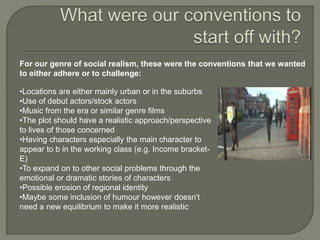
For our genre of social realism, these were the conventions that we wanted
to either adhere or to challenge:
•Locations are either mainly urban or in the suburbs
•Use of debut actors/stock actors
•Music from the era or similar genre films
•The plot should have a realistic approach/perspective
to lives of those concerned
•Having characters especially the main character to
appear to b in the working class (e.g. Income bracket-
E)
•To expand on to other social problems through the
emotional or dramatic stories of characters
•Possible erosion of regional identity
•Maybe some inclusion of humour however doesn't
need a new equilibrium to make it more realistic
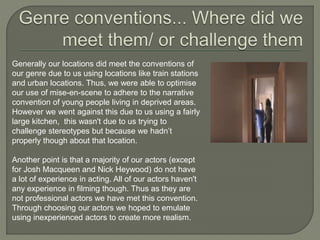
Generally our locations did meet the conventions of
our genre due to us using locations like train stations
and urban locations. Thus, we were able to optimise
our use of mise-en-scene to adhere to the narrative
convention of young people living in deprived areas.
However we went against this due to us using a fairly
large kitchen, this wasn't due to us trying to
challenge stereotypes but because we hadn’t
properly though about that location.
Another point is that a majority of our actors (except
for Josh Macqueen and Nick Heywood) do not have
a lot of experience in acting. All of our actors haven't
any experience in filming though. Thus as they are
not professional actors we have met this convention.
Through choosing our actors we hoped to emulate
using inexperienced actors to create more realism.
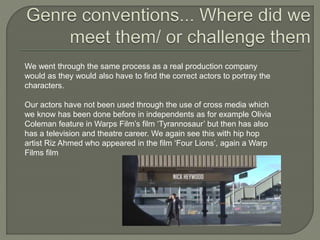
We went through the same process as a real production company
would as they would also have to find the correct actors to portray the
characters.
Our actors have not been used through the use of cross media which
we know has been done before in independents as for example Olivia
Coleman feature in Warps Film’s film ‘Tyrannosaur’ but then has also
has a television and theatre career. We again see this with hip hop
artist Riz Ahmed who appeared in the film ‘Four Lions’, again a Warp
Films film
Having Josh was very useful for gaining actors as he does acting
himself and helped us get Nick onboard who also does acting, this
made our opening sequence more professional and our characters
with complex stories were portrayed very effectively.
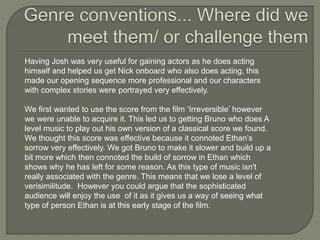
We first wanted to use the score from the film ‘Irreversible’ however
we were unable to acquire it. This led us to getting Bruno who does A
level music to play out his own version of a classical score we found.
We thought this score was effective because it connoted Ethan’s
sorrow very effectively. We got Bruno to make it slower and build up a
bit more which then connoted the build of sorrow in Ethan which
shows why he has left for some reason. As this type of music isn't
really associated with the genre. This means that we lose a level of
verisimilitude. However you could argue that the sophisticated
audience will enjoy the use of it as it gives us a way of seeing what
type of person Ethan is at this early stage of the film.
The effect that our song had was how it slowly built up a slight effect of
sadness and builds up emotional pleasures leading you to gain personal
identity from it. However due to them being more sophisticated they would
have the intelligence to not worry and try to crack the many enigmas. This was
also effective as it doesn't give anything away to the audience. The sound is
most effective in showing the representation of how is life is out of control.
The song starts off quietly and eventually gets louder and faster this connotes
the life of Ethan as his life starts off quietly and with little notice, however this
will change as he has to uncover where his dad is and why he left him. This will
attract the audience as they will notice this connotation due to their superior
intelligence as they are in the A/B income class.
The soundtrack would create verisimilitude as the
themes and build up of the song confirms their
impression of the problems those in deprived
areas face. This then connotes their primary
experience is one of sadness and isolation
relatable. However this song would not
conventionally be heard by a young teen so that
would mean the verisimilitude is only reflective for
the audience and not on the characters in the
film.
In addition, I feel that our narrative has adhered to the
convention of it being realistic, especially due to the rise of young
teens having to leave home due to being left at a young age or
being abused however mainly due to them not being educated
well enough leading to those previous points I said. As Ethan
leaves his home due to him being depressed which is a rising
occurrence in the last few years. Ethan stole money from his
carers which is against the law and is stereotypically associated
with the working class. However, as our production is a
sophisticated product, we have questioned stereotypes which
relate to our present political climate, which we ask our primary
audience to question. For example whether stopping a parent
from seeing there child is the best option as it changes the child
and may lead to depression like it did with Ethan and could lead
to drugs and alcohol which again is another leading problem that
we have today in our society.
However, I think that we may have possibly have got a bit
carried away with the editing process, as we might have
been almost too stereotypical in representing the working
class or even the upper class with the businessman being
obviously shown as sophisticated. Thus, via hegemonic
process we may in the long run actually put-off our
sophisticated audience as we may have made our
narrative too hard to follow and meaning that our
audience may not be interested in finding out what
happens next. For example, the stereotypical
representation that the young teen working class being
seen as not smart and un-trusted, which was conveyed
with quite long takes, such as the one were Ethan is
struggling with work and gets annoyed, as this shows
how it is a regularly re-occurring thing by young teens in
the working class.
This then shows how we almost started accepting the
media representations that we are trying to challenge.
To change this we could have, perhaps used more short
takes to connote the build up of Ethan's feelings and
how he has to do this. We should have made the
narrative a bit more easier to understand and maybe
make sure our audience can actually know what type of
income class they are.
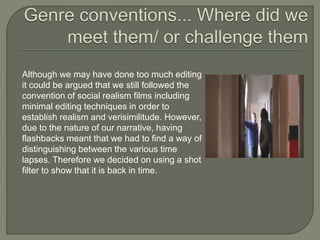
Although we may have done too much editing
it could be argued that we still followed the
convention of social realism films including
minimal editing techniques in order to
establish realism and verisimilitude. However,
due to the nature of our narrative, having
flashbacks meant that we had to find a way of
distinguishing between the various time
lapses. Therefore we decided on using a shot
filter to show that it is back in time.
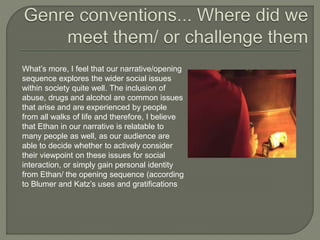
What’s more, I feel that our narrative/opening
sequence explores the wider social issues
within society quite well. The inclusion of
abuse, drugs and alcohol are common issues
that arise and are experienced by people
from all walks of life and therefore, I believe
that Ethan in our narrative is relatable to
many people as well, as our audience are
able to decide whether to actively consider
their viewpoint on these issues for social
interaction, or simply gain personal identity
from Ethan/ the opening sequence (according
to Blumer and Katz’s uses and gratifications
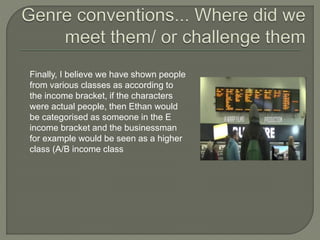
Finally, I believe we have shown people
from various classes as according to
the income bracket, if the characters
were actual people, then Ethan would
be categorised as someone in the E
income bracket and the businessman
for example would be seen as a higher
class (A/B income class
•Most opening credits follow this common convention order:
•Name of studio
•Production company
•Producers/directors
•Starring..
•Film title
•Casting director
•Music
•Production designer
•Film editors
•Directors of photography
•Producer
•Director
•(Based on... True story/events, the novel etc
An opening sequence is designed to instantly
engage its audience and should introduce, genre,
narrative and characters. This is particularly evident
with our use of conventional establishing shots of
out train station location.
we could have used co-production with our
institutions to make it more conventional as normal
independents join up so they are able to fund the
distribution, production and exhibition of a film.
The script was fairly limited due to us not
wanting to give much away, however we
added in speech during the flashback to
show how his past is violent and
unpleasant. Most of our opening
sequence is speechless due to the use of
the soundtrack playing on top with also
the diegetic surrounding sounds. I think
the use of the script was good due to it
giving little clues to the audience so that
they can crack the enigmas.
Perhaps we made a mistake about our
sophisticated audience and the conventions of a
sophisticated media product could have improved
our use of conventions further. It could be argues
that our production enforces dominant ideologies
about the working class. Consequently, the
audience may accept these representations of the
government parental care being safe and
reassuring so they think that society is looking
after them opposed to enforcing divides. We
could have further challenged dominant
ideologies on our production more by using more
violence during the flashback scene as this would
reflect the political issues of social care and status
within society.
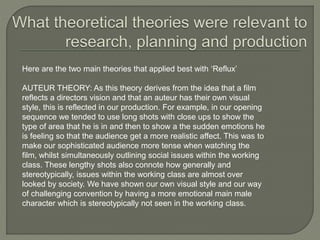
Here are the two main theories that applied best with ‘Reflux’
AUTEUR THEORY: As this theory derives from the idea that a film
reflects a directors vision and that an auteur has their own visual
style, this is reflected in our production. For example, in our opening
sequence we tended to use long shots with close ups to show the
type of area that he is in and then to show a the sudden emotions he
is feeling so that the audience get a more realistic affect. This was to
make our sophisticated audience more tense when watching the
film, whilst simultaneously outlining social issues within the working
class. These lengthy shots also connote how generally and
stereotypically, issues within the working class are almost over
looked by society. We have shown our own visual style and our way
of challenging convention by having a more emotional main male
character which is stereotypically not seen in the working class.
Evaluation question 1 media coursework

Evaluation question 1 media coursework

  • 1.
    In what waysdoes your media product use, develop or challenge forms and conventions of real media products
  • 2.
    For our genreof social realism, these were the conventions that we wanted to either adhere or to challenge: •Locations are either mainly urban or in the suburbs •Use of debut actors/stock actors •Music from the era or similar genre films •The plot should have a realistic approach/perspective to lives of those concerned •Having characters especially the main character to appear to b in the working class (e.g. Income bracket- E) •To expand on to other social problems through the emotional or dramatic stories of characters •Possible erosion of regional identity •Maybe some inclusion of humour however doesn't need a new equilibrium to make it more realistic
  • 3.
    Generally our locationsdid meet the conventions of our genre due to us using locations like train stations and urban locations. Thus, we were able to optimise our use of mise-en-scene to adhere to the narrative convention of young people living in deprived areas. However we went against this due to us using a fairly large kitchen, this wasn't due to us trying to challenge stereotypes but because we hadn’t properly though about that location. Another point is that a majority of our actors (except for Josh Macqueen and Nick Heywood) do not have a lot of experience in acting. All of our actors haven't any experience in filming though. Thus as they are not professional actors we have met this convention. Through choosing our actors we hoped to emulate using inexperienced actors to create more realism.
  • 4.
    We went throughthe same process as a real production company would as they would also have to find the correct actors to portray the characters. Our actors have not been used through the use of cross media which we know has been done before in independents as for example Olivia Coleman feature in Warps Film’s film ‘Tyrannosaur’ but then has also has a television and theatre career. We again see this with hip hop artist Riz Ahmed who appeared in the film ‘Four Lions’, again a Warp Films film
  • 5.
    Having Josh wasvery useful for gaining actors as he does acting himself and helped us get Nick onboard who also does acting, this made our opening sequence more professional and our characters with complex stories were portrayed very effectively. We first wanted to use the score from the film ‘Irreversible’ however we were unable to acquire it. This led us to getting Bruno who does A level music to play out his own version of a classical score we found. We thought this score was effective because it connoted Ethan’s sorrow very effectively. We got Bruno to make it slower and build up a bit more which then connoted the build of sorrow in Ethan which shows why he has left for some reason. As this type of music isn't really associated with the genre. This means that we lose a level of verisimilitude. However you could argue that the sophisticated audience will enjoy the use of it as it gives us a way of seeing what type of person Ethan is at this early stage of the film.
  • 6.
    The effect thatour song had was how it slowly built up a slight effect of sadness and builds up emotional pleasures leading you to gain personal identity from it. However due to them being more sophisticated they would have the intelligence to not worry and try to crack the many enigmas. This was also effective as it doesn't give anything away to the audience. The sound is most effective in showing the representation of how is life is out of control. The song starts off quietly and eventually gets louder and faster this connotes the life of Ethan as his life starts off quietly and with little notice, however this will change as he has to uncover where his dad is and why he left him. This will attract the audience as they will notice this connotation due to their superior intelligence as they are in the A/B income class.
  • 7.
    The soundtrack wouldcreate verisimilitude as the themes and build up of the song confirms their impression of the problems those in deprived areas face. This then connotes their primary experience is one of sadness and isolation relatable. However this song would not conventionally be heard by a young teen so that would mean the verisimilitude is only reflective for the audience and not on the characters in the film.
  • 8.
    In addition, Ifeel that our narrative has adhered to the convention of it being realistic, especially due to the rise of young teens having to leave home due to being left at a young age or being abused however mainly due to them not being educated well enough leading to those previous points I said. As Ethan leaves his home due to him being depressed which is a rising occurrence in the last few years. Ethan stole money from his carers which is against the law and is stereotypically associated with the working class. However, as our production is a sophisticated product, we have questioned stereotypes which relate to our present political climate, which we ask our primary audience to question. For example whether stopping a parent from seeing there child is the best option as it changes the child and may lead to depression like it did with Ethan and could lead to drugs and alcohol which again is another leading problem that we have today in our society.
  • 9.
    However, I thinkthat we may have possibly have got a bit carried away with the editing process, as we might have been almost too stereotypical in representing the working class or even the upper class with the businessman being obviously shown as sophisticated. Thus, via hegemonic process we may in the long run actually put-off our sophisticated audience as we may have made our narrative too hard to follow and meaning that our audience may not be interested in finding out what happens next. For example, the stereotypical representation that the young teen working class being seen as not smart and un-trusted, which was conveyed with quite long takes, such as the one were Ethan is struggling with work and gets annoyed, as this shows how it is a regularly re-occurring thing by young teens in the working class.
  • 10.
    This then showshow we almost started accepting the media representations that we are trying to challenge. To change this we could have, perhaps used more short takes to connote the build up of Ethan's feelings and how he has to do this. We should have made the narrative a bit more easier to understand and maybe make sure our audience can actually know what type of income class they are.
  • 11.
    Although we mayhave done too much editing it could be argued that we still followed the convention of social realism films including minimal editing techniques in order to establish realism and verisimilitude. However, due to the nature of our narrative, having flashbacks meant that we had to find a way of distinguishing between the various time lapses. Therefore we decided on using a shot filter to show that it is back in time.
  • 12.
    What’s more, Ifeel that our narrative/opening sequence explores the wider social issues within society quite well. The inclusion of abuse, drugs and alcohol are common issues that arise and are experienced by people from all walks of life and therefore, I believe that Ethan in our narrative is relatable to many people as well, as our audience are able to decide whether to actively consider their viewpoint on these issues for social interaction, or simply gain personal identity from Ethan/ the opening sequence (according to Blumer and Katz’s uses and gratifications
  • 13.
    Finally, I believewe have shown people from various classes as according to the income bracket, if the characters were actual people, then Ethan would be categorised as someone in the E income bracket and the businessman for example would be seen as a higher class (A/B income class
  • 14.
    •Most opening creditsfollow this common convention order: •Name of studio •Production company •Producers/directors •Starring.. •Film title •Casting director •Music •Production designer •Film editors •Directors of photography •Producer •Director •(Based on... True story/events, the novel etc
  • 15.
    An opening sequenceis designed to instantly engage its audience and should introduce, genre, narrative and characters. This is particularly evident with our use of conventional establishing shots of out train station location. we could have used co-production with our institutions to make it more conventional as normal independents join up so they are able to fund the distribution, production and exhibition of a film.
  • 16.
    The script wasfairly limited due to us not wanting to give much away, however we added in speech during the flashback to show how his past is violent and unpleasant. Most of our opening sequence is speechless due to the use of the soundtrack playing on top with also the diegetic surrounding sounds. I think the use of the script was good due to it giving little clues to the audience so that they can crack the enigmas.
  • 17.
    Perhaps we madea mistake about our sophisticated audience and the conventions of a sophisticated media product could have improved our use of conventions further. It could be argues that our production enforces dominant ideologies about the working class. Consequently, the audience may accept these representations of the government parental care being safe and reassuring so they think that society is looking after them opposed to enforcing divides. We could have further challenged dominant ideologies on our production more by using more violence during the flashback scene as this would reflect the political issues of social care and status within society.
  • 18.
    Here are thetwo main theories that applied best with ‘Reflux’ AUTEUR THEORY: As this theory derives from the idea that a film reflects a directors vision and that an auteur has their own visual style, this is reflected in our production. For example, in our opening sequence we tended to use long shots with close ups to show the type of area that he is in and then to show a the sudden emotions he is feeling so that the audience get a more realistic affect. This was to make our sophisticated audience more tense when watching the film, whilst simultaneously outlining social issues within the working class. These lengthy shots also connote how generally and stereotypically, issues within the working class are almost over looked by society. We have shown our own visual style and our way of challenging convention by having a more emotional main male character which is stereotypically not seen in the working class.