Iodine supplementation: the case for.
Dr William Barnes MbchB Bsc FACNEM 2010
In a recent article in the Age July 2010, Prof Makrides Professor of Nutrition at Adelaide
University is quoted as saying “there is little scientific evidence to support taking iron or
iodine supplements during or ahead of pregnancy, while both were promoted as
beneficial to mums-to-be.”
She goes on to say “we don’t have the information “with regard to the case for iodine
supplementation in pregnancy.
This statement surprises me; in fact my reading of current literature is that there is a very
strong case in Australia and New Zealand for the supplementation of Iodine in a number
of Scenarios including pregnancy.
The conclusion in a paper published in the journal Nutrition ( 2009) by researchers from
Westmead Hospital medical research.(2). States “ Public health strategies, including
nutritional education and supplementation, are URGENTLY required to improve iodine
status in pregnant women. Currently no readily accessible information on iodine is
available to women attending antenatal clinics in Australia”.
If we take evidence provided all over the world this statement holds true for most
countries around the world.
In fact according to another article published by researchers at the university of
Wollongong NSW (3) , state “ Australia is grappling with the re-emergence of mild to
moderate iodine deficiency in all groups tested , including school children, adult
volunteers , and pregnant and postpartum women”
How could this occur? What is the history ? Who is at greatest risk? Is salt and bread
fortification iodine going to rectify this nutritional issue? Is supplementation necessary
and in what groups?
These are the questions that need to be answered.
Iodine deficiency:
Iodine is an element( halogen) required for the synthesis of the thyroid hormones
thyroxine (T4) and triiodothyronine (T3) . Iodide is almost completely absorbable in the
stomach and in the upper small intestine. After ingestion iodate is rapidly reduced to
iodide and completely absorpted. The excess iodine not needed for hormone synthesis is
mainly excreted through the kidneys.
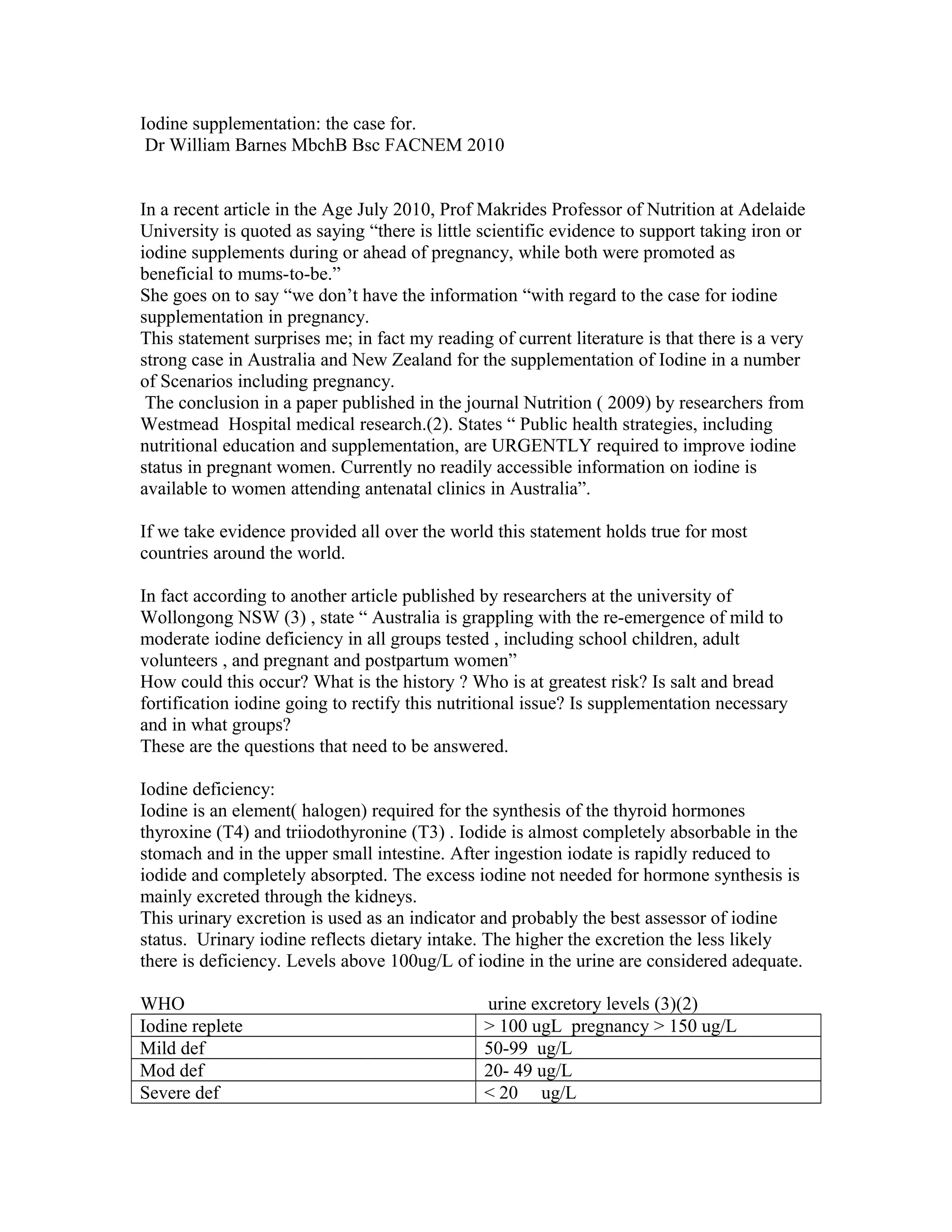
This urinary excretion is used as an indicator and probably the best assessor of iodine
status. Urinary iodine reflects dietary intake. The higher the excretion the less likely
there is deficiency. Levels above 100ug/L of iodine in the urine are considered adequate.
WHO urine excretory levels (3)(2)
Iodine replete > 100 ugL pregnancy > 150 ug/L
Mild def 50-99 ug/L
Mod def 20- 49 ug/L
Severe def < 20 ug/L
1
Sources of Iodine:
2
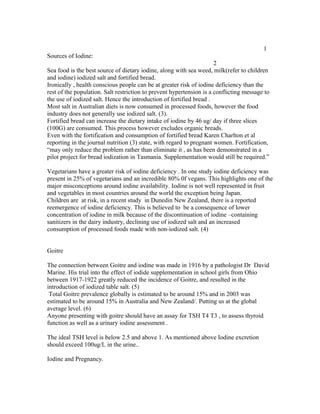
Sea food is the best source of dietary iodine, along with sea weed, milk(refer to children
and iodine) iodized salt and fortified bread.
Ironically , health conscious people can be at greater risk of iodine deficiency than the
rest of the population. Salt restriction to prevent hypertension is a conflicting message to
the use of iodized salt. Hence the introduction of fortified bread .
Most salt in Australian diets is now consumed in processed foods, however the food
industry does not generally use iodized salt. (3).
Fortified bread can increase the dietary intake of iodine by 46 ug/ day if three slices
(100G) are consumed. This process however excludes organic breads.
Even with the fortification and consumption of fortified bread Karen Charlton et al
reporting in the journal nutrition (3) state, with regard to pregnant women. Fortification,
“may only reduce the problem rather than eliminate it , as has been demonstrated in a
pilot project for bread iodization in Tasmania. Supplementation would still be required.”
Vegetarians have a greater risk of iodine deficiency . In one study iodine deficiency was
present in 25% of vegetarians and an incredible 80% 0f vegans. This highlights one of the
major misconceptions around iodine availability. Iodine is not well represented in fruit
and vegetables in most countries around the world the exception being Japan.
Children are at risk, in a recent study in Dunedin New Zealand, there is a reported
reemergence of iodine deficiency. This is believed to be a consequence of lower
concentration of iodine in milk because of the discontinuation of iodine –containing
sanitizers in the dairy industry, declining use of iodized salt and an increased
consumption of processed foods made with non-iodized salt. (4)
Goitre
The connection between Goitre and iodine was made in 1916 by a pathologist Dr David
Marine. His trial into the effect of iodide supplementation in school girls from Ohio
between 1917-1922 greatly reduced the incidence of Goitre, and resulted in the
introduction of iodized table salt. (5)
Total Goitre prevalence globally is estimated to be around 15% and in 2003 was
estimated to be around 15% in Australia and New Zealand/. Putting us at the global
average level. (6)
Anyone presenting with goitre should have an assay for TSH T4 T3 , to assess thyroid
function as well as a urinary iodine assessment .
The ideal TSH level is below 2.5 and above 1. As mentioned above Iodine excretion
should exceed 100ug/L in the urine..
Iodine and Pregnancy.
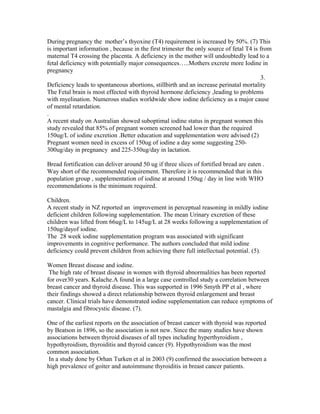
During pregnancy the mother’s thyoxine (T4) requirement is increased by 50%. (7) This
is important information , because in the first trimester the only source of fetal T4 is from
maternal T4 crossing the placenta. A deficiency in the mother will undoubtedly lead to a
fetal deficiency with potentially major consequences…..Mothers excrete more Iodine in
pregnancy
3.
Deficiency leads to spontaneous abortions, stillbirth and an increase perinatal mortality
The Fetal brain is most effected with thyroid hormone deficiency ,leading to problems
with myelination. Numerous studies worldwide show iodine deficiency as a major cause
of mental retardation.
.
A recent study on Australian showed suboptimal iodine status in pregnant women this
study revealed that 85% of pregnant women screened had lower than the required
150ug/L of iodine excretion .Better education and supplementation were advised (2)
Pregnant women need in excess of 150ug of iodine a day some suggesting 250-
300ug/day in pregnancy and 225-350ug/day in lactation.
Bread fortification can deliver around 50 ug if three slices of fortified bread are eaten .
Way short of the recommended requirement. Therefore it is recommended that in this
population group , supplementation of iodine at around 150ug / day in line with WHO
recommendations is the minimum required.
Children.
A recent study in NZ reported an improvement in perceptual reasoning in mildly iodine
deficient children following supplementation. The mean Urinary excretion of these
children was lifted from 66ug/L to 145ug/L at 28 weeks following a supplementation of
150ug/dayof iodine.
The 28 week iodine supplementation program was associated with significant
improvements in cognitive performance. The authors concluded that mild iodine
deficiency could prevent children from achieving there full intellectual potential. (5).
Women Breast disease and iodine.
The high rate of breast disease in women with thyroid abnormalities has been reported
for over30 years. Kalache.A found in a large case controlled study a correlation between
breast cancer and thyroid disease. This was supported in 1996 Smyth PP et al , where
their findings showed a direct relationship between thyroid enlargement and breast
cancer. Clinical trials have demonstrated iodine supplementation can reduce symptoms of
mastalgia and fibrocystic disease. (7).
One of the earliest reports on the association of breast cancer with thyroid was reported
by Beatson in 1896, so the association is not new. Since the many studies have shown
associations between thyroid diseases of all types including hyperthyroidism ,
hypothyroidism, thyroiditis and thyroid cancer (9). Hypothyroidism was the most
common association.
In a study done by Orhan Turken et al in 2003 (9) confirmed the association between a
high prevalence of goiter and autoimmune thyroiditis in breast cancer patients.
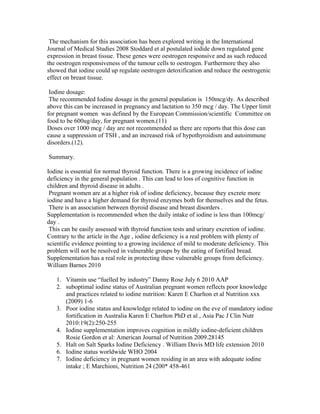
The mechanism for this association has been explored writing in the International
Journal of Medical Studies 2008 Stoddard et al postulated iodide down regulated gene
expression in breast tissue. These genes were oestrogen responsive and as such reduced
the oestrogen responsiveness of the tumour cells to oestrogen. Furthermore they also
showed that iodine could up regulate oestrogen detoxification and reduce the oestrogenic
effect on breast tissue.
Iodine dosage:
The recommended Iodine dosage in the general population is 150mcg/dy. As described
above this can be increased in pregnancy and lactation to 350 mcg / day. The Upper limit
for pregnant women was defined by the European Commission/scientific Committee on
food to be 600ug/day, for pregnant women.(11)
Doses over 1000 mcg / day are not recommended as there are reports that this dose can
cause a suppression of TSH , and an increased risk of hypothyroidism and autoimmune
disorders.(12).
Summary.
Iodine is essential for normal thyroid function. There is a growing incidence of iodine
deficiency in the general population . This can lead to loss of cognitive function in
children and thyroid disease in adults .
Pregnant women are at a higher risk of iodine deficiency, because they excrete more
iodine and have a higher demand for thyroid enzymes both for themselves and the fetus.
There is an association between thyroid disease and breast disorders .
Supplementation is recommended when the daily intake of iodine is less than 100mcg/
day .
This can be easily assessed with thyroid function tests and urinary excretion of iodine.
Contrary to the article in the Age , iodine deficiency is a real problem with plenty of
scientific evidence pointing to a growing incidence of mild to moderate deficiency. This
problem will not be resolved in vulnerable groups by the eating of fortified bread.
Supplementation has a real role in protecting these vulnerable groups from deficiency.
William Barnes 2010
1. Vitamin use “fuelled by industry” Danny Rose July 6 2010 AAP
2. suboptimal iodine status of Australian pregnant women reflects poor knowledge
and practices related to iodine nutrition: Karen E Charlton et al Nutrition xxx
(2009) 1-6
3. Poor iodine status and knowledge related to iodine on the eve of mandatory iodine
fortification in Australia Karen E Charlton PhD et al , Asia Pac J Clin Nutr
2010:19(2):250-255
4. Iodine supplementation improves cognition in mildly iodine-deficient children
Rosie Gordon et al: American Journal of Nutrition 2009.28145
5. Halt on Salt Sparks Iodine Deficiency . William Davis MD life extension 2010
6. Iodine status worldwide WHO 2004
7. Iodine deficiency in pregnant women residing in an area with adequate iodine
intake ; E Marchioni, Nutrition 24 (200* 458-461
8. The thyroid, iodine and breast cancer Peter Smyth Breast cancer Research 2003
5: 235-238
9. Breast cancer in association with thyroid disorders O Turken et al : Breast cancer
Research. Vol 5 No 5
10. Iodine alters gene expression in MCF7 breast cancer cell line:Evidence for an
Anti-Estrogen effect of iodine F Stoddard et al Int J Med Sci 2008,5
11. Micronutrients and women of reproductive potential: required dietary intake and
consequences of dietary deficiency or excess. Part 11-, Vit D Vit A Iron, Zinc,
Iodine, Essential Fatty Acids : Joe Simpson et al The journal of Maternal-Fetal
and neonatal medicine 2010 1-24
12. Iodine deficiency and therapeutic considerations. Lyn Patrick Alternative Med
Review Vol 13 Number 2 2008.
;
The most sensitive phase for iodine deficiency is during pregnancy. During the first and
8. The thyroid, iodine and breast cancer Peter Smyth Breast cancer Research 2003
5: 235-238
9. Breast cancer in association with thyroid disorders O Turken et al : Breast cancer
Research. Vol 5 No 5
10. Iodine alters gene expression in MCF7 breast cancer cell line:Evidence for an
Anti-Estrogen effect of iodine F Stoddard et al Int J Med Sci 2008,5
11. Micronutrients and women of reproductive potential: required dietary intake and
consequences of dietary deficiency or excess. Part 11-, Vit D Vit A Iron, Zinc,
Iodine, Essential Fatty Acids : Joe Simpson et al The journal of Maternal-Fetal
and neonatal medicine 2010 1-24
12. Iodine deficiency and therapeutic considerations. Lyn Patrick Alternative Med
Review Vol 13 Number 2 2008.
;
The most sensitive phase for iodine deficiency is during pregnancy. During the first and

Dr William Barnes - The case for Iodine Supplementation

  • 1.
    Iodine supplementation: thecase for. Dr William Barnes MbchB Bsc FACNEM 2010 In a recent article in the Age July 2010, Prof Makrides Professor of Nutrition at Adelaide University is quoted as saying “there is little scientific evidence to support taking iron or iodine supplements during or ahead of pregnancy, while both were promoted as beneficial to mums-to-be.” She goes on to say “we don’t have the information “with regard to the case for iodine supplementation in pregnancy. This statement surprises me; in fact my reading of current literature is that there is a very strong case in Australia and New Zealand for the supplementation of Iodine in a number of Scenarios including pregnancy. The conclusion in a paper published in the journal Nutrition ( 2009) by researchers from Westmead Hospital medical research.(2). States “ Public health strategies, including nutritional education and supplementation, are URGENTLY required to improve iodine status in pregnant women. Currently no readily accessible information on iodine is available to women attending antenatal clinics in Australia”. If we take evidence provided all over the world this statement holds true for most countries around the world. In fact according to another article published by researchers at the university of Wollongong NSW (3) , state “ Australia is grappling with the re-emergence of mild to moderate iodine deficiency in all groups tested , including school children, adult volunteers , and pregnant and postpartum women” How could this occur? What is the history ? Who is at greatest risk? Is salt and bread fortification iodine going to rectify this nutritional issue? Is supplementation necessary and in what groups? These are the questions that need to be answered. Iodine deficiency: Iodine is an element( halogen) required for the synthesis of the thyroid hormones thyroxine (T4) and triiodothyronine (T3) . Iodide is almost completely absorbable in the stomach and in the upper small intestine. After ingestion iodate is rapidly reduced to iodide and completely absorpted. The excess iodine not needed for hormone synthesis is mainly excreted through the kidneys. This urinary excretion is used as an indicator and probably the best assessor of iodine status. Urinary iodine reflects dietary intake. The higher the excretion the less likely there is deficiency. Levels above 100ug/L of iodine in the urine are considered adequate. WHO urine excretory levels (3)(2) Iodine replete > 100 ugL pregnancy > 150 ug/L Mild def 50-99 ug/L Mod def 20- 49 ug/L Severe def < 20 ug/L
  • 2.
    1 Sources of Iodine: 2 Seafood is the best source of dietary iodine, along with sea weed, milk(refer to children and iodine) iodized salt and fortified bread. Ironically , health conscious people can be at greater risk of iodine deficiency than the rest of the population. Salt restriction to prevent hypertension is a conflicting message to the use of iodized salt. Hence the introduction of fortified bread . Most salt in Australian diets is now consumed in processed foods, however the food industry does not generally use iodized salt. (3). Fortified bread can increase the dietary intake of iodine by 46 ug/ day if three slices (100G) are consumed. This process however excludes organic breads. Even with the fortification and consumption of fortified bread Karen Charlton et al reporting in the journal nutrition (3) state, with regard to pregnant women. Fortification, “may only reduce the problem rather than eliminate it , as has been demonstrated in a pilot project for bread iodization in Tasmania. Supplementation would still be required.” Vegetarians have a greater risk of iodine deficiency . In one study iodine deficiency was present in 25% of vegetarians and an incredible 80% 0f vegans. This highlights one of the major misconceptions around iodine availability. Iodine is not well represented in fruit and vegetables in most countries around the world the exception being Japan. Children are at risk, in a recent study in Dunedin New Zealand, there is a reported reemergence of iodine deficiency. This is believed to be a consequence of lower concentration of iodine in milk because of the discontinuation of iodine –containing sanitizers in the dairy industry, declining use of iodized salt and an increased consumption of processed foods made with non-iodized salt. (4) Goitre The connection between Goitre and iodine was made in 1916 by a pathologist Dr David Marine. His trial into the effect of iodide supplementation in school girls from Ohio between 1917-1922 greatly reduced the incidence of Goitre, and resulted in the introduction of iodized table salt. (5) Total Goitre prevalence globally is estimated to be around 15% and in 2003 was estimated to be around 15% in Australia and New Zealand/. Putting us at the global average level. (6) Anyone presenting with goitre should have an assay for TSH T4 T3 , to assess thyroid function as well as a urinary iodine assessment . The ideal TSH level is below 2.5 and above 1. As mentioned above Iodine excretion should exceed 100ug/L in the urine.. Iodine and Pregnancy.
  • 3.
    During pregnancy themother’s thyoxine (T4) requirement is increased by 50%. (7) This is important information , because in the first trimester the only source of fetal T4 is from maternal T4 crossing the placenta. A deficiency in the mother will undoubtedly lead to a fetal deficiency with potentially major consequences…..Mothers excrete more Iodine in pregnancy 3. Deficiency leads to spontaneous abortions, stillbirth and an increase perinatal mortality The Fetal brain is most effected with thyroid hormone deficiency ,leading to problems with myelination. Numerous studies worldwide show iodine deficiency as a major cause of mental retardation. . A recent study on Australian showed suboptimal iodine status in pregnant women this study revealed that 85% of pregnant women screened had lower than the required 150ug/L of iodine excretion .Better education and supplementation were advised (2) Pregnant women need in excess of 150ug of iodine a day some suggesting 250- 300ug/day in pregnancy and 225-350ug/day in lactation. Bread fortification can deliver around 50 ug if three slices of fortified bread are eaten . Way short of the recommended requirement. Therefore it is recommended that in this population group , supplementation of iodine at around 150ug / day in line with WHO recommendations is the minimum required. Children. A recent study in NZ reported an improvement in perceptual reasoning in mildly iodine deficient children following supplementation. The mean Urinary excretion of these children was lifted from 66ug/L to 145ug/L at 28 weeks following a supplementation of 150ug/dayof iodine. The 28 week iodine supplementation program was associated with significant improvements in cognitive performance. The authors concluded that mild iodine deficiency could prevent children from achieving there full intellectual potential. (5). Women Breast disease and iodine. The high rate of breast disease in women with thyroid abnormalities has been reported for over30 years. Kalache.A found in a large case controlled study a correlation between breast cancer and thyroid disease. This was supported in 1996 Smyth PP et al , where their findings showed a direct relationship between thyroid enlargement and breast cancer. Clinical trials have demonstrated iodine supplementation can reduce symptoms of mastalgia and fibrocystic disease. (7). One of the earliest reports on the association of breast cancer with thyroid was reported by Beatson in 1896, so the association is not new. Since the many studies have shown associations between thyroid diseases of all types including hyperthyroidism , hypothyroidism, thyroiditis and thyroid cancer (9). Hypothyroidism was the most common association. In a study done by Orhan Turken et al in 2003 (9) confirmed the association between a high prevalence of goiter and autoimmune thyroiditis in breast cancer patients.
  • 4.
    The mechanism forthis association has been explored writing in the International Journal of Medical Studies 2008 Stoddard et al postulated iodide down regulated gene expression in breast tissue. These genes were oestrogen responsive and as such reduced the oestrogen responsiveness of the tumour cells to oestrogen. Furthermore they also showed that iodine could up regulate oestrogen detoxification and reduce the oestrogenic effect on breast tissue. Iodine dosage: The recommended Iodine dosage in the general population is 150mcg/dy. As described above this can be increased in pregnancy and lactation to 350 mcg / day. The Upper limit for pregnant women was defined by the European Commission/scientific Committee on food to be 600ug/day, for pregnant women.(11) Doses over 1000 mcg / day are not recommended as there are reports that this dose can cause a suppression of TSH , and an increased risk of hypothyroidism and autoimmune disorders.(12). Summary. Iodine is essential for normal thyroid function. There is a growing incidence of iodine deficiency in the general population . This can lead to loss of cognitive function in children and thyroid disease in adults . Pregnant women are at a higher risk of iodine deficiency, because they excrete more iodine and have a higher demand for thyroid enzymes both for themselves and the fetus. There is an association between thyroid disease and breast disorders . Supplementation is recommended when the daily intake of iodine is less than 100mcg/ day . This can be easily assessed with thyroid function tests and urinary excretion of iodine. Contrary to the article in the Age , iodine deficiency is a real problem with plenty of scientific evidence pointing to a growing incidence of mild to moderate deficiency. This problem will not be resolved in vulnerable groups by the eating of fortified bread. Supplementation has a real role in protecting these vulnerable groups from deficiency. William Barnes 2010 1. Vitamin use “fuelled by industry” Danny Rose July 6 2010 AAP 2. suboptimal iodine status of Australian pregnant women reflects poor knowledge and practices related to iodine nutrition: Karen E Charlton et al Nutrition xxx (2009) 1-6 3. Poor iodine status and knowledge related to iodine on the eve of mandatory iodine fortification in Australia Karen E Charlton PhD et al , Asia Pac J Clin Nutr 2010:19(2):250-255 4. Iodine supplementation improves cognition in mildly iodine-deficient children Rosie Gordon et al: American Journal of Nutrition 2009.28145 5. Halt on Salt Sparks Iodine Deficiency . William Davis MD life extension 2010 6. Iodine status worldwide WHO 2004 7. Iodine deficiency in pregnant women residing in an area with adequate iodine intake ; E Marchioni, Nutrition 24 (200* 458-461
  • 5.
    8. The thyroid,iodine and breast cancer Peter Smyth Breast cancer Research 2003 5: 235-238 9. Breast cancer in association with thyroid disorders O Turken et al : Breast cancer Research. Vol 5 No 5 10. Iodine alters gene expression in MCF7 breast cancer cell line:Evidence for an Anti-Estrogen effect of iodine F Stoddard et al Int J Med Sci 2008,5 11. Micronutrients and women of reproductive potential: required dietary intake and consequences of dietary deficiency or excess. Part 11-, Vit D Vit A Iron, Zinc, Iodine, Essential Fatty Acids : Joe Simpson et al The journal of Maternal-Fetal and neonatal medicine 2010 1-24 12. Iodine deficiency and therapeutic considerations. Lyn Patrick Alternative Med Review Vol 13 Number 2 2008. ; The most sensitive phase for iodine deficiency is during pregnancy. During the first and
  • 6.
    8. The thyroid,iodine and breast cancer Peter Smyth Breast cancer Research 2003 5: 235-238 9. Breast cancer in association with thyroid disorders O Turken et al : Breast cancer Research. Vol 5 No 5 10. Iodine alters gene expression in MCF7 breast cancer cell line:Evidence for an Anti-Estrogen effect of iodine F Stoddard et al Int J Med Sci 2008,5 11. Micronutrients and women of reproductive potential: required dietary intake and consequences of dietary deficiency or excess. Part 11-, Vit D Vit A Iron, Zinc, Iodine, Essential Fatty Acids : Joe Simpson et al The journal of Maternal-Fetal and neonatal medicine 2010 1-24 12. Iodine deficiency and therapeutic considerations. Lyn Patrick Alternative Med Review Vol 13 Number 2 2008. ; The most sensitive phase for iodine deficiency is during pregnancy. During the first and