IN WHAT WAYS DOES YOUR
MEDIA PRODUCT USE,
DEVELOP OR CHALLENGE
FORMS AND
CONVENTIONS OF REAL
MEDIA PRODUCTS.
GENRE
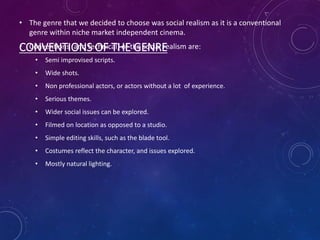
CONVENTIONS OF THE GENRE
• The genre that we decided to choose was social realism as it is a conventional
genre within niche market independent cinema.
• Conventions (and technical) of the social realism are:
• Semi improvised scripts.
• Wide shots.
• Non professional actors, or actors without a lot of experience.
• Serious themes.
• Wider social issues can be explored.
• Filmed on location as opposed to a studio.
• Simple editing skills, such as the blade tool.
• Costumes reflect the character, and issues explored.
• Mostly natural lighting.
WHERE DID WE MEET OR CHALLENGE THE
CONVENTIONS OF SOCIAL REALISM?
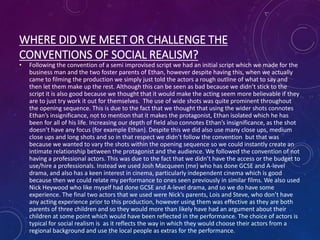
• Following the convention of a semi improvised script we had an initial script which we made for the
business man and the two foster parents of Ethan, however despite having this, when we actually
came to filming the production we simply just told the actors a rough outline of what to say and
then let them make up the rest. Although this can be seen as bad because we didn’t stick to the
script it is also good because we thought that it would make the acting seem more believable if they
are to just try work it out for themselves. The use of wide shots was quite prominent throughout
the opening sequence. This is due to the fact that we thought that using the wider shots connotes
Ethan’s insignificance, not to mention that it makes the protagonist, Ethan isolated which he has
been for all of his life. Increasing our depth of field also connotes Ethan’s insignificance, as the shot
doesn’t have any focus (for example Ethan). Despite this we did also use many close ups, medium
close ups and long shots and so in that respect we didn’t follow the convention but that was
because we wanted to vary the shots within the opening sequence so we could instantly create an
intimate relationship between the protagonist and the audience. We followed the convention of not
having a professional actors. This was due to the fact that we didn’t have the access or the budget to
use/hire a professionals. Instead we used Josh Macqueen (me) who has done GCSE and A-level
drama, and also has a keen interest in cinema, particularly independent cinema which is good
because then we could relate my performance to ones seen previously in similar films. We also used
Nick Heywood who like myself had done GCSE and A-level drama, and so we do have some
experience. The final two actors that we used were Nick’s parents, Lois and Steve, who don’t have
any acting experience prior to this production, however using them was effective as they are both
parents of three children and so they would more than likely have had an argument about their
children at some point which would have been reflected in the performance. The choice of actors is
typical for social realism is as it reflects the way in which they would choose their actors from a
regional background and use the local people as extras for the performance.
WHERE DID WE MEET OR CHALLENGE THE
CONVENTIONS OF SOCIAL REALISM?
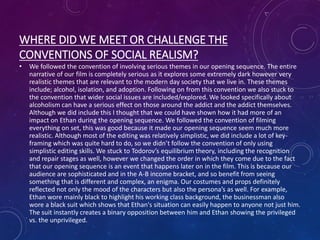
• We followed the convention of involving serious themes in our opening sequence. The entire
narrative of our film is completely serious as it explores some extremely dark however very
realistic themes that are relevant to the modern day society that we live in. These themes
include; alcohol, isolation, and adoption. Following on from this convention we also stuck to
the convention that wider social issues are included/explored. We looked specifically about
alcoholism can have a serious effect on those around the addict and the addict themselves.
Although we did include this I thought that we could have shown how it had more of an
impact on Ethan during the opening sequence. We followed the convention of filming
everything on set, this was good because it made our opening sequence seem much more
realistic. Although most of the editing was relatively simplistic, we did include a lot of key-
framing which was quite hard to do, so we didn’t follow the convention of only using
simplistic editing skills. We stuck to Todorov’s equilibrium theory, including the recognition
and repair stages as well, however we changed the order in which they come due to the fact
that our opening sequence is an event that happens later on in the film. This is because our
audience are sophisticated and in the A-B income bracket, and so benefit from seeing
something that is different and complex, an enigma. Our costumes and props definitely
reflected not only the mood of the characters but also the persona’s as well. For example,
Ethan wore mainly black to highlight his working class background, the businessman also
wore a black suit which shows that Ethan's situation can easily happen to anyone not just him.
The suit instantly creates a binary opposition between him and Ethan showing the privileged
vs. the unprivileged.
WHERE DID WE MEET OR CHALLENGE THE
CONVENTIONS OF SOCIAL REALISM?
• We followed the lighting convention and used natural lighting throughout the opening
sequence, not only was this because using artificial lighting would have been difficult to
set up and use at the train station, but natural lighting was the most effective when
filming, and looked best on camera.
• We didn’t purposefully challenge any conventions apart from using semi improvised
scripts, because it made a more believable performance.
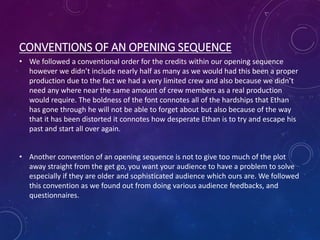
CONVENTIONS OF AN OPENING SEQUENCE
• We followed a conventional order for the credits within our opening sequence
however we didn’t include nearly half as many as we would had this been a proper
production due to the fact we had a very limited crew and also because we didn’t
need any where near the same amount of crew members as a real production
would require. The boldness of the font connotes all of the hardships that Ethan
has gone through he will not be able to forget about but also because of the way
that it has been distorted it connotes how desperate Ethan is to try and escape his
past and start all over again.
• Another convention of an opening sequence is not to give too much of the plot
away straight from the get go, you want your audience to have a problem to solve
especially if they are older and sophisticated audience which ours are. We followed
this convention as we found out from doing various audience feedbacks, and
questionnaires.
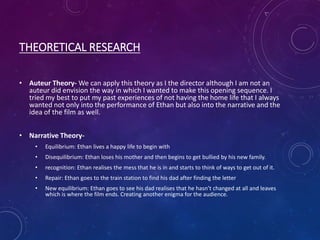
THEORETICAL RESEARCH
• Auteur Theory- We can apply this theory as I the director although I am not an
auteur did envision the way in which I wanted to make this opening sequence. I
tried my best to put my past experiences of not having the home life that I always
wanted not only into the performance of Ethan but also into the narrative and the
idea of the film as well.
• Narrative Theory-
• Equilibrium: Ethan lives a happy life to begin with
• Disequilibrium: Ethan loses his mother and then begins to get bullied by his new family.
• recognition: Ethan realises the mess that he is in and starts to think of ways to get out of it.
• Repair: Ethan goes to the train station to find his dad after finding the letter
• New equilibrium: Ethan goes to see his dad realises that he hasn’t changed at all and leaves
which is where the film ends. Creating another enigma for the audience.
COMPARISON-HINTERLAND
• Both Hinterland and Reflux use a wide variation of shots. Hinterland tends to use
more close-ups and medium close ups however uses long shots and wide shots as
well, whereas in Reflux It is the opposite of that.
• The majority of the shots in hinterland are stationary camera whereas the majority
of the shots in Reflux have some sort of movement to them only to fit the criteria
of the mark scheme. In a full production you have complete freedom to do what
ever you like.
• Hinterland also uses the graphic match with the credits just like what we did with
the train and the title of the film at the end of the opening sequence.
• Hinterland also looks at hard hitting themes such as the development of love in
young people, maybe not quite as gritty as ours however it does still address a
deep topic.
• Hinterland uses the wide shots to address the locations that the film is being shot
at, whereas we used it more to look at the characters in the narrative.
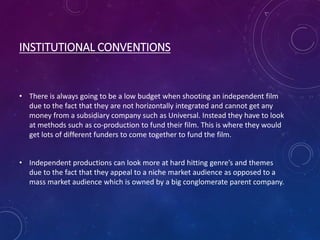
INSTITUTIONAL CONVENTIONS
• There is always going to be a low budget when shooting an independent film
due to the fact that they are not horizontally integrated and cannot get any
money from a subsidiary company such as Universal. Instead they have to look
at methods such as co-production to fund their film. This is where they would
get lots of different funders to come together to fund the film.
• Independent productions can look more at hard hitting genre’s and themes
due to the fact that they appeal to a niche market audience as opposed to a
mass market audience which is owned by a big conglomerate parent company.

Question 1

  • 1.
    IN WHAT WAYSDOES YOUR MEDIA PRODUCT USE, DEVELOP OR CHALLENGE FORMS AND CONVENTIONS OF REAL MEDIA PRODUCTS.
  • 2.
  • 3.
    CONVENTIONS OF THEGENRE • The genre that we decided to choose was social realism as it is a conventional genre within niche market independent cinema. • Conventions (and technical) of the social realism are: • Semi improvised scripts. • Wide shots. • Non professional actors, or actors without a lot of experience. • Serious themes. • Wider social issues can be explored. • Filmed on location as opposed to a studio. • Simple editing skills, such as the blade tool. • Costumes reflect the character, and issues explored. • Mostly natural lighting.
  • 4.
    WHERE DID WEMEET OR CHALLENGE THE CONVENTIONS OF SOCIAL REALISM? • Following the convention of a semi improvised script we had an initial script which we made for the business man and the two foster parents of Ethan, however despite having this, when we actually came to filming the production we simply just told the actors a rough outline of what to say and then let them make up the rest. Although this can be seen as bad because we didn’t stick to the script it is also good because we thought that it would make the acting seem more believable if they are to just try work it out for themselves. The use of wide shots was quite prominent throughout the opening sequence. This is due to the fact that we thought that using the wider shots connotes Ethan’s insignificance, not to mention that it makes the protagonist, Ethan isolated which he has been for all of his life. Increasing our depth of field also connotes Ethan’s insignificance, as the shot doesn’t have any focus (for example Ethan). Despite this we did also use many close ups, medium close ups and long shots and so in that respect we didn’t follow the convention but that was because we wanted to vary the shots within the opening sequence so we could instantly create an intimate relationship between the protagonist and the audience. We followed the convention of not having a professional actors. This was due to the fact that we didn’t have the access or the budget to use/hire a professionals. Instead we used Josh Macqueen (me) who has done GCSE and A-level drama, and also has a keen interest in cinema, particularly independent cinema which is good because then we could relate my performance to ones seen previously in similar films. We also used Nick Heywood who like myself had done GCSE and A-level drama, and so we do have some experience. The final two actors that we used were Nick’s parents, Lois and Steve, who don’t have any acting experience prior to this production, however using them was effective as they are both parents of three children and so they would more than likely have had an argument about their children at some point which would have been reflected in the performance. The choice of actors is typical for social realism is as it reflects the way in which they would choose their actors from a regional background and use the local people as extras for the performance.
  • 5.
    WHERE DID WEMEET OR CHALLENGE THE CONVENTIONS OF SOCIAL REALISM? • We followed the convention of involving serious themes in our opening sequence. The entire narrative of our film is completely serious as it explores some extremely dark however very realistic themes that are relevant to the modern day society that we live in. These themes include; alcohol, isolation, and adoption. Following on from this convention we also stuck to the convention that wider social issues are included/explored. We looked specifically about alcoholism can have a serious effect on those around the addict and the addict themselves. Although we did include this I thought that we could have shown how it had more of an impact on Ethan during the opening sequence. We followed the convention of filming everything on set, this was good because it made our opening sequence seem much more realistic. Although most of the editing was relatively simplistic, we did include a lot of key- framing which was quite hard to do, so we didn’t follow the convention of only using simplistic editing skills. We stuck to Todorov’s equilibrium theory, including the recognition and repair stages as well, however we changed the order in which they come due to the fact that our opening sequence is an event that happens later on in the film. This is because our audience are sophisticated and in the A-B income bracket, and so benefit from seeing something that is different and complex, an enigma. Our costumes and props definitely reflected not only the mood of the characters but also the persona’s as well. For example, Ethan wore mainly black to highlight his working class background, the businessman also wore a black suit which shows that Ethan's situation can easily happen to anyone not just him. The suit instantly creates a binary opposition between him and Ethan showing the privileged vs. the unprivileged.
  • 6.
    WHERE DID WEMEET OR CHALLENGE THE CONVENTIONS OF SOCIAL REALISM? • We followed the lighting convention and used natural lighting throughout the opening sequence, not only was this because using artificial lighting would have been difficult to set up and use at the train station, but natural lighting was the most effective when filming, and looked best on camera. • We didn’t purposefully challenge any conventions apart from using semi improvised scripts, because it made a more believable performance.
  • 7.
    CONVENTIONS OF ANOPENING SEQUENCE • We followed a conventional order for the credits within our opening sequence however we didn’t include nearly half as many as we would had this been a proper production due to the fact we had a very limited crew and also because we didn’t need any where near the same amount of crew members as a real production would require. The boldness of the font connotes all of the hardships that Ethan has gone through he will not be able to forget about but also because of the way that it has been distorted it connotes how desperate Ethan is to try and escape his past and start all over again. • Another convention of an opening sequence is not to give too much of the plot away straight from the get go, you want your audience to have a problem to solve especially if they are older and sophisticated audience which ours are. We followed this convention as we found out from doing various audience feedbacks, and questionnaires.
  • 8.
    THEORETICAL RESEARCH • AuteurTheory- We can apply this theory as I the director although I am not an auteur did envision the way in which I wanted to make this opening sequence. I tried my best to put my past experiences of not having the home life that I always wanted not only into the performance of Ethan but also into the narrative and the idea of the film as well. • Narrative Theory- • Equilibrium: Ethan lives a happy life to begin with • Disequilibrium: Ethan loses his mother and then begins to get bullied by his new family. • recognition: Ethan realises the mess that he is in and starts to think of ways to get out of it. • Repair: Ethan goes to the train station to find his dad after finding the letter • New equilibrium: Ethan goes to see his dad realises that he hasn’t changed at all and leaves which is where the film ends. Creating another enigma for the audience.
  • 9.
    COMPARISON-HINTERLAND • Both Hinterlandand Reflux use a wide variation of shots. Hinterland tends to use more close-ups and medium close ups however uses long shots and wide shots as well, whereas in Reflux It is the opposite of that. • The majority of the shots in hinterland are stationary camera whereas the majority of the shots in Reflux have some sort of movement to them only to fit the criteria of the mark scheme. In a full production you have complete freedom to do what ever you like. • Hinterland also uses the graphic match with the credits just like what we did with the train and the title of the film at the end of the opening sequence. • Hinterland also looks at hard hitting themes such as the development of love in young people, maybe not quite as gritty as ours however it does still address a deep topic. • Hinterland uses the wide shots to address the locations that the film is being shot at, whereas we used it more to look at the characters in the narrative.
  • 10.
    INSTITUTIONAL CONVENTIONS • Thereis always going to be a low budget when shooting an independent film due to the fact that they are not horizontally integrated and cannot get any money from a subsidiary company such as Universal. Instead they have to look at methods such as co-production to fund their film. This is where they would get lots of different funders to come together to fund the film. • Independent productions can look more at hard hitting genre’s and themes due to the fact that they appeal to a niche market audience as opposed to a mass market audience which is owned by a big conglomerate parent company.