Evaluation Of Preliminary Task

         George Hopkins
How effective was the pre-production
           workflow for your preliminary task?
Overall I feel that TwinPine films as a group worked effectively in
  the pre-production process. We all put ideas in and discussed
  our thoughts and opinions on each others ideas. We made a
  mind map with all our ideas on along with the pros and cons of
  each idea to try and come up with the overall idea. When we
  did come up with our idea we made a storyboard of what we
  wanted to happen. This helped plan because with the
  storyboard we could decide what camera shots and movements
  we were going to use. It also helped us decide what location we
  would film at. Overall I feel that the only thing that hindered
  our progress was the fact that on occasions one or two
  members of the group were absent when discussions were
  taking place, however we overcame this by continuing the
  discussions and filling the other members in on their return.
What technology did you use to film the task and how
                 well did this go?
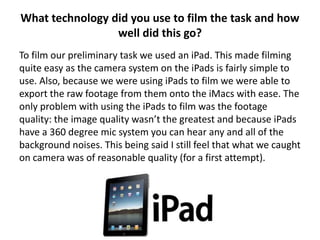
To film our preliminary task we used an iPad. This made filming
quite easy as the camera system on the iPads is fairly simple to
use. Also, because we were using iPads to film we were able to
export the raw footage from them onto the iMacs with ease. The
only problem with using the iPads to film was the footage
quality: the image quality wasn’t the greatest and because iPads
have a 360 degree mic system you can hear any and all of the
background noises. This being said I still feel that what we caught
on camera was of reasonable quality (for a first attempt).
What did you learn from the actual filming that you
       will need to think about in the future?
What I learnt from filming is that what you put down on the
storyboard and what the outcome is can be two different things,
for example you could put down on the storyboard that you
want one shot being filmed in a certain way, try it and the decide
that you don’t like it and instead try it from a different angle.
Another thin I learnt from filming is to always film shots more
that once, then when it comes to the editing of your raw footage
you can experiment with different shots of the same scene to
see which you prefer and also if you film only once there could
be mistakes you are unaware of so film multiples of each scene.
What technology did you use to edit your preliminary
          task and how well did this go?

For the editing of the preliminary task we used iMovie on the
Macs. iMovie is a simple film editing software and I found it
quick and simple to use. Its layout is simple to get to grips with
and I feel that it did a good job on this task. I do feel however
that it was lacking some things for example, when we had filmed
certain scene we noticed a lot of background noise and when
coming to edit the footage we found that we could not edit out
any unwanted sound. This being said I do feel that iMovie was
good to use for editing our footage together and the end product
was of a good standard.
How well does your completed preliminary task meet
             the criteria set out for it?
The task we were set was to create a piece of film which evolved
character opening a door, crossing a room and sitting down in a
chair opposite another character, with whom she/he then
exchanges a couple of lines of dialogue. We needed to include
match on action, shot/reverse shot and the 180-degree rule. I
feel that our product meets this criteria because we showed the
mafia boss walking through a door, crossing the room and sitting
opposite chuck who then exchange a few lines of dialogue. I also
feel that we incorporated all three techniques into our final
piece: match on action with the opening and closing of the door
at the beginning, shot/reverse shot within the dialogue and the
180-degree rule both before and during the dialogue.
Overall what have I learnt from the process of
           completing the preliminary task?
I have learnt from the process of completing the preliminary task
that when creating a film it doesn’t just go from an idea to
finished product, there is a lot to be considered in between like
location planning, mise-en-scene, scripts, camera movements
and angles etc. Another thing I have learnt that in order to create
a great quality product, the planning is crucial! I have also learnt
about the filming and editing process of a product that takes
place and because of this, it will further improve my skills later
when moving on to do the main task. Finally, I have learnt that
in order to be successful, teamwork is key!

Evaluation of preliminary task

  • 1.
    Evaluation Of PreliminaryTask George Hopkins
  • 2.
    How effective wasthe pre-production workflow for your preliminary task? Overall I feel that TwinPine films as a group worked effectively in the pre-production process. We all put ideas in and discussed our thoughts and opinions on each others ideas. We made a mind map with all our ideas on along with the pros and cons of each idea to try and come up with the overall idea. When we did come up with our idea we made a storyboard of what we wanted to happen. This helped plan because with the storyboard we could decide what camera shots and movements we were going to use. It also helped us decide what location we would film at. Overall I feel that the only thing that hindered our progress was the fact that on occasions one or two members of the group were absent when discussions were taking place, however we overcame this by continuing the discussions and filling the other members in on their return.
  • 3.
    What technology didyou use to film the task and how well did this go? To film our preliminary task we used an iPad. This made filming quite easy as the camera system on the iPads is fairly simple to use. Also, because we were using iPads to film we were able to export the raw footage from them onto the iMacs with ease. The only problem with using the iPads to film was the footage quality: the image quality wasn’t the greatest and because iPads have a 360 degree mic system you can hear any and all of the background noises. This being said I still feel that what we caught on camera was of reasonable quality (for a first attempt).
  • 4.
    What did youlearn from the actual filming that you will need to think about in the future? What I learnt from filming is that what you put down on the storyboard and what the outcome is can be two different things, for example you could put down on the storyboard that you want one shot being filmed in a certain way, try it and the decide that you don’t like it and instead try it from a different angle. Another thin I learnt from filming is to always film shots more that once, then when it comes to the editing of your raw footage you can experiment with different shots of the same scene to see which you prefer and also if you film only once there could be mistakes you are unaware of so film multiples of each scene.
  • 5.
    What technology didyou use to edit your preliminary task and how well did this go? For the editing of the preliminary task we used iMovie on the Macs. iMovie is a simple film editing software and I found it quick and simple to use. Its layout is simple to get to grips with and I feel that it did a good job on this task. I do feel however that it was lacking some things for example, when we had filmed certain scene we noticed a lot of background noise and when coming to edit the footage we found that we could not edit out any unwanted sound. This being said I do feel that iMovie was good to use for editing our footage together and the end product was of a good standard.
  • 6.
    How well doesyour completed preliminary task meet the criteria set out for it? The task we were set was to create a piece of film which evolved character opening a door, crossing a room and sitting down in a chair opposite another character, with whom she/he then exchanges a couple of lines of dialogue. We needed to include match on action, shot/reverse shot and the 180-degree rule. I feel that our product meets this criteria because we showed the mafia boss walking through a door, crossing the room and sitting opposite chuck who then exchange a few lines of dialogue. I also feel that we incorporated all three techniques into our final piece: match on action with the opening and closing of the door at the beginning, shot/reverse shot within the dialogue and the 180-degree rule both before and during the dialogue.
  • 7.
    Overall what haveI learnt from the process of completing the preliminary task? I have learnt from the process of completing the preliminary task that when creating a film it doesn’t just go from an idea to finished product, there is a lot to be considered in between like location planning, mise-en-scene, scripts, camera movements and angles etc. Another thing I have learnt that in order to create a great quality product, the planning is crucial! I have also learnt about the filming and editing process of a product that takes place and because of this, it will further improve my skills later when moving on to do the main task. Finally, I have learnt that in order to be successful, teamwork is key!