Package ‘lpSolve’
                                                              February 14, 2012

Version 5.6.6

Date 2011-04-19

Title Interface to Lp_solve v. 5.5 to solve linear/integer programs

Author Michel Berkelaar and others

Maintainer Sam Buttrey <buttrey@nps.edu>

Description Lp_solve is freely available (under LGPL 2) software for
     solving linear, integer and mixed integer programs. In this
     implementation we supply a ‘‘wrapper’’ function in C and some R functions that solve gen-
     eral linear/integer problems,assignment problems, and transportation problems. This version
     calls lp_solve version 5.5.

License LGPL-2

Repository CRAN

Date/Publication 2011-04-26 06:30:54


R topics documented:
         lp . . . . .     .   .   .   .   .   .   .   .   .   .   .   .   .   .   .   .   .   .   .   .   .   .   .   .   .   .   .   .   .   .   .   .   .   .   .   .   .   .   .   .   .    2
         lp.assign . .    .   .   .   .   .   .   .   .   .   .   .   .   .   .   .   .   .   .   .   .   .   .   .   .   .   .   .   .   .   .   .   .   .   .   .   .   .   .   .   .   .    4
         lp.object . .    .   .   .   .   .   .   .   .   .   .   .   .   .   .   .   .   .   .   .   .   .   .   .   .   .   .   .   .   .   .   .   .   .   .   .   .   .   .   .   .   .    6
         lp.transport     .   .   .   .   .   .   .   .   .   .   .   .   .   .   .   .   .   .   .   .   .   .   .   .   .   .   .   .   .   .   .   .   .   .   .   .   .   .   .   .   .    7
         make.q8 . .      .   .   .   .   .   .   .   .   .   .   .   .   .   .   .   .   .   .   .   .   .   .   .   .   .   .   .   .   .   .   .   .   .   .   .   .   .   .   .   .   .    8
         print.lp . . .   .   .   .   .   .   .   .   .   .   .   .   .   .   .   .   .   .   .   .   .   .   .   .   .   .   .   .   .   .   .   .   .   .   .   .   .   .   .   .   .   .    9

Index                                                                                                                                                                                         11


                                                                                      1
2                                                                                                      lp


    lp                         Linear and Integer Programming


Description
     Interface to lp_solve linear/integer programming system

Usage
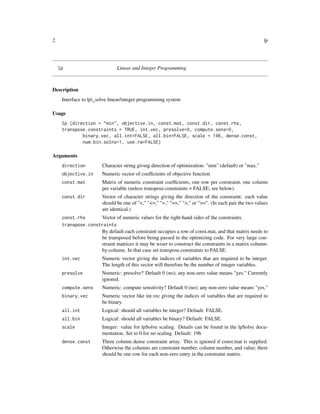
     lp (direction = "min", objective.in, const.mat, const.dir, const.rhs,
     transpose.constraints = TRUE, int.vec, presolve=0, compute.sens=0,
             binary.vec, all.int=FALSE, all.bin=FALSE, scale = 196, dense.const,
             num.bin.solns=1, use.rw=FALSE)

Arguments
     direction          Character string giving direction of optimization: "min" (default) or "max."
     objective.in       Numeric vector of coefficients of objective function
     const.mat          Matrix of numeric constraint coefficients, one row per constraint, one column
                        per variable (unless transpose.constraints = FALSE; see below).
     const.dir          Vector of character strings giving the direction of the constraint: each value
                        should be one of "<," "<=," "=," "==," ">," or ">=". (In each pair the two values
                        are identical.)
     const.rhs      Vector of numeric values for the right-hand sides of the constraints.
     transpose.constraints
                    By default each constraint occupies a row of const.mat, and that matrix needs to
                    be transposed before being passed to the optimizing code. For very large con-
                    straint matrices it may be wiser to construct the constraints in a matrix column-
                    by-column. In that case set transpose.constraints to FALSE.
     int.vec            Numeric vector giving the indices of variables that are required to be integer.
                        The length of this vector will therefore be the number of integer variables.
     presolve           Numeric: presolve? Default 0 (no); any non-zero value means "yes." Currently
                        ignored.
     compute.sens       Numeric: compute sensitivity? Default 0 (no); any non-zero value means "yes."
     binary.vec         Numeric vector like int.vec giving the indices of variables that are required to
                        be binary.
     all.int            Logical: should all variables be integer? Default: FALSE.
     all.bin            Logical: should all variables be binary? Default: FALSE.
     scale              Integer: value for lpSolve scaling. Details can be found in the lpSolve docu-
                        mentation. Set to 0 for no scaling. Default: 196
     dense.const        Three column dense constraint array. This is ignored if const.mat is supplied.
                        Otherwise the columns are constraint number, column number, and value; there
                        should be one row for each non-zero entry in the constraint matrix.
lp                                                                                                     3

     num.bin.solns      Integer: if all.bin=TRUE, the user can request up to num.bin.solns optimal so-
                        lutions to be returned.
     use.rw             Logical: if TRUE and num.bin.solns > 1, write the lp out to a file and read it
                        back in for each solution after the first. This is just to defeat a bug somewhere.
                        Although the default is FALSE, we recommend you set this to TRUE if you
                        need num.bin.solns > 1, until the bug is found.

Details
     This function calls the lp_solve 5.5 solver. That system has many options not supported here. The
     current version is maintained at http://lpsolve.sourceforge.net/5.5
     Note that every variable is assumed to be >= 0!

Value
     An lp object. See lp.object for details.

Author(s)
     Sam Buttrey, <buttrey@nps.edu>

See Also
     lp.assign, lp.transport

Examples
     #
     # Set up problem: maximize
     #   x1 + 9 x2 +   x3 subject to
     #   x1 + 2 x2 + 3 x3 <= 9
     # 3 x1 + 2 x2 + 2 x3 <= 15
     #
     f.obj <- c(1, 9, 3)
     f.con <- matrix (c(1, 2, 3, 3, 2, 2), nrow=2, byrow=TRUE)
     f.dir <- c("<=", "<=")
     f.rhs <- c(9, 15)
     #
     # Now run.
     #
     lp ("max", f.obj, f.con, f.dir, f.rhs)
     ## Not run: Success: the objective function is 40.5
     lp ("max", f.obj, f.con, f.dir, f.rhs)$solution
     ## Not run: [1] 0.0 4.5 0.0
     #
     # The same problem using the dense constraint approach:
     #
     f.con.d <- matrix (c(rep (1:2,each=3), rep (1:3, 2), t(f.con)), ncol=3)
     lp ("max", f.obj, , f.dir, f.rhs, dense.const=f.con.d)
     ## Not run: Success: the objective function is 40.5
     #
4                                                                                   lp.assign

     # Get sensitivities
     #
     lp ("max", f.obj, f.con, f.dir, f.rhs, compute.sens=TRUE)$sens.coef.from
     ## Not run: [1] -1e+30 2e+00 -1e+30
     lp ("max", f.obj, f.con, f.dir, f.rhs, compute.sens=TRUE)$sens.coef.to
     ## Not run: [1] 4.50e+00 1.00e+30 1.35e+01
     #
     # Right now the dual values for the constraints and the variables are
     # combined, constraints coming first. So in this example...
     #
     lp ("max", f.obj, f.con, f.dir, f.rhs, compute.sens=TRUE)$duals
     ## Not run: [1]   4.5   0.0 -3.5    0.0 -10.5
     #
     # ...the duals of the constraints are 4.5 and 0, and of the variables,
     # -3.5, 0.0, -10.5. Here are the lower and upper limits on these:
     #
     lp ("max", f.obj, f.con, f.dir, f.rhs, compute.sens=TRUE)$duals.from
     ## Not run: [1] 0e+00 -1e+30 -1e+30 -1e+30 -6e+00
     lp ("max", f.obj, f.con, f.dir, f.rhs, compute.sens=TRUE)$duals.to
     ## Not run: [1] 1.5e+01 1.0e+30 3.0e+00 1.0e+30 3.0e+00
     #
     # Run again, this time requiring that all three variables be integer
     #
     lp ("max", f.obj, f.con, f.dir, f.rhs, int.vec=1:3)
     ## Not run: Success: the objective function is 37
     lp ("max", f.obj, f.con, f.dir, f.rhs, int.vec=1:3)$solution
     ## Not run: [1] 1 4 0
     #
     # You can get sensitivities in the integer case, but they’re harder to
     # interpret.
     #
     lp ("max", f.obj, f.con, f.dir, f.rhs, int.vec=1:3, compute.sens=TRUE)$duals
     ## Not run: [1] 1 0 0 7 0
     #
     # Here’s an example in which we want more than one solution to a problem
     # in which all variables are binary: the 8-queens problem,
     # with dense constraints.
     #
     chess.obj <- rep (1, 64)
     q8 <- make.q8 ()
     chess.dir <- rep (c("=", "<"), c(16, 26))
     chess.rhs <- rep (1, 42)
     lp (’max’, chess.obj, , chess.dir, chess.rhs, dense.const = q8,
         all.bin=TRUE, num.bin.solns=3)


    lp.assign               Integer Programming for the Assignment Problem
lp.assign                                                                                               5

Description
    Interface to lp_solve linear/integer programming system specifically for solving assignment prob-
    lems

Usage
    lp.assign (cost.mat, direction = "min", presolve = 0, compute.sens = 0)

Arguments
    cost.mat           Matrix of costs: the ij-th element is the cost of assigning source i to destination
                       j.
    direction          Character vector, length 1, containing either "min" (the default) or "max"
    presolve           Numeric: presolve? Default 0 (no); any non-zero value means "yes." Currently
                       ignored.
    compute.sens       Numeric: compute sensitivity? Default 0 (no); any non-zero value means "yes."
                       In that case presolving is attempted.

Details
    This is a particular integer programming problem. All the decision variables are assumed to be
    integers; each row has the constraint that its entries must add up to 1 (so that there is one 1 and
    the remaining entries are 0) and each column has the same constraint. This is assumed to be a
    minimization problem.

Value
    An lp object. See documentation for details. The constraints are assumed (each row adds to 1, each
    column adds to 1, and no others) and are not returned.

Author(s)
    Sam Buttrey, <buttrey@nps.edu>

See Also
    lp, lp.transport

Examples
    assign.costs <- matrix (c(2, 7, 7, 2, 7, 7, 3, 2, 7, 2, 8, 10, 1, 9, 8, 2), 4, 4)
    ## Not run:
    > assign.costs
         [,1] [,2] [,3] [,4]
    [1,]    2    7    7    1
    [2,]    7    7    2    9
    [3,]    7    3    8    8
    [4,]    2    2   10    2
6                                                                                           lp.object

     ## End(Not run)
     lp.assign (assign.costs)
     ## Not run: Success: the objective function is 8
     lp.assign (assign.costs)$solution
     ## Not run:
          [,1] [,2] [,3] [,4]
     [1,]    0    0    0    1
     [2,]    0    0    1    0
     [3,]    0    1    0    0
     [4,]    1    0    0    0

     ## End(Not run)


    lp.object                   LP (linear programming) object


Description
     Structure of lp object

Value
     An lp.object is a list containing the following elements:

     direction           Optimization direction, as entered
     x.count             Number of variables in objective function
     objective           Vector of objective function coefficients, as entered
     const.count         Number of constraints entered
     constraints         Constraint matrix, as entered (not returned by lp.assign or lp.transport)
     int.count           Number of integer variables
     int.vec             Vector of integer variables’ indices, as entered
     objval              Value of objective function at optimum
     solution            Vector of optimal coefficients
     num.bin.solns       Numeric indicator of number of solutions returned
     status              Numeric indicator: 0 = success, 2 = no feasible solution

Author(s)
     Sam Buttrey, <buttrey@nps.edu>

See Also
     lp, lp.assign, lp.transport
lp.transport                                                                                            7


  lp.transport                Integer Programming for the Transportation Problem


Description
    Interface to lp_solve linear/integer programming system specifically for solving transportation
    problems

Usage
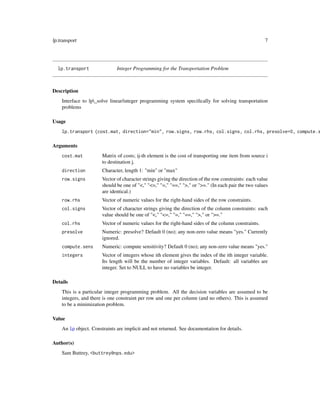
    lp.transport (cost.mat, direction="min", row.signs, row.rhs, col.signs, col.rhs, presolve=0, compute.s

Arguments
    cost.mat           Matrix of costs; ij-th element is the cost of transporting one item from source i
                       to destination j.
    direction          Character, length 1: "min" or "max"
    row.signs          Vector of character strings giving the direction of the row constraints: each value
                       should be one of "<," "<=," "=," "==," ">," or ">=." (In each pair the two values
                       are identical.)
    row.rhs            Vector of numeric values for the right-hand sides of the row constraints.
    col.signs          Vector of character strings giving the direction of the column constraints: each
                       value should be one of "<," "<=," "=," "==," ">," or ">=."
    col.rhs            Vector of numeric values for the right-hand sides of the column constraints.
    presolve           Numeric: presolve? Default 0 (no); any non-zero value means "yes." Currently
                       ignored.
    compute.sens       Numeric: compute sensitivity? Default 0 (no); any non-zero value means "yes."
    integers           Vector of integers whose ith element gives the index of the ith integer variable.
                       Its length will be the number of integer variables. Default: all variables are
                       integer. Set to NULL to have no variables be integer.

Details
    This is a particular integer programming problem. All the decision variables are assumed to be
    integers, and there is one constraint per row and one per column (and no others). This is assumed
    to be a minimization problem.

Value
    An lp object. Constraints are implicit and not returned. See documentation for details.

Author(s)
    Sam Buttrey, <buttrey@nps.edu>
8                                                                                      make.q8

References
     Example problem from Bronson (1981), Operations Research, Scahum’s Outline Series, McGraw-
     Hill.


See Also
     lp.assign, lp.transport


Examples
     #
     # Transportation problem, Bronson, problem 9.1, p. 86
     #
     # Set up cost matrix
     #
     costs <- matrix (10000, 8, 5); costs[4,1] <- costs[-4,5] <- 0
     costs[1,2] <- costs[2,3] <- costs[3,4] <- 7; costs[1,3] <- costs[2,4] <- 7.7
     costs[5,1] <- costs[7,3] <- 8; costs[1,4] <- 8.4; costs[6,2] <- 9
     costs[8,4] <- 10; costs[4,2:4] <- c(.7, 1.4, 2.1)
     #
     # Set up constraint signs and right-hand sides.
     #
     row.signs <- rep ("<", 8)
     row.rhs <- c(200, 300, 350, 200, 100, 50, 100, 150)
     col.signs <- rep (">", 5)
     col.rhs <- c(250, 100, 400, 500, 200)
     #
     # Run
     #
     lp.transport (costs, "min", row.signs, row.rhs, col.signs, col.rhs)
     ## Not run: Success: the objective function is 7790
     lp.transport (costs, "min", row.signs, row.rhs, col.signs, col.rhs)$solution
     ## Not run:
           [,1] [,2] [,3] [,4] [,5]
     [1,]     0 100     0 100     0
     [2,]     0    0 300     0    0
     [3,]     0    0    0 350     0
     [4,] 200      0    0    0    0
     [5,]    50    0    0    0   50
     [6,]     0    0    0    0   50
     [7,]     0    0 100     0    0
     [8,]     0    0    0   50 100

     ## End(Not run)


    make.q8                  Generate sparse constraint matrix for 8-queens problem
print.lp                                                                                           9

Description
    Generate sparse constraint matrix for 8-queens problem

Usage
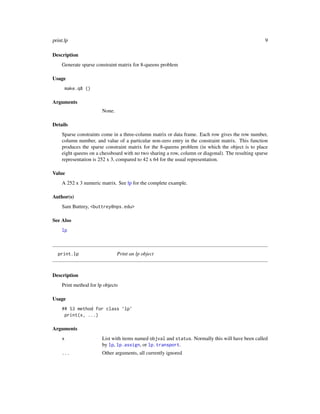
        make.q8 ()

Arguments
                       None.

Details
    Sparse constraints come in a three-column matrix or data frame. Each row gives the row number,
    column number, and value of a particular non-zero entry in the constraint matrix. This function
    produces the sparse constraint matrix for the 8-queens problem (in which the object is to place
    eight queens on a chessboard with no two sharing a row, column or diagonal). The resulting sparse
    representation is 252 x 3, compared to 42 x 64 for the usual representation.

Value
    A 252 x 3 numeric matrix. See lp for the complete example.

Author(s)
    Sam Buttrey, <buttrey@nps.edu>

See Also
    lp


  print.lp                     Print an lp object


Description
    Print method for lp objects

Usage
    ## S3 method for class ’lp’
     print(x, ...)

Arguments
    x                  List with items named objval and status. Normally this will have been called
                       by lp, lp.assign, or lp.transport.
    ...                Other arguments, all currently ignored
10                                                                                                 print.lp

Details
     This function prints the objective function value, together with the word "Success" if the operation
     is successful, or an indication of the error if not. If multiple solutions have been produced (because
     this was an all-binary problem and lp was called with num.bin.solns > 1) the number of solutions is
     also displayed.

Value
     None

Author(s)
     Sam Buttrey, <buttrey@nps.edu>

See Also
     lp, lp.assign, lp.transport
Index

∗Topic optimize
    lp, 2
    lp.assign, 4
    lp.object, 6
    lp.transport, 7
    make.q8, 8
    print.lp, 9
8-queens problem (make.q8), 8

lp, 2, 5–7, 9, 10
lp.assign, 3, 4, 6, 8–10
lp.object, 3, 6
lp.transport, 3, 5, 6, 7, 8–10

make.q8, 8

print.lp, 9


                                 11

lpSolve - R Library

  • 1.
    Package ‘lpSolve’ February 14, 2012 Version 5.6.6 Date 2011-04-19 Title Interface to Lp_solve v. 5.5 to solve linear/integer programs Author Michel Berkelaar and others Maintainer Sam Buttrey <buttrey@nps.edu> Description Lp_solve is freely available (under LGPL 2) software for solving linear, integer and mixed integer programs. In this implementation we supply a ‘‘wrapper’’ function in C and some R functions that solve gen- eral linear/integer problems,assignment problems, and transportation problems. This version calls lp_solve version 5.5. License LGPL-2 Repository CRAN Date/Publication 2011-04-26 06:30:54 R topics documented: lp . . . . . . . . . . . . . . . . . . . . . . . . . . . . . . . . . . . . . . . . . . . . . . 2 lp.assign . . . . . . . . . . . . . . . . . . . . . . . . . . . . . . . . . . . . . . . . . . . 4 lp.object . . . . . . . . . . . . . . . . . . . . . . . . . . . . . . . . . . . . . . . . . . . 6 lp.transport . . . . . . . . . . . . . . . . . . . . . . . . . . . . . . . . . . . . . . . . . 7 make.q8 . . . . . . . . . . . . . . . . . . . . . . . . . . . . . . . . . . . . . . . . . . . 8 print.lp . . . . . . . . . . . . . . . . . . . . . . . . . . . . . . . . . . . . . . . . . . . . 9 Index 11 1
  • 2.
    2 lp lp Linear and Integer Programming Description Interface to lp_solve linear/integer programming system Usage lp (direction = "min", objective.in, const.mat, const.dir, const.rhs, transpose.constraints = TRUE, int.vec, presolve=0, compute.sens=0, binary.vec, all.int=FALSE, all.bin=FALSE, scale = 196, dense.const, num.bin.solns=1, use.rw=FALSE) Arguments direction Character string giving direction of optimization: "min" (default) or "max." objective.in Numeric vector of coefficients of objective function const.mat Matrix of numeric constraint coefficients, one row per constraint, one column per variable (unless transpose.constraints = FALSE; see below). const.dir Vector of character strings giving the direction of the constraint: each value should be one of "<," "<=," "=," "==," ">," or ">=". (In each pair the two values are identical.) const.rhs Vector of numeric values for the right-hand sides of the constraints. transpose.constraints By default each constraint occupies a row of const.mat, and that matrix needs to be transposed before being passed to the optimizing code. For very large con- straint matrices it may be wiser to construct the constraints in a matrix column- by-column. In that case set transpose.constraints to FALSE. int.vec Numeric vector giving the indices of variables that are required to be integer. The length of this vector will therefore be the number of integer variables. presolve Numeric: presolve? Default 0 (no); any non-zero value means "yes." Currently ignored. compute.sens Numeric: compute sensitivity? Default 0 (no); any non-zero value means "yes." binary.vec Numeric vector like int.vec giving the indices of variables that are required to be binary. all.int Logical: should all variables be integer? Default: FALSE. all.bin Logical: should all variables be binary? Default: FALSE. scale Integer: value for lpSolve scaling. Details can be found in the lpSolve docu- mentation. Set to 0 for no scaling. Default: 196 dense.const Three column dense constraint array. This is ignored if const.mat is supplied. Otherwise the columns are constraint number, column number, and value; there should be one row for each non-zero entry in the constraint matrix.
  • 3.
    lp 3 num.bin.solns Integer: if all.bin=TRUE, the user can request up to num.bin.solns optimal so- lutions to be returned. use.rw Logical: if TRUE and num.bin.solns > 1, write the lp out to a file and read it back in for each solution after the first. This is just to defeat a bug somewhere. Although the default is FALSE, we recommend you set this to TRUE if you need num.bin.solns > 1, until the bug is found. Details This function calls the lp_solve 5.5 solver. That system has many options not supported here. The current version is maintained at http://lpsolve.sourceforge.net/5.5 Note that every variable is assumed to be >= 0! Value An lp object. See lp.object for details. Author(s) Sam Buttrey, <buttrey@nps.edu> See Also lp.assign, lp.transport Examples # # Set up problem: maximize # x1 + 9 x2 + x3 subject to # x1 + 2 x2 + 3 x3 <= 9 # 3 x1 + 2 x2 + 2 x3 <= 15 # f.obj <- c(1, 9, 3) f.con <- matrix (c(1, 2, 3, 3, 2, 2), nrow=2, byrow=TRUE) f.dir <- c("<=", "<=") f.rhs <- c(9, 15) # # Now run. # lp ("max", f.obj, f.con, f.dir, f.rhs) ## Not run: Success: the objective function is 40.5 lp ("max", f.obj, f.con, f.dir, f.rhs)$solution ## Not run: [1] 0.0 4.5 0.0 # # The same problem using the dense constraint approach: # f.con.d <- matrix (c(rep (1:2,each=3), rep (1:3, 2), t(f.con)), ncol=3) lp ("max", f.obj, , f.dir, f.rhs, dense.const=f.con.d) ## Not run: Success: the objective function is 40.5 #
  • 4.
    4 lp.assign # Get sensitivities # lp ("max", f.obj, f.con, f.dir, f.rhs, compute.sens=TRUE)$sens.coef.from ## Not run: [1] -1e+30 2e+00 -1e+30 lp ("max", f.obj, f.con, f.dir, f.rhs, compute.sens=TRUE)$sens.coef.to ## Not run: [1] 4.50e+00 1.00e+30 1.35e+01 # # Right now the dual values for the constraints and the variables are # combined, constraints coming first. So in this example... # lp ("max", f.obj, f.con, f.dir, f.rhs, compute.sens=TRUE)$duals ## Not run: [1] 4.5 0.0 -3.5 0.0 -10.5 # # ...the duals of the constraints are 4.5 and 0, and of the variables, # -3.5, 0.0, -10.5. Here are the lower and upper limits on these: # lp ("max", f.obj, f.con, f.dir, f.rhs, compute.sens=TRUE)$duals.from ## Not run: [1] 0e+00 -1e+30 -1e+30 -1e+30 -6e+00 lp ("max", f.obj, f.con, f.dir, f.rhs, compute.sens=TRUE)$duals.to ## Not run: [1] 1.5e+01 1.0e+30 3.0e+00 1.0e+30 3.0e+00 # # Run again, this time requiring that all three variables be integer # lp ("max", f.obj, f.con, f.dir, f.rhs, int.vec=1:3) ## Not run: Success: the objective function is 37 lp ("max", f.obj, f.con, f.dir, f.rhs, int.vec=1:3)$solution ## Not run: [1] 1 4 0 # # You can get sensitivities in the integer case, but they’re harder to # interpret. # lp ("max", f.obj, f.con, f.dir, f.rhs, int.vec=1:3, compute.sens=TRUE)$duals ## Not run: [1] 1 0 0 7 0 # # Here’s an example in which we want more than one solution to a problem # in which all variables are binary: the 8-queens problem, # with dense constraints. # chess.obj <- rep (1, 64) q8 <- make.q8 () chess.dir <- rep (c("=", "<"), c(16, 26)) chess.rhs <- rep (1, 42) lp (’max’, chess.obj, , chess.dir, chess.rhs, dense.const = q8, all.bin=TRUE, num.bin.solns=3) lp.assign Integer Programming for the Assignment Problem
  • 5.
    lp.assign 5 Description Interface to lp_solve linear/integer programming system specifically for solving assignment prob- lems Usage lp.assign (cost.mat, direction = "min", presolve = 0, compute.sens = 0) Arguments cost.mat Matrix of costs: the ij-th element is the cost of assigning source i to destination j. direction Character vector, length 1, containing either "min" (the default) or "max" presolve Numeric: presolve? Default 0 (no); any non-zero value means "yes." Currently ignored. compute.sens Numeric: compute sensitivity? Default 0 (no); any non-zero value means "yes." In that case presolving is attempted. Details This is a particular integer programming problem. All the decision variables are assumed to be integers; each row has the constraint that its entries must add up to 1 (so that there is one 1 and the remaining entries are 0) and each column has the same constraint. This is assumed to be a minimization problem. Value An lp object. See documentation for details. The constraints are assumed (each row adds to 1, each column adds to 1, and no others) and are not returned. Author(s) Sam Buttrey, <buttrey@nps.edu> See Also lp, lp.transport Examples assign.costs <- matrix (c(2, 7, 7, 2, 7, 7, 3, 2, 7, 2, 8, 10, 1, 9, 8, 2), 4, 4) ## Not run: > assign.costs [,1] [,2] [,3] [,4] [1,] 2 7 7 1 [2,] 7 7 2 9 [3,] 7 3 8 8 [4,] 2 2 10 2
  • 6.
    6 lp.object ## End(Not run) lp.assign (assign.costs) ## Not run: Success: the objective function is 8 lp.assign (assign.costs)$solution ## Not run: [,1] [,2] [,3] [,4] [1,] 0 0 0 1 [2,] 0 0 1 0 [3,] 0 1 0 0 [4,] 1 0 0 0 ## End(Not run) lp.object LP (linear programming) object Description Structure of lp object Value An lp.object is a list containing the following elements: direction Optimization direction, as entered x.count Number of variables in objective function objective Vector of objective function coefficients, as entered const.count Number of constraints entered constraints Constraint matrix, as entered (not returned by lp.assign or lp.transport) int.count Number of integer variables int.vec Vector of integer variables’ indices, as entered objval Value of objective function at optimum solution Vector of optimal coefficients num.bin.solns Numeric indicator of number of solutions returned status Numeric indicator: 0 = success, 2 = no feasible solution Author(s) Sam Buttrey, <buttrey@nps.edu> See Also lp, lp.assign, lp.transport
  • 7.
    lp.transport 7 lp.transport Integer Programming for the Transportation Problem Description Interface to lp_solve linear/integer programming system specifically for solving transportation problems Usage lp.transport (cost.mat, direction="min", row.signs, row.rhs, col.signs, col.rhs, presolve=0, compute.s Arguments cost.mat Matrix of costs; ij-th element is the cost of transporting one item from source i to destination j. direction Character, length 1: "min" or "max" row.signs Vector of character strings giving the direction of the row constraints: each value should be one of "<," "<=," "=," "==," ">," or ">=." (In each pair the two values are identical.) row.rhs Vector of numeric values for the right-hand sides of the row constraints. col.signs Vector of character strings giving the direction of the column constraints: each value should be one of "<," "<=," "=," "==," ">," or ">=." col.rhs Vector of numeric values for the right-hand sides of the column constraints. presolve Numeric: presolve? Default 0 (no); any non-zero value means "yes." Currently ignored. compute.sens Numeric: compute sensitivity? Default 0 (no); any non-zero value means "yes." integers Vector of integers whose ith element gives the index of the ith integer variable. Its length will be the number of integer variables. Default: all variables are integer. Set to NULL to have no variables be integer. Details This is a particular integer programming problem. All the decision variables are assumed to be integers, and there is one constraint per row and one per column (and no others). This is assumed to be a minimization problem. Value An lp object. Constraints are implicit and not returned. See documentation for details. Author(s) Sam Buttrey, <buttrey@nps.edu>
  • 8.
    8 make.q8 References Example problem from Bronson (1981), Operations Research, Scahum’s Outline Series, McGraw- Hill. See Also lp.assign, lp.transport Examples # # Transportation problem, Bronson, problem 9.1, p. 86 # # Set up cost matrix # costs <- matrix (10000, 8, 5); costs[4,1] <- costs[-4,5] <- 0 costs[1,2] <- costs[2,3] <- costs[3,4] <- 7; costs[1,3] <- costs[2,4] <- 7.7 costs[5,1] <- costs[7,3] <- 8; costs[1,4] <- 8.4; costs[6,2] <- 9 costs[8,4] <- 10; costs[4,2:4] <- c(.7, 1.4, 2.1) # # Set up constraint signs and right-hand sides. # row.signs <- rep ("<", 8) row.rhs <- c(200, 300, 350, 200, 100, 50, 100, 150) col.signs <- rep (">", 5) col.rhs <- c(250, 100, 400, 500, 200) # # Run # lp.transport (costs, "min", row.signs, row.rhs, col.signs, col.rhs) ## Not run: Success: the objective function is 7790 lp.transport (costs, "min", row.signs, row.rhs, col.signs, col.rhs)$solution ## Not run: [,1] [,2] [,3] [,4] [,5] [1,] 0 100 0 100 0 [2,] 0 0 300 0 0 [3,] 0 0 0 350 0 [4,] 200 0 0 0 0 [5,] 50 0 0 0 50 [6,] 0 0 0 0 50 [7,] 0 0 100 0 0 [8,] 0 0 0 50 100 ## End(Not run) make.q8 Generate sparse constraint matrix for 8-queens problem
  • 9.
    print.lp 9 Description Generate sparse constraint matrix for 8-queens problem Usage make.q8 () Arguments None. Details Sparse constraints come in a three-column matrix or data frame. Each row gives the row number, column number, and value of a particular non-zero entry in the constraint matrix. This function produces the sparse constraint matrix for the 8-queens problem (in which the object is to place eight queens on a chessboard with no two sharing a row, column or diagonal). The resulting sparse representation is 252 x 3, compared to 42 x 64 for the usual representation. Value A 252 x 3 numeric matrix. See lp for the complete example. Author(s) Sam Buttrey, <buttrey@nps.edu> See Also lp print.lp Print an lp object Description Print method for lp objects Usage ## S3 method for class ’lp’ print(x, ...) Arguments x List with items named objval and status. Normally this will have been called by lp, lp.assign, or lp.transport. ... Other arguments, all currently ignored
  • 10.
    10 print.lp Details This function prints the objective function value, together with the word "Success" if the operation is successful, or an indication of the error if not. If multiple solutions have been produced (because this was an all-binary problem and lp was called with num.bin.solns > 1) the number of solutions is also displayed. Value None Author(s) Sam Buttrey, <buttrey@nps.edu> See Also lp, lp.assign, lp.transport
  • 11.
    Index ∗Topic optimize lp, 2 lp.assign, 4 lp.object, 6 lp.transport, 7 make.q8, 8 print.lp, 9 8-queens problem (make.q8), 8 lp, 2, 5–7, 9, 10 lp.assign, 3, 4, 6, 8–10 lp.object, 3, 6 lp.transport, 3, 5, 6, 7, 8–10 make.q8, 8 print.lp, 9 11