
EV / AV
AutoBook
2018
PREVIEW
ii
WELCOME!


In 2018, electric vehicles and autonomous
driving are again the hottest topic in the
automotive industry, a global phenomenon
where non-traditional players like Tesla were
able to claim market leading positions agains
classic competitors like Volkswagen,
Mercedes and Toyota.
Battery prices fell 35 percent in the last 12
months and are on a trajectory to make
unsubsidized electric vehicles as affordable as their gasoline
counterparts in the next six years.
The number of commercial charging stations is also growing quickly in
part because they are relatively cheap—costing $3,000 to $7,500 per
port. When attached to a business, they can attract customers, and
encourage them to stay longer and spend more.
By 2040, long-range electric cars will cost less than $22,000 (in
today’s dollars), according to the projections. Thirty-five percent of
new cars worldwide will have a plug.
The highlight clearly was Tesla’s success to secure more than 400,000
reservations for their Model 3. Production has begun in mid 2017 and
Tesla deliveries for 2018 are ramping up to 5,000 units per week with
eventually 10,000 units per week being planned.
Also Autonomous Driving has seen major breakthrough with Tesla
demonstrating fully functional AV technology in their Model S.
Many agree that a shift is under way that will lead to widespread
adoption of EVs in the next decade. It’s looking like the 2020s will be
the decade of the electric car.
How to use the EV/AV AutoBook
The information was compiled from personal research, the internet
and with support of friends at automotive companies, automotive
organizations, industrial estates and business associates and is
designed to support:
1) Business Development - managers who seek to identify
potential customers and sales opportunities
2) Outsourcing – local and international commodity managers,
buyers who are looking to source components
Focus on contacts
The EV/AV AutoBook features quick links to access web sites, Google
Map locations and social media sites of the featured companies and
their representatives. Simply click on the icons to connect:
I am sure this book will give you lots of information and inspire you to
do business in the EV/AV Sector.
To your success!
Ulrich Kaiser
Chapter 1
Introduction
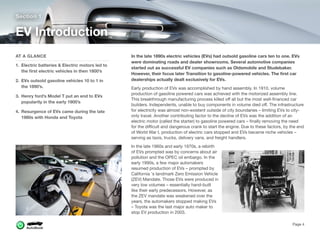
In the late 1890s electric vehicles (EVs) had outsold gasoline cars ten to one. EVs
were dominating roads and dealer showrooms. Several automotive companies
started out as successful EV companies such as Oldsmobile and Studebaker.
However, their focus later Transition to gasoline-powered vehicles. The first car
dealerships actually dealt exclusively for EVs.
Early production of EVs was accomplished by hand assembly. In 1910, volume
production of gasoline powered cars was achieved with the motorized assembly line.
This breakthrough manufacturing process killed off all but the most well-financed car
builders. Independents, unable to buy components in volume died off. The infrastructure
for electricity was almost non-existent outside of city boundaries – limiting EVs to city-
only travel. Another contributing factor to the decline of EVs was the addition of an
electric motor (called the starter) to gasoline powered cars – finally removing the need
for the difficult and dangerous crank to start the engine. Due to these factors, by the end
of World War I, production of electric cars stopped and EVs became niche vehicles –
serving as taxis, trucks, delivery vans, and freight handlers.
In the late 1960s and early 1970s, a rebirth
of EVs prompted was by concerns about air
pollution and the OPEC oil embargo. In the
early 1990s, a few major automakers
resumed production of EVs – prompted by
California 's landmark Zero Emission Vehicle
(ZEV) Mandate. Those EVs were produced in
very low volumes – essentially hand-built
like their early predecessors. However, as
the ZEV mandate was weakened over the
years, the automakers stopped making EVs
– Toyota was the last major auto maker to
stop EV production in 2003.
Section 1
AT A GLANCE
1. Electric batteries & Electric motors led to
the first electric vehicles in then 1800’s
2. EVs outsold gasoline vehicles 10 to 1 in
the 1890’s.
3. Henry ford’s Model T put an end to EVs
popularity in the early 1900’s
4. Resurgence of EVs came during the late
1980s with Honda and Toyota
EV Introduction
Page 4
Chapter 2
Statistics
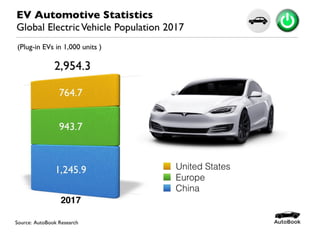
6
Chapter 3
OEMs
Photo: Volkswagen
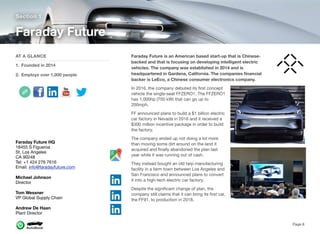
Faraday Future is an American based start-up that is Chinese-
backed and that is focusing on developing intelligent electric
vehicles. The company was established in 2014 and is
headquartered in Gardena, California. The companies financial
backer is LeEco, a Chinese consumer electronics company.
In 2016, the company debuted its first concept
vehicle the single-seat FFZERO1. The FFZERO1
has 1,000hp (750 kW) that can go up to
200mph.
FF announced plans to build a $1 billion electric
car factory in Nevada in 2016 and it received a
$300 million incentive package in order to build
the factory.
The company ended up not doing a lot more
than moving some dirt around on the land it
acquired and finally abandoned the plan last
year while it was running out of cash.
They instead bought an old tarp manufacturing
facility in a farm town between Los Angeles and
San Francisco and announced plans to convert
it into a high-tech electric car factory.
Despite the significant change of plan, the
company still claims that it can bring its first car,
the FF91, to production in 2018.
Section 1
AT A GLANCE
1. Founded in 2014
2. Employs over 1,000 people
Faraday Future
Page 8
Faraday Future HQ
18455 S Figueroa
St. Los Angeles

CA 90248
Tel: +1 424 276 7616
Email: info@faradayfuture.com
Michael Johnson
Director
Tom Wessner
VP Global Supply Chain
Andrew De Haan
Plant Director
Section 2
Electric Vehicle OEMs
Page 9
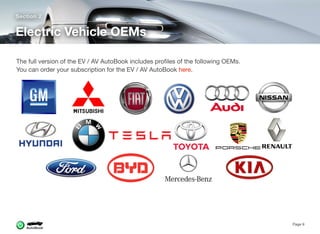
The full version of the EV / AV AutoBook includes profiles of the following OEMs.

You can order your subscription for the EV / AV AutoBook here.
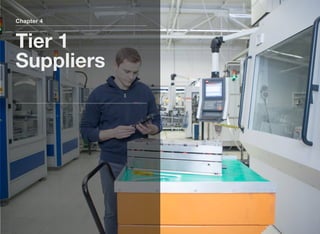
Chapter 4
Tier 1
Suppliers
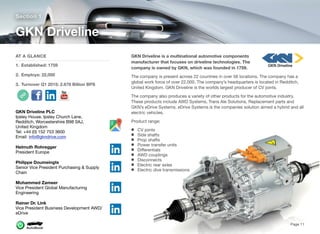
GKN Driveline is a multinational automotive components
manufacturer that focuses on driveline technologies. The
company is owned by GKN, which was founded in 1759.
The company is present across 22 countries in over 56 locations. The company has a
global work force of over 22,000. The company’s headquarters is located in Redditch,
United Kingdom. GKN Driveline is the worlds largest producer of CV joints.
The company also produces a variety of other products for the automotive industry.
These products include AWD Systems, Trans Ale Solutions, Replacement parts and
GKN’s eDrive Systems. eDrive Systems is the companies solution aimed a hybrid and all
electric vehicles.
Product range:
CV joints
Side shafts
Prop shafts
Power transfer units
Differentials
AWD couplings
Disconnects
Electric rear axles
Electric dive transmissions
Section 1
AT A GLANCE
1. Established: 1759
2. Employs: 22,000
3. Turnover Q1 2015: 2.678 Billion BPS
GKN Driveline
Page 11
GKN Driveline PLC
Ipsley House, Ipsley Church Lane,
Redditch, Worcestershire B98 0AJ,
United Kingdom
Tel: +44 (0) 152 753 3600
Email: info@gkndrive.com
Helmuth Rohregger
President Europe
Philippe Doumeingts
Senior Vice President Purchasing & Supply
Chain
Mohammed Zameer
Vice President Global Manufacturing
Engineering
Rainer Dr. Link
Vice President Business Development AWD/
eDrive
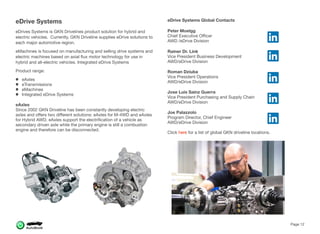
eDrive Systems
eDrives Systems is GKN Drivelines product solution for hybrid and
electric vehicles. Currently, GKN Driveline supplies eDrive solutions to
each major automotive region.
eMachines is focused on manufacturing and selling drive systems and
electric machines based on axial flux motor technology for use in
hybrid and all-electric vehicles. Integrated eDrive Systems
Product range:
eAxles
eTransmissions
eMachines
Integrated eDrive Systems
eAxles
Since 2002 GKN Driveline has been constantly developing electric
axles and offers two different solutions: eAxles for M-4WD and eAxles
for Hybrid AWD. eAxles support the electrification of a vehicle as
secondary driven axle while the primary engine is still a combustion
engine and therefore can be disconnected.
eDrive Systems Global Contacts
Peter Moelgg
Chief Executive Officer
AWD /eDrive Division
Rainer Dr. Link
Vice President Business Development
AWD/eDrive Division
Roman Dziuba
Vice President Operations
AWD/eDrive Division
Jose Luis Sainz Guerra
Vice President Purchasing and Supply Chain
AWD/eDrive Division
Joe Palazzolo
Program Director, Chief Engineer
AWD/eDrive Division
Click here for a list of global GKN driveline locations.
Page 12
Section 2
Automotive Tier 1 Suppliers
Page 13
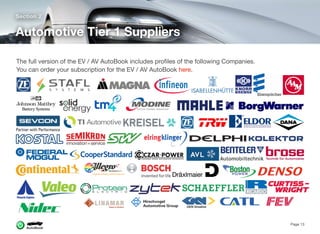
The full version of the EV / AV AutoBook includes profiles of the following Companies.

You can order your subscription for the EV / AV AutoBook here.
Chapter 5
Associations
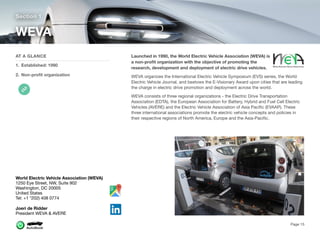
Launched in 1990, the World Electric Vehicle Association (WEVA) is
a non-profit organization with the objective of promoting the
research, development and deployment of electric drive vehicles.
WEVA organizes the International Electric Vehicle Symposium (EVS) series, the World
Electric Vehicle Journal, and bestows the E-Visionary Award upon cities that are leading
the charge in electric drive promotion and deployment across the world.
WEVA consists of three regional organizations - the Electric Drive Transportation
Association (EDTA), the European Association for Battery, Hybrid and Fuel Cell Electric
Vehicles (AVERE) and the Electric Vehicle Association of Asia Pacific (EVAAP). These
three international associations promote the electric vehicle concepts and policies in
their respective regions of North America, Europe and the Asia-Pacific. 
Section 1
AT A GLANCE
1. Established: 1990
2. Non-profit organization
WEVA
Page 15
World Electric Vehicle Association (WEVA)
1250 Eye Street, NW, Suite 902
Washington, DC 20005
United States
Tel: +1 *202) 408 0774
Joeri de Ridder
President WEVA & AVERE
Section 2
Electric Vehicle Associations
Page 16
The full version of the EV / AV AutoBook includes profiles of the following Associations.

You can order your subscription for the EV / AV AutoBook here.
Chapter 6
Events
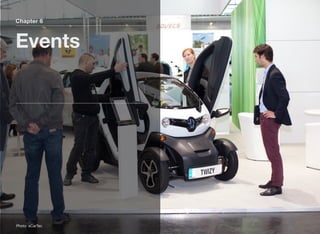
Photo: eCarTec
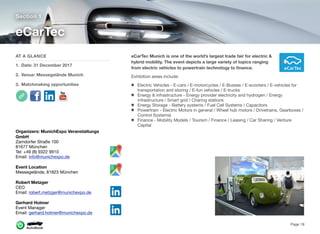
eCarTec Munich is one of the world’s largest trade fair for electric &
hybrid mobility. The event depicts a large variety of topics ranging
from electric vehicles to powertrain technology to finance.
Exhibition areas include:
Electric Vehicles - E-cars / E-motorcycles / E-Busses / E-scooters / E-vehicles for
transportation and storing / E-fun vehicles / E-trucks
Energy & infrastructure - Energy provider electricity and hydrogen / Energy
infrastructure / Smart grid / Charing stations
Energy Storage - Battery systems / Fuel Cell Systems / Capacitors
Powertrain - Electric Motors in general / Wheel hub motors / Drivetrains, Gearboxes /
Control Systems)
Finance - Mobility Models / Tourism / Finance / Leasing / Car Sharing / Venture
Capital
Section 1
AT A GLANCE
1. Date: 31 December 2017
2. Venue: Messegelände Munich
3. Matchmaking opportunities
eCarTec
Page 18
Organizers: MunichExpo Veranstaltungs
GmbH
Zamdorfer Straße 100
81677 München
Tel: +49 (8) 9322 9910
Email: info@munichexpo.de 

Event Location
Messegelände, 81823 München
Robert Metzger
CEO
Email: robert.metzger@munichexpo.de
Gerhard Holmer
Event Manager
Email: gerhard.holmer@munichexpo.de
Section 2
Automotive Events
Page 19
The full version of the EV / AV AutoBook includes profiles of the following Events.

You can order your subscription for the EV / AV AutoBook here.
Chapter 7
Media
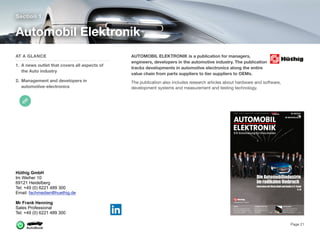
AUTOMOBIL ELEKTRONIK is a publication for managers,
engineers, developers in the automotive industry. The publication
tracks developments in automotive electronics along the entire
value chain from parts suppliers to tier suppliers to OEMs.
The publication also includes research articles about hardware and software,
development systems and measurement and testing technology.
Section 1
AT A GLANCE
1. A news outlet that covers all aspects of
the Auto industry
2. Management and developers in
automotive-electronics
Automobil Elektronik
Page 21
Hüthig GmbH
Im Weiher 10
69121 Heidelberg
Tel: +49 (0) 6221 489 300
Email: fachmedien@huethig.de
Mr Frank Henning
Sales Professional
Tel: +49 (0) 6221 489 300
Section 2
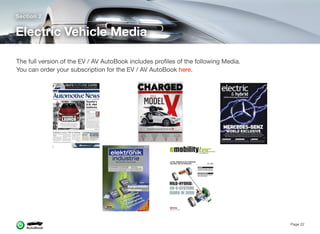
Electric Vehicle Media
Page 22
The full version of the EV / AV AutoBook includes profiles of the following Media.

You can order your subscription for the EV / AV AutoBook here.
Acknowledgements
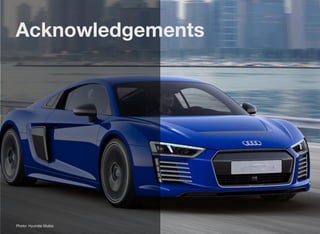
Photo: Hyundai Mobis
about this book
xxiv
© 2018 Kaiser International Limited
Publisher: Uli Kaiser
uli@autobook.biz 

Editorial Contact: Tilmann Kaiser 

tilmann@autobook.biz 


Thanks to everyone supporting this publication with resources, information, data,
feedback.
Copyright of all company logos are with the respective companies
Copyright of all car photographs are with the respective companies
Copyright of all product photographs are with the respective companies
Copyright of all web site photographs are with the respective companies
Kaiser International Limited 

Markthallenstr. 2, 78315 Radolfzell, Germany
Phone +49 7732 9456842 

Mobile +49 151 1183 0804

EV / AV AutoBook 2018 Preview

  • 1.
  • 2.
    ii WELCOME!
 
 In 2018, electricvehicles and autonomous driving are again the hottest topic in the automotive industry, a global phenomenon where non-traditional players like Tesla were able to claim market leading positions agains classic competitors like Volkswagen, Mercedes and Toyota. Battery prices fell 35 percent in the last 12 months and are on a trajectory to make unsubsidized electric vehicles as affordable as their gasoline counterparts in the next six years. The number of commercial charging stations is also growing quickly in part because they are relatively cheap—costing $3,000 to $7,500 per port. When attached to a business, they can attract customers, and encourage them to stay longer and spend more. By 2040, long-range electric cars will cost less than $22,000 (in today’s dollars), according to the projections. Thirty-five percent of new cars worldwide will have a plug. The highlight clearly was Tesla’s success to secure more than 400,000 reservations for their Model 3. Production has begun in mid 2017 and Tesla deliveries for 2018 are ramping up to 5,000 units per week with eventually 10,000 units per week being planned. Also Autonomous Driving has seen major breakthrough with Tesla demonstrating fully functional AV technology in their Model S. Many agree that a shift is under way that will lead to widespread adoption of EVs in the next decade. It’s looking like the 2020s will be the decade of the electric car. How to use the EV/AV AutoBook The information was compiled from personal research, the internet and with support of friends at automotive companies, automotive organizations, industrial estates and business associates and is designed to support: 1) Business Development - managers who seek to identify potential customers and sales opportunities 2) Outsourcing – local and international commodity managers, buyers who are looking to source components Focus on contacts The EV/AV AutoBook features quick links to access web sites, Google Map locations and social media sites of the featured companies and their representatives. Simply click on the icons to connect: I am sure this book will give you lots of information and inspire you to do business in the EV/AV Sector. To your success! Ulrich Kaiser
  • 3.
  • 4.
    In the late1890s electric vehicles (EVs) had outsold gasoline cars ten to one. EVs were dominating roads and dealer showrooms. Several automotive companies started out as successful EV companies such as Oldsmobile and Studebaker. However, their focus later Transition to gasoline-powered vehicles. The first car dealerships actually dealt exclusively for EVs. Early production of EVs was accomplished by hand assembly. In 1910, volume production of gasoline powered cars was achieved with the motorized assembly line. This breakthrough manufacturing process killed off all but the most well-financed car builders. Independents, unable to buy components in volume died off. The infrastructure for electricity was almost non-existent outside of city boundaries – limiting EVs to city- only travel. Another contributing factor to the decline of EVs was the addition of an electric motor (called the starter) to gasoline powered cars – finally removing the need for the difficult and dangerous crank to start the engine. Due to these factors, by the end of World War I, production of electric cars stopped and EVs became niche vehicles – serving as taxis, trucks, delivery vans, and freight handlers. In the late 1960s and early 1970s, a rebirth of EVs prompted was by concerns about air pollution and the OPEC oil embargo. In the early 1990s, a few major automakers resumed production of EVs – prompted by California 's landmark Zero Emission Vehicle (ZEV) Mandate. Those EVs were produced in very low volumes – essentially hand-built like their early predecessors. However, as the ZEV mandate was weakened over the years, the automakers stopped making EVs – Toyota was the last major auto maker to stop EV production in 2003. Section 1 AT A GLANCE 1. Electric batteries & Electric motors led to the first electric vehicles in then 1800’s 2. EVs outsold gasoline vehicles 10 to 1 in the 1890’s. 3. Henry ford’s Model T put an end to EVs popularity in the early 1900’s 4. Resurgence of EVs came during the late 1980s with Honda and Toyota EV Introduction Page 4
  • 5.
  • 6.
  • 7.
  • 8.
    Faraday Future isan American based start-up that is Chinese- backed and that is focusing on developing intelligent electric vehicles. The company was established in 2014 and is headquartered in Gardena, California. The companies financial backer is LeEco, a Chinese consumer electronics company. In 2016, the company debuted its first concept vehicle the single-seat FFZERO1. The FFZERO1 has 1,000hp (750 kW) that can go up to 200mph. FF announced plans to build a $1 billion electric car factory in Nevada in 2016 and it received a $300 million incentive package in order to build the factory. The company ended up not doing a lot more than moving some dirt around on the land it acquired and finally abandoned the plan last year while it was running out of cash. They instead bought an old tarp manufacturing facility in a farm town between Los Angeles and San Francisco and announced plans to convert it into a high-tech electric car factory. Despite the significant change of plan, the company still claims that it can bring its first car, the FF91, to production in 2018. Section 1 AT A GLANCE 1. Founded in 2014 2. Employs over 1,000 people Faraday Future Page 8 Faraday Future HQ 18455 S Figueroa St. Los Angeles
 CA 90248 Tel: +1 424 276 7616 Email: info@faradayfuture.com Michael Johnson Director Tom Wessner VP Global Supply Chain Andrew De Haan Plant Director
  • 9.
    Section 2 Electric VehicleOEMs Page 9 The full version of the EV / AV AutoBook includes profiles of the following OEMs.
 You can order your subscription for the EV / AV AutoBook here.
  • 10.
  • 11.
    GKN Driveline isa multinational automotive components manufacturer that focuses on driveline technologies. The company is owned by GKN, which was founded in 1759. The company is present across 22 countries in over 56 locations. The company has a global work force of over 22,000. The company’s headquarters is located in Redditch, United Kingdom. GKN Driveline is the worlds largest producer of CV joints. The company also produces a variety of other products for the automotive industry. These products include AWD Systems, Trans Ale Solutions, Replacement parts and GKN’s eDrive Systems. eDrive Systems is the companies solution aimed a hybrid and all electric vehicles. Product range: CV joints Side shafts Prop shafts Power transfer units Differentials AWD couplings Disconnects Electric rear axles Electric dive transmissions Section 1 AT A GLANCE 1. Established: 1759 2. Employs: 22,000 3. Turnover Q1 2015: 2.678 Billion BPS GKN Driveline Page 11 GKN Driveline PLC Ipsley House, Ipsley Church Lane, Redditch, Worcestershire B98 0AJ, United Kingdom Tel: +44 (0) 152 753 3600 Email: info@gkndrive.com Helmuth Rohregger President Europe Philippe Doumeingts Senior Vice President Purchasing & Supply Chain Mohammed Zameer Vice President Global Manufacturing Engineering Rainer Dr. Link Vice President Business Development AWD/ eDrive
  • 12.
    eDrive Systems eDrives Systemsis GKN Drivelines product solution for hybrid and electric vehicles. Currently, GKN Driveline supplies eDrive solutions to each major automotive region. eMachines is focused on manufacturing and selling drive systems and electric machines based on axial flux motor technology for use in hybrid and all-electric vehicles. Integrated eDrive Systems Product range: eAxles eTransmissions eMachines Integrated eDrive Systems eAxles Since 2002 GKN Driveline has been constantly developing electric axles and offers two different solutions: eAxles for M-4WD and eAxles for Hybrid AWD. eAxles support the electrification of a vehicle as secondary driven axle while the primary engine is still a combustion engine and therefore can be disconnected. eDrive Systems Global Contacts Peter Moelgg Chief Executive Officer AWD /eDrive Division Rainer Dr. Link Vice President Business Development AWD/eDrive Division Roman Dziuba Vice President Operations AWD/eDrive Division Jose Luis Sainz Guerra Vice President Purchasing and Supply Chain AWD/eDrive Division Joe Palazzolo Program Director, Chief Engineer AWD/eDrive Division Click here for a list of global GKN driveline locations. Page 12
  • 13.
    Section 2 Automotive Tier1 Suppliers Page 13 The full version of the EV / AV AutoBook includes profiles of the following Companies.
 You can order your subscription for the EV / AV AutoBook here.
  • 14.
  • 15.
    Launched in 1990,the World Electric Vehicle Association (WEVA) is a non-profit organization with the objective of promoting the research, development and deployment of electric drive vehicles. WEVA organizes the International Electric Vehicle Symposium (EVS) series, the World Electric Vehicle Journal, and bestows the E-Visionary Award upon cities that are leading the charge in electric drive promotion and deployment across the world. WEVA consists of three regional organizations - the Electric Drive Transportation Association (EDTA), the European Association for Battery, Hybrid and Fuel Cell Electric Vehicles (AVERE) and the Electric Vehicle Association of Asia Pacific (EVAAP). These three international associations promote the electric vehicle concepts and policies in their respective regions of North America, Europe and the Asia-Pacific.  Section 1 AT A GLANCE 1. Established: 1990 2. Non-profit organization WEVA Page 15 World Electric Vehicle Association (WEVA) 1250 Eye Street, NW, Suite 902 Washington, DC 20005 United States Tel: +1 *202) 408 0774 Joeri de Ridder President WEVA & AVERE
  • 16.
    Section 2 Electric VehicleAssociations Page 16 The full version of the EV / AV AutoBook includes profiles of the following Associations.
 You can order your subscription for the EV / AV AutoBook here.
  • 17.
  • 18.
    eCarTec Munich isone of the world’s largest trade fair for electric & hybrid mobility. The event depicts a large variety of topics ranging from electric vehicles to powertrain technology to finance. Exhibition areas include: Electric Vehicles - E-cars / E-motorcycles / E-Busses / E-scooters / E-vehicles for transportation and storing / E-fun vehicles / E-trucks Energy & infrastructure - Energy provider electricity and hydrogen / Energy infrastructure / Smart grid / Charing stations Energy Storage - Battery systems / Fuel Cell Systems / Capacitors Powertrain - Electric Motors in general / Wheel hub motors / Drivetrains, Gearboxes / Control Systems) Finance - Mobility Models / Tourism / Finance / Leasing / Car Sharing / Venture Capital Section 1 AT A GLANCE 1. Date: 31 December 2017 2. Venue: Messegelände Munich 3. Matchmaking opportunities eCarTec Page 18 Organizers: MunichExpo Veranstaltungs GmbH Zamdorfer Straße 100 81677 München Tel: +49 (8) 9322 9910 Email: info@munichexpo.de 
 Event Location Messegelände, 81823 München Robert Metzger CEO Email: robert.metzger@munichexpo.de Gerhard Holmer Event Manager Email: gerhard.holmer@munichexpo.de
  • 19.
    Section 2 Automotive Events Page19 The full version of the EV / AV AutoBook includes profiles of the following Events.
 You can order your subscription for the EV / AV AutoBook here.
  • 20.
  • 21.
    AUTOMOBIL ELEKTRONIK isa publication for managers, engineers, developers in the automotive industry. The publication tracks developments in automotive electronics along the entire value chain from parts suppliers to tier suppliers to OEMs. The publication also includes research articles about hardware and software, development systems and measurement and testing technology. Section 1 AT A GLANCE 1. A news outlet that covers all aspects of the Auto industry 2. Management and developers in automotive-electronics Automobil Elektronik Page 21 Hüthig GmbH Im Weiher 10 69121 Heidelberg Tel: +49 (0) 6221 489 300 Email: fachmedien@huethig.de Mr Frank Henning Sales Professional Tel: +49 (0) 6221 489 300
  • 22.
    Section 2 Electric VehicleMedia Page 22 The full version of the EV / AV AutoBook includes profiles of the following Media.
 You can order your subscription for the EV / AV AutoBook here.
  • 23.
  • 24.
    about this book xxiv ©2018 Kaiser International Limited Publisher: Uli Kaiser uli@autobook.biz 
 Editorial Contact: Tilmann Kaiser 
 tilmann@autobook.biz 
 
 Thanks to everyone supporting this publication with resources, information, data, feedback. Copyright of all company logos are with the respective companies Copyright of all car photographs are with the respective companies Copyright of all product photographs are with the respective companies Copyright of all web site photographs are with the respective companies Kaiser International Limited 
 Markthallenstr. 2, 78315 Radolfzell, Germany Phone +49 7732 9456842 
 Mobile +49 151 1183 0804