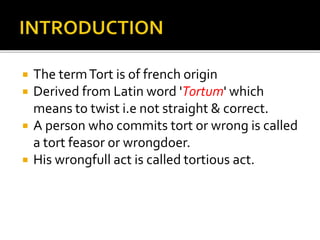
 The termTort is of french origin
 Derived from Latin word 'Tortum' which
means to twist i.e not straight & correct.
 A person who commits tort or wrong is called
a tort feasor or wrongdoer.
 His wrongfull act is called tortious act.
 Tort is a civil wrong.
 Encyclopedia of the laws of England states
that what we now understand by a tort is a
breach of some duty between citizen defines
by the general law, which creates a civil cause
of action.
Winfield
Tortious liability arises from the breach of
duty primarily fixed by law, this duty is towards
the person generally and its breach is
redressable by an action for unliquidated
damages.
 Duty primarily fixed by the law.
 Duty is towards a person generally.
 Remedy in the form of unliquidated
damages.
A tort is a civil wrong for which the remedy is an
unliquidated damages and which is not
exclusively the breach of a contract or the
breach of trust or the breach of the merely
equitable obligation.
 Civil wrong.
 Tort is other than breach of contract &Trust.
 Action for unliquidated damages.
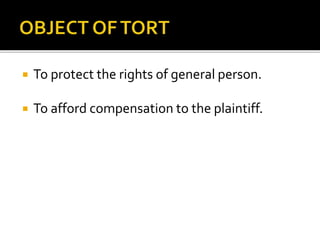
 To protect the rights of general person.
 To afford compensation to the plaintiff.
I. Wrongfull act
II. Legal damage or injury
III.Legal remedy
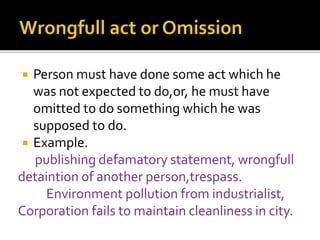
 Person must have done some act which he
was not expected to do,or, he must have
omitted to do something which he was
supposed to do.
 Example.
publishing defamatory statement, wrongfull
detaintion of another person,trespass.
Environment pollution from industrialist,
Corporation fails to maintain cleanliness in city.
 Wrongfull act or omission must be
recognised by the law, if there is moral social
or religious wrong, the liability will not occur.
 Example.
Somebody fails to help starving man, save a
drowning child, it is moral wrong.
If person enters in the temple or mosque
with footwear, it is religious wrong.
 If an act or omission is done under some
lawfull excuseb, it would not amount to
breach of legal duty.
 Example
While following the thief if police officer
enters into the premises of other person, it will
not be a wrong.
 InTort the plaintiff has to prove that there
has been a legal damage caused to him.
 Damage means the harm or loss suffered or
presumed to be suffered by a person as a
result of some wrongfull act done by another
person.
 To constitute tort there must exist ' injuria'
which means infringement or violation of
legal right.
Injuria Sine Damnum
Injuria- Infringement of legal right
Sine-Without or in absence of
Damnum- Damage, physical, mental or
otherwise.
In such a case the suit is maintainable
eventhough the plaintiff suffer no damages.
Case Laws
Ashby v.White
Voting case
Bhim Singh v. State of Jammu &Kashmir
Marzetti v.Williams
wrongfull omission of name from voting list.
Damnum- Damage, physical, mental or
otherwise
Sine-Without or in absence of
Injuria- Infringement orViolation of legal right.
Person is not entitled to get compensation for
his loss because his legal right is not violated.
Examples of Damnum Sine Injuria
Opening of fancy shop opposite to others fancy
shop.
Case law
Gloucester Grammer School Case
Bradford Corporation v. Pickles
Digging of deep well.
Chesmore v. Richard
This essential is based on the maxim Ubi Jus Ibi
Remedium means where there is right there is
remedy.
Means untill & unless there is remedy there is no
use of right.
TORT
 Infringement of private right.
 Civil action is brought by the
party himself.
 Intention is not important.
 Tort is private wrong.
 Wrongdoer has to pay
damages to the injured party
 Amount of compensation
goes to the injured party.
 Lt is Judge made law
CRIME
 Infringement of public right.
 Case is conducted in the
name of state.
 Intention is important.
 Crime is public wrong.
 Wrongdoer is punished by the
state.
 Amount of fine in criminal act
goes to the govt.
 Crimes are defined &codified.
TORT
 Nature of punishment is
light in the form of
awarding damage
CRIME
 Nature of punishmentn is
heavy and seriousfrom
death to fine.
TORT
 Duty is fixed by the law.
 Duty towards every person
of society.
 Tort is committed against
or without consent.
 Violation of right in rem in
tort.
 Unliquidated damages
CONTRACT
 Duty is fixed by the party.
 Duty is towards specific
person.
 Contract is based on the
free consent of parties.
 Violation of right in
personam.
 Liquidated damages.
TORT
 It is Judge made law.
 Person injured is entitled
for such damage which he
has not actually suffered.
CONTRACT
 It is codified law.
 In contract the party is
entitled only for actual
damages
PPT MADE BY
WASEEM I. KHAN

Introduction to tort

  • 2.
     The termTortis of french origin  Derived from Latin word 'Tortum' which means to twist i.e not straight & correct.  A person who commits tort or wrong is called a tort feasor or wrongdoer.  His wrongfull act is called tortious act.
  • 3.
     Tort isa civil wrong.  Encyclopedia of the laws of England states that what we now understand by a tort is a breach of some duty between citizen defines by the general law, which creates a civil cause of action.
  • 4.
    Winfield Tortious liability arisesfrom the breach of duty primarily fixed by law, this duty is towards the person generally and its breach is redressable by an action for unliquidated damages.  Duty primarily fixed by the law.  Duty is towards a person generally.  Remedy in the form of unliquidated damages.
  • 5.
    A tort isa civil wrong for which the remedy is an unliquidated damages and which is not exclusively the breach of a contract or the breach of trust or the breach of the merely equitable obligation.  Civil wrong.  Tort is other than breach of contract &Trust.  Action for unliquidated damages.
  • 6.
     To protectthe rights of general person.  To afford compensation to the plaintiff.
  • 7.
    I. Wrongfull act II.Legal damage or injury III.Legal remedy
  • 8.
     Person musthave done some act which he was not expected to do,or, he must have omitted to do something which he was supposed to do.  Example. publishing defamatory statement, wrongfull detaintion of another person,trespass. Environment pollution from industrialist, Corporation fails to maintain cleanliness in city.
  • 9.
     Wrongfull actor omission must be recognised by the law, if there is moral social or religious wrong, the liability will not occur.  Example. Somebody fails to help starving man, save a drowning child, it is moral wrong. If person enters in the temple or mosque with footwear, it is religious wrong.
  • 10.
     If anact or omission is done under some lawfull excuseb, it would not amount to breach of legal duty.  Example While following the thief if police officer enters into the premises of other person, it will not be a wrong.
  • 11.
     InTort theplaintiff has to prove that there has been a legal damage caused to him.  Damage means the harm or loss suffered or presumed to be suffered by a person as a result of some wrongfull act done by another person.  To constitute tort there must exist ' injuria' which means infringement or violation of legal right.
  • 12.
    Injuria Sine Damnum Injuria-Infringement of legal right Sine-Without or in absence of Damnum- Damage, physical, mental or otherwise. In such a case the suit is maintainable eventhough the plaintiff suffer no damages.
  • 13.
    Case Laws Ashby v.White Votingcase Bhim Singh v. State of Jammu &Kashmir Marzetti v.Williams wrongfull omission of name from voting list.
  • 14.
    Damnum- Damage, physical,mental or otherwise Sine-Without or in absence of Injuria- Infringement orViolation of legal right. Person is not entitled to get compensation for his loss because his legal right is not violated.
  • 15.
    Examples of DamnumSine Injuria Opening of fancy shop opposite to others fancy shop. Case law Gloucester Grammer School Case Bradford Corporation v. Pickles Digging of deep well. Chesmore v. Richard
  • 16.
    This essential isbased on the maxim Ubi Jus Ibi Remedium means where there is right there is remedy. Means untill & unless there is remedy there is no use of right.
  • 17.
    TORT  Infringement ofprivate right.  Civil action is brought by the party himself.  Intention is not important.  Tort is private wrong.  Wrongdoer has to pay damages to the injured party  Amount of compensation goes to the injured party.  Lt is Judge made law CRIME  Infringement of public right.  Case is conducted in the name of state.  Intention is important.  Crime is public wrong.  Wrongdoer is punished by the state.  Amount of fine in criminal act goes to the govt.  Crimes are defined &codified.
  • 18.
    TORT  Nature ofpunishment is light in the form of awarding damage CRIME  Nature of punishmentn is heavy and seriousfrom death to fine.
  • 19.
    TORT  Duty isfixed by the law.  Duty towards every person of society.  Tort is committed against or without consent.  Violation of right in rem in tort.  Unliquidated damages CONTRACT  Duty is fixed by the party.  Duty is towards specific person.  Contract is based on the free consent of parties.  Violation of right in personam.  Liquidated damages.
  • 20.
    TORT  It isJudge made law.  Person injured is entitled for such damage which he has not actually suffered. CONTRACT  It is codified law.  In contract the party is entitled only for actual damages
  • 21.