Euro zone (Union) crisis
Presented by
Naushad chaudhary
PGDM-(Finance)
Batch-(2012-14)
KOHINOOR BUSINESS SCHOOL
MUMBAI
INDIA
WHAT IS EURO ZONE?
• Established: 1st January 1999
• It is an economic and monetary union(EMU)of 17 European
Union countries
[1-Germany, 2-Italy, 3-France, 4 -Finland, 5-Netherlands, 6-Ireland, 7-Greece, 8-Austria, 9-Spain, 10-
Portugal, 11-Belgium, 12-Luxembourg, 13-Slovakia, 14-Slovenia, 15-Malta, 16-Cyprus, 17-Estonia]
• They have fully adopted the euro as their national currency.
• The main objective behind forming Euro zone:
-Reduce trading cost
-Boost tourism
-Smooth the economy
PROBLEMS IN EURO ZONE
• Most governments were running a budget deficit.
(Spending more than there earning)
• All 17 countries were behaving differently (without any real
central fiscal control
• Lack of strong political leadership
INTRODUCTION TO EURO ZONE CRISIS
• Began in 2009 from Ireland:
1990 to 2000-Ireland economy was Booming
(But relied on personal debt + overinflated housing market)
• Other Smaller European countries (PIIGS: Portugal, Italy, Ireland, Greece,
and Spain) were having too much debt and become unable to repay them.
• The Global financial crises in 2008 affected huge specially to small
European countries
KEY FACTORS LED TO EURO ZONE CRISIS
• Violation of EU Rules:
-Countries such as Greece and Cyprus did not give real data about the financial and economic
situation
-Greece and Portugal were spending more then there revenue
-Economy slowdown
-Tex revenue started falling down
• Banking Sector Problem: Banks were having a highly risky financial instruments in
there portfolio such as:
-Collateralized Debt Obligations (CDOs)
-Credit Default Swaps
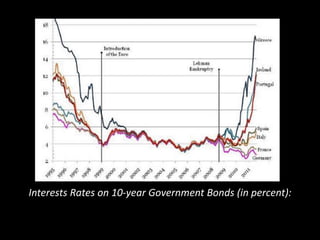
• Rising interest rates:
- Because of Liquidity problem interest rates started picking up
- Become difficult for the borrower to repay there loan
Interests Rates on 10-year Government Bonds (in percent):
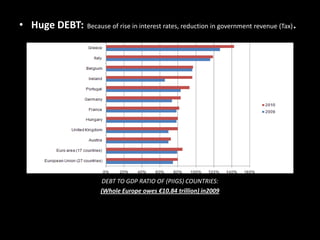
• Huge DEBT: Because of rise in interest rates, reduction in government revenue (Tax).
DEBT TO GDP RATIO OF (PIIGS) COUNTRIES:
(Whole Europe owes €10.84 trillion) in2009
• Increase in wage rates: Because of inflation
• Investor confidence wavers: Investors started to transfer there money away
from the problem.
• Key stakeholders tighten their wallets: Reduce spending, Economy slow
down, unemployment
-Government income started shrinking and debts become harder to repay.
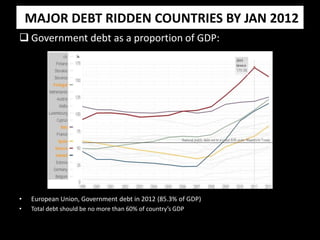
MAJOR DEBT RIDDEN COUNTRIES BY JAN 2012
 Government debt as a proportion of GDP:
• European Union, Government debt in 2012 (85.3% of GDP)
• Total debt should be no more than 60% of country’s GDP
IMPACT OF EUROZONE CRICIS
• Investor’s lose confidence on government securities:
- Greek crisis has made investors nervous about lending money to governments through buying
government bonds.
• Reduced wealth: By raising tax
• Unemployment: (Spain is experiencing the highest unemployment rate of 20%)
• Global economy slowdown:
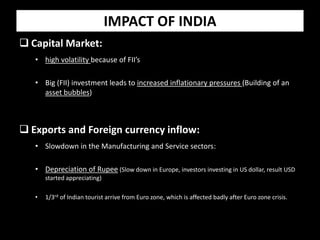
IMPACT OF INDIA
 Capital Market:
• high volatility because of FII’s
• Big (FII) investment leads to increased inflationary pressures (Building of an
asset bubbles)
 Exports and Foreign currency inflow:
• Slowdown in the Manufacturing and Service sectors:
• Depreciation of Rupee (Slow down in Europe, investors investing in US dollar, result USD
started appreciating)
• 1/3rd of Indian tourist arrive from Euro zone, which is affected badly after Euro zone crisis.
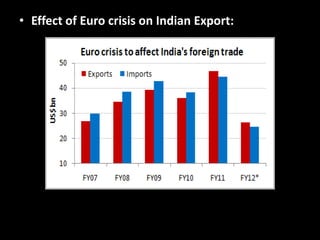
• Effect of Euro crisis on Indian Export:
PRESENT SITUATION IN (PIIGS)
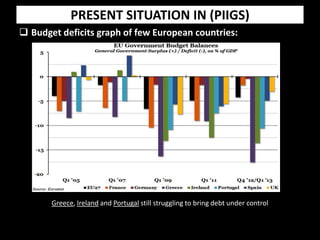
 Budget deficits graph of few European countries:
Greece, Ireland and Portugal still struggling to bring debt under control
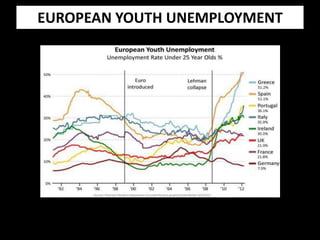
EUROPEAN YOUTH UNEMPLOYMENT
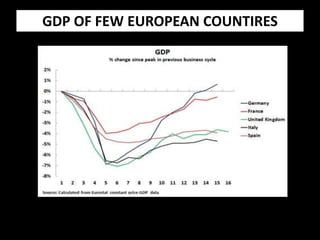
GDP OF FEW EUROPEAN COUNTIRES
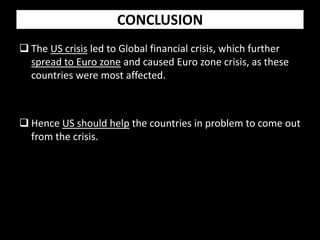
CONCLUSION
 The US crisis led to Global financial crisis, which further
spread to Euro zone and caused Euro zone crisis, as these
countries were most affected.
 Hence US should help the countries in problem to come out
from the crisis.
THANK YOU


Euro zone crisis

  • 1.
    Euro zone (Union)crisis Presented by Naushad chaudhary PGDM-(Finance) Batch-(2012-14) KOHINOOR BUSINESS SCHOOL MUMBAI INDIA
  • 2.
    WHAT IS EUROZONE? • Established: 1st January 1999 • It is an economic and monetary union(EMU)of 17 European Union countries [1-Germany, 2-Italy, 3-France, 4 -Finland, 5-Netherlands, 6-Ireland, 7-Greece, 8-Austria, 9-Spain, 10- Portugal, 11-Belgium, 12-Luxembourg, 13-Slovakia, 14-Slovenia, 15-Malta, 16-Cyprus, 17-Estonia] • They have fully adopted the euro as their national currency. • The main objective behind forming Euro zone: -Reduce trading cost -Boost tourism -Smooth the economy
  • 3.
    PROBLEMS IN EUROZONE • Most governments were running a budget deficit. (Spending more than there earning) • All 17 countries were behaving differently (without any real central fiscal control • Lack of strong political leadership
  • 4.
    INTRODUCTION TO EUROZONE CRISIS • Began in 2009 from Ireland: 1990 to 2000-Ireland economy was Booming (But relied on personal debt + overinflated housing market) • Other Smaller European countries (PIIGS: Portugal, Italy, Ireland, Greece, and Spain) were having too much debt and become unable to repay them. • The Global financial crises in 2008 affected huge specially to small European countries
  • 5.
    KEY FACTORS LEDTO EURO ZONE CRISIS • Violation of EU Rules: -Countries such as Greece and Cyprus did not give real data about the financial and economic situation -Greece and Portugal were spending more then there revenue -Economy slowdown -Tex revenue started falling down • Banking Sector Problem: Banks were having a highly risky financial instruments in there portfolio such as: -Collateralized Debt Obligations (CDOs) -Credit Default Swaps • Rising interest rates: - Because of Liquidity problem interest rates started picking up - Become difficult for the borrower to repay there loan
  • 6.
    Interests Rates on10-year Government Bonds (in percent):
  • 7.
    • Huge DEBT:Because of rise in interest rates, reduction in government revenue (Tax). DEBT TO GDP RATIO OF (PIIGS) COUNTRIES: (Whole Europe owes €10.84 trillion) in2009
  • 8.
    • Increase inwage rates: Because of inflation • Investor confidence wavers: Investors started to transfer there money away from the problem. • Key stakeholders tighten their wallets: Reduce spending, Economy slow down, unemployment -Government income started shrinking and debts become harder to repay.
  • 9.
    MAJOR DEBT RIDDENCOUNTRIES BY JAN 2012  Government debt as a proportion of GDP: • European Union, Government debt in 2012 (85.3% of GDP) • Total debt should be no more than 60% of country’s GDP
  • 10.
    IMPACT OF EUROZONECRICIS • Investor’s lose confidence on government securities: - Greek crisis has made investors nervous about lending money to governments through buying government bonds. • Reduced wealth: By raising tax • Unemployment: (Spain is experiencing the highest unemployment rate of 20%) • Global economy slowdown:
  • 11.
    IMPACT OF INDIA Capital Market: • high volatility because of FII’s • Big (FII) investment leads to increased inflationary pressures (Building of an asset bubbles)  Exports and Foreign currency inflow: • Slowdown in the Manufacturing and Service sectors: • Depreciation of Rupee (Slow down in Europe, investors investing in US dollar, result USD started appreciating) • 1/3rd of Indian tourist arrive from Euro zone, which is affected badly after Euro zone crisis.
  • 12.
    • Effect ofEuro crisis on Indian Export:
  • 13.
    PRESENT SITUATION IN(PIIGS)  Budget deficits graph of few European countries: Greece, Ireland and Portugal still struggling to bring debt under control
  • 14.
  • 15.
    GDP OF FEWEUROPEAN COUNTIRES
  • 16.
    CONCLUSION  The UScrisis led to Global financial crisis, which further spread to Euro zone and caused Euro zone crisis, as these countries were most affected.  Hence US should help the countries in problem to come out from the crisis.
  • 17.