Scala
Scalable Language
Moore’s Law (Scalability)
- Moore’s law
now achieved
by increasing #
of cores, not
clock cycles
- We need
Concurrency
and Parallelism
Data from Kunle Olukoten
Concurrency and Parallelism
- Parallel Programming
- Execute programs faster on parallel hardware
- Concurrent Programming
- Manage concurrent execution threads explicitly.
- Both are too Hard
- The speedup of a program using multiple processors in
parallel computing is limited by the time needed for the
sequential fraction of the program. [Amdahl’s Law]
The Root of The Problem
- Non-determinism caused by
concurrent threads accessing
shared mutable state.
non-determinism = parallel processing + mutable state
- heisenberg problem (bug goes away when we
introduce instrumentation)
var x = 0
async { x = x + 1 }
async { x = x * 2 }
print(x)
// can give 0, 1, 2
The Root of The Problem
- Non-determinism caused by
concurrent threads accessing
shared mutable state.
non-determinism = parallel processing + mutable state
- heisenberg problem (bug goes away when we
introduce instrumentation)
- To get deterministic processing, avoid the mutable
state.
- Avoid mutable state means program functionally.
var x = 0
async { x = x + 1 }
async { x = x * 2 }
print(x)
// can give 0, 1, 2
Why Scala
- Scala is by far the only prominent strongly
typed language that provide functional style
and great concurrency support. [Akka
Essentials: Munish K, Gupta]
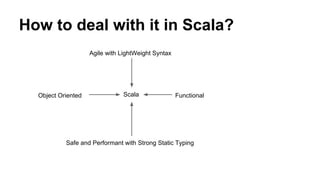
How to deal with it in Scala?
Scala FunctionalObject Oriented
Agile with LightWeight Syntax
Safe and Performant with Strong Static Typing
How to deal with it in Scala?
Scala FunctionalObject Oriented
Agile with LightWeight Syntax
Safe and Performant with Strong Static Typing
Parallel
Sequential
Scala Toolbox
- Parallelism
- Collections
- Parallel Collections
- Distributed Collections
- Concurrency
- Akka
- Message passing framework
- Actors
- Futures
Lets see an Example
- Java
- C++
- Scala
What’s Scala
- Pure Object Oriented Language
- Supports both Imperative and functional style.
- Provides Parallelism using collections
- Provides Concurrency using actors
- Statically Typed Language With Type Inference
- Runs on JVM. Intermixes well with Java
- Scala Web Frameworks
- Play
- Spray
- Highly scalable i.e. takes less code to create high
performing applications
Course Contents
1. The Basics (A1)
2. Control Structures and Functions (A1)
3. Arrays (A1)
4. Maps and Tuples (A1)
5. Classes (A1)
6. Objects (A1)
7. Packages and Imports (A1)
8. Inheritance (A1)
9. Files and Regular Expressions (A1)
The Basics
- The Scala Interpreter
- Declaring Values and Variables
- Commonly Used Types
- Arithmetic and Operator overloading
- Calling Functions and Methods
- The apply Method
- Scaladoc
Scala Environment Setup
- Java Setup (JDK)
- sbt Setup (An open source build tool for Scala and Java. Just like
Maven and Ant)
- Intellij (Can also use Eclipse)
- (https://class.coursera.org/progfun-003/wiki/ToolsSetup)
Scala Interpreter
- Read-Evaluate-Print-Loop (REPL)
- Every value is an object
- Tab Completion
- Scala Worksheet
Declaring Values and Variables
● val vs var
● Type Inference
● Multiple values declaration
Commonly Used Types
- Byte, Char, Short, Int, Long, Float, Double,
Boolean
- All types are classes
- No distinction between primitive types and
class types.
- 1.toString()
- 1.to(10)
Arithmetic and Operator Overloading
- Arithmetic operators in Scala work just as in
Java or C++
- However, these operators are actually
methods.
- a + b is a shorthand for a.+(b)
Calling Functions and Methods
- Scala provides functions in addition to
methods
- scala.math library
- sqrt(2)
- pow(2, 4)
- min(2, Pi)
The apply Method
- In Scala, it is common to use a syntax that
looks like a function call.
- s(i) where s is a string. It will return ith character of
string. In C++, it is s[i]. in java it is s.charAt(i)
- s(i) is a shorthand for s.apply(i)
Testing in Scala
- Testing Frameworks
- ScalaTest
- Specs2
- Browser-UI test support
- ScalaTest includes a DSL for writing browser-based
tests using Selenium.
Scaladoc
http://www.scala-lang.org/api/current/#package
Scala is scalable
- What does it mean?
- It means, scala is great for
- scripting stuff
- writing applications
- writing monster "enterprise" (for the want of a
word) applications
- Lets see the code in action
Level of Expertise in Scala
Application Programmer Library Designer Overall Scala Level
Beginning (A1) Beginning
Intermediate (A2) Junior (L1) Intermediate
Expert (A3) Senior (L2) Advanced
Expert (L3) Expert
Control Structure and Functions(A1)
● Conditional Expressions
● Statement Termination
● Block Expressions and Assignments
● Input and Output
● Loops
● Advanced for Loops and for Comprehensions
● Functions
● Default and Named Arguments
● Variable Arguments
● Procedures
● Lazy Values
● Exceptions

Lecture1

  • 1.
  • 2.
    Moore’s Law (Scalability) -Moore’s law now achieved by increasing # of cores, not clock cycles - We need Concurrency and Parallelism Data from Kunle Olukoten
  • 3.
    Concurrency and Parallelism -Parallel Programming - Execute programs faster on parallel hardware - Concurrent Programming - Manage concurrent execution threads explicitly. - Both are too Hard - The speedup of a program using multiple processors in parallel computing is limited by the time needed for the sequential fraction of the program. [Amdahl’s Law]
  • 4.
    The Root ofThe Problem - Non-determinism caused by concurrent threads accessing shared mutable state. non-determinism = parallel processing + mutable state - heisenberg problem (bug goes away when we introduce instrumentation) var x = 0 async { x = x + 1 } async { x = x * 2 } print(x) // can give 0, 1, 2
  • 5.
    The Root ofThe Problem - Non-determinism caused by concurrent threads accessing shared mutable state. non-determinism = parallel processing + mutable state - heisenberg problem (bug goes away when we introduce instrumentation) - To get deterministic processing, avoid the mutable state. - Avoid mutable state means program functionally. var x = 0 async { x = x + 1 } async { x = x * 2 } print(x) // can give 0, 1, 2
  • 6.
    Why Scala - Scalais by far the only prominent strongly typed language that provide functional style and great concurrency support. [Akka Essentials: Munish K, Gupta]
  • 7.
    How to dealwith it in Scala? Scala FunctionalObject Oriented Agile with LightWeight Syntax Safe and Performant with Strong Static Typing
  • 8.
    How to dealwith it in Scala? Scala FunctionalObject Oriented Agile with LightWeight Syntax Safe and Performant with Strong Static Typing Parallel Sequential
  • 9.
    Scala Toolbox - Parallelism -Collections - Parallel Collections - Distributed Collections - Concurrency - Akka - Message passing framework - Actors - Futures
  • 10.
    Lets see anExample - Java - C++ - Scala
  • 11.
    What’s Scala - PureObject Oriented Language - Supports both Imperative and functional style. - Provides Parallelism using collections - Provides Concurrency using actors - Statically Typed Language With Type Inference - Runs on JVM. Intermixes well with Java - Scala Web Frameworks - Play - Spray - Highly scalable i.e. takes less code to create high performing applications
  • 12.
    Course Contents 1. TheBasics (A1) 2. Control Structures and Functions (A1) 3. Arrays (A1) 4. Maps and Tuples (A1) 5. Classes (A1) 6. Objects (A1) 7. Packages and Imports (A1) 8. Inheritance (A1) 9. Files and Regular Expressions (A1)
  • 13.
    The Basics - TheScala Interpreter - Declaring Values and Variables - Commonly Used Types - Arithmetic and Operator overloading - Calling Functions and Methods - The apply Method - Scaladoc
  • 14.
    Scala Environment Setup -Java Setup (JDK) - sbt Setup (An open source build tool for Scala and Java. Just like Maven and Ant) - Intellij (Can also use Eclipse) - (https://class.coursera.org/progfun-003/wiki/ToolsSetup)
  • 15.
    Scala Interpreter - Read-Evaluate-Print-Loop(REPL) - Every value is an object - Tab Completion - Scala Worksheet
  • 16.
    Declaring Values andVariables ● val vs var ● Type Inference ● Multiple values declaration
  • 17.
    Commonly Used Types -Byte, Char, Short, Int, Long, Float, Double, Boolean - All types are classes - No distinction between primitive types and class types. - 1.toString() - 1.to(10)
  • 18.
    Arithmetic and OperatorOverloading - Arithmetic operators in Scala work just as in Java or C++ - However, these operators are actually methods. - a + b is a shorthand for a.+(b)
  • 19.
    Calling Functions andMethods - Scala provides functions in addition to methods - scala.math library - sqrt(2) - pow(2, 4) - min(2, Pi)
  • 20.
    The apply Method -In Scala, it is common to use a syntax that looks like a function call. - s(i) where s is a string. It will return ith character of string. In C++, it is s[i]. in java it is s.charAt(i) - s(i) is a shorthand for s.apply(i)
  • 21.
    Testing in Scala -Testing Frameworks - ScalaTest - Specs2 - Browser-UI test support - ScalaTest includes a DSL for writing browser-based tests using Selenium.
  • 22.
  • 23.
    Scala is scalable -What does it mean? - It means, scala is great for - scripting stuff - writing applications - writing monster "enterprise" (for the want of a word) applications - Lets see the code in action
  • 24.
    Level of Expertisein Scala Application Programmer Library Designer Overall Scala Level Beginning (A1) Beginning Intermediate (A2) Junior (L1) Intermediate Expert (A3) Senior (L2) Advanced Expert (L3) Expert
  • 25.
    Control Structure andFunctions(A1) ● Conditional Expressions ● Statement Termination ● Block Expressions and Assignments ● Input and Output ● Loops ● Advanced for Loops and for Comprehensions ● Functions ● Default and Named Arguments ● Variable Arguments ● Procedures ● Lazy Values ● Exceptions