With the support of the Lifelong Learning Programme of the European Union 
CENTRES (Creative Entrepreneurship in Schools) project has been funded with support from the European Commission. 
This publication reflects the views only of the author, and the Commission cannot be held responsible for any use which may be made of the information contained therein. 
CENTRES 
www.centres-eu.org 
PRACTICE FIRM 
This paper is the third of three e-learning modules created under the auspices of the CENTRES project. The pilot activity in the Czech Republic was focused on the training of career counsellors in schools in the field of creative 
entrepreneurship and creative career guidance. 
Foreword 
In the Czech Republic, the practice firm has been in the curriculum for the past 20 years, particularly in the curricula of business academies. It integrates business related subjects and the practical use of theoretical knowledge in the market. In recent years, the practice firm is increasingly used by non-business schools specialising in crafts as an elective subject. It helps students prepare for the real life. Graduate unemployment is rising and quite often there is no other choice in life other than self-employment, becoming an entrepreneur. 
Annotation 
The training module is intended for upper secondary school teachers, in particular those teaching business related and other vocational subjects. The practice firm is a subject bringing a vocational element into an increasing number of non-economic school programs in the Czech Republic as well as other European countries. 
The training module deals with the subject history, inclusion in to the curriculum, benefits for graduates, characteristics of instruction, prerequisites for managing practice firm successfully, content of activities, organisational structure and specifics of trading and evaluation. The training module also introduces the Czech headquarters, known as the Central office, its structure and services available for teachers and schools. 
Keywords: practice firm, entrepreneurship, trade, business, law, employment, economics, accounting, marketing, law, Central office, CEFIF, evaluation, vocational work experience, graduate
With the support of the Lifelong Learning Programme of the European Union 
CENTRES (Creative Entrepreneurship in Schools) project has been funded with support from the European Commission. 
This publication reflects the views only of the author, and the Commission cannot be held responsible for any use which may be made of the information contained therein. 
www.centres-eu.org 
Graduate profile 
Graduates gain a broader perspective of the practice firm instruction elements and learn about the teacher, student and equipment requirements. Teaching the subject is demanding on both the teachers and students. This material helps teachers become familiar with the subject contents, specifics, options and benefits. It provides a summary of twenty years of teaching experience in the Czech Republic and the experience of working with the various foreign central offices. 
Content 
Introduction – target audience 
History 
Characteristics 
Inclusion in to the curriculum 
Founding the practice firm 
Selecting trade, name and legal form 
Organisational structure 
Central office 
Trading, accounting, practice banks Materials and Central office events Methods of evaluation 
Conclusion 
Reference 
Introduction 
Slide 1 Target audience 
The practice firm offers a specific form of training useful to upper secondary schools in preparing students for their future working life. It provides a useful method to practice theoretical knowledge. Working in a virtual company should be as close to the real thing as possible, reflecting the future work that students are studying. Usually, it is the very first work experience that students go through. 
Students take on specific positions while the relationship between them and the teacher changes. Working independently, students consult the teacher (coordinator). They take responsibility for their work and the work of their "subordinates" (classmates).
With the support of the Lifelong Learning Programme of the European Union 
CENTRES (Creative Entrepreneurship in Schools) project has been funded with support from the European Commission. 
This publication reflects the views only of the author, and the Commission cannot be held responsible for any use which may be made of the information contained therein. 
www.centres-eu.org 
They cooperate with each other to solve problems for the benefit of the practice firm 
(outcome). 
Interesting fact: A position in the company can be filled via a selection process. Older students experienced in the subject can help prepare job interviews for younger students which are taking over the practice firm or founding a new one. This helps them prepare for their own job interviews. 
Slide 2 Basic operations 
The practice firm is founded by students and the teacher at the practice offices of the Central office. The practice firm shall be governed by the applicable laws and uses real legal forms in setting-up the company. 
Basic activities are carried out just like in a real company: purchasing, sales, stock, 
communication with suppliers and customers, processing orders and invoices, selecting employees and their remuneration and registration, marketing, accounting and more. The only difference is absence of production and movement of goods, services and money. 
Interesting fact: Practice firms use the services of a practice tax department, trade licensing office, commercial register, social and health insurance companies, commercial insurance brokers, domestic and foreign exchange banks and central supplier. 
Slide 3 Benefits 
• Maximum approximation of real work and orientation in real working life 
• Practice of theoretically acquired knowledge 
• Increased independence of students´ work 
• A sense of responsibility for own work and work of the team 
• Ability to work in a team 
• Collaboration with other schools (unknown persons) 
• Practice of communication and presentation of achieved results and ability to respond 
• Development of language skills
CENTRES (Creative Entrepreneurship in Schools) project has been funded with support from the European Commission. 
This publication reflects the views only of the author, and the Commission cannot be held responsible for any use which may be made of the information contained therein. 
With the support of the Lifelong Learning Programme of the European Union 
www.centres-eu.org 
Task: Try to imagine: What skills will you be practicing in the current circumstances? How does it work? What is hard to do in the current circumstances? What are the biggest challenges of your graduate students? 
Slide 4 Prerequisites for managing the practice firm 
• Sufficient theoretical knowledge of students in setting-up a practice firm - a legal entity, usually a limited liability company (Ltd.) 
• If this knowledge is not sufficient (especially students in lower grades or from non- business programs), establish a practice firm in the self-employment mode or use half the term to teach the missing theoretical knowledge 
• Support of the school management - sufficient number of hours based on the type of 
practice firm, permission to attend practice firm fairs, competitions, etc. 
• Teachers who are able and willing to manage the practice firm 
• Equipment consisting of at least five computers, including at least two computers with 
Internet access, or permission to use a computer lab to work on the practice firm 
• Additional classroom equipment – space to hold meetings, work in groups, print, store materials, etc.) 
Interesting fact: The prerequisites to successfully manage the practice firm change. Currently, the most important criterion is computers. There are only a few activities that can be practiced successfully without computers. 
Slide 5 What can teachers expect from the practice firm 
In a practice firm, students practice theory taught in several subjects, especially accounting, economics, marketing and law. Not many practice firm teachers have all the necessary qualifications. In some areas of activity, the teacher will gradually learn what is needed. 
Accounting: The ability to help students keep accounts, starting with the initial budget all the way until final closure. 
Economics, Law and Marketing: Knowledge of regulations of the individual economic activities and processes and organisation of corporate agendas. 
Pedagogical and psychological knowledge: The organisation of students´ work in group 
teaching, motivating students to focus on individual work and assessment of students in a specific subject.
CENTRES (Creative Entrepreneurship in Schools) project has been funded with support from the European Commission. 
This publication reflects the views only of the author, and the Commission cannot be held responsible for any use which may be made of the information contained therein. 
With the support of the Lifelong Learning Programme of the European Union 
www.centres-eu.org 
Interesting fact: The first year of teaching the practice firm can be very challenging. The Central office provides consultation directly to teachers and organises workshops for students in schools. Throughout the school year, teachers and students can consult the CEFIF Information Centre. 
"Lesson 1" The history 
Slide 1 The origins of practice firms 
The first practice firm was created in Germany in 1975 as a requalification course for the unemployed. In the first year, some 120 practice firms have been registered and their number is gradually increasing. In Germany and other countries, the practice firm is still a traditional part of requalification programs. Germany´s example inspired neighbouring European countries and this type of retraining for the unemployed has spread. In Germany, the first International Headquarters for practice firms has been established in Heidelberg and later in Essen, home to PEN INTERNATIONAL – the current international headquarters for practice firms. 
Interesting fact: The first predecessor to the practice firm was founded in Germany in the 
17th Century by a bookbinder who used it to verify which apprentice will be his future employee and in so doing inspired other "entrepreneurs". 
Slide 2 The origins of practice firms as a subject in upper secondary schools 
Later, Austria used the practice firm as a practical subject taught in upper secondary schools. In the beginning of the 90s, practice firms have become a compulsory part of the business school curriculum in Austria and the subject is included there to this day. The practice firm was established in other European countries as an upper secondary school subject in the mid-90s. There are approximately 1700 practice firms in schools in Belgium, Denmark, Finland, France, Ireland, Italy, Luxembourg, Netherlands, Norway, Portugal, Spain, Sweden, Switzerland and the UK. 
Interesting fact: In the Czech Republic, the first teacher was "trained" by Mr. Slanař in the 90s, the director of the Vienna 10 business academy, whose parents were Czech, and speaks Czech very well. He keeps a close eye on the activities of the Czech and Slovak practice firm to this day.
CENTRES (Creative Entrepreneurship in Schools) project has been funded with support from the European Commission. 
This publication reflects the views only of the author, and the Commission cannot be held responsible for any use which may be made of the information contained therein. 
With the support of the Lifelong Learning Programme of the European Union 
www.centres-eu.org 
Slide 3 Practice firms in the Czech Republic 
The idea to set-up practice firms as a pedagogical tool was developed at the Department of Education of the University of Economics in Prague. Docent Rotport, PhD. and his colleagues cooperated with the University of Economics in Bratislava and the Vienna business academy. In 1992, the first 6 practice firm have been founded in the Czech Republic. The first three Czech practice firms cooperated with the Central office in Bratislava, which has already been established. The formal division of Czechoslovakia was taking place, however, and the Central office (CEFIF) was founded at the University of Economics in Prague on 16th November 1992. Docent Miloslav Rotport, PhD became its first director. In 1992, first seminars were held for prospective teachers and became very popular. They are still in high demand by schools and teachers of business related subjects. 
Interesting fact: The first trade licenses were presented to practice firms registered in the Czech Republic on 13th February 1993 during a seminar in Svitavy. Trade license no. 1 was issued to Krystal practice firm at ČSOA Resslova 5, Prague 2. 
"Lesson 2" The characteristics 
Slide 1 Different than traditional subjects: 
• Students work independently and take responsibility for their work and for the completion 
of individual tasks 
• Groups of students (departments) work together, coordinate their activities towards common goals 
• They are controlled by the director (student) and heads of departments (classmates) 
• Practice firms organise meetings, company managers (students) set and monitor tasks 
• The teacher is the coordinator and consultant 
Interesting fact: Students are often stricter when monitoring and demanding task outcomes than their teacher. 
Slide 2 Students practice: 
• theoretically acquired knowledge under conditions of maximum approximation of real 
work for better orientation in the business world 
• independent work in various departments
CENTRES (Creative Entrepreneurship in Schools) project has been funded with support from the European Commission. 
This publication reflects the views only of the author, and the Commission cannot be held responsible for any use which may be made of the information contained therein. 
With the support of the Lifelong Learning Programme of the European Union 
www.centres-eu.org 
• teamwork 
• cooperation with other schools (strangers) 
• communication skills to present the outcomes to the public 
• develop language skills 
Interesting fact: A significant number of these skills is not being developed through traditional subjects, though they are being demanded from graduates during the university admission process or first job interview. 
Slide 3 Work content: 
• Adding theoretical knowledge 
• Legal requirements: obtaining a trade license, registration in the commercial register, tax and insurance registration 
• Market research 
• Preparation of the financial plan 
• Independent work in concrete positions and management of individual departments and 
the whole practice firm - orientation in the business world 
• Teamwork 
• Creation of marketing tools: letter heads, business cards, logos, presentations, 
catalogues, and others 
• Trading with Czech and foreign practice firms (strangers) 
• Management of payroll and accounting (or tax records) 
• Preparation of tenders and materials in foreign languages - development of language skills 
• Practicing presenting the practice firm and students´ work in school and at regional, 
national and international events and competitions (in foreign languages) 
Interesting fact: Many marketing materials created by practice firms would do well in real life. Some practice firms decide to go in to real business. 
"Lesson 3" The inclusion of the subject 
Slide 1 Options for including the practice firm in to the curriculum: 
• Vocational experience 
• Learning experience
CENTRES (Creative Entrepreneurship in Schools) project has been funded with support from the European Commission. 
This publication reflects the views only of the author, and the Commission cannot be held responsible for any use which may be made of the information contained therein. 
With the support of the Lifelong Learning Programme of the European Union 
www.centres-eu.org 
• Traditional subject 
• Optional subject 
• Extra-curricular activity 
The recommended number of hours - two to four hours a week every week 
• One year course with maximum hour allocation 
• One and a half year course with average hour allocation 
• Two-year course with the lowest possible hour allocation 
Slide 2 Practice firm in the Czech Republic is taught by various types of schools: 
• Tertiary level vocational schools 
• Business academies 
• Upper secondary – other business related education programs categories L, M and possibly also K 
• Upper secondary – other non-business related education programs categories L, M and possibly also K 
• Upper secondary – follow-up studies 
• Upper secondary – education programs category H 
Each type of school has its own characteristics that need to be respected so that the practice firm is as useful to students as possible. 
Interesting fact: The "higher" the type of school, the better the students' knowledge and possibility to gain the best out of practicing content in the practice firm. Students of education programs type H and follow-up studies are more aware of the practicality of this subject and applicability in the near future. If set-up correctly, it will help them to become self-employed. 
Slide 3 Recommendations for including the practice firm in the curriculum by school type: 
• Tertiary vocational school: 1st or 2nd year with 2-3 hours per week - one-year course. 
• Business Academy: 3rd and 4th year with 2-3 hours per week - one and a half or two year course. 
• Other business programs - education categories L, M and K: 3rd and 4th year with 3 hours per week as a two-year course.
CENTRES (Creative Entrepreneurship in Schools) project has been funded with support from the European Commission. 
This publication reflects the views only of the author, and the Commission cannot be held responsible for any use which may be made of the information contained therein. 
With the support of the Lifelong Learning Programme of the European Union 
www.centres-eu.org 
• Other non-business programs - education categories L, M and K: 3rd and 4th year with 
2-3 hours per week as one and a half or two-year course – depending on the education area, possibly with lower number of hours in a practice firm in entrepreneur mode. 
• Follow-up studies: 1st and 2nd year with 3 hours per week as a one and a half or two year course. Usually a practice firm in entrepreneur mode. Theoretical knowledge is taught in the first half of the first year. 
• Education programs category H: 2nd and 3rd year with 1 to 2 hours per week as a one and a half or two year course. Recommended configuration includes the practice firm in an entrepreneur mode and keeping tax records. 
Interesting fact: Practice firms set-up on the follow-up study level have long been among the best. Students are usually well aware that they will have to become self-employed and realize the practicality of this subject for the foreseeable future. 
"Lesson 4" Founding the practice firm 
Slide 1 School decision 
Schools must realize that there are decisions relating to practice firms, which are taken by the students. In particular, these will cover the area of business and the name of the practice firm. 
Vocational schools or vocational programs – when selecting the type of trade will vocational 
focus be compulsory? What kind of skills students need? What are the most common professions taken up by school graduates? What kind of "experience" do they need the most? Does the school cooperate with social partners or sponsors, which would welcome the advertising options available? Can the school or students find such sponsors? Establishing contacts with real companies will lead to closer and highly desirable connection with the profession. Will the names of the practice firms be permanent and represent the school well? The more decisions and influence left in the hands of the students, the closer the relationship with the firm. This includes the decision to select the name and trade. 
Interesting facts: Some social partners and sponsors expect the practice firms to take their names, others will not.
CENTRES (Creative Entrepreneurship in Schools) project has been funded with support from the European Commission. 
This publication reflects the views only of the author, and the Commission cannot be held responsible for any use which may be made of the information contained therein. 
With the support of the Lifelong Learning Programme of the European Union 
www.centres-eu.org 
Slide 2 The first lesson 
The teacher introduces students to the activities that take place in a practice firm, students discuss their expectations and the teacher adds information about the content of the individual jobs. Students´ expectations often differ from the reality. 
Choose the director of the practice firm, heads of individual departments and assign each student a job position as soon as possible. The selection process should be based on discussion, coordinated by the teacher or a subsequent vote. Some practice firms organise tenders with the help of older students for the position of director and department heads. After positions have been filled, the first meeting is organised. The meeting is led by the director (student). Each meeting is minuted, including the setting of tasks and completion of deadlines. 
Interesting fact: Students often decide who will be their director and the area of business etc.. The teacher always coordinates and facilitates the proceedings. If "facilitation" fails, the teacher can make the decision on students´ behalf. 
Slide 3 Guided by the teacher, students are responsible for: 
• Company name (check if the name is available and will be accepted) 
• Trade 
• Legal form 
• If in company mode: 
o who are the partners (owners) o who will be the statutory body 
o who will be the director 
o who will work in the departments and manage the departments 
o how many staff, will they work full-time 
• If in entrepreneur mode: 
o who will be the self-employed person 
o will someone cooperate 
• Setting-up corporate e-mail 
• Completing and submitting the CEFIF questionnaire
CENTRES (Creative Entrepreneurship in Schools) project has been funded with support from the European Commission. 
This publication reflects the views only of the author, and the Commission cannot be held responsible for any use which may be made of the information contained therein. 
With the support of the Lifelong Learning Programme of the European Union 
www.centres-eu.org 
"Lesson 5" Selecting the trade, name and legal form of organisation 
Slide 1 Selecting the trade 
If not given by the school, the trade will be chosen by the students. Students should choose something they know or can learn from their closest environment such as the school, family or friends. Most often, students select areas, in which they have personal interests. Ideally, even their successors should be able to identify themselves with the choice. 
The practice firm themes differ somewhat from those of a real business but there are some real elements involved. Students may consider calculating estimates of potential business success. They may also consider the practice firm market in the Czech Republic, or even abroad, including consumption and competition possibilities. Travel agencies, hotels, catering or adventure companies, wedding, advertising or real estate agencies, logistics firms, airports, radio stations as well as funeral services are very popular. Girls often engage in practice firms devoted to cosmetics and fashion while boys love electronics, car sales, sports, etc. Very few practice firms are involved in production, although the direct sales of products may also be considered part of the production process. 
Slide 2 Personal choice 
The more decision power the students are given the more devoted they become. However, it is necessary to remind students that the services or products will have to be sold. Students will have to learn something about them. Are they really so knowledgeable about cars or electronics and all the technical parameters? Is the interest of girls in fashion and cosmetics strong enough? They may be interested in the fashion trends, but do they care about prices, materials, etc.? Do they really enjoy traveling? Students determine the trade, in which their business belongs and how difficult it is to set it up. What type of a company is suited for the trade? Does it correspond to the "school setting", the need to practice founding of a limited company or, conversely, a business of a self-employed entrepreneur? The role of the teacher is to remind students about these issues. 
Interesting fact: Students are often attracted by operating travel agencies with exotic destinations. However, they have never visited and never read anything about them. Common statements include: Flying to Japan includes a stopover in Beijing, a flight to Australia takes seven hours, the Azores enjoy tropical weather.
CENTRES (Creative Entrepreneurship in Schools) project has been funded with support from the European Commission. 
This publication reflects the views only of the author, and the Commission cannot be held responsible for any use which may be made of the information contained therein. 
With the support of the Lifelong Learning Programme of the European Union 
www.centres-eu.org 
Slide 3 Selecting the name 
When choosing the name, consider any potential sponsor or social partner that might exist. The existence of a real partner is greatly beneficial. They may sponsor the activities or provide a direct link to the real world. In these cases, it is appropriate to comply. Some schools prefer to reflect the school's name, city, etc. in the name of the practice firm. The identification of schools with the practice firm brings a greater sense of responsibility for the actions the practice firm takes and the way the school will be represented. If these or other factors are not relevant, the name is chosen by the students. Check with the Central office if the name is not already taken or reserved for a new practice firm. CEFIF ensures that the names are sufficiently identifiable and other students don´t mix them up. Unlike in the real world, similar sounding names are not allowed. 
Interesting fact: It may be appropriate to think of the name as a marketing tool of the practice firm. Students may take into account the way it links with the goods or services, the sound of the name, length and other factors. 
Slide 4 The legal form 
The delegation of decision-making in the practice firm is intended to gain the students´ interest. Students learn about responsibility and become more active. The decision about the legal form should always be taken by the teacher. It should be guided by the specific needs of the school to practice a specific subject matter and the available number of hours. The most common type of legal form of real companies is a limited liability company (about 95%). This is similar in the network of practice firms. Practice banks, insurance companies, etc. also tend to mirror the real world and become joint stock companies. Practice firms in non-business programs are often set-up in the entrepreneur mode (as self-employed persons). Copying real practices is what makes this the most practical exercise and use of the subject. 
Interesting fact: The new law on corporations, replaced by the commercial code on 1.1. 
2014, significantly changes in many aspects the foundation of companies. The practice firm network is also likely to adopt changes. Many adaptions relate to European trends such as the amount of capital needed to set up a limited liability company (set-up will be possible with basic investment of only one Czech Crown).
CENTRES (Creative Entrepreneurship in Schools) project has been funded with support from the European Commission. 
This publication reflects the views only of the author, and the Commission cannot be held responsible for any use which may be made of the information contained therein. 
With the support of the Lifelong Learning Programme of the European Union 
www.centres-eu.org 
"Lesson 6" Organisational structure 
Slide 1 Organisational structure 
• Director 
• Assistant Director 
• Human resources and legal sections 
• Accounting 
• Payroll 
• Sales and marketing 
Organisational structure of the practice firm replicates that of a real company, except for the absence of the production department. Principal activities of the practice firm include the founding of the company (legal and HR sections), marketing and sales activities (marketing and sales departments), payroll and business contracts (payroll and accounting), payment of taxes and insurance (legal and accounting sections) and termination or interruption of the practice firm. 
Interesting fact: Just like in a real life business, the practice firm staff must help each other. Each department is busiest in different parts of the school year. 
Slide 2 Rotation of a cumulative function 
If they do well, directors should remain in place throughout the lifetime of the practice firm (specific groups of students). In other positions, students may rotate approx. once every six months or use the "cumulative function". 
Rotation: Students change job positions 1-3 x (depending on the lifetime of the practice firm, 1-2 years). 
Cumulative function: This corresponds to one full time contract and another short-term 
contract in another department. If the student´s main contract focuses on practicing primarily "economic knowledge" the supplementary agreement would emphasize practicing "accounting" or vice versa. 
Changing jobs is not desirable when there are fewer hours allocated or when the subject is taught only in the 4th year. There would not be enough time to practice basic activities in a given job, to go through the experience.
CENTRES (Creative Entrepreneurship in Schools) project has been funded with support from the European Commission. 
This publication reflects the views only of the author, and the Commission cannot be held responsible for any use which may be made of the information contained therein. 
With the support of the Lifelong Learning Programme of the European Union 
www.centres-eu.org 
Interesting fact: The teacher should facilitate students´ assignment with individual positions. It is necessary to take into account students´ abilities, knowledge, but also the knowledge they lack (and need to practice the most). 
Slide 3 Director 
• Main partner of the teacher 
• Responsible for the operation of the company 
• Assigns and supervises the work 
• Issues regulations 
• Leads meetings 
• Coordinates preparation work for school events and extracurricular activities 
• Represents the company in public 
• Evaluates department heads 
Interesting fact: A student with good organisational skills, teacher´s partner, not the class clown! A good director promotes teamwork and cooperation among the departments. 
Slide 4 Assistant to the director 
• Keeps track of incoming correspondence, including e-mail 
• Cleans e-mail box every working day (of the practice firm) 
• Prepares meeting minutes 
• Manages documentation of the company and navigates it easily 
• Collects and manages corporate contacts 
• Sends bulk e-mails 
• Prepares and sends CEFIF questionnaire every September and after every change taking place in the practice firm 
Interesting fact: The basic requirement is accuracy and reliability. 
Slide 5 HR and legal section 
• Processes documentation for founding, changing and terminating the practice firm for the practice authorities and for: 
o commercial register
CENTRES (Creative Entrepreneurship in Schools) project has been funded with support from the European Commission. 
This publication reflects the views only of the author, and the Commission cannot be held responsible for any use which may be made of the information contained therein. 
With the support of the Lifelong Learning Programme of the European Union 
www.centres-eu.org 
o trade office 
o tax office 
• Processes employment contracts and remuneration 
• Keeps employee records 
o holidays 
o sick leave 
o remuneration, bonuses 
• Coordinates remuneration of workers 
• Coordinates employee assessment 
Interesting fact: The activities of this department are actively supported by the director. 
Slide 6 Sales and Marketing 
• Prepares promotional company materials, namely: 
o Logo 
o Letterheads, mail forms, business cards o Catalogue of goods or services, leaflets o Company slogan 
• Prepares and maintains the website 
• Processes current special offers 
• Prepares promotional events in cooperation with the sales department 
• Prepares business correspondence (supply and demand of goods) 
• Actively seeks out business partners, communicates with business partners 
• Communicates with the central supplier 
• Purchases goods from other practice firms 
Interesting fact: You need to be inventive to work in the marketing department. However, your computer skills, including working with graphics should also be particularly outstanding. 
Slide 7 Accounting sections: Accounting and payroll 
• Keeps accounts 
• Issues orders and invoices according to the instructions of the Sales department
CENTRES (Creative Entrepreneurship in Schools) project has been funded with support from the European Commission. 
This publication reflects the views only of the author, and the Commission cannot be held responsible for any use which may be made of the information contained therein. 
With the support of the Lifelong Learning Programme of the European Union 
www.centres-eu.org 
• Monitors invoice deadlines and issues reminders 
• Pays invoices 
• Processes and pays taxes 
• Processes employee salaries, rewards and sick leaves 
• Prepares and sends social insurance, health insurance and insurance of employee liability 
• Manages cash office 
Interesting fact: Most practice firms produce students who after graduation will go on to work in accounting. This practice is an added bonus, but often it is the only experience the graduate has to offer to the first employer. 
"Lesson 7" Central office (CEFIF) Slide 1 Main tasks and objectives 
The Central office represents all the necessary authorities and organisations for the proper functioning of practice firms and they need to cooperate together. CEFIF provides practice firms and teachers with the necessary information and forms. It has set up a CEFIF Information centre and publishes annually updated CEFIF CD. CEFIF also allows you to participate in the practice firm market in the Czech Republic and abroad using various databases. CEFIF holds and cooperates on the organisation of international, national and regional practice firm events. It organises competitions, commercial and contractual days, fairs for students and much more. 
Interesting fact: The Czech Republic holds the second largest fair for practice (training) firms in Europe. Twice in the last ten years, this fair was the largest in Europe and the second largest in the world. 
Slide 2 Practice authorities and the organisation of the Central office 
CEFIF has set up the following practice administration authorities and organisations that 
work directly with students in practice firms: 
• CEFIF Trade office 
• CEFIF Commercial register 
• CEFIF Tax office 
• CEFIF Social insurance administration
CENTRES (Creative Entrepreneurship in Schools) project has been funded with support from the European Commission. 
This publication reflects the views only of the author, and the Commission cannot be held responsible for any use which may be made of the information contained therein. 
With the support of the Lifelong Learning Programme of the European Union 
www.centres-eu.org 
• ZDRAFIK (health insurance) 
• CEFIF Commercial Insurance 
• CEFIF Central supplier 
• Domestic banks: CEFIF Bank, Banka Academia Praha, OBA banka Karviná, První plzeňská fiktivní banka (The First Practice Bank of Plzen) and Sollbanka 
• FIBA (foreign exchange bank) 
• CEFIF Information centre 
Interesting fact: The Czech Central office works closely with the international headquarters for practice firms, PEN INTERNATIONAL EUROPEN. 
Slide 3 Contacts 
Centrum fiktivních firem (Central office) 
Národní ústav pro vzdělávání, školské poradenské zařízení a zařízení pro další vzdělávání pedagogických pracovníků Weillova 6 
102 00 Praha 10 www.nuv.cz 
Informační středisko CEFIF (Information centre) 
Dana Batelková 
dana.batelkova@nuv.cz 
tel.: 274 022 427, 776 483 653 
Interesting fact: The CEFIF Information centre provides information and assistance to schools, teachers and also directly to individual practice firm students. 
Slide 4 CEFIF Trade office 
When founding the practice firm or "refounding" or changing it, the CEFIF Trade office issues a listing (or amendments) from the Trade register. 
To obtain an extract from the register students should complete: 
• Common registration form for companies or self-employed persons (entrepreneurs) 
• Attachments 
The Common registration form includes two types of attachments:
CENTRES (Creative Entrepreneurship in Schools) project has been funded with support from the European Commission. 
This publication reflects the views only of the author, and the Commission cannot be held responsible for any use which may be made of the information contained therein. 
With the support of the Lifelong Learning Programme of the European Union 
www.centres-eu.org 
• Attachments which are used to enter data, which did not fit in to the form 
• Attachments which provide additional facts 
The Common registration form can be used to report the founding of the company, or to report the start-up for the following offices: 
• Tax office 
• Social security administration 
• Health insurance 
• Labour office 
Interesting fact: Most schools retain the names of their practice firm, by which they are already well known. Upon the arrival of new students in the practice firm, the teacher can decide on legal changes or if s/he wants to "refound" the company with the same ID. 
Slide 5 CEFIF Commercial register 
When founding or "refounding" the practice firm or when changes are made, the CEFIF Commercial register issues a listing (or change of registration) from the Commercial register. 
To register in the Commercial register (companies) students need to complete: 
• Registration or amendment proposal for entry in to the Commercial register 
• Social (Founding) contract 
• Memorandum or decision of the constituent general meeting (approving the amendment) 
• Declaration of the entry administrator (contract on property settlement) 
• Affidavits and signatures 
• Other documents are optional 
To register in the Commercial register (entrepreneurs) students need to complete: 
• Registration or amendment proposal for entry in to the Commercial register 
• Other documents are optional 
Interesting fact: In order to legally set-up a company, practice firms fulfil important obligations similar to real companies. Due to the complexity of setting up a real company, CEFIF does not insist on all documentation, only the most important one. Other documents are optional. If additional documents are received, the CEFIF authorities will examine them and issue a statement.
CENTRES (Creative Entrepreneurship in Schools) project has been funded with support from the European Commission. 
This publication reflects the views only of the author, and the Commission cannot be held responsible for any use which may be made of the information contained therein. 
With the support of the Lifelong Learning Programme of the European Union 
www.centres-eu.org 
Slide 6 CEFIF Tax office 
When funding, "refunding" or making changes to the practice firm, the CEFIF Tax office issues a certificate of registration. 
To obtain registration with the Tax office students need to complete: 
• Taxpayer application form (company) 
or 
• Taxpayer application form (entrepreneur) 
Other documents are optional. These primarily include: 
• VAT application form 
• Tax on property application form 
• Tax on motor vehicles application form 
Interesting fact: Students may choose to register with the Tax office using the Common registration form and its attachments or forms of the Tax office. 
Slide 7 Contributions to CEFIF Social security, ZDRAFIK and CEFIF Insurance company 
When funding, "refunding" or making changes to the practice firm, obligations as a payer of insurance are carried out. 
Practice firms register a make practice payments for: 
• CEFIF Social security administration 
• ZDRAFIK Health insurance 
They also sign insurance contracts and pay the CEFIF Insurance company the following contributions: 
• Legal organisation’s liability insurance (at least one employee) 
• Legal travel agency insurance 
Optionally, some practice firms sign other insurance contracts such as: 
• Industry insurance 
• Motor vehicle insurance 
• Property insurance 
• Travel agency passenger insurance
CENTRES (Creative Entrepreneurship in Schools) project has been funded with support from the European Commission. 
This publication reflects the views only of the author, and the Commission cannot be held responsible for any use which may be made of the information contained therein. 
With the support of the Lifelong Learning Programme of the European Union 
www.centres-eu.org 
Task: Try to set up a company with students using real forms, specifically the application for a trade license. 
"Lesson 8" Trading, accounting, practice banks 
Slide 1 Business Strategy 
The main objective of a company, including practice firms, is sales of goods or services. Before practice firms can start trading, they must complete several tasks to make sure the goal is achievable. 
If there is enough time, the practice firm should: 
• Carry out market research 
• Prepare start-up budget 
• Prepare business plan 
• Prepare the starting balance sheet 
While preparing the very first marketing materials and during final editing it is very important to set prices correctly. It needs particular attention even though it is not possible to provide a functioning market economy without free circulation of real money. 
Interesting fact: The practice firm should above all aim to generate work experience. A coffee shop or a souvenir salesman cannot earn as much as a seller of luxury cars, without real movement of money. The profit indicator in the practice firm environment does not function in the traditional way! 
Slide 2 Trading 
The main activity of all companies is trading. Practice firms trade primarily: 
• Among themselves within the area of the Czech Republic using the CEFIF database 
• With practice firms abroad using foreign databases of PEN INTERNATIONAL 
• At fairs and contract days of practice firms 
• At school events (open days, with teachers, classmates, etc.) 
• With CEFIF´s Central supplier 
Practice firms need to trade (practice) primarily among themselves. The Central supplier was created to provide the supply of goods and services that are not available in the market.
CENTRES (Creative Entrepreneurship in Schools) project has been funded with support from the European Commission. 
This publication reflects the views only of the author, and the Commission cannot be held responsible for any use which may be made of the information contained therein. 
With the support of the Lifelong Learning Programme of the European Union 
www.centres-eu.org 
Interesting fact: The Central supplier shall deliver everything that cannot be provided by practice firms. It will not, however, deliver goods if the practice firm fails to try and secure trading partners among the other practice firms. 
Slide 3 Practice firm database 
The Central office processes and updates the practice firm database in the Czech Republic. The up-to-date database is available on the CEFIF website at http://www.nuov.cz/centrum- fiktivnich-firem. Practice firms can use it to look for other practice firms, with which they may actively cooperate at that time. Information given includes: 
• Full name of the practice firm 
• Mailing address, including the school, where the practice firm operates 
• Email address 
• Website, if it exists 
• Regularly updated information about the current quantity available for trading 
• Area of the trade 
Interesting fact: Practice firms use the international database available at http://cms.europen.info/. It contains full contact details of nearly 8,000 practice firms from 
42 countries around the world. You can search the database using various criteria. 
Slide 4 CEFIF Central Supplier 
The Central supplier is a wholesale company supplying what is missing in the practice firm market. It has its own supply catalogues. Practice firms can order anything. Orders are sent to the central supplier electronically. The recipient fills in an order form stating the type of goods required, quantity and price per item, as if it were a pre-negotiated with the central supplier. The central supplier will accept these terms to speed up the trading. The order is sent back only if the price is in stark contrast to a usual price in the real market. The central supplier can also be used during start-up to speed up the practice firm supply and start work as soon as possible. The central supplier will also supply backdated goods, should the practice firm sell more goods than expected, goods they don´t have. 
Interesting fact: Some schools or teachers set-up their own suppliers. CEFIF is not opposed in any way.
CENTRES (Creative Entrepreneurship in Schools) project has been funded with support from the European Commission. 
This publication reflects the views only of the author, and the Commission cannot be held responsible for any use which may be made of the information contained therein. 
With the support of the Lifelong Learning Programme of the European Union 
www.centres-eu.org 
Slide 5 Practice banks 
In order to carry out their activities, practice firms need current accounts. This service is provided by a network of practice banks. Most of them are managed by secondary schools students. Practice firms can choose one and set-up an account. The following student banks are available: 
• Banka Academia Praha 
• OBA banka Karviná 
• První plzeňská fiktivní banka (The First Practice Bank of Plzen) 
• Sollbanka Brno 
New and experienced practice firms, if there are problems, use the services of the CEFIF bank managed by the Central office. All practice banks do electronic banking. Account statements are issued once a month. 
Interesting fact: The FIBA foreign exchange bank has been set-up for the purposes of international cooperation. It cooperates with all registered practice firms abroad. 
Slide 6 Accounting 
Schools have to choose either a manual or electronic method of accounting (using PC software). Approximately one half prefers to do it manually - strengthen the knowledge of accounting principles. In the Czech Republic, several quality accounting software programs exist. We recommend using the same software, which is taught in the Accounting class. Such software will usually respect the regional customs of the local employers. In the Czech Republic, frequent changes in legislation take place. These changes often require changing the software. 
Interesting fact: Schools often use software, which is available free of charge or at discounted prices and they are usually late with new updates. CEFIF accepts out-of-date software version for one full school semester.
CENTRES (Creative Entrepreneurship in Schools) project has been funded with support from the European Commission. 
This publication reflects the views only of the author, and the Commission cannot be held responsible for any use which may be made of the information contained therein. 
With the support of the Lifelong Learning Programme of the European Union 
www.centres-eu.org 
"Lesson 9" Tools and events of the Central office 
Slide 1 CEFIF CD 
The CEFIF CD is a crucial resource for teaching the practice firm. CEFIF issues a CD update every September to all registered schools in the CEFIF network. All tools are correct at the time of the CD issue. 
Practice firms can find the following: 
• Forms needed by practice firms to register in Microsoft Office, Open Office including form 
specimens 
• Excerpts from the most important laws and other information, advice and guidance 
needed to set-up and manage practice firms 
• Digital learning materials that take students through the set-up of the firm step by step. 
Interesting fact: Warning! There are many out-of-date forms available for download that are later rejected because they are no longer valid. 
Slide 2 Fairs, contract days and other regional and school events 
In the Czech Republic, 14 to 16 regional fairs take place each school year. Most practice firms participate in regional fairs to present what they´ve achieved. Some schools organise trade or contractual days and invite other schools in the network. Most schools use the practice firm for promotional purposes during open days and other school events. Practice firms organise trading "hours" and sell goods and services to classmates. International fairs are the highlight of the year. Each year, an international trade fair takes place in Prague at the end of March. Czech practice firms participate regularly in the international exhibition in Bratislava. In Europe and globally, 25 to 30 international trade fairs take place every year. Information is available at http://cms.europen.info/index.php?id=46. 
Interesting fact: In the 2012/2013 school year, the international exhibition in Prague was attended by 140 practice firms from 11 European countries. 
Slide 3 National and regional competitions 
CEFIF holds several annual national competitions. Other competitions take place at practice firm events. 
Examples of renowned competitions in recent years:
CENTRES (Creative Entrepreneurship in Schools) project has been funded with support from the European Commission. 
This publication reflects the views only of the author, and the Commission cannot be held responsible for any use which may be made of the information contained therein. 
With the support of the Lifelong Learning Programme of the European Union 
www.centres-eu.org 
• Best tender 
• Best business plan 
• Economic quiz 
• Most transactions realised in a given time period 
• Most transactions realised with foreign firms 
• Best business correspondence 
• Best website 
• Best e-shop 
• Best electronic presentation 
• Best video clip 
• Best slogan 
• Best flyer 
• Best business card 
• Best advert 
Interesting fact: Practice firms win real prizes, not fictitious ones. National competitions award cash, while other competitions various type of prizes. 
Slide 4 Informer and website 
"The Informer" is another CEFIF tool, which publishes information, competitions, events, commentary, changes in regulations, advice and much more. Four issues are published each year. The latest figures are available on the CEFIF website. The September issue is focused on information for new students. The November issue is focused on announcing competitions and dates of events. The March issue assesses the competitions and informs about the latest events of the school year. The June issue provides analyses of the end of the school year and the best practice firm. It publishes "list of honours". The informer publishes, of course, much more information for practice firms and their teachers. The winners are published under their name and the name of the school that supports their activities. 
Interesting fact: The CEFIF website for practice firms can be found at http://www.nuov.cz/centrum-fiktivnich-firem.
CENTRES (Creative Entrepreneurship in Schools) project has been funded with support from the European Commission. 
This publication reflects the views only of the author, and the Commission cannot be held responsible for any use which may be made of the information contained therein. 
With the support of the Lifelong Learning Programme of the European Union 
www.centres-eu.org 
Slide 5 The list of honour and certificates 
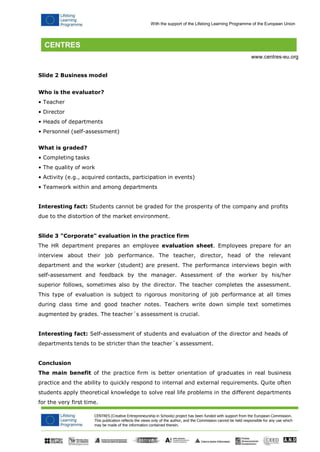
CEFIF publishes "the list of honour" on the website of the National Institute for Education. It includes information about practice firms, which are praised by their business partners for frequent and quality trading. The honour list also includes those who duly fulfil all their obligations, those who are registered properly and pay taxes and insurance. Based on teacher recommendation, the best practice firm students can obtain a certificate of work experience. Certificates are used by students in the initial interviews with potential employers or admissions to universities. In the school year, the practice firm must meet all the basic duties and certificates are issued to a maximum of ¼ students, only the best. Interesting fact: Certificates for the best practice firm students are available on the CEFIF website for possible verification by employers. 
Slide 6 Training and seminars for teachers 
The Central office organises training courses and seminars for practice firm teachers. Training and seminars are organised by CEFIF in Prague and in the regions. At least once a year, it organises general training for practice firm teachers certified by the Ministry of Education, Youth and Sports. At least twice a year, it organises specialised training on various topics, which are determined by practice firm teachers. 
Training topics from recent years include: 
• Evaluation specifics of the practice firm 
• Accounting specifics of the practice firm 
• Marketing specifics of the practice firm 
CEFIF also organises discussion seminars in all regions to exchange experience. New teachers and schools starting-up practice firms are offered consultation services by CEFIF, on the school premises. Practice firm students are offered participation in workshops and based on agreement with the teacher inspections of practice authorities. Consultations with CEFIF staff takes place during practice firm events. 
Interesting fact: Twice a year, CEFIF invites teachers to suggest a topic for specialized training taking place next year. It will organise training for the most popular topic.
CENTRES (Creative Entrepreneurship in Schools) project has been funded with support from the European Commission. 
This publication reflects the views only of the author, and the Commission cannot be held responsible for any use which may be made of the information contained therein. 
With the support of the Lifelong Learning Programme of the European Union 
www.centres-eu.org 
Slide 7 Certificates for students and teachers 
"Lesson 10" Methods of evaluation 
Slide 1 Objectives 
The economic conditions available for practice firms differ significantly from those in real life. Choosing form the various ways to generate profit is easy while some options are not applicable in practice. Profit is not important when evaluating the success of practice firms. The aim of practice firms is to prepare students for future work. Activities of students in practice firms are quite diverse. Evaluation must therefore be carried out on an individual basis, tailored to the requirements of individual positions. Students´ performance is not always easy to measure. The role of the evaluator can be extended to other people, not just the teacher. 
Interesting fact: Standard models of assessment based on grading, testing and written work do not apply. These methods of evaluation can be used before setting up the practice firm, while teaching additional theoretical knowledge.
CENTRES (Creative Entrepreneurship in Schools) project has been funded with support from the European Commission. 
This publication reflects the views only of the author, and the Commission cannot be held responsible for any use which may be made of the information contained therein. 
With the support of the Lifelong Learning Programme of the European Union 
www.centres-eu.org 
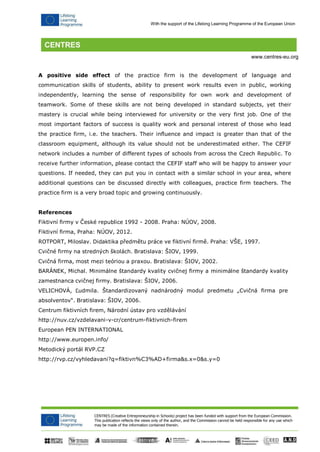
Slide 2 Business model 
Who is the evaluator? 
• Teacher 
• Director 
• Heads of departments 
• Personnel (self-assessment) 
What is graded? 
• Completing tasks 
• The quality of work 
• Activity (e.g., acquired contacts, participation in events) 
• Teamwork within and among departments 
Interesting fact: Students cannot be graded for the prosperity of the company and profits due to the distortion of the market environment. 
Slide 3 "Corporate" evaluation in the practice firm 
The HR department prepares an employee evaluation sheet. Employees prepare for an interview about their job performance. The teacher, director, head of the relevant department and the worker (student) are present. The performance interviews begin with self-assessment and feedback by the manager. Assessment of the worker by his/her superior follows, sometimes also by the director. The teacher completes the assessment. This type of evaluation is subject to rigorous monitoring of job performance at all times during class time and good teacher notes. Teachers write down simple text sometimes augmented by grades. The teacher´s assessment is crucial. 
Interesting fact: Self-assessment of students and evaluation of the director and heads of 
departments tends to be stricter than the teacher´s assessment. 
Conclusion 
The main benefit of the practice firm is better orientation of graduates in real business practice and the ability to quickly respond to internal and external requirements. Quite often students apply theoretical knowledge to solve real life problems in the different departments for the very first time.
CENTRES (Creative Entrepreneurship in Schools) project has been funded with support from the European Commission. 
This publication reflects the views only of the author, and the Commission cannot be held responsible for any use which may be made of the information contained therein. 
With the support of the Lifelong Learning Programme of the European Union 
www.centres-eu.org 
A positive side effect of the practice firm is the development of language and communication skills of students, ability to present work results even in public, working independently, learning the sense of responsibility for own work and development of teamwork. Some of these skills are not being developed in standard subjects, yet their mastery is crucial while being interviewed for university or the very first job. One of the most important factors of success is quality work and personal interest of those who lead the practice firm, i.e. the teachers. Their influence and impact is greater than that of the classroom equipment, although its value should not be underestimated either. The CEFIF network includes a number of different types of schools from across the Czech Republic. To receive further information, please contact the CEFIF staff who will be happy to answer your questions. If needed, they can put you in contact with a similar school in your area, where additional questions can be discussed directly with colleagues, practice firm teachers. The practice firm is a very broad topic and growing continuously. 
References 
Fiktivní firmy v České republice 1992 - 2008. Praha: NÚOV, 2008. Fiktivní firma, Praha: NÚOV, 2012. 
ROTPORT, Miloslav. Didaktika předmětu práce ve fiktivní firmě. Praha: VŠE, 1997. Cvičné firmy na stredných školách. Bratislava: ŠIOV, 1999. 
Cvičná firma, most mezi teóriou a praxou. Bratislava: ŠIOV, 2002. 
BARÁNEK, Michal. Minimálne štandardy kvality cvičnej firmy a minimálne štandardy kvality zamestnanca cvičnej firmy. Bratislava: ŠIOV, 2006. 
VELICHOVÁ, Ľudmila. Štandardizovaný nadnárodný modul predmetu „Cvičná firma pre absolventov“. Bratislava: ŠIOV, 2006. 
Centrum fiktivních firem, Národní ústav pro vzdělávání 
http://nuv.cz/vzdelavani-v-cr/centrum-fiktivnich-firem European PEN INTERNATIONAL http://www.europen.info/ 
Metodický portál RVP.CZ 
http://rvp.cz/vyhledavani?q=fiktivn%C3%AD+firma&s.x=0&s.y=0

Practice firm

  • 1.
    With the supportof the Lifelong Learning Programme of the European Union CENTRES (Creative Entrepreneurship in Schools) project has been funded with support from the European Commission. This publication reflects the views only of the author, and the Commission cannot be held responsible for any use which may be made of the information contained therein. CENTRES www.centres-eu.org PRACTICE FIRM This paper is the third of three e-learning modules created under the auspices of the CENTRES project. The pilot activity in the Czech Republic was focused on the training of career counsellors in schools in the field of creative entrepreneurship and creative career guidance. Foreword In the Czech Republic, the practice firm has been in the curriculum for the past 20 years, particularly in the curricula of business academies. It integrates business related subjects and the practical use of theoretical knowledge in the market. In recent years, the practice firm is increasingly used by non-business schools specialising in crafts as an elective subject. It helps students prepare for the real life. Graduate unemployment is rising and quite often there is no other choice in life other than self-employment, becoming an entrepreneur. Annotation The training module is intended for upper secondary school teachers, in particular those teaching business related and other vocational subjects. The practice firm is a subject bringing a vocational element into an increasing number of non-economic school programs in the Czech Republic as well as other European countries. The training module deals with the subject history, inclusion in to the curriculum, benefits for graduates, characteristics of instruction, prerequisites for managing practice firm successfully, content of activities, organisational structure and specifics of trading and evaluation. The training module also introduces the Czech headquarters, known as the Central office, its structure and services available for teachers and schools. Keywords: practice firm, entrepreneurship, trade, business, law, employment, economics, accounting, marketing, law, Central office, CEFIF, evaluation, vocational work experience, graduate
  • 2.
    With the supportof the Lifelong Learning Programme of the European Union CENTRES (Creative Entrepreneurship in Schools) project has been funded with support from the European Commission. This publication reflects the views only of the author, and the Commission cannot be held responsible for any use which may be made of the information contained therein. www.centres-eu.org Graduate profile Graduates gain a broader perspective of the practice firm instruction elements and learn about the teacher, student and equipment requirements. Teaching the subject is demanding on both the teachers and students. This material helps teachers become familiar with the subject contents, specifics, options and benefits. It provides a summary of twenty years of teaching experience in the Czech Republic and the experience of working with the various foreign central offices. Content Introduction – target audience History Characteristics Inclusion in to the curriculum Founding the practice firm Selecting trade, name and legal form Organisational structure Central office Trading, accounting, practice banks Materials and Central office events Methods of evaluation Conclusion Reference Introduction Slide 1 Target audience The practice firm offers a specific form of training useful to upper secondary schools in preparing students for their future working life. It provides a useful method to practice theoretical knowledge. Working in a virtual company should be as close to the real thing as possible, reflecting the future work that students are studying. Usually, it is the very first work experience that students go through. Students take on specific positions while the relationship between them and the teacher changes. Working independently, students consult the teacher (coordinator). They take responsibility for their work and the work of their "subordinates" (classmates).
  • 3.
    With the supportof the Lifelong Learning Programme of the European Union CENTRES (Creative Entrepreneurship in Schools) project has been funded with support from the European Commission. This publication reflects the views only of the author, and the Commission cannot be held responsible for any use which may be made of the information contained therein. www.centres-eu.org They cooperate with each other to solve problems for the benefit of the practice firm (outcome). Interesting fact: A position in the company can be filled via a selection process. Older students experienced in the subject can help prepare job interviews for younger students which are taking over the practice firm or founding a new one. This helps them prepare for their own job interviews. Slide 2 Basic operations The practice firm is founded by students and the teacher at the practice offices of the Central office. The practice firm shall be governed by the applicable laws and uses real legal forms in setting-up the company. Basic activities are carried out just like in a real company: purchasing, sales, stock, communication with suppliers and customers, processing orders and invoices, selecting employees and their remuneration and registration, marketing, accounting and more. The only difference is absence of production and movement of goods, services and money. Interesting fact: Practice firms use the services of a practice tax department, trade licensing office, commercial register, social and health insurance companies, commercial insurance brokers, domestic and foreign exchange banks and central supplier. Slide 3 Benefits • Maximum approximation of real work and orientation in real working life • Practice of theoretically acquired knowledge • Increased independence of students´ work • A sense of responsibility for own work and work of the team • Ability to work in a team • Collaboration with other schools (unknown persons) • Practice of communication and presentation of achieved results and ability to respond • Development of language skills
  • 4.
    CENTRES (Creative Entrepreneurshipin Schools) project has been funded with support from the European Commission. This publication reflects the views only of the author, and the Commission cannot be held responsible for any use which may be made of the information contained therein. With the support of the Lifelong Learning Programme of the European Union www.centres-eu.org Task: Try to imagine: What skills will you be practicing in the current circumstances? How does it work? What is hard to do in the current circumstances? What are the biggest challenges of your graduate students? Slide 4 Prerequisites for managing the practice firm • Sufficient theoretical knowledge of students in setting-up a practice firm - a legal entity, usually a limited liability company (Ltd.) • If this knowledge is not sufficient (especially students in lower grades or from non- business programs), establish a practice firm in the self-employment mode or use half the term to teach the missing theoretical knowledge • Support of the school management - sufficient number of hours based on the type of practice firm, permission to attend practice firm fairs, competitions, etc. • Teachers who are able and willing to manage the practice firm • Equipment consisting of at least five computers, including at least two computers with Internet access, or permission to use a computer lab to work on the practice firm • Additional classroom equipment – space to hold meetings, work in groups, print, store materials, etc.) Interesting fact: The prerequisites to successfully manage the practice firm change. Currently, the most important criterion is computers. There are only a few activities that can be practiced successfully without computers. Slide 5 What can teachers expect from the practice firm In a practice firm, students practice theory taught in several subjects, especially accounting, economics, marketing and law. Not many practice firm teachers have all the necessary qualifications. In some areas of activity, the teacher will gradually learn what is needed. Accounting: The ability to help students keep accounts, starting with the initial budget all the way until final closure. Economics, Law and Marketing: Knowledge of regulations of the individual economic activities and processes and organisation of corporate agendas. Pedagogical and psychological knowledge: The organisation of students´ work in group teaching, motivating students to focus on individual work and assessment of students in a specific subject.
  • 5.
    CENTRES (Creative Entrepreneurshipin Schools) project has been funded with support from the European Commission. This publication reflects the views only of the author, and the Commission cannot be held responsible for any use which may be made of the information contained therein. With the support of the Lifelong Learning Programme of the European Union www.centres-eu.org Interesting fact: The first year of teaching the practice firm can be very challenging. The Central office provides consultation directly to teachers and organises workshops for students in schools. Throughout the school year, teachers and students can consult the CEFIF Information Centre. "Lesson 1" The history Slide 1 The origins of practice firms The first practice firm was created in Germany in 1975 as a requalification course for the unemployed. In the first year, some 120 practice firms have been registered and their number is gradually increasing. In Germany and other countries, the practice firm is still a traditional part of requalification programs. Germany´s example inspired neighbouring European countries and this type of retraining for the unemployed has spread. In Germany, the first International Headquarters for practice firms has been established in Heidelberg and later in Essen, home to PEN INTERNATIONAL – the current international headquarters for practice firms. Interesting fact: The first predecessor to the practice firm was founded in Germany in the 17th Century by a bookbinder who used it to verify which apprentice will be his future employee and in so doing inspired other "entrepreneurs". Slide 2 The origins of practice firms as a subject in upper secondary schools Later, Austria used the practice firm as a practical subject taught in upper secondary schools. In the beginning of the 90s, practice firms have become a compulsory part of the business school curriculum in Austria and the subject is included there to this day. The practice firm was established in other European countries as an upper secondary school subject in the mid-90s. There are approximately 1700 practice firms in schools in Belgium, Denmark, Finland, France, Ireland, Italy, Luxembourg, Netherlands, Norway, Portugal, Spain, Sweden, Switzerland and the UK. Interesting fact: In the Czech Republic, the first teacher was "trained" by Mr. Slanař in the 90s, the director of the Vienna 10 business academy, whose parents were Czech, and speaks Czech very well. He keeps a close eye on the activities of the Czech and Slovak practice firm to this day.
  • 6.
    CENTRES (Creative Entrepreneurshipin Schools) project has been funded with support from the European Commission. This publication reflects the views only of the author, and the Commission cannot be held responsible for any use which may be made of the information contained therein. With the support of the Lifelong Learning Programme of the European Union www.centres-eu.org Slide 3 Practice firms in the Czech Republic The idea to set-up practice firms as a pedagogical tool was developed at the Department of Education of the University of Economics in Prague. Docent Rotport, PhD. and his colleagues cooperated with the University of Economics in Bratislava and the Vienna business academy. In 1992, the first 6 practice firm have been founded in the Czech Republic. The first three Czech practice firms cooperated with the Central office in Bratislava, which has already been established. The formal division of Czechoslovakia was taking place, however, and the Central office (CEFIF) was founded at the University of Economics in Prague on 16th November 1992. Docent Miloslav Rotport, PhD became its first director. In 1992, first seminars were held for prospective teachers and became very popular. They are still in high demand by schools and teachers of business related subjects. Interesting fact: The first trade licenses were presented to practice firms registered in the Czech Republic on 13th February 1993 during a seminar in Svitavy. Trade license no. 1 was issued to Krystal practice firm at ČSOA Resslova 5, Prague 2. "Lesson 2" The characteristics Slide 1 Different than traditional subjects: • Students work independently and take responsibility for their work and for the completion of individual tasks • Groups of students (departments) work together, coordinate their activities towards common goals • They are controlled by the director (student) and heads of departments (classmates) • Practice firms organise meetings, company managers (students) set and monitor tasks • The teacher is the coordinator and consultant Interesting fact: Students are often stricter when monitoring and demanding task outcomes than their teacher. Slide 2 Students practice: • theoretically acquired knowledge under conditions of maximum approximation of real work for better orientation in the business world • independent work in various departments
  • 7.
    CENTRES (Creative Entrepreneurshipin Schools) project has been funded with support from the European Commission. This publication reflects the views only of the author, and the Commission cannot be held responsible for any use which may be made of the information contained therein. With the support of the Lifelong Learning Programme of the European Union www.centres-eu.org • teamwork • cooperation with other schools (strangers) • communication skills to present the outcomes to the public • develop language skills Interesting fact: A significant number of these skills is not being developed through traditional subjects, though they are being demanded from graduates during the university admission process or first job interview. Slide 3 Work content: • Adding theoretical knowledge • Legal requirements: obtaining a trade license, registration in the commercial register, tax and insurance registration • Market research • Preparation of the financial plan • Independent work in concrete positions and management of individual departments and the whole practice firm - orientation in the business world • Teamwork • Creation of marketing tools: letter heads, business cards, logos, presentations, catalogues, and others • Trading with Czech and foreign practice firms (strangers) • Management of payroll and accounting (or tax records) • Preparation of tenders and materials in foreign languages - development of language skills • Practicing presenting the practice firm and students´ work in school and at regional, national and international events and competitions (in foreign languages) Interesting fact: Many marketing materials created by practice firms would do well in real life. Some practice firms decide to go in to real business. "Lesson 3" The inclusion of the subject Slide 1 Options for including the practice firm in to the curriculum: • Vocational experience • Learning experience
  • 8.
    CENTRES (Creative Entrepreneurshipin Schools) project has been funded with support from the European Commission. This publication reflects the views only of the author, and the Commission cannot be held responsible for any use which may be made of the information contained therein. With the support of the Lifelong Learning Programme of the European Union www.centres-eu.org • Traditional subject • Optional subject • Extra-curricular activity The recommended number of hours - two to four hours a week every week • One year course with maximum hour allocation • One and a half year course with average hour allocation • Two-year course with the lowest possible hour allocation Slide 2 Practice firm in the Czech Republic is taught by various types of schools: • Tertiary level vocational schools • Business academies • Upper secondary – other business related education programs categories L, M and possibly also K • Upper secondary – other non-business related education programs categories L, M and possibly also K • Upper secondary – follow-up studies • Upper secondary – education programs category H Each type of school has its own characteristics that need to be respected so that the practice firm is as useful to students as possible. Interesting fact: The "higher" the type of school, the better the students' knowledge and possibility to gain the best out of practicing content in the practice firm. Students of education programs type H and follow-up studies are more aware of the practicality of this subject and applicability in the near future. If set-up correctly, it will help them to become self-employed. Slide 3 Recommendations for including the practice firm in the curriculum by school type: • Tertiary vocational school: 1st or 2nd year with 2-3 hours per week - one-year course. • Business Academy: 3rd and 4th year with 2-3 hours per week - one and a half or two year course. • Other business programs - education categories L, M and K: 3rd and 4th year with 3 hours per week as a two-year course.
  • 9.
    CENTRES (Creative Entrepreneurshipin Schools) project has been funded with support from the European Commission. This publication reflects the views only of the author, and the Commission cannot be held responsible for any use which may be made of the information contained therein. With the support of the Lifelong Learning Programme of the European Union www.centres-eu.org • Other non-business programs - education categories L, M and K: 3rd and 4th year with 2-3 hours per week as one and a half or two-year course – depending on the education area, possibly with lower number of hours in a practice firm in entrepreneur mode. • Follow-up studies: 1st and 2nd year with 3 hours per week as a one and a half or two year course. Usually a practice firm in entrepreneur mode. Theoretical knowledge is taught in the first half of the first year. • Education programs category H: 2nd and 3rd year with 1 to 2 hours per week as a one and a half or two year course. Recommended configuration includes the practice firm in an entrepreneur mode and keeping tax records. Interesting fact: Practice firms set-up on the follow-up study level have long been among the best. Students are usually well aware that they will have to become self-employed and realize the practicality of this subject for the foreseeable future. "Lesson 4" Founding the practice firm Slide 1 School decision Schools must realize that there are decisions relating to practice firms, which are taken by the students. In particular, these will cover the area of business and the name of the practice firm. Vocational schools or vocational programs – when selecting the type of trade will vocational focus be compulsory? What kind of skills students need? What are the most common professions taken up by school graduates? What kind of "experience" do they need the most? Does the school cooperate with social partners or sponsors, which would welcome the advertising options available? Can the school or students find such sponsors? Establishing contacts with real companies will lead to closer and highly desirable connection with the profession. Will the names of the practice firms be permanent and represent the school well? The more decisions and influence left in the hands of the students, the closer the relationship with the firm. This includes the decision to select the name and trade. Interesting facts: Some social partners and sponsors expect the practice firms to take their names, others will not.
  • 10.
    CENTRES (Creative Entrepreneurshipin Schools) project has been funded with support from the European Commission. This publication reflects the views only of the author, and the Commission cannot be held responsible for any use which may be made of the information contained therein. With the support of the Lifelong Learning Programme of the European Union www.centres-eu.org Slide 2 The first lesson The teacher introduces students to the activities that take place in a practice firm, students discuss their expectations and the teacher adds information about the content of the individual jobs. Students´ expectations often differ from the reality. Choose the director of the practice firm, heads of individual departments and assign each student a job position as soon as possible. The selection process should be based on discussion, coordinated by the teacher or a subsequent vote. Some practice firms organise tenders with the help of older students for the position of director and department heads. After positions have been filled, the first meeting is organised. The meeting is led by the director (student). Each meeting is minuted, including the setting of tasks and completion of deadlines. Interesting fact: Students often decide who will be their director and the area of business etc.. The teacher always coordinates and facilitates the proceedings. If "facilitation" fails, the teacher can make the decision on students´ behalf. Slide 3 Guided by the teacher, students are responsible for: • Company name (check if the name is available and will be accepted) • Trade • Legal form • If in company mode: o who are the partners (owners) o who will be the statutory body o who will be the director o who will work in the departments and manage the departments o how many staff, will they work full-time • If in entrepreneur mode: o who will be the self-employed person o will someone cooperate • Setting-up corporate e-mail • Completing and submitting the CEFIF questionnaire
  • 11.
    CENTRES (Creative Entrepreneurshipin Schools) project has been funded with support from the European Commission. This publication reflects the views only of the author, and the Commission cannot be held responsible for any use which may be made of the information contained therein. With the support of the Lifelong Learning Programme of the European Union www.centres-eu.org "Lesson 5" Selecting the trade, name and legal form of organisation Slide 1 Selecting the trade If not given by the school, the trade will be chosen by the students. Students should choose something they know or can learn from their closest environment such as the school, family or friends. Most often, students select areas, in which they have personal interests. Ideally, even their successors should be able to identify themselves with the choice. The practice firm themes differ somewhat from those of a real business but there are some real elements involved. Students may consider calculating estimates of potential business success. They may also consider the practice firm market in the Czech Republic, or even abroad, including consumption and competition possibilities. Travel agencies, hotels, catering or adventure companies, wedding, advertising or real estate agencies, logistics firms, airports, radio stations as well as funeral services are very popular. Girls often engage in practice firms devoted to cosmetics and fashion while boys love electronics, car sales, sports, etc. Very few practice firms are involved in production, although the direct sales of products may also be considered part of the production process. Slide 2 Personal choice The more decision power the students are given the more devoted they become. However, it is necessary to remind students that the services or products will have to be sold. Students will have to learn something about them. Are they really so knowledgeable about cars or electronics and all the technical parameters? Is the interest of girls in fashion and cosmetics strong enough? They may be interested in the fashion trends, but do they care about prices, materials, etc.? Do they really enjoy traveling? Students determine the trade, in which their business belongs and how difficult it is to set it up. What type of a company is suited for the trade? Does it correspond to the "school setting", the need to practice founding of a limited company or, conversely, a business of a self-employed entrepreneur? The role of the teacher is to remind students about these issues. Interesting fact: Students are often attracted by operating travel agencies with exotic destinations. However, they have never visited and never read anything about them. Common statements include: Flying to Japan includes a stopover in Beijing, a flight to Australia takes seven hours, the Azores enjoy tropical weather.
  • 12.
    CENTRES (Creative Entrepreneurshipin Schools) project has been funded with support from the European Commission. This publication reflects the views only of the author, and the Commission cannot be held responsible for any use which may be made of the information contained therein. With the support of the Lifelong Learning Programme of the European Union www.centres-eu.org Slide 3 Selecting the name When choosing the name, consider any potential sponsor or social partner that might exist. The existence of a real partner is greatly beneficial. They may sponsor the activities or provide a direct link to the real world. In these cases, it is appropriate to comply. Some schools prefer to reflect the school's name, city, etc. in the name of the practice firm. The identification of schools with the practice firm brings a greater sense of responsibility for the actions the practice firm takes and the way the school will be represented. If these or other factors are not relevant, the name is chosen by the students. Check with the Central office if the name is not already taken or reserved for a new practice firm. CEFIF ensures that the names are sufficiently identifiable and other students don´t mix them up. Unlike in the real world, similar sounding names are not allowed. Interesting fact: It may be appropriate to think of the name as a marketing tool of the practice firm. Students may take into account the way it links with the goods or services, the sound of the name, length and other factors. Slide 4 The legal form The delegation of decision-making in the practice firm is intended to gain the students´ interest. Students learn about responsibility and become more active. The decision about the legal form should always be taken by the teacher. It should be guided by the specific needs of the school to practice a specific subject matter and the available number of hours. The most common type of legal form of real companies is a limited liability company (about 95%). This is similar in the network of practice firms. Practice banks, insurance companies, etc. also tend to mirror the real world and become joint stock companies. Practice firms in non-business programs are often set-up in the entrepreneur mode (as self-employed persons). Copying real practices is what makes this the most practical exercise and use of the subject. Interesting fact: The new law on corporations, replaced by the commercial code on 1.1. 2014, significantly changes in many aspects the foundation of companies. The practice firm network is also likely to adopt changes. Many adaptions relate to European trends such as the amount of capital needed to set up a limited liability company (set-up will be possible with basic investment of only one Czech Crown).
  • 13.
    CENTRES (Creative Entrepreneurshipin Schools) project has been funded with support from the European Commission. This publication reflects the views only of the author, and the Commission cannot be held responsible for any use which may be made of the information contained therein. With the support of the Lifelong Learning Programme of the European Union www.centres-eu.org "Lesson 6" Organisational structure Slide 1 Organisational structure • Director • Assistant Director • Human resources and legal sections • Accounting • Payroll • Sales and marketing Organisational structure of the practice firm replicates that of a real company, except for the absence of the production department. Principal activities of the practice firm include the founding of the company (legal and HR sections), marketing and sales activities (marketing and sales departments), payroll and business contracts (payroll and accounting), payment of taxes and insurance (legal and accounting sections) and termination or interruption of the practice firm. Interesting fact: Just like in a real life business, the practice firm staff must help each other. Each department is busiest in different parts of the school year. Slide 2 Rotation of a cumulative function If they do well, directors should remain in place throughout the lifetime of the practice firm (specific groups of students). In other positions, students may rotate approx. once every six months or use the "cumulative function". Rotation: Students change job positions 1-3 x (depending on the lifetime of the practice firm, 1-2 years). Cumulative function: This corresponds to one full time contract and another short-term contract in another department. If the student´s main contract focuses on practicing primarily "economic knowledge" the supplementary agreement would emphasize practicing "accounting" or vice versa. Changing jobs is not desirable when there are fewer hours allocated or when the subject is taught only in the 4th year. There would not be enough time to practice basic activities in a given job, to go through the experience.
  • 14.
    CENTRES (Creative Entrepreneurshipin Schools) project has been funded with support from the European Commission. This publication reflects the views only of the author, and the Commission cannot be held responsible for any use which may be made of the information contained therein. With the support of the Lifelong Learning Programme of the European Union www.centres-eu.org Interesting fact: The teacher should facilitate students´ assignment with individual positions. It is necessary to take into account students´ abilities, knowledge, but also the knowledge they lack (and need to practice the most). Slide 3 Director • Main partner of the teacher • Responsible for the operation of the company • Assigns and supervises the work • Issues regulations • Leads meetings • Coordinates preparation work for school events and extracurricular activities • Represents the company in public • Evaluates department heads Interesting fact: A student with good organisational skills, teacher´s partner, not the class clown! A good director promotes teamwork and cooperation among the departments. Slide 4 Assistant to the director • Keeps track of incoming correspondence, including e-mail • Cleans e-mail box every working day (of the practice firm) • Prepares meeting minutes • Manages documentation of the company and navigates it easily • Collects and manages corporate contacts • Sends bulk e-mails • Prepares and sends CEFIF questionnaire every September and after every change taking place in the practice firm Interesting fact: The basic requirement is accuracy and reliability. Slide 5 HR and legal section • Processes documentation for founding, changing and terminating the practice firm for the practice authorities and for: o commercial register
  • 15.
    CENTRES (Creative Entrepreneurshipin Schools) project has been funded with support from the European Commission. This publication reflects the views only of the author, and the Commission cannot be held responsible for any use which may be made of the information contained therein. With the support of the Lifelong Learning Programme of the European Union www.centres-eu.org o trade office o tax office • Processes employment contracts and remuneration • Keeps employee records o holidays o sick leave o remuneration, bonuses • Coordinates remuneration of workers • Coordinates employee assessment Interesting fact: The activities of this department are actively supported by the director. Slide 6 Sales and Marketing • Prepares promotional company materials, namely: o Logo o Letterheads, mail forms, business cards o Catalogue of goods or services, leaflets o Company slogan • Prepares and maintains the website • Processes current special offers • Prepares promotional events in cooperation with the sales department • Prepares business correspondence (supply and demand of goods) • Actively seeks out business partners, communicates with business partners • Communicates with the central supplier • Purchases goods from other practice firms Interesting fact: You need to be inventive to work in the marketing department. However, your computer skills, including working with graphics should also be particularly outstanding. Slide 7 Accounting sections: Accounting and payroll • Keeps accounts • Issues orders and invoices according to the instructions of the Sales department
  • 16.
    CENTRES (Creative Entrepreneurshipin Schools) project has been funded with support from the European Commission. This publication reflects the views only of the author, and the Commission cannot be held responsible for any use which may be made of the information contained therein. With the support of the Lifelong Learning Programme of the European Union www.centres-eu.org • Monitors invoice deadlines and issues reminders • Pays invoices • Processes and pays taxes • Processes employee salaries, rewards and sick leaves • Prepares and sends social insurance, health insurance and insurance of employee liability • Manages cash office Interesting fact: Most practice firms produce students who after graduation will go on to work in accounting. This practice is an added bonus, but often it is the only experience the graduate has to offer to the first employer. "Lesson 7" Central office (CEFIF) Slide 1 Main tasks and objectives The Central office represents all the necessary authorities and organisations for the proper functioning of practice firms and they need to cooperate together. CEFIF provides practice firms and teachers with the necessary information and forms. It has set up a CEFIF Information centre and publishes annually updated CEFIF CD. CEFIF also allows you to participate in the practice firm market in the Czech Republic and abroad using various databases. CEFIF holds and cooperates on the organisation of international, national and regional practice firm events. It organises competitions, commercial and contractual days, fairs for students and much more. Interesting fact: The Czech Republic holds the second largest fair for practice (training) firms in Europe. Twice in the last ten years, this fair was the largest in Europe and the second largest in the world. Slide 2 Practice authorities and the organisation of the Central office CEFIF has set up the following practice administration authorities and organisations that work directly with students in practice firms: • CEFIF Trade office • CEFIF Commercial register • CEFIF Tax office • CEFIF Social insurance administration
  • 17.
    CENTRES (Creative Entrepreneurshipin Schools) project has been funded with support from the European Commission. This publication reflects the views only of the author, and the Commission cannot be held responsible for any use which may be made of the information contained therein. With the support of the Lifelong Learning Programme of the European Union www.centres-eu.org • ZDRAFIK (health insurance) • CEFIF Commercial Insurance • CEFIF Central supplier • Domestic banks: CEFIF Bank, Banka Academia Praha, OBA banka Karviná, První plzeňská fiktivní banka (The First Practice Bank of Plzen) and Sollbanka • FIBA (foreign exchange bank) • CEFIF Information centre Interesting fact: The Czech Central office works closely with the international headquarters for practice firms, PEN INTERNATIONAL EUROPEN. Slide 3 Contacts Centrum fiktivních firem (Central office) Národní ústav pro vzdělávání, školské poradenské zařízení a zařízení pro další vzdělávání pedagogických pracovníků Weillova 6 102 00 Praha 10 www.nuv.cz Informační středisko CEFIF (Information centre) Dana Batelková dana.batelkova@nuv.cz tel.: 274 022 427, 776 483 653 Interesting fact: The CEFIF Information centre provides information and assistance to schools, teachers and also directly to individual practice firm students. Slide 4 CEFIF Trade office When founding the practice firm or "refounding" or changing it, the CEFIF Trade office issues a listing (or amendments) from the Trade register. To obtain an extract from the register students should complete: • Common registration form for companies or self-employed persons (entrepreneurs) • Attachments The Common registration form includes two types of attachments:
  • 18.
    CENTRES (Creative Entrepreneurshipin Schools) project has been funded with support from the European Commission. This publication reflects the views only of the author, and the Commission cannot be held responsible for any use which may be made of the information contained therein. With the support of the Lifelong Learning Programme of the European Union www.centres-eu.org • Attachments which are used to enter data, which did not fit in to the form • Attachments which provide additional facts The Common registration form can be used to report the founding of the company, or to report the start-up for the following offices: • Tax office • Social security administration • Health insurance • Labour office Interesting fact: Most schools retain the names of their practice firm, by which they are already well known. Upon the arrival of new students in the practice firm, the teacher can decide on legal changes or if s/he wants to "refound" the company with the same ID. Slide 5 CEFIF Commercial register When founding or "refounding" the practice firm or when changes are made, the CEFIF Commercial register issues a listing (or change of registration) from the Commercial register. To register in the Commercial register (companies) students need to complete: • Registration or amendment proposal for entry in to the Commercial register • Social (Founding) contract • Memorandum or decision of the constituent general meeting (approving the amendment) • Declaration of the entry administrator (contract on property settlement) • Affidavits and signatures • Other documents are optional To register in the Commercial register (entrepreneurs) students need to complete: • Registration or amendment proposal for entry in to the Commercial register • Other documents are optional Interesting fact: In order to legally set-up a company, practice firms fulfil important obligations similar to real companies. Due to the complexity of setting up a real company, CEFIF does not insist on all documentation, only the most important one. Other documents are optional. If additional documents are received, the CEFIF authorities will examine them and issue a statement.
  • 19.
    CENTRES (Creative Entrepreneurshipin Schools) project has been funded with support from the European Commission. This publication reflects the views only of the author, and the Commission cannot be held responsible for any use which may be made of the information contained therein. With the support of the Lifelong Learning Programme of the European Union www.centres-eu.org Slide 6 CEFIF Tax office When funding, "refunding" or making changes to the practice firm, the CEFIF Tax office issues a certificate of registration. To obtain registration with the Tax office students need to complete: • Taxpayer application form (company) or • Taxpayer application form (entrepreneur) Other documents are optional. These primarily include: • VAT application form • Tax on property application form • Tax on motor vehicles application form Interesting fact: Students may choose to register with the Tax office using the Common registration form and its attachments or forms of the Tax office. Slide 7 Contributions to CEFIF Social security, ZDRAFIK and CEFIF Insurance company When funding, "refunding" or making changes to the practice firm, obligations as a payer of insurance are carried out. Practice firms register a make practice payments for: • CEFIF Social security administration • ZDRAFIK Health insurance They also sign insurance contracts and pay the CEFIF Insurance company the following contributions: • Legal organisation’s liability insurance (at least one employee) • Legal travel agency insurance Optionally, some practice firms sign other insurance contracts such as: • Industry insurance • Motor vehicle insurance • Property insurance • Travel agency passenger insurance
  • 20.
    CENTRES (Creative Entrepreneurshipin Schools) project has been funded with support from the European Commission. This publication reflects the views only of the author, and the Commission cannot be held responsible for any use which may be made of the information contained therein. With the support of the Lifelong Learning Programme of the European Union www.centres-eu.org Task: Try to set up a company with students using real forms, specifically the application for a trade license. "Lesson 8" Trading, accounting, practice banks Slide 1 Business Strategy The main objective of a company, including practice firms, is sales of goods or services. Before practice firms can start trading, they must complete several tasks to make sure the goal is achievable. If there is enough time, the practice firm should: • Carry out market research • Prepare start-up budget • Prepare business plan • Prepare the starting balance sheet While preparing the very first marketing materials and during final editing it is very important to set prices correctly. It needs particular attention even though it is not possible to provide a functioning market economy without free circulation of real money. Interesting fact: The practice firm should above all aim to generate work experience. A coffee shop or a souvenir salesman cannot earn as much as a seller of luxury cars, without real movement of money. The profit indicator in the practice firm environment does not function in the traditional way! Slide 2 Trading The main activity of all companies is trading. Practice firms trade primarily: • Among themselves within the area of the Czech Republic using the CEFIF database • With practice firms abroad using foreign databases of PEN INTERNATIONAL • At fairs and contract days of practice firms • At school events (open days, with teachers, classmates, etc.) • With CEFIF´s Central supplier Practice firms need to trade (practice) primarily among themselves. The Central supplier was created to provide the supply of goods and services that are not available in the market.
  • 21.
    CENTRES (Creative Entrepreneurshipin Schools) project has been funded with support from the European Commission. This publication reflects the views only of the author, and the Commission cannot be held responsible for any use which may be made of the information contained therein. With the support of the Lifelong Learning Programme of the European Union www.centres-eu.org Interesting fact: The Central supplier shall deliver everything that cannot be provided by practice firms. It will not, however, deliver goods if the practice firm fails to try and secure trading partners among the other practice firms. Slide 3 Practice firm database The Central office processes and updates the practice firm database in the Czech Republic. The up-to-date database is available on the CEFIF website at http://www.nuov.cz/centrum- fiktivnich-firem. Practice firms can use it to look for other practice firms, with which they may actively cooperate at that time. Information given includes: • Full name of the practice firm • Mailing address, including the school, where the practice firm operates • Email address • Website, if it exists • Regularly updated information about the current quantity available for trading • Area of the trade Interesting fact: Practice firms use the international database available at http://cms.europen.info/. It contains full contact details of nearly 8,000 practice firms from 42 countries around the world. You can search the database using various criteria. Slide 4 CEFIF Central Supplier The Central supplier is a wholesale company supplying what is missing in the practice firm market. It has its own supply catalogues. Practice firms can order anything. Orders are sent to the central supplier electronically. The recipient fills in an order form stating the type of goods required, quantity and price per item, as if it were a pre-negotiated with the central supplier. The central supplier will accept these terms to speed up the trading. The order is sent back only if the price is in stark contrast to a usual price in the real market. The central supplier can also be used during start-up to speed up the practice firm supply and start work as soon as possible. The central supplier will also supply backdated goods, should the practice firm sell more goods than expected, goods they don´t have. Interesting fact: Some schools or teachers set-up their own suppliers. CEFIF is not opposed in any way.
  • 22.
    CENTRES (Creative Entrepreneurshipin Schools) project has been funded with support from the European Commission. This publication reflects the views only of the author, and the Commission cannot be held responsible for any use which may be made of the information contained therein. With the support of the Lifelong Learning Programme of the European Union www.centres-eu.org Slide 5 Practice banks In order to carry out their activities, practice firms need current accounts. This service is provided by a network of practice banks. Most of them are managed by secondary schools students. Practice firms can choose one and set-up an account. The following student banks are available: • Banka Academia Praha • OBA banka Karviná • První plzeňská fiktivní banka (The First Practice Bank of Plzen) • Sollbanka Brno New and experienced practice firms, if there are problems, use the services of the CEFIF bank managed by the Central office. All practice banks do electronic banking. Account statements are issued once a month. Interesting fact: The FIBA foreign exchange bank has been set-up for the purposes of international cooperation. It cooperates with all registered practice firms abroad. Slide 6 Accounting Schools have to choose either a manual or electronic method of accounting (using PC software). Approximately one half prefers to do it manually - strengthen the knowledge of accounting principles. In the Czech Republic, several quality accounting software programs exist. We recommend using the same software, which is taught in the Accounting class. Such software will usually respect the regional customs of the local employers. In the Czech Republic, frequent changes in legislation take place. These changes often require changing the software. Interesting fact: Schools often use software, which is available free of charge or at discounted prices and they are usually late with new updates. CEFIF accepts out-of-date software version for one full school semester.
  • 23.
    CENTRES (Creative Entrepreneurshipin Schools) project has been funded with support from the European Commission. This publication reflects the views only of the author, and the Commission cannot be held responsible for any use which may be made of the information contained therein. With the support of the Lifelong Learning Programme of the European Union www.centres-eu.org "Lesson 9" Tools and events of the Central office Slide 1 CEFIF CD The CEFIF CD is a crucial resource for teaching the practice firm. CEFIF issues a CD update every September to all registered schools in the CEFIF network. All tools are correct at the time of the CD issue. Practice firms can find the following: • Forms needed by practice firms to register in Microsoft Office, Open Office including form specimens • Excerpts from the most important laws and other information, advice and guidance needed to set-up and manage practice firms • Digital learning materials that take students through the set-up of the firm step by step. Interesting fact: Warning! There are many out-of-date forms available for download that are later rejected because they are no longer valid. Slide 2 Fairs, contract days and other regional and school events In the Czech Republic, 14 to 16 regional fairs take place each school year. Most practice firms participate in regional fairs to present what they´ve achieved. Some schools organise trade or contractual days and invite other schools in the network. Most schools use the practice firm for promotional purposes during open days and other school events. Practice firms organise trading "hours" and sell goods and services to classmates. International fairs are the highlight of the year. Each year, an international trade fair takes place in Prague at the end of March. Czech practice firms participate regularly in the international exhibition in Bratislava. In Europe and globally, 25 to 30 international trade fairs take place every year. Information is available at http://cms.europen.info/index.php?id=46. Interesting fact: In the 2012/2013 school year, the international exhibition in Prague was attended by 140 practice firms from 11 European countries. Slide 3 National and regional competitions CEFIF holds several annual national competitions. Other competitions take place at practice firm events. Examples of renowned competitions in recent years:
  • 24.
    CENTRES (Creative Entrepreneurshipin Schools) project has been funded with support from the European Commission. This publication reflects the views only of the author, and the Commission cannot be held responsible for any use which may be made of the information contained therein. With the support of the Lifelong Learning Programme of the European Union www.centres-eu.org • Best tender • Best business plan • Economic quiz • Most transactions realised in a given time period • Most transactions realised with foreign firms • Best business correspondence • Best website • Best e-shop • Best electronic presentation • Best video clip • Best slogan • Best flyer • Best business card • Best advert Interesting fact: Practice firms win real prizes, not fictitious ones. National competitions award cash, while other competitions various type of prizes. Slide 4 Informer and website "The Informer" is another CEFIF tool, which publishes information, competitions, events, commentary, changes in regulations, advice and much more. Four issues are published each year. The latest figures are available on the CEFIF website. The September issue is focused on information for new students. The November issue is focused on announcing competitions and dates of events. The March issue assesses the competitions and informs about the latest events of the school year. The June issue provides analyses of the end of the school year and the best practice firm. It publishes "list of honours". The informer publishes, of course, much more information for practice firms and their teachers. The winners are published under their name and the name of the school that supports their activities. Interesting fact: The CEFIF website for practice firms can be found at http://www.nuov.cz/centrum-fiktivnich-firem.
  • 25.
    CENTRES (Creative Entrepreneurshipin Schools) project has been funded with support from the European Commission. This publication reflects the views only of the author, and the Commission cannot be held responsible for any use which may be made of the information contained therein. With the support of the Lifelong Learning Programme of the European Union www.centres-eu.org Slide 5 The list of honour and certificates CEFIF publishes "the list of honour" on the website of the National Institute for Education. It includes information about practice firms, which are praised by their business partners for frequent and quality trading. The honour list also includes those who duly fulfil all their obligations, those who are registered properly and pay taxes and insurance. Based on teacher recommendation, the best practice firm students can obtain a certificate of work experience. Certificates are used by students in the initial interviews with potential employers or admissions to universities. In the school year, the practice firm must meet all the basic duties and certificates are issued to a maximum of ¼ students, only the best. Interesting fact: Certificates for the best practice firm students are available on the CEFIF website for possible verification by employers. Slide 6 Training and seminars for teachers The Central office organises training courses and seminars for practice firm teachers. Training and seminars are organised by CEFIF in Prague and in the regions. At least once a year, it organises general training for practice firm teachers certified by the Ministry of Education, Youth and Sports. At least twice a year, it organises specialised training on various topics, which are determined by practice firm teachers. Training topics from recent years include: • Evaluation specifics of the practice firm • Accounting specifics of the practice firm • Marketing specifics of the practice firm CEFIF also organises discussion seminars in all regions to exchange experience. New teachers and schools starting-up practice firms are offered consultation services by CEFIF, on the school premises. Practice firm students are offered participation in workshops and based on agreement with the teacher inspections of practice authorities. Consultations with CEFIF staff takes place during practice firm events. Interesting fact: Twice a year, CEFIF invites teachers to suggest a topic for specialized training taking place next year. It will organise training for the most popular topic.
  • 26.
    CENTRES (Creative Entrepreneurshipin Schools) project has been funded with support from the European Commission. This publication reflects the views only of the author, and the Commission cannot be held responsible for any use which may be made of the information contained therein. With the support of the Lifelong Learning Programme of the European Union www.centres-eu.org Slide 7 Certificates for students and teachers "Lesson 10" Methods of evaluation Slide 1 Objectives The economic conditions available for practice firms differ significantly from those in real life. Choosing form the various ways to generate profit is easy while some options are not applicable in practice. Profit is not important when evaluating the success of practice firms. The aim of practice firms is to prepare students for future work. Activities of students in practice firms are quite diverse. Evaluation must therefore be carried out on an individual basis, tailored to the requirements of individual positions. Students´ performance is not always easy to measure. The role of the evaluator can be extended to other people, not just the teacher. Interesting fact: Standard models of assessment based on grading, testing and written work do not apply. These methods of evaluation can be used before setting up the practice firm, while teaching additional theoretical knowledge.
  • 27.
    CENTRES (Creative Entrepreneurshipin Schools) project has been funded with support from the European Commission. This publication reflects the views only of the author, and the Commission cannot be held responsible for any use which may be made of the information contained therein. With the support of the Lifelong Learning Programme of the European Union www.centres-eu.org Slide 2 Business model Who is the evaluator? • Teacher • Director • Heads of departments • Personnel (self-assessment) What is graded? • Completing tasks • The quality of work • Activity (e.g., acquired contacts, participation in events) • Teamwork within and among departments Interesting fact: Students cannot be graded for the prosperity of the company and profits due to the distortion of the market environment. Slide 3 "Corporate" evaluation in the practice firm The HR department prepares an employee evaluation sheet. Employees prepare for an interview about their job performance. The teacher, director, head of the relevant department and the worker (student) are present. The performance interviews begin with self-assessment and feedback by the manager. Assessment of the worker by his/her superior follows, sometimes also by the director. The teacher completes the assessment. This type of evaluation is subject to rigorous monitoring of job performance at all times during class time and good teacher notes. Teachers write down simple text sometimes augmented by grades. The teacher´s assessment is crucial. Interesting fact: Self-assessment of students and evaluation of the director and heads of departments tends to be stricter than the teacher´s assessment. Conclusion The main benefit of the practice firm is better orientation of graduates in real business practice and the ability to quickly respond to internal and external requirements. Quite often students apply theoretical knowledge to solve real life problems in the different departments for the very first time.
  • 28.
    CENTRES (Creative Entrepreneurshipin Schools) project has been funded with support from the European Commission. This publication reflects the views only of the author, and the Commission cannot be held responsible for any use which may be made of the information contained therein. With the support of the Lifelong Learning Programme of the European Union www.centres-eu.org A positive side effect of the practice firm is the development of language and communication skills of students, ability to present work results even in public, working independently, learning the sense of responsibility for own work and development of teamwork. Some of these skills are not being developed in standard subjects, yet their mastery is crucial while being interviewed for university or the very first job. One of the most important factors of success is quality work and personal interest of those who lead the practice firm, i.e. the teachers. Their influence and impact is greater than that of the classroom equipment, although its value should not be underestimated either. The CEFIF network includes a number of different types of schools from across the Czech Republic. To receive further information, please contact the CEFIF staff who will be happy to answer your questions. If needed, they can put you in contact with a similar school in your area, where additional questions can be discussed directly with colleagues, practice firm teachers. The practice firm is a very broad topic and growing continuously. References Fiktivní firmy v České republice 1992 - 2008. Praha: NÚOV, 2008. Fiktivní firma, Praha: NÚOV, 2012. ROTPORT, Miloslav. Didaktika předmětu práce ve fiktivní firmě. Praha: VŠE, 1997. Cvičné firmy na stredných školách. Bratislava: ŠIOV, 1999. Cvičná firma, most mezi teóriou a praxou. Bratislava: ŠIOV, 2002. BARÁNEK, Michal. Minimálne štandardy kvality cvičnej firmy a minimálne štandardy kvality zamestnanca cvičnej firmy. Bratislava: ŠIOV, 2006. VELICHOVÁ, Ľudmila. Štandardizovaný nadnárodný modul predmetu „Cvičná firma pre absolventov“. Bratislava: ŠIOV, 2006. Centrum fiktivních firem, Národní ústav pro vzdělávání http://nuv.cz/vzdelavani-v-cr/centrum-fiktivnich-firem European PEN INTERNATIONAL http://www.europen.info/ Metodický portál RVP.CZ http://rvp.cz/vyhledavani?q=fiktivn%C3%AD+firma&s.x=0&s.y=0