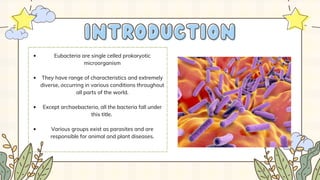
Eubacteria are singlecelled prokaryotic
microorganism
They have range of characteristics and extremely
diverse, occurring in various conditions throughout
all parts of the world.
Except archaebacteria, all the bacteria fall under
this title.
Various groups exist as parasites and are
responsible for animal and plant diseases.
INTRODUCTION
INTRODUCTION
3.
They are unicellular,prokaryotic microorganisms.
Eubacteria lack a membrane-bound nucleus.
The cell wall is made up of peptidoglycan in a cross-linked chain
pattern.
Eubacteria reproduce by binary fission or by budding.
A chromosome is single and circular.
The size of the bacteria ranges from 0.2 to greater than 5
micrometers.
They have 70S-type ribosomes as organelles composed of RNA
and protein that complete the process of translation.
The shape of the eubacteria is different such as cocci, bacilli, rods,
vibrio, filament, or spirochetes.
GENERAL CHARACTERISTICTS
GENERAL CHARACTERISTICTS
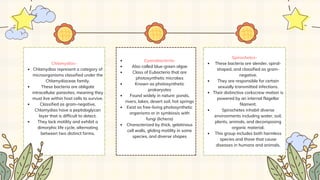
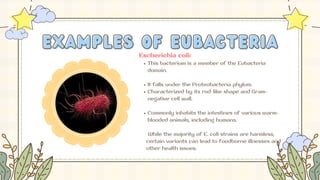
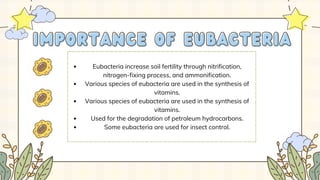
Eubacteria are generallydivided into five main groups, known as phyla:
Chlamydias
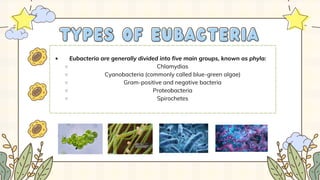
Cyanobacteria (commonly called blue-green algae)
Gram-positive and negative bacteria
Proteobacteria
Spirochetes
TYPES OF EUBACTERIA
TYPES OF EUBACTERIA
6.
Cyanobacteria-
Also called blue-greenalgae
Class of Eubacteria that are
photosynthetic microbes
Known as photosynthetic
prokaryotes
Found widely in nature: ponds,
rivers, lakes, desert soil, hot springs
Exist as free-living photosynthetic
organisms or in symbiosis with
fungi (lichens)
Characterized by thick, gelatinous
cell walls, gliding motility in some
species, and diverse shapes
Chlamydias-
Chlamydias represent a category of
microorganisms classified under the
Chlamydiaceae family.
These bacteria are obligate
intracellular parasites, meaning they
must live within host cells to survive.
Classified as gram-negative,
Chlamydias have a peptidoglycan
layer that is difficult to detect.
They lack motility and exhibit a
dimorphic life cycle, alternating
between two distinct forms.
Spirochetes-
These bacteria are slender, spiral-
shaped, and classified as gram-
negative.
They are responsible for certain
sexually transmitted infections.
Their distinctive corkscrew motion is
powered by an internal flagellar
filament.
Spirochetes inhabit diverse
environments including water, soil,
plants, animals, and decomposing
organic material.
This group includes both harmless
species and those that cause
diseases in humans and animals.
7.
ON BASIS OFGRAM
ON BASIS OF GRAM
STAINING
STAINING
1. Gram’s positive:
Gram’s positive bacteria have a thick cell
wall and consist of a high amount (about
80%) of peptidoglycan.
They retain blue or violet, or purple color in
gram staining.
The lipid content in gram-positive bacteria
is low, so they are sensitive to lysozyme
and antibiotics.
Mesosomes are present.
Examples: Azotobacter, Mycobacterium.
2. Gram’s negative:
The cell wall is thin and contains a low
amount (about 20%) of peptidoglycan.
They do not retain blue but retain the
pink or red color of the safranin.
The amount of lipid content is high
because of the high lipid content. They
can resist lysozyme and antibiotics.
Mesosomes are generally absent.
Example: Salmonella, E.coli.
8.
EXAMPLES OF EUBACTERIA
EXAMPLESOF EUBACTERIA
Escherichia coli:
This bacterium is a member of the Eubacteria
domain.
It falls under the Proteobacteria phylum.
Characterized by its rod-like shape and Gram-
negative cell wall.
Commonly inhabits the intestines of various warm-
blooded animals, including humans.
While the majority of E. coli strains are harmless,
certain variants can lead to foodborne illnesses and
other health issues.
9.
2. STREPTOCOCCUS
2. STREPTOCOCCUS
PNEUMONIAE
PNEUMONIAE
Thisis another common eubacteria.
It is classified within the Firmicutes phylum.
Characterized by its spherical (cocci) form, it
stains Gram-positive.
pneumoniae resides harmlessly in the respiratory
system, including the nasal passages and sinuses
of healthy individuals.
However, under certain conditions, it can turn
harmful, invading other body regions and often
leading to serious infections such as pneumonia
and meningitis, especially in people with weakened
immune defenses
10.
Eubacteria increase soilfertility through nitrification,
nitrogen-fixing process, and ammonification.
Various species of eubacteria are used in the synthesis of
vitamins.
Various species of eubacteria are used in the synthesis of
vitamins.
Used for the degradation of petroleum hydrocarbons.
Some eubacteria are used for insect control.
IMPORTANCE OF EUBACTERIA
IMPORTANCE OF EUBACTERIA


![Cell wall and plasma
membrane
Cytoplasm
Ribosomes [70s]
Nucleoid [DNA]
Plasmids [extra chromosomal
DNA]
Pilli and flagella [optional]
CELL STRUCTURE
CELL STRUCTURE](https://image.slidesharecdn.com/eubacteria-thetruebacteria-251222154134-6e6c20f8/85/EUBACTERIA-the-true-bacteria-pptx-pdf-bsc-4-320.jpg)