



THAI POLICY IN THE ASEAN CONTEXT
THE OFFICE OF THE HIGHER EDUCATION COMMISSION
MINISTRY OF EDUCATION
Poon Kasemsap, Kasetsart UniversityMar 20, 2015
Academic forum and Public Policy Dialogue
On Higher Education for Sustainable Agriculture
and Food Security in Thailand
Sustainable development
"development that meets the needs of the present
without compromising the ability of future
generations to meet their own needs."
From: Our Common Future, also known as the Brundtland Report.
Brundtland Commission (1987).
“Report of the World Commission on Environment and Development. United Nations.
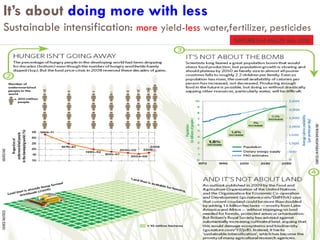
It’s about doing more with less
Sustainable intensification: more yield-less water,fertilizer, pesticides
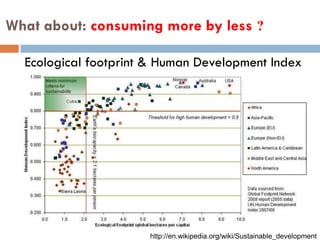
What about: consuming more by less ?
Ecological footprint & Human Development Index
http://en.wikipedia.org/wiki/Sustainable_development
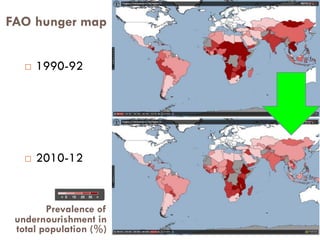
FAO hunger map
 1990-92
 2010-12
Prevalence of
undernourishment in
total population (%)
Global challenges in agriculture
 Climate change: CO2 , temperature, water, …
 And all possible consequences …
 Loss of biodiversity
 Globalization
 Change in demands of biofuels:
 Affect balance of ‘food’ + ‘feed’ + ‘fuel’
 The financial and food price crises
 Cold ‘war’ on exchange rates
 Conflicts and wars
 More …
The most critical success factor is ……
Higher education has to change
 Change towards sustainable development begins
with the ‘human’ factor.
 We need changes in higher education system
so that it could effectively and efficiently address
the massive needs in high quality human resources
required by the approaching challenges
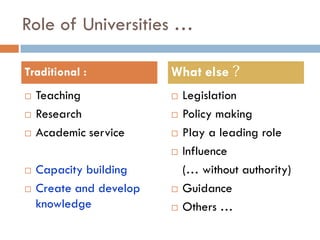
Role of Universities …
 Teaching
 Research
 Academic service
 Capacity building
 Create and develop
knowledge
 Legislation
 Policy making
 Play a leading role
 Influence
(… without authority)
 Guidance
 Others …
Traditional : What else
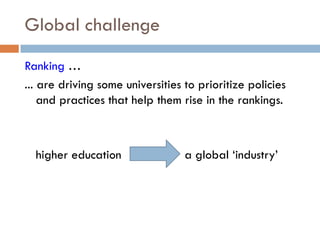
Global challenge
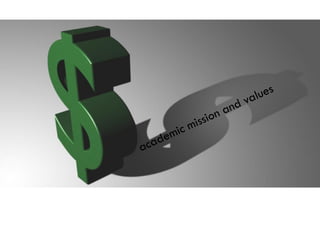
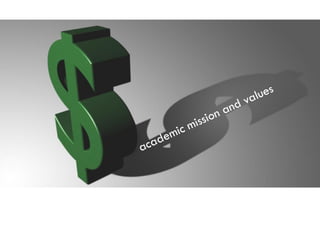
Ranking …
... are driving some universities to prioritize policies
and practices that help them rise in the rankings.
higher education a global ‘industry’
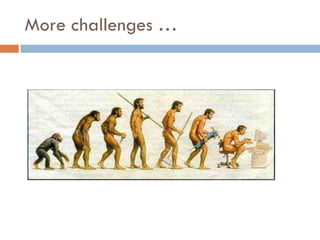
More challenges …
Back to ‘Role of University’
Know exactly :
o what do we really do ?
o for whom do we do it ?
o how do we excel ?
For whom do we do it …
Intellectual property… Private vs. Public property
nutrition security
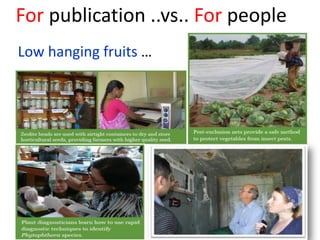
For publication ..vs.. For people
Low hanging fruits …
What do we do … still, no change
explorebranson.com
Not just high quality human resources …
… we needs great leaders
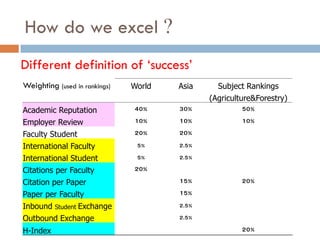
How do we excel ?
Weighting (used in rankings) World Asia Subject Rankings
(Agriculture&Forestry)
Academic Reputation 40% 30% 50%
Employer Review 10% 10% 10%
Faculty Student 20% 20%
International Faculty 5% 2.5%
International Student 5% 2.5%
Citations per Faculty 20%
Citation per Paper 15% 20%
Paper per Faculty 15%
Inbound Student Exchange 2.5%
Outbound Exchange 2.5%
H-Index 20%
Different definition of ‘success’
In Higher Education and Capacity Building
Regional cooperation & Integration
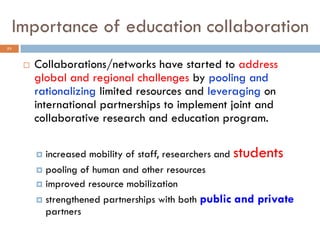
Importance of education collaboration
 Collaborations/networks have started to address
global and regional challenges by pooling and
rationalizing limited resources and leveraging on
international partnerships to implement joint and
collaborative research and education program.
 increased mobility of staff, researchers and students
 pooling of human and other resources
 improved resource mobilization
 strengthened partnerships with both public and private
partners
23
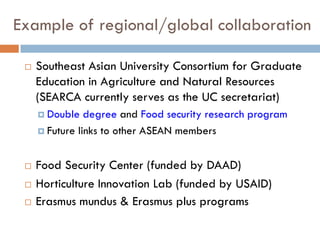
Example of regional/global collaboration
 Southeast Asian University Consortium for Graduate
Education in Agriculture and Natural Resources
(SEARCA currently serves as the UC secretariat)
 Double degree and Food security research program
 Future links to other ASEAN members
 Food Security Center (funded by DAAD)
 Horticulture Innovation Lab (funded by USAID)
 Erasmus mundus & Erasmus plus programs
Benefits of cooperation & integration
in higher education
 Improved quality of teaching, learning, research.
 Deeper engagement with national, regional, and
global issues and stakeholders.
 Better preparation of students as national and global
citizens and as productive members of the workforce.
 Access for students to programs that are unavailable
or scarce in their home countries.
 Enhanced opportunities for faculty improvement and,
through mobility, decreased risk of academic
‘inbreeding’.
 Possibility to participate in regional/international
networks to conduct research on pressing issues at
home and abroad
 and benefit from the expertise and perspectives of
researchers from many parts of the world.
 Opportunity to situate institutional performance within
the context of international good practice.
 Improved institutional policy-making, governance,
student services, outreach, and quality assurance
through sharing of experiences across national
borders.
Benefits of cooperation & integration
in higher education
Southeast Asia
ARD Higher education cooperation
Will help to promote:
 Resilience:
 learners vs. the learned
 Equity:
 across and within ASEAN member countries
 Integration:
 toward borderless ‘higher education system’
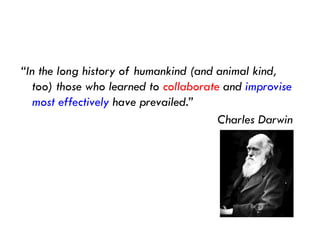
“In the long history of humankind (and animal kind,
too) those who learned to collaborate and improvise
most effectively have prevailed.”
Charles Darwin

Thai Policy in the ASEAN Context

  • 1.
    THAI POLICY INTHE ASEAN CONTEXT THE OFFICE OF THE HIGHER EDUCATION COMMISSION MINISTRY OF EDUCATION Poon Kasemsap, Kasetsart UniversityMar 20, 2015 Academic forum and Public Policy Dialogue On Higher Education for Sustainable Agriculture and Food Security in Thailand
  • 2.
    Sustainable development "development thatmeets the needs of the present without compromising the ability of future generations to meet their own needs." From: Our Common Future, also known as the Brundtland Report. Brundtland Commission (1987). “Report of the World Commission on Environment and Development. United Nations.
  • 3.
    It’s about doingmore with less Sustainable intensification: more yield-less water,fertilizer, pesticides
  • 4.
    What about: consumingmore by less ? Ecological footprint & Human Development Index http://en.wikipedia.org/wiki/Sustainable_development
  • 5.
    FAO hunger map 1990-92  2010-12 Prevalence of undernourishment in total population (%)
  • 6.
    Global challenges inagriculture  Climate change: CO2 , temperature, water, …  And all possible consequences …  Loss of biodiversity  Globalization  Change in demands of biofuels:  Affect balance of ‘food’ + ‘feed’ + ‘fuel’  The financial and food price crises  Cold ‘war’ on exchange rates  Conflicts and wars  More …
  • 7.
    The most criticalsuccess factor is ……
  • 8.
    Higher education hasto change  Change towards sustainable development begins with the ‘human’ factor.  We need changes in higher education system so that it could effectively and efficiently address the massive needs in high quality human resources required by the approaching challenges
  • 9.
    Role of Universities…  Teaching  Research  Academic service  Capacity building  Create and develop knowledge  Legislation  Policy making  Play a leading role  Influence (… without authority)  Guidance  Others … Traditional : What else
  • 10.
    Global challenge Ranking … ...are driving some universities to prioritize policies and practices that help them rise in the rankings. higher education a global ‘industry’
  • 13.
  • 16.
    Back to ‘Roleof University’ Know exactly : o what do we really do ? o for whom do we do it ? o how do we excel ?
  • 17.
    For whom dowe do it … Intellectual property… Private vs. Public property nutrition security
  • 18.
    For publication ..vs..For people Low hanging fruits …
  • 19.
    What do wedo … still, no change explorebranson.com
  • 20.
    Not just highquality human resources … … we needs great leaders
  • 21.
    How do weexcel ? Weighting (used in rankings) World Asia Subject Rankings (Agriculture&Forestry) Academic Reputation 40% 30% 50% Employer Review 10% 10% 10% Faculty Student 20% 20% International Faculty 5% 2.5% International Student 5% 2.5% Citations per Faculty 20% Citation per Paper 15% 20% Paper per Faculty 15% Inbound Student Exchange 2.5% Outbound Exchange 2.5% H-Index 20% Different definition of ‘success’
  • 22.
    In Higher Educationand Capacity Building Regional cooperation & Integration
  • 23.
    Importance of educationcollaboration  Collaborations/networks have started to address global and regional challenges by pooling and rationalizing limited resources and leveraging on international partnerships to implement joint and collaborative research and education program.  increased mobility of staff, researchers and students  pooling of human and other resources  improved resource mobilization  strengthened partnerships with both public and private partners 23
  • 24.
    Example of regional/globalcollaboration  Southeast Asian University Consortium for Graduate Education in Agriculture and Natural Resources (SEARCA currently serves as the UC secretariat)  Double degree and Food security research program  Future links to other ASEAN members  Food Security Center (funded by DAAD)  Horticulture Innovation Lab (funded by USAID)  Erasmus mundus & Erasmus plus programs
  • 25.
    Benefits of cooperation& integration in higher education  Improved quality of teaching, learning, research.  Deeper engagement with national, regional, and global issues and stakeholders.  Better preparation of students as national and global citizens and as productive members of the workforce.  Access for students to programs that are unavailable or scarce in their home countries.  Enhanced opportunities for faculty improvement and, through mobility, decreased risk of academic ‘inbreeding’.
  • 26.
     Possibility toparticipate in regional/international networks to conduct research on pressing issues at home and abroad  and benefit from the expertise and perspectives of researchers from many parts of the world.  Opportunity to situate institutional performance within the context of international good practice.  Improved institutional policy-making, governance, student services, outreach, and quality assurance through sharing of experiences across national borders. Benefits of cooperation & integration in higher education
  • 27.
    Southeast Asia ARD Highereducation cooperation Will help to promote:  Resilience:  learners vs. the learned  Equity:  across and within ASEAN member countries  Integration:  toward borderless ‘higher education system’
  • 28.
    “In the longhistory of humankind (and animal kind, too) those who learned to collaborate and improvise most effectively have prevailed.” Charles Darwin