Ethics is good
business
Vinod Kothari
1012 Krishna, 224 AJC Bose Road
Kolkata- 700 017. India.
http://www.vinodkothari.com
http://www.credit-deriv.com
E-mail:vinod@vinodkothari.com
Phone 91-33-23233863/22817715/ 22811276
Fax: 91-33-23233863/ 22817715/ 22811276
Ethics are no more in religious texts;
they are a part of business law
If you think business and ethics are aliens, you are
mistaken
Not only are ethics respected in business, they are
a part of the law
As a part of Sarbanes Oxley law, directors have to
sign an ethics declaration
This law enacted in pursuance of series of corporate
scandals:
Enron, WorldCom, Tyco, etc.
In India also, this has been implemented: all
directors annually sign Code of Corporate Ethics
This is part of Corporate Governance Code
Clause 49 of the Listing Agreement
Are ethics and business
compatible?
In an extreme, altruistic sense, business and
ethics may seem incompatible:
Earning profits may also be a unethical
In Islamic finance, earning interest is unethical
All possessions stem from insecurity; insecurity comes
from mistrust:
Therefore, possession itself may be unethical in extreme
sense
Lots of businesses may need violence of some
degree:
E.g., Medical research
Where do we draw the line between business and
morality:
If the approach is subjective, then ethics lose their
meaning as everyone defines ethics to suit one’s
convenience
Is there a universal, perennial definition of “ethics”?
Morality and religion
Morality and ethics have their roots in
religion
Religion and business are mutually
incompatible
Religion deals with the inner self; business
deals with the outer world
Religion deals with contentment; business
is a play of ambition
Religion says, adjust your within to suit
your without; business says, adjust your
without to suit your within
They are opposites, not merely
incompatible
When did ethics begin?
In most cultures, ethics are
connected with divine origins:
Babylonian civilization received laws of
Hammurabi from sun god
God gave 10 commandments to Moses
In Greek civilization, Plato says that god
Zeus gave morality to help mankind
Manusmriti Samhita incorporates earliest
code of social and legal ethics in India
Ethics and society
In fact both religion and ethics serve a
common need: society
Societies are built on the plank of co-
existence and mutuality
All societies, whether those of humans or
non-humans, need mutual support,
forbearance and care:
Observed in societies of wolves, baboons,
dolphins, etc.
Thus, two important pillars of all societies
are:
Reciprocity
kinship
Ethics – Indian view
Indian religion has always been associated with philosophy
The vedas (about 4000 years old) talked about 4 basic goals
of existence:
Prosperity
Satisfaction of desires
Moral duty
Salvation
Upnisads distinguished between law and ethics – ethics
come from inner desire
Charavac philosophy was basically materialistic and was a
voice of dissent
In a way, Charvak was reactionary; he was opposing the
Brahmanical dogmas in a sharp way
Jain scriptures deal with “akriyavad” at length
Jain philosophy was based on the quintessential principle of
non-violence
Buddha dwelt on compassion and brotherhood
Ethics – ancient Chinese view
Two great ancient Chinese philosophers,
Lao-tzu, and Confucius, existed in 6th
century BC.
Lao-tzu, proponent of the rule of Tao,
emphasized simplicity and humility; said
rank, social status are meaningless.
Confucius’ dealt with ‘superior’ man – one
who aims at good, has ethical values
One word he gave was reciprocity; do not do
unto others what you do not want to be done to
you
Ethics in ancient Greece
Early Greek philosophers: Pythagoras, Socrates, Plato and
Aristotle,, have all emphasized ethics
Pythagoras was contemporary of Buddha and Lao Tzu, and it is
contended by many that he was influenced by Jain philosophy
Socrates is regarded as one of the major contributors to
Western ethics:
Socrates did not prescribe ethics but propounded method of
enquiry
Plato, a disciple of Socrates, took forward ethics
Ethics results from balance of 3 forces: intellect, emotion and
desire
Plato for the first time dealt with long term good and short
term good:
He said, ethics survive in the long run
Aristotle propounded the theory known as “Golden Mean” –
somewhat similar to Buddha’s middle path
Ethics in Christianity
Jesus was admitted a reformer of Hebrew ethics and did not
innovate a system of his own.
St Augustine is regarded as one of the first ones to codify
Christian views on ethics:
He held spiritual bliss on the top of worldly pleasures
Also rejected the idea that love of God is for fear of punishment
in afterlife
Long time after St Augustine, French philosopher Peter
Abelard (11-12th
century) dealt with ethics:
Stressed on intentions or the inner consent to a crime
St Thomas Aquinas (13th
century) gave the idea of the
“natural law”
Ethics which are so basic that they require no legislator
In 17th
century England, there came scholars who were
called “intuitionalists” who believed in intuition
Coming to 17th
century England, the idea of enlightened self-
interest came in – that morality does not clash with self-
interest
Normative ethics – 19th
century
philosophy
19th
century thinkers did not dwell much on
whether ethics are subjective or objective
Meta-ethics, or normative ethics, deals with what
is right and what is wrong
In 19th
century England, another philosophy
emerged called “utilitarianism” (Bentham)
Utilitarians relate everything to pleasure and pain
Everything that increases pleasure or reduces pain is
good
From here on, economics enters ethics:
Economist JS Mill also contributed to the Bentham’s
theorry
Sidgwick also contributed to the same
Present day ethics philosophy
By end of 19th
century, Kant, Hegel and Marx had
expressed several views on ethics
Nietzsche came with radical thoughts – god is
dead
Sartre came with similar ideas, denying idea of
God and said whatever ensures existence is good
Currently, ethics is divided into 3 branches:
Meta-ethics: deals with ethical properties
Normative ethics: deals with what things are good or bad
Applied ethics: application of ethics to practical problems
Is what is good or bad judged from its
consequences:
Teleology – actions are judged by their consequences
Deontology – actions are judged by whether the accord
with the general rule
Are ethics limited to mankind?
Are ethics limited to men only or do they
extend to animals too?
Several philosophers have rejected the
classical view that men need ethics only to
fellow human beings who can reciprocate
Intermediate versions of pure vegetarianism
have been coming once in a while
Likewise, issues of responsibility to the
environment have also been raised.
In other words, philosophy is not far from
the religious view of total non-violence
Ethics is long term policy
All religion, all ethics and morals spring from the
basic conflict between short term and long term:
If we limit ourselves to the short term:
Pleasures today, even at the cost of pains tomorrow, sound
like a good bargain
If we take long term into account:
Every such pleasure which is not lasting, is avoidable
Long term is how long:
Do we look at our lifetime?
Do we look at the lives of our children and posterity?
Do we take the eternal view of perennial life
Religion in its absolute form tends towards the
eternal view:
All practical adaptations of ethics are essentially
truncated forms of the total religious view
Long termism in business
Issues of corporate ethics have taken the form of short-
termism vs. long-termism
If businesses are focused on long term stability and growth,
they are ethical:
Short term strategies, aimed at earning per share for the year in
question, compromise on longer interests
Warren Buffet has often stressed on long term strategies
Investigations into Fannie Mae suggested that the entire
senior management was intensively focused on earnings
guidance
Capital market orientation of companies force them to be
tempted by short term targets:
Increasingly, the entire system of how companies are evaluated
by analysts, investors and stock markets leads to a short term
approach
McKinsey survey [March 2006] shows that companies are
focused on short term strategies due to market pressures
Can it be ethical, if it is not legal?
Is law the embodiment of ethics?
The essence of ethics is long-termism
Laws are contemporary
Not all laws are based on foundations of ethics
Laws change every quarter; surely every
year
The way present-day laws are made, they are
full of errors and aberrations
Hence, it is possible to draw lines of distinction
between law and ethics
Jain ethics
Charitra dharma, that is, ethics, is
one of the two main foundations of
Jainism, the other being shrut or
philosophy
Jainism is founded on the equality of
all living beings
To an extent, it puts all non-living beings
also on a status of respect
Hence, Jainism represents the
highest standard of ethics ever
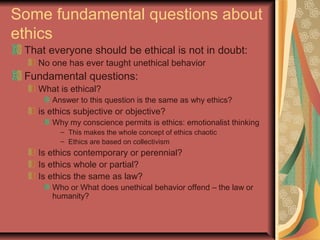
Some fundamental questions about
ethics
That everyone should be ethical is not in doubt:
No one has ever taught unethical behavior
Fundamental questions:
What is ethical?
Answer to this question is the same as why ethics?
is ethics subjective or objective?
Why my conscience permits is ethics: emotionalist thinking
– This makes the whole concept of ethics chaotic
– Ethics are based on collectivism
Is ethics contemporary or perennial?
Is ethics whole or partial?
Is ethics the same as law?
Who or What does unethical behavior offend – the law or
humanity?
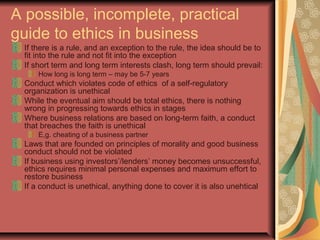
A possible, incomplete, practical
guide to ethics in business
If there is a rule, and an exception to the rule, the idea should be to
fit into the rule and not fit into the exception
If short term and long term interests clash, long term should prevail:
How long is long term – may be 5-7 years
Conduct which violates code of ethics of a self-regulatory
organization is unethical
While the eventual aim should be total ethics, there is nothing
wrong in progressing towards ethics in stages
Where business relations are based on long-term faith, a conduct
that breaches the faith is unethical
E,g. cheating of a business partner
Laws that are founded on principles of morality and good business
conduct should not be violated
If business using investors’/lenders’ money becomes unsuccessful,
ethics requires minimal personal expenses and maximum effort to
restore business
If a conduct is unethical, anything done to cover it is also unehtical
Warren Buffet’s rule of thumb for
ethical conduct
“…I want employees to ask themselves
(when they are in doubt about whether a
particular conduct is ethical or not) whether
they are willing to have any contemplated
act appear the next day on the front page
of their local paper – to be read by their
spouses, children and friends – with the
reporting done by an informed and critical
reporter.” [Berkshire Hathaway’s code of
ethics]

Ethics is good business presentation 3

  • 1.
    Ethics is good business VinodKothari 1012 Krishna, 224 AJC Bose Road Kolkata- 700 017. India. http://www.vinodkothari.com http://www.credit-deriv.com E-mail:vinod@vinodkothari.com Phone 91-33-23233863/22817715/ 22811276 Fax: 91-33-23233863/ 22817715/ 22811276
  • 2.
    Ethics are nomore in religious texts; they are a part of business law If you think business and ethics are aliens, you are mistaken Not only are ethics respected in business, they are a part of the law As a part of Sarbanes Oxley law, directors have to sign an ethics declaration This law enacted in pursuance of series of corporate scandals: Enron, WorldCom, Tyco, etc. In India also, this has been implemented: all directors annually sign Code of Corporate Ethics This is part of Corporate Governance Code Clause 49 of the Listing Agreement
  • 3.
    Are ethics andbusiness compatible? In an extreme, altruistic sense, business and ethics may seem incompatible: Earning profits may also be a unethical In Islamic finance, earning interest is unethical All possessions stem from insecurity; insecurity comes from mistrust: Therefore, possession itself may be unethical in extreme sense Lots of businesses may need violence of some degree: E.g., Medical research Where do we draw the line between business and morality: If the approach is subjective, then ethics lose their meaning as everyone defines ethics to suit one’s convenience Is there a universal, perennial definition of “ethics”?
  • 4.
    Morality and religion Moralityand ethics have their roots in religion Religion and business are mutually incompatible Religion deals with the inner self; business deals with the outer world Religion deals with contentment; business is a play of ambition Religion says, adjust your within to suit your without; business says, adjust your without to suit your within They are opposites, not merely incompatible
  • 5.
    When did ethicsbegin? In most cultures, ethics are connected with divine origins: Babylonian civilization received laws of Hammurabi from sun god God gave 10 commandments to Moses In Greek civilization, Plato says that god Zeus gave morality to help mankind Manusmriti Samhita incorporates earliest code of social and legal ethics in India
  • 6.
    Ethics and society Infact both religion and ethics serve a common need: society Societies are built on the plank of co- existence and mutuality All societies, whether those of humans or non-humans, need mutual support, forbearance and care: Observed in societies of wolves, baboons, dolphins, etc. Thus, two important pillars of all societies are: Reciprocity kinship
  • 7.
    Ethics – Indianview Indian religion has always been associated with philosophy The vedas (about 4000 years old) talked about 4 basic goals of existence: Prosperity Satisfaction of desires Moral duty Salvation Upnisads distinguished between law and ethics – ethics come from inner desire Charavac philosophy was basically materialistic and was a voice of dissent In a way, Charvak was reactionary; he was opposing the Brahmanical dogmas in a sharp way Jain scriptures deal with “akriyavad” at length Jain philosophy was based on the quintessential principle of non-violence Buddha dwelt on compassion and brotherhood
  • 8.
    Ethics – ancientChinese view Two great ancient Chinese philosophers, Lao-tzu, and Confucius, existed in 6th century BC. Lao-tzu, proponent of the rule of Tao, emphasized simplicity and humility; said rank, social status are meaningless. Confucius’ dealt with ‘superior’ man – one who aims at good, has ethical values One word he gave was reciprocity; do not do unto others what you do not want to be done to you
  • 9.
    Ethics in ancientGreece Early Greek philosophers: Pythagoras, Socrates, Plato and Aristotle,, have all emphasized ethics Pythagoras was contemporary of Buddha and Lao Tzu, and it is contended by many that he was influenced by Jain philosophy Socrates is regarded as one of the major contributors to Western ethics: Socrates did not prescribe ethics but propounded method of enquiry Plato, a disciple of Socrates, took forward ethics Ethics results from balance of 3 forces: intellect, emotion and desire Plato for the first time dealt with long term good and short term good: He said, ethics survive in the long run Aristotle propounded the theory known as “Golden Mean” – somewhat similar to Buddha’s middle path
  • 10.
    Ethics in Christianity Jesuswas admitted a reformer of Hebrew ethics and did not innovate a system of his own. St Augustine is regarded as one of the first ones to codify Christian views on ethics: He held spiritual bliss on the top of worldly pleasures Also rejected the idea that love of God is for fear of punishment in afterlife Long time after St Augustine, French philosopher Peter Abelard (11-12th century) dealt with ethics: Stressed on intentions or the inner consent to a crime St Thomas Aquinas (13th century) gave the idea of the “natural law” Ethics which are so basic that they require no legislator In 17th century England, there came scholars who were called “intuitionalists” who believed in intuition Coming to 17th century England, the idea of enlightened self- interest came in – that morality does not clash with self- interest
  • 11.
    Normative ethics –19th century philosophy 19th century thinkers did not dwell much on whether ethics are subjective or objective Meta-ethics, or normative ethics, deals with what is right and what is wrong In 19th century England, another philosophy emerged called “utilitarianism” (Bentham) Utilitarians relate everything to pleasure and pain Everything that increases pleasure or reduces pain is good From here on, economics enters ethics: Economist JS Mill also contributed to the Bentham’s theorry Sidgwick also contributed to the same
  • 12.
    Present day ethicsphilosophy By end of 19th century, Kant, Hegel and Marx had expressed several views on ethics Nietzsche came with radical thoughts – god is dead Sartre came with similar ideas, denying idea of God and said whatever ensures existence is good Currently, ethics is divided into 3 branches: Meta-ethics: deals with ethical properties Normative ethics: deals with what things are good or bad Applied ethics: application of ethics to practical problems Is what is good or bad judged from its consequences: Teleology – actions are judged by their consequences Deontology – actions are judged by whether the accord with the general rule
  • 13.
    Are ethics limitedto mankind? Are ethics limited to men only or do they extend to animals too? Several philosophers have rejected the classical view that men need ethics only to fellow human beings who can reciprocate Intermediate versions of pure vegetarianism have been coming once in a while Likewise, issues of responsibility to the environment have also been raised. In other words, philosophy is not far from the religious view of total non-violence
  • 14.
    Ethics is longterm policy All religion, all ethics and morals spring from the basic conflict between short term and long term: If we limit ourselves to the short term: Pleasures today, even at the cost of pains tomorrow, sound like a good bargain If we take long term into account: Every such pleasure which is not lasting, is avoidable Long term is how long: Do we look at our lifetime? Do we look at the lives of our children and posterity? Do we take the eternal view of perennial life Religion in its absolute form tends towards the eternal view: All practical adaptations of ethics are essentially truncated forms of the total religious view
  • 15.
    Long termism inbusiness Issues of corporate ethics have taken the form of short- termism vs. long-termism If businesses are focused on long term stability and growth, they are ethical: Short term strategies, aimed at earning per share for the year in question, compromise on longer interests Warren Buffet has often stressed on long term strategies Investigations into Fannie Mae suggested that the entire senior management was intensively focused on earnings guidance Capital market orientation of companies force them to be tempted by short term targets: Increasingly, the entire system of how companies are evaluated by analysts, investors and stock markets leads to a short term approach McKinsey survey [March 2006] shows that companies are focused on short term strategies due to market pressures
  • 16.
    Can it beethical, if it is not legal? Is law the embodiment of ethics? The essence of ethics is long-termism Laws are contemporary Not all laws are based on foundations of ethics Laws change every quarter; surely every year The way present-day laws are made, they are full of errors and aberrations Hence, it is possible to draw lines of distinction between law and ethics
  • 17.
    Jain ethics Charitra dharma,that is, ethics, is one of the two main foundations of Jainism, the other being shrut or philosophy Jainism is founded on the equality of all living beings To an extent, it puts all non-living beings also on a status of respect Hence, Jainism represents the highest standard of ethics ever
  • 18.
    Some fundamental questionsabout ethics That everyone should be ethical is not in doubt: No one has ever taught unethical behavior Fundamental questions: What is ethical? Answer to this question is the same as why ethics? is ethics subjective or objective? Why my conscience permits is ethics: emotionalist thinking – This makes the whole concept of ethics chaotic – Ethics are based on collectivism Is ethics contemporary or perennial? Is ethics whole or partial? Is ethics the same as law? Who or What does unethical behavior offend – the law or humanity?
  • 19.
    A possible, incomplete,practical guide to ethics in business If there is a rule, and an exception to the rule, the idea should be to fit into the rule and not fit into the exception If short term and long term interests clash, long term should prevail: How long is long term – may be 5-7 years Conduct which violates code of ethics of a self-regulatory organization is unethical While the eventual aim should be total ethics, there is nothing wrong in progressing towards ethics in stages Where business relations are based on long-term faith, a conduct that breaches the faith is unethical E,g. cheating of a business partner Laws that are founded on principles of morality and good business conduct should not be violated If business using investors’/lenders’ money becomes unsuccessful, ethics requires minimal personal expenses and maximum effort to restore business If a conduct is unethical, anything done to cover it is also unehtical
  • 20.
    Warren Buffet’s ruleof thumb for ethical conduct “…I want employees to ask themselves (when they are in doubt about whether a particular conduct is ethical or not) whether they are willing to have any contemplated act appear the next day on the front page of their local paper – to be read by their spouses, children and friends – with the reporting done by an informed and critical reporter.” [Berkshire Hathaway’s code of ethics]